




An Act about road management and other purposes related to transport
This Act may be cited as the Transport Operations (Road Use Management) Act 1995.Editor’s note—Uncommenced amendments to the following provisions have been included in this indicative reprint—•amendment of sections 78, 79, 79B, 86, 90A, 90C, 91D, 91I, 91J, 122, definition disqualifying offence, schedule 4•insertion of new sections 79H–79JSee 2024 Act No. 45pt 3div 2sdiv 2 and 2024 Act No. 49s 130 sch 4pt 1.•omission of section 81.
(1)The overall objectives of this Act are, consistent with the objectives of the Transport Planning and Coordination Act 1994, to—(a)provide for the effective and efficient management of road use in the State; and(b)provide a scheme for managing the use of the State’s roads that will—(i)promote the effective and efficient movement of people, goods and services; and(ii)contribute to the strategic management of road infrastructure in ways consistent with the Transport Infrastructure Act 1994; and(iii)improve road safety and the environmental impact of road use in ways that contribute to overall transport effectiveness and efficiency; and(iv)support a reasonable level of community access and mobility in support of government social justice objectives; and(c)provide for the effective and efficient management of vehicle use in a public place.(2)This Act establishes a scheme to allow—(a)identification of vehicles, drivers and road users; and(b)establishment of performance standards for vehicles, drivers and road users; and(c)establishment of rules for on-road behaviour; and(d)monitoring of compliance with this Act, including by using alternative compliance schemes; and(e)management of non-performing vehicles, drivers and road users; and(f)control of access to the road network, or parts of the road network, for vehicles, drivers and road users; and(g)management of traffic to enhance safety and transport efficiency.(3)It is acknowledged that the objectives as stated in subsection (1), and the scheme as outlined in subsection (2), are limited in their application to heavy vehicles to the extent that the national scheme for facilitating and regulating the use of heavy vehicles on roads, having effect in Queensland as the Heavy Vehicle National Law (Queensland), applies to heavy vehicles in the place of this Act.
4Achieving an appropriate balance between safety and cost
(1)Although it may be possible to regulate to achieve the highest level of safety, doing so would ignore the impact of the regulation on the effectiveness and efficiency of road use.(2)Therefore, this Act acknowledges the need to achieve an appropriate balance between safety, and the costs that regulation imposes on road users and the community.
64AAct binds everyone, including government entities
(1)In this section—government entity includes—(a)the State, the Commonwealth or another State; or(b)an instrumentality or agent of the State, the Commonwealth or another State.(2)This Act binds everyone, including every government entity.(3)However, a regulation may exempt a government entity from this Act or a provision of this Act.
(1)A dictionary in schedule 4 defines particular words used in this Act.(2)Definitions found elsewhere in the Act are signposted in the dictionary.
(1)Each of the following vehicles is a prohibited bike—(a)a noncompliant electrically power-assisted cycle;(b)a noncompliant personal mobility device;(c)a 2-wheeled or 3-wheeled vehicle that is capable of being propelled by an electric motor or internal-combustion engine and—(i)is not eligible to be registered; oran electric or petrol-powered motorbike that does not comply with the Australian Design Rules under the Road Vehicle Standards Act 2018 (Cwlth)(ii)is eligible to be registered but is not registered.Example for subparagraph (ii)—
a motorbike that is not registered(2)However, none of the following vehicles is a prohibited bike—(a) a personal mobility device;(b)an electrically power-assisted cycle;(c) a low powered toy scooter;(d) a motorised mobility device.(3)For subsection (1) it is irrelevant whether the vehicle may also be propelled by use of pedals.(4)In this section—noncompliant electrically power-assisted cycle means a vehicle that resembles an electrically power-assisted cycle but does not meet all elements of the definition of electrically power-assisted cycle under this Act.noncompliant personal mobility device means a vehicle that resembles a personal mobility device but does not meet all elements of the definition of personal mobility device under this Act.
(1)The chief executive must, from time to time, develop for the Minister’s approval a road use management strategy designed to give effect to the transport coordination plan in accordance with this Act’s objectives.(2)In developing a road use management strategy, the chief executive must take reasonable steps to engage in public consultation.(3)The Minister may, at any time, direct the chief executive—(a)to prepare a new road use management strategy for the Minister’s approval; or(b)to amend a road use management strategy.(4)The Minister may—(a)approve a road use management strategy submitted for approval; or(b)require the chief executive to amend a road use management strategy submitted for approval.
(1)A road use management strategy must include—(a)a statement of the specific objectives to be achieved; and(b)road use management initiatives; and(c)criteria for deciding priorities for government spending on road use management initiatives; and(d)appropriate performance indicators for deciding whether, and to what extent, the strategy’s objectives have been achieved.(2)A road use management strategy must aim to provide an adequate framework for coordinating and integrating road use management policies as between the different transport modes and levels of government.(3)A road use management strategy may also take into account agreements about transport between the State and the Commonwealth, a local government or another State.(4)If there is an integrated regional transport plan under the Transport Planning and Coordination Act 1994 for an area, a road use management strategy for the area must not be inconsistent with, and must give effect to, the plan.
The Minister must table a copy of each road use management strategy, and each amendment of a road use management strategy, approved by the Minister in the Legislative Assembly within 5 sitting days after it is approved.
(1)Before the start of each financial year, the chief executive must develop, for the Minister’s approval, a road use implementation program for the year and for 1 or more later years.(2)A road use implementation program must include—(a)a statement of the policies, projects and financial provisions for implementing the road use management strategy; and(b)a statement of the performance targets to be achieved.(3)A road use implementation program may include a proposal to spend an amount not directly related to road use, if the proposal would contribute to the effectiveness and efficiency of road use management.(4)In developing a road use implementation program, the chief executive must take reasonable steps to engage in public consultation.(5)A road use implementation program must be made available to the public in the way decided by the Minister.(6)The Minister may, at any time, direct the chief executive to amend a road use implementation program.(7)The Minister may—(a)approve a road use implementation program submitted for approval; or(b)require the chief executive to amend a road use implementation program submitted for approval.
(1)Subject to the Minister’s directions, a road use implementation program must be consistent with a road use management strategy.(2)If the Minister’s directions result in a road use implementation program being inconsistent with a road use management strategy, the Minister must table a copy of the directions in the Legislative Assembly within 5 sitting days after they are given.
12Report on operation of programs
Each annual report of the department must include a report on the implementation of the road use implementation program during the year of the report.
(1)This section applies to the Minister and chief executive in developing and implementing policies about road use management, and in exercising powers under this Act.(2)The Minister and chief executive must endeavour to—(a)achieve an appropriate balance between safety, and the costs that regulation imposes on road users and the community; and(b)establish the benefits and costs of policy alternatives; and(c)take account of national and international benchmarks and best practice; and(d)promote efficiency, affordable quality and cost-effectiveness; and(e)ensure competition is not unjustifiably restricted; and(f)ensure accountability for, and transparency of, decisions affecting road use.(3)Each annual report of the department must include a report on how effect has been given to this section during the year of the report.
(1)The following objectives are, as far as practicable, to be applied by anyone wanting to encourage a high level of road user performance and compliance with this Act—(a)information about their obligations under this Act should be made available to road users;(b)voluntary compliance should be sought in preference to enforcement;(c)enforcement should be aimed primarily at deterring noncompliance by road users;(d)enforcement strategies should, accordingly, try to increase road users’ perceptions of the risk of being detected if they offend;(e)measures aimed at encouraging compliance should—(i)target the road users who are least likely to comply with this Act; and(ii)try to avoid imposing costs on the road users who are likely to comply voluntarily;(f)appropriate alternative compliance schemes should be used as a way of demonstrating compliance.(2)Preventing the continued commission of offences and imposing appropriate penalties should be seen as objectives that support the other objectives in subsection (1).
15Alternative ways of complying with Act
(1)A person who operates a vehicle (an operator) may apply to the chief executive for approval of a scheme (an alternative compliance scheme) for an alternative way to comply with a provision of this Act that is prescribed under a regulation.(2)The regulation must prescribe the purpose of the prescribed provision.(3)An application for approval of an alternative compliance scheme must be in writing.(4)The chief executive may approve an alternative compliance scheme only if satisfied it provides an effective way of demonstrating the operator’s vehicles, or drivers operating under it in Queensland, achieve the prescribed purpose.(5)The chief executive may approve the scheme by written notice to the operator.(6)The approval may be given on conditions stated in it and operates for the period stated in it.(7)The prescribed provision does not apply to the operator’s vehicles or drivers as provided under the scheme while—(a)an approval is in force for the operator; and(b)the operator complies with the scheme, including the conditions of its approval.(8)In this section—interstate scheme means a scheme approved as an alternative compliance scheme under a corresponding law to this part.scheme includes an interstate scheme.vehicle means a private vehicle or a prescribed vehicle.
17AMeaning of approval for pt 1A
(1)This section applies for part 1A.(2)An approval includes an accreditation, administrative determination, certificate, consent, exemption, licence, permit and registration given or granted by the chief executive under this Act.(3)However, an approval does not include the following—(a)an approval under section 166;(b)a Queensland driver licence;(c)an authorised scheme under chapter 5, part 7A;(d)the authorisation, under chapter 5, part 7A, of a person to perform a role under an authorised scheme;(e)an exemption under section 153.(4)Despite subsection (3)(b), an approval includes an interlock exemption.
17BGranting, renewing or refusing approval
(1)A regulation may provide for the granting or renewing of, or refusing to grant or renew, an approval, other than an approval for an alternative compliance scheme under section 15.(2)Without limiting subsection (1), a regulation may authorise the chief executive to refuse to grant or renew an approval prescribed under a regulation, other than a permit under section 111, if the applicant for or holder of an approval, or a relevant person for the applicant or holder within the meaning of section 17C(3), has been—(a)convicted of a disqualifying offence; or(b)charged with a disqualifying offence and the charge has not been finally disposed of.(3)In this section—grant includes issue or give.
17CChief executive may obtain information from commissioner
(1)This section applies if a regulation made under section 17B authorises the chief executive to grant or renew an approval.(2)The chief executive may ask the commissioner for a written report about the criminal history of any of the following persons—(a)the applicant for or holder of the approval;(b)a relevant person for the applicant for or holder of the approval.(3)For subsection (2)(b), a person is a relevant person for the applicant for or holder of an approval—(a)if the applicant or holder is a corporation and the person is an executive officer of the corporation; or(b)if the approval is an AIS approval and the person is a person who, under a regulation—(i)has been nominated by the applicant or holder to be a nominee for the applicant or holder; and(ii)has agreed to the nomination; or(c)if the approval is an approval as a registered service provider and the person is a person who, under a regulation—(i)has been nominated by the applicant or holder to sign declarations for the applicant or holder about another person’s competency for riding a motorbike; and(ii)has agreed to the nomination.(4)For subsection (2), the chief executive’s request may include the following information—(a)the person’s name and any other name the chief executive believes the person may use or may have used;(b)the person’s gender and date and place of birth;(c)details of the person’s driver licence;(d)details of the person’s application or approval.(5)If requested, the commissioner must give the chief executive a written report about the criminal history of a person mentioned in subsection (2)—(a)that is in the commissioner’s possession; or(b)to which the commissioner ordinarily has access through arrangements with the police service of the Commonwealth or another State.(6)In this section—AIS approval means an approval granted under a regulation that authorises its holder to operate a station (whether fixed or mobile) at which—(a)vehicles may be inspected for compliance with vehicle standards under a regulation made under section 148; or(b)heavy vehicles may be inspected for compliance with heavy vehicle standards under the national regulations (HVNL).nominee, for an AIS approval, has the meaning given by a regulation made under section 148.registered service provider means a person registered under a regulation to provide training to, and assess the competency of, persons learning how to ride a motorbike or particular class of motorbike.
17DNotice of change in police information about a person
(1)This section applies if—(a)the commissioner reasonably suspects that a person is—(i)the holder of an approval; or(ii)a relevant person for the holder of an approval within the meaning of section 17C(3); and(b)the person’s criminal history changes.(2)The commissioner may notify the chief executive that the person’s criminal history has changed.(3)The commissioner’s notice to the chief executive must state the following—(a)the person’s name and any other name the commissioner believes the person may use or may have used;(b)the person’s gender and date and place of birth;(c)whether the change is—(i)a charge made against the person for an offence; or(ii)a conviction of the person;(d)details of the charge or conviction.
17EChief executive may enter into arrangement about giving and receiving information with commissioner
(1)This section applies only to the extent another provision of this Act allows the chief executive to give information to the commissioner or the commissioner to give information to the chief executive.(2)The chief executive and the commissioner may enter into a written arrangement by which the information is given or received.(3)Without limiting subsection (2), the arrangement may provide for the electronic transfer of information, including on a daily basis.(4)However, if information is to be electronically transferred and, under this Act, there is a limitation on who may access the information or the purposes for which the information may be used, the arrangement must provide for the limitation.
18Grounds for amending, suspending or cancelling approvals
(1)Each of the following is a ground for amending, suspending or cancelling an approval—(a)the approval was issued because of a document or representation that is—(i)false or misleading; or(ii)obtained or made in another improper way;(b)the holder of the approval has contravened a condition of the approval;(c)the holder of the approval, or any relevant person for the holder within the meaning of section 17C(3), has been convicted of—(i)an offence against—(A)this Act or a corresponding law; or(B)the Heavy Vehicle National Law or a law of another State that corresponds to a provision of the Heavy Vehicle National Law; or(ii)for the holder of an approval prescribed under a regulation, or a relevant person for the holder within the meaning of section 17C(3)—a disqualifying offence;(d)for the registration of a motor vehicle with a GVM of more than 4.5t—the vehicle has been used to commit an offence against—(i)this Act or a corresponding law; or(ii)the Heavy Vehicle National Law or a law of another State that corresponds to a provision of the Heavy Vehicle National Law;(e)for an approval of an alternative compliance scheme—(i)the scheme is not, or is no longer, an effective way of demonstrating the operator’s vehicles or drivers operating under it in Queensland achieve the relevant purpose prescribed under section 15(2); or(ii)for an interstate scheme—the approval under a corresponding law to this chapter is amended, suspended or cancelled;(f)for a permit under section 111(1)(a)—the holder is no longer a person with a disability within the meaning of that section;(g)for an approval that exempts a person from complying with a provision of this Act—(i)public safety has been endangered, or is likely to be endangered because of the approval; or(ii)transport infrastructure within the meaning of the Transport Infrastructure Act 1994 has been damaged, or is likely to be damaged because of the approval;(h)for any approval other than an approval mentioned in paragraph (g)—public safety has been endangered, or is likely to be endangered, because of the approval;(i)for an approval that is a dangerous goods driver licence—the person to whom the licence is granted no longer satisfies the criteria, however described, under the regulation that provides for the licence;(k)for an approval prescribed under a dangerous goods regulation as an approval for this paragraph—(i)a change in circumstances has happened after the approval was granted; and(ii)had the changed circumstances existed when the approval was granted, the approval would not have been granted under the regulation because of the requirements under the regulation applying to the grant;(l)for an approval prescribed under a dangerous goods regulation as an approval for this paragraph—the holder has contravened this Act or a corresponding law and the contravention makes the holder unsuitable to continue to hold the approval;(m)for an approval that is a dangerous goods driver licence—the holder is suffering from a medical condition or has a physical or mental incapacity, that makes the holder unsuitable to continue to hold the licence;(n)for an approval that is a dangerous goods vehicle licence—the vehicle does not comply with this Act;(o)for an approval that is a repeat offender education program exemption—(i)a change in circumstances has happened after the exemption was granted and, had the changed circumstances existed when the exemption was granted, it would not have been granted because of the requirements under section 91H(1) applying to the grant; or(ii)the holder of the approval has failed to comply with section 91HD;(p)for an approval that is an interlock exemption—a change in circumstances has happened after the exemption was granted and, had the changed circumstances existed when the exemption was granted, it would not have been granted because of the requirements under section 91Q(3) applying to the grant;(q)for an approval that is an interlock exemption—the holder of the approval has failed to comply with a restriction applying to the approval;(r)the chief executive considers it necessary in the public interest;(s)any other ground prescribed by regulation.(2)In this section—change in circumstances—(a)for a person granted an interlock exemption because of circumstances mentioned in section 91Q(3)(a)—does not include the establishment of a prescribed interlock installer’s place of business near the person’s place of residence; or(b)for a person granted a repeat offender education program exemption because of circumstances mentioned in section 91H(2)(a)—does not include the establishment of a place where a repeat offender education program is provided near the person’s place of residence.dangerous goods driver licence means a licence, as prescribed under a dangerous goods regulation, to drive a dangerous goods vehicle.dangerous goods vehicle licence means a licence, as prescribed under a dangerous goods regulation, of a dangerous goods vehicle.operator see section 15(1).repeat offender education program exemption means an exemption from the requirement to complete a repeat offender education program granted under section 91HA.
19Procedure for amending, suspending or cancelling approvals
(1)If the chief executive considers a ground exists to amend, suspend or cancel an approval, (the proposed action), the chief executive must give the holder written notice—(a)stating the proposed action; and(b)stating the ground for the proposed action; and(c)outlining the facts and circumstances forming the basis for the ground; and(d)if the proposed action is to amend the approval (including a condition of the approval)—stating the proposed amendment; and(e)if the proposed action is to suspend the approval—stating the proposed suspension period; and(f)inviting the holder to show (within a stated time of at least 28 days) why the proposed action should not be taken.(2)If, after considering all written representations made within the stated time, the chief executive still considers a ground exists to take the proposed action, the chief executive may—(a)if the proposed action was to amend the approval—amend the approval; or(b)if the proposed action was to suspend the approval—suspend the approval for no longer than the period stated in the notice; or(c)if the proposed action was to cancel the approval—(i)amend the approval; or(ii)suspend the approval for a period, including on the condition that—(A)if the grounds for taking action under this section are capable of being remedied by the holder, the holder remedy the grounds to the chief executive’s reasonable satisfaction within a reasonable time before the suspension period ends; and(B)if the holder fails to remedy the grounds in accordance with subparagraph (A), the chief executive may cancel the approval under section 19A; or(iii)cancel the approval.(3)The chief executive must give the holder a written notice about the decision (subsection (3) notice).(4)The decision takes effect on the later of the following—(a)the day the subsection (3) notice is given to the holder;(b)the day stated in the subsection (3) notice.(5)However, despite subsection (1), if the chief executive considers it necessary in the public interest, the chief executive may, by written notice (immediate suspension notice) given to the holder, immediately suspend the approval until the earliest of the following—(a)the chief executive, after complying with subsections (1) and (2), gives the holder a subsection (3) notice;(b)the end of 56 days after the day the immediate suspension notice is given to the holder.(6)A subsection (3) notice, or an immediate suspension notice, must state—(a)the reasons for the decision for which the notice is given; and(b)the prescribed review information for the decision.(7)If a subsection (3) notice is given about a decision to suspend an approval on the condition mentioned in subsection (2)(c)(ii), the subsection (3) notice must also state that the approval may be cancelled under section 19A if the holder fails to comply with the condition.(8)Subsections (1) to (7) do not apply—(a)if the chief executive proposes to amend the approval only—(i)for a formal or clerical reason; or(ii)in another way that does not adversely affect the holder’s interests; or(b)if the holder asks the chief executive to amend or cancel the approval and the chief executive proposes to give effect to the request.(9)The chief executive may amend or cancel an approval under subsection (8) by written notice given to the holder.
19ACancelling suspended approval for failing to take remedial action
(1)This section applies if the chief executive—(a)suspends an approval on the condition mentioned in section 19(2)(c)(ii); and(b)reasonably believes the holder has failed to comply with the condition.(2)The chief executive may by written notice given to the holder cancel the approval.(3)The notice must state—(a)the reasons for the decision to cancel the approval; and(b)the prescribed review information for the decision.(4)The cancellation takes effect on the later of the following—(a)the day the notice is given to the holder;(b)the day stated in the notice.
19CAutomatic suspension of particular licences under dangerous goods regulation
(1)If the driver licence of the holder of a dangerous goods driver licence is no longer in force under this Act or a corresponding law, the dangerous goods driver licence is suspended.(2)If a dangerous goods vehicle is no longer registered under this Act or a corresponding law, the dangerous goods vehicle licence is suspended.(3)Section 19 does not apply to a suspension under this section.(4)In this section—dangerous goods driver licence means a licence, as prescribed under a dangerous goods regulation, to drive a dangerous goods vehicle.dangerous goods vehicle licence means a licence, as prescribed under a dangerous goods regulation, of a dangerous goods vehicle.driver licence does not include a dangerous goods driver licence.
In this part—advertising code means—(a)the document called the ‘AANA Code of Ethics’ published by the Australian Association of National Advertisers ACN 003 179 673, as in force from time to time; or(b)another document that—(i)states a code of ethics, or sets standards, for advertising; and(ii)is prescribed by regulation to be an advertising code.advertising code breach notice see section 19E(1)(b).advertising standards entity means the entity, prescribed by regulation, that manages the process for resolving complaints about advertising as part of the self-regulation of advertising.registration cancellation notice see section 19F(1).
(1)This division applies if—(a)the community panel determines that an advertisement on a registered vehicle breaches the advertising code; and(b)the advertising standards entity gives the chief executive a written notice (an advertising code breach notice) stating—(i)the details of the determination; and(ii)that the determination is final.(2)For subsection (1)(b)(ii), the determination is final if the period for asking for a review of the determination has ended and—(a)any of the following applies to each request for a review of the determination—(i)the request was not accepted because it did not meet the grounds on which a determination may be reviewed;(ii)the determination was confirmed;(iii)the review resulted in a determination that an advertisement on the vehicle breaches the advertising code; or(b)no request for a review of the determination was made.(3)In subsection (1)(a), a reference to a determination by the community panel includes a reference to a determination made by another entity as a result of a review of a determination of the community panel.(4)In this section—community panel means the entity, prescribed by regulation, that—(a)is appointed by the Advertising Standards entity; and(b)has the function of considering complaints about advertising made by members of the public to determine whether the advertising breaches the advertising code.
19F Registration cancellation notice
(1)The chief executive may give the registered operator of the vehicle a written notice (a registration cancellation notice) stating that—(a)the advertising standards entity has given an advertising code breach notice for the vehicle to the chief executive; and(b)the vehicle’s registration will be cancelled on a stated day unless the advertising standards entity withdraws its advertising code breach notice before that day.(2)The day stated in the registration cancellation notice must be at least 14 days after the notice is given to the registered operator.(3)The chief executive may, by written notice given to the registered operator, state a later day on which the vehicle’s registration will be cancelled.
19GAdvertising standards entity withdraws advertising code breach notice
(1)This section applies if—(a)the chief executive gives a registration cancellation notice to the registered operator of the vehicle; and(b)the advertising standards entity gives a written notice to the chief executive, before the chief executive cancels the vehicle’s registration under section 19H, withdrawing its advertising code breach notice.(2)The chief executive must—(a)take no further action under this division to cancel the registration of the vehicle; and(b)give a written notice to the registered operator of the vehicle stating that—(i)the advertising code breach notice has been withdrawn; and(ii)no further action will be taken to cancel the registration of the vehicle.
19H Cancellation of registration
(1)The chief executive may cancel the vehicle’s registration, on or after the cancellation day, if the advertising standards entity has not given the chief executive a written notice withdrawing the advertising code breach notice for the vehicle.(2)The chief executive must give the registered operator of the vehicle written notice of the cancellation.(3)If the chief executive decides not to cancel the vehicle’s registration, the chief executive must give written notice that no further action will be taken to cancel the registration of the vehicle to the registered operator.(4)In this section—cancellation day means the day stated in a registration cancellation notice given under section 19F(1), or a later day stated in a notice given under section 19F(3), as the day on which the vehicle’s registration will be cancelled.
19IRequirement to return number plates
(1)The notice of the cancellation of the vehicle’s registration under section 19H(2) must require the registered operator to return to the chief executive the number plates issued for the vehicle, within 14 days after the notice is given.(2)The registered operator must comply with the requirement under subsection (1).Maximum penalty—20 penalty units.
(3)However, if a number plate has been lost, stolen or destroyed, the registered operator does not contravene subsection (2) if the registered operator, by written notice, gives details of the loss, theft or destruction to the chief executive within the period mentioned in subsection (1).
This division applies if—(a)the chief executive—(i)gives a registration cancellation notice for a vehicle to the registered operator; and(ii)does not give the registered operator a notice that no further action will be taken to cancel the vehicle’s registration under section 19G(2)(b) or 19H(3); and(b)after the registration cancellation notice is given, the registration of the vehicle is cancelled, whether under section 19H or otherwise.
19K No refund of registration fee
The registered operator of the vehicle is not entitled to a refund of the registration fee, or part of the fee, paid for the vehicle because of the cancellation.
19L Applying for registration after registration cancelled
(1)An application made under a regulation for the registration of the vehicle must be accompanied by a statutory declaration by the applicant stating that the advertisement the subject of the registration cancellation notice has been removed from the vehicle.(2)The chief executive must refuse to accept the application for registration unless it is accompanied by the statutory declaration.
19M No transfer of registration
The chief executive must not record a transfer of the registration of a vehicle if—(a)a registration cancellation notice for the vehicle has been given to the registered operator; and(b)the chief executive has not given the registered operator a notice that no further action will be taken to cancel the vehicle’s registration under section 19G(2)(b) or 19H(3).
(1)This section applies to each of the following decisions of the chief executive—(a)a decision to give a registration cancellation notice under section 19F(1);(b)a decision to cancel, or not to cancel, the registration of a vehicle under section 19H.(2)The Judicial Review Act 1991, part 4 does not apply to the decision.(3)Subject to subsection (4), the decision—(a)is final and conclusive; and(b)can not be challenged, appealed against, reviewed, quashed, set aside or called in question in any other way, under the Judicial Review Act 1991 or otherwise (whether by the Supreme Court, another court, a tribunal or another entity); and(c)is not subject to any declaratory, injunctive or other order of the Supreme Court, another court, a tribunal or another entity on any ground.(4)The Judicial Review Act 1991, part 5 applies to the decision to the extent the decision is affected by jurisdictional error.(5)In this section—decision includes a decision or conduct leading up to or forming part of the process of making a decision.
19ONotices given by electronic communication
The chief executive may give a notice to the registered operator of a vehicle under this part by electronic communication to an electronic address of the registered operator if the operator—(a)gave the address to the chief executive for the purpose of communicating with the registered operator (whether or not it was given for use under this part); and(b)has not asked the chief executive (orally or in writing) to discontinue use of the address.Examples of an electronic address—
an email address or mobile phone number
20Appointment of authorised officers
(1)Every police officer is an authorised officer.(2)The chief executive may appoint any of the following persons to be an authorised officer—(a)officers and employees of the public service;(aa)an employee of the National Heavy Vehicle Regulator;(b)other persons prescribed under a regulation.(3)The chief executive may appoint a person as an authorised officer only if satisfied the person has the necessary expertise to be an authorised officer.(4)A provision of part 3 that corresponds to a provision of the Police Powers and Responsibilities Act 2000 does not apply to an authorised officer who is a police officer.
21Appointment of accredited persons
(1)The chief executive may appoint a person to be an accredited person to perform functions prescribed under a regulation only if satisfied the person has the necessary expertise to be an accredited person to perform the functions.(2)A regulation may provide for accreditation documents for accredited persons.
(1)An authorised officer or accredited person—(a)has the powers given under this or another Act; and(b)is subject to the directions of the chief executive or commissioner in exercising the powers.(2)The powers may be limited—(a)under a regulation; or(b)under a condition of appointment; or(c)by written notice given by the chief executive or commissioner to the authorised officer or accredited person.
(1)An authorised officer or accredited person holds office on the conditions stated in the instrument of appointment.(2)An authorised officer or accredited person—(a)if the appointment provides for a term of appointment—ceases holding office at the end of the term; and(b)if the conditions of appointment provide—ceases holding office on ceasing to hold another office stated in the appointment conditions (the main office); and(c)may resign by signed notice given to the chief executive or commissioner.(3)However, an authorised officer or accredited person may not resign from the office under this Act (the secondary office) if a term of employment to the main office requires the officer or person to hold the secondary office.
(1)This section does not apply to an authorised officer who is a police officer.(2)The chief executive must give each authorised officer an identity card.(3)The identity card must—(a)contain a recent photo of the person; and(b)be signed by the person; and(c)identify the person as an authorised officer; and(d)state an expiry date.(4)A person who stops being an authorised officer must return the person’s identity card to the chief executive as soon as practicable (but within 21 days) after the person stops being an authorised officer, unless the person has a reasonable excuse.Maximum penalty—20 penalty units.
(5)This section does not prevent the giving of a single identity card to a person for this and other Acts.
25Production or display of identity cards
(1)This section does not apply to a police officer.(2)An authorised officer may exercise a power in relation to a person only if—(a)the officer first produces the officer’s identity card for the other person’s inspection; or(b)the officer has the officer’s identity card displayed so it is clearly visible to the person.(3)However, if for any reason it is not practicable to comply with subsection (2) before exercising the power, the officer must produce the identity card as soon as it is practicable.
(1)An authorised officer may enter a place if—(a)its occupier consents to the entry; or(b)the entry is authorised by a warrant; or(c)it is mentioned in a licence or other document prescribed under a regulation as a place of business, or another place, required to be open to inspection and the entry is made when the place is—(i)open for the conduct of business or otherwise open for entry; or(ii)required under the licence or document to be open for inspection; or(d)for a place other than in a dwelling house—(i)the officer reasonably believes—(A)a vehicle is for sale in the place; and(B)the place is open for entry to anyone interested in purchasing the vehicle; and(ii)the entry is made between sunrise and sunset; or(e)the officer reasonably believes a dangerous situation exists in the place and it is necessary for the officer to enter it to take action under section 161N to prevent the danger.(2)An authorised officer, without the occupier’s consent or a warrant, may—(a)enter a public place when the place is open to the public; or(b)enter the land around premises to ask its occupier for consent to enter the premises.
26AFurther power to enter place of business in relation to prescribed dangerous goods vehicle
(1)Without limiting section 26 but subject to section 26B, an authorised officer may enter a place of business of a person involved in the transport of dangerous goods at any time during the usual business hours of the business—(a)without the occupier’s consent or a warrant; and(b)whether or not the place is actually being used at that time for carrying on the business;if the authorised officer has—
(c)the suspicion mentioned in subsection (2); or(d)the belief and suspicion mentioned in subsection (3).(2)For subsection (1)(c), the authorised officer must reasonably suspect that there may be at the place—(a)a document relating to the transport of dangerous goods or a prescribed dangerous goods vehicle, that is required to be kept under a transport Act or alternative compliance scheme; or(b)a device relating to the transport of dangerous goods or a prescribed dangerous goods vehicle, that is required to be installed, used or maintained under a transport Act or alternative compliance scheme.(3)For subsection (1)(d), the authorised officer—(a)must reasonably believe that there may be at the place evidence of an offence, relating to the transport of dangerous goods or a prescribed dangerous goods vehicle, against a transport Act; and(b)must reasonably suspect the evidence may be concealed or destroyed unless the place is immediately entered and searched.(4)This section does not authorise an authorised officer, without the occupier’s consent or a warrant, to enter—(a)a place that is apparently unattended, unless the officer reasonably believes the place is attended; or(b)a place, or any part of a place, used predominantly for residential purposes.(5)For subsection (4)(b), a place or part of a place is not used predominantly for residential purposes if it is used merely for temporary or casual sleeping or other accommodation for drivers of vehicles.(6)The authorised officer may open unlocked doors and other unlocked panels and things at the place for gaining entry to the place under subsection (1).(7)This section does not authorise an authorised officer to use force for exercising a power under this section.(8)In this section—place of business, of a person involved in the transport of dangerous goods, means a place—(a)at or from which the person carries on a business; or(b)that is occupied by the person in connection with a business carried on by the person.transport Act does not include the Queensland Road Rules.
26BFurther power to enter particular places if incident involving death, injury or damage
(1)Without limiting section 26, an authorised officer, without the occupier’s consent or a warrant, may enter a place at any time if the officer reasonably believes—(a)an incident involving the death of, or injury to, a person or damage to property involves or may have involved any of the following—(i)a prescribed dangerous goods vehicle;(ii)the transport of dangerous goods; and(b)the incident may have involved an offence against a transport Act; and(c)there is a connection between the place and the prescribed dangerous goods vehicle or the transport of dangerous goods; and(d)there may be at the place evidence of the offence mentioned in paragraph (b) that may be concealed or destroyed unless the place is immediately entered and searched.(2)However, if the authorised officer is not a police officer, the authorised officer may enter the place only if the entry is authorised by a police officer of at least the rank of inspector.(3)For subsection (1), there is a connection between a place and a prescribed dangerous goods vehicle if—(a)the place is the vehicle’s garage address; or(b)the vehicle is, or within the past 72 hours has been, located at the place; or(c)the place is, or may be, otherwise directly or indirectly connected with the vehicle or any part of its equipment or load.(3A)For subsection (1), there is a connection between a place and the transport of dangerous goods if—(a)dangerous goods were transported to or from the place within the period of 72 hours before the proposed entry to the place; or(b)the place is, or may be, otherwise directly or indirectly connected with the dangerous goods.(4)Section 26A(4) to (7) applies to the entry to a place by an authorised officer under this section.(5)In this section—transport Act does not include the Queensland Road Rules.
(1)This section applies if an authorised officer intends to ask an occupier of a place to consent to the officer or another officer entering the place.(2)Before asking for the consent, the officer must inform the occupier—(a)of the purpose of the entry; and(b)that the occupier is not required to consent.(3)If the consent is given, the officer may ask the occupier to sign an acknowledgement of the consent.(4)The acknowledgement must state—(a)the purpose of the entry, including the powers intended to be exercised to achieve the purpose of the entry; and(b)that the following have been explained to the occupier—(i)the purpose of the entry, including the powers intended to be exercised to achieve the purpose of the entry;(ii)that the occupier is not required to consent; and(c)that the occupier gives the authorised officer or another authorised officer consent to enter the place and exercise the powers; and(d)the time and day the consent was given; and(e)any conditions of the consent.(5)If the occupier signs an acknowledgement of consent, the officer must immediately give a copy to the occupier.(6)Subsection (7) applies to a court if—(a)a question arises, in a proceeding in or before the court, whether the occupier of a place consented to an authorised officer entering the place under this Act; and(b)an acknowledgement under this section is not produced in evidence for the entry; and(c)it is not proved that the occupier consented to the entry.(7)The court may presume that the occupier did not consent.
(1)An authorised officer may apply to a magistrate for a warrant to enter a place.(2)The application must be sworn and state the grounds on which the warrant is sought.(3)The magistrate may refuse to consider the application until the officer gives the magistrate all the information the magistrate requires about the application in the way the magistrate requires.The magistrate may require additional information supporting the application to be given by statutory declaration.(4)The magistrate may issue a warrant if satisfied there are reasonable grounds for suspecting—(a)there is a particular thing or activity (the evidence) that may provide evidence of an offence against a transport Act; and(b)the evidence is, or may be within the next 7 days, at the place.(4A)The magistrate may also issue a warrant if the magistrate is satisfied that—(a)either of the following apply in relation to a particular place—(i)a vehicle that has been or may have been involved in a dangerous situation is or has been located at the place; or(ii)the place is or may be otherwise connected, directly or indirectly, with a vehicle that has been or may have been involved in a dangerous situation; and(b)there is evidence at the place (including for paragraph (a)(i), the vehicle itself) that is relevant to the exercise of powers under this Act relating to dangerous situations.(5)The warrant must state—(a)that an authorised officer may, with necessary and reasonable help and force, enter the place and exercise the officer’s powers under this Act; and(b)the offence for which the warrant is sought; and(c)the evidence that may be seized under the warrant; and(d)the hours when the place may be entered; and(e)the date, within 7 days after the warrant’s issue, the warrant ends.(6) In this section—transport Act does not include the Tow Truck Act 2023.
29Warrants—applications made other than in person
(1)An authorised officer may apply for a warrant by phone, fax, radio or another form of communication if the officer considers it necessary because of—(a)urgent circumstances; or(b)other special circumstances, including, for example, the officer’s remote location.(2)Before applying for the warrant, the officer must prepare an application stating the grounds on which the warrant is sought.(3)The officer may apply for the warrant before the application is sworn.(4)After issuing the warrant, the magistrate must immediately fax a copy to the officer if it is reasonably practicable to fax a copy.(5)If it is not reasonably practicable to fax a copy to the officer—(a)the magistrate must—(i)tell the officer what the terms of the warrant are; and(ii)tell the officer the date and time the warrant was issued; and(b)the officer must complete a form of warrant (warrant form) and write on it—(i)the magistrate’s name; and(ii)the date and time the magistrate issued the warrant; and(iii)the warrant’s terms.(6)The facsimile warrant, or the warrant form properly completed by the officer, authorises the entry and the exercise of the other powers stated in the warrant issued by the magistrate.(7)The officer must, at the first reasonable opportunity, send the magistrate—(a)the sworn application; and(b)if the officer completed a warrant form—the completed warrant form.(8)On receiving the documents, the magistrate must attach them to the warrant.(9)Subsection (10) applies to a court if—(a)a question arises, in a proceeding in or before the court, whether a power exercised by an authorised officer was not authorised by a warrant issued under this section; and(b)the warrant is not produced in evidence.(10)The court must presume that the exercise of the power was not authorised by a warrant issued under this section, unless the contrary is proved.
(1)As soon as reasonably practicable after exercising evidence preservation powers, an authorised officer must apply in writing to a magistrate for an order approving the exercise of the powers (post-entry approval order).(2)The application must be sworn and state the grounds on which it is sought.(3)The authorised officer need not appear at the consideration of the application, unless the magistrate otherwise requires.(4)The magistrate may refuse to consider the application until the authorised officer gives the magistrate all the information the magistrate requires about the application in the way the magistrate requires.The magistrate may require additional information supporting the application to be given by statutory declaration.
29BMaking of post-entry approval order
A magistrate may make a post-entry approval order only if satisfied—(a)in the circumstances existing before the exercise of the evidence preservation powers for which the order is sought—(i)the authorised officer, before exercising the powers, had the required suspicion or belief for exercising them; and(ii)there was a reasonable likelihood that the evidence for which the powers were exercised would be concealed or destroyed; or(b)having regard to the nature of the evidence found during the exercise of the powers, it is in the public interest to make the order.
(1)Within 28 days after a magistrate refuses to make a post-entry approval order (the appeal period), the chief executive may appeal against the magistrate’s order to the Supreme Court.(2)If the chief executive appeals, the chief executive must retain any seized thing until the appeal is decided.(3)If the chief executive does not appeal, the chief executive must, immediately the appeal period ends, return any seized thing to the person from whom it was seized.(4)In this section—seized thing means a thing seized by an authorised officer in the exercise of the evidence preservation powers for which the post-entry approval order was sought.
30General powers after entering places
(1)This section applies to an authorised officer if—(a)the authorised officer enters a place under section 26(1); or(b)the authorised officer is also an authorised officer under the Heavy Vehicle National Law (Queensland) and enters a place under that Law.(2)The officer may, for monitoring or enforcing compliance with this Act—(a)search any part of the place; or(b)inspect, measure, weigh, test, photograph or film the place or anything in the place; or(c)take samples of anything in the place; or(d)copy, or take an extract from, a document in the place; or(e)take the persons, equipment and materials the officer reasonably requires for exercising a power under this Act into the place; or(f)require a person in the place to give the officer reasonable help to exercise the powers mentioned in paragraphs (a) to (e).Examples of requirements under paragraph (f)—
•a requirement to operate equipment or facilities•a requirement to give access, free of charge, to photocopying equipment(3)A person must comply with a requirement under subsection (2)(f), unless the person has a reasonable excuse.Maximum penalty—60 penalty units.
(4)A requirement under subsection (2)(f) does not include—(a)a requirement to produce a document or give information; or(b)a requirement to help the authorised officer find and gain access to a document or information.See sections 49, 49A and 50AB for powers about requiring or directing a person to produce a document, provide information or help an authorised officer find and gain access to a document or information.(5)Subsection (6) applies for the exercise of a power under subsection (2) by an authorised officer, in relation to a heavy vehicle, the transport of dangerous goods or a prescribed dangerous goods vehicle to decide if anything found at the place may be seized under division 3.(6)The authorised officer may move the thing to another place if—(a)it is not practicable to exercise the power in relation to the thing at the place where it is found; or(b)the occupier of the place where it is found consents in writing.(7)If the power to enter arose only because an occupier of the place consented to the entry under this Act or under the Heavy Vehicle National Law (Queensland), the authorised officer’s powers under subsection (2) are subject to any conditions of the consent and end if the consent is withdrawn.(8)If the power to enter arose only because the entry was authorised under a warrant obtained under this Act or under the Heavy Vehicle National Law (Queensland), the authorised officer’s powers under subsection (2) are subject to the terms of the warrant.
30AFurther powers after entering place under s 26A or 26B
(1)This section applies to an authorised officer who enters a place under section 26A or 26B.(2)If the authorised officer enters the place because the authorised officer has the suspicion mentioned in section 26A(2), the authorised officer may do either or both of the following—(a)inspect—(i)a document that is required to be kept under a transport Act or an alternative compliance scheme; or(ii)a device that is required to be installed, used or maintained under a transport Act or an alternative compliance scheme;(b)copy, or take an extract from, any or all of the following that are at the place—(i)a document mentioned in paragraph (a)(i);(ii)a readout or other data obtained from a device mentioned in paragraph (a)(ii).(3)Subsection (4) applies if the authorised officer enters the place to obtain evidence of an offence against a transport Act because—(a)the authorised officer has the belief and suspicion mentioned in section 26A(3) in relation to the evidence; or(b)the authorised officer has the belief mentioned in section 26B(1) in relation to the evidence.(4)The authorised officer may, for obtaining evidence of an offence against a transport Act, do any or all of the following—(a)search any part of the place;(b)inspect anything in the place, including, for example, dangerous goods or packaging at the place;(c)copy, or take an extract from, any or all of the following in the place—(i)a document mentioned in subsection (2)(a)(i);(ii)transport documentation;(iii)a document, or a readout or other data obtained from anything, that the authorised officer reasonably believes provides, or on further inspection may provide, evidence of the offence.(5)For exercising a power under subsection (2)(b) or (4)(c), the authorised officer may use photocopying equipment in the place free of charge.(6)Also, for exercising a power under subsection (2) or (4), the authorised officer may—(a)take the persons, equipment and materials the authorised officer reasonably requires for exercising the power into the place; or(b)if the exercising of the power is because of a suspicion mentioned in section 26A(2) or a belief and suspicion mentioned in section 26A(3)—require a person involved in the transport of dangerous goods in relation to which the power is to be exercised to give the authorised officer reasonable help to exercise the power, whether or not the person is in or at the place.(7)A person must comply with a requirement made under subsection (6)(b), unless the person has a reasonable excuse.Maximum penalty—60 penalty units.
(8)A requirement under subsection (6)(b) does not include—(a)a requirement to produce a document or give information; or(b)a requirement to help the authorised officer find and gain access to a document or information.See sections 49, 49A and 50AB for powers about requiring or directing a person to produce a document, provide information or help an authorised officer find and gain access to a document or information.(9)Subsection (10) applies for the exercise of a power by an authorised officer under subsection (4) to decide if anything found at the place may be seized under division 3.(10)The authorised officer may move the thing to another place if—(a)it is not practicable to exercise the power in relation to the thing at the place where it is found; or(b)the occupier of the place where it is found consents in writing.(11)In this section—transport Act does not include the Queensland Road Rules.
30BUsing equipment for exercising power
(1)This section applies for the exercise of a power under section 30 or 30A in relation to a thing found in a place entered under this Act.(2)An authorised officer, or a person helping the authorised officer, may operate available equipment if the authorised officer or person reasonably believes—(a)the available equipment is suitable for exercising the power; and(b)the power can be exercised without damaging the available equipment or the thing.(3)In this section—available equipment, for exercising a power in relation to a thing—(a)means equipment that is—(i)in or at the place in which the thing is found; or(ii)taken onto the place under section 30(2)(e) or 30A(6)(a); or(iii)in another place to which the thing has been moved under section 30(6) or 30A(10); and(b)includes electronic equipment for accessing information contained on a thing found in or at the place.Example of information contained on a thing—
information contained on a disk, tape or other device
31Power to stop private vehicles
(1)An authorised officer, who is not a police officer, may require the person in control of a private vehicle to stop the vehicle—(a)at a checkpoint—only if the vehicle is a type of vehicle that the officer is stopping at the checkpoint by reference to objective criteria that are part of a program approved under section 47; or(b)if the officer reasonably believes the vehicle does not comply with a transport Act; or(c)if the officer reasonably believes the driver has just committed, or is committing, an offence against the Queensland Road Rules, section 154(1) or 156(1); or(d)if the officer reasonably believes—(i)the driver has just committed, is committing, or is about to commit an offence against the Transport Infrastructure Act 1994, section 46 or the Queensland Road Rules, section 100; and(ii)the officer reasonably believes making the requirement is necessary to prevent damage to road transport infrastructure or ensure the safety of road users or other persons.(2)In addition, an authorised officer may require the person in control of a private vehicle to stop the vehicle to find out whether the vehicle is carrying explosives within the meaning of the Explosives Act 1999 if—(a)the officer is also an inspector or an authorised officer under the Explosives Act 1999; and(b)the officer reasonably believes the vehicle is carrying explosives within the meaning of the Explosives Act 1999.(2A)However, an authorised officer who is not a police officer may make a requirement under subsection (1)(a) or (b) or (2) during the day only.(2AA)In addition, an authorised officer who is not a police officer may only make a requirement under subsection (1)(c) on a business day during the period between 6a.m. and 7p.m.(2B)Also, an authorised officer who is not a police officer and is not wearing a uniform approved by the chief executive may only exercise the powers of an authorised officer in relation to a private vehicle if the officer reasonably believes the vehicle is so dangerous as to be likely to cause the death of, or injury to, a person.(3)A requirement may be made under subsection (1) or (2) in a way prescribed under a regulation.(4)A person must comply with a requirement under subsection (1) or (2), unless the person has a reasonable excuse.Maximum penalty—60 penalty units.
Example of a reasonable excuse—
It is a reasonable excuse for a person not to comply with a requirement if—(a)the person reasonably believes that to immediately comply would endanger the person or someone else; and(b)the person complies with the requirement at the first reasonable opportunity.(5)A regulation may impose restrictions on the stopping of private vehicles by authorised officers who are not police officers.(6)In this section—day means the period between sunrise and sunset on the same day.
32Power to stop heavy vehicles or prescribed vehicles
(1)An authorised officer may require the person in control of a heavy vehicle or prescribed vehicle to stop the vehicle to check whether the vehicle or person is complying with a transport Act.(2)In addition, an authorised officer who is also an inspector or an authorised officer under the Explosives Act 1999 may require the person in control of a heavy vehicle or prescribed vehicle to stop the vehicle to check whether the vehicle is carrying explosives within the meaning of the Explosives Act 1999.(3)The requirement may be made in a way prescribed under a regulation.(4)Without limiting subsection (3), the requirement may require the person to move the vehicle in preparation for stopping it.•a requirement to change lanes•a requirement to exit a motorway at a particular exit•a requirement to enter a vehicle inspection site(5)The person must comply with the requirement, unless the person has a reasonable excuse.Maximum penalty—90 penalty units.
(6)Without limiting section 31, a power under this section may be exercised in relation to a suspected dangerous goods vehicle as if it were a prescribed vehicle.
33Requiring vehicle to be moved for exercising power
(1)This section applies to—(a)a motor vehicle, other than a heavy vehicle or a prescribed dangerous goods vehicle, that is stationary on a road or has been stopped under section 31 or 32; and(b)without limiting sections 33A to 33C, a heavy vehicle or a prescribed dangerous goods vehicle that—(i)is stationary in a following place—(A)a road or road-related area;(B)a public place;(C)another place occupied or owned by the State or a government entity;(D)for a prescribed dangerous goods vehicle—a prescribed place an authorised officer has entered under section 26 or a place an authorised officer has entered under section 26A or 26B; or(ii)has been stopped under—(A)section 32; or(B)the Heavy Vehicle National Law (Queensland).(2)To enable an authorised officer to exercise a power under a transport Act, the officer may require a person mentioned in paragraph (a) or (b) to move the vehicle, or cause it to be moved, to a stated reasonable place—(a)for a vehicle other than a heavy vehicle or a prescribed dangerous goods vehicle—the person in control of the vehicle; or(b)for a heavy vehicle or a prescribed dangerous goods vehicle—the person in control, or the operator, of the vehicle.The authorised officer may require the person to move the vehicle onto a weighing device or to a testing device.(3)However, the place must be—(a)for a private vehicle other than a suspected dangerous goods vehicle—within a 5km radius from where the vehicle was stationary or stopped; or(b)for a heavy vehicle, a prescribed vehicle or a suspected dangerous goods vehicle—within a 30km radius from—(i)where the vehicle was stationary or stopped; or(ii)if the requirement is given in the course of the vehicle’s journey—any point along the forward route of the journey.(3A)A requirement under subsection (2) may be made orally or in any other way, including, for example—(a)for a requirement made to the person in control of a vehicle—by way of a sign or electronic or other signal; or(b)for a requirement made to the operator of a heavy vehicle or a prescribed dangerous goods vehicle—by telephone, facsimile, electronic mail or radio.(4)The person must comply with the requirement, unless the person has a reasonable excuse.Maximum penalty—
(a)for a private vehicle other than a suspected dangerous goods vehicle—60 penalty units; or(b)for a heavy vehicle, a prescribed vehicle or a suspected dangerous goods vehicle—90 penalty units.(5)For a heavy vehicle, a prescribed vehicle or a suspected dangerous goods vehicle, if the person does not comply with the requirement, the officer may move the vehicle to the required place.(6)In this section—prescribed place, for a prescribed dangerous goods vehicle, means—(a)any of the following places relating to a person involved in the transport of dangerous goods in the vehicle—(i)a place at or from which the person carries on a business;(ii)a place that is occupied by the person in connection with a business carried on by the person;(iii)the registered office of a business carried on by the person; or(b)a place that is—(i)the garage address for the vehicle; or(ii)without limiting subparagraph (i), the base of the vehicle’s driver; or(c)a place where a document relating to the vehicle is located or required to be kept under a transport Act or alternative compliance scheme.
33ARequiring prescribed dangerous goods vehicle to be moved if causing harm or obstruction etc.
(1)This section applies if—(a)a prescribed dangerous goods vehicle is stationary in a following place—(i)a road or road-related area;(ii)a public place;(iii)another place occupied or owned by the State or a government entity;(iv)a prescribed place an authorised officer has entered under section 26;(v)a place an authorised officer has entered under section 26A or 26B; and(b)the authorised officer reasonably believes the vehicle—(i)is causing, or creating a risk of, serious harm to public safety, the environment or road infrastructure; or(ii)is causing, or likely to cause, an obstruction to—(A)traffic; or(B)an event lawfully authorised to be held on the road; or(C)a vehicle entering or leaving land adjacent to the road.(2)The authorised officer may require the person in control, or the operator, of the vehicle to do either or both of the following—(a)move the vehicle, or cause it to be moved, to the extent necessary to avoid the harm or obstruction;(b)do, or cause to be done, anything else the officer reasonably requires to avoid the harm or obstruction.(3)A requirement under subsection (2) may be made in a way mentioned in section 33(3A).(4)The person must comply with the requirement, unless the person has a reasonable excuse.Maximum penalty—90 penalty units.
(5)Without limiting what may be a reasonable excuse for subsection (4), in a proceeding for an offence against the subsection, it is a defence if the person charged with the offence proves—(a)it was not possible to move the vehicle because it was broken down; and(b)the breakdown happened for a physical reason beyond the person’s control; and(c)the breakdown could not be readily rectified in a way that would enable the requirement to be complied with within a reasonable time.(6)In this section—prescribed place see section 33(6).
33BMoving unattended prescribed dangerous goods vehicle on road
(1)This section applies if an authorised officer—(a)reasonably believes that a prescribed dangerous goods vehicle on a road is unattended; and(b)intends to exercise a power under this Act in relation to the vehicle; and(c)reasonably believes it is necessary to move the vehicle to enable the exercise of the power.(2)The authorised officer may take the steps that are reasonably necessary to move the vehicle on the road, or to remove the vehicle from the road, to enable the exercise of the power.Example of reasonably necessary steps—
driving, pushing or towing the vehicle(3)Despite subsection (2), the authorised officer may only drive, or authorise someone else (the assistant) to drive, the vehicle if the authorised officer or assistant is qualified and fit to drive it.(4)It is immaterial that—(a)the assistant is not the operator of the vehicle; or(b)the authorised officer or assistant is not authorised by the operator to drive it.(5)If the authorised officer asks a service or towing vehicle operator to move or remove the vehicle, the service or towing vehicle operator may take the steps that are reasonably necessary to move or remove the vehicle, as requested.(6)The authorised officer, the assistant or a service or towing vehicle operator mentioned in subsection (5) may use the force that is reasonably necessary to do any or all of the following—(a)open unlocked doors and other unlocked panels and things in the vehicle;(b)gain access to the vehicle, its engine or other mechanical components to enable it to be moved;(c)enable the vehicle to be towed.(7)Subsection (6) does not authorise an authorised officer, assistant or service or towing vehicle operator to use force against a person.(8)In this section—road includes a road-related area.
33CMoving other stationary prescribed dangerous goods vehicle if causing harm or obstruction etc.
(1)This section applies if an authorised officer reasonably believes the following about a vehicle—(a)the vehicle is a prescribed dangerous goods vehicle in any of the following places—(i)a road or road-related area;(ii)a public place;(iii)another place occupied or owned by the State or a government entity;(iv)a prescribed place an authorised officer has entered under section 26;(v)a place an authorised officer has entered under section 26A or 26B;(b)the vehicle is unattended or broken down;(c)the vehicle—(i)is causing, or creating an imminent risk of, serious harm to public safety, the environment or road infrastructure; or(ii)is causing, or likely to cause, an obstruction to—(A)traffic; or(B)an event lawfully authorised to be held on the road; or(C)a vehicle entering or leaving land adjacent to the road.(2)The authorised officer may move or authorise someone else (the assistant) to move the vehicle or, if it is a combination, any vehicle forming part of the combination, to the extent it is reasonably necessary to avoid the harm or obstruction.by driving, pushing or towing the vehicle(3)The authorised officer or assistant may—(a)enter the vehicle to enable the authorised officer or assistant to move it; and(b)for a combination—separate any or all of the vehicles forming part of the combination for the purpose of moving them.(4)The authorised officer may drive the vehicle or authorise someone else (also the assistant) to drive it if the authorised officer reasonably believes—(a)the vehicle is driveable; and(b)there is no-one else in or near the vehicle who is more capable of driving it and fit and willing to drive it.(5)It is immaterial that—(a)the assistant is not the operator of the vehicle; or(b)the authorised officer or assistant is not authorised by the operator to drive the vehicle or qualified to drive it.(6)In driving the vehicle under subsection (4), the authorised officer or assistant is exempt from a provision of a transport Act to the extent the provision would require the authorised officer or assistant to be licensed to drive the vehicle.(7)The authorised officer or assistant mentioned in subsection (2) or (4) may use the force that is reasonably necessary to the extent it is reasonably necessary to avoid the harm or obstruction.(8)Subsection (7) does not authorise an authorised officer or assistant to use force against a person.(9)In this section—prescribed place, in relation to a prescribed dangerous goods vehicle, means—(a)any of the following places relating to a person involved in the transport of dangerous goods in the vehicle—(i)a place at or from which the person carries on a business;(ii)a place that is occupied by the person in connection with a business carried on by the person;(iii)the registered office of a business carried on by the person; or(b)a place that is—(i)the garage address for the vehicle; or(ii)without limiting subparagraph (i), the base of the vehicle’s driver; or(c)a place where a document relating to the vehicle is located or required to be kept under a transport Act or alternative compliance scheme.
33DPower if prescribed dangerous goods vehicle broken down or immobilised on a road
(1)This section applies if an authorised officer reasonably believes—(a)a prescribed dangerous goods vehicle is broken down or immobilised on a road or road-related area; and(b)it is necessary to give a direction under subsection (2) to a person in control of the vehicle to protect persons, property or the environment.(2)The authorised officer may give a direction to the person in control of the vehicle about the following—(a)carrying out repair work on the vehicle;(b)towing the vehicle off the road or road-related area;(c)removing the dangerous goods from the vehicle;(d)dealing with the dangerous goods after their removal from the vehicle.(3)A person given a direction under subsection (2) must comply with it, unless the person has a reasonable excuse.Maximum penalty—60 penalty units.
(1)This section applies to a motor vehicle that—(a)is stationary on a road; or(b)has been stopped under—(i)section 31 or 32; or(ii)the Heavy Vehicle National Law (Queensland); or(c)is in a place that—(i)an authorised officer has entered under section 26; or(ii)an authorised officer who is also an authorised officer under the Heavy Vehicle National Law (Queensland) has entered under that Law; or(iii)an authorised officer has entered under the Tow Truck Act 2023, section 85.(2)To check whether the vehicle complies with a transport Act, an authorised officer may inspect or test it.(3)To enable the officer to inspect or test the vehicle, the officer may do anything reasonable to be done for the inspection or test.Examples of what may be reasonable for an inspection or test—
The officer may—(a)enter the vehicle; or(b)unlock, unfasten, open or remove any part of it; or(c)move its load.
34APower to require testing of particular vehicles
(1)This section applies—(a)to any of the following vehicles—(i)a vehicle that is, or resembles, an electrically power-assisted cycle or personal mobility device;(ii)a vehicle that a person using the vehicle claims is an electrically power-assisted cycle or personal mobility device;(iii)a vehicle that an authorised officer reasonably suspects is a prohibited bike; and(b)if the vehicle—(i)is being ridden, or otherwise in the possession of a person while, on a road, on a road-related area or in a public place; or(ii)has been seized by a police officer under the Police Powers and Responsibilities Act 2000chapter 4A, part 2.(2) An authorised officer may require the rider, or another person in possession, of the vehicle to do 1 or more of the following—(a) place, or allow the officer to place, the vehicle on an approved testing device;(b) transport the vehicle, or allow the officer to transport the vehicle, to a place for the purpose of the vehicle being tested on using an approved testing device;(c) do anything reasonably necessary to enable a test to be carried out using the approved testing device in accordance with a procedure approved by the commissioner.enable electronic communication between the vehicle and an approved testing device through a physical or wireless connection(3)A person must comply with a requirement made of the person under subsection (2), unless the person has a reasonable excuse.Maximum penalty—60 penalty units.
35Power to enter vehicles etc. other than for vehicle inspection
(1)This section applies to an authorised officer who reasonably believes—(a)a vehicle in any of the following places is used, or is being used, to transport dangerous goods—(i)a place the officer has entered under section 26;(ii)a place the officer has, as an authorised officer under the Heavy Vehicle National Law (Queensland), entered under that Law;(iii)a place the officer has entered under the Tow Truck Act 2023, section 85; or(b)a heavy vehicle or a prescribed vehicle is being, or has just been, used to transport dangerous goods; or(c)a vehicle is being, or has just been, used to commit an offence against a transport Act; or(d)a vehicle, or a thing in the vehicle, may provide evidence of an offence against a transport Act that is being, or has just been, committed.(2)The officer may, for enforcing a transport Act—(a)enter the vehicle, using necessary and reasonable help and force; orIn addition, to enable the vehicle to be entered, the officer may stop the vehicle under section 31 (Power to stop private vehicles) or 32 (Power to stop heavy vehicles or prescribed vehicles).(b)search any part of the vehicle; or(c)inspect, measure, weigh, test, photograph or film the vehicle or anything in the vehicle; or(d)take samples of the vehicle or anything in the vehicle; or(e)copy, or take an extract from, a document in the vehicle; ordownload information contained on a disk, tape or other device in the vehicle(f)move the vehicle’s load; or(g)take the persons, equipment and materials the officer reasonably requires into the vehicle.(2A)Subsections (2B) and (2C) apply if—(a)the vehicle is a heavy vehicle or a prescribed dangerous goods vehicle; and(b)the officer is not a police officer and reasonably believes the vehicle has, or may have, been involved in an incident involving the death of, or injury to, a person or damage to property.(2B)The authorised officer—(a)may exercise a power under this section only if authorised to do so by a police officer of at least the rank of inspector; and(b)without limiting paragraph (a), may open unlocked doors and other unlocked panels and things in the vehicle for gaining entry to it under subsection (2)(a).(2C)Despite subsection (2)(a), an authorised officer who is not a police officer must not use force to enter the vehicle.(3)An authorised officer may not exercise the powers under subsection (2) in relation to the following things found in a vehicle—(a)a personal possession;(b)for a private vehicle—a document that is not issued, or required to be kept, under a transport Act or a corresponding law.
35AFurther powers to inspect and search prescribed dangerous goods vehicle
(1)Without limiting sections 34 and 35, this section applies to a prescribed dangerous goods vehicle, whether or not the prescribed dangerous goods vehicle is unattended, if it is stationary in a following place—(a)a road or road-related area;(b)a public place;(c)another place occupied or owned by the State or a government entity;(d)a prescribed place an authorised officer has entered under section 26;(e)a place an authorised officer has entered under section 26A or 26B.(2)An authorised officer may inspect the vehicle to check whether it complies with a transport Act or an alternative compliance scheme.(3)Also, an authorised officer may search the vehicle to carry out a check as mentioned in subsection (2) if the authorised officer reasonably believes any of the following—(a)the vehicle has been used, is being used, or is likely to be used, to commit an offence against a transport Act;(b)the vehicle may have been involved in an incident involving injury to, or the death of, a person or damage to property;(c)the vehicle has been or may have been involved in a situation that was a dangerous situation when it happened.(4)An authorised officer may form the belief mentioned in subsection (3) whether or not the vehicle has been inspected under this Act.(5)Without limiting subsection (2) or (3), for exercising a power under the subsection, the authorised officer may do any or all of the following—(a)enter the vehicle;(b)exercise a power that an authorised officer may exercise under section 35(2)(c) to (g);(c)move, but not take away, anything in the vehicle that is not locked or sealed.(6)An authorised officer may exercise a power under this section at any time and without the consent of the vehicle’s driver or anyone else.(7)However, if an authorised officer has the belief mentioned in subsection (3)(b) in relation to the vehicle, the authorised officer—(a)may exercise a power under this section in relation to the vehicle only if authorised to do so by a police officer of at least the rank of inspector; and(b)without limiting paragraph (a), may open unlocked doors and other unlocked panels and things in the vehicle for gaining entry to it under subsection (5)(a).(8)This section does not authorise an authorised officer to use force for exercising a power under this section.(9)Also, an authorised officer may not exercise a power under this section in relation to a personal possession found in the vehicle.(10)In this section—prescribed place see section 33(6).transport Act does not include the Queensland Road Rules.
35BFurther powers to access or download stored information or to decide if anything found in a prescribed dangerous goods vehicle may be seized
(1)Without limiting section 35 or 35A, this section applies to help an authorised officer who exercises a power in relation to a prescribed dangerous goods vehicle under section 35 or 35A—(a)to access or download information contained on anything found in or at the vehicle; orExample of information contained on a thing—
information contained on a disk, tape or other device(b)to decide if anything found in the vehicle may be seized under division 3.(2)The authorised officer, or a person helping the authorised officer, may exercise the power by operating equipment that is—(a)in or at the vehicle; or(b)taken into the vehicle under section 35(2)(g); or(c)where the thing has been moved under subsection (4).(3)However, subsection (2) only applies if the authorised officer or person reasonably believes—(a)the equipment is suitable for exercising the power; and(b)the power can be exercised without damaging the equipment or thing.(4)For exercising a power as mentioned in subsection (1)(b), the authorised officer may move the thing to somewhere else if—(a)it is not practicable to exercise the power in relation to the thing where it is found; or(b)the person in control of the vehicle consents in writing.
35CRunning or stopping prescribed dangerous goods vehicle engine
(1)An authorised officer may, to allow the officer to effectively exercise a power under this Act in relation to a prescribed dangerous goods vehicle, enter the vehicle and run or stop its engine (take the prescribed action) or authorise someone else (the assistant) to enter the vehicle and take the prescribed action if—(a)a person fails to comply with a requirement made by an authorised officer under section 39 to take the prescribed action; or(b)no person involved in the transport of the dangerous goods in relation to the vehicle is available or willing to take the prescribed action; or(c)the authorised officer reasonably believes there is no-one else in or near the vehicle who is more capable of taking the prescribed action and is fit and willing to do so.(2)The authorised officer or assistant may use the force that is reasonably necessary to enter the vehicle and take the prescribed action.(3)Subsection (2) does not authorise an authorised officer or assistant to use force against a person.(4)It is immaterial that—(a)the assistant is not the operator of the vehicle; or(b)the authorised officer or assistant is not—(i)authorised by the operator to drive the vehicle or take the prescribed action; or(ii)qualified to drive the vehicle or take the prescribed action.(5)This section does not authorise the authorised officer or assistant to drive the vehicle.(6)In running the engine, the authorised officer or assistant is exempt from a provision of a transport Act to the extent the provision would require the authorised officer or assistant to be qualified to take the prescribed action.
36Power to require vehicle inspections
(1)If an authorised officer reasonably believes a vehicle may not comply with this Act, the officer may require its owner or registered operator to have it inspected at a stated reasonable time and place.(2)The requirement—(a)must be made by notice in the approved form; or(b)if for any reason it is not practicable to give the notice—may be made orally and confirmed by notice in the approved form as soon as practicable.(3)A person must comply with a requirement under subsection (1), unless the person has a reasonable excuse.Maximum penalty for subsection (3)—60 penalty units.
37Power to prohibit use of vehicles
(1)If an authorised officer reasonably believes a private vehicle or prescribed vehicle is unsafe, the officer may, by notice in the approved form, require the owner, registered operator or person in control of the vehicle not to use it, or permit it to be used, on a road or public place until—(a)it is inspected at a stated reasonable place and found to comply with this Act; or(b)stated reasonable action is taken in relation to the vehicle to ensure it complies with this Act.Examples of action that may be reasonable for paragraph (b)—
•adjusting or moving the vehicle’s load•carrying out stated repairs to the vehicle and having the vehicle inspected at a stated place to ensure it complies with this Act(2)A person must not contravene, or attempt to contravene, a requirement under subsection (1), unless the person has a reasonable excuse.Maximum penalty for subsection (2)—
(a)for a private vehicle—60 penalty units; or(b)for a prescribed vehicle—90 penalty units.(3)If the person in control of a vehicle who receives a notice is not also the owner or registered operator of the vehicle, the person must inform the owner or registered operator of the receipt of the notice as soon as it is practicable.Maximum penalty for subsection (3)—
(a)for a private vehicle—60 penalty units; or(b)for a prescribed vehicle—90 penalty units.
38Power to prohibit persons driving
(1)This section applies if—(a)a motor vehicle is stationary on a road or road-related area or has been stopped under—(i)section 31 or 32; or(ii)the Heavy Vehicle National Law (Queensland); and(b)an authorised officer reasonably believes a person would contravene this Act by driving the vehicle.(2)The authorised officer may require a person mentioned in paragraph (a) or (b) not to drive the vehicle in contravention of this Act—(a)for a vehicle other than a heavy vehicle or a prescribed dangerous goods vehicle—the person in control of it; or(b)for a heavy vehicle or a prescribed dangerous goods vehicle—any person.(2A)The requirement—(a)for a vehicle other than a heavy vehicle or a prescribed dangerous goods vehicle—must be given by notice in the approved form; or(b)for a heavy vehicle or a prescribed dangerous goods vehicle—may be given orally or in any other way, including, for example, by way of a sign or electronic or other signal.(3)A person must not contravene, or attempt to contravene, a requirement under subsection (2), unless the person has a reasonable excuse.Maximum penalty for subsection (3)—
(a)for a private vehicle other than a suspected dangerous goods vehicle—60 penalty units; or(b)for a suspected dangerous goods vehicle, a heavy vehicle or a prescribed vehicle—90 penalty units.
39Powers to enable effective and safe exercise of other powers
(1)An authorised officer may require a person mentioned in the following paragraphs to give the officer reasonable help to enable the officer to effectively exercise—(a)a power under this Act in relation to a vehicle other than a prescribed dangerous goods vehicle—the person in control of the vehicle;(b)a power under this Act in relation to a prescribed dangerous goods vehicle—a person involved in the transport of dangerous goods in relation to the vehicle;(c)a power under this Act in relation to the transport of dangerous goods—a person involved in the transport of the dangerous goods to which the power relates.•to hold the vehicle stationary on a weighing device to enable the vehicle to be weighed•to open the vehicle’s bonnet to enable the engine to be inspected•to help the authorised officer to weigh or measure all or part of the vehicle, including an axle or axle group•to help the authorised officer to weigh, measure or take samples of all or part of the vehicle’s equipment or load including a substance or packaging•to operate equipment or facilities•to give access, free of charge, to photocopying equipment(1A)A requirement that may be made under subsection (1)—(a)includes a requirement to run or stop the vehicle’s engine (take the prescribed action); but(b)does not include—(i)a requirement to drive the vehicle; or(ii)a requirement to produce a document or give information; or(iii)a requirement to help the authorised officer find and gain access to a document or information.See sections 49, 49A and 50AB for powers about requiring or directing a person to produce a document, provide information or help an authorised officer find and gain access to a document or information.(1B)Subsections (1C) to (1F) apply to a person mentioned in subsection (1)(b) who is required to take the prescribed action.(1C)The person may use the force that is reasonably necessary to enter the vehicle and take the prescribed action.(1D)However subsection (1C) does not authorise the person to use force against anyone.(1E)It is immaterial that—(a)the person is not the operator of the vehicle; or(b)the person is not—(i)authorised by the operator to drive the vehicle or take the prescribed action; or(ii)qualified to drive the vehicle or take the prescribed action.(1F)In running the engine, the person is exempt from a provision of a transport Act to the extent the provision would require the person to be qualified to take the prescribed action.(2)An authorised officer may require the person in control of a vehicle, or a person who is in or has just left the vehicle, to do or not to do anything the officer reasonably believes is necessary—(a)to enable the officer to safely exercise a power under a transport Act in relation to the vehicle; or(b)to preserve the safety of the officer, the person or other persons.•require the persons in the vehicle to get out of the vehicle while the authorised officer inspects the vehicle’s undercarriage•require a person who has just left the vehicle to stand back from the carriageway of the road•require a person to remain in control of the vehicle for a reasonable time(2A)A requirement under subsection (1) or (2) may be made orally, in writing or in any other way, including, for example, by way of a sign, electronic or other signal, post, telephone, facsimile, electronic mail or radio.(3)A person must comply with a requirement under subsection (1) or (2), unless the person has a reasonable excuse.Maximum penalty—
(a)for a power exercised in relation to a private vehicle other than a suspected dangerous goods vehicle—60 penalty units; or(b)for a power exercised in relation to a suspected dangerous goods vehicle, a heavy vehicle, a prescribed vehicle or the transport of dangerous goods—90 penalty units.
39AAdditional power for Explosives Act 1999 for particular authorised officers
(1)This section applies if a vehicle has been stopped under—(a)section 31(2) or 32(2); or(b)the Heavy Vehicle National Law (Queensland).(2)An authorised officer who is also an inspector or an authorised officer under the Explosives Act 1999 may check the vehicle to find out—(a)whether the vehicle is carrying explosives within the meaning of the Explosives Act 1999; and(b)if the vehicle is carrying explosives—whether the explosives are being carried as required under the Explosives Act 1999.(3)The authorised officer may exercise powers the person has under this Act or the Explosives Act 1999, or both.
39BStopped or moved vehicle to remain at a place
(1)This section applies if a person is required to—(a)stop a vehicle under section 31 or 32; or(b)move a vehicle to a place under section 33 or 33A.(2)The person must not allow the vehicle to be moved from the place where it is stopped or moved to, until the end of the time reasonably necessary to enable the authorised officer to perform a function or exercise a power for which the vehicle was stopped or moved.Maximum penalty—60 penalty units.
39CInterfering with equipment or load of particular vehicles
(1)This section applies if a person is required—(a)to stop a vehicle under section 32; or(b)to move a heavy vehicle, a prescribed vehicle or a suspected dangerous goods vehicle to a place under section 33; or(c)to move a vehicle to a place under section 33A.(2)A person must not, for the time reasonably necessary to enable the authorised officer to perform a function or exercise a power for which the vehicle was stopped or moved—(a)interfere with any equipment in the vehicle; or(b)unload or change the position of any part of the vehicle’s load.Maximum penalty—60 penalty units.
(1)An authorised officer who enters a place under this part with the occupier’s consent, or who, as a person who is also an authorised officer under the Heavy Vehicle National Law (Queensland), enters a place under that Law with the occupier’s consent, may seize a thing in the place if—(a)the officer reasonably believes the thing is evidence of an offence against a transport Act; and(b)seizure of the thing is consistent with the purpose of entry as told to the occupier when asking for the occupier’s consent.(2)An authorised officer who enters a place under this part with a warrant may seize the evidence for which the warrant was issued.(3)In addition to any seizure provided for in subsections (1) and (2), an authorised officer who enters a place under section 26(1) of this Act, or who, as an authorised officer under the Heavy Vehicle National Law (Queensland), enters a place under that Law, may seize anything at the place if the authorised officer reasonably believes—(a)the thing is evidence of an offence against a transport Act; and(b)the seizure is necessary to prevent the thing being hidden, lost or destroyed or used to continue or repeat the offence.(4)An authorised officer who enters a vehicle under this part, or who, as a person who is also an authorised officer under the Heavy Vehicle National Law (Queensland), enters a vehicle under that Law, may seize anything in the vehicle if the officer reasonably believes the thing is evidence of an offence against a transport Act.(5)Subject to subsection (2), nothing in this section authorises an authorised officer to seize a digital device if—(a)the officer reasonably believes a person has committed an offence under section 53(2) or 126(1); and(b)in committing the offence a person used the device to store or display the following things, or an image or other design purporting to be the thing—(i)a digital authority;(ii)a digital evidence of age;(iii)a digital evidence of identity.
40AFurther powers to seize evidence in relation to particular vehicles
(1)An authorised officer who enters a place—(a)because the officer has the belief and suspicion mentioned in section 26A(3); or(b)under section 26B;may seize a document, device or other thing that is in the place if the officer reasonably believes it is, or may provide, evidence of an offence against a transport Act.(2)Subsection (3) applies if, under this part, an authorised officer, or a person helping the officer—(a)either—(i)enters a place in relation to a heavy vehicle, a prescribed dangerous goods vehicle or the transport of dangerous goods; or(ii)enters or inspects a heavy vehicle or prescribed dangerous goods vehicle; and(b)finds a disk, tape or other storage device (the original information storage device) containing information the authorised officer reasonably believes is relevant to decide whether a transport Act or an alternative compliance scheme has been contravened.(3)The authorised officer or person may—(a)put the information in documentary form and seize the document; or(b)copy the information from the original information storage device to another information storage device and seize the other information storage device; or(c)seize the original information storage device and any equipment at the place or vehicle necessary for accessing the information contained in the device if—(i)it is not practicable to take action, at the place or vehicle, under paragraph (a) or (b) in relation to the information; and(ii)the officer or person reasonably believes the device and equipment can be seized without being damaged.(3A)Nothing in this section authorises an authorised officer to seize a digital device if—(a)the officer reasonably believes a person has committed an offence under section 53(2) or 126(1); and(b)in committing the offence a person used the device to store or display the following things, or an image or other design purporting to be the thing—(i)a digital authority;(ii)a digital evidence of age;(iii)a digital evidence of identity.(4)In this section—transport Act does not include the Queensland Road Rules.
(1)Having seized a thing under this division, an authorised officer may—(a)move the thing from the place or vehicle where it was seized (the place of seizure); or(b)leave the thing at the place of seizure but take reasonable action to restrict access to it.Examples of restricting access to a thing—
•sealing a thing and marking it to show access to it is restricted•sealing the entrance to a room where the seized thing is situated and marking it to show access to it is restricted(2)If an authorised officer restricts access to a seized thing, a person must not tamper, or attempt to tamper, with it without an authorised officer’s approval.Maximum penalty—60 penalty units.
(3)To enable a thing to be seized, an authorised officer may require the person in control of it to take it to a stated reasonable place by a stated reasonable time.(4)The requirement—(a)must be made by notice in the approved form; or(b)if for any reason it is not practicable to give the notice—may be made orally and confirmed by notice in the approved form as soon as practicable.(5)The person must comply with the requirement, unless the person has a reasonable excuse.Maximum penalty—60 penalty units.
(1)As soon as practicable after an authorised officer seizes a thing, the officer must give a receipt for it to the person from whom it was seized.(2)However, if for any reason it is not practicable to comply with subsection (1), the officer must leave the receipt at the place of seizure, in a reasonably secure way and in a conspicuous position.(3)An authorised officer need not give a receipt for a seized thing if—(a)the thing is unattended when seized; and(b)the officer does not know who the owner of the thing is; and(c)the officer can not find the owner after making reasonable inquiries (given the thing’s value).(4)The receipt must generally describe each thing seized and its condition.
(1)A seized thing is forfeited to the State if the chief executive or commissioner—(a)can not find its owner after making reasonable inquiries (given the thing’s value); or(b)is unable, after making reasonable efforts, to return it to its owner; or(c)reasonably believes—(i)possession of the thing is an offence against a transport Act; or(ii)it is necessary to keep the thing to prevent it being used to commit an offence against a transport Act; or(iii)the thing does not comply with a transport Act and can not be repaired or otherwise changed to comply with a transport Act; or(iv)the thing is inherently unsafe.(2)If the chief executive or commissioner decides to forfeit a thing under subsection (1)(c), the chief executive or commissioner must inform the owner of the thing of the decision by written notice.(3)Subsection (2) does not apply if the chief executive or commissioner can not find the owner after making reasonable inquiries (given the thing’s value).(4)The notice must state—(a)the reasons for the decision; and(b)the prescribed review information for the decision.
44Dealing with forfeited things
(1)On the forfeiture of a thing—(a)it becomes the State’s property; and(b)it may be dealt with as the chief executive or commissioner considers appropriate.(2)The chief executive or commissioner must not deal with the thing until any review of, or appeal against, the decision to forfeit the thing is decided.
(1)Until a seized thing is forfeited or returned, an authorised officer must allow its owner—(a)to inspect it; or(b)if it is a document—to copy it.(2)Subsection (1) does not apply if it is impracticable or would be unreasonable to allow the inspection or copying.
(1)If a seized thing has not been forfeited, the chief executive or commissioner must return it to its owner at the end of—(a)6 months; or(b)if a proceeding for an offence involving it is started within the 6 months—the proceeding and any appeal from the proceeding.(2)Despite subsection (1), the authorised officer must return the seized thing to its owner immediately the officer stops being satisfied—(a)its retention as evidence of an offence against a transport Act is necessary; or(b)for equipment seized under section 40A(3)(c)—the equipment is needed to access the information.(3)Despite subsections (1) and (2), if the chief executive or the commissioner (the official) gave the seized thing to an external public authority under section 168B, the official must ensure the seized thing is returned to its owner as soon as practicable after the official is satisfied its retention as evidence for the external public authority’s law enforcement purposes is no longer necessary.
46ASeizing certain vehicles for sale
(1)This section applies if—(a)an authorised officer reasonably believes a vehicle is for sale on a place that is not—(i)the premises of a person licensed to conduct the business of a motor dealer under the Motor Dealers and Chattel Auctioneers Act 2014; or(ii)a private dwelling or its curtilage; and(b)a document specified under a regulation for the vehicle is—(i)not displayed on the vehicle in the way required under the regulation; or(ii)if a document is displayed on the vehicle as required under the regulation and the authorised officer has inspected the vehicle under section 34—in the reasonable opinion of the officer, false or misleading in a material particular; and(c)the authorised officer reasonably believes an offence that may be constituted by anything mentioned in paragraph (b) involving the vehicle has been committed; and(d)the authorised officer, after making reasonable inquiries—(i)can not find the person (the seller) selling the vehicle, whether as owner or otherwise; or(ii)if the seller is found, reasonably believes a name or address given by the seller is false; and(e)while making the inquiries, the authorised officer warned any person to whom the officer has made an inquiry about the vehicle that it may be seized if the authorised officer—(i)can not find the seller; or(ii)reasonably believes the things mentioned in paragraph (d)(ii).(2)The authorised officer may seize the vehicle and move it from the place where it was seized.(3)A person may reclaim the vehicle by—(a)satisfying an authorised officer the person claiming the vehicle is the owner; and(b)paying the reasonable costs of seizing, moving and storing the vehicle and the seizure notice under subsection (4).(4)The chief executive must, as soon as possible after a vehicle is seized under this section, give notice (a seizure notice) of its seizure in a newspaper circulating in the locality where the vehicle was seized.(5)The seizure notice must state the following—(a)a description of the vehicle and any registration number displayed on it;(b)where and when it was seized;(c)a statement to the effect of subsection (3).(6)If the vehicle is not reclaimed within 1 month after the seizure notice is published, the chief executive may sell the vehicle by public auction.(7)The proceeds of the sale of the vehicle must be applied in the following order—(a)in payment of the expenses of the sale;(b)in payment of the costs of seizing, moving and storing the vehicle and the seizure notice;(c)if there is an amount owing to an entity under a security interest registered for the vehicle under the Personal Property Securities Act 2009 (Cwlth)—in payment of the amount owing under the security interest;(d)in payment of the balance to the owner, or if the owner can not be found, into the consolidated fund.(7A)A secured party can not enforce any security interest in the proceeds of sale against an entity to whom an amount is payable under subsection (7)(a) or (b).(8)An authorised officer is taken to have made reasonable inquiries to find a person mentioned in subsection (1)(d) if the officer has not been able to find the person after making reasonable inquiries—(a)at an address indicated on or near the vehicle not more than 10km from the vehicle; or(b)by making a telephone call to a phone number displayed on or near the vehicle.(9)Sections 42 and 45 apply to a vehicle seized under this section with all necessary changes.(10)In this section—secured party has the meaning given by the Personal Property Securities Act 2009 (Cwlth), section 10.
(1)This section applies if—(a)an authorised officer may seize a document, device or other thing under this part in relation to a heavy vehicle, a prescribed dangerous goods vehicle or the transport of dangerous goods; and(b)the thing can not, or can not readily, be physically seized and removed.(2)The authorised officer may issue a written notice (embargo notice) under this section prohibiting any dealing with the thing or any part of it without the written consent of the chief executive, commissioner or authorised officer.(3)The embargo notice—(a)must be in the approved form, or contain the particulars prescribed under a regulation; and(b)must list the activities it prohibits; and(c)must set out a copy of section 46C(1) and (3).(4)The authorised officer may issue the embargo notice—(a)by causing a copy of it to be served on the relevant entity; or(b)if the relevant entity can not be located after all reasonable steps have been taken to do so, by fixing a copy of the embargo notice in a prominent position on the thing the subject of the notice.(5)In this section—dealing, with a thing or part of a thing, includes—(a)moving, selling, leasing or transferring the thing or part; and(b)changing information on, or deleting information from, the thing or part.relevant entity, for an embargo notice, means—(a)the person in control of the heavy vehicle or prescribed dangerous goods vehicle to which the thing the subject of the embargo notice relates; or(b)the occupier of the place in which the thing the subject of the embargo notice is located.
46CNoncompliance with embargo notice
(1)A person who knows that an embargo notice relates to a document, device or other thing (the embargoed thing) must not—(a)do anything the notice prohibits; or(b)instruct someone else to do anything the notice prohibits or prohibits the person from doing.Maximum penalty—80 penalty units.
(2)In a proceeding for an offence against subsection (1) to the extent it relates to a charge that the person charged with the offence (defendant) moved the embargoed thing, or part of it, it is a defence if the defendant proves that he or she—(a)moved the embargoed thing, or part of it, to protect or preserve it; or(b)notified the authorised officer who issued the embargo notice of the move and new location of the embargoed thing, or part of it, within 48 hours after the move.(3)A person served with an embargo notice must take all reasonable steps to stop any other person from doing anything forbidden by the notice.Maximum penalty—80 penalty units.
(4)Despite any other Act or law, a sale, lease, transfer or other dealing with an embargoed thing in contravention of this section is void.
(1)The chief executive may approve a program under which authorised officers may set up checkpoints to inspect motor vehicles to ensure the vehicles comply with a transport Act.(2)Also, the chief executive may approve a program under which authorised officers who are also inspectors or authorised officers under the Explosives Act 1999 may set up checkpoints to inspect motor vehicles to ensure compliance with that Act.(3)Under an approved program, an authorised officer may set up a checkpoint on a road, or elsewhere with its occupier’s consent.
48Power to require name and address
(1)This section applies if—(a)an authorised officer finds a person committing an offence against a transport Act; or(b)an authorised officer finds a person in circumstances that lead, or has information that leads, the officer to reasonably suspect the person has just committed an offence against a transport Act; orExample of an offence against a transport Act—
an offence against the Queensland Road Rules, section 154(1) or 156(1)(c)a vehicle is stationary on a road or has been stopped under section 32.(2)The officer may require the following person to state the person’s name and address—(a)for subsection (1)(a) or (b)—the person mentioned in the relevant paragraph;(b)for subsection (1)(c)—the person in control of the vehicle mentioned in the paragraph.(3)When making the requirement, the officer must warn the person it is an offence to fail to state the person’s name or address, unless the person has a reasonable excuse.(4)The officer may require the person to give evidence of the correctness of the stated name or address if the officer reasonably suspects the stated name or address is false.See the Transport Planning and Coordination Act 1994, sections 29AH and 29AI for the use of a digital authority, a digital evidence of age or a digital evidence of identity.(5)A person must comply with a requirement under subsection (2) or (4), unless the person has a reasonable excuse.Maximum penalty—60 penalty units.
(6)A person does not commit an offence against subsection (5) if—(a)the person was required to state the person’s name and address by an authorised officer who suspected the person had committed an offence against this Act; and(b)the person is not proved to have committed the offence.(7) In this section—transport Act does not include the Tow Truck Act 2023.
48AA Power to require information from shared e-mobility providers
(1)This section applies if—(a)an authorised officer finds an electrically power-assisted cycle or personal mobility device (a relevant device) at a place; and(b)the authorised officer reasonably suspects the relevant device—(i)is parked at the place in a way that contravenes this Act; and(ii)is provided by a shared e-mobility provider in carrying on the provider’s business as a shared e-mobility provider.(2)The authorised officer may require the shared e-mobility provider to give any of the following information in relation to the relevant device—(a)the name given by the person who was the last person to ride the relevant device (the last known rider) before the device was found by the authorised officer;(b)the last known rider’s contact details;(c)the day and time the ride of the last known rider started and ended;(d)the place where the relevant device was parked at the end of the ride as recorded by the shared e-mobility provider;(e)any photograph of the relevant device at the place mentioned in paragraph (d) provided by the last known rider;(f)for a photograph mentioned in paragraph (e) that has metadata, the metadata relevant to—(i)the day and time the photograph was taken; and(ii)the place, if recorded in the metadata, where the photograph was taken;(g)any other information, including telemetry data issued by the relevant device, showing where the device was—(i)parked at the end of the ride by the last known rider; and(ii)found by the authorised officer;(h)details that identify the relevant device including, for example, the identification number or QR code of the relevant device.(3)When making a requirement under subsection (2), the authorised officer must warn the shared e-mobility provider it is an offence to fail to comply with the requirement unless the provider has a reasonable excuse.(4)The shared e-mobility provider must comply with a requirement under subsection (2), unless the provider has a reasonable excuse.Maximum penalty—40 penalty units.
(5)It is a reasonable excuse for the shared e-mobility provider to fail to give information under subsection (4) if giving the information might tend to incriminate the provider.(6)However, subsection (5) does not apply to an employee of the shared e-mobility provider for an alleged offence committed by the employee.(7)In this section—information includes a document.shared e-mobility provider means a person who carries on a business in which electrically power-assisted cycles or personal mobility devices are available to the public for loan or hire by using a publicly accessible electronic booking system.
48AFurther power to require personal details for exercising power in relation to transport of dangerous goods
(1)This section applies if—(a)an authorised officer finds a person committing a vehicle offence or dangerous goods offence; or(b)an authorised officer reasonably suspects a person has committed, or is about to commit, a vehicle offence or dangerous goods offence; or(c)an authorised officer reasonably suspects a person is or may be the driver or other person in control of a prescribed dangerous goods vehicle that has or may have been involved in an incident involving injury to, or death of, a person or damage to property; or(d)an authorised officer reasonably suspects a person is or may be any of the following and is or may be able to help in the investigation of a vehicle offence, suspected vehicle offence, dangerous goods offence or suspected dangerous goods offence—(i)for a vehicle offence or suspected vehicle offence involving a prescribed dangerous goods vehicle—a person involved in the transport of dangerous goods by the vehicle;(ii)for a dangerous goods offence or suspected dangerous goods offence—a person involved in the transport of the relevant dangerous goods.(2)The officer may require the person to state the person’s personal details.(3)When making the requirement, the officer must warn the person it is an offence to fail to state the person’s personal details, unless the person has a reasonable excuse.(4)The officer may require the person to give evidence of the correctness of the stated personal details if the officer reasonably suspects the stated personal details are false or misleading.See the Transport Planning and Coordination Act 1994, sections 29AH and 29AI for the use of a digital authority, a digital evidence of age or a digital evidence of identity.(5)A person must comply with a requirement under subsection (2) or (4), unless the person has a reasonable excuse.Maximum penalty—45 penalty units.
(6)Without limiting what may be a reasonable excuse for subsection (5), in a proceeding for an offence of contravening a requirement made under subsection (2) to state a business address, it is a defence if the person charged with the offence proves the person did not have a business address.(7)A person does not commit an offence against subsection (5) if—(a)the person was required to state the person’s personal details by an authorised officer who suspected the person had committed a vehicle offence or dangerous goods offence; and(b)the person is not proved to have committed the offence.(8)In this section—dangerous goods offence means an offence against this Act that involves or relates to the transport of dangerous goods, other than a vehicle offence or an offence against the Queensland Road Rules.personal details, of a person, means 1 or more of the following—(a)the person’s full name;(b)the person’s date of birth;(c)the address where the person is living;(d)the address where the person usually lives;(e)the person’s business address.vehicle offence means an offence against a transport Act that involves or relates to a prescribed dangerous goods vehicle, other than an offence against the Queensland Road Rules.
49Power to require documents to be produced
(1)Subject to subsections (2A) and (2B), an authorised officer may require a person to produce for inspection a document issued, or required to be kept by the person, under a transport Act or a corresponding law.•an Australian driver licence•a logbook•transport documentation(2)The person must comply with the requirement, unless the person has a reasonable excuse.Maximum penalty—45 penalty units.
(2A)Unless subsection (2B) applies, only an authorised officer who is a police officer may require the driver of a private vehicle to produce his or her driver licence under subsection (1).(2B)An authorised officer who is not a police officer may require the driver of a private vehicle to produce his or her driver licence under subsection (1) if the officer reasonably believes the driver has just committed, or is committing, an offence against—(a)the Transport Infrastructure Act 1994, section 46; or(b)the Queensland Road Rules, section 100, 154(1) or 156(1).(2C)If a driver mentioned in subsection (2B) holds an open licence but is unable to comply with the requirement immediately, the driver may comply with the requirement by producing the licence to the chief executive, at a place nominated by the authorised officer, within 2 business days after the requirement is made.(2D)The place nominated under subsection (2C) must be an office of the department that is reasonable in the circumstances.(3)The officer may keep the document to make a note on it or copy it.(4)If the officer copies it, the officer may require the person responsible for keeping the document to certify the copy as a true copy of the document.(5)The person must certify the copy, unless the person has a reasonable excuse.Maximum penalty—45 penalty units.
(6)The officer must return the document to the person as soon as practicable after making the note or copying it.(7)Despite subsections (3) and (6), a regulation may provide that an authorised officer may seize a document produced under subsection (1) if—(a)the document is a licence and the authorised officer reasonably believes any of the following—(i)the licence has been cancelled or suspended;(ii)the licence has ended;(iii)the licence has been amended and the amendment is not recorded on the licence;(iv)the person who produces the licence is not the licensee or is disqualified, however described, by an Australian court from holding or obtaining an Australian driver licence; or(b)the document purports to be a licence and the authorised officer reasonably believes the document is not a licence.(8) In this section—transport Act does not include the Tow Truck Act 2023.
49ADirection to provide information about transport of dangerous goods
(1)This section applies to a person involved in the transport of dangerous goods.(2)An authorised officer may, for compliance purposes, give the person a direction to provide information to the officer about the dangerous goods, a prescribed dangerous goods vehicle carrying or intended to be used for carrying the dangerous goods, or any other load or equipment carried or intended to be carried by the vehicle.(3)Without limiting subsection (2), a direction under that subsection may require a person who is associated with a particular vehicle to provide information about the current or intended journey of the vehicle, including, for example, the following—(a)the location of the start or intended start of the journey;(b)the route or intended route of the journey;(c)the location of the destination or intended destination of the journey.(4)In giving a direction under subsection (2) to a person, the authorised officer must warn the person it is an offence to fail to give the information, unless the person has a reasonable excuse.(5)A person given a direction under subsection (2) must comply with the direction, unless the person has a reasonable excuse.Maximum penalty—45 penalty units.
(6)It is a reasonable excuse for an individual to fail to give the information if giving the information might tend to incriminate the individual.(7)In this section—compliance purposes means—(a)to find out whether this Act is being complied with; or(b)to investigate a vehicle offence, suspected vehicle offence, dangerous goods offence, or a suspected dangerous goods offence.dangerous goods offence see section 48A(8).vehicle offence see section 48A(8).
50ABPower to require help to find and access particular documents or information
(1)An authorised officer may require a relevant person for a heavy vehicle or a person involved in the transport of dangerous goods to help the officer find and gain access to any documents or information to enable the officer to effectively exercise a power under any of the following provisions for monitoring or enforcing compliance with this Act—•section 30(2)(a) or (b)•section 30A(2) or (4)•section 35(2)(b) or (c)•section 35A(2) or (3)•section 40•section 40A.Examples of documents or information—
•a document required to be kept in the vehicle under a transport Act about the vehicle’s performance, specifications, capabilities or authorised operations•a weighing document for a container loaded on to the vehicle•a telephone record(2)A person must comply with a requirement under subsection (1), unless the person has a reasonable excuse.Maximum penalty—90 penalty units.
(3)For subsection (1), a relevant person for the heavy vehicle is—(a)a person in control of the vehicle; or(b)a person at a place entered by the authorised officer for exercising a power under this Act in relation to the heavy vehicle.(4)In this section—information includes electronically stored information.
(1)This section has effect in relation to the Commonwealth or another State (the other jurisdiction) while a law of the other jurisdiction contains a provision corresponding to this section.(2)The Minister may enter into an agreement with a Minister of the other jurisdiction for the purposes of this section and to amend or revoke the agreement.(3)To the extent envisaged by the agreement—(a)an authorised officer, other than a police officer, may, in Queensland or the other jurisdiction, exercise a power in relation to a relevant matter that is conferred on officers of the other jurisdiction under the law of the other jurisdiction; and(b)an authorised officer who is a police officer may, in Queensland or the other jurisdiction, exercise a power in relation to a relevant matter that is conferred on a police officer of the other jurisdiction under the law of the other jurisdiction; and(c)an officer, other than a police officer, of the other jurisdiction may, in Queensland or the other jurisdiction, exercise a power in relation to a relevant matter that is conferred on authorised officers, other than police officers, under this Act; and(d)a police officer of the other jurisdiction may, in Queensland or the other jurisdiction, exercise a power in relation to a relevant matter that is conferred on authorised officers who are police officers under this Act.(4)However, if, under this Act or the law of the other jurisdiction, a power may only be exercised in relation to a relevant matter by a police officer, an authorised officer who is not a police officer must not exercise the power in relation to a relevant matter in Queensland or the other jurisdiction.(5)Anything done or omitted to be done by an authorised officer or police officer under subsection (3)(a) or (b) is taken to have been done under this Act as well as under the law of the other jurisdiction.(6)A regulation may make provision for the exercise of a power under this section.(7)Nothing in this section affects the appointment under section 20(2) of a person as an authorised officer for this Act.(8)In this section—relevant matter means—(a)a prescribed dangerous goods vehicle; or(b)the transport of dangerous goods.
In this part—control includes possession.load includes any goods, equipment or thing—(a)that is carried by, in or on a vehicle, or is attached to a vehicle, mentioned in section 51G; or(b)that was carried by, in or on a vehicle or attached to a vehicle, on a road but has become separated from the vehicle.moving expenses, for a removed thing, means actual expenses relating to 1 or more of the following acts—(a)calling a service or towing vehicle to the removed thing on a road;(b)moving the removed thing on a road;(c)removing the removed thing from a road;(d)storing the removed thing after it has been removed from a road;(e)releasing a removed thing mentioned in paragraph (d) from storage;(f)disposing of a removed thing mentioned in paragraph (c) other than by selling it.removed thing means a vehicle, load or other thing moved or removed under section 51G.used, for something other than a vehicle, includes held in someone’s possession.
51GMoving abandoned, or otherwise stationary, vehicle, load or other thing on road
(1)This section applies if—(a)any of the following applies—(i)a vehicle or load on a road is immobilised by a breakdown, collision or fuel shortage or is otherwise stationary;(ii)another thing that is not abandoned is placed or comes to rest on a road;(iii)the chief executive reasonably believes a vehicle, load or other thing on a road is abandoned; and(b)either—(i)the chief executive can not immediately find the person in control of the vehicle, load or other thing; or(ii)the chief executive can immediately find the person in control of the vehicle, load or other thing but reasonably believes the person is unable or unwilling to move the vehicle, load or other thing immediately.(2)The chief executive may take the steps that are reasonably necessary to move the vehicle, load or other thing on, or remove the vehicle, load or other thing from, the road.Example of reasonably necessary steps—
driving, pushing or towing the vehicle, load or other thing(3)If the chief executive asks a service or towing vehicle operator to move or remove the vehicle, load or other thing, the service or towing vehicle operator may take the steps that are reasonably necessary to move or remove it as requested.(4)However, for a vehicle, load or other thing mentioned in subsection (1)(a)(i) or (ii), the chief executive may take the steps mentioned in subsection (2) only if the chief executive reasonably believes it is necessary for the safety or convenience of people using the road.
(1)The chief executive may recover as a debt the moving expenses for a removed thing incurred by the State under this part.(2)The moving expenses may be recovered from—(a)the person who was in control of the removed thing immediately before it was moved or removed; or(b)if the identity of the person mentioned in paragraph (a) can not be discovered—the removed thing’s owner, unless the removed thing was being used without the owner’s consent.(3)The moving expenses claimed under subsection (1) must be reasonable.(4)If moving expenses were incurred because of the paramount or high degree of importance given to moving or removing the removed thing on or from the road quickly as mentioned in section 51N(2)(a), a court must act on the basis that the expenses were reasonable.
(1)As soon as practicable, but within 14 days after removing a removed thing from a road, the chief executive must give the owner of the removed thing a written notice—(a)stating that the removed thing has been removed; and(b)explaining how it may be recovered; and(c)stating that it may be sold if it is not recovered.(2)If the owner can not be identified or located within the 14 days, the notice may be given by publishing it in a newspaper circulating generally in the State.(3)The chief executive need not give the notice required by this section for a vehicle if—(a)the chief executive reasonably believes the vehicle is abandoned; and(b)either—(i)the proceeds of the vehicle’s sale are not likely to cover—(A)the moving expenses for the vehicle; and(B)the expenses incurred by the chief executive in selling the vehicle; or(ii)it is otherwise impracticable to give the notice.(4)The chief executive need not give the notice required by this section for a removed thing other than a vehicle if—(a)the chief executive reasonably believes the removed thing is abandoned; or(b)the proceeds of the removed thing’s sale are not likely to cover—(i)the moving expenses for the removed thing; and(ii)the expenses incurred by the chief executive in selling the removed thing; or(c)it is otherwise impracticable to give the notice.(5)In this section—removed thing other than a vehicle, for subsection (4), includes anything, including the load of a vehicle, that has become separated from the vehicle during the exercise of powers under this part.vehicle, for subsection (3), includes the vehicle’s load to the extent it has remained with the vehicle during the exercise of powers under this part.
(1)The chief executive must release a removed thing that was removed from a road to its owner if—(a)the removed thing was used by a person without the owner’s consent immediately before it was removed; or(b)the removed thing was used by the owner or a person with the owner’s consent immediately before it was removed and the moving expenses for the removed thing have been paid.(2)Subsection (1) does not apply if the chief executive has disposed of the removed thing under section 51L or 51M.
(1AA)This section is subject to section 51M.(1)The chief executive may dispose of a removed thing removed from a road if—(a)the moving expenses for the removed thing are not paid within 2 months after a notice is given to the removed thing’s owner under section 51J; or(b)the chief executive decides under section 51J(3) or (4) not to give a notice to the removed thing’s owner and at least 2 months have passed since the chief executive made the decision.(2)Unless subsection (3) applies, the chief executive may only dispose of the removed thing by selling it.(3)If the sale proceeds of the removed thing are not likely to cover the moving expenses and sale expenses for the removed thing, the chief executive may dispose of the removed thing in the way the chief executive considers appropriate.(4)If the removed thing is sold, the sale proceeds must be applied in making payments in the following order—(a)the sale expenses for the removed thing;(b)the moving expenses for the removed thing;(c)if there is an amount owing to an entity under a security interest registered for the removed thing under the Personal Property Securities Act 2009 (Cwlth)—the amount owing under the security interest;(d)the balance to the owner of the removed thing or, if the owner can not be found, to the consolidated fund.(4A)A secured party can not enforce any security interest in the proceeds of sale against an entity to whom an amount is payable under subsection (4)(a) or (b).(5)If the sale proceeds are less than the moving expenses and sale expenses for the removed thing, the difference is a debt payable to the State by the person who is liable under section 51I for the moving expenses.(6)The chief executive may waive all or part of the moving expenses and sale expenses.(7)Compensation is not recoverable against the chief executive or the State for a payment made under this section.(8)In this section—sale expenses, for a removed thing, means the expenses reasonably incurred by the chief executive in selling the removed thing.secured party has the meaning given by the Personal Property Securities Act 2009 (Cwlth), section 10.
51MImmediate disposal in particular circumstances
(1)Despite any other provision of this part, the chief executive may dispose of a removed thing other than a vehicle when and in the way the chief executive considers appropriate if—(a)the chief executive reasonably believes the removed thing has been abandoned; or(b)the proceeds of any sale of the removed thing are unlikely to cover—(i)the moving expenses for the removed thing; and(ii)the expenses likely to be incurred by the chief executive in selling the removed thing; or(c)it is otherwise impracticable to retain the removed thing.The chief executive may immediately dispose of gravel spilled on a road by a passing truck by having it bulldozed off the side of the road.(2)In this section—removed thing other than a vehicle see section 51J(5).
51NProtection for persons exercising power under pt 4C
(1)This section applies to proceedings in relation to liability for breach of duty arising out of damage to a removed thing that happens when a person exercises power, or assists another person exercising power, under this part in relation to the removed thing.(2)The person, a person assisting the person, the State or a local authority is not civilly liable—(a)because of the paramount or high degree of importance the person gave to moving or removing the removed thing on or from the road quickly; or(b)to the extent there was an increased likelihood that vehicles, loads and other things would be damaged in the exercise of power under this part, because of the nature of the power.
51ORelationship with s 66
The powers of the chief executive under this part are not limited by a local law made under section 66(3) and section 66(6) does not apply to this part.
51PRelationship with s 137
The powers of the chief executive under this part are not limited by the obligation imposed on a person by section 137(2) or anything a person is doing, attempting to do or proposing to do to comply with the person’s obligations under the section.
52False or misleading statements
(1)In this section—official means the chief executive, the commissioner, an authorised officer, an accredited person or the SPEA administering authority for a camera-detected offence.transport Act does not include the Tow Truck Act 2023.(2)A person must not, in relation to the administration of a transport Act, state anything to an official that the person knows is false or misleading in a material particular.Maximum penalty—
(a)if the statement relates to a heavy vehicle, a prescribed dangerous goods vehicle or the transport of dangerous goods—100 penalty units; or(b)if paragraph (a) does not apply and the statement is made in an online declaration under section 114—60 penalty units or 2 years imprisonment; or(c)otherwise—60 penalty units.(3)It is enough for a complaint against a person for an offence against subsection (2) to state that the statement made was false or misleading to the person’s knowledge.
53False or misleading documents, generally
(1)In this section—official means the chief executive, the commissioner, an authorised officer, an accredited person or the SPEA administering authority for a camera-detected offence.transport Act does not include the Tow Truck Act 2023.(2)A person must not, in relation to the administration of a transport Act, give an official a document containing information the person knows is false or misleading in a material particular.Maximum penalty—
(a)if the document relates to a heavy vehicle, a prescribed dangerous goods vehicle or the transport of dangerous goods—100 penalty units; or(b)if paragraph (a) does not apply and the document is, or is part of, an online declaration under section 114—60 penalty units or 2 years imprisonment; or(c)otherwise—60 penalty units.(3)Subsection (2) does not apply to a person if the person, when giving the document—(a)informs the official, to the best of the person’s ability, how it is false or misleading; and(b)if the person has, or can reasonably obtain, the correct information—gives the correct information.(4)It is enough for a complaint against a person for an offence against subsection (2) to state that the information given was false or misleading to the person’s knowledge.
53AProof of giving false and misleading statements and documents
(1)This section applies to a proceeding for an offence against section 52 or 53.(2)It is sufficient proof the statement was made, or the document was given, to the official to prove it was made or given to a person authorised to receive it.(3)It does not matter whether the person was an official or whether the authorisation was a delegation, agency or any other form of authorisation by which someone acts through another.
54Obstructing authorised officers or accredited persons
(1)A person must not obstruct an official in the exercise of a power, unless the person has a reasonable excuse.Maximum penalty—
(a)if paragraph (b) does not apply—60 penalty units; or(b)if the official is an authorised officer exercising a power in relation to a heavy vehicle, a prescribed dangerous goods vehicle or the transport of dangerous goods—80 penalty units.(2)If a person has obstructed an official under subsection (1) and the official decides to exercise the power, the official must, if practicable, warn the person—(a)that the official considers the person’s conduct is obstructing the official; and(b)that it is an offence to obstruct the official unless the person has a reasonable excuse.(3)In this section—obstruct includes abuse, hinder, insult, intimidate, resist and threaten and attempt to obstruct.official means an authorised officer or accredited person.
55Pretending to be an authorised officer or accredited person
A person must not pretend to be—(a)an authorised officer; or(b)an accredited person.Maximum penalty—
(a)for paragraph (a)—100 penalty units; or(b)for paragraph (b)—60 penalty units.
56Using documents voided for nonpayment
(1)This section applies if—(a)a person (the applicant) pays the fee for a licence or other document under a transport Act, or the fee for an application for a licence or other document under a transport Act, by cheque or another method of payment; and(b)the licence or other document is issued to the applicant.(1A)However, this section does not apply in relation to a licence or other document prescribed by regulation.(2)If the cheque or payment is not honoured on presentation or is later dishonoured—(a)the licence or document is void from the day it was issued; and(b)the applicant must, on demand by the chief executive or commissioner, immediately give the licence or document to the department or a police officer.(3)If, after the demand—(a)the applicant fails to immediately give the licence or document to the department or a police officer; or(b)the applicant uses, continues to use, or allows someone else to use, the licence or document; or(c)a person other than the applicant (the other person) uses, continues to use, or allows someone else to use, the licence or document;the applicant and the other person commit an offence.
Maximum penalty—60 penalty units.
(4)It is a defence for the other person to prove he or she did not know a demand had been made under subsection (2)(b).(5)If the State incurs expense because a cheque or payment is not honoured or is later dishonoured—(a)the applicant must reimburse the expense; and(b)the amount of the expense may be recovered as a debt payable by the applicant to the State.
57Executive officer may be taken to have committed offence
(1)If a corporation commits an offence against a deemed executive liability provision, each executive officer of the corporation is taken to have also committed the offence if—(a)the officer authorised or permitted the corporation’s conduct constituting the offence; or(b)the officer was, directly or indirectly, knowingly concerned in the corporation’s conduct.(2)The executive officer may be proceeded against for, and convicted of, the offence against the deemed executive liability provision whether or not the corporation has been proceeded against for, or convicted of, the offence.(3)This section does not affect either of the following—(a)the liability of the corporation for the offence against the deemed executive liability provision;(b)the liability, under the Criminal Code, chapter 2, of any person, whether or not the person is an executive officer of the corporation, for the offence against the deemed executive liability provision.(4)In this section—deemed executive liability provision means any of the following provisions—•section 153A(1)•section 154(3)•section 154(4)•section 154(6)•section 156(2)•section 160(3)•section 161Q.
57AResponsibility for acts or omissions of representatives
(1)This section applies in a proceeding for an offence against a transport Act.(2)If it is relevant to prove a person’s state of mind about a particular act or omission, it is enough to show—(a)the act was done or omitted to be done by a representative of the person within the scope of the representative’s actual or apparent authority; and(b)the representative had the state of mind.(3)An act for a person done, or omitted to be done, by a representative of the person within the scope of the representative’s actual or apparent authority is taken to have been done or omitted to be done also by the person unless the person proves—(a)if the person was in a position to influence the representative’s conduct in relation to the act or omission—the person took all reasonable steps to prevent the act or omission; or(b)the person was not in a position to influence the representative’s conduct in relation to the act or omission.(4)In this section—representative means—(a)for a corporation—an executive officer, employee or agent of the corporation; or(b)for an individual—an employee or agent of the individual.
(1)This section applies if—(a)an authorised officer damages anything when exercising or purporting to exercise a power under a transport Act; or(b)a person acting under the direction or authorisation of an authorised officer damages anything.(2)The officer must promptly give written notice of particulars of the damage to the following person—(a)if the thing is a vehicle that has a registered operator—the registered operator;(b)if the thing is anything else—the person who appears to be its owner.(3)If the officer believes the damage was caused by a latent defect in the thing or circumstances beyond the officer’s control, the officer may state it in the notice.(4)If, for any reason, it is not practicable to comply with subsection (2), the officer must leave the notice where the damage happened, in a reasonably secure way and in a conspicuous position.(5)This section does not apply to damage the officer reasonably believes is trivial.(6) In this section—transport Act does not include the Tow Truck Act 2023.
(1)This section does not apply to the exercise of a power (including the making of a requirement) to which section 31(1)(a) applies.(2)A person may claim compensation from the State if the person incurs loss or expense because of the exercise or purported exercise of a power under a transport Act, including, for example, in complying with a requirement made of the person.(3)Compensation may be claimed and ordered in a proceeding—(a)brought in a court with jurisdiction for the recovery of the compensation; or(b)for an offence against this Act brought against the person claiming compensation.(4)A court may order compensation to be paid only if satisfied it is just to make the order in the circumstances of the particular case.(5)A regulation may prescribe matters that may, or must, be taken into account by the court when considering whether it is just to make the order.(6) In this section—transport Act does not include the Tow Truck Act 2023.
65Internal review of decisions
(1)A person whose interests are affected by a decision described in schedule 3 (the original decision) may ask the chief executive to review the decision.(2)The person is entitled to receive a statement of reasons for the original decision whether or not the provision under which the decision is made requires that the person be given a statement of reasons for the decision.(3)The Transport Planning and Coordination Act 1994, part 5, division 2—(a)applies to the review; and(b)provides—(i)for the procedure for applying for the review and the way it is to be carried out; and(ii)for when the person may apply to QCAT to have the original decision stayed.(4)In this section—chief executive means, if the original decision is made by the commissioner, the commissioner.
65AExternal review of decisions
(1)If a reviewed decision is not the decision sought by the applicant for the review, the chief executive must give the applicant a QCAT information notice for the reviewed decision.(2)The applicant may apply, as provided under the QCAT Act, to QCAT for a review of the reviewed decision.(3)If the decision is a prescribed authority decision or an automatic interlock extension decision, QCAT can not make an order staying the operation of the decision.(4)In this section—automatic interlock extension decision means an automatic extension of a person’s prescribed period taken to be a decision under section 91VA.chief executive means, if the reviewed decision is made by the commissioner, the commissioner.prescribed authority decision means a decision to withdraw a person’s authority to drive on a Queensland road under a non-Queensland driver licence if the reason, or 1 of the reasons, for the decision is the person’s mental or physical incapacity.QCAT information notice means a notice complying with the QCAT Act, section 157(2).reviewed decision means the chief executive’s decision on a review under section 65.
(1)Subject to this chapter, a local government may not—(a)make a local law about anything provided for in—(i)this chapter, including anything about which a regulation may be made under this chapter; or(ii)the Heavy Vehicle National Law (Queensland), including anything about which national regulations (HVNL) may be made; or(b)exercise a power conferred by this chapter, or by the Heavy Vehicle National Law (Queensland), on someone else.(2)However, a local government may exercise a power that is not inconsistent with this chapter or the Heavy Vehicle National Law (Queensland).(3)Despite subsection (1), a local government may make local laws with respect to the following matters—(a)the regulation of—(i)the driving, leading, stopping or wheeling of vehicles or animals on a footpath, shared path, water-channel or gutter; and(ii)the driving or leading of animals to cross a road; and(iii)the seizure, removal, detention and disposal of a vehicle or animal mentioned in subparagraph (i) or (ii) found in circumstances constituting an offence against a local law;(b)the regulation of the use of any part of a footpath for the purpose of providing food or drink or both to members of the public;(c)the regulation of the advertising upon any road of any business including by means of the distribution of any handbill or other printed or written matter;(d)the regulation of the washing or cleansing, painting, repairing, alteration or maintenance of vehicles in, on or over a road;(e)the regulation of the stacking, storing or exposure of goods in, on or over a road and the seizure, removal, detention and disposal of any goods so stacked, stored or exposed;(f)the regulation of roadside vending;(g)the regulation of lights, notices and signs—(i)on a road; or(ii)near a road if the lights, notices and signs endanger, or are likely to endanger, traffic;(h)the regulation of the amplification or reproduction of any sound by anything—(i)on a road; or(ii)near a road if the sound causes, or is likely to cause, anyone to gather on the road to endanger, hinder or obstruct traffic;(i)the seizure and disposal of anything used to make a sound mentioned in paragraph (h);(j)the regulation of the driving of vehicles and animals on a foreshore;(k)the regulation of vehicle access to a public place that is a local government controlled area.(4)Without in any way limiting the matters which are not included within the ordinary scope and meaning of the subject matter of the powers conferred by subsection (3)(a) such subject matter shall not include, in particular, any of the following matters—(a)the right of way of any vehicle or animal so driven, ridden, led or wheeled;(b)the qualification of a person to drive a motor vehicle;(c)the driving of or attempting to put in motion or occupying the driving seat of or being in charge of a motor vehicle whilst under the influence of liquor or a drug;(d)the driving or being in charge of a horse or other animal or the driving or being in charge of a vehicle (other than a motor vehicle) or attempting to put in motion any vehicle (other than a motor vehicle) whilst under the influence of liquor or a drug;(e)the manner of driving of a vehicle or animal including the driving of the same dangerously or without due care and attention or without reasonable consideration for other persons or negligently, recklessly or at a speed in excess of the maximum speed at which the vehicle may lawfully be driven.(5)The local government may make a local law under subsection (3)(a) to (j) for—(a)a road in its area that is not a declared road; and(b)a declared road in its area, with the chief executive’s written agreement.(6)If a local government makes a local law about a matter mentioned in subsection (3)(a) to (f), the provisions of this Act about the matter no longer apply to the whole or part of the local government’s area to which the local law applies.(7)The provisions do not revive on the repeal of the local law.(8)A local government may make a local law that will result in a change to the management of a local government road, of a kind mentioned in the Transport Planning and Coordination Act 1994, section 8D(1), only if the chief executive has approved the proposed change under the Transport Planning and Coordination Act 1994, section 8D.(9)In this section—shared path see the Queensland Road Rules, section 242(2).
In this part and part 6—install means construct, make, mark, place or erect, or affix to or paint on any structure, and repair, maintain, manage and control.on means on, in, into, over or near.remove means remove, alter, discontinue, cancel, demolish or erase.structure includes any building, wall, fence, pillar, post or other structure, erection or device wheresoever situated and by whomsoever owned.
68Chief executive may install or remove official traffic signs
The chief executive may, for the purposes of this or another Act—(a)install an official traffic sign on a road or off-street regulated parking area; and(b)remove an official traffic sign from a road or off-street regulated parking area.
69Local government may install or remove official traffic signs
(1)A local government may install an official traffic sign in its area—(a)on a road that is not a declared road; or(b)on a declared road, with the chief executive’s written agreement; or(c)on an off-street regulated parking area.(2)Under subsection (1)(b), a local government may install an official traffic sign that—(a)defines a traffic area; and(b)indicates that parking on declared roads within the traffic area is regulated.(3)A local government may remove an official traffic sign installed by it.(4)A local government may install or remove an official traffic sign that will result in a change to the management of a local government road, of a kind mentioned in the Transport Planning and Coordination Act 1994, section 8D(1), only if the chief executive has approved the proposed change under the Transport Planning and Coordination Act 1994, section 8D.
70Notice to install or remove an official traffic sign
(1)If, in the opinion of the chief executive, an official traffic sign should be installed on, or removed from, any road in an area which is not a declared road, the chief executive may serve notice on the local government for such area specifying the nature of the official traffic sign required to be installed or removed and the location at or from which such official traffic sign shall be installed or removed.(2)The notice shall specify a date not less than 14 days from the date of service of the notice on or before which the installation or removal of the official traffic sign specified shall be completed.(3)If the local government does not comply with the terms of the notice within the time specified, the chief executive may install or remove the official traffic sign specified in the notice and recover any cost and expense incurred by the chief executive in so doing from the local government.
71Installation of official traffic signs in case of danger
(1)Where the chief executive, a superintendent, a holder of a prescribed office under the Crown, a chief executive officer of a local government, or a person authorised in that behalf by the chief executive, a superintendent, a holder of a prescribed office under the Crown, a local government or a chief executive officer of a local government, as the case may be, is satisfied in the circumstances of the case that a danger, hindrance or obstruction to traffic or other emergency exists or is likely to exist, or the use of a road or any part thereof or an off-street regulated parking area or any part thereof is prevented, hindered or obstructed, or likely to be prevented, hindered or obstructed, such person may install any official traffic sign which, in the person’s opinion, may be necessary, required or desirable for the purpose of regulating, guiding or warning traffic.(2)Any official traffic sign so installed may, unless otherwise directed by the chief executive pursuant to section 70 be maintained and continued for so long as the chief executive, superintendent, holder of a prescribed office under the Crown, chief executive officer of a local government, or person authorised as prescribed by subsection (1) is satisfied that the danger, hindrance or obstruction to traffic or other emergency exists or is likely to exist or the use of the road or the part thereof or the off-street regulated parking area or the part thereof is prevented, hindered or obstructed or likely to be prevented, hindered or obstructed.
72Installation of official traffic signs by prescribed persons
(1)Where a person is carrying out any works on any road or off-street regulated parking area with the approval of the chief executive or a local government, the person and any employee of the person acting with the person’s authority, if satisfied in the circumstances of the case that a danger, hindrance or obstruction to traffic exists or is likely to exist, or that the use of the road or parking area or any part thereof is prevented, hindered or obstructed or likely to be prevented, hindered or obstructed, by reason of the carrying out of the works, may install any official traffic sign which in the person’s opinion may be necessary or desirable for the purpose of regulating, guiding or warning traffic with respect to the works.(1A)Any official traffic sign so installed may, subject to sections 68 and 69, be maintained and continued for so long as the person or employee is satisfied that the danger, hindrance or obstruction to traffic exists or is likely to exist or that the use of the road or off-street regulated parking area or the part thereof is prevented, hindered or obstructed or likely to be prevented, hindered or obstructed.(2)Any person who obstructs another person in the exercise of that other person’s powers under subsection (1) shall be guilty of an offence.Maximum penalty for subsection (2)—40 penalty units or 6 months imprisonment.
72AWay to install official traffic sign
An official traffic sign must be installed in a way specified by the MUTCD.
73Obstruction of prescribed officer and destruction of official traffic signs to be an offence
(1)Any person who—(a)obstructs the chief executive, a superintendent, a holder of a prescribed office under the Crown, or a chief executive officer of a local government in the exercise of powers under this part or chapter 5, part 6; or(b)obstructs any person acting under an authority given under section 71 in the exercise of the powers under this part or chapter 5, part 6 had by the person by virtue of such authority; or(c)without lawful authority demolishes, destroys, pulls down, erases, removes, defaces or otherwise damages or interferes with an official traffic sign;shall be guilty of an offence.
Maximum penalty—40 penalty units or 6 months imprisonment.
(2)A person guilty of an offence against any provision of subsection (1) shall also be liable to pay the amount of the expenses of making good any damage occasioned by the offence.(3)The court convicting the person of the offence may, whether an application or complaint is made in respect thereof or not, order the person to pay such amount or such amount may be recovered by either the chief executive or a local government or any person duly authorised by the chief executive or a local government, either generally or in the particular case, by action in any court of competent jurisdiction.(4)Without limit to the power of a police officer or any other person thereunto authorised by some other provision of this Act to prosecute an offence against subsection (1)—(a)an offence against subsection (1) committed in relation to the chief executive or the holder of a prescribed office under the Crown, or any person acting under the authority of either of them, or in relation to an official traffic sign installed on a road by the said chief executive or holder of a prescribed office under the Crown, or any person acting under the authority of either of them, may be prosecuted by the chief executive or holder or by any person thereunto authorised by the chief executive; and(b)an offence against subsection (1) committed in relation to the chief executive officer of a local government or a local government or a person acting under the authority of the chief executive officer of a local government or local government, or in relation to an official traffic sign installed on a road or an off-street regulated parking area in its area by the local government may be prosecuted by the chief executive officer or by any person thereunto authorised by the chief executive officer.
74Contravention of official traffic sign an offence
(1)A person who contravenes an indication given by an official traffic sign commits an offence.Maximum penalty—40 penalty units or 6 months imprisonment.
(2)A local government may take proceedings for the imposition and enforcement of a penalty under subsection (1) for a contravention relating to an official traffic sign installed by it.(2A)However, a local government may not act under subsection (2) if the traffic sign is about a matter mentioned in section 66(4), or for which a number of demerit points may be allocated against a person’s traffic history under a regulation.(3)The penalty recovered by the local government for the offence must be paid to the local government.(4)Subsection (2) does not limit the right of another entity to take proceedings for the imposition and enforcement of a penalty under subsection (1) for a contravention relating to an official traffic sign.
75Unlawful installation of official traffic signs
(1)Any person who without lawful authority installs on a road or an off-street regulated parking area an official traffic sign or other thing in the nature of or similar to or which is likely to be mistaken for an official traffic sign shall be guilty of an offence, and any such sign or other thing may be removed by the chief executive or the local government (whether or not any proceeding is taken for an offence with respect thereto).Maximum penalty—40 penalty units or 6 months imprisonment.
(2)Upon convicting a person for an offence against any of the provisions of subsection (1) the court, in addition to any penalty which it may impose, may (whether an application or complaint is made in respect thereof or not) order the person to pay the costs of the removal of the official traffic sign or other thing in question to the chief executive or the local government, as the case may be.
76Injury to official traffic signs
(1)Where any injury is done to an official traffic sign the following persons, namely—(a)any person who negligently or wilfully causes such injury;(b)if that person is an agent or employee—the principal or employer of that person;shall each be answerable in damages to the chief executive or the local government (according to which of them installed such sign) for the whole injury, and such damages may be—(c)sued for by; or(d)recovered in a summary way under the Justices Act 1886, on complaint of;the chief executive or the local government or any person authorised by the chief executive or the local government in that behalf, either generally or in the particular case, but the chief executive or the local government shall not be entitled by virtue of the provisions of this section to recover twice for the same cause of action.(2)Where the owner of any vehicle pays any money in respect of any injury caused through the wilful act or negligence of the driver of that vehicle to any official traffic sign, the owner shall be entitled to recover the money so paid, with costs, from that driver.
77Restricted written or electronic release of person’s prescribed authority and traffic history information
(1)The chief executive may release, in writing or electronically, information kept under this Act about a person’s prescribed authority or traffic history to—(a)on receiving an application—(i)the person; or(ii)with the person’s written consent—another person; orSee chapter 5B for requirements about the application.(b)the commissioner; or(c)an entity that issues driver licences under a corresponding law to this Act; or(d)an entity (a foreign licensing authority) that issues foreign driver licences; or(e)an entity that, under an agreement between the State and other Australian jurisdictions, maintains a database containing information about driver licences and traffic histories.(2)Also, the chief executive may release, in writing, to an entity information kept under this Act about a person’s prescribed authority if—(a)the person produces the prescribed authority to the entity as proof of the person’s identity; and(b)the entity applies for the information; andSee chapter 5B for requirements about the application.(c)the information is necessary to verify the validity of the prescribed authority.(3)Before releasing information to an entity under subsection (1)(c), the chief executive must be satisfied any release of the information by the entity will be limited to circumstances similar to those mentioned in subsection (1).(4)The chief executive may release information about a person’s prescribed authority or traffic history under subsection (1)(d) only on the following conditions—(a)the information may be used by the foreign licensing authority only to decide whether to issue a foreign driver licence to the person, unless the person gives written consent to another use;(b)the information may be released by the foreign licensing authority only with the person’s written consent.(5)Before releasing information to an entity under subsection (1)(e), the chief executive must be satisfied any release of the information by the entity will be limited to—(a)circumstances similar to those mentioned in subsection (1); or(b)releasing, to the National Heavy Vehicle Regulator, the Queensland driver licence information it requires to exercise its functions under the Heavy Vehicle National Law (Queensland).(6)To remove any doubt, it is declared that the release of information under subsection (1)(e) is not limited by the Transport Planning and Coordination Act 1994, part 4D.The Transport Planning and Coordination Act 1994, part 4D provides for disclosure, collection and use of identity information in connection with identity matching services under that part.(7)In this section—document verification service means the service, administered by the Commonwealth, by which documents used by persons as evidence of those persons’ identities are verified.Queensland driver licence information means information about a Queensland driver licence recorded in a register kept by the chief executive under this Act.
77AAA Chief executive may advise registered operator of offences committed in registered operator’s vehicle
(1)Subsection (2) applies if—(a)a person (the offender) does something in a motor vehicle that is a contravention that forms part of the offender’s traffic history; and(b)the offender is not a registered operator of the motor vehicle.(2)The chief executive may by electronic communication notify the registered operator of the following—(a)the name of the offender;(b)a description of the offender’s contravention;(c)the time, date and location of the contravention.(3)The reference in subsection (2) to the registered operator is a reference to—(a)if there is only 1 registered operator of the vehicle—the registered operator; or(b)if there is more than 1 registered operator of the vehicle—the registered operator mentioned first on the vehicle’s registration certificate.
77AARestricted oral release of particular information
(1)The chief executive may orally release, to a person, information kept under this Act about the person’s prescribed authority or traffic history.(2)However, subsection (1) applies only if the chief executive is satisfied that the person is the person to whom the information relates.The chief executive may be satisfied as required under subsection (2) if the person correctly answers a series of questions, or produces a document, for identifying the person.
77ABConfirming Queensland driver licence is valid
(1)This section applies if a person (the enquirer) gives the chief executive, by electronic communication, all of the following items of information about a Queensland driver licence (the identifying information)—(a)the name and date of birth of the person in whose name the licence is issued;(b)the number of the licence;(c)any other information prescribed by a regulation.(2)If all of the items of identifying information match the information held by the department for the licence, the chief executive may, by electronic communication, confirm this with the enquirer and advise whether the licence is valid.(3)If some of the items of identifying information do not match the information held by the department for the licence, the chief executive may, by electronic communication, advise the enquirer of this but must not advise which of the items do not match.(4)In this section—valid, in relation to a Queensland driver licence, means—(a)the licence has not expired; or(b)the licence has not been cancelled or suspended; or(c)the person in whose name the licence is issued is not disqualified from holding or obtaining a Queensland driver licence.
77AReleasing information about Queensland driver licence or traffic history for research purposes
(1)The chief executive may release prescribed information to an entity for road research purposes if—(a)either—(i)the entity is conducting the research for the chief executive; or(ii)the chief executive has, on application by the entity, approved the entity’s conduct of the research; andSee chapter 5B for requirements about the application.(b)the information proposed to be released does not identify any person to whom it relates.(2)In this section—prescribed information means the following information recorded in a register kept by the chief executive under this Act—(a)information about Queensland driver licences;(b)the traffic history of drivers.
78Driving of motor vehicle without a driver licence prohibited
(1)A person must not drive a motor vehicle on a road unless the person holds a driver licence authorising the person to drive the vehicle on the road.Maximum penalty—
(a)if the person committed the offence while the person was disqualified, under section 79I or by any court order, from holding or obtaining a driver licence—60 penalty units or 18 months imprisonment; or(b)otherwise—40 penalty units or 1 year’s imprisonment.(1A)An infringement notice under the State Penalties Enforcement Act 1999 (infringement notice) may be issued to a person for a contravention of subsection (1) only if—(a)the person is an unlicensed driver for the motor vehicle driven by the person; and(b)the person has not, in the 5 years before the contravention, been convicted of an offence against subsection (1); and(c)subsections (1B) to (1E) do not prevent the infringement notice being issued to the person.(1B)An infringement notice can not be issued to a person for a contravention of subsection (1) if—(a)the person has, in the 2 years before the contravention, been a person mentioned in section 91J(1); and(b)the person did not become an interlock driver because a Queensland driver licence was not granted to the person after the person’s disqualification period mentioned in that section ended.(1C)Subject to subsection (1D), an infringement notice can not be issued to a person for a contravention of subsection (1) if—(a)the person had been an interlock driver; but(b)at the time of the contravention—(i)the person did not hold a valid Queensland driver licence; and(ii)the person’s interlock period had not ended.(1D)An infringement notice may be issued to a person mentioned in subsection (1C) whose Queensland driver licence expired within 4 weeks before the contravention mentioned in the subsection.(1E)An infringement notice must not be issued to a person for a contravention of subsection (1) if the person has never held a driver licence.(2)If a person commits an offence against subsection (1) when the person is a disqualified driver, or is a repeat unlicensed driver for the offence, the court, in deciding what penalty to impose on the person, must consider—(a)all the circumstances of the case, including circumstances of aggravation or mitigation; and(b)the public interest; and(c)the person’s criminal history and traffic history; and(d)any information before it relating to the person’s medical history, or the person’s mental or physical capacity, that the court considers relevant; and(e)whether the offence was committed in association with the commission or attempted commission of another offence and, if so, the nature of the other offence; and(f)any other matters that the court considers relevant.(3)If the court convicts a person of an offence against subsection (1) and any of the following circumstances apply, the court, whether or not any other sentence is imposed, must disqualify the person from holding or obtaining a Queensland driver licence for the period mentioned in relation to the circumstance—(a)if the person committed the offence while the person was disqualified, by any court order, from holding or obtaining a driver licence—for a period, of at least 2 years but not more than 5 years, decided by the court;(aa)if the person committed the offence while the person was disqualified, under section 79I, from holding or obtaining a Queensland driver licence—a period, of at least 2 years but not more than 5 years, decided by the court;(b)if the person committed the offence while the person was disqualified from holding or obtaining a driver licence because of the allocation of demerit points—6 months;See section 127(4)(b) for the effect of a suspension because of the allocation of demerit points under the driver licensing regulation.(c)if the person committed the offence while the person’s authority to drive on a Queensland road under a non-Queensland driver licence was suspended because of the allocation of demerit points—6 months;(d)if the person committed the offence while the person was disqualified from holding or obtaining a driver licence because the person had been convicted of an offence against the Queensland Road Rules, section 20, for driving more than 40km/h over the speed limit—6 months;(e)if the person committed the offence while the person’s authority to drive on a Queensland road under a non-Queensland driver licence was suspended because the person had been convicted of an offence against the Queensland Road Rules, section 20, for driving more than 40km/h over the speed limit—6 months;(f)if the person committed the offence while the person’s driver licence was suspended under the State Penalties Enforcement Act 1999 or Transport Operations (Passenger Transport) Act 1994—a period, of at least 1 month but not more than 6 months, decided by the court;(g)if the person committed the offence while the person’s authority to drive on a Queensland road under a non-Queensland driver licence was suspended under the State Penalties Enforcement Act 1999 or Transport Operations (Passenger Transport) Act 1994—a period, of at least 1 month but not more than 6 months, decided by the court;(h)if the person committed the offence while the person was a repeat unlicensed driver for the offence—a period, of at least 1 month but not more than 6 months, decided by the court;(i)if the person committed the offence while, under section 79B—(i)the person’s Queensland driver licence was suspended; or(ii)the person’s authority to drive on a Queensland road under a non-Queensland driver licence was suspended; or(iii)the person was disqualified from holding or obtaining a Queensland driver licence;for a period, of at least 2 years but not more than 5 years, decided by the court;(j)if the person committed the offence while the person was a person mentioned in subsection (1B) or (1C)—for a period, of at least 1 month but not more than 6 months, decided by the court;(k)if, at the time of committing the offence, the person had never held a driver licence—3 months.(3A)For subsection (3)—(a)if the circumstances mentioned in paragraph (a) and another paragraph of the subsection exist—the court must apply paragraph (a); and(b)if the circumstances mentioned in paragraph (aa) and another paragraph, other than paragraph (a), of the subsection exist—the court must apply paragraph (aa).(3A)For subsection (3), if the circumstances mentioned in paragraph (a) and another paragraph of the subsection exist, the court must apply paragraph (a).(4)Subsection (3) applies whether or not a conviction is recorded for the offence.(5)A person must not allow another person to drive a motor vehicle on a road if the person knows the other person does not hold a driver licence authorising the other person to drive the vehicle on the road.Maximum penalty—20 penalty units or 6 months imprisonment.
(6)In this section—any court order means an order of any Australian court.disqualified driver means a person—(a)who is disqualified from holding or obtaining a driver licence because of any court order; or(b)who is disqualified from holding or obtaining a driver licence because—(i)of the allocation of demerit points; or(ii)the person was convicted of an offence against the Queensland Road Rules, section 20, for driving more than 40km/h over the speed limit; or(iii)the person’s driver licence is suspended under the State Penalties Enforcement Act 1999 or Transport Operations (Passenger Transport) Act 1994; or(ba)who is disqualified from holding or obtaining a Queensland driver licence under section 79I; or(c)whose authority to drive on a Queensland road under the person’s non-Queensland driver licence is suspended—(i)because of the allocation of demerit points; or(ii)because the person was convicted of an offence against the Queensland Road Rules, section 20, for driving more than 40km/h over the speed limit; or(iii)under the State Penalties Enforcement Act 1999 or Transport Operations (Passenger Transport) Act 1994.repeat unlicensed driver, for an offence, means a person who—(a)is an unlicensed driver for the motor vehicle driven by the person when the offence is committed; and(b)has, in the 5 years before committing the offence, been convicted of an offence against subsection (1).unlicensed driver, for a motor vehicle, means a person, other than a disqualified driver, who does not hold a driver licence authorising the person to drive the vehicle on the road.
78APermit to drive—recently expired driver licence
(1)This section applies if a police officer issues an infringement notice under the State Penalties Enforcement Act 1999 to a person with a recently expired licence for a contravention of section 78(1).(2)The police officer may issue a permit authorising the person to drive to a stated place.(3)The permit must—(a)be in the approved form; and(b)state the number of the infringement notice; and(c)state the term, not longer than 24 hours, for which it is issued; and(d)state the conditions, if any, on which it is issued.(4)If the permit is issued on a condition, the permit is cancelled if the condition is contravened.(5)To remove any doubt, it is declared that a police officer issuing a permit under subsection (2) does not contravene section 78(5).(6)In this section—recently expired licence, in relation to a person’s contravention of section 78(1), means—(a)a driver licence that has been expired for no more than 1 year before the contravention; or(b)a non-Queensland driver licence if, within the 1 year before the contravention, the authority to drive on a Queensland road under the licence has been withdrawn, other than because—(i)the person was granted a Queensland driver licence; or(ii)the chief executive reasonably believed the person had a mental or physical incapacity that was likely to adversely affect the person’s ability to drive safely.
78BRiding electrically power-assisted cycle or personal mobility device without valid licence prohibited
(1)A person must not ride an electrically power-assisted cycle or personal mobility device on a road, on a road-related area or in a public place unless the person—(a)is at least 16 years; and(b)holds either—(i)a valid Queensland driver licence; or(ii)a valid non-Queensland driver licence.Maximum penalty—30 penalty units.
(2)In this section—valid, in relation to a Queensland driver licence or non-Queensland driver licence, means—(a)the licence has not expired; and(b)the licence has not been cancelled or suspended; and(c)the person in whose name the licence is issued is not disqualified from holding or obtaining a driver licence in this or another jurisdiction.
78CRequirement for e-mobility providers to ensure user is over 16 years and holds valid licence
(1)An e-mobility provider must take reasonable steps to ensure each user of the provider’s electrically power-assisted cycles or personal mobility devices—(a)is at least 16 years; and(b)holds either—(i)a valid Queensland driver licence; or(ii)a valid non-Queensland driver licence.Maximum penalty—
(a)for a first offence—140 penalty units; or(b)for a second offence—280 penalty units; or(c)for a third or later offence—420 penalty units.(2)It is a defence to a charge for an offence against subsection (1) for the e-mobility provider to prove—(a)that a user has made a declaration that the user is at least 16 years and holds a valid Queensland driver licence or non-Queensland driver licence; and(b)it was reasonable in the circumstances for the provider to rely on the declaration.(3)In this section—e-mobility provider means a person who carries on a business in which electrically power-assisted cycles or personal mobility devices are available to the public for loan or hire.user means an individual who borrows or hires an electrically power-assisted cycle or personal mobility device from an e-mobility provider.
78DLiability of parent—particular offences committed by child under 16
(1)If a child under 16 years commits an offence against section 78B or 84B, a parent of the child is taken to have also committed an offence against section 78B or 84B, as the case may be, and is liable to the same penalty.(2)However, it is a defence for the parent to prove that—(a)the parent did not know, and could not reasonably have been expected to know, of the child’s conduct constituting the offence against section 78B or 84B; or(b)the parent took all reasonable steps to ensure the child did not engage in the conduct constituting the offence against section 78B or 84B.(3)In deciding whether things done or omitted to be done by the parent constitute reasonable steps for subsection (2)(b), a court must have regard to whether the parent was in a position to influence the child’s conduct in relation to the offence.(4)The parent may be proceeded against for, and convicted of, an offence against section 78B or 84B whether or not the child has been proceeded against for, or convicted of, the child’s offence against section 78B or 84B.(5)In a proceeding for an offence against a parent of a child under 16 years for an offence against section 78B or 84B, in relation to proof of whether a person is the parent of the child, a belief of a police officer, on reasonable grounds, that a person is the parent of the child is, unless the contrary is proved, sufficient evidence of the fact that the person is the child’s parent.(6)For subsection (5), a belief mentioned in that subsection may be formed by the police officer after reasonable enquiries are made of the child and parent when the police officer finds the child riding an electrically power-assisted cycle, personal mobility device or prohibited bike on a road, on a road-related area or in a public place or soon after that time.(7)This section does not affect—(a)the liability of the child for an offence against section 78B or 84B; or(b)the liability, under the Criminal Code, chapter 2, of any person, whether or not the person is a parent of the child, for the child’s offence against section 78B or 84B.(8)In this section—approved carer, of a child, means—(a)an approved foster carer under the Child Protection Act 1999, schedule 3 in whose care the child is placed under section 82 of that Act; or(b)an approved kinship carer of the child under the Child Protection Act 1999, schedule 3; or(c)a provisionally approved carer of the child under the Child Protection Act 1999, schedule 3.chief executive (child safety) means the chief executive of the department in which the Child Protection Act 1999 is administered.parent, of a child—(a)means an adult who is the child’s mother, father or someone else, other than the chief executive (child safety), having or exercising parental responsibility for the child; but(b)does not include—(i)a person standing in the place of a parent of the child on a temporary basis; or(ii)an approved carer of the child.
79Vehicle offences involving liquor or other drugs
(1)Offence of driving etc. while under the influence
Any person who, while under the influence of liquor or a drug—(a)drives a motor vehicle, tram, train or vessel; or(b)attempts to put in motion a motor vehicle, tram, train or vessel; or(c)is in charge of a motor vehicle, tram, train or vessel;is guilty of an offence and liable to a penalty not exceeding 28maximum penalty of 40 penalty units or to imprisonment for a term not exceeding 9 months imprisonment.
(1A)Liability under subsection (1) if convicted within 5 years under subsection (1)
If within the period of 5 years before conviction for an offence under subsection (1) the offender has been previously convicted under that subsection, the person is liable for that offence to a maximum penalty of 6072 penalty units or 18 months imprisonment.(1B)Liability under subsection (1) if convicted within 5 years on indictment or against Criminal Code, section 328A
If within the period of 5 years before conviction for an offence under subsection (1) the offender has been previously convicted on indictment of any offence in connection with or arising out of the driving of a motor vehicle by the offender or has been summarily convicted of an offence against any provision of the Criminal Code, section 328A, the offender is liable for the first mentioned offence to a maximum penalty of 6072 penalty units or 18 months imprisonment.(1C)Liability under subsection (1) if 2 convictions within 5 years under various provisions
If within the period of 5 years before conviction for an offence under subsection (1) the offender has been twice previously convicted—(a)under subsection (1); or(b)on indictment of any offence in connection with or arising out of the driving of a motor vehicle by the offender; or(c)summarily of an offence against any provision of the Criminal Code, section 328A;or has been previously convicted—(d)under subsection (1) and on indictment of any offence in connection with or arising out of the driving of a motor vehicle by the offender; or(e)under subsection (1) and summarily of an offence against any provision of the Criminal Code, section 328A; or(f)on indictment of any offence in connection with or arising out of the driving of a motor vehicle by the offender and summarily of an offence against any provision of the Criminal Code, section 328A;the justices must for that offence impose, as the whole or part of the punishment, imprisonment.(1D)Liability under subsection (1) if convicted within 5 years under other subsections
If within the period of 5 years before conviction for an offence under subsection (1) the offender has been previously convicted of an offence under subsection (1F), (2), (2AA), (2A), (2B), (2D), (2J), (2K) or (2L), the offender is liable for the first mentioned offence to a maximum penalty not exceeding 30of 42 penalty units or to imprisonment for a term not exceeding 1 year’s imprisonment.(1E)Liability under subsection (1) if 2 convictions within 5 years under other subsections
If within the period of 5 years before conviction for an offence under subsection (1) the offender has been twice previously convicted of an offence under subsection (1F), (2), (2AA), (2A), (2B), (2D), (2J), (2K) or (2L), the offender is liable for the first mentioned offence to a maximum penalty of 6072 penalty units or 18 months imprisonment.(1F)Offence of driving etc. while over middle alcohol limit but not over high alcohol limit
Any person who, while the person is over the middle alcohol limit but is not over the high alcohol limit—(a)drives a motor vehicle, tram, train or vessel; or(b)attempts to put in motion a motor vehicle, tram, train or vessel; or(c)is in charge of a motor vehicle, tram, train or vessel;is guilty of an offence and liable to a penalty not exceeding 20maximum penalty of 28 penalty units or to imprisonment for a term not exceeding 6 months imprisonment.(2)Offence of driving etc. while over general alcohol limit but not over middle alcohol limit
Any person who, while the person is over the general alcohol limit but is not over the middle alcohol limit—(a)drives a motor vehicle, tram, train or vessel; or(b)attempts to put in motion a motor vehicle, tram, train or vessel; or(c)is in charge of a motor vehicle, tram, train or vessel;is guilty of an offence and liable to a penalty not exceeding 14maximum penalty of 20 penalty units or to imprisonment for a term not exceeding 3 months imprisonment.(2AAA)Offence of riding bicycle or personal mobility device while over middle alcohol limit but not over high alcohol limit
A person who is 16 years or older and who rides a bicycle or personal mobility device on a road, on a road-related area or in a public place while the person is over the middle alcohol limit but is not over the high alcohol limit is guilty of an offence.Maximum penalty—28 penalty units.
(2AAB)Offence of riding bicycle or personal mobility device while over general alcohol limit but not over middle alcohol limit
A person who is 16 years or older and who rides a bicycle or personal mobility device on a road, on a road-related area or in a public place while the person is over the general alcohol limit but is not over the middle alcohol limit is guilty of an offence.Maximum penalty—20 penalty units.
(2AA)Offence of driving etc. while relevant drug is present in blood or saliva
Any person who, while a relevant drug is present in the person’s blood or saliva—(a)drives a motor vehicle, tram, train or vessel; or(b)attempts to put in motion a motor vehicle, tram, train or vessel; or(c)is in charge of a motor vehicle, tram, train or vessel;is guilty of an offence and liable to a penalty not exceedingmaximum penalty of 14 penalty units or to imprisonment for a term not exceeding 3 months imprisonment.
(2A)Offence of driving etc. while over no alcohol limit but not over general alcohol limit if particular type of driver or licence
Any person who is the holder of a learner, probationary or provisional licence or is not the holder of a driver licence, and who, while the person is over the no alcohol limit but is not over the general alcohol limit—(a)drives a motor vehicle (other than a motor vehicle to which subsection (2B) applies); or(b)attempts to put such motor vehicle in motion; or(c)is in charge of such motor vehicle;is guilty of an offence and liable to a penalty not exceeding 14maximum penalty of 20 penalty units or to imprisonment for a term not exceeding 3 months imprisonment.
(2BB)Definition for subsection (2A)
In subsection (2A)—learner, probationary or provisional licence includes a licence, permit, certificate or other authority issued under a law of another State, the Commonwealth or another country that corresponds to a learner licence, probationary licence or provisional licence.(2B)Offence of driving etc. particular motor vehicles while over no alcohol limit but not over general alcohol limit
Any person who, while the person is over the no alcohol limit but is not over the general alcohol limit—(a)drives a motor vehicle to which this subsection applies; or(b)attempts to put such motor vehicle in motion; or(c)is in charge of such motor vehicle;is guilty of an offence and liable to a penalty not exceeding 14maximum penalty of 20 penalty units or to imprisonment for a term not exceeding 3 months imprisonment.(2C)Motor vehicles to which subsection (2B) applies
Subsection (2B) applies to the following motor vehicles—(a)a truck, a bus, an articulated motor vehicle, a B-double, a road train;(b)a vehicle carrying a placard load of dangerous goods;(c)an authorised tow truck for an operator accreditation under the Tow Truck Act 2023;(ca)a tow truck, within the meaning of the Tow Truck Act 2023, if—(i)the tow truck is used in a tow truck business under that Act; and(ii)the person conducting the tow truck business must hold an operator accreditation under that Act;(d)a pilot or escort vehicle that is escorting an oversize vehicle;(e)a taxi or limousine under the Transport Operations (Passenger Transport) Act 1994;(ea)a vehicle that is not a taxi or limousine under the Transport Operations (Passenger Transport) Act 1994 that is available to be used, about to be used or being used to provide a public passenger service under the Transport Operations (Passenger Transport) Act 1994;Example of a vehicle available to be used to provide a public passenger service—
a driver of the vehicle is on duty to accept bookings for a booked hire service, including, for example, by being connected to a booking service or app to accept bookings(f)a vehicle while it is being used by a driver trainer to give driver training;(g)a specially constructed vehicle within the meaning of the driver licensing regulation;(h)a tractor that is not a specially constructed vehicle mentioned in paragraph (g).(2D)Offence of driving etc. tram, train or vessel while over no alcohol limit but not over general alcohol limit
Any person who, while the person is over the no alcohol limit but is not over the general alcohol limit—(a)drives a tram, a train or a vessel to which this subsection applies; or(b)attempts to put in motion a tram, a train or a vessel to which this subsection applies; or(c)is in charge of a tram, a train or a vessel to which this subsection applies;is guilty of an offence and liable to a penalty not exceeding 14maximum penalty of 20 penalty units or to imprisonment for a term not exceeding 3 months imprisonment.
(2E)Vessels to which subsection (2D) applies
Vessels to which subsection (2D) apply are air cushion vehicles and non-recreational vessels that carry, or are authorised to carry, more than 12 passengers.(2EA)For subsection (2E)—authorised to carry, for a non-recreational vessel, means authorised to carry under—(a)for an other Queensland regulated ship—the Transport Operations (Marine Safety) Act 1994; or(b)for a domestic commercial vessel—the domestic commercial vessel national law.domestic commercial vessel national law see the Transport Operations (Marine Safety—Domestic Commercial Vessel National Law Application) Act 2016, section 20.non-recreational vessel means—(a)an other Queensland regulated ship under the Transport Operations (Marine Safety) Act 1994; or(b)a domestic commercial vessel under the domestic commercial vessel national law.passenger, for a vessel, means a passenger as defined in part B of the National Standard for Commercial Vessels.(2F)Liability under various subsections if conviction within 5 years under the subsections
If within the period of 5 years before conviction for an offence under subsection (1F), (2), (2AA), (2A), (2B), (2D), (2J), (2K) or (2L) the offender has been previously convicted under subsection (1F), (2), (2AA), (2A), (2B), (2D), (2J), (2K) or (2L), the person is liable for that offence to a penalty not exceeding 20maximum penalty of 28 penalty units or to imprisonment for a term not exceeding 6 months imprisonment.(2G)Liability under various subsections if 2 convictions within 5 years under the subsections
If within the period of 5 years before conviction for an offence under subsection (1F), (2), (2AA), (2A), (2B), (2D), (2J), (2K) or (2L) the offender has been twice previously convicted under subsection (1F), (2), (2AA), (2A), (2B), (2D), (2J), (2K) or (2L), the person is liable for that offence to a penalty not exceeding 28maximum penalty of 36 penalty units or to imprisonment for a term not exceeding 9 months imprisonment.(2H)Liability under various subsections if conviction within 5 years for other offences
If within the period of 5 years before conviction for an offence under subsection (1F), (2), (2AA), (2A), (2B), (2D), (2J), (2K) or (2L) the offender has been previously convicted on indictment of any offence in connection with or arising out of the driving of a motor vehicle by the person or has been summarily convicted of an offence against any provision of the Criminal Code, section 328A or has been previously convicted under subsection (1), the person is liable for the first mentioned offence to a maximum penalty not exceeding 30of 42 penalty units or to imprisonment for a term not exceeding 1 year’s imprisonment.(2I)Liability under various subsections if conviction within 5 years under the subsections and another conviction
If within the period of 5 years before conviction for an offence under subsection (1F), (2), (2AA), (2A), (2B), (2D), (2J), (2K) or (2L) the offender has been previously convicted under those subsections and—(a)has been previously convicted on indictment of any offence in connection with or arising out of the driving of a motor vehicle by the person; or(b)has been summarily convicted of an offence against any provision of the Criminal Code, section 328A; or(c)has been previously convicted under subsection (1);the person is liable for the first mentioned offence to a maximum penalty of 6072 penalty units or 18 months imprisonment.(2J)Offence for particular licence holders if driving etc. while over no alcohol limit but not over general alcohol limit
A person who is the holder of a restricted licence, or is a section 79E driver or interlock driver, while the person is over the no alcohol limit but is not over the general alcohol limit, must not—(a)drive a motor vehicle; or(b)attempt to put a motor vehicle in motion; or(c)be in charge of a motor vehicle.Maximum penalty—2026 penalty units or 6 months imprisonment.
(2K)Offence for class RE licence holders if riding etc. a motorbike while over no alcohol limit but not over general alcohol limit
A person who is the holder of a class RE licence, while the person is over the no alcohol limit but not over the general alcohol limit, must not—(a)ride a motorbike; or(b)attempt to put a motorbike in motion; or(c)be in charge of a motorbike;unless the person has held a valid class RE licence for a period of least 1 year during the previous 5-year period.Maximum penalty—1420 penalty units or 3 months imprisonment.
See subsections (2) and (2B) for offences relating to driving other motor vehicles.(2L)Offence for class RE licence holders if learning to ride etc. a class R motorbike while over no alcohol limit but not over general alcohol limit
A person who is the holder of a class RE licence, while the person is over the no alcohol limit but is not over the general alcohol limit, must not—(a)learn to ride a class R motorbike; or(b)attempt to put a class R motorbike in motion; or(c)be in charge of a class R motorbike.Maximum penalty—1420 penalty units or 3 months imprisonment.
(2M)Definitions for subsections (2K) and (2L)
In subsections (2K) and (2L), where a following defined term appears—class RE licence—(a)means a class RE provisional, probationary or open licence within the meaning of the driver licensing regulation; and(b)includes a licence issued under a law of another State, the Commonwealth or another country corresponding to a licence mentioned in paragraph (a).class R motorbike means a class R motorbike within the meaning of the driver licensing regulation.valid, in relation to a class RE licence, means—(a)the licence has not expired; or(b)the licence has not been cancelled or suspended; or(c)the licensee is not disqualified, by order of an Australian court, from holding or obtaining a driver licence.(3)Presumption that defendant is under the influence of liquor if over high alcohol limit
If on the hearing of a complaint of an offence against subsection (1) the court is satisfied that at the material time the defendant was over the high alcohol limit, the defendant is conclusively presumed to have been at that time under the influence of liquor.(4)Conviction for offence against subsection (1F), (2), (2A), (2B), (2D), (2J), (2K) or (2L) in particular circumstance
Subject to subsection (3), if on the hearing of a complaint of an offence against subsection (1) the court is satisfied—(a)as to all the elements of the offence charged other than the element of the defendant’s being under the influence of liquor or a drug at the material time; and(b)that at the material time the defendant—(i)was over the middle alcohol limit; or(ii)was over the general alcohol limit; or(iii)was a person to whom subsection (2A), (2B), (2D), (2J), (2K) or (2L) referred and was over the no alcohol limit;the court must convict the defendant of the offence under subsection (1F), (2), (2A), (2B), (2D), (2J), (2K) or (2L) that is established by the evidence.(4A)Conviction for offence against subsection (1F) or (2) in particular circumstance
If in the circumstances provided for in subsection (4), the court is satisfied that an offence under subsection (1F) or (2) and an offence under subsection (2A), (2B), (2D), (2J), (2K) or (2L) are both established by the evidence, the court must convict the defendant of the offence under subsection (1F) or (2).(5)Conviction for offence under subsection (2AA) in particular circumstances
If, on the hearing of a complaint of an offence against subsection (1), the court is satisfied—(a)as to all the elements of the offence charged other than the element of the defendant’s being under the influence of liquor or a drug at the material time; and(b)that at the material time there was a relevant drug present in the defendant’s blood or saliva;the court must convict the defendant of the offence under subsection (2AA) that is established by the evidence.(5A)Subsection (5) does not limit subsections (4) and (4A).(6)Court not to convict if satisfied of particular matters
If on the hearing of a complaint of an offence against subsection (1)(c), (1F)(c), (2)(c), (2AA)(c), (2A)(c), (2B)(c), (2J)(c), (2K)(c) or (2L)(c) in respect of a motor vehicle the court is satisfied beyond reasonable doubt by evidence on oath that at the material time—(a)the defendant—(i)by occupying a compartment of the motor vehicle in respect of which the offence is charged other than the compartment containing the driving seat of that motor vehicle; or(ii)not being in that motor vehicle, by some action;had manifested an intention of refraining from driving that motor vehicle while any of the following circumstances relevant to a conviction on the complaint applied—(iii)the defendant was under the influence of liquor or a drug;(iv)the defendant was over—(A)the middle alcohol limit; or(B)the general alcohol limit; or(C)if at the material time the defendant was a person to whom subsection (2A), (2B), (2J), (2K) or (2L) referred—the no alcohol limit;(v)there was a relevant drug present in the defendant’s blood or saliva; and(b)the defendant—(i)was not under the influence of liquor or a drug to such an extent; or(ii)was not, as indicated by the concentration of alcohol in the defendant’s blood or breath, influenced by alcohol to such an extent;as to be incapable of understanding what the defendant was doing or as to be incapable of forming the intention referred to in paragraph (a); and(c)the motor vehicle in respect of which the offence is charged was parked in such a way as not to constitute a source of danger to other persons or other traffic; and(d)the defendant had not previously been convicted of an offence under subsection (1), (1F), (2), (2AA), (2A), (2B), (2D), (2J), (2K) or (2L) within a period of 1 year before the date in respect of which the defendant is charged;the court must not convict the defendant of the offence charged.(7)Offence of driving etc. animals and other things while under the influence
Any person who, while under the influence of liquor or a drug, drives or is in charge of any horse or other animal on a road, or drives or is in charge of any vehicle (other than a motor vehicle, bicycle or personal mobility device) on a road, or attempts to put in motion any vehicle (other than a motor vehicle, bicycle or personal mobility device) on a road, is guilty of an offence.Maximum penalty—40 penalty units or 9 months imprisonment.
(7A)Offence of riding etc. bicycle or personal mobility device while under the influence on road, on a road-related area or in public place
A person who, while under the influence of liquor or a drug, rides or is in charge of a bicycle or personal mobility device on a road, on a road-related area or in a public place, or attempts to put in motion a bicycle or personal mobility device on a road, on a road-related area or in a public place, is guilty of an offence.Maximum penalty—40 penalty units or 9 months imprisonment.
(7B)Presumption that defendant of offences involving bicycles or personal mobility devices is under the influence of liquor if over high alcohol limit
If, on the hearing of a complaint of an offence under subsection (7A), the court is satisfied that at the material time the defendant was over the high alcohol limit, the defendant is conclusively presumed to have been at that time under the influence of liquor.(8)Use of ‘liquor or a drug’ in charge not bad
A complaint for an offence against any provision of subsection (1), (7) or (7)(7A) is not bad for uncertainty or duplicity because it charges the alleged offender with being under the influence of ‘liquor or a drug’.(8A)Conviction even if particular influence not established
If, on the hearing of a complaint mentioned in subsection (8), the evidence led and admitted (including evidence (if any) for the defence) establishes—(a)that the person so charged was under an influence which was that of liquor or a drug, or both liquor and a drug; and(b)all other elements of the offence;the person must be convicted of the offence even though the particular influence is not established by the evidence.(9)Suspension of driver licence on failure to appear
If a person charged with an offence against any provision of subsection (1), (1F), (2), (2AA), (2A), (2B), (2D), (2J), (2K) or (2L) in relation to a motor vehicle does not appear personally before a Magistrates Court at any time and place when and where the person is required to appear, the court must then and there order that any and every Queensland driver licence held by the person be from that time suspended until—(a)the court revokes the order in the interests of justice; or(b)the time when the charge is heard and decided or otherwise disposed of.(9A)Subsection (9) applies subject to the following—(a)subsection (10);(b)the Bail Act 1980, section 20(3AA) to the extent the section provides that the person need not appear personally if the person is represented by the person’s lawyer.(10)Court’s discretion for subsection (9) order
A Magistrates Court has and may exercise a discretion not to make an order under subsection (9) if it is satisfied—(a)on medical or other evidence placed before the court that the person’s failure to appear before it was caused by any medical or other circumstance making the person physically incapable of appearing before the court; or(b)making the order would not otherwise be in the interests of justice.(10AA)A Magistrates Court has and may exercise a discretion to make an order revoking an order made under subsection (9) if it is satisfied revoking the order is in the interests of justice.(10A)Definition for subsection (10)
In subsection (10)—medical or other evidence placed before the court means—(a)the oral testimony of at least 1 doctor adduced before the court; or(b)at least 1 certificate placed before the court purporting to be a medical certificate by a doctor; or(c)both such testimony and certificate; or(d)such other evidence as is considered by the court to be sufficient in the circumstances to satisfy the court that the person was physically incapable of appearing before the court.(11)Application of subsections (1)–(2L)
Subsections (1) to (2L) apply in relation to any person—(a)who is in charge of a motor vehicle on a road or elsewhere; or(b)who drives a motor vehicle on a road or elsewhere; or(c)who on a road or elsewhere attempts to put a motor vehicle in motion; or(d)who drives or is in charge of or attempts to put in motion a tram or train on a road or elsewhere; or(e)who drives or is in charge of or attempts to put in motion a vessel that is being used, or is apparently about to be used, in navigation.(12)Criminal Code, section 24, not applicable
The Criminal Code, section 24 does not apply to an offence under this section.(13)In this section—attempts to put in motion, a motor vehicle, for an interlock driver, does not, subject to subsection (14), include an attempt to put in motion a motor vehicle nominated by the interlock driver under section 91L and fitted with a prescribed interlock.in charge of, a motor vehicle, for an interlock driver, does not, subject to subsection (14), include being in charge of a motor vehicle nominated by the interlock driver under section 91L and fitted with a prescribed interlock.(14)The definitions in subsection (13) do not restrict the operation of subsection (1) or (2AA) in so far as the interlock driver attempts to put in motion, or is in charge of, a motor vehicle while under the influence of a drug or while a relevant drug is present in the person’s blood or saliva.
79AAProvisions applying to supervisor of a learner
(1)This section applies to a person who is the supervisor of a learner while the learner is driving a motor vehicle under the direction of the supervisor.(2)The supervisor is in charge of the motor vehicle for the purposes of—(a)the relevant provisions; and(b)other provisions of this Act applying in relation to any charge, proceedings, conviction or sentence for an offence against a relevant provision.Examples for subsection (2)(a)—
1If a learner is driving a car under the direction of a supervisor, the supervisor is in charge of the car and must not be over the general alcohol limit.2If a learner is driving a truck or bus under the direction of a supervisor, the supervisor of the learner is in charge of the truck or bus and must not be over the no alcohol limit.(3)Subsection (2) has no effect on the application of the relevant provisions, or any other provisions of this Act, to the learner.(4)In this section—learner means—(a)the holder of a licence that, under a regulation, authorises the holder to learn to drive a motor vehicle; or(b)the holder of a licence granted outside Queensland that corresponds to a licence mentioned in paragraph (a).relevant provisions means sections 79 and 80.supervisor, of a learner—(a)means a person who—(i)under a regulation, is a person with whom a learner is authorised to drive under direction; or(ii)purports to be a person mentioned in subparagraph (i); but(b)does not include a person accredited as a driver trainer under a regulation while the person is acting in the person’s professional capacity as a driver trainer.
79AWhen is a person over the limit
(1)For this Act, a person is over the no alcohol limit if—(a)the concentration of alcohol in the person’s blood is more than 0mg of alcohol in 100mL of blood; or(b)the concentration of alcohol in the person’s breath is more than 0g of alcohol in 210L of breath.(2)For this Act, a person is over the general alcohol limit if—(a)the concentration of alcohol in the person’s blood is, or is more than, 50mg of alcohol in 100mL of blood; or(b)the concentration of alcohol in the person’s breath is, or is more than, 0.050g of alcohol in 210L of breath.(2A)For this Act, a person is over the middle alcohol limit if—(a)the concentration of alcohol in the person’s blood is, or is more than, 100mg of alcohol in 100mL of blood; or(b)the concentration of alcohol in the person’s breath is, or is more than, 0.100g of alcohol in 210L of breath.(3)For this Act, a person is over the high alcohol limit if—(a)the concentration of alcohol in the person’s blood is, or is more than, 150mg of alcohol in 100mL of blood; or(b)the concentration of alcohol in the person’s breath is, or is more than, 0.150g of alcohol in 210L of breath.(4)For this Act—(a)the concentration of alcohol in a person’s blood may be expressed as—(i)a stated number of milligrams of alcohol in 100mL of blood; or(ii)a percentage that expresses the stated number of milligrams of alcohol in 100mL of blood; and(b)the concentration of alcohol in a person’s breath may be expressed as—(i)a stated number of grams of alcohol in 210L of breath; or(ii)a stated number of grams in 210L.1The concentration of alcohol in a person’s blood may be expressed as 63mg of alcohol in 100mL of blood or as 0.063%.2The concentration of alcohol in a person’s breath may be expressed as 0.063g of alcohol in 210L of breath or as 0.063g/210L.
79BImmediate suspension or disqualification
(1)This section applies if a person is—(a)charged under section 79(1) with an offence committed while under the influence of liquor or a drug; or(ab)charged under section 79(1F) with an offence; or(b)charged under section 80(11) with failing to provide a specimen of the person’s breath or saliva for analysis or a specimen of the person’s blood for a laboratory test; or(c)charged under section 79(2), (2AA), (2A), (2B), (2J), (2K) or (2L) with an offence committed after having been charged, after the commencement of this paragraph, with another offence under section 79(2), (2AA), (2A), (2B), (2J), (2K) or (2L) and the earlier charge has not been dealt with by a court, or withdrawn or otherwise discontinued; or(ca)charged under section 79(2), (2AA), (2A), (2B), (2J), (2K) or (2L) with an offence committed after a replacement licence is issued, and while a section 79E order applies, to the person; or(d)charged under the Criminal Code, section 328A(1) or (4) with the dangerous operation of a motor vehicle, when accompanied by the circumstance of aggravation that at the time of committing the offence the person was adversely affected by an intoxicating substance.; or(e)charged with a drink driving offence after being served with an infringement notice under section 79H for another offence but before the administrative disqualification of the person starts.(1A)However, this section only applies in the circumstances mentioned in subsection (1)(a) to (ca) if the person is charged under a provision mentioned in subsection (1)(a) to (ca) with an offence relating to—(a)driving a motor vehicle; or(b)attempting to put in motion a motor vehicle; or(c)being in charge of a motor vehicle.(2)If the person holds a Queensland driver licence, the person’s Queensland driver licence is suspended.(3)If the person’s authority to drive on a Queensland road is under a non-Queensland driver licence, the person’s authority under the licence to drive on a Queensland road is suspended.(4)If the person does not hold a driver licence, the person is disqualified from obtaining or holding a Queensland driver licence.(5)The suspension or disqualification under subsection (2), (3) or (4) starts when the person is charged and ends—(a)for a suspension of a Queensland driver licence in relation to which a court may make a section 79E order, when the first of the following happens—(i)a replacement licence is issued to the person under section 79F;(ii)the charge is dealt with by a court or is withdrawn or otherwise discontinued; or(b)in any other case, when the charge is dealt with by a court or is withdrawn or otherwise discontinued.Section 127 provides for consequences for disqualifications, suspensions, etc. In particular, see section 127(4) and (5).(6)If a person’s driver licence is suspended under this section and, at the time the driver licence is suspended, section 80(22AA) also applies to the person, the suspension of the driver licence under section 80(22AA) is superseded by the suspension under this section.(7)In this section—drink driving offence see section 79H(4).replacement licence see section 79F(2).
79CWhen person is charged for s 79B
(1)This section applies if a proceeding for an offence as mentioned in section 79B(1) is started against a person by notice to appear, arrest or on complaint and summons.(2)If the proceeding is started by notice to appear, the person is, for section 79B, taken to be charged with the offence when the notice to appear is issued and served on the person.(3)If the proceeding is started by arrest, the person is, for section 79B, taken to have been charged with the offence when the person is arrested.(4)If the proceeding is started by complaint and summons, the person is, for section 79B, taken to have been charged with the offence when the complaint and summons is issued and served on the person.(5)In this section—notice to appear has the meaning given by the Police Powers and Responsibilities Act 2000.
79DNotice to be given of suspension or disqualification
(1)This section applies if, under section 79B—(a)a person’s Queensland driver licence, or authority to drive on a Queensland road under a non-Queensland driver licence, is suspended; or(b)a person is disqualified from obtaining or holding a Queensland driver licence.(2)As soon as practicable after the person is charged with the offence to which the suspension or disqualification relates—(a)a police officer must give the person a notice about the suspension or disqualification, in the approved form, for the person’s information; and(b)the commissioner must give the chief executive notice about the details of the suspension or disqualification.(3)Failure by a police officer or the commissioner to give notice under subsection (2)(a) or (b) about the suspension or disqualification does not invalidate the suspension or disqualification, or affect anything done in relation to the suspension or disqualification unless, in relation to a notice under subsection (2)(a), the police officer has no reasonable excuse for failing to give the notice.
79ECourt may allow particular person whose licence is suspended under s 79B to drive
(1)This section applies to a person—(a)whose Queensland driver licence is suspended under section 79B(2) because the person has been charged as mentioned in section 79B(1)(a), (ab), (b) or (d); and(b)who is eligible, and who applies, under a regulation as mentioned in subsection (4).(2)On application to a court by the person, the court may, by order, authorise the person to continue to drive motor vehicles under a Queensland driver licence in stated circumstances.(3)Despite the order, the person is not authorised to drive a motor vehicle under a Queensland driver licence until the person obtains a replacement licence under section 79F.Until a replacement licence is obtained under 79F, the suspension continues under section 79B and it would be an offence against section 78 for the person to drive a motor vehicle for which a licence is required.(4)A regulation may provide for matters relating to an order under subsection (2), including, for example, the following—(a)the persons who are eligible, and who are not eligible, to apply for an order;(b)how and when an application for an order is to be made;(c)the criteria to be used in deciding an application for an order;(d)the types of restrictions the court may or must apply to a licence;(e)the period for which an order is effective;(f)variation of an order;(g)the consequences for failing to comply with an order or a restriction applicable to a licence, including, for example, the creation of offences and the disqualification of a person from holding or obtaining a licence.
79FReplacement licence if there is an order under s 79E
(1)This section applies to a person authorised to continue to drive motor vehicles by a section 79E order.(2)The person may apply for a form of licence (a replacement licence) that is the same kind, class or description as the licence suspended under section 79B except for the inclusion of a code indicating that the holder of the licence is authorised to drive motor vehicles only under a section 79E order.See chapter 5B for requirements about the application.(3)In making a decision about the application, the chief executive must—(a)have regard to the section 79E order; and(b)deal with the application as if it were an application for a Queensland driver licence.(4)The chief executive may only refuse the application if under an Act—(a)the person’s licence is suspended or cancelled, or the person is disqualified from holding or obtaining a Queensland driver licence, for a reason other than the reason that resulted in the suspension to which the section 79E order relates; or(b)the person’s licence would have been suspended or cancelled, or the person would have been disqualified from holding or obtaining a Queensland driver licence, except the person’s licence was already suspended under section 79B(2).(5)Subsection (4) applies—(a)despite subsection (3)(b); and(b)subject to section 163B(4).
79GWhen person is disqualified while section 79E order applies
(1)This section applies if—(a)a person in relation to whom a section 79E order applies is, for any reason, disqualified by a court for a period from holding or obtaining a Queensland driver licence; and(b)the period of disqualification ends before the relevant charge for the person’s suspended licence, in relation to which the section 79E order was made, is dealt with by a court or is withdrawn or is otherwise discontinued.(2)The person is, by operation of law and without a specific order, disqualified from holding or obtaining a Queensland driver licence until the relevant charge is dealt with by a court or is withdrawn or is otherwise discontinued.(3)In this section—relevant charge, for a person’s suspended licence, means the charge that resulted in the licence being suspended under section 79B(2).suspended licence, of a person, means the person’s Queensland driver licence that has been suspended under section 79B(2) because the person has been charged as mentioned in section 79B(1)(a), (ab), (b) or (d).
79HInfringement notices for driving while over general alcohol limit but not over middle alcohol limit
(1)An infringement notice may be served on a person for a contravention of section 79(2)(a) or (b) to the extent it involves a motor vehicle only if—(a)the person has not, within 5 years before the contravention, committed a drink driving offence; and(b)the person holds a Queensland driver licence authorising the person to drive the vehicle on the road.(2)However, an infringement notice can not be served on a person for a contravention of section 79(2)(a) or (b) if any of following circumstances apply—(a)the motor vehicle is a motor vehicle mentioned in section 79(2C);(b)the person is an interlock driver;(c)the person’s Queensland driver licence is—(i)a learner, probationary, provisional or restricted licence; or(ii)a driver licence receipt for a learner, probationary, provisional or restricted licence.(3)The authorised person who serves the infringement notice must, when the infringement notice is served, also give the person a written notice that states the following matters—(a)the name of the person;(b)the details of the infringement notice served on the person;(c)that the person will be disqualified under section 79I from holding or obtaining a Queensland driver licence for a period of 2 months unless the person elects to have the matter decided in a Magistrates Court under the State Penalties Enforcement Act 1999, section 22(1)(b);(d)if the person is disqualified under section 79I—that the period of disqualification will start on the day that is 28 clear days after the date of the infringement notice;(e)any other matter prescribed by regulation.(4)In this section—authorised person see the State Penalties Enforcement Act 1999, schedule 2.drink driving offence means any of the following—(a)an offence against section 79(1), involving a motor vehicle, while under the influence of liquor;(b)an offence against section 79(1F) or (2) involving a motor vehicle;(c)an offence against section 79(2A), (2B), (2J), (2K) or (2L);(d)an offence under section 80(11), involving a motor vehicle, in relation to failing to provide—(i)a specimen of breath for analysis; or(ii)a specimen of blood for a laboratory test if the requisition to which the failure relates was made for the purpose of determining the concentration of alcohol (if any) in the person’s blood;(e)an offence against the Criminal Code, section 328A(1) or (4), involving a motor vehicle, when accompanied by the circumstance of aggravation that at the time of committing the offence the offender was adversely affected by alcohol.
79IAdministrative disqualification for driving while over general alcohol limit but not over middle alcohol limit
(1)This section applies if, under section 79H, an infringement notice is served on a person for a contravention of section 79(2)(a) or (b).(2)The person is disqualified from holding or obtaining a Queensland driver licence for a period of 2 months (the administrative disqualification period).(3)The administrative disqualification period for the person starts on the day that is 28 clear days after the date of the infringement notice.(4)However, the person is not disqualified under subsection (2) if either of the following circumstances apply before the start of the administrative disqualification period for the person—(a)the person elects to have the matter of the offence decided in a Magistrates Court under the State Penalties Enforcement Act 1999, section 22(1)(b);(b)the infringement notice is cancelled or withdrawn under the State Penalties Enforcement Act 1999.(5)Also, if the person is disqualified under subsection (2) and either of the following circumstances apply, the administrative disqualification period for the person immediately ends—(a)the person elects under the State Penalties Enforcement Act 1999, section 41(1)(c), 51(1)(a) or 56(1)(d) to have the matter of the offence decided in a Magistrates Court;(b)the infringement notice is cancelled or withdrawn under the State Penalties Enforcement Act 1999.(6)The chief executive must, as soon as practicable and before the administrative disqualification period for the person starts, give the person a written notice that states the following matters—(a)the name of the person;(b)that the person will be disqualified under this section from holding or obtaining a Queensland driver licence for a period of 2 months unless the person elects to have the matter decided in a Magistrates Court under the State Penalties Enforcement Act 1999, section 22(1)(b);(c)a description of when the period of disqualification will start;(d)that the person may be taken to be convicted of an offence under section 79(2)(a) or (b) under section 79J;(e)any other matter prescribed by regulation.(7)Failure to comply with subsection (6) does not affect the validity of the disqualification of the person under this section nor anything done or not done in relation to the disqualification.
79JEffect of administrative disqualification
(1)This section applies in relation to an administrative disqualification of a person.(2)On the day the administrative disqualification period for the person starts, the person is taken to have been convicted of an offence against section 79(2)(a) or (b) for the purposes of—(a)section 79, 86 or 87; and(b)part 3A; and(c)part 3B; and(d)section 127 as if the conviction of an offence against section 79(2)(a) or (b) under this section resulted in the person being disqualified.(3)However, if the administrative disqualification of the person immediately ends under section 79I(5)—(a)the person is taken not to have been convicted of the offence despite subsection (2); and(b)the person’s Queensland driver licence is taken not to have been cancelled despite subsection (2) and section 127; and(c)the person is entitled, if the person complied with section 130, to have the person’s Queensland driver licence returned within a reasonable period.
80Breath and saliva tests, and analysis and laboratory tests
(1)Definitions
In this section—authorised police officer means any police officer authorised by the commissioner under subsection (8G) to operate either or both of the following—(a)a breath analysing instrument;(b)a saliva analysing instrument.breath analysing instrument means an instrument—(a)for finding out the concentration of alcohol in—(i)a person’s blood by analysing a specimen of the person’s breath; or(ii)a person’s breath by analysing a specimen of the person’s breath; and(b)approved under a regulation.breath test means a test to obtain an indication of the concentration of alcohol in a person’s breath using a device approved under a regulation.As to devices previously approved by gazette notice, see the Statutory Instruments Act 1992, section 20C.health care professional means—(a)a doctor; or(b)a nurse; or(c)a qualified assistant.nurse means a person registered under the Health Practitioner Regulation National Law—(a)to practise in the nursing profession, other than as a student; and(b)in the registered nurses division of that profession.qualified assistant means a person whose duties include the taking of blood.saliva analysing instrument means an instrument, that is approved under a regulation, for finding out whether a relevant drug is present in a person’s saliva by analysing a specimen of the person’s saliva.saliva analysis, for a specimen of saliva, means analysis of the specimen by using a saliva analysing instrument and, if the saliva analysing instrument indicates the presence of a relevant drug in the specimen, analysis of another part of the specimen of saliva by a laboratory test approved under a regulation.saliva test means a test to obtain an indication of the presence of a relevant drug in a person’s saliva by using a device approved under a regulation.specimen, in relation to saliva, includes parts of the saliva specimen.suspend, in relation to a driver licence issued outside Queensland, includes suspend the authority to drive on a Queensland road under the licence.(1A)When person taken not to have provided specimen
If a person is required under this section to provide a specimen of breath for a breath test or analysis, a specimen of saliva for a saliva test or for saliva analysis or a specimen of blood for a laboratory test, the person is taken not to have provided the specimen unless it—(a)is sufficient to enable the test or the analysis to be carried out; and(b)is provided in a way that enables the objective of the test or analysis to be satisfactorily achieved.(2)Request for specimen of breath or saliva in relation to circumstances involving motor vehicles, trams, trains or vessels
A police officer may require any person found by the officer or who the officer reasonably suspects was during the last preceding 3 hours—(a)driving a motor vehicle, tram or train on a road or elsewhere; or(b)attempting to put in motion a motor vehicle, tram or train on a road or elsewhere; or(c)in charge of a motor vehicle, tram or train on a road or elsewhere; or(ca)otherwise operating, or interfering with the operation of, a motor vehicle dangerously on a road or elsewhere; or(d)driving or in charge of or attempting to put in motion a vessel being used or apparently about to be used in navigation;to provide a specimen of breath for a breath test by the person, a specimen of saliva for a saliva test by the person, or both.(2AA)Request for specimen of breath in relation to circumstances involving bicycles or personal mobility devices
A police officer may require a person who is 16 years or older and who is found by the officer or who the officer reasonably suspects was during the last preceding 3 hours—(a)riding or attempting to ride a bicycle or personal mobility device on a road, on a road-related area or in a public place; or(b)in charge of a bicycle or personal mobility device on a road, on a road-related area or in a public place;to provide a specimen of breath for a breath test by the person.(2A)Request for specimen of breath or saliva after incident involving motor vehicles, trams, trains or vessels
If a motor vehicle, tram, train or vessel is involved in an incident resulting in injury to or death of any person or damage to property a police officer may require any person who the officer reasonably suspects—(a)was driving or attempting to drive the motor vehicle, tram or train on a road or elsewhere; or(b)was in charge of the motor vehicle, tram or train on a road or elsewhere; or(ba)for an incident involving a motor vehicle—was otherwise operating, or interfering with the operation of, the motor vehicle dangerously; or(c)was driving or in charge of or attempting to drive the vessel;at the time of the incident to provide a specimen of breath for a breath test by the person, a specimen of saliva for a saliva test by the person or both.(2AAA)Request for specimen of breath after incident involving bicycles or personal mobility devices
If a bicycle or personal mobility device is involved in an incident resulting in injury to or death of any person or damage to property a police officer may require any person who is 16 years or older and who the officer reasonably suspects—(a)was riding or attempting to ride the bicycle or personal mobility device on a road, on a road-related area or in a public place; or(b)was in charge of a bicycle or personal mobility device on a road, on a road-related area or in a public place;at the time of the incident to provide a specimen of breath for a breath test by the person.(2B)Application of subsection (2C)
Subsection (2C) applies if—(a)a police officer requires a person to provide a specimen of breath for a breath test by the person, a specimen of saliva for a saliva test by the person, or both, under subsection (2) or, (2AA), (2A)(2A) or (2AAA); and(b)the person—(i)is taken not to have provided the specimen of breath or saliva under subsection (1A); or(ii)provides the specimen of breath or saliva; but—(A)the device used for the test is or becomes defective precluding its satisfactory operation; or(B)for any reason it is not possible to use or continue using the device to conduct the breath test or saliva test; or(C)for any other reason it is not possible to complete the breath test or saliva test.(2C)More than 1 specimen may be required
A police officer may require a person to provide—(a) under subsection (2) or (2A), as many specimens of breath or saliva, or both, as the police officer considers reasonably necessary to carry out the breath test, the saliva test or both; or(b)under subsection (2AA) or (2AAA), as many specimens of breath as the police officer considers reasonably necessary to carry out the breath test.(2C)More than 1 specimen may be required
Under subsection (2) or (2A), the police officer may require the person to provide as many specimens of breath or saliva, or both, as the police officer considers reasonably necessary to carry out the breath test, the saliva test or both.(3)Time and place for provision of specimen
A police officer who is exercising a power conferred on the officer by subsection (2) or, (2AA), (2A)(2A) or (2AAA) may require the person in question to provide the specimen of breath or saliva—(a)at the time when and the place where the police officer makes the requirement including at any police station where the person may then be; or(b)at the police station nearest to that place or at some other police station conveniently located as soon as practicable after the police officer makes the requirement if the police officer believes on reasonable grounds that it is reasonable for such person to be taken to a police station for the purpose, having regard to the circumstances of the case; or(c)without limiting paragraph (b), as soon as practicable after the police officer makes the requirement, at a place at which the police officer believes on reasonable grounds there is located a device that the police officer may use for carrying out a breath test or saliva test if the police officer does not have a device for the relevant test with him or her.(4)Time limits for requirement for specimen
A requirement must not be made under subsection (2) or, (2AA), (2A)(2A) or (2AAA) unless it is made as soon as practicable and within 3 hours after the event happens that authorises the police officer to make the requirement under the subsection.(5)Forcible taking of person to police station or other place
If a person required by a police officer under subsection (2) or, (2AA), (2A)(2A) or (2AAA) to provide at a police station or other place a specimen of breath for a breath test, or of saliva for a saliva test, by the person fails to go voluntarily to the police station or other place for that purpose, any police officer, using such force as is necessary, may take the person to the police station or, as the case may be, other place for that purpose.(5A)Offence of failing to provide specimen as required
Subject to subsection (5B), if a person required by a police officer under subsection (2) or, (2AA), (2A)(2A) or (2AAA) to provide a specimen of breath for a breath test, or a specimen of saliva for a saliva test, by the person either—(a)fails to provide the specimen; or(b)fails to provide the specimen in the manner directed by the police officer who makes the requirement;the person commits an offence against this Act.Maximum penalty—40 penalty units or 6 months imprisonment.
(5B)When person is not guilty under subsection (5A)
A person referred to in subsection (5A) is not guilty of an offence under that subsection if—(a)immediately after the requirement is made, the person produces to the police officer a certificate in the approved form from a doctor stating that—(i)because of a stated illness or disability, the person is incapable of providing a specimen of breath, a specimen of saliva or both a specimen of breath and of saliva; or(ii)the provision of a specimen of breath, a specimen of saliva or both a specimen of breath and of saliva could adversely affect the person’s health; or(b)the person satisfies the justices that the requisition to provide a specimen of breath, a specimen of saliva or both a specimen of breath and of saliva was not lawfully made or that the person was, by reason of the events that occurred, incapable of providing the specimen as required or that there was some other reason of a substantial character for the person’s failure to provide the specimen as required other than a desire to avoid providing information that might be used in evidence.(6)Powers of police for subsections (8)–(8L)
If—(a)it appears to a police officer in consequence of a breath test carried out by the officer on a specimen of breath of any person that the person is over the general alcohol limit; or(aa)it appears to a police officer in consequence of a breath test carried out by the officer on a specimen of breath of any person that the person is over the no alcohol limit and the police officer reasonably suspects that the person is a person to whom section 79(2A), (2B), (2D), (2J), (2K) or (2L) refers; or(ab)it appears to a police officer in consequence of a saliva test carried out by the officer on a specimen of saliva of any person that a relevant drug is present in the person’s saliva; or(b)a person required by a police officer under subsection (2) or, (2AA), (2A)(2A) or (2AAA) to provide a specimen of breath for a breath test, or a specimen of saliva for a saliva test, by the person—(i)fails to provide the specimen; or(ii)fails to provide the specimen in the manner directed by the police officer who makes the requirement; or(iii)declines to wait for such time as is reasonable in the circumstances to enable the test to be carried out satisfactorily; or(ba)a police officer reasonably suspects that a person who produces a certificate under subsection (5B)(a) is, because of the external signs exhibited by the person, affected by liquor or a drug;any police officer, using such force as is necessary, may—(c)take the person to a police station, hospital or other place authorised under this section; or(ca)take the person to a vehicle or vessel where facilities are available for the analysis by a breath analysing instrument of a specimen of breath or by a saliva analysing instrument of a specimen of saliva; or(d)if the person is already at a police station—detain the person there or take the person—(i)to such other police station as is convenient and reasonable in the circumstances; or(ii)to a vehicle or vessel, such as is convenient and reasonable in the circumstances, where facilities are available for the analysis by a breath analysing instrument of a specimen of breath or by a saliva analysing instrument of a specimen of saliva; or(e)if the person is already at a vehicle or vessel where facilities are available for the analysis by a breath analysing instrument of a specimen of breath or by a saliva analysing instrument of a specimen of saliva—detain the person there or take the person—for the purposes of subsections (8) to (8L).(i)to another such vehicle or vessel as is convenient and reasonable in the circumstances; or(ii)to a police station such as is convenient and reasonable in the circumstances;(8)Particular persons under arrest or detained may be required to provide specimen
Any person who—(a)is arrested for an offence against section 79 or 83; or(b)is arrested for any indictable offence in connection with or arising out of the driving of a motor vehicle by the person (including any offence against any provision of the Criminal Code, section 328A); or(ba)is arrested for an offence against the Criminal Code, section 328A in connection with or arising out of the operation, or interference with the operation, of a motor vehicle, other than an offence mentioned in paragraph (b); or(c)is, for the purposes of subsections (8) to (8L), detained at or taken to a police station, or detained at or taken to a vehicle or vessel where facilities are available for the analysis by a breath analysing instrument of a specimen of breath or by a saliva analysing instrument of a specimen of saliva, or taken to a hospital or other place authorised under this section;may, while at a police station, vehicle, vessel, hospital or other place authorised under this section as aforesaid, be required by any police officer to provide 1 or more of the following as any police officer requires—(d)a specimen of the person’s breath for analysis by a breath analysing instrument;(e)a specimen of the person’s saliva for saliva analysis;(f)a specimen of the person’s blood for a laboratory test.(8A)Detaining person mentioned in subsection (8)
A person to whom subsection (8) applies may be detained at a police station, vehicle, vessel, hospital or other place as aforesaid for the purposes of subsections (8) to (8L) by a police officer.(8B)Person may be taken to particular places for subsections (8)–(8L)
Any person referred to in subsection (8) may, for the purposes of subsections (8) to (8L), be taken—(a)to a police station; or(b)to a police station, vehicle or vessel where facilities are available for either or both of the following—(i)analysing a specimen of breath by a breath analysing instrument;(ii)analysing a specimen of saliva by a saliva analysing instrument; or(c)to a hospital; or(d)if there are reasonable grounds for believing that a doctor or nurse is available at any other place—to that place;and such person may be taken to more than 1 of such places if the purposes of those subsections can not be carried out or effected at a place to which the person has been first taken.(8C)Police officer may require specimen if person at hospital
If a person whom a police officer may require under subsection (2) or, (2AA), (2A)(2A) or (2AAA) to provide a specimen of breath for a breath test, or a specimen of saliva for a saliva test, by the person (an authorising requirement) is at the hospital for treatment, that person may be required by any police officer to provide at the hospital—(a)if the specimen that may be required under the authorising requirement is a specimen of breath—a specimen of the person’s breath for analysis by a breath analysing instrument or a specimen of the person’s blood for a laboratory test; or(b)if the specimen that may be required under the authorising requirement is a specimen of saliva—a specimen of the person’s saliva for saliva analysis or a specimen of the person’s blood for a laboratory test.(8D)Limitation applying to requisition under subsection (8C)
A requirement for a person to provide a specimen under subsection (8C) must not be made under the subsection unless—(a)a doctor who is familiar with the person’s injuries and apparent state of health at the time of the requirement approves of the person providing the specimen; and(b)the requirement is made as soon as practicable and within 3 hours of the event that authorises the police officer to make the authorising requirement.(8E)Specimen of blood must be required if doctor’s certificate produced
If a person who is required under subsection (8) or (8C) to provide a specimen of the person’s breath or saliva for analysis forthwith on being so required produces to the police officer who made the requisition a doctor’s certificate mentioned in subsection (5B)(a) material to the provision of the specimen, the police officer must not require a specimen of breath or saliva of the person but must require a specimen of the person’s blood.(8F)Providing a specimen of breath
A person who is required under subsection (8) or (8C) to provide a specimen of the person’s breath for analysis must do so, when directed by the doctor or authorised police officer operating or who is to operate the breath analysing instrument, by placing the person’s mouth over the mouthpiece of the instrument and blowing directly and continuously (and without escape of breath otherwise) through that mouthpiece into the instrument until told to stop by the doctor or authorised police officer operating the instrument.(8FA)Providing a specimen of saliva
A person required under subsection (8) or (8C) to provide a specimen of the person’s saliva for saliva analysis must do so by—(a)placing a collection unit, that is prescribed under a regulation, into or adjacent to the person’s mouth when directed by the authorised police officer operating, or who is to operate, a saliva analysing instrument; and(b)while providing the specimen, holding or otherwise dealing with the collection unit, in a way prescribed under a regulation, until told to stop by the authorised police officer.(8G)Authorising a police officer to operate breath or saliva analysing instrument
The commissioner may, by writing under the commissioner’s hand, authorise any police officer to be an authorised police officer to operate either or both of the following on being satisfied the officer is competent to operate the instrument—(a)a breath analysing instrument;(b)a saliva analysing instrument.(8H)Lost, mislaid or destroyed instrument of authority
If an authorised police officer’s instrument of authority issued under subsection (8G) is lost, mislaid, or destroyed or otherwise can not be produced—(a)the police officer continues to be an authorised police officer even though the instrument of authority has been lost, mislaid, or destroyed or otherwise can not be produced; and(b)the commissioner may issue to the officer a replacement instrument of authority; and(c)the replacement instrument of authority is taken to have effect from the date the original instrument of authority was issued.(8I)Certificate of commissioner about authorisation
A certificate purporting to be signed by the commissioner that the police officer named in the certificate is authorised by the commissioner to operate a breath analysing instrument or saliva analysing instrument is, in the absence of proof to the contrary, proof that the named police officer is so authorised.(8L)Application of subsection (8M)
Subsection (8M) applies if—(a)a person has been required to provide, under subsection (8) or (8C), a specimen of the person’s breath for analysis by a breath analysing instrument, a specimen of the person’s saliva for saliva analysis or a specimen of the person’s blood for a laboratory test; and(b)the person—(i)is taken under subsection (1A) not to have provided the specimen that was required; or(ii)provides a specimen of breath for analysis by a breath analysing instrument or a specimen of saliva for saliva analysis; but—(A)the relevant breath analysing instrument or saliva analysing instrument is or becomes defective precluding its satisfactory operation to analyse the breath specimen or saliva specimen; or(B)for any reason it is not possible to use or continue using the breath analysing instrument for analysing the breath specimen or the saliva analysing instrument for analysing the saliva specimen; or(C)for an analysis by a breath analysing instrument, the instrument indicates to the authorised police officer operating the instrument that alcohol or some other substance is present in the mouth of the person supplying the breath specimen; or(D)for any other reason it is not possible to complete the analysis.(8M)Requiring as many specimens as considered reasonably necessary
Under subsection (8) or (8C), the police officer is authorised to require the person to provide as many specimens of breath, saliva or blood as the officer considers reasonably necessary to carry out the analysis or test.(9)Requiring specimen of blood or urine for laboratory test
If a person—(a)is arrested for any offence referred to in subsection (8); or(b)is, for the purposes of subsections (8) to (8L), detained at or taken to a police station, vehicle or vessel, or taken to a hospital or other place authorised under this section;and while at a police station, vehicle, vessel, hospital or other place authorised under this section as aforesaid is required by a police officer to provide a specimen of the person’s breath for analysis by a breath analysing instrument, or the person’s saliva for saliva analysis, the police officer making the requisition may—(c)if the police officer who arrested, detained or took as aforesaid the person believes on reasonable grounds that at the time of the arrest, detaining or taking the person exhibited external signs indicating that the person was affected by liquor or a drug; and(d)if—require the person to provide a specimen of the person’s blood for a laboratory test and, subject to the direction of a doctor or nurse, a specimen of the person’s urine for a laboratory test.(i)the analysis by the breath analysing instrument of the specimen of breath provided under the requisition indicates either that there is no alcohol in the person’s blood or breath or that the concentration of alcohol in the person’s blood or breath does not reasonably explain the external signs exhibited and observed; or(ii)the analysis by the saliva analysing instrument of the specimen of saliva provided under the requisition indicates that there is no relevant drug in the person’s saliva;(9A)Powers of a police officer making requisition under subsection (9)
The police officer making the requisition may detain the person at a police station, vehicle, vessel, hospital or other place authorised under this section for a period of time that is reasonable in the circumstances to enable a doctor to attend there in connection with the provision by the person of a specimen of blood or urine or, as the case requires, such police officer may take the person to a place where, in the reasonable belief of such officer, a doctor or nurse is available for the purposes of the provision by the person of a specimen of the person’s blood.(9B)Taking of specimen of blood by health care professional
A person who is required by a police officer, under this section, to provide a specimen of the person’s blood for a laboratory test must allow a doctor or nurse, or a qualified assistant directed by a doctor or nurse to take the specimen, to take the specimen when and as directed by and to the satisfaction of the health care professional, the health care professional being hereby authorised to take such specimen whether or not the person consents to the taking.(9C)Providing specimen of urine as directed by doctor or nurse
A person who is required under subsection (9) to provide a specimen of the person’s urine for a laboratory test must do so when and as directed by a doctor or nurse.(10)Requiring doctor or nurse to obtain specimen of blood for laboratory test
A police officer may require a doctor or nurse who is attending a person who is at a hospital for treatment to obtain a specimen of the person’s blood for a laboratory test, if the person—(a)is a person whom a police officer may require under subsection (2) or, (2AA), (2A)(2A) or (2AAA) to provide a specimen of breath for a breath test or a specimen of saliva for a saliva test; and(b)is, or appears to be, unable to consent to the taking of the specimen of blood because the person is, or appears to be, unconscious or otherwise unable to communicate.(10A)Obligations of doctors and nurses when taking specimen of blood
The doctor or nurse must—(a)take a specimen of the person’s blood that will enable the laboratory test to be carried out; or(b)ensure that a qualified assistant takes a specimen of the person’s blood that will enable the laboratory test to be carried out.(10B)Qualified assistant may take specimen of blood
A qualified assistant may take the specimen of the person’s blood if directed to do so by the doctor or nurse.(10C)Specimen of blood also to be given to person
The health care professional who takes the specimen of the person’s blood under subsection (10A)(a) or (10B) must, immediately after taking the specimen, take another specimen of the person’s blood and give it to the person as soon as practicable.(10D)Doctor or nurse need not comply with subsection (10A) in particular circumstances
The doctor or nurse need not comply with subsection (10A) if the doctor or nurse—(a)reasonably believes that taking the specimen would be prejudicial to the person’s treatment; or(b)has another reasonable excuse.A doctor or nurse would have a reasonable excuse if he or she was required to attend to a patient suffering a heart attack and was unable to take the specimen of blood when required.(10E)Limitation on requiring specimen of blood when specimen of breath previously provided and analysed
A police officer must not make a requirement under subsection (10) relating to a person whom a police officer may require under subsection (2) or, (2AA), (2A)(2A) or (2AAA) to provide a specimen of breath for a breath test if—(a)under this section, the person has provided a specimen of breath (the analysis specimen) for analysis by a breath analysing instrument in relation to the occurrence or event in relation to which the police officer may require a specimen of breath for a breath test as mentioned in subsection (10)(a); and(b)the analysis specimen has been analysed by a breath analysing instrument; and(c)there is a certificate under subsection (15) for the analysis.(10EA)Limitation on requiring specimen of blood when specimen of saliva previously analysed
Also, a police officer must not make a requirement under subsection (10) relating to a person whom a police officer may require under subsection (2) or (2A) to provide a specimen of saliva for a saliva test if—(a)under this section, the person has provided a specimen of saliva for saliva analysis in relation to the occurrence or event in relation to which the police officer may require a specimen of saliva for a saliva test as mentioned in subsection (10)(a); and(b)the specimen for saliva analysis has been analysed by a saliva analysing instrument; and(c)a notice about the analysis is retained by, or given to, the police officer as mentioned in subsection (15AB)(b)(i) and (ii).(10F)Subsections (10A) and (10C) do not create offences.(10G)Lawful to take specimen of blood without consent
It is lawful for a health care professional to take a specimen of a person’s blood under subsection (10A)(a), (10B) or (10C) even though the person has not consented to the taking.(11)Guilt of offence and liability for failing to provide specimen
If a police officer makes a requisition under subsection (8), (8C) or (9) in relation to a person driving, attempting to put in motion or in charge of a motor vehicle, tram, train, vessel, bicycle or vesselpersonal mobility device, and the person fails to provide as prescribed in this section—(a)a specimen of the person’s breath for analysis by a breath analysing instrument; or(b)a specimen of the person’s saliva for saliva analysis; or(c)a specimen of the person’s blood for a laboratory test;each of the following applies—(d)the person is guilty of an offence that is taken to be an offence against—(i)for an offence involving a motor vehicle, tram, train or vessel—the appropriate provision of section 79(1); or(ii)for an offence involving a bicycle or personal mobility device—section 79(7A);(d)the person is guilty of an offence that is taken to be an offence against the appropriate provision of section 79(1);(e)for an offence involving a motor vehicle, tram, train or vessel—the person is liable to the same punishment in all respects, including disqualification from holding or obtaining a Queensland driver licence, as the person would be if the offence were actually an offence committed by the person against the appropriate provision of section 79(1).(11AA)If a police officer makes a requisition under subsection (8), (8C) or (9) in relation to a person other than a person mentioned in subsection (11), and the person fails to provide as prescribed in this section—(a)a specimen of the person’s breath for analysis by a breath analysing instrument; or(b)a specimen of the person’s saliva for saliva analysis; or(c)a specimen of the person’s blood for a laboratory test;the person commits an offence against this Act.Maximum penalty—40 penalty units or 6 months imprisonment.
(11A)Person not guilty under subsection (11) in particular circumstances
A person referred to in subsection (11) or (11AA) is not guilty of an offence under that subsection if the person satisfies the justices that the requisition to provide the specimen was not lawfully made or that the person was, because of the events that occurred, incapable of providing the specimen or that there was some other reason of a substantial character for the person’s failure to provide the specimen other than a desire to avoid providing information that might be used in evidence.(15)Breath analysis certificate
As soon as practicable after a specimen of breath provided under a requisition has been analysed by means of a breath analysing instrument, the doctor or authorised police officer operating such instrument must sign 2 copies of a certificate in writing stating the concentration of alcohol indicated by the analysis to be present in the blood or breath of the person whose breath has been analysed, the date and time at which the analysis was made, and must—(a)either—(i)if the specimen was analysed by the police officer who made the requisition—retain 1 copy of the certificate; or(ii)otherwise—deliver 1 copy of the certificate to the police officer who made the requisition; and(b)deliver the other copy to the person whose breath has been analysed (or to another person on behalf of that person on request by that other person).(15A)Subsection (15) certificate evidence
A copy of a certificate under subsection (15)—(a)is evidence that the instrument operated by the doctor or officer was a breath analysing instrument; and(b)is evidence that the instrument was in proper working order and properly operated by the doctor or officer; and(c)is evidence that all regulations relating to breath analysing instruments were complied with; and(d)is presumed to have been given to the person whose breath was analysed, unless the contrary is proved.(15AB)Saliva analysis instrument record and notices
As soon as practicable after a specimen of saliva provided under a requisition has been analysed by means of a saliva analysing instrument, the authorised police officer operating the instrument must—(a)enter details in a notice, in the approved form, about the analysis; and(b)either—(i)if the specimen was analysed by the police officer who made the requisition—retain 1 copy of the notice; or(ii)otherwise—give 1 copy of the notice to the police officer who made the requisition; and(c)give a copy of the notice to the person whose saliva has been analysed (or, at the person’s request, to another person on the person’s behalf).(15AC)Approved form for person whose saliva is tested is to include particular matters
If a relevant drug is present in analysed saliva, the approved form given to a person as mentioned in subsection (15AB)(c) for the analysis must include notice about each of the following—(a)the person may request a specimen of the person’s saliva be given to him or her as stated in subsection (20A);(b)another part of the specimen that was analysed by the saliva analysing instrument will be delivered to a laboratory of an analyst to be tested for the presence of a relevant drug.(15B)Certificate of failure to provide breath or saliva specimen
If a person who is required under subsection (8) or (8C) to provide a specimen of the person’s breath for analysis or saliva for saliva analysis fails to do so as prescribed by that subsection, the doctor or authorised police officer operating or to operate the breath analysing instrument or the police officer operating or to operate the saliva analysing instrument must, as soon as practicable after the person fails to provide the specimen, sign 2 copies of a certificate in writing stating—(a)the full name of the person concerned; and(b)the name of the police officer who made the requisition; and(ba)whether the requisition was for a specimen of the person’s breath for analysis or saliva for saliva analysis; and(c)the name of the operator of the breath analysing instrument or saliva analysing instrument; and(d)the name and patent number or name and model number appearing on the breath analysing instrument or saliva analysing instrument; and(e)that the person concerned failed to provide as prescribed by that subsection a specimen of breath or saliva when required;and must—(g)either—(i)if the operator of the breath analysing instrument is the police officer who made the requisition—retain 1 copy of the certificate; or(ii)otherwise—deliver 1 copy of the certificate to the police officer who made the requisition; and(h)deliver the other copy to the person who failed to provide as prescribed the specimen of breath or saliva when required (or to another person on behalf of that person on request by that other person).(15F)Subsection (15B) certificate evidence
A certificate referred to in subsection (15B) must, on its production in any proceeding, be accepted as evidence—(a)that a requisition to provide a specimen of the person’s breath for analysis or saliva for saliva analysis was made to the person concerned by the police officer named in the certificate as the police officer making the requisition; and(b)that the person concerned failed to provide as prescribed by subsections (8) to (8L) a specimen of breath or saliva when required; and(c)that an approved breath analysing instrument or saliva analysing instrument was available at the place where and at the time when the requisition was made for the purpose of analysing a specimen provided in accordance with the requisition;and until the contrary is proved is conclusive such evidence.
(15G)Evidence from breath analysing instrument
Evidence by a doctor or an authorised police officer or by a copy of a certificate referred to in subsection (15) purporting to be signed by a doctor or an authorised police officer of the concentration of alcohol indicated to be present in the blood or breath of a person by a breath analysing instrument operated by such doctor or authorised police officer is, subject to subsection (15H), conclusive evidence of the concentration of alcohol present in the blood or breath of the person in question at the time (being in the case of such certificate the date and time stated therein) the breath of that person was analysed and at a material time in any proceedings if the analysis was made not more than 3 hours after such material time, and at all material times between those times.(15H)Evidence may be negatived
The defendant may negative such evidence as aforesaid if the defendant proves that at the time of the operation of the breath analysing instrument it was defective or was not properly operated.(16)Delivery of blood, urine or saliva specimen to laboratory
As soon as practicable after—(a)a specimen of blood or urine has been obtained under this section; or(b)a specimen of saliva has been obtained under this section and a notice is retained by, or given to a police officer as mentioned in subsection (15AB)(b)(i) and (ii) stating that a relevant drug was present in the analysed specimen of saliva;the police officer who required the specimen must deliver it, or arrange for it to be delivered on the police officer’s behalf, to the laboratory of an analyst.(16A)Prescribed delivery of specimen to laboratory
The specimen of blood, urine or saliva to be delivered under subsection (16) must be delivered to the analyst’s laboratory in the way prescribed under a regulation.(16B)Certificate by analyst is evidence of stated matters
A certificate purporting to be signed by an analyst and stating—(a)that there was received at the laboratory of the analyst from the police officer named in the certificate a specimen of the blood, or a specimen of the saliva, as stated in the certificate (the delivered specimen) of the person named in the certificate provided by that person on the date and at the place and time stated in the certificate; and(b)that the analyst or another analyst made a laboratory test of the delivered specimen on the date and at the place stated in the certificate; and(ba)if a laboratory test of the delivered specimen was done by another analyst—the analyst who signed the certificate—(i)examined the laboratory’s records about the receipt, storage and testing of the delivered specimen; and(ii)confirms the records show that all quality assurance procedures for the receipt, storage and testing of the delivered specimen that were in place in the laboratory at the time of the laboratory test were complied with; and(c)that—is evidence of those matters and until the contrary is proved is conclusive such evidence.(i)if the delivered specimen was a specimen of blood—(A)the concentration of alcohol in the person’s blood indicated by the laboratory test was a stated number of milligrams of alcohol in the blood per 100mL of blood; or(B)a stated drug or metabolite of a stated drug was indicated by the laboratory test to be present in the person’s blood; or(ii)if the delivered specimen was a specimen of saliva—a stated relevant drug or metabolite of a stated relevant drug was indicated by the laboratory test to be present in the person’s saliva;(16BA)Request for laboratory’s records
If the commissioner receives a written request for a copy of the laboratory’s records about the receipt, storage or testing of a delivered specimen from the person who gave the specimen, the commissioner must give a copy of the records to the person within 7 business days after receiving the request.(16C)Certificate by health care professional of failure to provide blood specimen
If a person who is required under subsection (8), (8C) or (9) to provide a specimen of the person’s blood for a laboratory test fails to do so as prescribed by the subsection under which the requisition is made, the health care professional by whom the specimen is to be taken must, as soon as practicable thereafter, sign 2 copies of a certificate in writing stating—(a)the full name of the person concerned; and(b)the name of the police officer who made the requisition; and(c)that the person concerned failed to provide a specimen of blood when required;and must deliver—(e)1 copy of such certificate to the police officer who made the requisition; and(f)the other copy to the person who failed to provide the specimen of blood when required (or to another person on behalf of that person on request by that other person).(16E)Subsection (16C) certificate evidence
A certificate referred to in subsection (16C) must, on its production in any proceeding, be accepted as evidence—(a)that a requisition to provide a specimen of the person’s blood for a laboratory test was made to the person concerned by the police officer named in the certificate as the police officer making the requisition; and(b)that the person concerned failed to provide as prescribed by the subsection under which the requisition was made a specimen of the person’s blood when required;and until the contrary is proved is conclusive such evidence.(16F)Three hours proof of alcohol or drug concentration by laboratory test
Evidence by an analyst or by a certificate referred to in subsection (16B) of the concentration of alcohol indicated to be present in, or of the drug or metabolite of the drug indicated to be present in, the blood of a person by a laboratory test of a specimen of the blood of that person is, subject to subsection (16G), conclusive evidence of the presence of the concentration of alcohol in, or the drug or the metabolite of the drug in, the blood of that person at the time (being in the case of such certificate the date and time stated therein) when the person provided the specimen and at a material time in any proceedings if the specimen was provided not more than 3 hours after such material time, and at all material times between those times.The reference to drug in this subsection, because of its generality, includes a relevant drug.(16FA)Three hours proof of relevant drug presence by laboratory test
Evidence by an analyst, or by a certificate referred to in subsection (16B), that a stated relevant drug or metabolite of a stated relevant drug is indicated to be present in the blood or saliva of a person by a laboratory test of a specimen of the blood or saliva of the person, subject to subsection (16G), is conclusive evidence of the presence of the stated relevant drug or the metabolite of the stated relevant drug in the person’s blood or saliva—(a)at the time (being for a certificate the date and time stated in the certificate) when the person provided the specimen; and(b)at a material time in any proceedings if the specimen was provided not more than 3 hours after the material time; and(c)at all material times between those times.(16G)Evidence may be negatived
The defendant may negative the evidence mentioned in subsection (16F) or (16FA) if the defendant proves the result of the laboratory test of that specimen of blood or saliva was not a correct result.(16H)Adjournment of hearing for reasons relating to certificate of analyst
The court must on the application of the complainant adjourn the hearing as necessary to enable the production in evidence of the certificate of the analyst and if within 3 days after providing the specimen the defendant has given to the police officer in charge of the police station at which or nearest to the hospital or other place where the specimen of blood for the laboratory test, or the specimen of saliva for saliva analysis, was provided a notice in writing that the defendant requires a copy of the certificate to be given to the defendant at the address stated in the notice must, at the request of the defendant, adjourn the hearing as necessary to ensure that such copy has been given to the defendant at such address not less than 3 days before the production of the certificate in evidence.(16I)Such copy may be given either personally or by sending it by registered post or certified mail.(16J)Deposition about giving certificate
The person who gives the copy (whether personally or by sending it by registered post or certified mail) may attend before any justice of the peace having jurisdiction in the State or part of the State or part of the Commonwealth where the person gives the copy and depose on oath and in writing endorsed on a copy of the certificate to the giving thereof.(16K)Subsection (16J) deposition evidence
The deposition is, on production to the court, evidence of the matters contained therein and, until the contrary is proved, is conclusive such evidence.(16L)Court may deal with a charge even if laboratory test result unknown
Nothing contained in subsections (16H) to (16K) precludes the court in its discretion from dealing with a charge of an offence against section 79(1), (2AA) or (2AA)(7A) on the application of the defendant notwithstanding that at that time the result of the laboratory test of the specimen of the blood or of saliva of the defendant is not known if—(a)the defendant pleads guilty to the offence; and(b)the court is satisfied that the facts available to be put forward by the prosecution, and unchallenged by the defendant, are sufficient to enable it to deal properly with the matter.(18)Certificate by health care professional is evidence of stated matters
A certificate purporting to be signed by a health care professional that on a date and at a place and time stated therein the health care professional took a specimen of blood for a laboratory test, or a specimen of saliva for saliva analysis, of a person named in the certificate must, on its production in any proceeding, be accepted as evidence of those matters and until the contrary is proved is conclusive such evidence.(18A)Certificate by particular person is evidence of matters relating to the person
If by any provision of this section a certificate of or purporting to be signed by a health care professional, an authorised police officer or an analyst is made evidence of any matter, a certificate purporting to be signed by a health care professional, an authorised police officer or an analyst, as the case may be, as to that matter must, on its production in any proceeding, be accepted as evidence—(a)that the signature on the certificate is that of the person by whom the certificate purports to be made; and(b)of all matters contained therein including the status, authority or qualification of the person by whom the certificate purports to be made;and until the contrary is proved is conclusive such evidence.(19)Evidence of compliance with subsection (16A)
If a police officer delivers a specimen of blood (the specimen), or a specimen of saliva (also the specimen), or arranges for the specimen to be delivered on the officer’s behalf, to an analyst’s laboratory in a way prescribed by regulation, in any proceeding—(a)evidence of that fact given by the officer and any person who delivered the specimen on the officer’s behalf; and(b)a certificate, produced in evidence, purporting to be signed by the analyst certifying that the specimen was received at the analyst’s laboratory from the officer;is sufficient evidence of compliance with subsection (16A).(20)Person providing specimen of blood or saliva may request specimen
A person who, being thereunto required under subsection (8), (8C) or (9), has provided a specimen of blood for a laboratory test, or a specimen of saliva for saliva analysis, may when the person provides the specimen or immediately after providing it and where the person provides it (or another person on behalf of that person may when or immediately after the person provides the specimen and where the person provides it) request—(a)the health care professional who took the specimen of blood to give the person a specimen of the person’s blood; or(b)the police officer who took the specimen of saliva for saliva analysis to give to the person a specimen of the person’s saliva.(21)Definition for subsection (22)
In subsection (22)—relevant provision means—(a)subsection (8) to the extent it applies to a person mentioned in subsection (8)(a), (b) or (c) who may be required to provide a specimen of the person’s breath, saliva or blood for analysis or a test in relation to circumstances involving a motor vehicle, tram, train or vessel; or(b)subsection (8C) to the extent it applies to a person who may be required to provide a specimen of breath for a breath test under subsection (2)(a), (b), (c) or (d) or (2A)(a), (b) or (c).(20A)Health care professional must comply with request under subsection (20)
Upon such request, subject to the person concerned then and there providing a second specimen of blood or saliva, the health care professional must give the second specimen of blood, or the police officer must give the second specimen of saliva, to the person or to the person requesting it on the person’s behalf.(22)Application of subsection (22AA)
Subsection (22AA) applies if—(a)the analysis by means of a breath analysing instrument of a specimen of breath of a person required by a police officer to be provided under a relevant provision indicates that the person is over the general alcohol limit or in the case of a person to whom section 79(2A), (2B), (2D), (2J), (2K) or (2L) refers, that the person is over the no alcohol limit; or(ab)the analysis by means of a saliva analysing instrument of a specimen of saliva of a person required by a police officer to be provided under a relevant provision indicates that a relevant drug is present in the person’s saliva; or(b)a person required to provide a specimen of breath, or a specimen of saliva for saliva analysis, as mentioned in paragraph (a) or (ab) fails to provide the specimen as prescribed under subsections (8) to (8L); or(ba)a person has been arrested for an offence under section 79(1) but has not been required by a police officer to provide a specimen of breath for analysis or a specimen of blood for a laboratory test under subsection (8) or (8C)—(i)because the person is violent; or(ii)because of the external signs exhibited by the person, the police officer reasonably believes the person is so affected by alcohol or a drug as to be unable to provide the specimen; or(iii)because of the remoteness of the area—(A)a breath analysing instrument is not available to analyse a specimen of the person’s breath; or(B)a doctor or nurse is not available to take a specimen of blood from the person for a laboratory test or to direct a qualified assistant to take the specimen; or(c)a person who is required by a police officer under a relevant provision to provide a specimen of the person’s blood for a laboratory test permits a specimen of the person’s blood to be taken for the purpose and thereupon such police officer requires that person to provide a specimen of breath for a breath test, or saliva for a saliva test, by the officer (the officer being hereby authorised to require such a specimen of breath for a breath test, or saliva for a saliva test, to be provided), and—(i)it appears to the police officer in consequence of the breath test carried out by the officer that the device by means of which the test is carried out indicates that the person is over the general alcohol limit or in the case of a person to whom section 79(2A), (2B), (2D), (2J), (2K) or (2L) refers, that the person is over the no alcohol limit; or(ia)it appears to the police officer in consequence of the saliva test carried out by the officer that the device by means of which the test is carried out indicates a relevant drug is present in the person’s saliva; or(ii)the person fails to provide such specimen of breath or saliva; or(d)a person who is required by a police officer under a relevant provision, or under subsection (9) in relation to a relevant provision, to provide a specimen of the person’s blood for a laboratory test fails to provide such specimen; or(e)a specimen of a person’s blood is taken under a relevant provision, or under another provision of this section in relation to a relevant provision, for a laboratory test and a doctor or nurse certifies in writing to the police officer who made the requisition for the provision or taking of the specimen of blood that, in respect of the person concerned, the case is a proper one for the suspension of that person’s driver licence for a period of 24 hours.(22AA)Suspension of driver licence for 24 hours in particular circumstances
The person’s driver licence is suspended for 24 hours from when—(a)the analysis mentioned in subsection (22)(a) or (ab) was made; or(b)the requirement mentioned in subsection (22)(b), (c)(ii) or (d) was made; or(c)the arrest mentioned in subsection (22)(ba) was made; or(d)the breath test of the specimen of the person’s breath mentioned in subsection (22)(c)(i), or the saliva test of the specimen of the person’s saliva mentioned in subsection (22)(c)(ia), was carried out; or(e)the certificate in writing mentioned in subsection (22)(e) was given.(22A)Police officer to give statement of suspension
The police officer who required the specimen mentioned in subsection (22) from a person (an affected person), or who arrested a person (also an affected person) as mentioned in subsection (22)(ba) but did not request a specimen from the person, must sign and deliver to the person concernedaffected person (or to another person on behalf of thatthe affected person at the request of that other person) a statement in writing that the driver licence of the person concernedaffected person is suspended as prescribed by subsection (22AA) for the period of 24 hours commencing at the time stated therein.(22AB)Definition for subsection (22AC)
In subsection (22AC)—relevant provision means—(a)subsection (8) to the extent it applies to a person mentioned in subsection (8)(a), (b) or (c) who may be required to provide a specimen of the person’s breath, saliva or blood for analysis or a test in relation to circumstances involving a bicycle or personal mobility device; or(b)subsection (8C) to the extent it applies to a person who may be required to provide a specimen of breath for a breath test under subsection (2AA) or (2AAA).(22AC)Application of subsection (22AD)
Subsection (22AD) applies if—(a)the analysis by means of a breath analysing instrument of a specimen of breath of a person required by a police officer to be provided under a relevant provision indicates that the person is over the general alcohol limit; or(b)the analysis by means of a saliva analysing instrument of a specimen of saliva of a person required by a police officer to be provided under a relevant provision indicates that a relevant drug is present in the person’s saliva; or(c)a person required to provide a specimen of breath, or a specimen of saliva for saliva analysis, as mentioned in paragraph (a) or (b) fails to provide the specimen as prescribed under subsections (8) to (8L); or(d)a person has been arrested for an offence under section 79(7A) but has not been required by a police officer to provide a specimen of breath for analysis or a specimen of blood for a laboratory test under subsection (8) or (8C) for any of the following reasons—(i)the person is violent;(ii)because of the external signs exhibited by the person, the police officer reasonably believes the person is so affected by alcohol or a drug as to be unable to provide the specimen;(iii)because of the remoteness of the area—(A)a breath analysing instrument is not available to analyse a specimen of the person’s breath; or(B)a doctor or nurse is not available to take a specimen of blood from the person for a laboratory test or to direct a qualified assistant to take the specimen; or(e)a person who is required by a police officer under a relevant provision to provide a specimen of the person’s blood for a laboratory test permits a specimen of the person’s blood to be taken for that purpose and the police officer then requires the person to provide a specimen of breath for a breath test, or saliva for a saliva test, by the officer, and—(i)it appears to the police officer as a result of the breath test carried out by the officer that the device by means of which the test is carried out indicates that the person is over the general alcohol limit; or(ii)it appears to the police officer in consequence of the saliva test carried out by the officer that the device by means of which the test is carried out indicates a relevant drug is present in the person’s saliva; or(iii)the person fails to provide a specimen of breath or saliva; or(f)a person who is required by a police officer under a relevant provision, or under subsection (9) in relation to a relevant provision, to provide a specimen of the person’s blood for a laboratory test fails to provide the specimen; or(g)a specimen of a person’s blood is taken under a relevant provision, or under another provision of this section in relation to a relevant provision, for a laboratory test and a doctor or nurse certifies in writing to the police officer who made the requisition for the provision or taking of the specimen of blood that, in respect of the person concerned, the case is a proper one for the person to be prohibited from riding a bicycle or personal mobility device for a period of 8 hours.(22AD)Prohibition from riding bicycle or personal mobility device
The person is prohibited from riding a bicycle or personal mobility device for a period of 8 hours from when—(a)the analysis mentioned in subsection (22AC)(a) or (b) was made; or(b)the requirement mentioned in subsection (22AC)(c) or (f) was made; or(c)the arrest mentioned in subsection (22AC)(d) was made; or(d)the requirement to provide a specimen of breath or saliva mentioned in subsection (22AC)(e) was made; or(e)a certificate in writing mentioned in subsection (22AC)(g) was given.(22AE)Police officer to give notice of prohibition
The police officer who required a specimen mentioned in subsection (22AC) from a person (an affected person), or who arrested a person (also an affected person) as mentioned in subsection (22AC)(d) but did not request a specimen from the person, must sign and deliver to the affected person (or to another person on behalf of the affected person at the request of that other person) a notice in writing that the affected person is prohibited as prescribed by subsection (22AD) for the period of 8 hours starting at the time stated in the notice.(22B)Arrest immaterial
It is immaterial, in any of the cases referred to in subsection (22) or (22AC), whether the person concerned is arrested or not.(22C)No review or appeal lies for suspension
Notwithstanding any other provision of this Act, a review or an appeal does not lie in respect of the suspension of a driver licence under subsection (22AA) or the prohibition from riding a bicycle or personal mobility device under subsection (22AD).(22D)Offence of driving motor vehicle during suspension
Any person who, while the person’s driver licence is suspended under subsection (22AA), drives a motor vehicle on a road or elsewhere is guilty of an offence and liable to a penalty not exceeding 14 penalty units or to imprisonment for a term not exceeding 1 year.(22DA)Offence of riding bicycle or personal mobility device while prohibited under subsection (22AD)
A person who rides a bicycle or personal mobility device on a road, on a road-related area or in a public place while prohibited under subsection (22AD) is guilty of an offence.Maximum penalty—14 penalty units.
(23)If doctor unavailable, police officer may take person to another place for taking of specimen
If under this section a police officer may in the performance, exercise or carrying out of the officer’s functions, powers or duties under this section take a person to a hospital or police station for the taking of a specimen and the police officer believes on reasonable grounds that a doctor is not available at the hospital or to go to the police station, or that, for the taking of a specimen of blood at the hospital, a nurse also is not available, the officer may, whether the person concerned is under arrest or not, take such person to a place where to the officer’s knowledge or in the officer’s reasonable belief a doctor is available for the taking of a specimen.(24)Evidence of concentration of alcohol, drug etc. is admissible in trial on indictment
Evidence of either or both of the following—(a)the presence of the concentration of alcohol in the blood or breath of a person, or the concentration of a drug or metabolite of a drug (other than a relevant drug or a metabolite of a relevant drug) in the blood of a person;(b)the presence of a relevant drug in the blood or saliva of a person;at a time material to the time of an offence as hereinafter mentioned obtained in accordance with any of the provisions of this section is admissible in the trial on indictment of that person of any offence in connection with or arising out of the driving, operation, or interference with the operation, of a motor vehicle or on any hearing of a charge summarily against the person of an offence against any provision of the Criminal Code, section 328A, and must not be excluded only because the evidence was compulsorily obtained or otherwise obtained in accordance with this section.(24A)Provisions about evidence admissible under subsection (24)
Evidence admissible under subsection (24)—(a)may be given in the same manner, whether by a witness or by a certificate, as it may be given under the provisions of this section, other than that subsection, in respect of an offence against this Act; and(b)is admissible in the same circumstances and in all respects to the same extent as it would be admissible under the provisions of this section, other than subsection (24), in respect of an offence against this Act and, subject to paragraph (c), has the same evidentiary value in relation to the same matters and times as are provided for by the provisions of this section, other than that subsection, in respect of such evidence; and(c)where such evidence indicates a person was over the high alcohol limit, is conclusive evidence that the person was adversely affected by alcohol at all times in relation to which such evidence has evidentiary value under this section.(26)Defendant to give 14 days notice of intention to lead evidence of particular matters
If a defendant proposes to lead evidence to prove in any proceeding—(a)under subsection (15H), that at the time of the operation of a breath analysing instrument it was defective or was not properly operated; or(b)under subsection (16G), that the result of a laboratory test of a specimen of blood or saliva referred to in subsection (16F) or (16FA) was not a correct result; or(c)under subsection (18) or (18A), that the signature referred to therein is not the signature of the health care professional, authorised police officer or analyst by whom the certificate referred to therein purports to be signed or that any matter contained in the said certificate is not correct;the defendant must give notice thereof to the complainant not less than 14 clear days before the return date of the summons or the appointed date for the hearing of the charge.(27)Requirements for notice under subsection (26)
The notice must—(a)be written; and(b)be signed by the defendant or the defendant’s solicitor; and(c)for a notice under subsection (26)(a)—state the grounds on which the defendant intends to rely to prove that the breath analysing instrument was defective or was not properly operated; anda claim that the breath analysing instrument was defective because it mistook the presence of mouthwash in the defendant’s mouth for the presence of alcohol in the defendant’s blood(d)for a notice under subsection (26)(b)—state the grounds on which the defendant intends to rely to prove that the result of the laboratory test was not a correct result.(28)Court’s leave necessary for particular persons to be required to attend hearing
A defendant who gives a notice under subsection (26)(b) may, only with the court’s leave, require a person who was involved in the taking, receipt, storage or testing of the specimen of blood or saliva to attend the hearing to give evidence.(29)When court may grant leave under subsection (28)
The court may grant the leave only if satisfied—(a)that the complainant has been given an opportunity to make a submission to the court about granting the leave; and(b)that—(i)there is a reasonable possibility that an irregularity or defect exists in relation to the taking, receipt, storage or testing of the specimen of blood or saliva about which the person required to attend the hearing is able to give evidence; or(ii)it is otherwise in the interests of justice that the person be required to attend the hearing to give evidence relevant to the proceeding.(30)Matters for proceedings for offence against section 79 or 83 or the Criminal Code, section 328A
In a proceeding for an offence against section 79 or 83 or the Criminal Code, section 328A, unless the contrary is proved—(a)a qualified assistant who takes a specimen of blood from a person for a laboratory test is to be taken to have been directed by a doctor or nurse to take the specimen; and(b)any equipment used in a laboratory test of a specimen of blood or saliva is to be taken to have given accurate results.
80AALimitation on use of saliva for saliva test or saliva analysis and related matters
(1)This section applies to a specimen of saliva for a saliva test or for saliva analysis obtained under section 80 from a person.(2)The specimen must not be used for—(a)DNA analysis to help decide whether or not the person may be a suspect in relation to an offence; or(b)a purpose stated in the Police Powers and Responsibilities Act 2000, section 537.Matters mentioned in subsection (2) are regulated under the Police Powers and Responsibilities Act 2000, chapters 17 and 18.(3)If the saliva test or saliva analysis does not indicate the presence of a relevant drug in the person’s saliva, the specimen must be destroyed as soon as possible after the result is known.(4)If a saliva test or saliva analysis indicates the presence of a relevant drug in the person’s saliva, the specimen must be destroyed as soon as possible after the results are no longer necessary for proceedings against the person, including an appeal about a conviction under this or another Act.
80AObstructing the taking of a blood specimen
(1)A person must not obstruct a health care professional taking a specimen of blood from someone else under section 80, without a reasonable excuse.Maximum penalty—40 penalty units.
(2)In this section—health care professional has the same meaning it has in section 80.obstruct includes hinder, resist and attempt to obstruct.
80BInterstate exchange of information
(1)The commissioner may enter into an arrangement with an interstate commissioner for the exchange, between Queensland and the other State, of information obtained under section 80 or a corresponding law to section 80.(2)In this section—interstate commissioner means the commissioner of the police service (however described) of another State.
81Notices to offenders for certain first offences
(1)A police officer may serve a notice on a person if—(a)the police officer believes on reasonable grounds that the person has committed an offence against—(i)section 79(2), (2A), (2B), (2D), (2K) or (2L); or(ii)section 79(2J) while the person is the holder of a restricted licence; and(b)the person has not, within the 5 years before the alleged offence, been convicted of an offence against section 79 or 80(11).(3)The notice must—(a)be in a form approved by the commissioner; and(b)be identified by a serial number; and(c)specify the full name and address of the person; and(d)specify the time, date and place of the commission of the alleged offence; and(e)clearly indicate the nature of the alleged offence; and(f)state the alleged concentration of alcohol in the person’s blood or breath; and(g)specify the day of its issue; and(h)state that, if the person does not wish the matter to be dealt with by a court, the person may pay to the department the amount of the prescribed penalty specified in the notice within 28 days after issue of the notice; and(i)state that if the person acts in accordance with paragraph (h) the person—(i)will be disqualified from holding or obtaining a Queensland driver licence for the prescribed period; and(ii)must surrender to a superintendent every Queensland driver licence held by the person on the day after the day on which the disqualification takes effect.(4)Subject to subsections (12) and (14), if the notice under subsection (1) is served and, within 28 days after the issue of the notice, the amount of the prescribed penalty is paid in accordance with the notice and received by the department—(a)any liability of the person to a penalty in relation to the alleged offence is discharged and no further proceedings may be taken in relation to the alleged offence; and(b)if the alleged offence is in relation to a motor vehicle, the person is disqualified from holding or obtaining a Queensland driver licence for the prescribed period starting from—(i)the end of 28 days after the day of issue of the notice; or(ii)if the person makes an application under subsection (7) and the court refuses to direct the issue of a restricted licence to the person—the day of the refusal;whichever is the later; and(c)the person is taken, for the purposes of another offence against section 79 or 80(11), to have been convicted of the alleged offence on the day on which the amount is received by the department.(5)A person who, under this section, is disqualified from holding or obtaining a Queensland driver licence must on the day after the day on which the disqualification takes effect, surrender every Queensland driver licence held by the person to a superintendent.(6)Section 130, other than subsection (1), applies, with all necessary modifications and any prescribed modifications, to a person who is disqualified from holding or obtaining a Queensland driver licence under this section and to any licence held by the person.(7)If, under this section, a person is disqualified from holding or obtaining a Queensland driver licence from a particular day, the person may, before that day, apply to a court in accordance with the regulations for an order directing that the person be issued with a restricted licence.(8)A person who applies under subsection (7) must immediately give a copy of the application to the department.(9)An applicant—(a)must attend the court; and(b)if required by the court—must give evidence in respect of matters relevant to the application; and(c)is liable to cross-examination.(10)Witnesses may also be called and cross-examined.(11)Section 87, other than subsections (1) and (2), applies, with all necessary modifications and any prescribed modifications, in relation to an application under subsection (7) as if it were an application under section 87(1).(12)If the commissioner is of the opinion that—(a)an offence in respect of which a notice under subsection (1) was issued to a person is not an offence in respect of which such a notice could be issued; or(b)prescribed circumstances exist in relation to the alleged offence;the commissioner may withdraw the notice by serving on the person a withdrawal notice in a form approved by the commissioner.
(13)The commissioner must give written reasons in the notice for the decision to withdraw under subsection (12).(14)The commissioner may withdraw a notice issued under subsection (1) for the purpose of—(a)issuing a fresh notice; or(b)taking no further action;in respect of the offence alleged in the withdrawn notice.
(15)If a notice is withdrawn—(a)the period (if any) of disqualification specified in the notice up to the withdrawal is valid; and(b)under subsection (12)—the person may, with the approval of the commissioner, be proceeded against in relation to the alleged offence; and(c)any penalty paid by the person is to be refunded.(16)A court that convicts a person of an offence alleged in a notice under subsection (1) after the notice has been withdrawn under subsection (12) or (14) must take into account any period of disqualification of the person that resulted from the operation of the notice that had passed before the withdrawal of the notice.(17)If more than 1 notice is served on a person under subsection (1) in relation to the same alleged offence, the total period of disqualification of the person is not to exceed the period prescribed in relation to the offence alleged in the last or latest notice.(18)If a notice under subsection (1) is served on a person and the prescribed penalty is not paid within 28 days after the day of issue of the notice, nothing in this section prejudices the institution or prosecution of a proceeding for the alleged offence to which the notice relates.
82Offenders may be ordered to attend training programs
(1)This section applies if a person (the offender) is convicted before a court at a place prescribed under a regulation of an offence under section 79.(2)Whether or not any other order is made against the offender, the court may order the offender to attend and complete a training program while the offender is disqualified from holding or obtaining a Queensland driver licence.(3)The training program is to be—(a)approved by the chief executive; and(b)conducted by a person prescribed under a regulation.(4)A written notice of the day, time and place of the program that the offender is to attend, is to be given to the offender by a person prescribed under a regulation.
83Careless driving of motor vehicles
(1)Any person who drives a motor vehicle on a road or elsewhere without due care and attention or without reasonable consideration for other persons using the road or place is guilty of an offence.Maximum penalty—
(a)if the person causes the death of or grievous bodily harm to another person and was an unlicensed driver for the motor vehicle at the time of committing the offence—160 penalty units or 2 years imprisonment; or(b)if the person causes the death of or grievous bodily harm to another person—80 penalty units or 1 year’s imprisonment; or(c)otherwise—40 penalty units or 6 months imprisonment.(2)If the court convicts a person of an offence against subsection (1) in the circumstances mentioned in paragraph (a) or (b) of the penalty, the court, whether or not any other sentence is imposed, must disqualify the person from holding or obtaining a Queensland driver licence for a period of at least 6 months.(3)In this section—unlicensed driver, for the motor vehicle, means a person—(a)whose driver licence authorising the person to drive the motor vehicle is suspended, other than under—(i)the State Penalties Enforcement Act 1999, section 105 or a corresponding law to that section; or(ii)the Transport Operations (Passenger Transport) Act 1994, section 91ZJ(1)(a) or a corresponding law to that section; or(b)whose driver licence authorising the person to drive the motor vehicle expired more than 5 years before the offence was committed; or(c)whose driver licence authorising the person to drive the motor vehicle is cancelled; or(d)who—(i)is disqualified from obtaining or holding a driver licence authorising the person to drive the motor vehicle; and(ii)is not the holder of a restricted licence authorising the person to drive the motor vehicle; or(e)whose authority under a non-Queensland driver licence to drive the motor vehicle is suspended under the driver licensing regulation; or(f)whose authority under a non-Queensland driver licence to drive the motor vehicle is withdrawn under the driver licensing regulation other than because the person was granted a Queensland driver licence; or(g)who has never held a driver licence authorising the person to drive the motor vehicle or any other motor vehicle.
84Dangerous driving of vehicles (other than motor vehicles), trams, trains or animals on roads
(1)Any person who drives a vehicle (other than a motor vehicle), a tram, a train or an animal on a road dangerously is guilty of an offence and is liable to a penalty not exceeding 4 penalty units or to imprisonment for a term not exceeding 6 months.(1A)If the offender has been previously convicted under subsection (1) the offender is liable to a penalty not exceeding 8 penalty units or to imprisonment for a term not exceeding 1 year.(1B)If the offender has been twice previously convicted under subsection (1), the court must, on conviction, impose imprisonment as the whole or part of the punishment.(1C)For the purpose of deciding whether or not the provisions of subsections (1) to (1B) require imprisonment to be imposed as the whole or part of the punishment for an offence (the latest offence) against subsection (1), not more than 1 previous conviction for an offence against the subsection incurred by the offender earlier than the period of 10 years immediately preceding the date of the offender’s conviction for the latest offence is to be taken into account.(1D)In this section—drives a vehicle (other than a motor vehicle), a tram, a train or an animal on a road dangerously includes the driving of a vehicle (other than a motor vehicle), a tram, a train or an animal at a speed or in a manner dangerous to the public, having regard to all the circumstances of the case, including the nature, condition and use of the road and the amount of traffic which is on the road at the time or which might reasonably be expected to be on the road.(2)Any person who drives a vehicle (other than a motor vehicle), a tram, a train, or an animal on a road without due care and attention or without reasonable consideration for other persons using the road is guilty of an offence.Maximum penalty for subsection (2)—40 penalty units or 6 months imprisonment.
84AA DrivingRiding particular vehicles without due care and attention on road-related areas
A person who drivesrides a bicycle or personal mobility device on a road-related area without due care and attention or without reasonable consideration for another person using the road-related area is guilty of an offence.Maximum penalty—40 penalty units.
84ADriving of motor vehicles carrying placard loads in tunnels
(1)A person must not drive a motor vehicle carrying a placard load in a tunnel that has a sign (a placard load prohibited sign) complying with subsection (2) at or before the entrance to the tunnel.Maximum penalty—
(a)if the contravention results in harm to a person, property or the environment—200 penalty units or 1 year’s imprisonment; or(b)otherwise—100 penalty units.(2)The placard load prohibited sign must—(a)indicate that transporting a placard load in the tunnel is prohibited; and(b)be clearly visible to a person entering the tunnel.(3)In the absence of proof to the contrary—(a)a motor vehicle is proved to be carrying a placard load if there is evidence of a placard, or a thing purporting to be a placard, placed on the vehicle or on a thing carried by the vehicle; and(b)a placard load prohibited sign at or before the entrance to a tunnel is taken to be clearly visible to a person entering the tunnel; and(c)a motor vehicle is proved to have been driven in a tunnel if there is evidence, in the form of an image or video made by a photographic detection device, of—(i)the motor vehicle facing the tunnel on the entry road for the tunnel; or(ii)the motor vehicle facing away from the tunnel on the exit road from the tunnel.(4)For subsection (3)(a), it is immaterial whether an image or video of a motor vehicle showing a placard or a thing purporting to be a placard—(a)is in colour or black and white; or(b)shows the dimensions of the placard or the thing purporting to be a placard.(5)Also, for a proceeding for an offence against subsection (1), evidence, in the form of an image or video made by a photographic detection device, of a trailer at a place is taken to be evidence of a motor vehicle including the trailer at the place.(6)In this section—entry road, to a tunnel, means the part of a road leading into the tunnel after the last exit from the road before the tunnel.exit road, from a tunnel, means the part of a road leading out of the tunnel before the first exit from the road after the tunnel.explosive see the Explosives Act 1999, schedule 2.placard means a placard required under this Act or another Act, or by a condition of a licence or other authority granted under an Act, to be used in transporting dangerous goods, explosives or radioactive substances.1See the dangerous goods regulation.2See the Explosives Act 1999, section 50(2)(a).3See the Radiation Safety Act 1999, section 75(4).placard load means a load of dangerous goods, explosives or radioactive substances that may be transported by a motor vehicle only if a placard about the load is placed on the vehicle or on a thing carried by the vehicle.place, on a motor vehicle or on a thing carried by a motor vehicle, includes attach to, or stencil or print on, the vehicle or the thing.radioactive substance see the Radiation Safety Act 1999, schedule 2.
84BRiding prohibited bikes in public
(1)A person must not ride a prohibited bike on a road, on a road-related area or in a public place.Maximum penalty—40 penalty units.
(2)It is a defence to a charge under subsection (1) for the person to prove the prohibited bike is—(a)being ridden in a public place to participate in an organised competition or show happening at the place with the consent of the owner or occupier of the place; orExamples of organised competition or show—
•a freestyle motocross competition•a racing event•an agricultural show•a circus(b)a vehicle to which the Transport Operations (Road Use Management—Vehicle Registration) Regulation 2021, section 10(2) applies.(3)If, because a person rides a prohibited bike on a road, the person commits an offence against a provision of a regulation made under this Act—(a)the person may be charged with an offence against either subsection (1) or the provision of the regulation; and(b)the person must not be—(i)charged with both offences; or(ii)given an infringement notice under the State Penalties Enforcement Act 1999 for both offences.(4)In this section—organised competition or show does not include a spontaneous race or gathering of vehicles.
84CFalse or misleading labelling related to electrically power-assisted cycles
(1)A person must not attach, or cause to be attached, to a vehicle a label that purports to be a compliance label, unless the vehicle is an electrically power-assisted cycle.Maximum penalty—30 penalty units.
(2)A person must not ride a vehicle on a road, on a road-related area or in a public place if the vehicle—(a)has a compliance label attached to it; and(b)does not comply with the EPAC standard.Maximum penalty—30 penalty units.
(3)It is a defence to a charge under subsection (2) for the person to prove the person purchased the vehicle from a retailer in the ordinary course of business and the label was already attached to the vehicle at the time of the purchase.(4)In this section—compliance label, in relation to a vehicle, means a permanent label or marking, added by the manufacturer, indicating the vehicle complies with the EPAC standard.manufacturer, of a vehicle, includes anyone who assembles or prepares the vehicle before its sale by a retailer.retailer means a business that purports to sell electrically power-assisted cycles, regardless of what other items the business also sells.
85Racing and speed trials on roads
(1)Any person who organises or promotes or takes part in—(a)any race between vehicles or animals on a road; or(b)any attempt to establish or break any vehicle or animal speed record on a road; or(c)any trial of the speed of a vehicle or animal on a road; or(d)any competitive trial designed to test the skill of any vehicle driver or the reliability or mechanical condition of any vehicle on any road where a prize or trophy or other benefit or advantage in excess of the value of $100 may be won by a competitor;is guilty of an offence, unless the prior permission in writing of the commissioner to the holding or making of the race, attempt, or trial has been obtained.
Maximum penalty—40 penalty units or 6 months imprisonment.
(2)The commissioner has power to grant or refuse permits under this section.(3)The commissioner may in any such permit impose any conditions the commissioner deems necessary in the interests of public safety or convenience.(4)Any such permit or conditions may be of general or limited application.(5)If any person organising, promoting, or taking part in any such race, attempt, or trial contravenes or fails to comply with any condition imposed as aforesaid, that person is guilty of an offence.Maximum penalty—40 penalty units or 6 months imprisonment.
(6)If the court convicts a person of an offence against subsection (1), the court, whether or not any other sentence is imposed, must disqualify the person from holding or obtaining a Queensland driver licence for a period of at least 6 months.
85A Wilfully causing motor vehicle to lose traction with road
(1)A person must not wilfully drive a motor vehicle on a road or in a public place in a way that causes a sustained loss of traction of 1 or more of the wheels of the motor vehicle and the road or other surface.Maximum penalty—20 penalty units.
•driving a vehicle in a way that causes a sustained loss of traction of 1 or more of the wheels with a road surface so that the tyres or a substance poured onto the road surface smokes•driving a motor vehicle in a carpark in a way that causes a sustained loss of traction of 1 or more of the wheels with a wet or gravelled surface, regardless of whether the tyres smoke because of the loss of traction(2)A person does not commit an offence against subsection (1) if—(a)a permit issued under a regulation authorises the person to drive a motor vehicle in a way that would otherwise contravene subsection (1); and(b)the person drives a motor vehicle in a way permitted or allowed under the permit, including under the conditions stated in the permit.(3)Also, an authorised officer does not commit an offence against subsection (1) if the authorised officer is driving the motor vehicle while exercising a power, or performing a function, under this Act or another Act.An authorised officer is carrying out a friction supply test, otherwise known as a skid test, while driving a motor vehicle on a road or in a public place.See also section 144 in relation to a police officer exercising a power, or performing a function, under this Act or another Act.
86Disqualification of drivers of motor vehicles for certain offences
(1)A person who is convicted of an offence in relation to a motor vehicle against section 79(1) is, if during the period of 5 years before conviction the person has not been previously convicted—(a)under section 79(1); or(b)under section 79(1F), (2), (2AA), (2A), (2B), (2D), (2J), (2K) or (2L); or(c)on indictment, of any offence in connection with or arising out of the driving of a motor vehicle by the person; or(d)summarily of an offence against any provision of the Criminal Code, section 328A;disqualified by such conviction and without any specific order for a period of 6 months from the date of such conviction from holding or obtaining a Queensland driver licence.
(1A)If within the period of 5 years before such conviction the person has been previously convicted of an offence under section 79(1), the person is disqualified by such conviction and without any specific order for a period of 1 year from the date of such conviction from holding or obtaining a Queensland driver licence.(1B)If within the period of 5 years before such conviction the person has been previously convicted more than once of an offence under section 79(1), the person is disqualified by such conviction and without any specific order for a period of 2 years from the date of such conviction from holding or obtaining a Queensland driver licence.(1C)If within the period of 5 years before such conviction the person has been previously convicted on indictment of any offence in connection with or arising out of the driving of a motor vehicle by the person or summarily of an offence against any provision of the Criminal Code, section 328A, the person is disqualified by such conviction and without any specific order for a period of 1 year from the date of such conviction from holding or obtaining a Queensland driver licence.(1D)If within the period of 5 years before such conviction the person has been previously convicted more than once on indictment of any offence in connection with or arising out of the driving of a motor vehicle by the person or more than once summarily of an offence against any provision of the Criminal Code, section 328A or has been previously convicted on indictment of any offence in connection with or arising out of the driving of a motor vehicle by the person and summarily of an offence against any provision of the Criminal Code, section 328A, the person is disqualified by such conviction and without any specific order for a period of 2 years from the date of such conviction from holding or obtaining a Queensland driver licence.(1E)If within the period of 5 years before such conviction the person has been previously convicted of an offence under section 79(1) and has been previously convicted on indictment of any offence in connection with or arising out of the driving of a motor vehicle by the person or summarily of an offence against any provision of the Criminal Code, section 328A, the person is disqualified by such conviction and without any specific order for a period of 2 years from the date of such conviction from holding or obtaining a Queensland driver licence.(1F)If within the period of 5 years before such conviction the person has been previously convicted of an offence under section 79(1F), (2), (2AA), (2A), (2B), (2D), (2J), (2K) or (2L), the person is disqualified by such conviction and without any specific order for a period of 9 months from the date of such conviction from holding or obtaining a Queensland driver licence.(1G)If within the period of 5 years before such conviction the person has been previously convicted more than once of an offence under section 79(1F), (2), (2AA), (2A), (2B), (2D), (2J), (2K) or (2L), the person is disqualified by such conviction and without any specific order for a period of 1 year from the date of such conviction from holding or obtaining a Queensland driver licence.(2)A person who is convicted of an offence in relation to a motor vehicle against section 79(1F), (2), (2AA), (2A), (2B), (2D), (2J), (2K) or (2L) must, if during the period of 5 years before conviction the person has not been previously convicted—(a)under section 79(1F), (2), (2AA), (2A), (2B), (2D), (2J), (2K) or (2L); or(b)under section 79(1); or(c)on indictment, of any offence in connection with or arising out of the driving of a motor vehicle by the person; or(d)summarily of an offence against any provision of the Criminal Code, section 328A;be disqualified by such conviction—
(e)in a case where at the time of the commission of the offence the person convicted was, in respect of the motor vehicle, not the holder of a driver licence, was a section 79E driver or was the holder of a learner, probationary, provisional or restricted licence, if paragraph (ea) does not apply—for a period of not less than 3 months and not more than 9 months from the date of such conviction from holding or obtaining a Queensland driver licence; or(ea)if the person is convicted of an offence in relation to a motor vehicle against section 79(1F)—for a period of not less than 3 months and not more than 12 months from the date of the conviction from holding or obtaining a Queensland driver licence; or(eb)if the person is convicted of an offence in relation to a motor vehicle against section 79(2)—for a period of not less than 2 months and not more than 9 months from the date of the conviction from holding or obtaining a Queensland driver licence; or(f)in any other case—for a period of not less than 1 month and not more than 9 months from the date of such conviction from holding or obtaining a Queensland driver licence.(2A)The period of disqualification must be decided by the court which, in making its decision, must have regard to the concentration of alcohol in the blood or breath of the defendant, or the presence of a relevant drug in the defendant’s blood or saliva, and the danger, real or potential, to the public in the circumstances of the case.(2B)If within the period of 5 years before such conviction the person has been previously convicted of an offence under section 79(1F), (2), (2AA), (2A), (2B), (2D), (2J), (2K) or (2L), the person must be disqualified by such conviction for a period of not less than 3 months and not more than 18 months from the date of such conviction from holding or obtaining a Queensland driver licence.(2C)The period of disqualification must be decided by the court which, in making its decision, must have regard to the concentration of alcohol in the blood or breath of the defendant, or the presence of a relevant drug in the defendant’s blood or saliva, and the danger, real or potential, to the public in the circumstances of the case.(2D)If within the period of 5 years before such conviction the person has been previously convicted more than once of an offence under section 79(1F), (2), (2AA), (2A), (2B), (2D), (2J), (2K) or (2L), the person is disqualified by such conviction and without any specific order for a period of 6 months from the date of such conviction from holding or obtaining a Queensland driver licence.(2E)If within the period of 5 years before such conviction the person has been previously convicted of an offence under section 79(1) or on indictment of any offence in connection with or arising out of the driving of a motor vehicle by the person or summarily of an offence against any provision of the Criminal Code, section 328A, the person is disqualified by such conviction and without any specific order for a period of 9 months from the date of such conviction from holding or obtaining a Queensland driver licence.(2F)If within the period of 5 years before such conviction the person has been previously convicted of an offence under section 79(1F), (2), (2AA), (2A), (2B), (2D), (2J), (2K) or (2L) and—(a)has been previously convicted of an offence under section 79(1); or(b)has been previously convicted on indictment of any offence in connection with or arising out of the driving of a motor vehicle by the person or summarily of an offence against any provision of the Criminal Code, section 328A;the person is disqualified by such conviction and without any specific order for a period of 1 year from the date of such conviction from holding or obtaining a Queensland driver licence.
(3)Subsection (3AA) applies if a person is—(a)convicted on indictment of an offence in connection with or arising out of the driving of a motor vehicle by the person, other than an offence against the Criminal Code, section 328A(4); or(b)summarily convicted of an offence against the Criminal Code, section 328A(1) or (2); or(c)convicted on indictment of an offence against the Criminal Code, section 328A(4).(3AA)Subject to subsections (3A) to (3F), the person is disqualified by the conviction and without any specific order from the date of the conviction from holding or obtaining a Queensland driver licence for the following period—(a)if subsection (3)(a) or (b) applies—6 months;(b)if subsection (3)(c) applies—1 year.(3A)If within the period of 5 years before a conviction mentioned in subsection (3)(a) or (b) the person has been previously convicted—(a)of an offence (whether of the same or of a different kind) of either of the classes referred to in subsection (3)(a) or (b); or(b)under section 79(1);the person is disqualified by the conviction and without any specific order for a period of 1 year from the date of the conviction from holding or obtaining a Queensland driver licence.
(3B)If within the period of 5 years before a conviction mentioned in subsection (3) the person has been previously convicted more than once of an offence (whether of the same or of a different kind) of any of the classes referred to in subsection (3) or has been previously convicted of an offence (whether of the same or of a different kind) of each of the classes referred to in subsection (3), the person is disqualified by the conviction and without any specific order for a period of 2 years from the date of the conviction from holding or obtaining a Queensland driver licence.(3C)If within the period of 5 years before a conviction mentioned in subsection (3) the person has been previously convicted more than once of an offence under section 79(1), the person is disqualified by the conviction and without any specific order for a period of 2 years from the date of the conviction from holding or obtaining a Queensland driver licence.(3D)If within the period of 5 years before a conviction mentioned in subsection (3) the person has been previously convicted of an offence (whether of the same or of a different kind) of any of the classes referred to in subsection (3) and has been previously convicted of an offence under section 79(1), the person is disqualified by the conviction and without any specific order for a period of 2 years from the date of the conviction from holding or obtaining a Queensland driver licence.(3E)If within the period of 5 years before a conviction mentioned in subsection (3)(a) or (b) the person has been previously convicted under section 79(1F), (2), (2AA), (2A), (2B), (2D), (2J), (2K) or (2L), the person is disqualified by the conviction and without any specific order for a period of 9 months from the date of the conviction from holding or obtaining a Queensland driver licence.(3F)If within the period of 5 years before a conviction mentioned in subsection (3)(a) or (b) the person has been previously convicted more than once of an offence under section 79(1F), (2), (2AA), (2A), (2B), (2D), (2J), (2K) or (2L), the person is disqualified by the conviction and without any specific order for a period of 1 year from the date of the conviction from holding or obtaining a Queensland driver licence.(4)A person who is convicted of an offence under section 80(22D) is disqualified by such conviction and without any specific order for a period of 6 months from the date of such conviction from holding or obtaining a Queensland driver licence.(5)In the case of any conviction referred to in this section in respect of which a person is disqualified by such conviction and without any specific order for a period of time specified from holding or obtaining a Queensland driver licence, the judge before whom such person is so convicted on indictment or the justices by whom such person is so convicted may order that from the date of conviction such person be disqualified absolutely or for a longer period than the period specified in the person’s case from holding or obtaining a Queensland driver licence, and the person, on the making of the order, is disqualified under and in accordance with that order.(5A)If a person ordered to attend a training program or defensive driving course referred to in section 82 fails to comply with the order, the chief executive may by notice given to the person call on the person to appear and show cause before a Magistrates Court constituted under the Justices Act 1886 at a time and place specified in the notice why the person should not be disqualified from holding or obtaining a Queensland driver licence for a period of 1 month in addition to the period for which the person is or was so disqualified by his or her conviction or the order of the judge or justices.(5B)If a person called on to appear and show cause under subsection (5A)—(a)fails to appear at the time and place specified or at any time or place to which the show cause proceeding may be adjourned; or(b)having appeared, fails to show cause to the satisfaction of the court;the person is, without any specific order being made, disqualified from holding or obtaining a Queensland driver licence for a period of 1 month in addition to the period for which the person is or was so disqualified by the person’s conviction or the order of the judge or justices.
(5C)The additional period of 1 month’s disqualification commences—(a)if it is incurred during the period for which the person is disqualified from holding or obtaining a Queensland driver licence by the person’s conviction or the order of the judge or justices—on the expiration of that period; or(b)if it is incurred after the expiration of the period for which the person is disqualified from holding or obtaining a Queensland driver licence by the person’s conviction or the order of the judge or justices—on the date of the person’s failure whereby the person has incurred the additional period of disqualification.(6)A disqualification under this section applies whether or not any other sentence is imposed for the offence.(7)In deciding a period of disqualification for a person whose licence is suspended, or who is disqualified from obtaining or holding a licence, under section 79B or 79I, the court may take into account the period of suspension or disqualification that has already been served under thatby the person under section.section 79B or 79I.(8)The provisions of this section apply notwithstanding anything contained in any other Act.
87Issue of restricted licence to disqualified person
(1)If a person is convicted by a court of an offence under section 79 or 80(5A) and—(a)by order of the court, is disqualified from holding or obtaining a Queensland driver licence; or(b)by operation of law and without specific order, is disqualified from holding or obtaining a Queensland driver licence;the court may, where it has received an application from the person, make an order directing that the person be issued with a restricted licence.
(2)An application for an order under this section may be made—(a)at the proceedings in which the conviction is recorded against the applicant by reason of which the applicant is disqualified from holding or obtaining a Queensland driver licence; and(b)in a case where the court makes an order disqualifying the applicant from holding or obtaining a Queensland driver licence—before the court makes that order;and not otherwise.
(2A)An application must be made in the approved form and in respect of every application—(a)the applicant must, if required by the court so to do, submit himself or herself as a witness; and(b)other persons may be called as witnesses;to give evidence in respect of all matters relevant to the application and may be cross-examined.
(3)An order under this section may be made—(a)at the proceedings in which the conviction is recorded against the applicant by reason of which the applicant is disqualified from holding or obtaining a Queensland driver licence; and(b)in a case where the court makes an order disqualifying the applicant from holding or obtaining a Queensland driver licence—in conjunction with that order;and not otherwise.
(3A)To remove doubt, it is declared that if a court makes an order under subsection (1) directing that a person be issued with a restricted licence, the person—(a)is disqualified from holding or obtaining a Queensland driver licence, other than the restricted licence; and(b)may not drive a motor vehicle during the period of the disqualification unless the person applies for and obtains the restricted licence the court ordered be issued.(3B)Also, to remove any doubt, it is declared that, if the person is disqualified from holding or obtaining a Queensland driver licence as mentioned in section 91D(1)(b), part 3A applies to the person in relation to the grant of the restricted licence.(4)A court that grants an application must make an order directing that a restricted licence be issued to the applicant during the period of the applicant’s disqualification subject to restrictions specified in the order—(a)which must restrict the use of the restricted licence by the applicant to specified circumstances directly connected with the applicant’s means of earning the applicant’s livelihood; and(b)which may include, but are not limited to the following—(i)the class of vehicle which may be driven;(ii)the purpose for which a vehicle may be driven;(iii)the times at which or period of time during which a vehicle may be driven.A restricted licence issued to an applicant convicted of an offence against section 79(1F) involving a motor vehicle is subject to the interlock condition. See section 91K.(4A)An order under this section may relate only to a restricted licence that is of the same class as the probationary, provisional or open licence which is held by the applicant for the order immediately before the disqualification in respect of which his or her application is made.(5)An application for an order under this section must not be granted—(a)unless the applicant satisfies the court that hears the application that—(i)the applicant is a fit and proper person to hold a restricted licence, having regard to the safety of other road users and the public generally; and(ii)a refusal would cause extreme hardship to the applicant or the applicant’s family by depriving the applicant of the applicant’s means of earning the applicant’s livelihood;(b)if the applicant’s provisional or open licence has been suspended or cancelled, or the applicant has been disqualified from holding or obtaining a Queensland driver licence, within 5 years before the application is made;(c)in a case where the applicant has been previously convicted—(i)under section 79 or 80(5A) or the Criminal Code, section 328A; or(ii)elsewhere than in Queensland of any offence which if committed in Queensland would be an offence under section 79 or 80(5A);within a period of 5 years before the conviction that results in the disqualification in respect of which the application is made;(d)in a case where the disqualification in respect of which the application is made resulted from a conviction of the applicant—(i)for an offence committed while the applicant was engaged in an activity directly connected with the applicant’s means of earning the applicant’s livelihood; or(ii)for an offence committed when the applicant was driving a motor vehicle the applicant was not authorised, under a provisional or open licence, to drive; or(iii)for an offence committed at a time when the applicant was the holder of a restricted licence issued under an order made under this section;(da)if the disqualification for which the application is made resulted from the applicant’s conviction for an offence against section 79(1), (2A), (2B), (2D), (2J), (2K) or (2L);(db)if—(i)the disqualification for which the application is made resulted from the applicant’s conviction for an offence against section 79(1F) or (2); and(ii)the applicant is a person to whom section 79(2A), (2B), (2D), (2J), (2K) or (2L) would have applied apart from the fact that the person was over the general alcohol limit;(dc)if—(i)the disqualification for which the application is made resulted from the applicant’s conviction for an offence against section 79(2AA); and(ii)the applicant is a person to whom section 79(2A), (2B), (2D), (2J), (2K) or (2L) would have applied if, at the time of the offence, the person were over the no alcohol limit but not over the general alcohol limit;(e)unless the disqualification for which the application is made resulted from the applicant’s conviction for an offence committed when the applicant held a provisional or open licence (other than a corresponding document);(f)unless the applicant is the holder of a provisional or open licence (other than a corresponding document) immediately before the disqualification in respect of which the application is made.(5A)For subsection (5)(a)(ii), if the applicant is not self-employed, the applicant must produce to the court an affidavit made by the applicant’s employer confirming the applicant would be deprived of the applicant’s means of earning a living if the application is refused.(5B)In subsection (5)(b), the reference to a suspension, cancellation or disqualification does not include—(a)a suspension, cancellation or disqualification that was set aside on a review or appeal; or(b)a suspension, cancellation or disqualification because of the applicant’s mental or physical disability; or(c)a suspension under the State Penalties Enforcement Act 1999 or Transport Operations (Passenger Transport) Act 1994; or(d)a suspension under section 79(9); or(da)if the disqualification for which the application is made resulted from the applicant’s conviction for an offence against section 79(1F)—a suspension under section 79B resulting from the applicant being charged with the offence; or(e)a 24 hour suspension under section 80(22AA); or(f)a suspension, if a court has, on application made in relation to the suspension, made a special hardship order.(5C)For subsection (5)(f), if—(a)the disqualification for which the application is made resulted from the applicant’s conviction for an offence against section 79(1F); and(b)immediately before the disqualification, the applicant’s provisional or open licence was suspended under section 79B(2) as a result of the applicant being charged with the offence;despite section 127(4), the applicant is the holder of a provisional or open licence immediately before the disqualification.
(6)If—(a)an order is made under this section by a court directing the issue of a restricted licence to an applicant in conjunction with an order disqualifying the applicant from holding or obtaining a Queensland driver licence; and(b)the provision of this Act that empowers a court to impose the disqualification specifies a maximum period of time for which a disqualification may be imposed;for the purpose of making the order disqualifying the applicant, the maximum period for which the court may impose the disqualification is twice that specified in the provision.
(6A)A court, in considering whether an order disqualifying the applicant from holding or obtaining a Queensland driver licence should be made under section 86(5), and in considering the terms of any other disqualification order it proposes to make, must have regard to any order it proposes to make under this section as a circumstance indicating that the disqualification imposed should be for a longer period of time than if it made no order under this section.(7)If an order is made under this section and the person in respect of whom the order is made makes an application to a superintendent for a restricted licence under and in accordance with this Act, the superintendent must issue to the person a restricted licence subject to the restrictions imposed by the court by the order made under this section, and such other terms, provisions, conditions, limitations or restrictions, consistent with the order, as are specified on the licence in accordance with this Act.A restricted licence issued to a person convicted of an offence against section 79(1F) involving a motor vehicle is subject to the interlock condition. See section 91K.(8)A restricted licence issued pursuant to an order under this section—(a)must be issued in the first instance for such period as is prescribed by regulation and thereafter must be renewed from time to time for such period as is prescribed by regulation until the period of disqualification in respect of which the order under this section was made expires; and(b)in a case where it is renewed during that period of disqualification—must, subject to section 88(7), be renewed subject to the restrictions specified in the order last made whether under this section or section 88.(8A)A restricted licence issued or renewed under an order made under this section remains in force until it expires or is cancelled, surrendered or suspended in accordance with this Act.(9)The power of the Governor in Council to make regulations in respect of a restricted licence includes the power to make regulations in respect of the restricted licence provided for under this section including regulations in respect of its cancellation or suspension notwithstanding that it is issued or renewed under an order of the court.(10)Any person who, being the holder of a restricted licence issued pursuant to an order made under this section, drives a motor vehicle otherwise than in accordance with the restrictions to which the licence is subject as a consequence of that order or an order under section 88 commits an offence and is liable to a penalty not exceeding 20 penalty units.(10A)Whether or not any other sentence is imposed for an offence under subsection (10)—(a)if the restricted licence issued to the person is still current at the time of the conviction—it is by virtue of the conviction thereby cancelled without specific order; and(b)the person is, because of the conviction, disqualified from holding or obtaining a Queensland driver licence for a period of 3 months from the expiration of the disqualification in respect of which the order was made under this section or, where the conviction is later than the expiration of that disqualification, for 3 months from the date of conviction.(11)For the purposes of this section, the proceedings in which a conviction is recorded are taken to continue until the court has completed the exercise of its jurisdiction to sentence the defendant in respect of the conviction, notwithstanding that the proceedings have been adjourned.
(1)If subsequent to a court making an order under section 87 or this section in respect of a person and the issuing to the person of a restricted licence the circumstances connected with the person’s means of earning the person’s livelihood have altered, the person may apply to a Magistrates Court exercising jurisdiction at the place where the person resides for an order varying the restrictions to which the restricted licence is subject as a consequence of the order made under section 87 or this section.(2)An application must be made in the approved form and in respect of every application—(a)the applicant must, if required by the court so to do, submit himself or herself as a witness; and(b)other persons may be called as witnesses;to give evidence in respect to all matters relevant to the application and may be cross-examined.
(3)Written notice of the application setting forth the time and place at which the application is to be heard must be given by the applicant, at least 14 days before the date of hearing, to the commissioner or to a police officer authorised by the commissioner to receive such notices.(4)The commissioner is entitled to be represented at the hearing of the application.(4A)A police officer may appear and act at the hearing of the application on behalf of the commissioner.(5)A court to which an application is made under subsection (1) may, if it considers that the justice of the case requires that it do so and having regard to the restrictions referred to in section 87(4), make an order varying the restrictions to which the restricted licence is subject as a consequence of an order made under section 87 or this section.(6)A superintendent to whom—(a)a copy of an order made under this section (the order) certified by the clerk of the court which made the order to be a true copy; and(b)the restricted licence to which the order relates;are produced must vary the restrictions to which the restricted licence is subject by reason of an order made under section 87 or a prior order made under this section so that they accord with those imposed by the court by the order.
(7)Until a superintendent, under subsection (6), varies the restrictions to which the restricted licence is subject, those restrictions continue to apply to the holder of the licence notwithstanding the making of an order or, as the case may be, a further order under this section.
89Power to disqualify person from holding or obtaining Queensland driver licence though acquitted of certain indictable offences
(1)If on the trial of any person charged on indictment with an offence in connection with or arising out of the driving of a motor vehicle by the person the judge presiding at the trial is satisfied that on the evidence such person should, in the interest of the public, be prohibited from driving a motor vehicle either absolutely or for a period, the judge may, notwithstanding that such person is found not guilty by the jury, order that the person is, from the date of the order, disqualified absolutely from holding or obtaining a Queensland driver licence, or is so disqualified for the period as the judge states in the order.(2)An order under this section may be made by the judge before the judge discharges the defendant on the conclusion of the trial, or the judge may discharge the defendant and adjourn the matter of whether or not the judge will make such order to a later date when the judge may receive such evidence in addition to the evidence given at the trial as the judge considers necessary under the circumstances.
90Power to disqualify person from holding or obtaining Queensland driver licence though complaint dismissed
(1)If upon the hearing of a complaint against any person of an offence against any provision of the Criminal Code, section 328A, or of an offence in relation to a motor vehicle against section 79, 83 or 85, the justices deciding the complaint are satisfied that upon the evidence such person should, in the interest of the public, be prohibited from driving a motor vehicle either absolutely or for a period, the justices may, notwithstanding that they dismiss the complaint, order that the person shall from the date of the order be disqualified absolutely from holding or obtaining a Queensland driver licence, or be so disqualified for such period as the justices shall specify in the order.(2)An order under this section may be made by the justices when they dismiss the complaint or the justices may dismiss the complaint and adjourn the matter of whether or not they will make such order to a later date when the justices may receive such evidence in addition to the evidence given upon the hearing of the complaint as they consider necessary under the circumstances.
In sections 90B to 90D—dangerous driving offence means an offence against the Criminal Code, section 328A(1) or (4) if the offence is accompanied by a circumstance of aggravation that, at the time of committing the offence, the person charged with the offence was adversely affected by an intoxicating substance.designated offence means—(a)an offence against—(i)section 79(1), (1F), (2) or (2AA), to the extent it involves a motor vehicle; or(ii)section 79(2A), (2B), (2J), (2K) or (2L); or(iii)section 80(11); or(iv)section 91W(1) for which paragraph (a)(i) or (ii) of the penalty for the offence applies; or(v)section 91X(1); or(b)a dangerous driving offence.disqualified means disqualified from holding or obtaining a Queensland driver licence.See section 127(4) which provides for the effect of a suspension under this Act of any licence.drink driving offence means—(a)an offence against—(i)section 78(1); or(ii)section 79(1), (1F), (2) or (2AA), to the extent it involves a motor vehicle; or(iii)section 79(2A), (2B), (2J), (2K) or (2L); or(iv)section 80(11); or(v)section 87(10); or(vi)section 91W(1) for which paragraph (a)(i) or (ii) of the penalty for the offence applies; or(vii)section 91X(1); or(viii)a provision of a regulation under section 79E(4) for failing to comply with an order under section 79E(2); or(b)a dangerous driving offence.relevant disqualifying provision means—(a)section 78(3)(i); or(b)section 81section 79I; or(c)section 86; or(d)section 87(10A)(b); or(e)section 91W(2); or(f)section 91X(2); or(g)a provision of a regulation under section 79E(4) providing for the disqualification of a person for failing to comply with an order under section 79E(2); or(h)the Penalties and Sentences Act 1992, section 187.section 89 disqualification means a disqualification ordered by a court under section 89 as a result of being charged with, but not convicted of, a dangerous driving offence.section 90 disqualification means a disqualification ordered by a court under section 90 as a result of being charged with, but not convicted of, a dangerous driving offence or an offence against section 79.
90BCumulative periods of disqualification for offences committed at different times
(1)This section applies if—(a)a person is disqualified (the initiating disqualification)—(i)under a relevant disqualifying provision for a drink driving offence; or(ii)under a section 89 disqualification; or(iii)under a section 90 disqualification; and(b)before the period of disqualification for the initiating disqualification ends, the person is disqualified again on 1 or more occasions (a later disqualification) as mentioned in paragraph (a).(2)However, this section does not apply if section 90C applies.(3)Each period of disqualification whether for an initiating disqualification or later disqualification takes effect cumulatively with each other period of disqualification.1D is charged with a drink driving offence. Before the court hears that charge D is charged again with a drink driving offence. The court convicts D of both offences and disqualifies D for a period of 2 months for 1 offence and a period of 4 months for the other offence. The total period of disqualification is 6 months.2D commits a drink driving offence on 25 December 2008 and commits another drink driving offence on 1 January 2009. A court convicts D of the 1 January offence on 2 January 2009 and disqualifies D for a period of 2 months. On 1 February, the court convicts D of the 25 December offence and disqualifies D for a period of 4 months. The total period of disqualification is 6 months.
90CCumulative periods of disqualification for acts done and offences committed at same time
(1)This section applies if—(a)a person does an act that results in the person being charged with a designated offence and, when the person does the act, the person commits an offence against section 78(1); and(b)as a result of being charged with the designated offence, the person is disqualified (the drink driving disqualification)—(i)under section 81 or 86section 86 or the Penalties and Sentences Act 1992, section 187; or(ii)under a section 89 disqualification; or(iii)under a section 90 disqualification; and(c)as a result of committing the offence against section 78(1), the person is disqualified (the unlicensed driving disqualification) under section 78(3)(a), (b) to (h), (j) or (k) or the Penalties and Sentences Act 1992, section 187.(2)Subsection (3) applies if, when the person does the act that results in the person being charged with the designated offence, the person does not hold a driver licence authorising the person to drive the motor vehicle on the road but is not disqualified—(a)under a relevant disqualifying provision for a drink driving offence; or(b)under a section 89 disqualification; or(c)under a section 90 disqualification.(3)The periods of disqualification for the drink driving disqualification and the unlicensed driving disqualification take effect cumulatively with each other.(4)Subsection (5) applies if, when the person does the act that results in the person being charged with the designated offence, the person does not hold a licence because the person is disqualified (the existing disqualification)—(a)under a relevant disqualifying provision for a drink driving offence; or(b)under a section 89 disqualification; or(c)under a section 90 disqualification.(5)Each period of disqualification, whether for a drink driving disqualification, an unlicensed driving disqualification or an existing disqualification, takes effect cumulatively with each other period of disqualification.
90DOther matters about cumulative periods of disqualification
(1)For sections 90B and 90C, the following is immaterial to the cumulative effect of disqualifications—(a)whether the periods of disqualification are imposed or ordered at the same hearing;(b)whether an offence or charge that resulted in a period of disqualification (or the conviction or sentence for the offence or charge) happened before or after another offence or charge (or the conviction or sentence for the other offence or charge) that resulted in a period of disqualification;(c)the order in which the periods of disqualification are imposed or ordered.(2)Also, for sections 90B and 90C, periods of disqualification mentioned in the sections take effect cumulatively with other periods of disqualification mentioned in the sections in the order in which they are imposed or ordered.(3)Further, sections 90B and 90C apply for a period of disqualification despite any provision of this Act or another Act that states the period of disqualification takes effect from a particular time.A person is convicted of an offence under section 79(1) and under section 86(1) is disqualified from holding or obtaining a Queensland driver licence for a period of 6 months from the date of the conviction. Three months after the person’s conviction, the person is convicted of a subsequent offence under section 79(1) and under section 86(1A) is disqualified from holding or obtaining a Queensland driver licence for a period of 1 year from the date of the subsequent conviction.
Despite the reference in section 86(1A) to the 1 year disqualification period applying from the date of the conviction, the 1 year disqualification period applies cumulatively after the end of the 6 month disqualification period for the earlier conviction.
91Chief executive to be advised of persons disqualified from holding Queensland driver licences etc.
When, by or under this Act, a person is disqualified or has been ordered by a judge of the Supreme Court or District Court or justices to be disqualified from holding or obtaining a Queensland driver licence either absolutely or for a period, then—(a)in the case where no order with respect to such disqualification was made by the judge of the Supreme Court or District Court before whom the person was convicted—particulars of the conviction; or(b)in the case where an order with respect to such disqualification was made by a judge of the Supreme Court or District Court upon the trial or conviction of that person—a copy of such order; or(c)in the case where no order with respect to such disqualification was made by the justices who convicted the person—a copy of the minute or memorandum of the conviction made and signed by such justices; or(d)in the case where the order with respect to such disqualification has been made by justices—a copy of such order;must be transmitted by the registrar of the Supreme or District Court or the clerk of the court concerned to the chief executive.
In this part—alcohol-related driver offence means any of the following offences committed after the commencement—(a)an offence against section 79(1), involving a motor vehicle, while under the influence of liquor;(b)an offence against section 79(1F), (2), (2A), (2B), (2J), (2K) or (2L) involving a motor vehicle;(c)an offence against section 80(11), involving a motor vehicle, in relation to failing to provide—(i)a specimen of breath for analysis; or(ii)a specimen of blood for a laboratory test if the requisition to which the failure relates was made for the purpose of determining the concentration of alcohol (if any) in the person’s blood;(d)an offence against the Criminal Code, section 328A(1) or (4), involving the offender operating or interfering with the operation of a motor vehicle dangerously other than as a passenger, when accompanied by the circumstance of aggravation that at the time of committing the offence the offender was adversely affected by alcohol.brief intervention education program see section 91B(2).driver licence disqualification, for a person, means the person’s disqualification from holding or obtaining a Queensland driver licence as mentioned in section 91D(1)(b).exemption application see section 91G(3).repeat offender education program see section 91B(3).
(1)The chief executive may approve the following programs—(a)a program designed to educate and support participants to separate the act of drinking alcohol from driving;(b)a program designed to educate participants about, and support participants to implement, strategies—(i)to prevent them from driving while under the influence of alcohol; and(ii)for changing behaviours relating to the misuse of alcohol.(2)A program approved under subsection (1)(a) is a brief intervention education program.(3)A program approved under subsection (1)(b) is a repeat offender education program.(4)A regulation may prescribe fees payable for a program approved under this section that is provided by the department.
91CPublication of details of program
(1)The chief executive must publish the following details of each program approved under section 91B on the department’s website—(a)how the program may be completed, including, for example—(i)by completing the program provided by the department or a service provider online; or(ii)by attending the program provided by the department or a service provider;(b)for a program provided by the department—the fee prescribed under section 91B(4) for the program;(c)for a program provided by a service provider—the name and contact details for each service provider who provides the program.(2)In this section—service provider means an entity engaged by the department to provide a program approved under this section.
(1)This division applies to a person who—(a)is convicted of an alcohol-related driver offence; and(b)is disqualified, other than under a prescribed provision, from holding or obtaining a Queensland driver licence by or because of the conviction or offence or under a penalty imposed for the offence.(2)However, this division stops applying to the person in relation to the person’s driver licence disqualification arising from the conviction if a period of 5 years lapses after the conviction.(3)Subsection (2) does not prevent this division applying to the person in relation to the person’s driver licence disqualification arising from the person’s conviction of another alcohol-related driver offence committed within or after the 5-year period.(4)In this section—prescribed provision means section 79B(4), 81(4)(b), 89(1) or 90(1).
91ERequirement to complete brief intervention education program
The person is not eligible for a Queensland driver licence unless the person has completed a brief intervention education program within the previous 5 years.
91FRequirement to complete repeat offender education program
(1)This section applies if the person’s driver licence disqualification arose from the person’s conviction of an alcohol-related driver offence committed within 5 years of the person’s previous conviction for an alcohol-related driver offence.(2)The person is not eligible for a Queensland driver licence unless the person—(a)has completed a repeat offender education program within the previous 5 years; or(b)has an exemption from completing a repeat offender education program under division 3.(3)However, subsection (2) does not apply to a Queensland driver licence to which the interlock condition applies.See section 91M(4) and (5) in relation to holders of a Queensland driver licence subject to the interlock condition.
(1)A person to whom division 2 applies may apply to the chief executive for an exemption from the requirement to complete a repeat offender education program.(2)The application may not be made before the end of the period for which the person is disqualified from holding or obtaining a Queensland driver licence.(3)An application under subsection (1) (an exemption application) must be accompanied by the fee prescribed by regulation.See chapter 5B for requirements about the application.
91HGrounds for granting exemption
(1)The chief executive may grant an exemption the subject of an exemption application only if the chief executive is satisfied—(a)it would be unreasonable to require the applicant to complete a repeat offender education program having regard to the way the program is provided and the applicant’s ability to access the program; or(b)a refusal to grant the exemption would cause the applicant severe hardship within the meaning prescribed by regulation.(2)If repeat offender education programs are provided at 1 or more places and are not provided online, the chief executive may be satisfied of the matter mentioned in subsection (1)(a) only if—(a)the shortest reasonable distance, or shortest reasonable travelling time, using a motor vehicle, between the applicant’s principal place of residence and the nearest place where a repeat offender education program is provided is greater than the distance or time prescribed by regulation; or(b)the applicant’s principal place of residence is at a location, prescribed by regulation, from which the nearest place where a repeat offender education program is provided is not reasonably accessible using a motor vehicle; or(c)the applicant’s principal place of residence is outside both of the following—(i)a radius prescribed by regulation from the nearest place where a repeat offender education program is provided;(ii)an area in which a service provider provides a repeat offender education program on a mobile basis.(3)If repeat offender education programs are provided only online, the chief executive may be satisfied of the matter mentioned in subsection (1)(a) only if the applicant does not have reasonable access to the internet.(4)If repeat offender education programs are provided at 1 or more places and online, the chief executive may be satisfied of the matter mentioned in subsection (1)(a) only if—(a)subsection (2)(a), (b) or (c) is satisfied for the person in relation to the places at which the program is provided; and(b)the applicant does not have reasonable access to the internet.
91HADeciding application for exemption
(1)The chief executive must decide an exemption application within 28 days after receiving it and either grant or refuse to grant the exemption.(2)If the chief executive does not decide an exemption application within the period required under subsection (1) or a longer period agreed with the applicant, the chief executive is taken to have made a decision (a deemed decision) refusing the exemption on the last day of the period.(3)Despite subsection (2), the chief executive may continue to consider the application and make a considered decision in relation to it.(4)If a considered decision is made, the considered decision replaces any deemed decision for the purposes of this Act.(5)In this section—considered decision means a decision in accordance with section 91H.
(1)As soon as practicable after a deemed decision or considered decision is made under section 91HA, the chief executive must give the applicant written notice of the decision.(2)The written notice must state—(a)the prescribed review information for the decision; and(b)for a considered decision, the reasons for the decision.(3)Also, if the chief executive decides to grant the exemption, the written notice must—(a)contain a brief statement of—(i)the matters of which the chief executive was satisfied under section 91H; and(ii)the matters that may be the subject of a relevant change of circumstances for section 91HD; and(b)when the exemption stops having effect under section 91HC.
(1)An exemption granted to a person under section 91HA stops having effect when whichever of the following happens first—(a)14 days elapse after the person gives the chief executive a notice under section 91HD;(b)the exemption is cancelled under section 19.(2)When the exemption stops having effect, the requirement that the person complete a repeat offender education program under section 91F applies to the person as provided in that section.
91HDNotice of change in circumstances
(1)A person who has an exemption granted under section 91H must, within 14 days after the happening of a relevant change of circumstances, give written notice of the change to the chief executive.If the person fails to comply with subsection (1), the chief executive may cancel the exemption under section 19—see section 18(1)(o).(2)In this section—relevant change of circumstances means a change in any of the matters stated, as required under section 91HB(3)(a)(ii), in a written notice given to the person.
91IDefinitions for pt 3Bpart
In this part—alcohol ignition interlock means a device that, when fitted to a motor vehicle, prevents the vehicle from being started unless the device is provided with a specimen of a person’s breath containing either no alcohol or less than a particular concentration of alcohol.approved means approved under a regulation.approved servicing requirement means a servicing requirement approved and published by the chief executive under section 91IA.disqualification period see section 91J(1).drink driving offence means any of the following—(a)an offence against section 78(1) for which the offender was disqualified under section 78(3)(j) from holding or obtaining a Queensland driver licence for a particular period;(b)an offence against section 79(1), involving a motor vehicle, while under the influence of liquor;(c)an offence against section 79(1F) involving a motor vehicle;(d)an offence under section 80(11), involving a motor vehicle, in relation to failing to provide—(i)a specimen of breath for analysis; or(ii)a specimen of blood for a laboratory test if the requisition to which the failure relates was made for the purpose of determining the concentration of alcohol (if any) in the person’s blood;(e)an offence against the Criminal Code, section 328A(1) or (4), involving a motor vehicle, when accompanied by the circumstance of aggravation that at the time of committing the offence the offender was adversely affected by alcohol;(f)an offence against section 91W(1) for which paragraph (a)(i) or (ii) of the penalty for the offence applies;(g)an offence against section 91X(1);(h)an offence against section 79(2), (2A), (2B), (2J), (2K) or (2L) involving a motor vehicle and committed within 5 years after the offender was previously convicted of—(i)an offence against any of those provisions; or(ii)an offence mentioned in any of paragraphs (a) to (g).exemption certificate see section 91R(3).interlock means an alcohol ignition interlock.interlock condition see section 91K(1).interlock driver—(a)means a person whose Queensland driver licence is subject to the interlock condition; and(b)includes a person who has an interlock exemption.interlock exemption means an exemption, granted under section 91Q, from the application of the interlock condition while the exemption has effect.interlock period see section 91M.nominated vehicle, for a person, means a motor vehicle nominated by the person under section 91L.nominated vehicle fitted with a prescribed interlock, for a person, includes a vehicle fitted with an interlock in compliance by the person with a non-Queensland interlock requirement.non-Queensland interlock period means the period during which a person, under a non-Queensland interlock requirement, may drive only a motor vehicle fitted with an alcohol ignition interlock.non-Queensland interlock requirement means a requirement under, or imposed under, a law of another jurisdiction allowing a person to drive only a motor vehicle fitted with an alcohol ignition interlock during a particular period.prescribed interlock means an approved interlock provided by a person who is an approved interlock provider and installed and maintained by a prescribed interlock installer.prescribed interlock installer means a person with whom an approved interlock provider has an arrangement for the person to install or maintain approved interlocks provided by the provider.prescribed period see section 91N(1).servicing requirement means a condition in an interlock agreement requiring a person to present the person’s nominated vehicle fitted with a prescribed interlock for servicing at stated intervals during the term of the agreement.
91IAApproved servicing requirements for prescribed interlock
The chief executive must—(a)approve servicing requirements for prescribed interlocks; and(b)approve requirements only if satisfied that the requirements are reasonable; and(c)publish the approved requirements on the department’s website.
91JPersons to whom div 2 appliesApplication of division
(1)This division applies to a person who—(a)is convicted of a drink driving offence; and(b)is disqualified, other than under a prescribed provision, by or because of the conviction or offence, or under the penalty imposed for the offence, for a particular period (the disqualification period) from holding or obtaining a Queensland driver licence.(2)For subsection (1)(b), a reference to a person who is disqualified from holding or obtaining a Queensland driver licence includes a person who is—(a)disqualified as a result of a conviction for an offence against section 79(1F) involving a motor vehicle; and(b)the subject of an order made under section 87 in relation to the disqualification.(3)This division also applies to a person who is subject to a non-Queensland interlock requirement.(4)Despite subsection (3), this division does not apply to a person mentioned in the subsection if, were this division to apply to the person, the person’s interlock period would have ended under section 91M.(5)In this section—prescribed provision means section 79B(4), 81(4)(b), 89(1) or 90(1).
(1)A Queensland driver licence granted to a person mentioned in section 91J(1) after the person’s disqualification period ends is subject to the condition (interlock condition) that, during the person’s interlock period, the person may drive only—(a)if paragraph (b) or (c) does not apply—a motor vehicle that is a nominated vehicle fitted with a prescribed interlock; or(b)when the person is receiving driver training from a person accredited as a driver trainer under a regulation—(i)a motor vehicle mentioned in paragraph (a); or(ii)a motor vehicle provided by the accredited driver trainer; or(c)when the person is taking a practical driving test under the driver licensing regulation—any motor vehicle.(2)A restricted licence granted under section 87 to a person mentioned in section 91J(1) during the person’s disqualification period is subject to the interlock condition.(3)A Queensland driver licence granted to a person mentioned in section 91J(3) during the person’s non-Queensland interlock period is subject to the interlock condition.(4)Subsection (1) does not apply in relation to a person mentioned in section 91J(1) if, during the person’s disqualification period—(a)an order was made under section 87 in relation to the disqualification; and(b)the person’s interlock period ended under section 91M(1)(b)(ii) or (iii).
(1)For section 91K(1)(a), a person—(a)may nominate only a motor vehicle of a class the person is authorised to drive under the person’s Queensland driver licence; and(b)may nominate more than 1 motor vehicle.•the person’s own motor vehicle•a motor vehicle owned by the person’s spouse, friend or employer(2)A particular vehicle can not be the nominated vehicle for more than 1 person unless a regulation provides for identifying the driver of the vehicle at a particular time.Example of what a regulation may provide for—
a scheme involving the driver using a PIN or swipe card or keeping a logbook(3)The nomination must be made to the chief executive.See chapter 5B for requirements about the nomination.
(1)For a person mentioned in section 91J(1) who is the subject of an order under section 87 in relation to the disqualification, the interlock period is the period—(a)starting when the order is made; and(b)ending when whichever of the following happens first—(i)a period of 5 years elapses after the order is made;(ii)the person’s prescribed period ends;(iii)the person’s restricted licence is cancelled under section 127 because of a further disqualification for a drink driving offence.(2)For a person mentioned in section 91J(1) whose disqualification period has ended (other than a person whose interlock period started under subsection (1)), the interlock period is the period—(a)starting when the disqualification period ended; and(b)ending when whichever of the following happens first—(i)a period of 5 years elapses after the disqualification period ended;(ii)the person’s prescribed period ends;(iii)the person’s Queensland driver licence is cancelled under section 127 because of a further disqualification for a drink driving offence.(3)For a person mentioned in section 91J(3), the interlock period is the period—(a)starting when the person’s non-Queensland interlock period starts; and(b)ending when whichever of the following happens first—(i)a period of 5 years elapses after the person’s non-Queensland interlock period starts;(ii)the person’s prescribed period ends;(iii)the person’s Queensland driver licence is cancelled under section 127 because of a further disqualification for a drink driving offence.(4)Subsection (5) applies if—(a)section 91F applies to a person mentioned in section 91J(1) or (3); and(b)the person’s interlock period would otherwise end under this section within 5 years after the interlock period started; and(c)when the person’s interlock period would otherwise end, the person—(i)has not completed a repeat offender education program within the previous 5 years; and(ii)does not have an exemption from completing a repeat offender education program under part 3A, division 3.(5)The person’s interlock period continues from when the interlock period would otherwise end under this section until whichever of the following happens first—(a)the person completes a repeat offender education program;(b)the person is granted an exemption from completing a repeat offender education program under part 3A, division 3;(c)a period of 5 years lapses after the interlock period started.
(1)The prescribed period for a person is the period of 12 months during which—(a)the person held a valid Queensland driver licence and had—(i)a nominated vehicle fitted with a prescribed interlock; or(ii)an interlock exemption that had effect; or(b)the person, while driving under the authority of a valid non-Queensland driver licence—(i)complied with a non-Queensland interlock requirement; or(ii)had an exemption from the non-Queensland interlock requirement that had effect; or(c)the person satisfied paragraph (a) for part of the period and satisfied paragraph (b) for the balance of the period.The prescribed period may comprise 3 months during which the person satisfies paragraph (a)(i), 3 months during which the person satisfies paragraph (a)(ii), 3 months during which the person satisfies paragraph (b)(i) and 3 months during which the person satisfies paragraph (b)(ii).(2)However, if a person’s prescribed period is extended under division 4, the prescribed period for the person is the period comprising—(a)the period of 12 months mentioned in subsection (1); and(b)each period—(i)by which the period mentioned in subsection (1) is extended under division 4; and(ii)during which the person meets the requirements of subsection (1)(a), (b) or (c).If a person’s prescribed period is extended under division 4 for a period of 4 months, the person’s prescribed period is the period of 16 months during which the person meets the requirements of subsection (1)(a), (b) or (c).(3)The prescribed period need not be continuous.(4)In this section—valid means—(a)in relation to a Queensland driver licence other than a restricted licence—(i)the licence has not expired; or(ii)the licence has not been cancelled, suspended or surrendered; or(iii)the licensee is not disqualified from holding or obtaining a Queensland driver licence; or(ab)in relation to a restricted licence—(i)the licence has not expired; or(ii)the licence has not been cancelled, suspended or surrendered; or(iii)the licensee is not, after the restricted licence is granted, disqualified from holding or obtaining a Queensland driver licence because of a conviction for another offence; or(b)in relation to a non-Queensland driver licence—(i)the licence has not expired; or(ii)the licence has not been cancelled or suspended; or(iii)the licensee is not disqualified from holding or obtaining the licence in the jurisdiction in which it may be issued.
91OWhen interlock condition ends
The interlock condition ends when the interlock period ends.
91PApplying for interlock exemption
(1)A person mentioned in section 91J(1) may apply to the chief executive for an interlock exemption.(2)The application can not be made sooner than—(a)6 weeks before the end of the person’s disqualification period; or(b)if the person is the subject of an order under section 87 in relation to the disqualification—the day the order is made.(3)A person mentioned in section 91J(3) may, at any time, apply to the chief executive for an interlock exemption.(4)An application under subsection (1) or (3) must be accompanied by the fee prescribed under a regulation.See chapter 5B for requirements about the application.
91QDeciding application for interlock exemption
(1)The chief executive must, subject to section 163B(4)—(a)decide an application for an interlock exemption within the prescribed 28-day period; and(b)grant or refuse to grant the exemption.(2)If the chief executive grants the exemption, the chief executive may impose restrictions applying to the exemption.(3)The chief executive may only grant an interlock exemption if the chief executive is satisfied—(a)that one of the following applies in relation to the applicant’s principal place of residence (the applicant’s residence)—(i)the shortest reasonable distance, or shortest reasonable travelling time, using a motor vehicle, between the applicant’s residence and the nearest place of business of a prescribed interlock installer (the nearest place of business) is greater than the distance or time prescribed under a regulation;(ii)the applicant’s residence is at a location, prescribed under a regulation, from which the nearest place of business is not reasonably accessible using a motor vehicle; or(iii)the applicant’s residence is outside both of the following—(A)a radius prescribed under a regulation from the nearest place of business;(B)an area in which a prescribed interlock installer provides or operates a mobile service for the installation of interlocks; or(b)that, as evidenced by a doctor’s certificate provided to the chief executive, the applicant has a medical condition preventing the applicant from providing a sufficient breath sample to operate an approved interlock; or(c)of another matter prescribed under a regulation for this subsection.(4)If the chief executive does not decide the application within the prescribed 28-day period, the chief executive is taken to have made a decision (a deemed decision) refusing to grant the exemption on the last day of the period.(5)Despite subsection (4), the chief executive may continue to consider the application and make a considered decision in relation to it.(6)If a considered decision is made, the considered decision replaces any deemed decision for the purposes of this Act.(7)As soon as practicable after a deemed decision or considered decision is made, the chief executive must give the applicant a written notice stating—(a)the prescribed review information for the decision; and(b)for a considered decision, the reasons for the decision.Sections 65 and 65A provide for the review of the decision.(8)In this section—considered decision means a decision in accordance with subsection (3).prescribed 28-day period means the later of the following periods—(a)28 days after the chief executive receives the application;(b)28 days after the chief executive receives further information or documents about the application requested under section 163B(1).
91RDecision on application and exemption certificate
(1)The chief executive must inform an applicant for an interlock exemption of the chief executive’s decision on the application by written notice.(2)If the chief executive decides to grant the exemption, the written notice must contain a brief statement of—(a)the matters of which the chief executive was satisfied under section 91Q(3); and(b)the matters in relation to which the person must notify the chief executive, under section 91Y, of any change.(3)Also, if the chief executive decides to grant the exemption, the chief executive must give the applicant a certificate about the exemption (the exemption certificate).(4)The exemption certificate must be in the approved form and must state—(a)the exemption’s expiry date; and(b)any restrictions applying to the exemption; and(c)to the extent it is relevant, the information mentioned in section 91S.(5)If the chief executive decides to refuse to grant the exemption, the notice must state—(a)the reasons for the decision; and(b)the prescribed review information for the decision.
91SWhen interlock exemption stops having effect
A person’s interlock exemption stops having effect when whichever of the following happens first—(a)the exemption certificate expires;(b)14 days elapse after the person gives the chief executive a notice under section 91Y;(c)the exemption is cancelled under section 19;Section 19 provides the procedure for cancelling an approval which, as defined in section 17A, includes an interlock exemption.(d)the interlock period ends.
91TWhat happens when interlock exemption stops having effect
When a person’s interlock exemption stops having effect, the interlock condition of the person’s Queensland driver licence applies to its full extent for the remainder of the person’s interlock period.
91UGrounds for discretionary extension of prescribed period
(1)It is a ground for extending an interlock driver’s prescribed period if—(a)the person drove a nominated vehicle for the person without first providing the vehicle’s prescribed interlock with a specimen of the person’s breath; orThe person drove a nominated vehicle for the person immediately after another person provided the vehicle’s prescribed interlock with the specimen of breath that enabled the vehicle to start.(b)the person drove a nominated vehicle for the person when the person knew, or ought reasonably to have known, the vehicle’s prescribed interlock was not operating properly; or(c)the person drove a nominated vehicle for the person when the person knew, or ought reasonably to have known that the vehicle’s prescribed interlock had been interfered with.(2)In this section—interfered with includes tampered with, damaged, destroyed and removed.
91VProcedure for discretionary extension of prescribed period
(1)If the chief executive considers a ground exists to extend an interlock driver’s prescribed period (the proposed action), the chief executive may give the person a written notice (the show cause notice).(2)The show cause notice must—(a)state the proposed action; and(b)state the ground for the proposed action; and(c)outline the facts and circumstances forming the basis for the ground; and(d)state the period, of 4 months, by which the prescribed period is to be extended; and(e)invite the person to show cause, within a stated time of at least 28 days, why the proposed action should not be taken.(3)The chief executive may, before or after the end of the time stated in the show cause notice, extend the time within which the person may show cause.(4)If, after considering any personal or written representations made within the time stated or allowed, the chief executive still considers a ground exists to take the proposed action, the chief executive may extend the prescribed period for a period not longer than the period stated in the show cause notice.(5)The chief executive must give the person written notice of the decision stating the following—(a)the period for which the prescribed period is extended;(b)the reasons for the decision;(c)the prescribed review information for the decision.
91VAAutomatic extension of prescribed period
(1)A person’s prescribed period is extended by the automatic period of extension if any of the following events (each a relevant event) happens during the last 4 months of the person’s prescribed period—(a)the person provides a prescribed interlock with a specimen of the person’s breath containing alcohol;(b)the person incurs a permanent lockout on a prescribed interlock for failure to meet an approved servicing requirement for the interlock.(2)The automatic period of extension is the number of days between and including the previous end date and the new end date.(3)The automatic extension of the person’s prescribed period—(a)is imposed when the relevant interlock data is received by the chief executive, and is calculated from the date of the relevant event; and(b)replaces the previous end date with the new end date.(4)The automatic extension is taken for section 65A to be a decision by the chief executive to extend the person’s prescribed period by the automatic period of extension because of a relevant event.(5)The person must be notified of the automatic extension in the way prescribed by regulation.(6)In this section a reference to a prescribed interlock, in relation to a person, is a reference to a prescribed interlock fitted to a nominated vehicle for the person.(7)In this section—new end date, for a person, means the day that is 4 months after the date on which the relevant event happened.previous end date, for a person, means the date on which the person’s prescribed period would have ended under section 91N were it not for the automatic extension.relevant interlock data, for a person, means the data from the person’s prescribed interlock that shows a relevant event happened.
91WDriving a motor vehicle other than as allowed under an interlock condition
(1)An interlock driver must not drive a motor vehicle that is a prohibited vehicle for the person, unless the person has an interlock exemption that has effect.Maximum penalty—
(a)if the motor vehicle driven by the person was not fitted with a prescribed interlock, whether or not it was a nominated vehicle for the person—(i)for a first conviction—28 penalty units; or(ii)for a conviction within 5 years after a previous conviction to which the circumstance mentioned in this paragraph applies—60 penalty units; or(b)if the motor vehicle driven by the person was not a nominated vehicle for the person but was fitted with a prescribed interlock—28 penalty units.(2)If the court convicts a person of an offence against subsection (1), the court, whether or not any other sentence is imposed, must disqualify the person from holding or obtaining a Queensland driver licence for the following period—(a)for a conviction mentioned in paragraph (a)(i) of the penalty—3 months;(b)for a conviction mentioned in paragraph (a)(ii) of the penalty—6 months.(3)Subsection (4) applies if a police officer reasonably suspects an interlock driver is, or has been, driving a prohibited vehicle for the person.(4)If asked by the police officer whether the person may drive the vehicle under the interlock condition of the person’s Queensland driver licence, the person must produce for inspection an exemption certificate given to the person under section 91Q for an interlock exemption that has effect, unless the person has a reasonable excuse for not complying with the request.Maximum penalty—28 penalty units.
(5)Without limiting the matters that may be a reasonable excuse for subsection (4), it is a reasonable excuse if the person has not been given an exemption certificate under section 91R.(6)In this section—conviction means a conviction for an offence against subsection (1).prohibited vehicle, for a person, means a motor vehicle other than a motor vehicle the person may drive under the interlock condition of the person’s Queensland driver licence.
91XNoncompliance with restrictions applying to interlock exemption
(1)An interlock driver who has an interlock exemption must comply with any restrictions applying to the exemption.Maximum penalty—
(a)for a first conviction—28 penalty units; or(b)for a conviction within 5 years after a previous conviction—60 penalty units.(2)If the court convicts a person of an offence against subsection (1), the court, whether or not any other sentence is imposed, must disqualify the person from holding or obtaining a Queensland driver licence for the following period—(a)for a conviction mentioned in paragraph (a) of the penalty—3 months;(b)for a conviction mentioned in paragraph (b) of the penalty—6 months.(3)In this section—conviction means a conviction for an offence against subsection (1).
91YPerson with interlock exemption must give notification of change in circumstances
(1)A person who has an interlock exemption must, within 14 days after the happening of a relevant change of circumstances, give written notice of the change to the chief executive.Maximum penalty—28 penalty units.
(2)In this section—relevant change of circumstances means a change in any of the matters stated, as required under section 91R(2)(b), in a written notice given to the person.
91ZRegulations relating to interlocks
A regulation may be made under this division, including, for example, for making provision about the following—(a)the approval of interlocks;(b)the approval by the chief executive of providers or installers of interlocks, including conditions relating to an approval and the audit of approvals and conditions relating to approvals;(c)the criteria necessary to be met by a provider or installer of interlocks for obtaining and continuing to hold an approval, including criteria relating to service standards and requirements;(d)the installation, maintenance and removal of interlocks, including arrangements to be entered into in relation to their installation, maintenance or removal;(e)the way notice is to be given to a person of an automatic extension of the person’s prescribed period;(f)the grounds for review of an automatic extension of a person’s prescribed period.
92Duties and liabilities of drivers involved in incidents resulting in injury or death
(1)The driver of a vehicle, tram or animal involved on a road or road-related area, or of a motor vehicle involved elsewhere than on a road or road-related area, in an incident resulting in injury to or death of a person must—(a)immediately stop the vehicle, tram or animal; and(b)if a person is injured—(i)remain at or near the scene of the incident and immediately render such assistance as the driver can to the injured person; and(ii)make reasonable endeavours to obtain such medical and other aid as may reasonably be required for the injured person; and(c)if a person is dead or apparently dead—(i)remain at or near the scene of the incident; and(ii)exhibit proper respect for the person’s body and take whatever steps are reasonably practicable to have the body removed to an appropriate place.Maximum penalty—
(a)if the incident results in the death of or grievous bodily harm to a person—120 penalty units or 3 years imprisonment; or(b)otherwise—20 penalty units or 1 year’s imprisonment.(2)If the court convicts a person of an offence against subsection (1) in the circumstances mentioned in paragraph (a) of the penalty, the court, whether or not any other sentence is imposed, must disqualify the person from holding or obtaining a Queensland driver licence for a period of at least 6 months.(3)Despite subsection (1)(b)(i) and (c)(i), the driver may leave the scene of the incident solely for the purpose of—(a)if a person is injured—obtaining medical or other aid for the person; or(b)if a person is dead or apparently dead—arranging for the removal of the person’s body to an appropriate place.(4)If in determining a complaint for an offence against subsection (1) the court is satisfied that the defendant showed a callous disregard for the needs of a person injured in the incident, the court shall impose, as the whole or part of the sentence, a period of imprisonment.(5)A person who reports the happening of an incident mentioned in subsection (1) to the Queensland Police Service knowing the report to be false commits an offence.Maximum penalty—40 penalty units or 6 months imprisonment.
(6)In a proceeding for an offence against this section, the incident may be specified by reference to the approximate time and place of the incident or to the person or persons involved or otherwise so as to sufficiently identify it.(7)Nothing in this section shall prejudice or affect the provisions of the Criminal Code or any Act relating to traffic or transport and, notwithstanding an order of disqualification under subsection (2) or for any specified period made under the Penalties and Sentences Act 1992, section 187, if a person is convicted of an offence against subsection (1) in relation to an incident and a court subsequently convicts the person on indictment for another offence relating to the incident, the court may, in addition to any sentence the court may impose for the subsequent conviction, order that, from the day of the subsequent conviction, the offender is disqualified absolutely from holding or obtaining a Queensland driver licence.
93Duties of drivers involved in crashes—stopping and providing information
(1)This section applies to a driver involved in a crash on a road or road-related area.(2)The driver must stop at the scene of the crash and give the driver’s required particulars, within the required time and, if practicable, at the scene of the crash, to—(a)any other driver involved in the crash; and(b)any other person involved in the crash who is injured; and(c)the owner of any property (including any vehicle or animal) damaged in the crash, unless, for damage to a vehicle or animal, the particulars are given to the driver of the vehicle or animal.Maximum penalty—20 penalty units.
(3)For subsection (2), the required particulars may be given to a person by giving the particulars to the person’s representative.(4)Also, the driver must, within the required time, give the driver’s required particulars to a police officer if—(a)a person is killed or injured in the crash; or(b)the driver does not, for any reason, give the driver’s required particulars to each person mentioned in subsection (2); or(c)the required particulars for any other driver involved in the crash are not given to the driver; or(d)a motor vehicle involved in the crash is towed or carried away by another vehicle.Maximum penalty—20 penalty units.
(5)Subsection (2) does not apply if the driver—(a)reasonably believes stopping and giving the driver’s required particulars to a person under the subsection would be likely to expose the driver or someone else to harm; and•the driver, who has experienced domestic violence from a person, reasonably believes that stopping and giving the required particulars to the person would be likely to expose the driver to emotional, financial or physical harm from the person•the driver, who is a child, reasonably believes that stopping and giving the required particulars to an adult who is unknown to the child would be likely to expose the child to emotional or physical harm from the adult(b)gives the driver’s required particulars to a police officer under subsection (4).(6)In this section—crash means—(a)a collision between 2 or more vehicles or animals; or(b)another accident or incident involving a vehicle in which a person is killed or injured, property is damaged or an animal in someone’s charge is killed or injured.driver does not include—(a)a person mentioned in schedule 4, definition pedestrian, paragraph (a), (b) or (c); or(b)a person walking beside and pushing a bicycle or personal mobility device.required particulars, for a driver involved in a crash, means—(a)the driver’s name and address; and(b)the name and address of the owner of the driver’s vehicle; and(c)the vehicle’s registration number, if any; and(d)any other information necessary to identify the vehicle.required time, for a driver involved in a crash, means as soon as possible but, except in exceptional circumstances, within 24 hours after the crash.vehicle includes a tram and train, but does not include—(a)a motorised mobility device; or(b)a wheelchair; or(c)a wheeled recreational device; or(d)a wheeled toy.
94Scheme to facilitate supply of information relating to incidents
(1)The commissioner or the chief executive, may authorise a scheme to facilitate the supply of information in the possession of a police officer or contained in a writing prepared by a police officer, as to the facts relating to any incident whereby, owing to the presence on a road or road-related area of a vehicle, tram, train or animal, death or injury has been caused to any person, or damage has been caused to any property (including any animal in the charge of any person) to any person who or whose property has been involved in that incident, or to the agent, servant or other representative of that person, and to any insurer or other person having a bona fide interest in that incident.(2)Any such scheme may provide for the payment of fees for the supply of that information on any basis or bases set out in the scheme.(3)The State, the Minister, the commissioner, a police officer, the chief executive or someone else authorised by the chief executive is not civilly or criminally liable for supplying information under a scheme.
(1)The commissioner or the chief executive may order the closure of any road, permanently or temporarily (notice whereof shall, if practicable, be given in some newspaper circulating in the locality concerned) against any class or description of traffic, provided that another road or route is available for that traffic.(2)Where the purpose of a closure is a private commercial purpose or other prescribed purpose, an order for the closure of a road under subsection (1) may be made upon application under that subsection to the commissioner or the chief executive and not otherwise.(3)The application must be in writing and accompanied by the fee prescribed under a regulation.(4)Upon receiving an application the commissioner or the chief executive, as the case may be, shall refuse the application or grant it and make an order for the closure of a road subject to such conditions, as the commissioner or the chief executive thinks fit, which may include but are not necessarily limited to the payment of fees and expenses in connection with the closure.(5)If the chief executive is of opinion that it is expedient for the proper execution of this Act, or otherwise is in the public interest, the chief executive may temporarily prohibit, divert or direct all or any part of the traffic in or from any road, and may take any measure and give or cause to be given any direction, signal or order which the chief executive considers necessary or desirable for the safe and effective regulation of traffic in the locality where that road is situated.(6)Any person who contravenes or fails to comply with any prohibition, direction, signal or order made or given under this section shall be guilty of an offence.Maximum penalty—40 penalty units or 6 months imprisonment.
(7)The chief executive may carry out such construction works as are necessary to give effect to the closure of any road ordered under subsection (1).
100Removal of things from roads
(1)Subsections (3) to (11) apply if the chief executive officer of a local government considers on reasonable grounds that a vehicle, tram or animal in the local government’s area has been abandoned on a road, other than a busway, by the person who last drove or used it, or that—(a)a vehicle, tram or animal in the local government’s area has been—(i)left on a road unattended whether temporarily or otherwise for a time or in a place, condition, way or circumstances where its presence is hazardous; or(ii)found on a road in a place, condition, way or circumstances where its presence is hazardous or in contravention of this Act; and(b)the driver of the vehicle, tram or animal—(i)can not readily be located; or(ii)has failed to immediately remove the vehicle, tram or animal when required by the local government to do so.Also see section 51G, which deals with the chief executive’s power to move a vehicle, load or other thing on a road.(2)For subsection (1), the presence of a vehicle, tram or animal on a road is hazardous if it is causing, or is likely to cause, danger, hindrance or obstruction to traffic or is preventing, hindering or obstructing, or is likely to prevent, hinder or obstruct, the use of the road or a part of the road for a lawful purpose.(3)The local government may remove the vehicle, tram or animal from the road and detain it at a place for safe keeping.(4)As soon as practicable after removal of the vehicle, tram or animal, the chief executive officer of the local government concerned shall cause notice in writing to be given to the owner thereof, if the owner can be ascertained, of such removal and of the place at which the vehicle, tram or animal is then detained.(5)Such notice shall, if practicable, be served upon the owner personally, but if it is not so served within 14 days from the date of such removal it may be given by public advertisement in a newspaper circulating in the locality in which the vehicle, tram or animal was found.(6)If within 1 month from the date of service or advertisement of such notice the owner of the vehicle, tram or animal or a person acting on the owner’s behalf or a person claiming a right to the possession of the vehicle, tram or animal, has not obtained possession of the vehicle, tram or animal in accordance with the provisions of subsection (10), the chief executive officer of the local government may—(a)by notice published in a newspaper circulating in the locality in which the vehicle, tram or animal was found, advertise that it will offer the vehicle, tram or animal for sale by public auction at the place and time stated in the advertisement; and(b)at the time on the day stated in the advertisement (which day shall be not earlier than 14 days after the date when the advertisement was published) and at the place stated in the advertisement, offer the vehicle, tram or animal for sale by public auction unless the owner thereof or a person acting on the owner’s behalf or a person claiming a right to possession thereof has sooner obtained possession of the vehicle, tram or animal in accordance with the provisions of subsection (10); and(c)if no offer for the vehicle, tram or animal is received at such auction—dispose of the same in such manner and on such terms as the chief executive officer of the local government may determine.(7)The proceeds of the sale or disposal of the vehicle, tram or animal shall be applied in the following order—(a)in payment of the expenses of the sale or disposal;(b)in payment of the cost of removal and detention of the vehicle, tram or animal and the service and advertisement of any notice served or advertised under subsection (5);(c)if there is an amount owing to an entity under a security interest registered for the vehicle, tram or animal under the Personal Property Securities Act 2009 (Cwlth)—the amount owing under the security interest;(d)in payment of the balance of such proceeds to the owner of the vehicle, tram or animal or, if after reasonable inquiry, the owner can not be ascertained, into the general fund of the local government.(7A)A secured party can not enforce any security interest in the proceeds of sale against an entity to whom an amount is payable under subsection (7)(a) or (b).(8)The local government may deal with any goods, equipment or thing contained in, on or about the vehicle, tram or animal at the time of its removal in the same manner as it may deal with the vehicle, tram or animal pursuant to this section.(9)However, any perishable goods in or on the vehicle, tram or animal at the time of its removal may be disposed of in the way the chief executive officer of the local government concerned shall direct and the proceeds (if any) of such disposal shall be applied in accordance with the provisions of subsection (7).(10)The chief executive officer of the local government must not deliver possession of the vehicle, tram or animal to the owner thereof, or to another person acting on the owner’s behalf, or to any other person claiming a right to the possession thereof unless the following provisions have been complied with—(a)the owner, or person acting on the owner’s behalf, or other person claiming a right to possession of the vehicle, tram or animal shall have applied in writing signed by the applicant to the chief executive officer of the local government concerned for the release from such detention of the vehicle, tram or animal;(b)the applicant shall have furnished proof to the satisfaction of the chief executive officer of the applicant’s ownership or of the applicant’s right to possession of the vehicle, tram or animal and, in the case of the applicant’s being a person acting on behalf of the owner, shall have furnished proof to the satisfaction of the chief executive officer of the applicant’s authority to act on behalf of such owner;(c)the applicant shall have paid all expenses incurred by the local government concerned in connection with the removal and detention of the vehicle, tram or animal and the service, or advertisement, of any notice served or advertised in relation to such removal and detention or intended sale of the vehicle, tram or animal;(d)the applicant has signed a receipt for the delivery of the vehicle, tram or animal to the applicant.(11)Any person who takes delivery, or obtains possession of or removes or attempts to remove from the detention of a local government a vehicle, tram or animal removed and detained pursuant to the provisions of subsection (3) except in accordance with the provisions of subsection (10) shall be guilty of an offence.Maximum penalty—40 penalty units or 6 months imprisonment.
(12)Under a local law, a local government may provide for the removal, safe storage or disposal of a vehicle, tram or animal in the local government’s area that a person authorised under the local law considers on reasonable grounds—(a)has been abandoned on a road, other than a busway; or(b)has been left as described in subsection (1)(a)(i); or(c)has been found as described in subsection (1)(a)(ii).(13)If a local law provides for a matter mentioned in subsection (12), subsections (3) to (11) no longer apply in the local government’s area.(14)Subsections (3) to (11) in their application in the local government’s area are not revived by the repeal of the local law.(14A)This section, or a local law mentioned in subsection (12), does not apply if an officer of a local government removes a vehicle, load or other thing from a road under chapter 3, part 4C, under a delegation from the chief executive.(15)In this section—secured party has the meaning given by the Personal Property Securities Act 2009 (Cwlth), section 10.vehicle includes any part of a vehicle.
(1)A local government may regulate parking in its area—(a)on a road, other than a declared road; or(b)on a declared road, with the chief executive’s written agreement; or(c)on an off-street regulated parking area.(1A)The chief executive may regulate parking on an off-street regulated parking area.(2)The regulation of parking may include—(a)specifying the times when a vehicle may or must not be parked; and(b)requiring the payment of a fee for a vehicle to be parked; and(c)specifying the types of vehicles that may or must not be parked; and(d)specifying the purposes for which a vehicle may or must not be parked; and(e)specifying where its regulation of parking applies.
102Parking regulation involves installing official traffic signs
(1)The chief executive or a local government may regulate parking by installing official traffic signs indicating how parking is regulated.(2)An official traffic sign may apply to parking—(a)at or near the place where the sign is installed, for example, a particular parking space, road or off-street regulated parking area; or(b)for a sign installed by a local government—throughout an area consisting of the whole or part of the local government’s area (a traffic area).(3)A local government may install an official traffic sign applying to parking throughout a traffic area only if—(a)the boundaries of the traffic area have been defined under a local law; and(b)the sign is installed on the road at every road entry to the traffic area.(4)An official traffic sign applying to parking throughout a traffic area—(a)may only indicate the following matters about how parking is regulated throughout the traffic area—(i)the times when a person may only park for a maximum specified time;(ii)the times when a person may only park by paid parking at a place where the local government has provided for paid parking;(iii)the types of vehicle a person may park; and(b)for parking for which another official traffic sign is installed within the traffic area—applies subject to the other official traffic sign.An official traffic sign installed within a traffic area may allow a longer or shorter parking time than that allowed by the official traffic sign for the entire traffic area.(5)Subsection (4)(a) does not limit the matters that may be indicated on an official traffic sign mentioned in subsection (4)(b).(6)A person parking anywhere within a traffic area is taken to have notice of the contents of the official traffic sign installed at the road entries to the traffic area.(7)If an official traffic sign is installed at or near a place so that a person parking at the place is likely to see the sign, the person is taken to have notice of the contents of the sign.(9)This section does not limit a local government’s power to install an official traffic sign under a provision other than this part or under another law.
103Examples of how parking may be regulated
(1)This section does not limit section 101 or 102 and its object is to state common examples of how parking may be regulated.(2)Official traffic signs may define or indicate—(a)where paid parking is authorised; or(b)spaces on roads or off-street parking areas that are designated parking spaces; or(c)loading zones; or(d)for roads or off-street parking areas—where parking is only allowed for a specified maximum time.(3)Official traffic signs installed by a local government may specify for a place or a traffic area—(a)the hours and days when parking is only allowed for a specified maximum time; and(b)the fixed hours for paid parking; and(c)for specified designated parking spaces—the maximum time for which a vehicle may be paid parked; and(d)a system (the authorised system) for the payment of a parking fee for paid parking including, for example, by the use of a coin, token, card or credit card; and(e)the denomination or number of coins to be inserted in a parking meter or parkatarea in payment of a parking fee.(4)Under a local law, a local government may—(a)allow a vehicle to park contrary to an indication on an official traffic sign regulating parking by time or payment of a fee, if the vehicle displays—(i)a parking permit for people with disabilities; or(ii)a permit issued by the local government; and(b)define the persons that may be issued with a permit.(5)Under a local law, a local government may—(a)allow a vehicle to park in a loading zone if the vehicle displays a commercial vehicle identification label issued by the local government; and(b)define the vehicles that may be issued with a commercial vehicle identification label of the type specified by the MUTCD.(6)A local government may, by local law or resolution, specify the following—(a)parking fees for a place or a traffic area;(b)the fee for—(i)a permit mentioned in subsection (4)(a)(i) or (ii); or(ii)a commercial vehicle identification label mentioned in subsection (5)(a).
104Off-street regulated parking areas
(1)An off-street regulated parking area is an area of land, including any structure on the land, that—(a)is controlled by the chief executive or a local government; and(b)is specified as an off-street regulated parking area under—(i)a regulation; or(ii)for a local government—a local law.(2)Land controlled by the chief executive or a local government includes land over which the chief executive or local government may exercise control for the purposes of this part under an arrangement with a person who owns, or has an interest in, the land.The chief executive may, under an arrangement with the owner of a shopping centre, regulate the use of the shopping centre’s public parking area that has been specified to be an off-street regulated parking area under a regulation.(3)An agreement to give effect to the arrangement for the area must provide for the matters prescribed under a regulation.
(1)Fixed hours start for a designated parking space after a local government has installed the appropriate official traffic signs for the space.(2)A person may park a vehicle in a designated parking space during the fixed hours only if—(a)the person does not park the vehicle in the space for longer than the maximum time indicated on the official traffic sign installed in relation to the space; and(b)the person pays the parking fee for the space as prescribed immediately on parking the vehicle.(3)The person may pay the parking fee—(a)if a parking meter or parkatarea is installed for the space—by inserting coins of the number and denomination appropriate to the parking fee in the parking meter or parkatarea; or(b)if an authorised system applies in relation to the space—by doing what is required by the system.(4)Nothing in this section prevents a person from making more than 1 payment while a vehicle is parked in a designated parking space, if the total time of continuous paid parking does not exceed the maximum time indicated on the official traffic sign installed in relation to the space.(5)A local government may install a parking meter or parkatarea for a designated parking space if it is installed in a way—(a)specified by the MUTCD; or(b)approved by the chief executive.
(1)During the fixed hours, a person must not park a vehicle in a designated parking space—(a)unless—(i)a parking meter or parkatarea installed for the space indicates that the parking fee has been paid; or(ii)the person has done what is required by an authorised system that applies in relation to the space; or(b)for a time longer than the maximum time indicated on the official traffic sign installed for the space; or(c)if another vehicle is parked in the space; or(d)so that the vehicle is not wholly within the space, unless the vehicle—(i)is longer than the length of the space; and(ii)is parked within a space in relation to which a parkatarea is installed; and(iii)is engaged in loading or unloading goods; and(iv)is as nearly as practicable wholly within the space.Maximum penalty—40 penalty units.
(2)A person who parks a vehicle in a designated parking space when a parking meter or parkatarea installed in relation to the space indicates that the parking fee has not been paid does not commit an offence against subsection (1)(a) if the person immediately pays the parking fee in accordance with section 105(3).(3)If—(a)a person commits an offence against subsection (1)(b) in a designated parking space; and(b)an infringement notice, under the State Penalties Enforcement Act 1999, for the offence is placed on or attached to the vehicle; and(c)the vehicle in relation to which the offence is committed remains parked in the space after the notice is affixed;the person commits a separate and further offence under subsection (1)(b) for each further time (equal to the maximum time indicated on the official traffic sign installed in relation to the space) that the vehicle remains parked in the space during the fixed hours.
107Owner responsible for offence
Subject as hereinafter provided, where any offence is committed in relation to the parking or stopping of any vehicle, the person who at the time of the commission of the breach was the owner of the vehicle shall be deemed to have committed that offence and may be proceeded against and shall be punishable accordingly.
108Local laws about minor traffic offences
(1)A local government may, under a local law, prescribe an amount as the infringement notice penalty for a minor traffic offence committed in the local government’s area.(2)For the State Penalties Enforcement Act 1999—(a)the minor traffic offence is an infringement notice offence; and(b)the penalty is the infringement notice penalty for the offence; and(c)the chief executive officer of the local government is the administering authority for the infringement notice and the infringement notice offence.(3)If the local government prescribes a penalty for a minor traffic offence, the penalty applies to the exclusion of another infringement notice penalty under the State Penalties Enforcement Act 1999 for the minor traffic offence committed in its area.(4)In this section—minor traffic offence means—(a)an offence against this part; or(b)an offence, prescribed under a regulation, that relates to the parking or stopping of a vehicle; or(c)an offence against section 74 that is a contravention of an indication given by an official traffic sign installed by a local government under this part.
109Agreement with local government on costs of administration
(1)The commissioner may, with the approval of the Minister, enter into an agreement with the local government whereby the local government shall pay to the commissioner an annual or other periodic sum in respect of the costs incurred in the carrying out of duties under this part by police officers.(2)If the commissioner and the local government can not agree upon such payment, the Governor in Council may, by regulation, determine that the local government shall pay to the commissioner, in respect of the costs incurred in the carrying out of duties under this part by police officers, such annual or other periodic sum as the auditor-general certifies to be fair and reasonable.(3)The Governor in Council may, by regulation, revoke or from time to time vary any such determination, but no such variation shall be made unless the auditor-general certifies that it is fair and reasonable.(4)The local government shall make to the commissioner payments in accordance with such determination (or, if such determination shall have been varied, such determination as varied for the time being).
110Notice restricting parking in special circumstances
(1)If the chief executive is satisfied special circumstances exist justifying a restriction on parking in a traffic area or designated parking space, the chief executive may, by notice published in a newspaper circulating generally in the locality concerned—(a)prohibit the parking of vehicles in the area or designated parking space for a stated time; and(b)direct the owner or driver of any vehicle parked in the area or designated parking space to remove the vehicle from the area.(2)If the owner or driver of a vehicle parked in a traffic area or designated parking space can not be readily located, or, if located, fails to remove the vehicle from the area or parking space when directed to do so, the chief executive may remove the vehicle from the area or parking space.(3)Section 100 applies to a vehicle mentioned in subsection (2).
111Parking permits for people with disabilities
(1)The chief executive may give a parking permit to—(a)a person with a disability; or(b)an organisation for a specified vehicle if the chief executive is satisfied—(i)the organisation transports in the vehicle persons with a disability; and(ii)the vehicle meets the criteria prescribed by regulation.(2)The chief executive may give the parking permit subject to conditions stated in the permit.(3)A regulation may prescribe standard conditions for parking permits given under this section.(4)In this section—person with a disability means a person who meets the eligibility criteria prescribed by regulation.
112Use of speed detection devices
(1)When using a radar speed detection device or laser-based speed detection device, a police officer must comply with—(a)the appropriate Australian Standard for using the device, as in force from time to time; or(b)if there is no appropriate Australian Standard for using the device in force at the time of the use—the manufacturer’s specifications for the device.(2)This section does not apply to a device that is a photographic detection device.
113Definitions for div 2
In this division—address means—(a)for an individual—(i)the individual’s usual place of residence; or(ii)a postal address for the individual; or(iii)if a matter relates to a business owned or controlled by the individual—the address of the business; or(b)for a corporation—(i)the head office, a registered office or a principal office of the corporation; or(ii)a postal address for the corporation.camera-detected offence means a prescribed offence in respect of which—(a)the infringement notice under the State Penalties Enforcement Act 1999; or(b)the complaint or summons;indicates that the offence was detected by a photographic detection device, or a photographic detection device that is linked to an information technology system described in section 113A(2).corresponding transport law, to a transport Act or a provision of a transport Act, means a law of the Commonwealth or another State that provides for the same matter as—(a)for a transport Act—the Act or a provision of the Act; or(b)for a provision of a transport Act—the provision.person in charge of a vehicle, in relation to an alleged offence, means—(a)if there was a responsible operator for the vehicle at the time the offence allegedly happened—(i)the responsible operator; or(ii)if the responsible operator gives a notice under section 114(3)(b)—the person named, in any notice under the section, as the person in charge of the vehicle at the time; or(b)if there was no responsible operator for the vehicle, and the vehicle was registered under a transport Act or a corresponding transport law, at the time the offence allegedly happened—(i)the registered operator of the vehicle at the time; or(ii)if the registered operator gives a notice under section 114(3)(b)—the person named, in any notice under the section, as the person in charge of the vehicle at the time; or(c)if there was no responsible operator for the vehicle, and the vehicle was not registered under a transport Act or a corresponding transport law, at the time the offence allegedly happened—(i)the person who, immediately before the registration expired, was the registered operator; or(ii)if the person who was the registered operator gives a notice under section 114(3)(b)—the person named, in any notice under the section, as the person in charge of the vehicle at the time; or(iii)if the person who was the registered operator gives a notice under section 114(3A)(b)—the person named, in any notice under the section, as the person who stole or took the vehicle; or(iv)if the person who was the registered operator gives a notice under section 114(3A)(c)—the person named, in any notice under the section, as the person to whom the vehicle was sold or disposed of.photographic detection device see section 113A(1).prescribed offence means an offence prescribed by regulation for this part that is an offence against this Act or another transport Act.responsible operator means a person nominated as responsible operator under section 170 or a person corresponding to a responsible operator under a corresponding transport law.transport Act means an Act administered by the Minister or the Motor Accident Insurance Act 1994.
113APhotographic detection device defined
(1)A photographic detection device is a device or system, that makes an image or video, of a type approved under a regulation as a photographic detection device.•a digital device•a camera system the components of which may include multiple cameras, trigger mechanisms, data transfer capability and image processing(2)Without limiting subsection (1), the device or system may be linked to an information technology system that—(a)accesses information held by the department, in order to detect an offence prescribed by regulation; and(b)if an offence prescribed by regulation is detected—issues an infringement notice for the offence.(3)An infringement notice issued under subsection (2)(b) is taken, for the State Penalties Enforcement Act 1999, and section 13(1) of that Act in particular, to be an infringement notice served by an authorised person under that Act.(4)A regulation approving a type of device or system for subsection (1) may provide information about—(a)how an image or video made by the device or system is accepted as having detected a prescribed offence; or(b)how the device or system provides for the deletion of—(i)an image or video that does not detect a prescribed offence; and(ii)any data or information related to that image or video or to the making of that image or video.
114Offences detected by photographic detection device
(1)If a prescribed offence happens and the offence is detected by a photographic detection device, a person is taken to have committed the offence if the person was the person in charge of the vehicle that was involved in the offence at the time the offence happened even though the actual offender may have been someone else.(2)If the actual offender is someone else, subsection (1) does not affect the liability of the actual offender but the person in charge and the actual offender can not both be punished for the offence.(3)It is a defence to a camera-detected offence, other than an unregistered or uninsured offence, for a person to prove that—(a)the person was not the driver of the vehicle at the time the offence happened; and(b)the person—(i)has notified the commissioner, the chief executive or the SPEA administering authority of the name and address of the person in charge of the vehicle at the time the offence happened; or(ii)has notified the commissioner, the chief executive or the SPEA administering authority that the person did not know and could not, with reasonable diligence, have ascertained the name and address of the person in charge of the vehicle at the time the offence happened.(3A)It is a defence to an unregistered or uninsured offence for a person to prove that—(a)when the offence happened, the vehicle—(i)was stolen or illegally taken; or(ii)had been sold or otherwise disposed of; and(b)if the vehicle was stolen or illegally taken—the person has notified the chief executive or the SPEA administering authority of that fact and either—(i)the name and address of the person who stole or took the vehicle; or(ii)that the person did not know and could not, with reasonable diligence, have ascertained the name and address of the person who stole or took the vehicle; and(c)if the vehicle had been sold or otherwise disposed of—the person has notified the chief executive or the SPEA administering authority of that fact and of the following information—(i)the name and address of the person to whom the vehicle was sold or disposed of;(ii)the date and, if relevant, time of the sale or disposal.(4)A defence under subsection (3) or (3A) is available only if the person notifies the commissioner, the chief executive or the SPEA administering authority about the matters in subsections (3) and (6), or subsection (3A), within the required time—(a)in a statutory declaration; or(b)in an online declaration.(5)The required time is 28 days after whichever of the following is first given to the person—(a)a written notice from the commissioner or chief executive alleging a camera-detected offence;(b)an infringement notice under the State Penalties Enforcement Act 1999.(6)For subsection (3)(b)(ii) a person must prove that—(a)at the time the offence happened, the person—(i)exercised reasonable control over the vehicle’s use; and(ii)had in place a reasonable way of finding out the name and address of the person in charge of the vehicle at any given time having regard to—(A)the number of drivers; and(B)the amount and frequency of use; and(C)whether the vehicle was driven for business or private use; and(b)after the offence happened, the person made proper search and enquiry to ascertain the name and address of the person in charge of the vehicle at the time the offence happened.(7)Subsection (6) does not apply if the person is able to prove that at the time the offence happened the vehicle—(a)was stolen or illegally taken; or(b)had already been sold or otherwise disposed of.(8)Nothing in this section stops a person notifying the commissioner, the chief executive or the SPEA administering authority that the person was the driver of the vehicle involved in a camera-detected offence—(a)in a statutory declaration; or(b)in an online declaration.(9)A notification purporting to have been given for a body corporate by a director, manager or secretary of the body corporate is to be taken to have been given by the body corporate.(10)In this section—online declaration means a declaration made using the online declaration system.online declaration system means an electronic system established by the chief executive for giving notifications under this section that is designed to—(a)be accessed by an individual through the individual’s customer account on the department’s website; and(b)send a notification of matters entered into the system by the individual to the commissioner, the chief executive or the SPEA administering authority; and(c)allow a record of the sent notification to be downloaded or printed by the individual.photographic detection device includes a photographic detection device that is linked to an information technology system described in section 113A(2).unregistered or uninsured offence means a camera-detected offence that involves a person driving or otherwise using, or permitting someone else to drive or otherwise use, a vehicle that—(a)is not registered as required by a regulation under this Act; or(b)is not insured as required by the Motor Accident Insurance Act 1994.
115Limitation of prosecution period extended in particular circumstances
(1)This section applies if a conviction or enforcement order against a person for a camera-detected offence is set aside because the person can not be proved to have committed the offence.(2)If a conviction or an enforcement order is set aside, despite any other Act, proceedings for a camera-detected offence may be started against another person within 3 months of the setting aside of the conviction or enforcement order.(3)For this section, a conviction without recording the conviction, is taken to be a conviction.
116Notice accompanying summons
(1)A notice, complaint or summons served on a person for a camera-detected offence must be accompanied by written information about—(a)if someone has notified the commissioner, the chief executive or the SPEA administering authority of the name and address of a person under section 114(3)(b)(i) or (3A)(b)(i) or (c)(i)—the particulars of the notification; and(b)the provisions of section 114; and(c)the right to examine an image or video related to the offence under section 118, and the right to challenge or raise particular matters about the offence as mentioned in section 120(7) or (7A).(2)A statement in a deposition made for the Justices Act 1886, section 56(3)(b) that the notice was served as required by subsection (1) is evidence of that fact.(3)The Justices Act 1886, section 56(5) applies to the deposition.
117Use of penalties collected for camera-detected offences
(1)All money collected for penalties imposed for camera-detected offences in excess of the administrative costs of collection must be used for the following purposes—(a)to fund the development or delivery of programs or initiatives for any of the following—(i)road safety education and awareness;(ii)enabling practices and behaviours that improve road safety;(iii)rehabilitation of persons who have been injured in a road crash;(b)to fund infrastructure and related technologies to improve the safety of State-controlled roads, with funding to be prioritised using a risk assessment methodology to maximise the reduction in the frequency and severity of road crashes.(2)In this section—road crash means a collision or incident—(a)on or adjacent to a road; and(b)involving a moving vehicle; and(c)in which a person is killed or injured or property is damaged.State-controlled road means a road or route or part of a road or route declared to be a State-controlled road under the Transport Infrastructure Act 1994.
118Photographic or video evidence—inspection
(1)This section applies to a person who has been charged with a camera-detected offence and wants to examine a copy of the image or video made by a photographic detection device on which the offence is based.(2)The person must ask the prosecution, at least 28 days before the charge is heard, to make a copy of the image or video made by a photographic detection device available for examination.(3)The prosecution must make reasonable arrangements to allow the examination at least 21 days before the charge is heard.
119Notice of dispute about traffic control device or sign
(1)If a person intends to dispute that a traffic control device or sign was functioning without defect or was visible, the person must give the prosecution written notice of the intention, specifying the device or sign, at least 7 days before the day fixed for the hearing.(2)A notice under subsection (1) must be in the approved form and must also state the grounds on which the person intends to rely to dispute that a traffic control device or sign was functioning without defect or was visible.
(1)This section applies to a proceeding for an offence involving a motor vehicle under this or another Act.(2)An image or video produced by the prosecution, complying with subsection (2AA), purporting to be an image or video that was properly made by a photographic detection device of a matter happening at a specified location and time is evidence of the following matters—(a)the image or video was made of a matter happening at the specified location and time;(b)the accuracy of the image or video;(c)the things depicted in the image or video;(d)any requirements prescribed by regulation about the operation and testing of a photographic detection device were complied with for the specified device at all material times.(2AA)An image or video mentioned in subsection (2) must include a certification, or be accompanied by a certificate, signed by an official stating that the image or video was properly made by a photographic detection device of a matter happening at a specified location and time.(2A)A certificate purporting to be signed by an official stating that a stated photographic detection device—(a)was tested at a stated time and in accordance with—(i)the specifications of the device’s manufacturer; and(ii)any further requirements about calibration testing prescribed under a regulation; and(b)was found to produce accurate results at the time of testing;is evidence of the matters stated and evidence the device was producing accurate results when so tested and for 1 year after the day of testing.
(3)If an image or video produced under subsection (2) is one in a series of images or videos also produced under subsection (2)—(a)the image or video may be numbered; and(b)the time it was made may be identified by reference to another image or video in the series.(4)If an image or video produced under subsection (2) has a marking or writing associated with the image or video—(a)the marking or writing is taken to have been properly made by the photographic detection device; and(b)the image or video is also evidence of each thing in relation to the image or video that the marking or writing is prescribed to mean under a regulation.(6)Evidence of the condition of the photographic detection device is not required unless evidence that the device was not in proper condition has been given.(7)A defendant who intends, at the hearing of a charge against the defendant under this Act, to challenge—(a)the accuracy of a photographic detection device; or(b)the image or video made by a photographic detection device; or(c)a marking or writing made by a photographic detection device associated with an image or video; or(ca)either of the following matters—(i)whether a motor vehicle was carrying a placard load (within the meaning under section 84A) in a tunnel;(ii)whether a placard load prohibited sign (within the meaning under section 84A) at or before the entrance to a tunnel was clearly visible to a person entering the tunnel; or(d)a matter mentioned in section 120A(4)(a),(b) or (c) or 120B(5)(a), (b), (c), (d) or (e); or(e)a matter mentioned in section 120D(2)(a), (b) or (c); or(f)a matter mentioned in section 120E(2); or(g)the accuracy of a matter stated in a report produced by the prosecution under section 120F;must give written notice of the challenge to the prosecution.
(7A)Also, a defendant who intends, at the hearing of a charge against the defendant under this Act, to raise a matter, prescribed by regulation, relating to an exception, exemption or defence under this Act for a camera-detected offence must give written notice of the matter to the prosecution.(8)A notice under subsection (7) or (7A) must be in the approved form and must—(a)be signed by the defendant; and(b)state the grounds on which the defendant intends to rely to challenge a matter mentioned in subsection (7) or raise a matter mentioned in subsection (7A); and(c)be given at least 14 days before the day fixed for the hearing.(9)In this section—associated with, in relation to a marking or writing, means—(a)for an image—on, adjacent to, or otherwise associated with the image; or(b)for a video—in or otherwise associated with the video.official—(a)generally—means the commissioner or the chief executive; and(b)in a proceeding for an offence against section 84A(1)—includes a person having responsibility for testing or checking the operation of a photographic detection device used in the detection of offences against section 84A(1).
120AAverage speed of motor vehicle is evidence of actual speed in certain circumstances
(1)In a proceeding for a prescribed offence in which the speed at which a motor vehicle travelled is relevant, the prosecution may, under this section, rely on the average speed of the vehicle between 2 points on a road as evidence of the actual speed of the vehicle for the purpose of proving the offence.Example of a prescribed offence in which the speed of a motor vehicle is relevant—
Queensland Road Rules, section 20 (Obeying the speed limit)(2)The following provisions apply in relation to the proceeding—(a)the average speed of the vehicle calculated under this section is admissible and is evidence of the actual speed at which the vehicle travelled between the 2 points on the road;(b)the vehicle is, for the purpose of calculating the vehicle’s average speed, taken to have travelled between the 2 points on the road by means of the shortest practicable distance between the points regardless of the actual route taken between the points.(3)The average speed of a motor vehicle between 2 points on a road is to be calculated using the following formula (and expressed in kilometres per hour rounded down to the next whole number)—where—
D is the shortest practicable distance, expressed in metres and rounded down to the next whole number, between the 2 points.T is the time, expressed in seconds, that elapsed between the vehicle passing the 2 points.(4)A certificate purporting to be signed by the commissioner that certifies any 1 or more of the following matters is admissible in a proceeding mentioned in subsection (1) and is evidence of any of the matters certified—(a)the shortest practicable distance, expressed in metres and rounded down to the next whole number, between 2 points on a road;(b)the time (expressed in seconds) that elapsed between a motor vehicle passing 2 points on a road;(c)the average speed, calculated under this section, at which a motor vehicle travelled between 2 points on a road (including an average speed calculated under this section by a photographic detection device).(5)In this section—edge line has the same meaning it has in the Queensland Road Rules.shortest practicable distance, between 2 points on a road, means—(a)if the road has edge lines, the shortest distance that a motor vehicle could have travelled between the 2 points without crossing an edge line of the road; or(b)if the road does not have edge lines, the shortest distance that a motor vehicle could have travelled between the 2 points while remaining on the road and without travelling on a road-related area.

120BApplication of highest or average speed limit if multiple speed limits
(1)This section applies to a proceeding for a prescribed offence in which the speed at which a motor vehicle travelled is relevant if—(a)under section 120A, the prosecution intends to rely on the average speed of a vehicle between 2 points on a road; and(b)more than 1 speed limit applies to the length of road between the 2 points.(2)Subject to subsection (3), for the proceeding, the speed limit for the length of road between the 2 points is taken to be the highest of the speed limits applying to the length of road.(3)If it is reasonably practicable to work out the average speed limit for the length of road under subsection (4), for the proceeding, the speed limit for the length of road between the 2 points is taken to be the average speed limit worked out under subsection (4).Examples of circumstances in which it may not be reasonably practicable to work out the average speed limit under subsection (4)—
The distance between the start and end of a length of road to which a particular speed limit applies cannot be worked out because it depends on the placement of a temporary sign that is moved repeatedly (for example, for road works).(4)The average speed limit for a length of road between 2 points is worked out using the following formula, and expressed in kilometres per hour rounded up to the next whole number—where—
D, for a speed limited part of the length of road, is the shortest practicable distance, expressed in metres and rounded down to the next whole number, between the start and end of the part of the length of road.S, for a speed limited part of the length of road, is the speed limit, expressed in kilometres per hour, applying to the part of the length of road.speed limited part, of the length of road, is a part of the length of road to which a particular speed limit applies.TD is the total shortest practicable distance, expressed in metres and rounded down to the next whole number, between the 2 points.(5)A certificate purporting to be signed by the commissioner that certifies any 1 or more of the following matters is admissible in the proceeding and is evidence of the matters certified—(a)the highest of the speed limits, expressed in kilometres per hour, applying to a length of road between 2 points;(b)the shortest practicable distance, expressed in metres and rounded down to the next whole number, between 2 points on a road;(c)the shortest practicable distance, expressed in metres and rounded down to the next whole number, between the start and end of a length of road to which a particular speed limit applies;(d)the speed limit, expressed in kilometres per hour, applying to a particular part of a length of road between 2 points;(e)the average speed limit, expressed in kilometres per hour, worked out under subsection (4), for a length of road between 2 points.(6)In this section—shortest practicable distance, between 2 points on a road, has the meaning it has in section 120A.
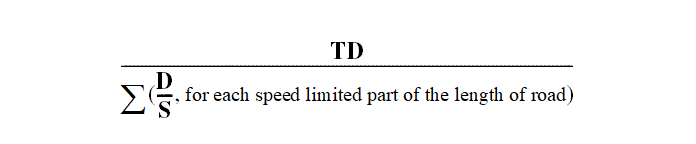
120CApplication of maximum speed limit if variable speed limit
(1)This section applies to a proceeding for a prescribed offence in which the speed at which a motor vehicle travelled is relevant if—(a)under section 120, the prosecution intends to rely on an image or video made by a photographic detection device as evidence of the speed of a vehicle on a length of road; and(b)the speed limit applying to the length of road is indicated by a variable speed limit sign.(2)This section also applies to a proceeding for a prescribed offence in which the speed at which a motor vehicle travelled is relevant if—(a)the prosecution intends to rely on section 120B for deciding the speed limit applying to a length of road; and(b)the speed limit applying to 1 or more parts of the length of road is indicated by a variable speed limit sign.(3)For the proceeding and for applying section 120B, the speed limit for the length of road, or the part of the length of road, is taken to be—(a)the speed limit indicated by the variable speed limit sign; or(b)if it is not reasonably practicable to verify the speed limit indicated by the variable speed limit sign—the speed limit that would apply to the length of road, or the part of the length of road, if the speed limit were not indicated by the variable speed limit sign.Example of circumstances in which paragraph (b) may apply—
A variable speed limit sign changes during the course of a day and it is not possible to verify what speed limit was indicated by the sign at the particular time of that day depicted in the image or video made by the photographic detection device.(4)In this section—variable speed limit sign means a speed limit sign or area speed limit sign that is a variable illuminated message sign within the meaning given by the Queensland Road Rules.
120D Photographic or video evidence about use of approved seatbelt
(1)This section applies to a proceeding for a prescribed offence in which the driver of, or passenger in, a vehicle not wearing an approved seatbelt is relevant if, under section 120, the prosecution intends to rely on an image or video made by a photographic detection device as evidence of the driver or passenger not wearing an approved seatbelt.(2)In the absence of proof to the contrary—(a)the vehicle depicted in the image or video is taken to be moving but not reversing, or stationary but not parked; and(b)the vehicle depicted in the image or video is taken to be fitted with an approved seatbelt in the seating position occupied by the driver or passenger; and(c)if the image or video depicts the driver or passenger not wearing a seatbelt, the driver or passenger is taken not to be wearing an approved seatbelt.(3)In this section—approved seatbelt, in relation to a prescribed offence, has the meaning it has for the prescribed offence.
120E Photographic or video evidence of matter relating to driver distraction offence
(1)This section applies to a proceeding for a prescribed offence that is a driver distraction offence if, under section 120, the prosecution intends to rely on an image or video made by a photographic detection device as evidence of a matter in relation to the offence.(2)In the absence of proof to the contrary, the vehicle depicted in the image or video is taken to be moving, or stationary but not parked.(3)In this section—driver distraction offence means an offence that—(a)is prescribed by regulation to be a driver distraction offence; and(b)involves—(i)the use of a mobile phone by a person in a vehicle; or(ii)the use, operation or holding of an electronic device by, or the resting of an electronic device on, a person in a vehicle.electronic device, in relation to a driver distraction offence, has the meaning it has for the offence.mobile phone, in relation to a driver distraction offence, has the meaning it has for the offence.operation, in relation to an electronic device, in relation to a driver distraction offence, has the meaning it has for the offence.use, in relation to an electronic device or mobile phone, in relation to a driver distraction offence, has the meaning it has for the offence.
120F Report about offence detected by photographic detection device
(1)This section applies to a proceeding for a prescribed offence if, under section 120, the prosecution intends to rely on an image or a series of images, or a video or a series of videos, made by a photographic detection device as evidence of particular elements of the offence.(2)The prosecution may produce a report complying with this section in the proceeding.(3)The report must—(a)be made in the way prescribed by regulation for the photographic detection device; and(b)contain only 1 or more of the following—(i)a copy of the image or some or all of the images in the series, or a still image or images taken from the video or some or all of the videos in the series;(ii)a summary of the things depicted in the image or images, or the still image or images from the video or videos;(iii)for a copy of images in a series or still images of videos in a series—the numbers of the images or videos and the times they were taken, as identified under section 120(3);(iv)a matter mentioned in section 120A(4)(a), (b) or (c) or 120B(5)(a), (b), (c), (d) or (e);(v)a matter prescribed under subsection (4)(b); and(c)include a certification, or be accompanied by a certificate, signed by the commissioner stating that the report—(i)was properly made in the way prescribed under paragraph (a) for the photographic detection device; and(ii)contains only matters mentioned in paragraph (b).(4)If the way prescribed under subsection (3)(a) for a photographic detection device requires or otherwise involves analysis or a determination being made by a person, the regulation must state—(a)the class of appropriately qualified persons who may conduct the analysis or make the determination; and(b)the matters about the proper conduct of the analysis or making of the determination that must be stated in a report under this section.(5)A report produced under this section is evidence of the following—(a)the things depicted in a copy of an image, or a still image from a video, contained in the report;(b)if a copy of an image or still image from a video contained in the report has a marking or writing associated with the image or video—each thing in relation to the image or video that the marking or writing is prescribed to mean under a regulation;(c)a matter stated in a summary mentioned in subsection (3)(b)(ii) contained in the report;(d)a matter mentioned in subsection (3)(b)(iii), (iv) or (v) contained in the report.
121Application of the State Penalties Enforcement Act 1999
(1)The State Penalties Enforcement Act 1999, part 3 applies to camera-detected offences subject to this division.(2)If there is any inconsistency between the State Penalties Enforcement Act 1999 and this division, the provisions of this division prevail.(3)Without limiting subsection (1) or (2), for the State Penalties Enforcement Act 1999—(a)a reference to person in charge or user is, if the context permits, taken to be a reference to the person in charge of the vehicle; and(b)a reference to illegal user declaration, known user declaration, sold vehicle declaration or unknown user declaration or ‘declaration’ generally is taken to be a reference to the appropriate approved form for section 114; and(c)the State Penalties Enforcement Act 1999, sections 18(2), 19(5), 20(5) and 21(2) are subject to section 114 and in particular section 114(6) applies instead of the State Penalties Enforcement Act 1999, section 21(2)(b).
121A Approved testing devices for particular vehicles
(1) The chief executive or commissioner may, by signed certificate, approve a device or system (an approved testing device) for—(a)testing a vehicle to assess whether it is an electrically power-assisted cycle, personal mobility device or prohibited bike; or(b)testing a vehicle to assess whether it complies with the EPAC standard.(2)The chief executive or commissioner may, by signed certificate, approve the following things—(a) the standards or procedures for testing or calibrating approved testing devices;(b) procedures for carrying out a test using an approved testing device, including at a roadside location;(c)training or qualification requirements for persons who may operate an approved testing device.(3)The chief executive must—(a)publish on a Queensland Government website a list of current approved testing devices; and(b)keep records of approvals and calibration checks for approved testing devices for the period prescribed by regulation.(4)The commissioner must give the chief executive the information necessary for publishing lists and keeping records under subsection (3), to the extent the commissioner has control of that information.(5)In this section—Queensland government website means a website with a URL that contains ‘qld.gov.au’, other than the website of a local government.
122Definitions for pt 7A
In this part—applicant means a person applying for authority to act as a crossing supervisor.authorised scheme see section 122A(1)(a).authority means authority to perform a role under an authorised scheme.criminal history, of a person who is an applicant or crossing supervisor—(a)means the following—(i)the date of conviction for a disqualifying offence or the date a charge of a disqualifying offence was laid, whether before or after the commencement of this section;(ii)the name of the Act, and the provision, under which the disqualifying offence is created;(iii)for a conviction for a disqualifying offence—the penalty or other order made in relation to the conviction; and(b)despite section 6 of the Criminal Law (Rehabilitation of Offenders) Act 1986, includes a conviction of the person to which that section applies; and(c)despite section 5 of the Criminal Law (Rehabilitation of Offenders) Act 1986, includes a charge made against the person for a disqualifying offence.crossing supervisor see section 122A(1)(b).disqualifying offence means—(a)a disqualifying offence, or serious offence, under the Working with Children (Risk Management and Screening) Act 2000Working with Children Check Act 2000; or(b)an offence against a provision of the Criminal Code mentioned in schedule 2; or(c)an offence against the Drugs Misuse Act 1986, part 2; or(d)an offence similar to an offence mentioned in paragraph (a), (b) or (c) committed outside Queensland.
122AChief executive may authorise scheme
(1)The chief executive may—(a)authorise a scheme to help children to safely cross roads (an authorised scheme); and(b)authorise a person to perform a role under the scheme (a crossing supervisor).(2)An authorised scheme comes into force on the day stated in the scheme.
122BUnauthorised person must not act as crossing supervisor
(1)A person must not perform a role under an authorised scheme as a crossing supervisor unless the person is a crossing supervisor.Maximum penalty—20 penalty units.
(2)A person must not hold himself or herself out as being a crossing supervisor if the person is not authorised as a crossing supervisor under an authorised scheme.Maximum penalty—20 penalty units.
122CChief executive may refuse to authorise person under scheme
The chief executive may refuse to authorise a person to perform a role under an authorised scheme if the person—(a)has been convicted of a disqualifying offence; or(b)has been charged with a disqualifying offence and the charge has not been finally dealt with; or(c)has previously had the person’s authority to act as a crossing supervisor cancelled under this part.
122DChief executive may impose conditions on authority
The chief executive may authorise a person to perform a role under an authorised scheme subject to conditions.
122ENotice to be given about refusal or imposition of condition
(1)This section applies if the chief executive—(a)refuses to authorise a person to perform a role under an authorised scheme; or(b)authorises a person to perform a role under an authorised scheme subject to conditions.(2)The chief executive must inform the person of the decision by written notice.(3)The notice must state—(a)the reasons for the decision; and(b)the prescribed review information for the decision.(4)The decision takes effect on the day the notice is given to the person.
122FCriminal history to be disclosed by applicants and crossing supervisors
(1)A person who is an applicant or a crossing supervisor must, by written notice as required by subsection (2), give the chief executive details of the person’s criminal history.Maximum penalty—40 penalty units.
(2)The applicant or crossing supervisor must give the written notice—(a)for a charge laid or an offence of which the applicant is convicted before the application is made—with the application; or(b)for a charge laid or an offence of which the applicant is convicted after the application is made but before the application is decided—as soon as practicable after the charge is laid or the applicant is convicted; or(c)for a charge laid or an offence of which the crossing supervisor is convicted after becoming a crossing supervisor—as soon as practicable after the charge is laid or the crossing supervisor is convicted.
122GCrossing supervisor may surrender authority
(1)A crossing supervisor who fails to give a notice required by section 122F(2)(c) does not commit an offence if, as soon as practicable after the requirement arises, the crossing supervisor gives the chief executive written notice that the crossing supervisor will immediately stop acting as a crossing supervisor.(2)If a crossing supervisor gives the chief executive a notice under subsection (1), the crossing supervisor’s authority to perform a role under an authorised scheme is taken to be cancelled on the day the notice is given to the chief executive.
122IGrounds for amending, suspending or cancelling authority
Each of the following is a ground for amending, suspending or cancelling a person’s authority as a crossing supervisor—
(a)the person has, since becoming a crossing supervisor, been charged with, or convicted of, a disqualifying offence;(b)the chief executive considers—(i)public safety, particularly the safety of children, has been endangered, or is likely to be endangered, because of the authority; or(ii)it is otherwise necessary in the public interest;(c)the authority was issued by error or was granted because of a false or fraudulent document, statement or representation;(d)the person has contravened a condition of the authority;(e)the person can no longer perform the role of a crossing supervisor satisfactorily, including because of any known medical condition or physical or mental incapacity.
122JShow cause procedure for amending, suspending or cancelling authority
If the chief executive considers a ground exists to amend, suspend or cancel a crossing supervisor’s authority (the proposed action), the chief executive must give the crossing supervisor written notice stating—(a)the proposed action; and(b)the ground for the proposed action; and(c)an outline of the facts and circumstances forming the basis for the ground; and(d)if the proposed action is to amend the authority, including a condition of the authority—the proposed amendment; and(e)if the proposed action is to suspend the authority—the proposed suspension period; and(f)an invitation to the crossing supervisor to show in writing, within a stated time of at least 28 days, why the proposed action should not be taken.
122KAmending, suspending or cancelling authority
(1)If, after considering all the written representations made within the stated time under section 122J(f), the chief executive still considers a ground exists to take proposed action, the chief executive may—(a)if the proposed action was to amend the authority—amend the authority in the way stated in the notice; or(b)if the proposed action was to suspend the authority—(i)amend the authority in the way the chief executive considers appropriate; or(ii)suspend the authority for no longer than the period stated in the notice; or(c)if the proposed action was to cancel the authority—(i)amend the authority in a way the chief executive considers appropriate; or(ii)suspend the authority for a period; or(iii)cancel the authority.(2)However, if the proposed action relates to a matter that is the subject of a proceeding before a court that has not been finally decided, the chief executive—(a)need not make a final decision under subsection (1) until the proceeding is finally decided; but(b)must make the decision as soon as reasonably practicable after the proceeding is decided.(3)This section does not apply if section 122P applies.
122LNotice to be given to crossing supervisor
(1)The chief executive must inform the crossing supervisor by written notice about the chief executive’s decision under section 122K(1).(2)If the chief executive decides to amend, suspend or cancel the authority, the notice must state—(a)the reasons for the decision; and(b)the prescribed review information for the decision.(3)The decision takes effect on the later of the following—(a)the day the notice is given to the crossing supervisor;(b)the day stated in the notice.
122MGrounds for immediate suspension of authority
(1)Despite section 122J, the chief executive may immediately suspend a crossing supervisor’s authority, by written notice given to the crossing supervisor, if the chief executive reasonably believes it is necessary because—(a)public safety, particularly the safety of children, has been endangered, or is likely to be endangered, because of the authority; or(b)it is otherwise necessary in the public interest.(2)Without limiting the chief executive’s powers under subsection (1), it is enough to immediately suspend a crossing supervisor’s authority if—(a)a person complains to a police officer about the crossing supervisor’s conduct and the chief executive reasonably believes—(i)the complaint is not trivial, vexatious or otherwise lacking in substance; and(ii)the alleged conduct complained of justifies taking action under subsection (1); or(b)having regard to statements or other information about the crossing supervisor’s conduct given to the chief executive, the chief executive reasonably believes the statements or other information justifies taking action under subsection (1).
122NProcedure for immediate suspension of authority
(1)If the chief executive immediately suspends an authority, the suspension—(a)takes effect on the day the notice is given to the crossing supervisor; and(b)has effect until—(i)if the chief executive informs the crossing supervisor of the chief executive’s decision by notice under section 122L—the day the decision takes effect under section 122L(3); or(ii)if the decision is set aside on review or appeal—the day the decision is set aside; or(iii)otherwise—the end of 56 days after the notice is given to the crossing supervisor or the end of any further period or periods by which the suspension is extended under subsection (3).(2)If the chief executive immediately suspends an authority, the notice under section 122M(1) must state—(a)the reasons for the decision; and(b)the general effect of subsection (1)(b); and(c)the prescribed review information for the decision.(3)If the immediate suspension of an authority relates to a matter that is the subject of a proceeding before a court that has not been finally decided, the chief executive—(a)may extend the suspension for a further period or periods until the proceeding is finally decided; but(b)must make a decision about whether to take proposed action under section 122K as soon as practicable after the proceeding is decided.
122OFurther action after immediate suspension
(1)This section applies if—(a)under section 122M, the chief executive immediately suspends a crossing supervisor’s authority; and(b)the chief executive proposes, under section 122J, to amend, further suspend or cancel the crossing supervisor’s authority (also the proposed action).(2)The chief executive must, within 14 days after immediately suspending the crossing supervisor’s authority, give the crossing supervisor a notice that states—(a)the information mentioned in section 122J(a), (b) and (c) in relation to the proposed action; and(b)if the proposed action is to amend the authority, including a condition of the authority—the proposed amendment; and(c)if the proposed action is further suspension of the authority—the proposed suspension period; and(d)an invitation to the crossing supervisor to show cause in writing, within a stated time of at least 28 days, why the proposed action should not be taken.(3)The notice under subsection (2) may be combined with the notice given to the crossing supervisor under section 122M.(4)Sections 122K and 122L apply to the proposed action as if the notice had been given under section 122J.(5)Despite subsection (4), section 122K(1)(b)(ii) or (c)(ii) does not limit the chief executive’s powers to extend the period of suspension under section 122N(3).
122POther amendments of authorities
(1)This section applies only if the chief executive proposes to amend a crossing supervisor’s authority—(a)for a formal or clerical reason; or(b)in another way that does not adversely affect the crossing supervisor’s interests; or(c)because the crossing supervisor asks.(2)The chief executive may make amendments of a type mentioned in subsection (1) by written notice given to the crossing supervisor.
(1)A responsible person who issues an instrument under this Act must keep a record of the particulars of the instrument at—(a)if the instrument is issued by the chief executive—an office of the department decided by the chief executive; or(b)otherwise—an office of the Queensland Police Service decided by the commissioner.(2)However, a record of particulars of a person’s Queensland driver licence must—(a)be kept at an office of the department decided by the chief executive; and(b)include the person’s traffic history.(3)The person who has custody of the record is—(a)for a record mentioned in subsection (1)—the person in charge of the office where the record is kept; or(b)for a record mentioned in subsection (2)—the chief executive.(4)An extract from or copy of any entry of any particulars of the record that is, or purports to be, certified by the person who has custody of the record as being an extract from or copy of the record, is for a court and all other purposes, evidence of the particulars contained in the record, without requiring the production of the record.(5)In this section—instrument means an appointment, approval, authorisation, cancellation, demand, determination, direction, licence, notification, order, suspension or surrender.issues includes gives or makes.responsible person means—(a)the chief executive; or(b)the commissioner; or(c)a superintendent.
123AProof of appointments unnecessary
For a proceeding for an offence against a transport Act, it is not necessary to prove the appointment of the following persons—(a)the chief executive;(b)the chief executive officer of a corresponding authority administering a corresponding law to a transport Act;(c)the commissioner;(d)the head of the police force or police service of the Commonwealth or another State;(e)an authorised officer;(f)a person appointed as an authorised officer, or holding an equivalent office, under a corresponding law to a transport Act;(g)an accredited person;(h)a police officer;(i)a member of the police force or police service of the Commonwealth or another State;(j)a person who has custody of the particulars of, or records relating to, Queensland driver licences;(k)the chief executive officer of a local government;(l)the clerk of a court;(m)a person having responsibility for custody of records relating to payments under this Act;(n)a person who is a delegate of the chief executive to sign a certificate or document;(o)the Minister responsible for administering, or the Secretary under, the Road Vehicle Standards Act 2018 (Cwlth), or a delegate of the Minister or Secretary under that Act;(p)the Minister responsible for administering the repealed Motor Vehicle Standards Act 1989 (Cwlth) or the Road Vehicle Standards (Consequential and Transitional Provisions) Act 2018 (Cwlth), or a delegate of the Minister under those Acts.
123BProof of signatures unnecessary
For a proceeding for an offence against a transport Act, a signature purporting to be the signature of 1 of the following persons is evidence of the signature it purports to be—(a)the chief executive;(b)the chief executive officer of a corresponding authority administering a corresponding law to a transport Act;(c)the commissioner;(d)the head of the police force or police service of the Commonwealth or another State;(e)an authorised officer;(f)a person appointed as an authorised officer, or holding an equivalent office, under a corresponding law to a transport Act;(g)an accredited person;(h)a police officer;(i)a member of the police force or police service of the Commonwealth or another State;(j)a person who has custody of the particulars of, or records relating to, Queensland driver licences;(k)the chief executive officer of a local government;(l)the clerk of a court;(m)a person having responsibility for custody of records relating to payments under this Act;(n)a person who is a delegate of the chief executive to sign a certificate or document;(o)the Minister responsible for administering, or the Secretary under, the Road Vehicle Standards Act 2018 (Cwlth), or a delegate of the Minister or Secretary under that Act;(p)the Minister responsible for administering the repealed Motor Vehicle Standards Act 1989 (Cwlth) or the Road Vehicle Standards (Consequential and Transitional Provisions) Act 2018 (Cwlth), or a delegate of the Minister under those Acts.
123CCertificate is evidence of matter in certificate
(1)A certificate stating a matter mentioned in schedule 1, column 1, purporting to be signed by a person mentioned in column 2 of that schedule opposite the matter, is evidence of the matter stated in the certificate.(2)A certificate mentioned in subsection (1)—(a)may relate to a specified time or period; and(b)if it is issued for a particular period—has the effect mentioned in subsection (1) for the entire period.(3)A regulation may provide for evidence of other matters to be provided by a certificate purporting to be signed by the chief executive, the commissioner or the chief executive administering a corresponding law to a transport Act.(4)A document, or a copy of a document, purporting to be made or given by a person under a transport Act containing personal particulars given by the person is evidence of the particulars.(5)Anything recorded by a photographic, mechanical, electronic or other device under a transport Act is evidence—(a)that the recording was made; and(b)of the accuracy of the recording; and(c)of the matters stated in the recording; and(d)of matters prescribed under a regulation.(6)Without limiting subsection (5), a record of the mass of a heavy vehicle, or of any component of the vehicle, made by the operator of a weighbridge at which the vehicle or component was weighed, or by an employee of the operator of the weighbridge, is evidence of the mass at the time the vehicle or component was weighed.(7)Evidence by an authorised officer of the contents of a document issued, required to be kept, under a transport Act or a corresponding law, that was examined by the officer while in someone else’s possession, may be given by the officer without the document being produced.An authorised officer who examines a driver’s Australian driver licence or logbook may return the licence or logbook to the driver to enable the driver to continue driving. The officer may give evidence of the contents of the licence or logbook without producing it.
To remove any doubt, it is declared that—(a)the Transport Planning and Coordination Act 1994, section 37 applies to a function or power of the chief executive under this part; and(b)the Police Service Administration Act 1990, section 4.10 applies to a power of the commissioner under this part.
123E Certified copies of documents
(1)This section applies to a document—(a)purporting to be a copy of—(i)a nomination of a motor vehicle for section 91K(1)(a), made in accordance with section 163A, and received by the chief executive; or(ii)an application made under this Act; or(iii)a written notice given to a person under this Act; or(iv)a certificate of exemption given under this Act; or(v)a certificate in the approved form signed by a health professional stating that a person does or does not have a mental or physical incapacity likely to affect their ability to drive safely; or(vi)a certificate issued to a person under the driver licensing regulation because—(A)the person held a valid provisional, probationary or open licence to drive a class of vehicle; and(B)that licence stopped being valid more than 5 years before the person applied for a licence of the same class as that licence; and(b)certified by the chief executive as a true copy of a document mentioned in subsection (1)(a).(2)For a proceeding for an offence against a transport Act, the document is evidence of the matters stated in it.
123F Certified copy of licence or other document
(1)This section applies to a document—(a)purporting to be a copy of—(i)a licence; or(ii)another document issued, or required to be kept, under a transport Act; and(b)certified as a true copy of the licence or other document by—(i)the chief executive; or(ii)the commissioner; or(iii)a person who has custody of the particulars of, or records relating to, Queensland driver licences.(2)For a proceeding for an offence against a transport Act the document—(a)is evidence of the licence or other document; and(b)is evidence of the matters stated in it.
123G Certified copy of licence or other document under corresponding law
(1)This section applies to a document—(a)purporting to be a copy of—(i)a driver licence under a corresponding law to a transport Act; or(ii)another document issued, or required to be kept, under a corresponding law to a transport Act; and(b)certified as a true copy of the driver licence or other document by—(i)the chief executive administering the corresponding law; or(ii)a person authorised by that chief executive.(2)For a proceeding for an offence against a transport Act the document is evidence of the driver licence or other document.
123H Certified copy of plan of installation of photographic detection device
(1)This section applies to a plan of installation of a photographic detection device at a place—(a) showing any features of—(i)the installation; or(ii)road infrastructure; or(iii)road boundaries; or(iv)road markings; and(b)certified by the chief executive or the commissioner as a true copy of the plan.(2)For a proceeding for an offence against a transport Act, the plan is evidence of the matters shown in it.
123I Certificate is evidence of another matter—stop watches, other watches and speedometers
(1)This section applies to a certificate—(a)purporting to be signed by the chief executive or the commissioner; and(b)stating that a specified stop watch, other watch or speedometer has been tested and found to produce accurate results at the time of testing.(2)For a proceeding for an offence against a transport Act, the certificate is evidence the stop watch, other watch or speedometer was producing accurate results when tested and for 6 months after the day of testing.
123J Certificate is evidence of another matter—speed detection
(1)This section applies to a certificate purporting to be signed by the commissioner and stating a specified induction loop speed detection device, laser-based speed detection device, piezo strip speed detection device or radar speed detection device—(a)was tested at a specified time in accordance with—(i)the appropriate Australian Standard for testing the device, as in force on the day of testing; or(ii)if there is no appropriate Australian Standard for testing the device in force on the day of testing—the manufacturer’s specifications; and(b)was found to produce accurate results at the time of testing.(2)For a proceeding for an offence against a transport Act, the certificate is evidence the device was producing accurate results when tested and for 1 year after the day of testing.
123K Certificate is evidence of another matter—speedometer accuracy indicator
(1)This section applies to a certificate purporting to be signed by the commissioner stating a specified vehicle speedometer accuracy indicator (commonly known as a chassis dynamometer) has been—(a)tested at a specified time; and(b)found to produce accurate results at the time of testing.(2)For a proceeding for an offence against a transport Act, the certificate is evidence the indicator was producing accurate results when tested and for 6 months after the day of testing.
123KA Certificate is evidence of another matter—approved testing device
(1)Subsection (2) applies to a certificate purporting to be signed by the chief executive or commissioner stating any of the following—(a)that a stated device or system is an approved testing device;(b)the results of a stated test carried out using an approved testing device on a stated device or vehicle at a stated time and place;(c)that a stated vehicle does not comply with the EPAC standard for stated reasons.(2) For a proceeding for an offence against a transport Act, the certificate is evidence of the matters stated in it.(3)Subsection (4) applies to a certificate purporting to be signed by the chief executive or commissioner stating—(a) that, on a stated day or during a stated period, a stated approved testing device was tested or calibrated in accordance with a stated standard or procedure approved by the chief executive or commissioner; or(b) that a stated approved testing device was operated in accordance with the manufacturer’s instructions or a procedure approved by the chief executive or commissioner.(4) For a proceeding for an offence against a transport Act, the certificate is evidence—(a)of the matters stated in it; and(b)that the stated approved testing device was producing accurate results when tested and for 1 year after the day of testing.
123L Certificate is evidence of another matter—analysing instrument
(1)This section applies to a certificate purporting to be signed by the commissioner or the chief executive stating that a breath analysing instrument or saliva analysing instrument has been—(a)tested at a specified time—(i)in accordance with the appropriate Australian Standard that is in force at the time or, if there is no appropriate standard, in accordance with the manufacturer’s specifications; and(ii)using devices or substances certified or otherwise authenticated under the National Measurement Act 1960 (Cwlth); and(b)found to produce accurate results at the time of testing.(2)For a proceeding for an offence against a transport Act, the certificate is evidence—(a)of the matters stated in it; and(b)that the breath analysing instrument or saliva analysing instrument was producing accurate results when tested and for 1 year after the day of testing.
123M Exemption or non-application of provision—onus of proof
In a proceeding for an offence under this Act, the defendant bears the onus of proving—(a)that a person, vehicle, tram, train, vessel or animal was at any time exempt from a provision of this Act; or(b)that a provision of this Act was not applicable to a person, vehicle, tram, train, vessel or animal.
123N Evidence of registration number
(1)This section applies to evidence that a number plate showing a particular registration number was attached to a motor vehicle at a particular time.(2)For a proceeding for an offence against a transport Act, the evidence is evidence that the motor vehicle is the motor vehicle noted in the register of vehicles as having that registration number at that time.(3)In this section—motor vehicle includes a motorised mobility device.
123O Matters not necessary to prove
For a proceeding for an offence against a transport Act, it is not necessary to prove the following—(a)the limits of a district or part of a district;(b)that a road or place is within a district or part of a district;(c)the authority of the chief executive, the commissioner or a police officer to do any act or take any proceedings.
123P Evidence about analysing instruments
(1)For a proceeding for an offence against a transport Act, evidence of the condition of a breath analysing instrument or saliva analysing instrument, or the manner in which it was operated, is not required unless evidence is given that the instrument—(a)was not in proper condition; or(b)was not properly operated.(2)In this section—breath analysing instrument see section 80(1).saliva analysing instrument see section 80(1).
123Q Evidence about parking meters and parkatareas
For a proceeding for an offence against a transport Act, evidence of the condition of a parking meter or parkatarea is not required unless evidence is given that the parking meter or parkatarea was not in proper condition.
(1)This section applies to a defendant who intends, at the hearing of a charge against the defendant under this Act, to challenge—(a)the accuracy of a speed detection device or vehicle speedometer accuracy indicator for which a certificate is given under section 123J or 123K; or(b)the time at which, or way in which, the device was used.(a)the accuracy of a speed detection device for which a certificate is given under section 123J; or(b)the accuracy of a vehicle speedometer accuracy indicator for which a certificate is given under section 123K; or(c)the results of an approved testing device for which a certificate is given under section 123KA; or(d)the time at which, or way in which, a device mentioned in paragraph (a) to (c) was used.(2)The defendant must give written notice of the challenge to the prosecution.(3)The notice must—(a)be in the approved form; and(b)be signed by the defendant; and(c)state the grounds on which the defendant intends to rely to challenge a matter mentioned in subsection (1)(a) or (b); and(d)be given at least 14 days before the day fixed for the hearing.
(1)In this section—instrument means an instrument declared under a regulation to be an instrument for this section, and includes—(a)a speedometer; and(b)a weighing device.(2)A certificate stating that, on a specified day or at a specified time on a specified day, a specified instrument—(a)was in a proper condition; or(b)had a specified level of accuracy;is evidence of those matters on the specified day or at the specified time, and for any period, prescribed under a regulation, after that day.(3)Evidence of the condition of the instrument, or the way in which it was operated, is not required unless evidence that the instrument was not in proper condition or was not properly operated has been given.(4)A defendant who intends to challenge the condition of an instrument, or the way in which it was operated, must give the complainant or arresting police officer (if any) written notice of the intention to challenge.(5)The notice must be given at least 14 working days before the return date of the summons or the appointed date for the hearing of the charge.
123SA Evidence of particular matters relating to vehicles
(1)In a proceeding for an offence against a transport Act—(a)evidence that a sticker, label, plate or marking was on or attached to a vehicle, or a component of a vehicle, purportedly in relation to an approval under a vehicle standards Act, is evidence of the matters stated on the sticker, label, plate or marking; and(b)a certificate purporting to be signed by the chief executive stating that a document attached to the certificate is an extract from a register, database or administration system kept by the Commonwealth under, or for the administration of, a vehicle standards Act is evidence of the matters stated in the document; andExamples of registers, databases and administration systems for paragraph (b)—
•the Register of Approved Vehicles under the Road Vehicle Standards Act 2018 (Cwlth) (also known as the RAV)•the online administration system known as the ‘Road Vehicle Regulator’ or ROVER•the online administration system known as the ‘Road Vehicle Certification System’ or RVCS(c)a document purporting to have been published or produced by a manufacturer in relation to the manufacturer’s specifications for a specified type of vehicle, or a component of a specified type of vehicle, is evidence of the specifications stated in the document for the type of vehicle or the component; and(d)a document purporting to have been prepared by a manufacturer or importer of vehicles or components of vehicles, or a person acting on behalf of the manufacturer or importer, that purports to contain the results of testing of vehicles or components done for the purposes of an approval under a vehicle standards Act is evidence of the matters stated in the document; and(e)evidence that a VIN or chassis number was on or attached to a vehicle is evidence that the vehicle had the VIN or chassis number; and(f)evidence that a modification plate under a vehicle standards and safety regulation, or an equivalent plate under a corresponding law to a vehicle standards and safety regulation, was on or attached to a specified vehicle is evidence of the matters stated on the plate.; and(g)evidence that a motorbike does not have a number plate attached to it is evidence that the motorbike is not registered;(h)evidence that a prohibited bike does not have a VIN engraved or permanently affixed to the bike is evidence that the bike is not eligible for registration;(i)evidence that an electrically power-assisted cycle has been modified is evidence that the cycle is not compliant with the EPAC standard.(2)If a defendant intends, at the hearing of a charge against the defendant under a transport Act, to challenge a matter mentioned in subsection (1), the defendant must give written notice of the challenge to the prosecution at least 14 days before the day fixed for the hearing.(3)The notice must—(a)be in the approved form; and(b)be signed by the defendant; and(c)state the grounds on which the defendant intends to rely to challenge the matter.(4)In this section—vehicle standards Act means any of the following Acts—(a)the Road Vehicle Standards Act 2018 (Cwlth);(b)the repealed Motor Vehicle Standards Act 1989 (Cwlth);(c)the Road Vehicle Standards (Consequential and Transitional Provisions) Act 2018 (Cwlth).
(1)Without limiting section 123C, 123F or 123G, transport documentation is admissible in a proceeding under a transport Act relating to a prescribed dangerous goods vehicle or the transport of dangerous goods and is evidence of—(a)the identity and status of the parties to any transaction to which the documentation relates; and(b)the destination or intended destination of any load to which the documentation relates.(2)In this section—status, of the parties to a transaction, includes the status of each of the parties as a person involved in the transport of dangerous goods.
123UEvidence not affected by nature of vehicle
Evidence obtained in relation to a vehicle because of the exercise of a power under this Act in the belief or suspicion that the vehicle is a heavy vehicle or prescribed vehicle is not affected merely because the vehicle is not a heavy vehicle or prescribed vehicle.
(1)A proceeding for an offence against a transport Act is a summary proceeding under the Justices Act 1886.(2)If the proceeding is for an offence against section 92(1) in relation to an incident that happened after the commencement of this subsection, the proceeding must start within 5 years after the offence was committed.(3)If the proceeding is for an offence involving a heavy vehicle, a dangerous goods vehicle or the transport of dangerous goods, other than an offence that may be started as mentioned in subsection (2), the proceeding must start—(a)within 2 years after the offence was committed; or(b)within 1 year after the offence comes to the complainant’s knowledge, but within 3 years after the offence was committed.(4)If the proceeding is for an offence other than an offence that may be started as mentioned in subsection (2) or (3), the proceeding must start—(a)within 1 year after the offence was committed; or(b)within 6 months after the offence comes to the complainant’s knowledge, but within 2 years after the offence was committed.(5)A statement in a complaint for an offence against a transport Act that the matter of the complaint came to the knowledge of the complainant on a stated day is evidence of when the matter came to the complainant’s knowledge.(6)In this section—transport Act does not include the Tow Truck Act 2023.
123WBlack and white reproductions of words in colour
If a word appears in colour (other than black and white) in a statutory instrument under this Act, a copy of the instrument may for all purposes be printed showing the same word in black and white.A statutory instrument may show a colour drawing of an official traffic sign. An official publication or reprint of the statutory instrument may show the same drawing in black and white.
(1)In any proceeding under or for the purpose of this Act, the following apply—(a)proof that a person applied for or obtained a licence for a vehicle shall be evidence that such person was the owner of such vehicle and, in the absence of evidence in rebuttal thereof, shall be conclusive evidence of such ownership;(b)a document purporting to be signed by the chief executive, the commissioner or a superintendent and stating that at any stated time there was or was not in force a licence under this Act as described therein issued to a stated person, or in respect of a stated vehicle, or for a stated purpose (or a document purporting to be signed by the officer ordinarily having the custody of the particulars of Queensland driver licences and stating that at any stated time there was or was not in force a Queensland driver licence under this Act issued to a stated person), or, in the case of either document as aforesaid, stating that any such licence was or was not issued subject to terms, conditions, or restrictions, or was or was not issued subject to the terms, conditions, and restrictions set out in that document shall, upon its production in evidence, be evidence of the matter or matters in that document, and in the absence of evidence in rebuttal thereof shall be conclusive evidence of such matter or matters;(c)against the owner of a vehicle, tram, or animal for permitting or allowing such vehicle, tram, or animal to be used or driven by a person not authorised under this Act by an appropriate driver licence or otherwise to use or drive that vehicle, tram, or animal, proof that such person used or drove that vehicle, tram, or animal shall be evidence that the owner of such vehicle, tram, or animal permitted or allowed such use or driving, and in the absence of evidence in rebuttal thereof shall be conclusive evidence that the owner of such vehicle, tram, or animal permitted or allowed such use or driving;(d)any certificate purporting to be signed by the chief executive, the commissioner, a superintendent, chief executive officer of a local government or a clerk of the court or other person having custody of records relating to payments of moneys payable under this Act of the receipt or non-receipt of any notice, application, or payment or of any other thing required by this Act to be given or made shall, upon its production in evidence, be evidence of the matter or matters certified to therein, and, in the absence of evidence in rebuttal thereof, shall be conclusive evidence of such matter or matters;(e)any certificate purporting to be signed by the chief executive as to any inspection made by any inspector appointed under this Act of any vehicle, whether such inspection was carried out at the direction of any police officer or not, shall, upon its production (and provided that a copy thereof has been made available a reasonable time before the hearing of the proceedings to any party, if requested), be evidence of the matter or matters stated therein and, in the absence of evidence in rebuttal thereof, shall be conclusive evidence of such matter or matters, and the appointment of the inspector who made such inspection shall be presumed until the contrary is proved;(f)any certificate or document—(i)purporting to be issued under regulations about motor vehicle or motorised mobility device registrations made under this Act or a law of another State or a Territory corresponding to the regulations (a corresponding law); or(ii)purporting to be signed by the chief executive, an entity responsible for registering motor vehicles or motorised mobility devices under a corresponding law, or a person authorised by the chief executive or entity;which states that on any day or during any period the motor vehicle or motorised mobility device stated in the certificate or document was registered in the name of the person stated therein shall be received in evidence, and shall be evidence that the person stated in the certificate or document was the owner of the motor vehicle or motorised mobility device stated therein on the day or during the period stated therein, and in the absence of evidence in rebuttal thereof, shall be conclusive evidence of such ownership;(g)any certificate or document referred to in paragraph (f) shall be presumed to have been duly issued or given until the contrary is proved;(h)a certificate purporting to be signed by the chief executive, the commissioner or a superintendent stating that the records of the chief executive, commissioner or superintendent, as the case may be, show that any person was the licensee of any vehicle licensed under this Act at any time shall be received in evidence and shall be evidence that such person was such licensee at such time, and, in the absence of evidence in rebuttal thereof, shall be conclusive evidence that such person was such licensee at that time;(i)the allegation or averment in any complaint that—(i)any person is or is not or was or was not at any time or date mentioned in the complaint—(A)the owner of any vehicle, tram, train, vessel, or animal; or(B)the holder of a licence or any particular class or description of licence; or(C)of, or under, or over a stated age; or(D)the holder of a driver licence authorising the holder to drive a motor vehicle on the road therein specified; or(ii)any thing is or was a vehicle, tram, train, vessel, or animal or of a particular class or description thereof; or(iii)any place or thing is or was—(A)a public place or part of a public place; or(B)a road or part of a road; or(C)a road-related area or part of a road-related area; or(D)an off-street regulated parking area or part of an off-street regulated parking area; or(iii)any place or thing is or was a road or a part of a road or an off-street regulated parking area or a part of such an area; or(iv)any way is or was a tramway or railway; or(v)any distance referred to therein is or was a stated distance or is or was greater or less than a stated distance; or(vi)any indication or prescribed indication is or was given by an official traffic sign;shall be evidence of the matter or matters so averred or alleged, and in the absence of evidence in rebuttal thereof shall be conclusive evidence of such matter or matters;(j)the allegation or averment in any complaint that any sign, signal, light, marking, or other device—(i)is or is not, or was or was not, an official traffic sign; or(ii)is or is not, or was or was not, lawfully constructed, made, marked, placed, erected, affixed, or painted in, into, or on or near any stated road or off-street regulated parking area, or that such sign, signal, light, marking, or other device is or is not, or was or was not, for any purpose stated in the complaint; or(iii)does or does not contain, or has or has not contained, any stated work, figure, warning, direction, indication, or symbol;shall be evidence of the matter or matters so alleged or averred and in the absence of evidence in rebuttal thereof shall be conclusive evidence of such matter or matters;(k)any person who appears, acts, or behaves as the driver, rider, or person having the possession, custody, care, or management of any vehicle, tram, train, vessel, or animal, or who uses or drives, or attempts to use or drive the same shall be presumed to be the person in charge thereof whether the person is or is not the real person in charge, and it is immaterial that by reason of circumstances not known to such person it is impossible to drive or otherwise use the same;(2)Subsection (1)(i) and (j) shall apply to any matter alleged or averred thereunder although—(a)evidence in support of such matter or of any other matter is given; or(b)any matter so alleged or averred is a mixed question of law and fact, but in that case the allegation or averment shall be evidence of the fact only.(3)Without limiting subsection (1)(i)(ii), in a proceeding under or for the purpose of this Act, a certificate purporting to be signed by the commissioner stating that a vehicle has been disposed of under the Police Powers and Responsibilities Act 2000, section 123K is, subject to subsection (4), conclusive evidence that, at the relevant time, the vehicle was a prohibited bike.(4)In a proceeding in which a certificate under subsection (3) is produced, the court may admit evidence that a vehicle the subject of the certificate was not at the relevant time a prohibited bike, or that the vehicle was not unlawfully ridden on a road, on a road-related area or in a public place, only if the evidence could not reasonably have been provided during the administrative process available before the disposal of the vehicle.(5)In this section—administrative process available before disposal means the release application process and internal review process available under chapter 4A, part 3 of the Police Powers and Responsibilities Act 2000.relevant time, in relation to a vehicle, means the time at or during which the vehicle is suspected of having been unlawfully ridden on a road, on a road-related area or in a public place.
(1)This section applies to a document purporting to be—(a)a print-out of an inspection certificate issued electronically under a vehicle standards and safety regulation; or(b)an inspection certificate issued manually under a vehicle standards and safety regulation.(2)For a proceeding for an offence against a transport Act, the document—(a)is taken to be an inspection certificate—(i)issued under the vehicle standards and safety regulation; and(ii)of the type it purports to be; and(b)is admissible in a proceeding for an offence against a transport Act as evidence of a matter stated in the document.(3)In this section—issued electronically means issued using an electronic method.issued manually means issued other than by using an electronic method.
124AAdditional ground of challenge not stated in written notice required under particular provisions
(1)This section applies to a hearing in relation to which a person has given a written notice under section 80(27), 119(1), 120(7), 123R(2) or 123SA(2).(2)The requirement mentioned in section 80(27)(c), 119(2), 120(8), 123R(3) or 123SA(3) to state in the written notice the grounds on which the person intends to challenge the evidence mentioned in that subsection does not prevent the person from raising a ground at the hearing to challenge the evidence if—(a)the person did not know the ground before the hearing; and(b)as far as the ground was able to be found out by the person—the person took all reasonable steps to find out the ground before the hearing.(3)If a person raises a ground at the hearing that was not stated in a written notice under section 80(27), 119(1), 120(7), 123R(2) or 123SA(2), the court may adjourn the hearing to the time, and on the terms as to costs, the court considers appropriate.(4)Subsection (3) does not limit the powers of the court.
125When offences not to be dealt with summarily
Where a person is charged with an act or omission which is both an offence under this Act and an indictable offence, the justices shall abstain from dealing with the case summarily if they are of opinion that the charge is a fit subject for prosecution by indictment and thereupon shall commit the alleged offender for trial.
125A Onus of proof not lessened or affected
This part does not lessen or affect any onus of proof otherwise falling on the defendant.
126Fraud and unlawful possession of licences
(1)A person shall not—(a)without lawful excuse (the proof of which shall be upon the person) have in the person’s possession—(i)any licence; or(ii)any article resembling a licence and calculated to deceive; or(iii)any document which was formerly a licence, but which is void, cancelled, suspended, or surrendered; or(b)forge, or without lawful excuse (the proof of which shall be upon the person) use, lend, or permit or allow to be used by any other person any licence; or(c)unless the person is authorised by or under this Act or is a person acting under the direction of the chief executive or the commissioner or a judge of the Supreme Court or District Court or justices, make or cause or permit or allow to be made any endorsement or any addition or alteration or erasure whatsoever on or from a licence.Maximum penalty—40 penalty units or 6 months imprisonment.
(2)Any licence obtained by any false statement or misrepresentation shall be null and void.(3)In this section—licence does not include an accreditation under the Tow Truck Act 2023.
126ASmartcard authority is property of the State
(1)A smartcard authority is and remains the property of the State.(2)Subsection (1) applies even though a person other than the State—(a)has the right to use information that is on the smartcard authority or stored electronically on it; or(b)has the right to have information stored on the smartcard authority.(3)The State is not legally liable for an act or omission relating to the keeping or use of the smartcard authority.
(1)Where under this or any other Act a judge of the Supreme Court or District Court or justices orders or order that any person shall be disqualified absolutely from holding or obtaining a licence of any kind, class or description (other than a Queensland driver licence), each subsisting such licence held by that person shall, by virtue of such order, be and be deemed to be cancelled on and from the date upon which that person became so disqualified.(2)Where under this or any other Act a judge of the Supreme Court or District Court or justices orders or order that any person shall be disqualified for a specified period from holding or obtaining a licence of any kind, class or description (other than a Queensland driver licence), each subsisting such licence held by that person shall by virtue of the order, where such licence—(a)would expire during the period of disqualification so ordered, be and be deemed to be cancelled on and from the date upon which that person became so disqualified; or(b)would not expire during the period of disqualification so ordered, be and be deemed to be suspended on and from the date upon which that person became so disqualified and thereafter until the expiration of the period of disqualification specified in the order.(2A)Where under this or any other Act a judge of the Supreme Court or District Court or justices orders or order that any person shall be disqualified absolutely or for a specified period from holding or obtaining a Queensland driver licence, each subsisting Queensland driver licence held by that person shall, by virtue of such order, be and be deemed to be cancelled on and from the date upon which that person became so disqualified.(3)Where under any provision of this Act a conviction for an offence disqualifies any person from holding or obtaining a Queensland driver licence for any period therein specified and no order of disqualification has been made upon such conviction, each and every subsisting Queensland driver licence held by that person shall, by virtue of such conviction, be and be deemed to be cancelled on and from the date of such conviction.(3A)If, under a law of another State, a person is disqualified absolutely or for a specified period from holding or obtaining a driver licence in the other State, each subsisting Queensland driver licence held by the person is, by virtue of the disqualification, cancelled on and from the date the person became disqualified.(4)Suspension under this Act of any licence—(a)shall, whilst such licence is so suspended, have the same effect as the cancellation of the licence; and(b)shall, whilst such licence is so suspended, disqualify the person who held that licence from holding or obtaining a licence of the same kind, class, or description; and(c)(if the period of such suspension is less than the period during which that licence ordinarily would have remained in force) shall not, upon the termination of that suspension, extend the period during which that licence thereafter remains in force beyond the period during which that licence would have remained in force if it had not been so suspended.(5)Any cancellation or suspension of a Queensland driver licence shall apply and extend to such licence and to every other Queensland driver licence authorising the person in question to drive any vehicle.(6)A person shall not apply for or obtain a Queensland driver licence or licence of any other kind, class, or description at a time when the person is disqualified—(a)by this Act; or(b)by an order made under this or any other Act (including any Act of a State or Territory or any other country);from holding or obtaining a driver licence or, as the case may be, licence of that other kind, class, or description.
(7)The provisions of subsection (6) do not apply to a person who in accordance with this Act applies for or obtains—(a)a restricted licence under an order made under section 87; or(b)a replacement licence under section 79F.(7A)Also, subsection (6) does not apply to a person subject to a non-Queensland interlock requirement who, under this Act, applies for or obtains a Queensland driver licence subject to an interlock condition under section 91K.(8)A person who applies for or obtains a licence in contravention of subsection (6) shall be guilty of an offence.Maximum penalty—
(a)for a Queensland driver licence—20 penalty units or 18 months imprisonment; or(b)for another licence—40 penalty units.(10)In determining the punishment to be imposed on a person who is guilty of an offence under subsection (8) where the licence applied for or obtained in contravention hereof is a Queensland driver licence, the justices shall have regard to—(a)the whole of the circumstances of the case, including circumstances of aggravation or mitigation; and(b)the interest of the public; and(c)the criminal and traffic history of the offender; and(d)all matters before them in relation to the medical history of the offender or the offender’s physical or mental capacity that are considered by them to be relevant in the circumstances; and(e)such other matters that are considered by them to be relevant in the circumstances.(11)Notwithstanding that, at the time of the commission of an offence under subsection (8) where the licence applied for or obtained in contravention hereof is a Queensland driver licence, the person who committed the offence is disqualified by this Act or by an order made under this or any other Act from holding or obtaining a Queensland driver licence, the justices before whom the person is convicted of the offence, whether or not any other sentence is imposed, shall order that the person shall, on and from the date of the conviction, be disqualified absolutely from holding or obtaining a Queensland driver licence, and the person shall thereupon be so disqualified under and in accordance with that order.(12)Any Queensland driver licence or licence of any other kind, class, or description, obtained by any person or issued to the person at any time when the person is disqualified—(a)by this Act; or(b)by an order made under this or any other Act (including any Act of a State or Territory or any other country);from holding or obtaining a driver licence or, as the case may be, licence of that other kind, class, or description shall be absolutely void and of no legal effect whatsoever.
(13)The provisions of subsection (12) do not apply to either of the following obtained by or issued to any person—(a)a restricted licence under an order made under section 87;(b)a replacement licence under section 79F.(13A)Also, subsection (12) does not apply to a person subject to a non-Queensland interlock requirement who, under this Act, applies for or obtains a Queensland driver licence subject to an interlock condition under section 91K.(14)Subsection (12) shall be read so as not to affect the liability (if any) of that person to punishment under any other provision of this Act or under any other Act in respect of anything done or omitted to be done by the person in relation to the obtaining of the licence in question.
128Effect of disqualification on subsequent issue of Queensland driver licence
Where the Queensland driver licence of a person is cancelled or deemed to be cancelled in accordance with the provisions of section 127 and that person subsequently makes application for a Queensland driver licence (other than a learner licence or a restricted licence applied for pursuant to an order made under section 87), the superintendent may cause the person to be tested as prescribed and issue a probationary licence to the person.
129AEffect of suspension of licence under other Acts
(1)This section applies if a person’s driver licence is suspended under—(a)the State Penalties Enforcement Act 1999, section 105; or(b)the Transport Operations (Passenger Transport) Act 1994, section 91ZJ.(2)The suspension of the driver licence—(a)has, while the licence is suspended, the same effect as if the licence were cancelled under this Act; and(b)if the period of the suspension ends before the licence would ordinarily expire, does not extend the period during which the licence would, apart from the suspension, have remained in force.(3)If under this Act, a person must hold a driver licence for a stated period—(a)the stated period is extended by the length of the period for which the licence is suspended under a provision mentioned in subsection (1); and(b)the period of the suspension does not break the continuous period for which the person must hold the licence.(4)If the period of the licence expires before the period of the suspension ends, the person must not apply for or obtain a Queensland driver licence until the period of the suspension ends.Maximum penalty—20 penalty units or 18 months imprisonment.
(5)The suspension of the driver licence also suspends any other driver licence authorising the person in question to drive a vehicle.(6)A person must not apply for or obtain a Queensland driver licence while the person’s licence is suspended under a provision mentioned in subsection (1) or a corresponding law of another State.Maximum penalty—20 penalty units or 18 months imprisonment.
(7)A person who is disqualified from applying for or obtaining a driver licence under either of the following provisions must not apply for or obtain a driver licence while the person is disqualified under that provision—(a)the State Penalties Enforcement Act 1999, section 106(4);(b)the Transport Operations (Passenger Transport) Act 1994, section 91ZJ.Maximum penalty—20 penalty units or 18 months imprisonment.
129BDisqualification period for person driving more than 40km/h over speed limit
(1)This section applies if—(a)a person is convicted of an offence against a regulation for driving more than 40km/h over the speed limit; and(b)the court that convicts the person decides, under the Penalties and Sentences Act 1992, section 187, to disqualify the person from holding or obtaining a driver licence for a period.(2)The disqualification must be for a period of at least 6 months.
130Delivery of cancelled or surrendered licences, or licences for endorsement
(1)Where any licence is or is deemed to be cancelled or is surrendered or is required for the purpose of making an endorsement thereon under this Act the licensee shall forthwith deliver that licence—(a)if any person is appointed by the regulations to whom a licence of that kind, class, or description is to be delivered upon its cancellation or surrender, or for its endorsement—to that person; or(b)where any person has not been so appointed by the regulations and—(i)where such licence is cancelled consequent on a conviction on indictment, or by or consequent on an order made by a judge of the Supreme Court or District Court—to the registrar of the Supreme Court or District Court which recorded the conviction or made the order; or(ii)where such licence is cancelled consequent on a conviction, or by or consequent on an order, by justices—to the clerk of the court which recorded the conviction or made the order; or(iii)in any other case—to the chief executive or the superintendent who is the officer in charge of the police station in the police division in which the address of the licensee, as indicated on the licence in question, is situated.(2)Any person who fails to deliver any licence as required by subsection (1) shall be guilty of an offence.Maximum penalty—40 penalty units or 6 months imprisonment.
(2A)If such default in delivering any licence is continued by any person who has been convicted of the offence of failing to deliver that licence as required by subsection (1), then that person shall be deemed to commit a continuing offence and shall be liable to a penalty of 1 penalty unit for each and every day during which such offence is so continued.(2B)However, the continuing offence in respect of the non-delivery of such licence shall not be deemed to commence until the expiration of 14 days from the date of conviction as aforementioned.(3)The person to whom any licence is delivered pursuant to the provisions of this section shall make an endorsement containing such particulars relating to its cancellation or surrender, or the other purpose for which the endorsement is required to be made thereon, as may be prescribed and shall transmit such licence to the commissioner unless, in the case of a licence continuing in force, the commissioner is authorised by the regulations to return such licence to the licensee.(5)Where any person (whether the person is at the time the holder of a licence or not) has been disqualified—(a)by this Act; or(b)by an order made under this or any other Act;from holding or obtaining any licence (other than a Queensland driver licence), every licence of that kind, class, or description which the person may then hold or may subsequently obtain shall be endorsed with such particulars relating to the person’s disqualification as may be prescribed.(6)On the issue of a new licence (other than a Queensland driver licence) to any person, the prescribed particulars endorsed or required to be endorsed on any previous licence of that kind, class, or description held by the person shall be copied or made on to the new licence unless the person has previously become entitled under the provisions of this Act to have that new licence issued to the person free from such endorsements.(7)Any person who, having failed to deliver in accordance with this Act for endorsement the person’s licence required hereby to be delivered for the purpose of making an endorsement thereon hereunder and not previously becoming entitled under the provisions of this Act to have a licence issued to the person free from such endorsement, applies for or obtains a new licence of the same kind, class, or description as that which was required to be endorsed without giving sufficient particulars to enable any and every required endorsement to be made on the new licence shall be guilty of an offence.Maximum penalty for subsection (7)—40 penalty units or 6 months imprisonment.
131Reviews and appeals with respect to issue of licences etc.
(1)This section does not apply in relation to a licence that is suspended under the State Penalties Enforcement Act 1999.(2)A person aggrieved by the refusal of the chief executive or commissioner or of a superintendent to issue or renew a licence, or by the suspension or cancellation of a licence by the chief executive or commissioner, or by the imposition of a condition in respect of a licence by or by direction of the chief executive or commissioner or a superintendent may apply, as provided under the QCAT Act, to QCAT for a review of the refusal, suspension, cancellation or imposition.(3)Subsection (2) does not apply to a refusal, suspension, cancellation or imposition that is a licensing decision.(4)A person aggrieved by a decision of the chief executive on a reconsideration of a licensing decision may apply to QCAT for a review of the decision on the reconsideration.(5)Despite the QCAT Act, a decision of QCAT on review under subsection (2) or (4) is final and binding and without further appeal under that Act.(6)Subsection (7) applies to a review of any of the following decisions to suspend or cancel a licence, unless the reason, or 1 of the reasons, for the suspension or cancellation is the mental or physical incapacity of the applicant—(a)a decision to which subsection (2) applies and that involves the suspension or cancellation of a licence of the applicant other than a Queensland driver licence;(b)a decision of the chief executive on a reconsideration of a decision to suspend or cancel the applicant’s Queensland driver licence.(7)On the making of the application for review, the cancellation or suspension is suspended pending the finalisation of the review but, subject to QCAT’s decision on the review, the cancellation or suspension takes effect from the date of the finalisation of the review for the part of the period for which it was made that had not expired when the review started.(8)If the reason, or 1 of the reasons, for the suspension or cancellation of the licence is the licence holder’s mental or physical incapacity, QCAT can not make an order staying the operation of the suspension or cancellation.(9)Subsections (2) to (8) must be read and construed so that a review does not lie under subsection (2) or (4)—(a)in respect of the cancellation or suspension of a Queensland driver licence by reason of the disqualification from holding or obtaining that licence of the licensee upon conviction or by order of a judge of the Supreme Court or District Court or of the court; or(b)in respect of the cancellation or suspension of a licence by or at or pursuant to the order or direction of a judge of the Supreme Court or District Court or of the court under any provision of this Act or under any other Act or law; or(c)in respect of the refusal to issue or renew a licence or a suspension or cancellation of a licence or the imposition of a condition in respect of a licence if provision is made elsewhere in this Act for or in respect of such a review; or(d)in respect of the suspension of a Queensland driver licence of a person because of the allocation of demerit points; or(e)in respect of the suspension of a Queensland driver licence of a person who has been convicted of an offence against a regulation for driving more than 40km/h over the speed limit.(10)A person who has been disqualified, by operation of law or an order, from holding or obtaining a Queensland driver licence absolutely or for a period of more than 2 years, may, at any time after the expiration of 2 years from the start of the disqualification period, apply for the disqualification to be removed.(11)The application for the disqualification to be removed must be made to—(a)if the disqualification was ordered by a judge of the Supreme Court—a judge of the Supreme Court; or(b)if the disqualification was ordered by a judge of the District Court—a judge of the District Court; or(c)if the disqualification was not ordered by a judge of the Supreme or District Court—(i)if the person lives in Queensland—the Magistrates Court exercising jurisdiction at the place where the person lives; or(ii)if the person lives outside Queensland—the Magistrates Court, central division of the Brisbane district.(12)Notice of any such application shall be given to the commissioner or to any police officer authorised by the commissioner to receive such notices, who shall be entitled to appear and be heard and to give and produce evidence at the hearing of such application for or against the granting of the application.(13)The notice required by subsection (12) to be given shall be given at least 28 clear days prior to the date of hearing of such application.(14)Upon hearing any such application the judge of the Supreme Court or District Court or justices constituting the court may, as is thought proper, having regard to the character of the person disqualified and the person’s conduct subsequent to the order, the nature of the offence, and any other circumstances of the case, either by order remove the disqualification as from such date as may be specified in the order or refuse the application.(15)Where an application under subsection (10) is refused, a further application hereunder shall not be entertained if made within 1 year after the date of the refusal.(16)If an order is made under subsection (10) for the removal of a disqualification, the judge or justices have power to order the applicant to pay the whole or any part of the costs of the application.(17)Particulars of the result of any application made under subsection (10) shall be transmitted by the registrar of the Supreme Court or District Court or the clerk of the court concerned to the commissioner.(18)A person who by virtue of an order of a judge of the Supreme Court or District Court or justices made under this or any other Act is disqualified from holding or obtaining a licence may appeal against the order in the same manner as against a conviction recorded against the person by that judge or the justices and the Supreme Court or District Court in determining the appeal may, as is thought proper, having regard to the circumstances of the case, either by order remove the disqualification as from such date as may be specified in that order or dismiss the appeal.(19)A memorandum of the determination of the appeal shall be transmitted by the registrar of the Supreme Court or, as the case may be, District Court to the commissioner.(20)Where a person has, following upon a conviction, been disqualified from holding or obtaining a Queensland driver licence and has commenced an appeal against that conviction, that disqualification shall, upon the commencement of that appeal, and without further order in that behalf, be suspended pending the determination of that appeal.(21)However, subject to any decision of a court upon that appeal, that portion of the period of disqualification which had not expired when such suspension began to operate shall take effect from the date of determination of that appeal.(22)Where on an appeal a conviction against any person for an offence against this or any other Act is quashed, any disqualification of that person from the holding or obtaining of a licence by that conviction without any specific order of disqualification having been made by a judge of the Supreme Court or District Court or justices shall thereupon be removed without any specific order being required for that purpose and without further or other authority than this Act.(23)Where under the authority of this or any other Act an order is made by a judge of the Supreme Court or District Court or justices disqualifying a person from holding or obtaining any licence such order shall be valid and effective notwithstanding that no application was made for that purpose or that the person so disqualified was not present or was not called upon to show cause against the making thereof.(24)In this section—licence does not include an accreditation under the Tow Truck Act 2023.licensing decision means a decision of the chief executive to—(a)refuse to grant or renew the person’s Queensland driver licence; or(b)amend, suspend or cancel the person’s Queensland driver licence; or(c)immediately amend or suspend the person’s Queensland driver licence; or(d)impose a condition on a Queensland driver licence.
131ARemoving absolute disqualification imposed before 13 March 2002
(1)This section applies to a person who was absolutely disqualified from holding or obtaining a Queensland driver licence under section 78 before 13 March 2002.(2)The person may, at any time after the expiration of 5 years from the start of the disqualification, apply to the chief executive to remove the disqualification.(3)When deciding whether to remove the disqualification, the chief executive may consider—(a)whether any demerit points have been recorded on the person’s traffic history in the 2 years immediately before the person applies to the chief executive; and(b)whether the person has been disqualified from holding or obtaining an Australian driver licence since the disqualification that the person is applying to the chief executive to remove.(4)The chief executive may decide—(a)to remove the disqualification from a certain date; or(b)to refuse to remove the disqualification.(5)The chief executive must inform the person of the chief executive’s decision by written notice.(6)If the chief executive refuses to remove the disqualification, the person must wait at least 1 year after the date of the chief executive’s written notice before—(a)reapplying to the chief executive, under this section, to remove the disqualification; or(b)applying to a court, under section 131, to remove the disqualification.
133Business owner to record information about repairs and painting
(1)A person (business owner) who operates a business that includes the repair or painting of motor vehicles or trailers must ensure a record is kept of each of the following (the required information) for a motor vehicle or trailer the business owner or an employee of the business owner repairs or paints in the course of operating the business—(a)the make and model of the motor vehicle or trailer;(b)the VIN or chassis number of the motor vehicle or trailer;(c)if the motor vehicle or trailer has a number plate—the registration number displayed on the plate;(d)the colour of the motor vehicle or trailer—(i)before it is repaired or painted; and(ii)after it is repaired or painted (if different);(e)the name and contact details of the person for whom the repair or painting is carried out (the customer);(f)the date and time the motor vehicle or trailer is delivered to the business owner or access is given to it;(g)the proposed nature of the repair or painting at the time the motor vehicle or trailer is delivered or access is given to it;(h)if, during the period the motor vehicle or trailer is in the business owner’s control, a person drives the motor vehicle or a motor vehicle attached to the trailer on a road outside the business owner’s premises—(i)the person’s name and contact details; and(ii)the date and time the person started and ended driving the motor vehicle;If an employee of the business owner tests the motor vehicle or trailer on a road, the employee’s name, contact details and the date and time the employee started and ended driving the motor vehicle must be recorded.(i)if a part for the repair of the motor vehicle or trailer is supplied by the customer or another person on the customer’s behalf—details of the part;(j)if the repair or painting carried out is different from the proposed nature of the repair or painting recorded under paragraph (g)—the repair or painting carried out;(k)any other information prescribed under a regulation.Maximum penalty—40 penalty units.
(2)If both a motor vehicle and a trailer attached to the motor vehicle are being repaired or painted, the business owner must ensure the required information is recorded for both the motor vehicle and the trailer.(3)The required information may be recorded in different documents.A business owner may record the required information about the same motor vehicle or trailer in a job card, invoice, receipt or computer program.(4)If the required information is recorded in more than 1 document, the business owner must also record in each document information that identifies the motor vehicle or trailer.Maximum penalty—40 penalty units.
A business owner may record in each document a job code that identifies the motor vehicle or trailer.(5)The business owner must ensure the name and address of the business owner’s business is recorded in at least 1 of the documents in which the required information is recorded.Maximum penalty—40 penalty units.
(6)A person must not state, or cause or allow to be stated, required information, or information that must be recorded under subsection (4) or (5), that the person knows, or ought reasonably to know, is false or misleading in a material particular.Maximum penalty—40 penalty units.
(7)In this section—contact details, of a person, means the person’s address or telephone number.employee includes agent or contractor.paint, a motor vehicle or trailer, means—(a)paint to change the predominant colour of the motor vehicle or trailer; or(b)paint a part of the motor vehicle or trailer that has or may have been damaged because of a collision involving the motor vehicle or trailer.repair, a motor vehicle or trailer, means to restore or replace a part of the motor vehicle or trailer that has or may have been damaged because of—(a)corrosion; or(b)a collision involving the motor vehicle or trailer.
133AWhen information in s 133 must be recorded
(1)The business owner must record the information mentioned in section 133(1) within the following periods—(a)for information mentioned in section 133(1)(a) to (c), (d)(i) and (e) to (g)—as soon as practicable after the motor vehicle or trailer is delivered or access is given to it;(b)for information mentioned in section 133(1)(d)(ii) and (j)—as soon as practicable after the motor vehicle or trailer is repaired or painted but before the motor vehicle or trailer ceases to be under the business owner’s control;(c)for information mentioned in section 133(1)(h)—as soon as practicable after the person mentioned in section 133(1)(h) drives the motor vehicle or a motor vehicle attached to the trailer;(d)for information mentioned in section 133(1)(i)—as soon as practicable after the part is supplied;(e)for information mentioned in section 133(1)(k)—the period prescribed under a regulation.(2)The business owner must record the information mentioned in section 133(4) when the required information is recorded in the relevant document.(3)The business owner must record the information mentioned in section 133(5) when the required information mentioned in subsection (1)(a) is recorded.
133BHow long information in s 133 must be kept
The business owner must keep the information mentioned in section 133(1), (4) and (5) for 3 years after the day the motor vehicle or trailer ceases to be under the business owner’s control.Maximum penalty—40 penalty units.
134Altering, defacing or removing identifying numbers
Any person who—(a)alters, defaces, or removes an identifying number on a motor vehicle without the permission in writing of the commissioner; or(b)places on a motor vehicle a number purporting to be, or which is likely to be taken to be, an identifying number, without previously—(i)delivering to the commissioner a notice in writing signed by such person and stating that the number is to be placed on the motor vehicle and containing particulars of such number and the registration number of the vehicle under this Act; and(ii)receiving permission in writing from the commissioner to place the identifying number on the motor vehicle; or(c)without lawful excuse, the proof of which shall lie upon the person, has in the person’s possession or under the person’s control any motor vehicle upon which an identifying number has been altered, or defaced, or from which an identifying number has been removed, or upon which any number has been placed in contravention of this section;shall be guilty of an offence.
Maximum penalty—100 penalty units or 1 year’s imprisonment.
135Unlawfully interfering with, or detaining, vehicles etc.
(1)A person must not, without the owner’s consent—(a)drive or otherwise use a vehicle on a road; or(b)wilfully interfere with—(i)any mechanism or other part of, or equipment attached to, a vehicle or tram on a road or elsewhere; or(ii)the harness or other equipment attached to an animal on a road; or(c)detain a vehicle parked or stopped on a road or elsewhere by—(i)attaching an immobilising device to the vehicle; or(ii)placing an immobilising device near the vehicle.by locking in an upright position, a moveable steel post (commonly called a parking sentinel) that is secured to the ground at the entrance of a parking space where the vehicle is parked or stoppedMaximum penalty—40 penalty units or 6 months imprisonment.
(1A)For subsection (1)(c), the owner’s consent must be given expressly.(2)Subsection (1) does not apply to a police officer exercising the officer’s powers or performing the officer’s functions, or a person acting under a lawful direction of a police officer.(3)Subsection (1)(c) does not apply to the sheriff or another person authorised by law to execute a warrant of execution against the vehicle.(3A)Subsection (1)(c) does not apply to an enforcement officer under the State Penalties Enforcement Act 1999 who is enforcing an immobilisation warrant under that Act.(4)This section does not limit the exercise of a power over a vehicle that a person may have as the holder of a security interest in the vehicle.(5)The common law remedy of distress damage feasant in relation to trespass on land by a vehicle is abolished to the extent that it is inconsistent with subsection (1)(c).(6)However, subsection (5) does not limit a right a person may have to remove, or cause to be removed, from land a vehicle parked or stopped on the land.(7)Subsection (6) does not apply to a person who has detained a vehicle in contravention of subsection (1)(c).(8)In this section—detain includes immobilise.immobilising device, for a vehicle, means—(a)wheel clamps; or(b)another device that effectively detains the vehicle.interfere with includes damage, destroy and remove.owner of a vehicle includes a person in lawful possession of the vehicle.security interest has the meaning given by the Personal Property Securities Act 2009 (Cwlth), section 12.
136Agreements for detaining vehicles
(1)An agreement, whether entered into before or after 12 December 1997 is of no legal effect to the extent to which it authorises, or purports to authorise, a person to—(a)do an act in contravention of section 135; or(b)remove a vehicle detained in contravention of section 135 from any land.(2)A party to an agreement that is of no legal effect wholly or partly because of subsection (1)—(a)is not entitled to recover any money for providing services under the agreement from—(i)the owner or occupier of the land to which the agreement relates or purports to relate; or(ii)any other person; and(b)must repay to the person from whom it was received—(i)any money received before the commencement of this section, for services that were to be provided after the commencement; and(ii)any money received after the commencement of this section for the services.(3)If a party does not repay money required by subsection (2)(b) to be repaid, the person entitled to be repaid may recover the money from the party as a debt.
(1)Any person who deposits or drops or causes or suffers to be deposited or dropped on any road any matter, substance, or thing likely to cause injury, damage, or danger to any person, vehicle, tram, train, or animal, and being any wood, stone, sand, gravel, nail, tack, scrap iron, glass, wire, tin, bottle, thorn, clipping, oily or sticky substance, or other matter, substance or thing whatsoever, shall be guilty of an offence.Maximum penalty—40 penalty units or 6 months imprisonment.
(1A)However, it shall be a defence to a charge under this section if the defendant proves that the defendant had taken reasonable precautions to prevent the matter, substance or thing from being so deposited or dropped.(2)Any person who deposits or drops or causes or suffers to be deposited or dropped upon any road any matter, substance or thing referred to in subsection (1) shall immediately upon becoming aware thereof remove or cause to be removed from such road all of such matter, substance or thing, and if the person fails to do so the person shall be guilty of an offence.Maximum penalty—40 penalty units or 6 months imprisonment.
(3)If any damage or injury (other than normal wear and tear) is caused to any road in consequence of the use or passage thereon of a vehicle, tram, or animal, or of anything carried, drawn, or propelled by a vehicle, tram, or animal, and such damage or injury is of such a nature that it may endanger any person, vehicle, tram, or animal using or being used upon such road, the driver of the vehicle, tram, or animal by the use or passage of which such damage or injury was caused or which carried, drew, or propelled the thing by the use or passage of which such damage or injury was caused shall immediately place a mark or sign on or near the place where the damage or injury has been caused of such a nature and in such a manner that it will act as a conspicuous warning of danger to any person approaching that place.(3A)The driver as aforesaid shall also report the damage or injury to the superintendent who is the officer in charge of the nearest police station as soon as reasonably practicable after the causing thereof.(3B)A person who fails to comply with subsection (3) or (3A) in any respect shall be guilty of an offence.Maximum penalty—40 penalty units or 6 months imprisonment.
(4)The provisions of this chapter—(a)shall not be deemed to repeal or prejudice or otherwise affect—(i)the provisions of any law or of any other Act or of any regulation or local law made under any other Act; or(ii)any power under any other Act to make local laws;with respect to the digging up or undermining of, or any other interference with, any road or part thereof, or the placing or use thereon or therein of anything which may, or would be likely to cause danger, obstruction, inconvenience, annoyance, injury, or accident; and(b)shall not be deemed to prejudice or otherwise affect the having, exercising, or performing by a local government of any power, function, authority, or duty with respect to any of the matters in this subsection specified, and any liability of the local government therefor.
139Service of determinations, notices, orders, and directions of the commissioner or the chief executive
(1)Every determination, notice, order, or direction made or given by the commissioner or the chief executive under this Act, or notice of rescission by the commissioner or the chief executive of any such determination, notice, order, or direction, may be published in the gazette, and upon such publication shall be judicially noticed and shall be and be deemed to be sufficiently served upon or notified to all persons affected by such determination, notice, order, or direction, or rescission thereof.(2)Subsection (1) shall not apply with respect to determinations by the commissioner or the chief executive of any provision, term, or condition of a licence, where such provision, term, or condition is set out in that licence.
140Service if address unknown etc.
(1)If a determination, notice, order, direction, or document (the notice) is required or authorised to be given to a person whose place of business, postal address or address is unknown to the commissioner or chief executive, the notice may be, and is taken to be, given by publishing it twice in a newspaper with an interval of at least 1 week between the dates of publication.(2)A declaration purporting to be made by the commissioner or chief executive that the place of business, postal address or address of a person is unknown is evidence of the matter.(3)The publication of a determination, notice, order, direction, or document may be proved by the production of a copy of the gazette or newspaper containing it.(4)This section does not limit section 139.
141Instruments not affected by error
An omission, misnomer or inaccurate description in a determination, notice, order or direction (the instrument) made or given by the commissioner, the chief executive or a superintendent does not affect the instrument if the instrument’s true intent can be understood.
142Health professional’s disclosure not breach of confidence
(1)A health professional is not liable, civilly or under an administrative process, for giving information in good faith to the chief executive about a person’s medical fitness—(a)to hold, or to continue to hold, a Queensland driver licence; or(b)to continue to be authorised to drive on a Queensland road under a non-Queensland driver licence.(2)Without limiting subsection (1)—(a)in a civil proceeding for defamation, the health professional has a defence of absolute privilege for publishing the information; and(b)if the health professional would otherwise be required to maintain confidentiality about the information under an Act, oath, rule of law or practice—(i)the health professional does not contravene the Act, oath, rule of law or practice by disclosing the information; and(ii)is not liable to disciplinary action for disclosing the information.(3)In this section—health professional means—(a)a doctor; or(b)a person registered under the Health Practitioner Regulation National Law to practise, other than as a student, in any of the following—(i)the occupational therapy profession;(ii)the optometry profession;(iii)the physiotherapy profession.information includes a document.
(1)A person must not disclose, record or use information that the person gained—(a)through involvement in the administration of this Act; or(b)because of an opportunity provided by the involvement.Maximum penalty—200 penalty units.
Generally, under section 144, provisions of this Act about offences do not apply to a police officer while exercising a power or performing a function under this or another Act. However, the Police Service Administration Act 1990, section 10.1 provides for an offence if a police officer uses information within the meaning of section 10.2G of that Act that the police officer should not use.(2)However, a person may disclose, record or use the information—(a)in the discharge of a function under this Act; or(b)if it is authorised—(i)under another Act or a regulation; or(ii)by the person to whom the information relates; or(c)in a proceeding before a court or tribunal in which the information is relevant.(3)In this section—disclose information means—(a)intentionally or recklessly disclose the information; or(b)allow access to the information.information includes—(a)a specimen provided by or taken from a person; and(b)a digital photo and digitised signature.
144Act does not apply to police officer in course of duty
Provisions of this Act about offences (other than section 79 and 80) do not apply to a police officer while exercising a power, or performing a function, under this or another Act.
(1)Fees for road use (other than registration fees) must take into account, but must not be more than, the costs of the road use to other road users and the community and the administrative costs involved.Examples of costs of road use to other road users and the community—
1accelerated road wear2costs of ensuring safety3congestion4noise5pollution(2)A regulation may prescribe a way of calculating or deciding the costs of road use.
146Regulating vehicle operations and road rules
(1)A regulation may prescribe rules about the operation of vehicles and use of the road network, including, for example, rules about—(a)driver behaviour; and(b)loading, unloading and securing loads; and(c)keeping and producing records; and(d)vehicle mass and dimension; and(e)defective vehicles and ways of managing them; and(f)the environmental impact of vehicle use; and(g)the use of the road network by vehicles, trains, trams, persons and animals; and(ga)traffic density, routes and load restrictions for vehicles with a GVM of more than 4.5t; and(h)removing vehicles from the road network if they pose a risk to safety or impede the use of the road network; and(i)the recovery of removed vehicles by their owners or registered operators, and fees for removing and storing the vehicles.(2)Also, a regulation may provide for the following—(a)for a motor vehicle with a GVM of more than 4.5t—(i)prohibiting the vehicle’s registration in circumstances stated in the regulation; or(ii)prohibiting the transfer, or cancellation, of the vehicle’s registration in circumstances stated in the regulation; or(iii)prohibiting a person from driving the vehicle in Queensland if the person irresponsibly uses the vehicle;(b)prohibiting a visiting heavy vehicle from being driven in Queensland if a person irresponsibly uses the vehicle.(3)A regulation may prescribe what is an irresponsible use of a motor vehicle.(4)In this section—visiting heavy vehicle means a motor vehicle with a GVM of more than 4.5t that is registered in the Commonwealth, another State or a foreign country under a corresponding law to this Act.
147Regulating vehicles etc. in public places
(1)A regulation may—(a)prescribe rules about the operation of vehicles and their use in a public place, including, for example, rules about—(i)driver behaviour; and(ii)loading, unloading and securing loads; and(iii)keeping and producing records; and(iv)vehicle mass and dimension; and(v)defective vehicles and ways of managing them; and(vi)the environmental impact of vehicle use; and(vii)rules for using public places for vehicles, drivers, cyclists, pedestrians and animals; and(viii)removing vehicles from a public place if they pose a risk to safety or impede the use of the public place; and(ix)the recovery of removed vehicles by their owners or registered operators, and fees for removing and storing the vehicles; and(b)prescribe vehicle standards with which vehicles must comply to use a public place.(2)A regulation may authorise a local government to—(a)declare, by gazette notice—(i)a place not to be a public place; or(ii)reasonable conditions, consistent with the objectives of this Act, for using a vehicle in a public place; or(b)by a local law, consistent with the objectives of this Act, regulate (including by permit) access of vehicles that must be registered under this Act, to a public place in its area.
148Regulating vehicle standards
A regulation may prescribe—(a)vehicle standards with which vehicles must comply to use the road network; and(b)rules about—(i)requiring vehicles to be inspected and inspection certificates to be obtained, at stated times or in stated circumstances, to ensure the vehicles comply with—(A)the standards prescribed under paragraph (a); and(B)the heavy vehicle standards prescribed under the Heavy Vehicle National Law; andExamples for subparagraph (i)—
•a requirement that a heavy vehicle be inspected at a regular interval•a requirement that a vehicle be inspected and an inspection certificate issued for it before the vehicle is sold or the registration is transferred(ii)issuing inspection certificates, defect notices and other documents for vehicles inspected; and(iii)approving premises (including mobile premises) as inspection stations for vehicles; and(c)fees for the inspection of, and the obtaining of inspection certificates for, heavy vehicles for compliance with the heavy vehicle standards prescribed under the Heavy Vehicle National Law.
149Regulating identification of vehicles
A regulation may—(a)prescribe ways of identifying vehicles; and(b)require the keeping of a register of the vehicles identified in those ways; and(c)provide for the circumstances in which details of the register’s contents can be given to someone.
150Regulating driver management
(1)A regulation may prescribe rules about the management of drivers, including, for example—(a)standards about driver skills and knowledge; and(aa)the training of drivers; and(ab)the approval of driver trainers and driver trainer competency assessors; and(b)the testing and licensing of drivers; and(c)rules about licences, including, in particular, the circumstances in which, and the reasons for which, they can be cancelled or suspended or conditions imposed on them; and(d)requiring the keeping of a register of licences; and(e)providing for the circumstances in which details of the register’s contents can be given to someone; and(f)the granting of exemptions from conditions of licences.(1A)Without limiting subsection (1)(c), a regulation may provide that a court may make orders, on the basis of special hardship, authorising persons whose licences have been suspended to continue to drive motor vehicles under Queensland driver licences in stated circumstances (special hardship orders), including, for example—(a)the persons who are eligible, and who are not eligible, to apply for the orders; and(aa)how and when applications for the orders are to be made; and(b)the criteria to be used in deciding applications for the orders; and(c)the types of restrictions the court may or must apply to licences; and(ca)the periods for which orders are effective; and(d)variation of the orders; and(e)the consequences for failing to comply with the orders, including, for example, the creation of offences and the disqualification of persons from holding or obtaining driver licences.(2)A regulation may prescribe the maximum fees payable for approved courses for pre-licence motorbike driver training.(3)In this section—approval includes accreditation.
150AA Regulating young drivers
(1)A regulation made under this part, to the extent it is about the management of young drivers, may provide for the following—(a)standards about young driver skills and knowledge;(b)the training of young drivers;(c)the keeping and production of logbooks to record the driving experience of young drivers;(d)the retention of the logbooks mentioned in paragraph (c);(e)the testing and licensing of young drivers;(f)rules about licences held by young drivers, including, in particular, the circumstances in which, and the reasons for which, they can be cancelled or suspended or conditions imposed on them;(g)the granting of exemptions from conditions of licences;(h)the passengers young drivers may carry in vehicles;(i)the use, operation or holding of mobile phones and other electronic devices by, or the resting of mobile phones and other electronic devices on, persons in vehicles driven by young drivers;(j)the vehicles that may and may not be driven by young drivers.(2)The following is not unlawful discrimination on the basis of age for the Anti-Discrimination Act 1991—(a)a provision of a regulation about the management of young drivers as mentioned in subsection (1), that is declared under the regulation as a provision that is not unlawful discrimination on the basis of age for the Anti-Discrimination Act 1991;(b)the doing of an act that is necessary to comply with, or that is authorised by, a provision declared under paragraph (a).(3)In this section—young driver means a driver under 25 years.
150AC Driver licensing regulation prevails over rules of court
(1)This section applies if the driver licensing regulation provides for how and when an application is to be made to a court.(2)If there is an inconsistency between the driver licensing regulation and any rules of court, the regulation prevails to the extent of the inconsistency.
150ARegulating form of licence
(1)A regulation may provide for the form of a licence under this Act, including the information to be included on a licence.(2)Without limiting subsection (1), a regulation may provide that a Queensland driver licence may include information that identifies the holder of the Queensland driver licence as being the holder of a licence under another Act.A regulation may provide that a Queensland driver licence may include information indicating the holder of the Queensland driver licence also holds a licence under the Transport Operations (Marine Safety) Act 1994.(3)Without limiting subsection (1), a regulation may provide for the following—(a)a document evidencing a Queensland driver licence to be in the form of a card or something similar approved by the chief executive and on which information may be stored electronically;(b)a PIN to be used by the holder of a Queensland driver licence as a security measure to protect information stored electronically on a document evidencing the Queensland driver licence.
150BA Regulating form of prescribed authority other than Queensland driver licence
(1)A regulation may provide for the form of a relevant prescribed authority, including the information to be included on a relevant prescribed authority.(2)Without limiting subsection (1), a regulation may provide for the following—(a)a document evidencing a relevant prescribed authority;(b)a document evidencing a relevant prescribed authority to be in the form of a card or something similar approved by the chief executive and on which information may be stored electronically;(c)a PIN to be used by the holder of a relevant prescribed authority as a security measure to protect information stored electronically on a document evidencing the relevant prescribed authority.(3)Also, without limiting subsection (1), a regulation may provide that—(a)a document evidencing a relevant prescribed authority may include on it information about another transport authority held by the person under a prescribed transport Act, if allowed under that Act; or(b)information about a relevant prescribed authority may be included on another transport authority.See also the Transport Planning and Coordination Act 1994, section 36G for smartcard transport authorities.(4)In this section—prescribed transport Act means—(a)the Tow Truck Act 2023; or(b)the Transport Operations (Passenger Transport) Act 1994; or(c)this Act.relevant prescribed authority means a prescribed authority other than a Queensland driver licence.transport authority means—(a)a driver accreditation or an assistant accreditation under the Tow Truck Act 2023; or(b)driver authorisation under the Transport Operations (Passenger Transport) Act 1994; or(c)a prescribed authority (other than a Queensland driver licence).
150BProceedings for particular offences involving requirements about passengers
(1)This section applies in relation to proceedings for an offence prescribed under a regulation under this part that may be committed by a driver driving a vehicle carrying passengers in contravention of a requirement that a passenger be over a particular age or have a particular family relationship to the driver.(2)In relation to proof of whether the particular family relationship existed between a passenger and the driver, a regulation may prescribe—(a)that a belief of a police officer, on reasonable grounds, that the relationship did not exist is sufficient evidence of that fact; and(b)that the driver has the onus of proving the relationship did exist.(3)For subsection (2)(a), the regulation may provide the belief mentioned in that paragraph may be formed by the police officer after reasonable enquiries made of the driver and passengers when the police officer finds the driver driving the passengers or soon after.
This chapter—(a)applies only to the transportation of dangerous goods, other than prescribed exempt transport; and(b)applies in addition to, and does not limit, any other provision of this Act or any other Act.
In this chapter—prescribed exempt transport means the transport of dangerous goods that is prescribed by regulation as exempt from the application of this chapter.
151ARegulation may include provision for tools of trade
(1)This section applies to dangerous goods that—(a)are not transported in the course of a business of transporting goods but are transported by a person who intends to use them or so they may be used for a commercial purpose; and(b)are transported as part of a load as prescribed under a regulation.(2)A regulation may provide that provisions of the regulation (the excluded provisions) do not apply to the transport of the dangerous goods mentioned in subsection (1).(3)Without limiting subsection (2), the regulation may provide the excluded provisions do not apply to a person if the person transports the dangerous goods in a way required by the regulation.
152Regulations about dangerous goods and transport of dangerous goods
(1)A regulation may make provision about dangerous goods and the transport of dangerous goods, including for example, the following—(a)identifying and classifying goods as dangerous goods, and the identification and classification of dangerous goods;(b)the making of decisions by the chief executive for the purposes of a regulation in relation to the following—(i)the identification and classification of goods as dangerous goods;(ii)the identification and classification of dangerous goods;(iii)the specification of what is, and what is not, compatible with dangerous goods for transport purposes;(iv)prohibiting or regulating the transport of dangerous goods;(v)regulating the containment of dangerous goods that are being, or that are to be, transported;(c)the analysis and testing of dangerous goods;(d)the marking and labelling of packages containing dangerous goods for transport and the placarding of vehicles and packaging on or in which dangerous goods are transported;(e)containers, vehicles, packaging, equipment and other items used in the transport of dangerous goods;(f)the manufacture of containers, vehicles, packaging, equipment and other items for use in the transport of dangerous goods;(g)voluntary accreditation schemes, including privileges to be accorded or sanctions to be imposed under the schemes and the cancellation or suspension of the schemes;(h)the loading of dangerous goods for, and the unloading of dangerous goods after, their transport;(i)deciding routes along which, the areas in which and the times during which dangerous goods may or may not be transported;(j)procedures for transporting dangerous goods, including, but not limited to—(i)the quantities and circumstances in which dangerous goods, may be transported; and(ii)safety procedures and equipment;(k)the licensing of—(i)vehicles and drivers for transporting dangerous goods; and(ii)persons involved in the transport of dangerous goods or vehicles used in the transport;(l)the mandatory accreditation of persons involved in the transport of dangerous goods or particular aspects of that transport;(m)the approval of—(i)vehicles, packaging, equipment and other items used in relation to transporting dangerous goods; and(ii)facilities for, and methods of, testing or using vehicles, packaging, equipment and other items used in relation to transporting dangerous goods; and(iii)processes carried out in relation to transporting dangerous goods;(n)documents required to be prepared or kept by persons involved in the transport of dangerous goods, and the approval by the chief executive of alternative documentation;(o)public liability insurance or some other form of indemnity that must be taken out by persons involved in the transport of dangerous goods;(p)obligations arising, and procedures to be followed, in the event of a dangerous situation;(q)the training and qualifications required of persons involved in, and the approval of training courses and qualifications relating to involvement in, transporting dangerous goods;(r)the recognition of accredited providers of training, package testing, design verification and other similar activities;(s)exempting from the application of this chapter the transport—(i)of stated types of dangerous goods; and(ii)of dangerous goods in stated circumstances or ways.(2)Without limiting subsection (1), a regulation may make provision about the recognition of laws of other jurisdictions relating to transporting dangerous goods, things done under those laws and giving effect to those things, including, for example, providing for—(a)the recognition of an entity (the competent authorities panel) whose membership includes the chief executive and dangerous goods authorities and that may be required to make decisions, and to provide oversight on decisions made, under this chapter in the interests of national uniformity; and(b)for other matters in relation to the competent authorities panel.(3)For subsection (2)(b), a regulation may provide that the chief executive must refer to the competent authorities panel—(a)an application made to the chief executive for a decision, approval or exemption under this Act if the chief executive considers the decision, approval or exemption should have effect in all participating dangerous goods jurisdictions or some of those jurisdictions including this jurisdiction; or(b)a decision, approval or exemption under this Act that has effect in all participating dangerous goods jurisdictions or some of those jurisdictions including this jurisdiction if—(i)the chief executive considers the decision, approval or exemption should be cancelled or amended; or(ii)a dangerous goods authority recommended to the chief executive that the decision, approval or exemption should be cancelled or amended; or(c)a recommendation by the chief executive to a dangerous goods authority that a decision, approval or exemption given by the authority under a corresponding law, that has effect in all participating dangerous goods jurisdictions or some of those jurisdictions including this jurisdiction, if the chief executive considers a ground exists under the corresponding law for the authority to cancel or amend the decision, approval or exemption.(4)If a regulation provides that a matter must be referred to the competent authorities panel, the regulation may provide that the chief executive must have regard to the panel’s decision.(5)A regulation may make provision in relation to an action taken or decision made by the competent authorities panel or a dangerous goods authority in relation to a matter considered by the competent authorities panel, including that the action or decision has effect in this jurisdiction as if it were an action or decision of the chief executive.(6)The reference in subsection (1)(b) to the chief executive making decisions about particular matters does not limit the Statutory Instruments Act 1992, section 26, in relation to any other matter mentioned in this section.(7)In this section—amend includes vary.
(1)A person, or a person who is the representative of a class of persons, may apply to the chief executive for an exemption from complying with a provision of a dangerous goods regulation about transporting particular dangerous goods.(2)The chief executive may, on an application under subsection (1) or on the chief executive’s own initiative, exempt a person or class of persons from complying with a provision of a dangerous goods regulation if satisfied that—(a)it is not reasonably practicable for the person or class of persons to comply with the provision; and(b)granting the exemption—(i)would not be likely to create a risk of death or injury to a person, or harm to the environment or to property, greater than that which would be the case if the person or class of persons was required to comply; and(ii)would not cause unnecessary administrative or enforcement difficulties, particularly about maintaining national uniformity of road transport laws.(3)If an exemption is given on conditions, the exemption operates only if the conditions are complied with.(4)If an application is made for an exemption and the chief executive grants the exemption, the chief executive must send to each applicant a notice stating—(a)the provisions of a dangerous goods regulation in relation to which the exemption applies; and(b)the dangerous goods to which the exemption applies; and(c)the time for which the exemption applies, including the date that the exemption takes effect; and(d)the conditions to which the exemption is subject; and(e)the geographical area for which the exemption applies; and(f)for a class exemption—each of the following to be stated in the exemption—(i)the class of person exempted;(ii)the class representative for the exemption.(5)If an application is made for an exemption and the chief executive does not grant the exemption, the chief executive must give a notice stating the following to each applicant—(a)that the chief executive is not granting the exemption;(b)the reasons for the decision;(c)the prescribed review information for the decision.A notice is not required when an exemption is granted on conditions.(6)The Statutory Instruments Act 1992, sections 24 to 26 apply to the exemption as if it were a statutory instrument.(7)A regulation may make provision in relation to applying for, and the giving of, exemptions under this Act.(8)In this section—applicant means—(a)a person who has applied under subsection (1) for himself or herself, whether or not the application is made jointly with other persons; or(b)a person who is a representative of a class of persons and who has applied under subsection (1) for the class of persons; or(c)a person who is a member of a class of persons and whose name and address is given in an application made by a person as mentioned in paragraph (b).
153AContravention of condition of exemption
(1)A person acting under the authority of an exemption under section 153 must not contravene a condition of the exemption.Maximum penalty—100 penalty units or 6 months imprisonment.
If a corporation commits an offence against this provision, an executive officer of the corporation may be taken, under section 57, to have also committed the offence.(2)If, because of the operation of section 153(3), a person commits an offence against a provision of a regulation (the other offence provision) the person was exempted from complying with under the exemption, the person—(a)may be charged with committing an offence against either subsection (1) or the other offence provision; but(b)must not be charged with both offences.Also see the Criminal Code, section 16.
153BGrounds for amending, suspending or cancelling exemption
It is a ground for amending, suspending or cancelling an exemption if—(a)the exemption was granted because of a document or representation that is false or misleading or obtained or made in another improper way; or(b)the person, or 1 or more of the persons, to whom the exemption applies—(i)has contravened a condition of the exemption; or(ii)has been convicted of an offence against this Act or a corresponding law that is an offence relevant to the issue of whether the person or persons should continue to be the subject of an exemption; or(c)public safety has been endangered, or is likely to be endangered because of the exemption; or(d)the chief executive considers that if he or she were dealing with an application for the exemption again (a notional application), the chief executive would not be satisfied, as mentioned in section 153(2), in relation to the granting of the notional application; or(e)the chief executive considers it necessary in the public interest.
153CWhat chief executive must do before taking proposed action, other than for class exemption
(1)This section applies if the chief executive proposes to amend, suspend or cancel an exemption, other than a class exemption (the proposed action).(2)Before taking the proposed action, the chief executive must give the holder written notice stating—(a)the proposed action; and(b)the grounds for the proposed action; and(c)an outline of the facts and circumstances forming the basis for the grounds; and(d)if the proposed action is to amend the exemption, including a condition of the exemption—the proposed amendment; and(e)if the proposed action is to suspend the exemption—the proposed suspension period; and(f)an invitation to the holder to show in writing, within a stated time of at least 28 days, why the proposed action should not be taken.
153DWhat chief executive must do before taking proposed action for class exemption
(1)This section applies if the chief executive proposes to amend, suspend or cancel a class exemption (the proposed action).(2)Before taking the proposed action, the chief executive must give written notice to the holder and in the gazette stating—(a)the proposed action; and(b)the grounds for the proposed action; and(c)an outline of the facts and circumstances forming the basis for the grounds; and(d)if the proposed action is to amend the exemption, including a condition of the exemption—the proposed amendment; and(e)if the proposed action is to suspend the exemption—the proposed suspension period; and(f)an invitation to the holder and any member of the class for the exemption to show in writing, within a stated time of at least 28 days, why the proposed action should not be taken.
153EDecision on proposed action
(1)If, after considering any written representations made within the time allowed under section 153C or 153D, the chief executive still considers proposed action under the section should be taken, the chief executive may—(a)if the proposed action was to amend the exemption—amend the exemption; or(b)if the proposed action was to suspend the exemption—suspend the exemption for no longer than the period stated in the notice under section 153C or 153D; or(c)if the proposed action was to cancel the exemption—(i)amend the exemption; or(ii)suspend the exemption for a period, including, if the grounds for taking action are capable of being remedied by the holder or any member of the class for the exemption, on the condition that—(A)the grounds must be remedied to the chief executive’s reasonable satisfaction within a reasonable time before the suspension period ends; and(B)the chief executive may cancel the exemption under section 153H if the grounds are not remedied as mentioned in subsubparagraph (A); or(iii)cancel the exemption.(2)The chief executive must give written notice of the chief executive’s decision to the holder.(3)If the chief executive decides to amend, suspend or cancel the exemption, the notice must state—(a)the reasons for the decision; and(b)if the exemption is suspended on the condition mentioned in subsection (1)(c)(ii)—the exemption may be cancelled under section 153H if the holder fails to comply with the condition; and(c)the prescribed review information for the decision.(4)The decision takes effect on the later of the following—(a)the day the notice is given to the holder;(b)the day stated in the notice.
153FProvisions not applying to beneficial or clerical amendment
(1)Sections 153C, 153D or 153E do not apply—(a)if the chief executive proposes to amend an exemption only—(i)for a formal or clerical reason; or(ii)in another way that does not adversely affect the interests of any person; or(b)if the chief executive proposes to amend an exemption in another way or cancel it and the holder asked the chief executive to make the amendment or to cancel the exemption.(2)The chief executive may amend an exemption in a way mentioned in subsection (1) by written notice to the holder.
153GImmediate suspension in the public interest
(1)Despite sections 153C and 153D, this section applies if the chief executive considers it is necessary in the public interest to immediately suspend an exemption.(2)The chief executive may, by written notice to the holder, immediately suspend the exemption until the earlier of the following—(a)a notice is given to the holder under section 153E(2) after complying with section 153C or 153D;(b)the end of 56 days after the day the notice under this section is given to the holder.(3)If the chief executive immediately suspends the exemption, the notice must state—(a)the reasons for the decision; and(b)the prescribed review information for the decision.(4)If the chief executive suspends a class exemption, the chief executive must give notice of the suspension in the gazette.
153HCancelling suspended exemption for failing to take remedial action
(1)This section applies if the chief executive—(a)suspends an exemption on the condition mentioned in section 153E(1)(c)(ii); and(b)reasonably believes the condition has not been complied with.(2)The chief executive may by written notice given to the holder cancel the exemption.(3)The notice must state—(a)the reasons for the chief executive’s belief; and(b)the prescribed review information for the decision.(4)The cancellation takes effect on the later of the following—(a)the day the notice is given to the holder;(b)the day stated in the notice.
154Failure to hold licence etc.
(1)A person must not drive a vehicle transporting dangerous goods if—(a)a dangerous goods regulation requires the vehicle to be licensed to transport the goods; and(b)the vehicle is not licensed under the dangerous goods regulation.Maximum penalty—100 penalty units.
(2)A person must not drive a vehicle transporting dangerous goods if—(a)a dangerous goods regulation requires the person to be licensed to drive the vehicle; and(b)the person is not licensed under the dangerous goods regulation.Maximum penalty—100 penalty units or 2 years imprisonment.
(3)A person must not employ, engage or permit another person to drive a vehicle transporting dangerous goods if—(a)a dangerous goods regulation requires the other person to be licensed to drive the vehicle; and(b)the other person is not licensed under the dangerous goods regulation.Maximum penalty—500 penalty units or 2 years imprisonment.
If a corporation commits an offence against this provision, an executive officer of the corporation may be taken, under section 57, to have also committed the offence.(4)A person must not employ, engage or permit another person to drive a vehicle transporting dangerous goods if—(a)a dangerous goods regulation requires the vehicle to be licensed to transport the goods; and(b)the vehicle is not licensed under the dangerous goods regulation.Maximum penalty—500 penalty units or 2 years imprisonment.
If a corporation commits an offence against this provision, an executive officer of the corporation may be taken, under section 57, to have also committed the offence.(5)A person who is required under a dangerous goods regulation to be accredited to be involved in transporting dangerous goods or a particular aspect of that transport must not be involved unless the person is accredited as required.Maximum penalty—500 penalty units.
(6)A person must not consign dangerous goods for transport on a vehicle if the person knows, or reasonably ought to know, that—(a)a dangerous goods regulation requires the vehicle to be licensed to transport the goods; and(b)the vehicle is not licensed under the dangerous goods regulation.Maximum penalty—100 penalty units.
If a corporation commits an offence against this provision, an executive officer of the corporation may be taken, under section 57, to have also committed the offence.
156Duties when transporting dangerous goods
(1)A person involved in transporting dangerous goods must ensure, as far as is practicable, that the goods are transported safely.(2)If a person involved in transporting dangerous goods contravenes this Act in circumstances where the person knew, or ought reasonably to have known, that the contravention would be likely to endanger the safety of another person or of property or the environment, the person commits an offence.Maximum penalty—
(a)if the contravention results in death or grievous bodily harm to a person—1,000 penalty units or 2 years imprisonment; or(b)otherwise—500 penalty units or 1 year’s imprisonment.If a corporation commits an offence against this provision, an executive officer of the corporation may be taken, under section 57, to have also committed the offence.(3)This section is in addition to and does not limit any other provision of this Act.
157Additional evidentiary aids for transporting dangerous goods
(1)This section applies if, in a prosecution for a contravention of this Act—(a)an authorised officer gives evidence the officer believes, or at a particular time relevant to the exercise of a power believed, any of the following matters—(i)that dangerous goods stated in transport documentation carried in a vehicle are or were being carried in the vehicle;(ii)that particular dangerous goods are or were dangerous goods or dangerous goods of a particular type;(iii)if a marking or placard on a substance or packaging indicates or indicated that the substance is or was, or the packaging contains or contained particular dangerous goods—that the substance is or was or the packaging contains or contained the dangerous goods indicated;(iv)if a marking on a package indicates or indicated that the package contains or contained particular dangerous goods—that the package contains or contained the dangerous goods indicated;(v)if a marking on a package indicates or indicated an attribute in relation to the contents of the package—that the contents of the package have or had the indicated attribute;(vi)if a marking or placard on a vehicle or equipment indicates or indicated the vehicle or equipment is or was being used to transport dangerous goods—that the vehicle or equipment is or was being used to transport the dangerous goods indicated;(vii)if a marking or placard on a substance or packaging indicates or indicated the substance, packaging or contents of the packaging have or had an indicated attribute—that the substance, packaging or contents have or had the indicated attribute;(viii)if a marking or placard on a vehicle or packaging indicates or indicated the vehicle’s load is or was, or the contents of the packaging are or were, an indicated quantity of dangerous goods—that the vehicle is or was loaded with, or the packaging contained, the quantity of dangerous goods indicated; and(b)the court considers the belief to be, or to have been, reasonable; and(c)there is no evidence to the contrary.(2)The court must accept the matter as proved.(3)In this section—attribute means—(a)capacity; or(b)character; or(c)date of manufacture; or(d)origin; or(e)ownership; or(f)specification; or(g)tare weight.on includes attached to.
157ADocument signed by chief executive is evidence of matters stated in it if no evidence to the contrary
(1)In a prosecution for a contravention of this Act, a court may admit each of the following documents as evidence if the document purports to be signed by the chief executive—(a)a document relating to whether a person is exempt from a requirement under section 153;(b)a document relating to a vehicle, equipment or another item required under a dangerous goods regulation to be approved by the chief executive;(c)a document relating to an accreditation or licence under a dangerous goods regulation about the transport of dangerous goods.(2)If there is no evidence to the contrary, the court must accept the document as proof of the facts stated in it.(3)This section does not limit section 123C, 123F or 123G.
158Recovery of costs from convicted person
(1)A court convicting a person of an offence against this Act about the transport of dangerous goods may order the person to pay to a government entity or the State any of the following—(a)costs that have been reasonably incurred in investigating and prosecuting the offence including, for example, collecting, packaging, testing, transporting, storing, destroying the dangerous goods or other evidence;(b)costs that, after the conviction, will be reasonably incurred in collecting, packaging, testing, transporting, storing, destroying, selling or otherwise disposing of the dangerous goods or other evidence, whether or not there is an order under section 161 for forfeiture of the dangerous goods or other things.(2)An amount ordered to be paid under subsection (1) is a debt owing to the entity or the State.(3)Subsection (1) is in addition to any other order the court may make.(4)A document purporting to be signed by any of the following stating details of the costs that have been or will be reasonably incurred for a matter mentioned in subsection (1) is evidence of the costs—(a)for the department—the chief executive;(b)for another government entity—the person who is the chief executive or otherwise responsible for the entity.
160Exclusion orders prohibiting involvement in the transport of dangerous goods
(1)This section applies if a person is convicted of an offence against this Act relating to the transport of dangerous goods.(2)The court before which the person is convicted may, after having regard to the following matters, make an order (an exclusion order) that the person be prohibited for a stated period from involvement in the transport of dangerous goods—(a)the person’s record in the transport of dangerous goods;(b)the person’s criminal history to the extent the court considers it relevant to the making of the exclusion order;(c)the circumstances surrounding the commission of the offence;(d)any other matters the court considers appropriate.(2A)However, the court must not make an exclusion order that prohibits the person from either of the following—(a)driving a vehicle other than a dangerous goods vehicle; or(b)registering a vehicle.(3)A person must not contravene an exclusion order made under subsection (2).Maximum penalty—500 penalty units or 2 years imprisonment.
If a corporation commits an offence against this provision, an executive officer of the corporation may be taken, under section 57, to have also committed the offence.(4)Subsections (2) and (2A) do not limit any other penalty the court may impose for the offence.(5)If a court has made an exclusion order, the court may revoke or amend the exclusion order on the application of—(a)the chief executive; or(b)the person for whom the order was made but only if the court is satisfied there has been a change of circumstances warranting revocation or amendment and the chief executive was given reasonable notice of the application.(6)For subsection (5), the chief executive is entitled to appear and be heard and to give and produce evidence at the hearing of the application for or against the granting of the revocation or amendment.(7)In this section—criminal history, of a person, means each of the following despite the Criminal Law (Rehabilitation of Offenders) Act 1986, sections 6, 8 and 9—(a)every conviction of the person for an offence, in Queensland or elsewhere, and whether before or after the commencement of this Act;(b)every charge made against the person for an offence, in Queensland or elsewhere, and whether before or after the commencement of this Act.
(1)If a person is convicted of an offence against this Act relating to the transport of dangerous goods, the court before which the person is convicted may order the dangerous goods or their packaging, or other things used to commit the offence, be forfeited to the State.(2)Dangerous goods, their packaging or other things that are forfeited may be destroyed or otherwise dealt with as directed by the chief executive.(3)Subsection (1) does not limit the court’s power to make any other order on the conviction including an order under section 158.
161AHelping in emergencies or accidents
(1)This section applies if an individual, other than an official mentioned in section 167—(a)helps, or attempts to help, in a situation in which an emergency or accident involving the transport of dangerous goods happens or is likely to happen; and(b)the help, or attempt to help, is given—(i)honestly and without negligence; and(ii)without any fee, charge or other reward.(2)The individual does not incur civil liability for helping or attempting to help.(3)However, this section does not apply to an individual whose act or omission wholly or partly caused the emergency or accident involving the transport of dangerous goods.
(1)This section applies if an authorised officer reasonably believes a person has contravened, is contravening or is likely to contravene a provision under this Act about the transport of dangerous goods or relating to a prescribed dangerous goods vehicle.(2)The authorised officer may give the person a notice (an improvement notice) requiring the person to remedy the contravention or likely contravention, or the matters or activities occasioning the contravention or likely contravention, before the date stated in the notice.(3)The improvement notice must state a date, with or without a time, by which the person is required to remedy the contravention or likely contravention, or the matters or activities causing the contravention or likely contravention, that the officer considers is reasonable having regard to—(a)the severity of any relevant risks; and(b)the nature of the contravention or likely contravention.(4)The improvement notice must state each of the following—(a)that the authorised officer reasonably believes that a person has contravened, is contravening or is likely to contravene a provision under this Act;(b)the reasons for that belief;(c)the provisions under this Act in relation to which that belief is held;(d)the prescribed review information for the decision;(e)that the notice is given under this section.(5)The improvement notice may state the way the alleged contravention or likely contravention, or the matters or activities occasioning the alleged contravention or likely contravention, are to be remedied.
161CContravention of improvement notice
A person given an improvement notice must comply with the notice, unless the person has a reasonable excuse.Maximum penalty—the maximum penalty for the contravention of the provision about which the notice is given.
161DImprovement notice may be given by attaching to vehicle
(1)If an improvement notice under section 161B relates to a vehicle, it may be given by securely attaching it to the vehicle in a conspicuous position.(2)A person must not remove an improvement notice from the vehicle before complying with the notice.Maximum penalty—100 penalty units.
(3)However, the person to whom the notice is given does not contravene subsection (2) if the person removes the notice from the vehicle and immediately reads it and reattaches it to the vehicle.
161ECancellation of an improvement notice
(1)This section applies to an improvement notice given to a person.(2)The chief executive may, by written notice to the person, cancel the improvement notice.
(1)This part applies only if an authorised officer reasonably believes a dangerous situation exists.(2)A power may be exercised under this part despite anything to the contrary in chapter 3, part 3.
161GPower to give notice about dangerous situation
(1)This section applies if the authorised officer reasonably believes a person is in a position to take steps to prevent a dangerous situation.(2)The authorised officer may give the person a written notice (a dangerous situation notice) requiring the person to take the steps reasonably necessary to prevent the dangerous situation.(3)Without limiting subsection (2), the authorised officer may require the prime contractor or consignor of dangerous goods to provide equipment and other resources necessary—(a)to control the dangerous situation; or(b)to contain, control, recover or dispose of the goods that have leaked, spilled or escaped; or(c)to recover a vehicle involved in the situation or its equipment.(4)If the notice relates to a vehicle, it may be given by securely attaching it to the vehicle in a conspicuous position.(5)A person must not remove a dangerous situation notice from a vehicle before the steps stated in the notice are taken.Maximum penalty—100 penalty units.
(6)However, the person to whom the notice is given does not contravene subsection (5) if the person removes the notice from the vehicle and immediately reads it and reattaches it to the vehicle.(7)Without limiting the power under a regulation to confer a power on a relevant emergency service officer, a regulation may authorise a relevant emergency service officer to exercise by written notice the same power as the power mentioned in subsection (3) or a similar power.
161HDangerous situation notice
(1)A dangerous situation notice has effect—(a)when it is given to the person; or(b)if the notice states a later date—on that date.(2)A dangerous situation notice given to a person must state each of the following—(a)the notice is given under section 161G;(b)the authorised officer believes a dangerous situation exists;(c)the grounds for the belief;(d)if the authorised officer believes the dangerous situation involves a contravention of an Act—the relevant provision of the Act;(e)the prescribed review information for the decision;(f)it is an offence to fail to comply with a dangerous situation notice;(g)the maximum penalty for the offence of failing to comply with a dangerous situation notice.(3)The dangerous situation notice may include a requirement about the steps to be taken to prevent the dangerous situation.(4)A requirement may—(a)offer a choice of ways to prevent the dangerous situation; and(b)prohibit the carrying out of an activity by stating—(i)a place where the activity may not be carried out; or(ii)a thing that may not be used in connection with the activity; or(iii)a procedure that may not be followed in connection with the activity.
161IContravention of dangerous situation notice
A person given a dangerous situation notice must comply with the requirements stated in the notice, unless the person has a reasonable excuse for not doing so.Maximum penalty—
(a)if the contravention results in death or grievous bodily harm to a person—200 penalty units; or(b)otherwise—100 penalty units.
161JOral direction may be given before dangerous situation notice is served
(1)This section applies if an authorised officer reasonably believes—(a)a person is in a position to take steps to prevent a dangerous situation; and(b)it is not reasonable or immediately possible to give a dangerous situation notice.(2)The authorised officer may give an oral direction to the person instead of a written notice.(3)The oral direction must include—(a)the matters mentioned in section 161H(2)(b), (c) and (d); and(b)a statement that it is an offence to fail to comply with an oral direction.(4)The person must comply with the oral direction.Maximum penalty—
(a)if the contravention results in death or grievous bodily harm to a person—200 penalty units; or(b)otherwise—100 penalty units.(5)The oral direction must be confirmed in writing by any authorised officer giving a dangerous situation notice under section 161G as soon as practicable.(6)The oral direction stops having effect if the dangerous situation notice is not given to the person within 5 days after the oral direction is given.
161KCancellation of dangerous situation notice
The chief executive may, by written notice to a person who was given a dangerous situation notice, cancel the notice.
161LAdditional power to require information or produce document
(1)If an authorised officer reasonably believes a person may be able to give information or produce a document that will help to prevent a dangerous situation, the officer may require the person to give the information or produce the document.Examples of information for subsection (1)—
•properties of dangerous goods being transported•safe ways of handling or containing and controlling the dangerous goods(2)The person must give the information or produce the document unless the person has a reasonable excuse.Maximum penalty—
(a)if the contravention results in death or grievous bodily harm to a person—200 penalty units; or(b)otherwise—100 penalty units.(3)The fact that giving the information or providing the document might tend to incriminate the person is not a reasonable excuse for subsection (2).(4)However, the information or document is not admissible in evidence against the person, other than a corporation, in criminal proceedings apart from proceedings for an offence against section 52 or 53.
161MProceedings for an offence not affected by dangerous situation notice
The fact that a dangerous situation notice has been given or cancelled does not affect any proceedings for an offence against this Act.
161NPreventing injury and damage—taking direct action
(1)This section applies if the authorised officer reasonably believes—(a)a person given an improvement notice or dangerous situation notice has not complied with the notice; or(b)having regard to the nature of the dangerous situation, action under an improvement notice or dangerous situation notice is inappropriate to prevent the dangerous situation.(2)The authorised officer may take, or cause to be taken, the action the officer reasonably believes is necessary to prevent the dangerous situation.(3)The action an authorised officer may take includes asking someone the officer reasonably believes has appropriate knowledge and experience to help the officer prevent the dangerous situation.(4)If the person agrees to help, the person is taken to have the powers of an authorised officer to the extent reasonably necessary for the person to help prevent the dangerous situation.(5)A power may be exercised under this section despite anything to the contrary in chapter 3, part 3.
161ORecovery of costs of government action
(1)This section applies if any of the following events happens in relation to the transport of dangerous goods—(a)a dangerous situation;(b)an incident—(i)wholly or partly constituted by or arising from—(A)the escape of dangerous goods; or(B)an explosion or fire involving dangerous goods; or(ii)involving the risk of the escape of dangerous goods or an explosion or fire involving dangerous goods.(2)If a government entity incurs costs because of the event, the entity may recover the costs reasonably incurred in dealing with the event as a debt owing to the entity or the State.(3)The costs are recoverable jointly and severally from the following—(a)the person who owned the dangerous goods when the event happened;(b)the person who had possession or control of the dangerous goods when the event happened;(c)the person who caused the event;(d)the person responsible (other than as an employee, agent or subcontractor of someone else) for the transport of the dangerous goods.(4)However, costs are not recoverable from a person who—(a)is mentioned in section 161A; or(b)establishes that—(i)the event was primarily caused by someone else; or(ii)the person could not, exercising reasonable care, have prevented the event; or(iii)the event was not attributable to the person or to an employee, agent or subcontractor of the person.(5)This section does not limit the powers a government entity has apart from this Act.
161PApplication of Act to goods too dangerous to be transported
(1)Unless otherwise provided, provisions of this Act relating to dangerous goods also apply in relation to goods too dangerous to be transported.(2)Subject to subsection (6), this Act does not authorise the transport of goods too dangerous to be transported.(3)For subsection (1)—(a)a reference in a provision of this Act to dangerous goods includes a reference to goods too dangerous to be transported; and(b)a reference in a provision of this Act to a dangerous goods regulation includes a reference to a regulation that makes provision for goods too dangerous to be transported; and(c)a reference in a provision of this Act to a dangerous goods vehicle includes a reference to a vehicle, or a combination that includes a vehicle, transporting goods too dangerous to be transported; and(d)a reference in a provision of this Act to a suspected dangerous goods vehicle includes a reference to a vehicle, or a combination that includes a vehicle, that an authorised officer reasonably believes is transporting goods too dangerous to be transported; and(e)a reference in a provision of this Act to a prescribed dangerous goods vehicle includes a reference to a vehicle to which paragraph (c) or (d) applies.(4)Subsections (1) and (3) do not apply to the following provisions—(a)section 18 and section 19C;(b)chapter 5A, parts 1 to 3;(c)section 154;(d)section 157A(1)(c).(5)Also, subsections (1) and (3) do not apply to subordinate legislation made under this Act unless a particular instrument of subordinate legislation expressly provides.(6)A requirement of this Act imposed because of this chapter does not apply to the transport of goods too dangerous to be transported to the extent the goods are transported by, or under the direction of, an authorised officer or relevant emergency service officer to prevent a dangerous situation.
161QConsignment of goods too dangerous to be transported prohibited
A person must not consign for transport goods too dangerous to be transported.Maximum penalty—
(a)if the contravention results in death or grievous bodily harm to a person—1,000 penalty units or 2 years imprisonment; or(b)otherwise—500 penalty units or 1 year’s imprisonment.If a corporation commits an offence against this provision, an executive officer of the corporation may be taken, under section 57, to have also committed the offence.
161RRegulations about goods too dangerous to be transported
(1)A regulation may make provision for goods too dangerous to be transported, including, for example, the following—(a)identifying, classifying and regulating goods that are too dangerous to be transported, including prohibiting the transport of the goods;(b)the making of decisions by the chief executive for the purposes of a regulation in relation to the following—(i)the identification and classification of goods as goods too dangerous to be transported;(ii)the identification and classification of goods too dangerous to be transported;(c)the analysis and testing of goods too dangerous to be transported.(2)Without limiting subsection (1), a regulation may make provision about the recognition of laws of other jurisdictions relating to goods too dangerous to be transported, things done under those laws and giving effect to those things, including, for example, providing for—(a)the recognition of an entity (the competent authorities panel) whose membership includes the chief executive and dangerous goods authorities and that may be required to make decisions, and to provide oversight on decisions made, under this chapter in the interests of national uniformity; and(b)for other matters in relation to the competent authorities panel.(3)For subsection (2)(b), a regulation may provide that the chief executive must refer to the competent authorities panel—(a)an application made to the chief executive for a decision under this Act if the chief executive considers the decision should have effect in all participating dangerous goods jurisdictions or some of those jurisdictions including this jurisdiction; or(b)a decision under this Act that has effect in all participating dangerous goods jurisdictions or some of those jurisdictions including this jurisdiction if—(i)the chief executive considers the decision should be cancelled or amended; or(ii)a dangerous goods authority recommended to the chief executive that the decision should be cancelled or amended; or(c)a recommendation by the chief executive to a dangerous goods authority that a decision given by the authority under a corresponding law, that has effect in all participating dangerous goods jurisdictions or some of those jurisdictions including this jurisdiction, if the chief executive considers a ground exists under the corresponding law for the authority to cancel or amend the decision.(4)If a regulation provides that a matter must be referred to the competent authorities panel, the regulation may provide that the chief executive must have regard to the panel’s decision.(5)A regulation may make provision in relation to an action taken or decision made by the competent authorities panel or a dangerous goods authority in relation to a matter considered by the competent authorities panel, including that the action or decision has effect in this jurisdiction as if it were an action or decision of the chief executive.(6)The reference in subsection (1)(b) to the chief executive making decisions about particular matters does not limit the Statutory Instruments Act 1992, section 26, in relation to any other matter mentioned in this section.(7)In this section—amend includes vary.
In this chapter—application means an application made under section 77(1)(a) or (2)(b), 77A(1)(a)(ii), 79F, 91G or 91P.information includes a document.nomination means a nomination made under section 91L.
163Chief executive may publish a notice about applications or nominations
(1)The chief executive may, by publishing a notice on the department’s website—(a)approve a way in which an application or nomination may be made; ororally, by electronic communication or by another form of communication(b)require stated information to be given in or with an application or nomination.(2)A notice under subsection (1)(a) may include requirements for making an application or nomination in the approved way.(3)A notice under subsection (1)(b) may only require information that is reasonably necessary for—(a)the chief executive to decide the application or consider the nomination; or(b)another purpose related to the application, the thing being applied for or the nomination.Examples of information that is not reasonably necessary—
•irrelevant personal information•relevant personal information if the provision of the information would be excessively intrusive to personal privacy(4)This section applies whether or not there is an approved form for making the application or nomination.
163A How applications and nominations must be made
(1)An application or nomination must be made—(a)if there is an approved form for the application or nomination—in that form; or(b)if there is an approved way for making the application or nomination under section 163(1)(a)—in that way; or(c)otherwise—in writing.(2)An application or nomination must include any information required under section 163(1)(b).(3)Subsection (2) does not limit another provision of this Act that requires an application or nomination to include, or be accompanied by, particular information.
163B Chief executive may request further information from applicants
(1)The chief executive may give a person making an application a written notice asking for further information the chief executive reasonably needs to decide the application.(2)The notice—(a)must state—(i)the information required; and(ii)the time, no earlier than 28 days after the notice is given, by which the information must be given; and(iii)that, if the applicant does not comply with the notice, the chief executive may cancel the application; and(b)may state a way in which the information must be given.(3)If the notice does not state a way in which the information must be given, the information must be given in writing.(4)If the applicant does not comply with the notice, the chief executive may give the applicant a further notice cancelling the application.(5)A notice cancelling the application—(a)has effect on the day it is given to the applicant or a later day stated in it; and(b)if it is given in relation to an application under section 91P, must state—(i)the reasons for the decision to cancel the application; and(ii)the prescribed review information for the decision.
163FDefinitions for pt 1
In this part—convicts, a person, includes finds a person guilty, and accepts a plea of guilty from a person, whether or not a conviction is recorded.dangerous goods vehicle offence means an offence against a transport Act in relation to a dangerous goods vehicle.road compensation order see section 164AB(1).transport Act, other than in section 164, does not include the Queensland Road Rules.
(1)If—(a)a court convicts a person of an offence against a transport Act; and(b)the person owes fees in relation to the offence;the court may, in addition to or instead of imposing a penalty, order the person to pay an amount of not more than double the amount of the fees.(2)If—(a)a court convicts a person of an offence against a transport Act; and(b)in committing the offence, the person caused damage to road transport infrastructure, including, for example, accelerated wear of road pavements or structures through overloading;the court may, in addition to imposing a penalty, order the person to pay an amount of not more than the cost of the damage.
(3)Subsection (2) does not apply in relation to a dangerous goods vehicle offence.See division 3 in relation to a dangerous goods vehicle offence.
164AA Definition for div 3
In this division—responsible entity means—(a)in relation to a State-controlled road under the Transport Infrastructure Act 1994—the chief executive; or(b)in relation to a road under the control of a local government—the local government.
(1)If a court convicts a person of a dangerous goods vehicle offence, the court may make an order (road compensation order) requiring the offender to pay to the responsible entity an amount by way of compensation for damage caused to any road infrastructure as a consequence of the commission of the offence.(2)The road compensation order may be made on application by the prosecutor and is in addition to any other penalty imposed for the offence.(3)The court may make the road compensation order if satisfied on the balance of probabilities that the commission of the offence caused or contributed to the damage.(4)The road compensation order may be made when the court convicts the person of the dangerous goods vehicle offence or at any time afterwards, but not later than the period within which a prosecution for the offence could have been started.
164AC Assessment of compensation
(1)In making the road compensation order, the court may assess the amount of compensation, or any other matter relevant to the assessment.the estimated cost of remedying the damage the subject of the road compensation order(2)In assessing the amount of compensation, the court may take into account the matters it considers relevant, including all or any of the following—(a)any evidence adduced in connection with the prosecution of the offence;(b)any evidence not adduced in connection with the prosecution of the offence but adduced in connection with the making of the proposed order;(c)any certificate of the responsible entity stating that the responsible entity maintains the relevant road;(d)any other certificate of the responsible entity, including, for example, a certificate—(i)estimating the monetary value of all or any part of the road infrastructure or of the damage to it; or(ii)estimating the cost of remedying the damage; or(iii)estimating the extent of the offender’s contribution to the damage.
164AD Copy of certificate to be given to defendant
(1)If the responsible entity proposes to use a certificate mentioned in section 164AC(2) in proceedings, the responsible entity must give a copy of the certificate to the defendant at least 28 business days before the day fixed for the hearing of the matter.(2)The certificate can not be used in the proceedings unless a copy of the certificate has been given to the defendant under subsection (1).(3)If the defendant intends to challenge a statement in the certificate, the defendant must give the responsible entity notice in writing of the intention to challenge (the notice of intention to challenge), stating the matters in the certificate that are intended to be challenged.(4)The defendant must give the notice of intention to challenge to the responsible entity at least 14 business days before the day fixed for the hearing.(5)If the defendant intends to challenge the accuracy of any measurement, analysis or reading in the certificate, the notice of intention to challenge must state—(a)the reason why the defendant alleges the measurement, analysis or reading is inaccurate; and(b)the measurement, analysis or reading the defendant considers to be correct.(6)The defendant can not challenge any matter in the certificate if the defendant has not complied with subsections (3) to (5), unless the court gives leave to do so in the interests of justice.
164AE Limits on amount of compensation
(1)If, in making the road compensation order, the court is satisfied that—(a)the commission of the dangerous goods vehicle offence contributed to the damage the subject of the order; but(b)other factors not connected with the commission of the offence also contributed to the damage;the court must limit the amount of the compensation payable by the offender to the amount the court assesses as being the offender’s contribution to the damage.(2)The maximum amount of compensation can not exceed the monetary limit to the court’s jurisdiction in civil proceedings.(3)The court may not include in the road compensation order any amount for—(a)personal injury or death; or(b)loss of income, whether sustained by the State or any other entity; or(c)damage to any property, including a vehicle, that is not part of the road infrastructure.
The court has the same power to award costs in relation to the proceedings for the road compensation order as it has under the Uniform Civil Procedure Rules 1999 in relation to civil proceedings, and those rules apply with any necessary changes to the proceedings for the road compensation order.
164AG Enforcement of compensation order and costs
The road compensation order, and any award of costs, are enforceable as if they were a judgment of the court in civil proceedings.
164AH Relationship with orders or awards of other courts and tribunals
(1)A road compensation order may not be made if another court or tribunal has awarded compensatory damages or compensation in civil proceedings in relation to the damage the subject of the order based on the same or similar facts.(2)If a court purports to make a road compensation order in the circumstances mentioned in subsection (1)—(a)the order is void to the extent it covers the same matters as those covered by the other award; and(b)any payment made under the order to the extent to which it is void must be repaid by the responsible entity.(3)The making of a road compensation order does not prevent another court or tribunal from afterwards awarding damages or compensation in civil proceedings in relation to the damage the subject of the order based on the same or similar facts, but the court or tribunal must take the order into account when awarding damages or compensation.(4)Nothing in this division affects or limits any liability to pay compensation under the Transport Infrastructure Act 1994, section 48 other than as provided by this section.
164ACommercial benefits penalty order
(1)If a court convicts a person of an offence against a transport Act in relation to a prescribed dangerous goods vehicle or the transport of dangerous goods, the court may, on application by the prosecutor, and in addition to imposing any other penalty for the offence, make a commercial benefits penalty order under this section.(2)The commercial benefits penalty order may require the person to pay, as a fine, an amount not exceeding 3 times the amount estimated by the court to be the gross commercial benefit—(a)received or receivable, by the person or by an associate of the person, from the commission of the offence; and(b)for a journey that was interrupted or not commenced because of action taken by an authorised officer in connection with the commission of the offence—that would have been received or receivable, by the person or by an associate of the person, from the commission of the offence had the journey been completed.(3)In estimating the gross commercial benefit, the court may take into account—(a)benefits of any kind, whether or not monetary; and(b)any other matters it considers relevant, including, for example—(i)the value of any goods involved in the offence; and(ii)the distance over which the goods were, or were to be, carried.(4)However, in estimating the gross commercial benefit, the court must disregard any costs, expenses or liabilities incurred by the person or by an associate of the person.(5)Nothing in this section prevents the court from ordering payment of an amount that is—(a)less than 3 times the estimated gross commercial benefit; or(b)less than the estimated gross commercial benefit.(6)For this section, a person is an associate of another if—(a)one is a spouse, parent, brother, sister or child of the other; or(b)they are members of the same household; or(c)they are partners; or(d)they are both trustees or beneficiaries of the same trust, or one is a trustee and the other is a beneficiary of the same trust; or(e)one is a body corporate and the other is a director or member of the governing body of the body corporate; or(f)one is a body corporate (other than a public company whose shares are listed on a stock exchange) and the other is a shareholder in the body corporate; or(g)they are related bodies corporate within the meaning of the Corporations Act; or(h)a chain of relationships can be traced between them under any one or more of the above paragraphs.(7)In this section—beneficiary, of a trust, includes an object of a discretionary trust.body corporate includes—(a)the State, another State or the Commonwealth; and(b)an entity other than an individual.transport Act does not include the Queensland Road Rules.
165Special provision for serving documents
(1)A document about a vehicle may be given to the vehicle’s owner or registered operator under a transport Act by securely fixing the document to a part of the vehicle in a way that a driver of the vehicle is likely to notice the document.(2)This section does not affect—(a)the operation of another law that permits service of a document other than as provided in this section; or(b)the power of a court or tribunal to authorise service of a document other than as provided in this section.
166Official traffic sign approvals
(1)The chief executive may approve the design of, and a method, standard or procedure about, an official traffic sign.(2)The approved design, method, standard or procedure must be contained in the MUTCD or an approved notice.(3)The MUTCD or approval notice must be available for purchase or inspection by the public at the department’s head office or the other offices of the department that the chief executive directs.
(1)In this section—official means—(a)the Minister; and(b)the chief executive; and(c)the commissioner; and(d)an authorised officer; and(e)an accredited person; and(ea)a relevant emergency service officer; and(f)a person acting under the direction or authorisation of an authorised officer or a relevant emergency service officer; and(g)an employee of the department of the police service; and(h)a health care professional under section 80 acting under that section; and(i)the chief executive officer, or an officer or employee, of a local government.(2)An official is not civilly liable for an act done, or omission made, honestly and without negligence under a transport Act.(3)If subsection (2) prevents civil liability attaching to an official, the liability attaches instead to—(a)for a person mentioned in subsection (1)(a) to (h)—the State; or(b)for a person mentioned in subsection (1)(i)—the local government.
168Effect of failure to comply with ch 2
(1)It is Parliament’s intention that chapter 2 be complied with.(2)However—(a)chapter 2 is directory only and does not create rights or impose legally enforceable obligations on the State, Minister, chief executive or anyone else; and(b)failure to comply with chapter 2 does not affect the validity of anything done or not done under this Act.(3)In addition, a decision made, or appearing to be made, under chapter 2—(a)is final and conclusive; and(b)can not be challenged, appealed against, reviewed, quashed, set aside, or called in question in another way, under the Judicial Review Act 1991 (whether by the Supreme Court, another court, a tribunal or another entity); and(c)is not subject to a writ or order of the Supreme Court, another court, a tribunal or another entity on any ground.(4)In this section—decision includes—(a)conduct engaged in to make a decision; and(b)conduct related to making a decision; and(c)failure to make a decision.
168BGiving evidence about dangerous goods matter to external public authority
(1)The chief executive or the commissioner (the official) may give any prescribed evidence to an external public authority if the official—(a)considers giving the evidence to the external public authority is appropriate for law enforcement purposes; and(b)has consulted with the external public authority about giving the evidence.(2)Subsection (1) does not apply if the official or external public authority would otherwise be required to maintain confidentiality about the evidence under an Act.(3)In this section—prescribed evidence means anything seized under chapter 3, part 3, division 3, or any information obtained under this Act about a contravention of this Act or a corresponding law in relation to a dangerous goods matter.
168CChief executive may give information to corresponding authority
(1)The chief executive may give information to a corresponding authority about—(a)any action taken in relation to a dangerous goods matter by the chief executive under a transport Act; or(b)any information in relation to a dangerous goods matter obtained under this Act, including any information contained in any document, device or other thing inspected or seized under this Act.(2)Subsection (1) does not apply if the chief executive or corresponding authority would otherwise be required to maintain confidentiality about the information under an Act.(3)In this section—transport Act does not include the Queensland Road Rules.
168DContracting out in relation to prescribed dangerous goods vehicles etc. prohibited
A contract or agreement relating to a prescribed dangerous goods vehicle or the transport of dangerous goods is void to the extent to which it—(a)is contrary to this Act; or(b)purports to exclude, limit or otherwise change the effect of a provision of this Act.
The chief executive may approve forms for use under this Act.
170Nomination of responsible operator
(1)If a registered operator has previously claimed the registered operator was not the driver and has failed to notify the name and address of the driver of a vehicle that was involved in a camera-detected offence, the chief executive may give written notice requesting the registered operator to nominate 1 responsible operator for each vehicle registered in the registered operator’s name whether jointly or otherwise.See chapter 5, part 7, division 2 for other provisions about camera-detected offences.(2)If the registered operator wants to nominate the responsible operator, the registered operator must give written notice containing the prescribed particulars to the chief executive within 28 days of receipt of the notice from the chief executive.(3)If a person does not nominate a responsible operator within 28 days, or nominates a person who is ineligible to be a responsible operator, the chief executive may nominate an existing registered operator as the responsible operator.(4)A responsible operator must be—(a)an individual who is—(i)17 years or more; and(ii)the holder of a licence issued under a law of a State to drive a vehicle on a road; or(b)a corporation that is—(i)a company registered under the Corporations Act; or(ii)incorporated by or under an Act; or(iii)incorporated for a public purpose by an Act of this or another State or the Commonwealth; or(c)this or another State or the Commonwealth.(5)Except for a nomination by the chief executive, the nomination must be accompanied by the written consent of the responsible operator.(6)If a licence is not required for the normal operation of the type of vehicle being registered and it is not designed to be towed, the responsible operator does not have to be the holder of a licence for the vehicle.(7)A person must not nominate a person as a responsible operator knowing that—(a)the nominated person is ineligible to be a responsible operator; or(b)any particulars about the nominated person are inaccurate.Maximum penalty—40 penalty units.
(8)A person who has been requested to nominate a responsible operator—(a)may subsequently apply for, renew or transfer the registration of a vehicle only if a responsible operator has been nominated for the vehicle; and(b)must ensure there is a responsible operator during the registration of the vehicle.(9)If for any reason there ceases to be a responsible operator for a vehicle, the chief executive may nominate a responsible operator.
(1)The Governor in Council may make regulations under this Act.(2)A regulation may be made prescribing offences for a contravention of a regulation and fixing a maximum penalty of not more than 80 penalty units for a contravention.(3)A regulation may—(a)prescribe fees payable for a transport Act, other than the Tow Truck Act 2023, and the effect of nonpayment; or(b)allow the chief executive to refund fees completely or partly or provide concessions; or(c)prescribe circumstances in which roads may be closed; or(d)prescribe offences for misuse of roads; or(e)require the collection, keeping or production of records; or(f)establish requirements for the certification of instruments (within the meaning of section 123S); or(g)prescribe rules about the use by the following, under the Transport Infrastructure Act 1994, of busway land—(i)buses operating on a busway established on the busway land;(ii)persons having the permission of the chief executive to be on the busway land; or(h)prescribe rules about the use by the following, under the Transport Infrastructure Act 1994, of light rail land—(i)light rail vehicles operating on a light rail established on the light rail land;(ii)persons having the permission of the chief executive or a light rail manager for the light rail to be on the light rail land; or(i)exempt a person or vehicle from a provision of this Act.offences for throwing rocks or other things onto roads(4)A regulation may enact provisions for the State that are the same as, or substantially similar to, model legislation or road transport legislation within the meaning of the National Transport Commission Act 2003 (Cwlth).(5)For the provisions mentioned in subsection (4), a regulation may—(a)confer powers on the chief executive, the commissioner, an authorised officer or an accredited person; or(b)make transitional provisions.
Part 1 Transitional provisions for Transport Operations (Road Use Management) Act 1995
172Reference provisions operate only after repeal of relevant Act
To remove any doubt, it is declared that sections 173 to 178 apply to an Act mentioned in them only after the Act is, or the relevant provisions of the Act are, repealed.A reference to the Carriage of Dangerous Goods by Road Act 1984 or a provision of that Act is not taken to be a reference to this Act until the repeal of the Carriage of Dangerous Goods by Road Act 1984 or the provision of that Act.
173Carriage of Dangerous Goods by Road Act 1984 references
A reference to the Carriage of Dangerous Goods by Road Act 1984 may, if the context permits, be taken to be a reference to this Act.
174Main Roads Act 1920 references
A reference to the Main Roads Act 1920 may, other than in relation to transport infrastructure or another matter dealt with under the Transport Infrastructure Act 1994, and the context otherwise permits, be taken to be a reference to this Act.
175Motor Vehicles Control Act 1975 references
A reference to the Motor Vehicles Control Act 1975 may, if the context permits, be taken to be a reference to this Act.
176Motor Vehicles Safety Act 1980 references
A reference to the Motor Vehicles Safety Act 1980 may, if the context permits, be taken to be a reference to this Act.
177State Transport Act 1960 references
A reference to the State Transport Act 1960 may, other than a reference (whether express or implied) to a provision of that Act repealed by the Transport Operations (Passenger Transport) Act 1994 and if the context otherwise permits, be taken to be a reference to this Act.
178Transport Infrastructure (Roads) Act 1991 references
A reference to the Transport Infrastructure (Roads) Act 1991 may, other than in relation to transport infrastructure or another matter dealt with under the Transport Infrastructure Act 1994, and the context otherwise permits, be taken to be a reference to this Act.
179Transitional provisions for Motor Vehicle Driving Instruction School Act 1969
(1)A person licensed as a driving instructor under the Motor Vehicle Driving Instruction School Act 1969 immediately before the commencement is taken to have provisional approval as a driver trainer under this Act.(2)The approval is, to the greatest practicable extent, subject to the same conditions that applied to the licence immediately before the commencement.(3)However, the approval—(a)does not authorise a matter that can not be authorised under an approval granted under this Act; and(b)may be renewed once only.
Part 2 Transitional provisions for Transport Legislation Amendment Act 1998
182Transitional provisions for Motor Vehicles Control Act 1975 about local laws
(1)This section applies to a local law made under the repealed Motor Vehicles Control Act 1975, section 35, and in force immediately before the commencement of this section.(2)The law remains in force, until amended or repealed under the Local Government Act 2009.
183Transport Infrastructure (Roads) Regulation 1991
For section 56, a certificate of registration under the Transport Infrastructure (Roads) Regulation 1991 is a document to which section 56 does not apply.
184Carriage of Dangerous Goods by Road Regulation 1989—transition of approvals
(1)An approval of something given under the code that was in force immediately before 7 August 1998 is taken to be an approval of the thing under the Transport Operations (Road Use Management—Dangerous Goods) Regulation 1998.(2)The approval is subject to the same conditions that applied immediately before the commencement of this section.(3)In this section—code means the code under the Carriage of Dangerous Goods by Road Regulation 1989.
185Carriage of Dangerous Goods by Road Act 1984—exemptions
(1)This section applies to an exemption given under the repealed Carriage of Dangerous Goods by Road Act 1984, section 24, that was in force immediately before the repeal of that Act.(2)The exemption is taken to be an exemption under section 153 that exempts the person to whom it was given from complying with a provision of the Transport Operations (Road Use Management—Dangerous Goods) Regulation 1998 that most closely corresponds to the provision stated in the exemption.(3)Subsection (2) applies even though section 153 had not commenced on the repeal.(4)The exemption—(a)is, to the greatest practicable extent, subject to the same conditions that applied immediately before the repeal; and(b)despite paragraph (a), expires on 31 January 1999.
Part 3 Transitional provisions for Road Transport Reform Act 1999
In this part—relocated provision means a provision of the Traffic Act that is relocated to this Act by the Road Transport Reform Act.Road Transport Reform Act means the Road Transport Reform Act 1999.Traffic Act means the Traffic Act 1949.
187Relocation of Traffic Act provisions
(1)To remove any doubt, it is declared that the relocated provisions were not re-enacted by the Road Transport Reform Act, but merely moved (without re-enactment) to this Act.(2)Without limiting subsection (1) and to further remove any doubt, it is also declared that the relocation did not—(a)impliedly repeal or amend, or otherwise affect the operation of, the existing provisions of this Act, the relocated provisions or the provisions of any other law; or(b)affect the meaning or effect that the existing or relocated provisions, or the provisions of the other law, had because of the respective times when they were enacted.(3)However, definitions in this Act apply to all provisions of this Act.(4)Further, it is declared that anything made or done or not made or done under a relocated provision before it is relocated is taken, after it is relocated, to have been made or done or not made or done under the provision as relocated.(5)In an Act or document, a reference to a provision of the Traffic Act that is relocated to this Act by the Road Transport Reform Act may, if the context permits, be taken to be a reference to the relocated provision in this Act.
From the commencement of this section—(a)a person’s traffic history is not affected by the relocation and renumbering of provisions from the Traffic Act to this Act by the Road Transport Reform Act; and(b)anything done or not done, including any conviction recorded, under a relocated provision, before it is relocated, is taken, after it is relocated, to have been done or not done under the provision as relocated.
(1)In this Act, a reference to—(a)a learner licence includes a reference to a learner’s permit issued under the Traffic Act; and(b)a probationary licence includes a reference to a provisional licence issued, under the Traffic Act, after a period of disqualification from holding or obtaining a driver’s licence; and(c)a restricted licence includes a reference to a provisional licence issued to give effect to a court order made under section 20A of the Traffic Act; and(d)a provisional licence includes a reference to a provisional licence issued under the Traffic Act, other than a provisional licence mentioned in paragraph (b) or (c); and(e)an open licence includes a reference to an open licence issued under the Traffic Act.(2)A reference in a document to a learner’s permit, whether made before or after the commencement of this section, includes a reference to a learner licence for the purposes of this Act.(3)A reference in a document to a provisional licence, whether made before or after the commencement of this section—(a)for a provisional licence issued to a person after a period of disqualification from holding or obtaining a driver licence—includes a reference to a probationary licence for the purposes of this Act; or(b)for a provisional licence issued to a person to give effect to a court order made under section 20A of the Traffic Act—includes a reference to a restricted licence for the purposes of this Act.(4)A reference in a document to a driver’s licence, whether made before or after the commencement of this section, includes a reference to a driver licence for the purposes of this Act.
The Traffic Regulation 1962 continues in force after the repeal of the Traffic Act as if it had been made under this Act.
191Acts or authorities under Traffic Act continue under this Act
(1)This section applies to an appointment, approval, certificate, decision, delegation, direction, exemption, licence, notice, notification, order, permit, registration or other act or authority (the act or authority) that—(a)was granted, issued, made and published, given or done under the Traffic Act; and(b)was in force immediately before 1 December 1999.(2)The act or authority continues in force as if granted, issued, made and published, given or done under this Act until the time when it would have expired under the Traffic Act.
All fees prescribed under the Traffic Act to be paid are, from 1 December 1999, prescribed under this Act and continue to be payable as prescribed.
193Application of Acts Interpretation Act, s 20
The Acts Interpretation Act 1954, section 20 applies to—(a)the amendment of the Traffic Act 1949 by the relocation of provisions to this Act; and(b)the repeal of the Traffic Act 1949.
194Wheeled recreational devices and wheeled toys
(1)To remove doubt, it is declared that a wheeled recreational device, pedal car, scooter, tricycle or similar toy is, and always has been, a vehicle within the meaning of the definition vehicle in schedule 4.(2)Subsection (1) is not effective to impose criminal liability retrospectively.
Part 4 Transitional provisions for Transport Operations (Road Use Management) Amendment Act 2002
195Provision for particular disqualifications
(1)This section applies to a person if—(a)during the period starting on 3 December 2001 and ending on the commencement of this section—(i)the person committed an offence against section 78(1) as in force immediately before the commencement of this section; and(ii)the person was convicted of the offence and was disqualified under section 78(3) from holding or obtaining a Queensland driver licence for 6 months; and(b)when the person committed the offence, the person was not disqualified from holding or obtaining a driver licence; and(c)the person’s driver licence for the motor vehicle that the person was driving when the offence was committed had expired no more than 5 years before the person committed the offence.(2)The person is no longer disqualified under section 78(3) from holding or obtaining a Queensland driver licence and any order of a court of any jurisdiction of the State, to the extent that it gives effect to the disqualification, is of no effect.(3)No compensation is payable to the person in relation to the period of disqualification served by the person before the disqualification ended.
196Persons affected by amendment Act
(1)This section applies to a person if—(a)during the period starting on 3 December 2001 and ending on the commencement of this section, the person is alleged to have contravened section 78(1) as in force immediately before the commencement of this section; and(b)the person has not been dealt with for the alleged contravention before the commencement of this section.(2)If prosecuted for the contravention, the person must be dealt with for the contravention as if the person had contravened section 78(1), unaffected by the definition any court order, as in force immediately after the commencement.
Part 5 Transitional provision for Transport Legislation Amendment Act (No. 2) 2002
197What Transport Legislation Amendment Act (No. 2) 2002 applies to
(1)Section 18(g) applies to an approval issued before or after the commencement of this section.(2)Section 50AA applies to an information offence committed after the commencement of this section.(3)Section 78(3), as in force immediately before the commencement of this section, continues to apply to an offence committed before the commencement.(4)Section 131(2), as amended by the Transport Legislation Amendment Act (No. 2) 2002, applies to a disqualification that happened before or after the commencement of this section.
Part 6 Transitional provision for the Transport Operations (Road Use Management) and Another Act Amendment Act 2003
198Evidentiary value of certificates preserved
A certificate, or a copy of the certificate, stating the concentration of alcohol present in a person’s blood as indicated by a breath analysing instrument issued before the commencement of this section continues, after the commencement, to be as effectual as it was before the commencement, including in evidence in any proceeding.
Part 7 Transitional provisions for the Transport Legislation Amendment Act 2005
199Transitional provision for offences against s 85
(1)This section applies if, after the commencement of this section—(a)a person is convicted of an offence against section 85(1); and(b)the act for which the person is convicted (the relevant act) happened before the commencement.(2)Section 85(6) applies to the conviction of the person as if the relevant act had happened after the commencement.
200Transitional provision for evidentiary certificates under s 124
(1)This section applies to a certificate under section 124(1)(p) or (pc) that was—(a)signed before the commencement of this section; and(b)in force immediately before the commencement.(2)The certificate continues to be evidence of the matters stated in it for the period it would have been evidence of the matters if this Act had not commenced.
201Transitional provision for s 129B
(1)This section applies if—(a)after the commencement of this section, a person is convicted of an offence against a regulation for driving more than 40km/h over the speed limit (the driving at excessive speed); and(b)the court that convicts the person decides, under the Penalties and Sentences Act 1992, section 187, to disqualify the person from holding or obtaining a driver licence for a period; and(c)the driving at excessive speed for which the person is convicted happened before the commencement.(2)Section 129B(2) applies to the conviction of the person as if the driving at excessive speed had happened after the commencement.
203Transitional power for authorised schemes and crossing supervisors
(1)If, immediately before the commencement, a scheme to help children safely cross roads was an authorised scheme under repealed section 138, on the commencement the scheme, with necessary changes, is taken to be an authorised scheme under chapter 5, part 7A as if it had been authorised under section 122A(1)(a).(2)If, immediately before the commencement, a person was a crossing supervisor under repealed section 138, on the commencement the person is taken to be a crossing supervisor under chapter 5, part 7A as if the person had been authorised under section 122A(1)(b).(3)An application under repealed section 138 to authorise a scheme, or authorise a person to perform a function or exercise a power under the scheme, made, but not decided, before the commencement may be decided under chapter 5, part 7A as if it were an application made under that part to authorise a scheme or authorise a person to perform a role.(4)In this section—commencement means the commencement of this section.repealed section 138 means section 138, as in force immediately before the commencement of this section.
Part 8 Transitional provisions for Maritime and Other Legislation Amendment Act 2006
204Transitional provision for ss 79B–79D
(1)This section applies if, after the commencement of this section—(a)a person is charged with an offence as mentioned in section 79B(1); and(b)the act constituting the offence happened before the commencement.(2)To remove any doubt, it is declared that sections 79B to 79D do not apply to the person in relation to the charge.
205Transitional provision for ss 90A–90D
Sections 90A to 90D apply only in relation to an act happening after the commencement of this section that results in a person being charged with an offence.1Before the commencement of this section, D is disqualified for an offence under section 79(1). After the commencement and while still disqualified, D drives a motor vehicle while under the influence of liquor, is charged with an offence against section 79(1) and is convicted and again disqualified. Section 90B(3) does not apply to D in relation to the disqualifications.2D commits an offence against section 79(2A) before the commencement of this section. After the commencement, a court convicts D of the offence and disqualifies him from holding or obtaining a driver licence for 4 months. While disqualified D commits a further offence against section 79(2A) and is again disqualified. Section 90B(3) does not apply to D in relation to the disqualifications.3Before the commencement of this section, D does an act that results in D being disqualified. After the commencement and while still disqualified, D does an act that results in D committing offences against sections 78(1) and 79(1). A period of disqualification is imposed for each offence. The periods of disqualification are cumulative with each other but take effect concurrently with the period of disqualification that took effect before the commencement of this section.
Part 9 Transitional provisions for Transport Legislation and Another Act Amendment Act 2007
In this part—amending Act means the Transport Legislation and Another Act Amendment Act 2007.
207No saliva testing or saliva analysis for 1 month after commencement
Despite the commencement of part 9, division 2 of the amending Act, a saliva test or specimen of saliva for saliva analysis is not to be taken or obtained under this Act until 1 month after the commencement.
A certificate given under section 124(1)(pa), (pb), (pd), (pe) or (pf), as in force immediately before the commencement of section 62 of the amending Act in relation to a proceeding started before that commencement but not decided before that commencement may continue to be used in or in relation to that proceeding after that commencement.
The object of the amendment of this Act by schedules 2 and 3 of the amending Act is to improve the readability of the provisions amended in the schedules and is not intended to affect their meaning.
Part 10 Transitional provisions for Transport Legislation Amendment Act 2007
210Recovering moving expenses for vehicle on prescribed road
(1)This section applies to moving expenses for a vehicle on a prescribed road incurred by the State, but not recovered, under a regulation before the commencement.(2)The moving expenses are taken to have been incurred, and may be recovered, under chapter 3, part 4C.(3)A proceeding to recover the moving expenses that was started, but not finished, before the commencement is taken to have been started under chapter 3, part 4C.(4)In this section—commencement means the commencement of section 51I.
211Recovering vehicle removed from prescribed road
(1)This section applies if a vehicle was removed from a prescribed road, and not recovered by its owner, under a regulation before the commencement.(2)The vehicle is taken to have been removed from the prescribed road under chapter 3, part 4C.(3)A notice of the kind mentioned in section 51J and given under a regulation in relation to the vehicle before the commencement is taken to be a notice given under section 51J.(4)For applying section 51L(1)(b) to the vehicle, a reference in the paragraph to a decision made under section 51J(3) includes a reference to a decision of the kind mentioned in section 51J(3) that was made under a regulation before the commencement.(5)In this section—commencement means the commencement of section 51J.
212Transitional provision for s 57B
(1)This section applies if a proceeding for an extended liability offence as defined in previous section 57B was started but not finished before the amending provision commenced.(2)Despite the Criminal Code, section 11, the proceeding may continue as if the amending provision had not been enacted.The Criminal Code, section 11, deals with the effect of changes in the law.(3)In this section—amending provision means the Transport Legislation Amendment Act 2007, section 62.previous section 57B means section 57B as in force immediately before the amending provision commenced.
Part 11 Validating provisions for Transport Legislation Amendment Act 2007
213Validation provision for section 171(4)
(1)A regulation made under section 171(4) that was in force immediately before the commencement of this section, including a regulation made after the repeal of the National Road Transport Commission Act 1991 (Cwlth), is, and always has been, as effective as it would be if the National Road Transport Commission Act 1991 (Cwlth) had not been repealed.(2)From the commencement of this section, a regulation that is effective under subsection (1) is taken to be the same as, or substantially similar to, model legislation or road transport legislation within the meaning of the National Transport Commission Act 2003 (Cwlth).
214Validation of particular codes of practice
(1)The Code of Practice—Light Vehicles as originally made is, and is taken to have always been, as valid as it would be if the Code of Practice had been approved by the chief executive on 1 January 1992.(2)The Code of Practice—Commercial Motor Vehicle Modifications as originally made is, and is taken to have always been, as valid as it would be if the Code of Practice had been approved by the chief executive on 1 July 1990.(3)The National Code of Practice—Heavy Vehicle Modifications as originally made is, and is taken to have always been, as valid as it would be if the Code of Practice had been approved by the chief executive on 1 December 1993.
215Validation of amendments of particular codes of practice
To remove any doubt, it is declared that an amendment of a code of practice mentioned in section 214 that was made after 1 July 1990 and before 26 July 2006 and was not approved by the chief executive is, and is taken to have always been, as valid as it would be if the amendment had been approved by the chief executive on the date the amendment was made.
216Validation of certain acts etc.
To remove any doubt, it is declared that all acts, matters and things done in reliance on a code of practice mentioned in section 214 or an amendment of a code of practice mentioned in section 215, are taken to be, and always to have been, as valid and effective as they would be if the code of practice or amendment had been approved by the chief executive on the date as mentioned in section 214 or 215.
Part 12 Transitional provision for Criminal Code and Other Acts Amendment Act 2008
217References to particular Criminal Code offence
Schedule 2 applies as if the reference to the Criminal Code, section 323 included a reference to the Criminal Code, section 323 as in force at any time before its repeal by the Criminal Code and Other Acts Amendment Act 2008.
Part 13 Transitional provisions for the Transport and Other Legislation Amendment Act 2008, part 2, division 3
(1)This section applies if a remedial action notice was validly given to a person under section 50A before the commencement of this section and the person had not complied with the notice before the commencement.(2)The remedial action notice is taken to be an improvement notice validly given to the person under chapter 5A, part 5.(3)The remedial action notice that is taken to be an improvement notice is subject to the same conditions that were applicable to the remedial action notice.
219Persons exempted before commencement
(1)This section applies to a person who, before the commencement, was granted an exemption under section 153 of this Act and the exemption was in force at the commencement (the old exemption).(2)On the commencement, the old exemption continues in force in accordance with its terms and conditions and is taken to be an exemption granted under this Act in relation to compliance with the old regulation.(3)Without limiting subsection (2), if—(a)the old exemption was granted on condition that it has effect only while the old regulation continues in effect; and(b)the old regulation is repealed and remade by another regulation (the new regulation); and(c)the new regulation provides that compliance with the old regulation in relation to a matter is satisfactory compliance with the matter despite the provisions about the matter in the new regulation;then, despite the condition, the exemption continues to have effect for the matter.
(4)If the old exemption continues to be in force on 31 December 2009, it expires on that day.(5)In this section—commencement means the commencement of this section.old regulation means the Transport Operations (Road Use Management—Dangerous Goods) Regulation 1998.
Part 15 Transitional provisions for Transport and Other Legislation Amendment Act 2010
(1)This section applies to—(a)a local law relating to the regulation of vehicle access to a public place that is a local government controlled area made before the commencement; and(b)any enforcement action taken in reliance on the local law before the commencement.(2)To remove any doubt, it is declared that—(a)the local law is as valid, and is taken always to have been as valid, as if it were made after the commencement; and(b)the enforcement action is as valid, and is taken always to have been as valid, as if it were taken after the commencement.(3)In this section—commencement means the commencement of section 66(3)(k).
222Transitional provisions relating to photographic detection devices
(1)Subsections (2) and (3) apply if a complaint or summons was issued for a camera-detected offence before the commencement.(2)It is immaterial whether the complaint or summons was served before or after the commencement.(3)Chapter 5, part 7, division 2 and sections 124 and 124A as in force before the commencement continue to apply in relation to the offence (including a proceeding for the offence) as if the Transport and Other Legislation Amendment Act 2010, chapter 2, part 5 had not commenced.(4)Subsection (3) does not limit subsection (5).(5)A certificate under section 120(2A) has effect, as mentioned in the subsection—(a)even if the certificate relates to the testing of a photographic detection device that happened before the commencement; and(b)irrespective of whether—(i)the offence for which the certificate is used was allegedly committed before or after the commencement; or(ii)the complaint or summons issued for the offence was issued before or after the commencement.(6)In this section—camera-detected offence see section 113.commencement means commencement of this section.
Part 17 Transitional provisions for the Transport and Other Legislation (Heavy Vehicle National Law) Amendment Act 2013
In this part—amending Act means the Transport and Other Legislation (Heavy Vehicle National Law) Amendment Act 2013.commencement means the commencement of this part.
225Evidence about heavy vehicle matter
Section 168B, as in force before the commencement, continues to apply to anything that, immediately before the commencement, was prescribed evidence under that section as if the amending Act had not commenced.
226Giving information to corresponding authority about heavy vehicle matter
If, immediately before the commencement, the chief executive was authorised under section 168C to give information to a corresponding authority, the section continues to apply to the information after the commencement as if the amending Act had not commenced.
Part 18 Transitional provision for Transport and Other Legislation Amendment Act 2014
227Keeping register under former s 133
(1)This section applies to a person who, before the commencement of this section, kept a register under section 133.(2)Section 133(2) and (3)(a) continue to apply to the person in relation to the keeping of the register as if the Transport and Other Legislation Amendment Act 2014, part 9 had not commenced.
Part 19 Transitional provision for Holidays and Other Legislation Amendment Act 2015
228Digital photos and digitised signatures
A digital photo or digitised signature of a person kept under this Act by the chief executive immediately before the commencement is, on the commencement, taken to be kept under the TPC Act by the chief executive of the department in which that Act is administered.
Part 20 Transitional provision for Transport and Other Legislation Amendment Act 2017
229Existing applications for particular information, replacement licence or interlock exemption
(1)This section applies if, immediately before the commencement, an application under section 77(1)(a) or (2)(b), 77A(1)(a)(ii), 79F or 91P of the pre-amended Act had been made but not decided.(2)For deciding the application, the pre-amended Act continues to apply as if the Transport and Other Legislation Amendment Act 2017 had not been enacted.(3)In this section—pre-amended Act means this Act as in force immediately before the commencement.
Part 21 Transitional provisions for Heavy Vehicle National Law and Other Legislation Amendment Act 2018
230Transitional provision for amendment to s 86
Section 86, as in force before the commencement, applies in relation to a person convicted of an offence against the Criminal Code, section 328A(4) if the offence was committed before the commencement.
231Transitional provision for amendment to s 92
Section 92(2), as inserted by the Heavy Vehicle National Law and Other Legislation Amendment Act 2018, applies in relation to a person convicted of an offence against section 92(1)(a) if the offence was committed after the commencement.
Part 22 Transitional provision for Termination of Pregnancy Act 2018
232Sch 2 applies to repealed offence
Schedule 2 applies as if it included a reference to the Criminal Code, section 226 as in force at any time before its repeal by the Termination of Pregnancy Act 2018.
Part 23 Transitional provisions for Transport Legislation (Road Safety and Other Matters) Amendment Act 2019
233Proceedings not finally decided
(1)This section applies if, immediately before the commencement, a proceeding had been started before QCAT for a review of a licensing decision, but QCAT had not made a decision.(2)The proceeding may continue as if the amendment Act had not been enacted.(3)In this section—amendment Act means the Transport Legislation (Road Safety and Other Matters) Amendment Act 2019.licensing decision see section 131(24).
234Breath and saliva testing of persons who are not drivers
(1)Section 80 applies to an offence against the Criminal Code, section 328A committed by a person who is not the driver of a vehicle only if the offence is committed after the commencement.(2)In this section—driver, of a vehicle, means a person who drives or is in charge of the vehicle, or attempts to put the vehicle in motion, on a road or elsewhere.
235Evidentiary provisions about placard loads in tunnels
(1)Section 84A(3)(c) and (5) applies to a proceeding for an offence against section 84A(1) only if the offence is committed after the commencement.(2)Section 120(7) applies to a matter mentioned in section 120(7)(ca) for a proceeding for an offence against section 84A(1) only if the offence is committed after the commencement.
236Evidentiary provisions about speed limits
Sections 120B and 120C apply to a proceeding for a prescribed offence only if the offence is committed after the commencement.
Section 124AA applies to a proceeding for an offence against a transport Act only if the offence is committed after the commencement.
238Transitional provision for amendment to s 91I
Section 91I, definition drink driving offence, as in force before the commencement, applies in relation to a person convicted of an offence against section 79(1F) involving a motor vehicle if the offence was committed before the commencement.
239Transitional provision for ch 5, pt 3B
Chapter 5, part 3B, as in force before the commencement, applies in relation to a person whose interlock period started before the commencement.
The following sections apply to a proceeding for an offence under a transport Act only if the offence is committed after the commencement—•section 123A(j), (k), (l), (m) and (n)•section 123B(k), (l), (m) and (n)•section 123E(1)(a)(ii), (iii), (iv), (v) and (vi)•schedule 1, item 14(c) and (d)•schedule 1, item 15•schedule 1, item 25•schedule 1, item 26•schedule 1, item 30•schedule 1, item 32•schedule 1, item 33•schedule 1, item 34.
241Evidentiary provisions—continued application
(1)The relevant evidentiary provisions continue to apply in relation to a proceeding for an offence under a transport Act if the offence was committed before the commencement.(2)In this section—amendment Act means the Transport Legislation (Road Safety and Other Matters) Amendment Act 2019.former, in relation to a provision, means as in force immediately before the provision was repealed by the amendment Act.relevant evidentiary provisions means the following former sections—•section 60(2)(t)(iii)•section 124(1)(gb), (gc) and (gd)(ii), (iii), (iv), (v) and (vi).
Part 24 Transitional provision for Transport Legislation (Disability Parking and Other Matters) Amendment Act 2020
242Existing parking permits for people with disabilities
(1)A permit issued under former section 111 that is in effect immediately before the commencement is taken to be a permit given under new section 111.(2)In this section—former section 111 means section 111 as in force from time to time before the commencement.new section 111 means section 111 as in force from the commencement.
Part 25 Transitional provisions for Transport and Other Legislation (Road Safety, Technology and Other Matters) Amendment Act 2020
243Photographic detection devices
(1)Chapter 5, part 7, division 2 applies to a video made by a photographic detection device only in relation to an offence committed after the commencement.(2)Sections 120D, 120E and 120F apply only in relation to an offence committed after the commencement.
Part 26 Transitional provision for Transport Legislation (Road Safety and Other Matters) Amendment Act 2022
(1)Sections 123A(o) and (p), 123B(o) and (p) and 123SA apply in relation to a proceeding for an offence under a transport Act only if the offence is committed after the commencement.(2)Schedule 1, item 28, as in force immediately before the commencement, continues to apply in relation to a proceeding for an offence under a transport Act if the offence was committed before the commencement.
Part 27 Transitional provisions for Transport and Other Legislation (Managing E-mobility Use and Protecting Our Communities) Amendment Act 2026
245Transition period for formerly compliant power-assisted bicycles and personal mobility devices
(1)For 6 months from the commencement of this section, the definition of electrically power-assisted cycle under this Act includes a vehicle that was a power-assisted bicycle under this Act as in force immediately before the commencement.(2)For 6 months from the commencement of this section, the definition of personal mobility device under this Act includes a vehicle that was a personal mobility device under this Act as in force immediately before the commencement.
(1)Former section 124(1)(i)(iii) continues to apply in relation to an allegation or averment in a complaint in a proceeding under or for the purpose of this Act started, but not decided, immediately before the commencement as if the amendment Act, section 44(1) had not commenced.(2)A certificate given under former schedule 1, item 2 as in force immediately before the commencement may continue to be used after the commencement in relation to a proceeding started, but not decided, immediately before the commencement.(3)New section 124 and schedule 1, item 2 apply in relation to a proceeding for an offence only if the offence is committed after the commencement.(4)In this section—amendment Act means the Transport and Other Legislation (Managing E-mobility Use and Protecting Our Communities) Amendment Act 2026.former, in relation to a provision of this Act, means the provision as in force from time to time before the commencement of this section.new, in relation to a provision of this Act, means the provision as in force from the commencement of this section.
Column 1 | Column 2 | |
1 | a specified place was within a specified type of area declared or prescribed under a transport Act | • the chief executive • the commissioner |
2 | a specified place was or was not— (a) a road or road-related area; or (b) an off-street regulated parking area; or (c) part of a place or thing mentioned in paragraph (a) or (b) (c) a public place; or (d) part of a place or thing mentioned in paragraph (a), (b) or (c) | • the chief executive • the commissioner |
3 | a specified thing was State or local government property | • the chief executive • the commissioner |
4 | a specified sign— (a) was or was not an official traffic sign; or (b) contained specified words; or (c) was on a specified place | • the chief executive • the commissioner |
5 | a specified licence or other document under a transport Act was or was not in force in relation to a specified person, vehicle or purpose | • the chief executive • the commissioner • a person who has custody of the particulars of, or records relating to, Queensland driver licences |
6 | a specified licence or other document under a corresponding law to a transport Act was or was not in force in relation to a specified person, vehicle or purpose | • the chief executive administering the corresponding law or a person authorised by that chief executive |
7 | particulars of a specified conviction, disqualification, suspension, cancellation or licence or other condition under a transport Act | • the chief executive • the commissioner |
8 | particulars of a specified conviction, disqualification, suspension, cancellation or licence or other condition under a corresponding law to a transport Act | • the chief executive administering the corresponding law or a person authorised by that chief executive |
9 | a person’s traffic history | • the chief executive |
10 | specified information was or was not in a register of vehicles kept by the chief executive under a transport Act | • the chief executive • the commissioner |
11 | specified information was or was not in a register of vehicles established under a corresponding law to a transport Act | • the chief executive administering the corresponding law or a person authorised by that chief executive |
12 | a specified report or specified information required to be given to the chief executive under a transport Act was received or has not been received | • the chief executive • the commissioner |
13 | no report or information of a specified type required to be given to the chief executive under a transport Act has been received | • the chief executive • the commissioner |
14 | a specified person had or had not notified the chief executive— (a) of any, or a specified, change of the person’s address or postal address; or (b) for a person who is an individual—that the person suffered from any, or a specified, mental or physical incapacity likely to adversely affect the person’s ability to drive safely; or (c) of a change of circumstances in relation to which the person must, under a transport Act, notify the chief executive of any change; or (d) of another matter in relation to which the person must, under a transport Act, notify the chief executive of any change | • the chief executive • the commissioner |
15 | an address or postal address recorded by the chief executive or the commissioner for a person | • the chief executive • the commissioner |
16 | a specified fee under a transport Act was or was not paid by a specified person | • the chief executive • the commissioner |
17 | a specified vehicle was or was not inspected by an authorised officer | • the chief executive • the commissioner |
18 | a specified vehicle was or was not inspected in accordance with a specified requirement of an authorised officer | • the chief executive • the commissioner |
19 | the results of a specified vehicle inspection | • the chief executive • the commissioner |
20 | a specified place was or was not subject to a specified prohibition, restriction or other requirement relating to— (a) the operation or use of a heavy vehicle or dangerous goods vehicle; or (b) the transport of dangerous goods | • the chief executive • the commissioner |
21 | a specified vehicle was or was not of a specified type or was carrying specified goods | • the chief executive • the commissioner |
22 | that the chief executive has or has not received from a specified person written evidence that a specified heavy vehicle or dangerous goods vehicle is covered by a policy of insurance or other form of indemnity either generally or during a specified period or in a specified situation or specified circumstances | • the chief executive • the commissioner |
23 | a specified heavy vehicle was weighed by or in the presence of a specified authorised officer on a specified weighbridge or weighing facility or by use of a specified weighing device | • the chief executive • the commissioner |
24 | that— (a) a specified vehicle was or was not the nominated vehicle for chapter 5, part 3B for a specified person; or (b) a specified nominated vehicle for chapter 5, part 3B for a specified person was or was not fitted with a prescribed interlock | • the chief executive • the commissioner |
25 | that a specified vehicle, other than a nominated vehicle for chapter 5, part 3B, was or was not fitted with a prescribed interlock | • the chief executive • the commissioner |
26 | that a person was or was not subject to an interlock period | • the chief executive • the commissioner |
27 | the contents of a specified substance that was tested by a specified analyst | • the chief executive • the commissioner |
29 | a specified laser-based speed detection device or radar speed detection device was used by the officer in accordance with— (a) the appropriate Australian Standard for using the device, as in force on the day of use; or (b) if there is no appropriate Australian Standard for using the device in force on the day of use—the manufacturer’s specifications | • a police officer |
30 | the chief executive had or had not received from a specified person a notification agreeing to be of good behaviour while driving for a year | • the chief executive • the commissioner |
31 | a specified application, or another specified document required to be lodged, under a transport Act was or was not received by the chief executive | • the chief executive • the commissioner |
32 | a specified person did or did not have a specified exemption, including a restriction or condition attaching to the exemption, under a transport Act | • the chief executive • the commissioner |
33 | the chief executive had or had not received an application for an exemption under this Act | • the chief executive • the commissioner |
34 | the chief executive had or had not granted an exemption under this Act, and if the chief executive had not granted the exemption, the reason for deciding not to grant the exemption | • the chief executive • the commissioner |
35 | a specified entity was a corresponding authority | • the chief executive • the commissioner |
36 | a specified entity was or was not a participant in an alternative compliance scheme | • the chief executive • the commissioner |
37 | specified information was notified to the chief executive or commissioner in an online declaration under section 114 by a specified person on a specified date | • the chief executive • the commissioner |
38 | a specified digital authority was or was not a specified relevant authority | • the chief executive |
Schedule 2 Disqualifying offences under the Criminal Code—crossing supervisors
section 122, definition disqualifying offence, paragraph (b)
section 227 (Indecent acts)
section 307 (Accessory after the fact to murder)
section 308 (Threats to murder in document)
section 314 (Concealing the birth of children)
section 319A (Termination of pregnancy performed by unqualified person)
section 320 (Grievous bodily harm)
section 321 (Attempting to injure by explosive or noxious substances)
section 321A (Bomb hoaxes)
section 322 (Administering poison with intent to harm)
section 323 (Wounding)
section 327 (Setting mantraps)
section 328 (Negligent acts causing harm)
section 335 (Common assault)
section 339 (Assaults occasioning bodily harm)
section 340 (Serious assaults)
section 355 (Deprivation of liberty)
section 356 (False certificates by officers charged with duties relating to liberty)
section 359 (Threats)
section 359E (Punishment of unlawful stalking, intimidation, harassment or abuse)
Section | Description of decision |
15 | refusing to approve an alternative compliance scheme, or approving an alternative compliance scheme on conditions |
19 | amending, suspending or cancelling approvals or corresponding approvals |
19A | cancelling suspended approvals or corresponding approvals |
43 | forfeiture of seized things |
46B | issuing embargo notice |
91HA | refusing to grant an exemption from the requirement to complete a repeat offender education program |
91Q(1)(b) | refusing to grant an interlock exemption |
91Q(4) | refusing to grant an interlock exemption |
91V(4) | extending a prescribed period (discretionary) |
91VA(1) | extending a prescribed period (automatic) |
122C | refusing to authorise a person |
122D | imposing conditions on an authority |
122K(1) | amending, suspending or cancelling an authority |
122M(1) | immediately suspending an authority |
153 | refusing to give exemption or giving an exemption on conditions |
153E | amending, suspending or cancelling an exemption |
153G | immediately suspending an exemption |
153H | cancelling a suspended exemption |
161B | giving an improvement notice |
161G | giving a dangerous situation notice |
163B(4) | cancelling an application made under section 91P |
accredited person means a person who holds an appointment as an accredited person under section 21.
address—
1Generally, address means place of residence or, in the case of the owner of a vehicle in respect of which a licence has issued under this Act, the owner’s place of residence or the place at which the owner carries on business or, in the case of a corporation, its registered office or, if the registered office is not in Queensland, the principal place where it carries on business in Queensland, and includes all such information and particulars as will enable such place of residence or of business to be readily and exactly located.
2For chapter 5, part 7, division 2, see section 113.
administrative determination means a decision prescribed under a dangerous goods regulation as an administrative determination.
administrative disqualification, of a person from holding or obtaining a Queensland driver licence, means a disqualification of the person under section 79I.
administrative disqualification period see section 79I(2).
advertising code, for chapter 3, part 1B, see section 19D.
advertising code breach notice, for chapter 3, part 1B, see section 19E(1)(b).
advertising standards entity, for chapter 3, part 1B, see section 19D.
air cushion vehicle means a vehicle which is designed to be supported when in motion wholly or partly by air expelled from the vehicle to form a cushion of which the boundaries include the ground, water or other surface beneath the vehicle.
alcohol ignition interlock see section 91I.
alcohol-related driver offence, for chapter 5, part 3A, see section 91A.
alternative compliance scheme see section 15.
amending Act, for chapter 7, part 9, see section 206.
analyst means a State analyst under the Medicines and Poisons Act 2019.
animal means any animal of any sex or age belonging to a species to which any of the following animals belong, namely, horse, cow, mule, donkey, camel, sheep, pig, dog, or goat.
applicant, for chapter 5, part 7A, see section 122.
application, for chapter 5B, see section 162.
approval for chapter 3, part 1A, see section 17A.
approved, for chapter 5, part 3B, see section 91I.
approved servicing requirement, for chapter 5, part 3B, see section 91I.
approved form see section 169.
approved testing device see section 121A(1).
arrest, used with reference to persons, means arrest without any warrant other than this Act and the taking of such person to a police station, there to be detained (unless the person is released on an attendance notice, bail or recognisance) until the person can be brought before a court to be dealt with according to law.
articulated motor vehicle means a combination of a prime mover and a semitrailer.
Australian court means a court of the State or another State or of the Commonwealth.
Australian driver licence means—
(a)a Queensland driver licence; or
(b)a corresponding document to a Queensland driver licence issued under a corresponding law to the provision of this Act under which a Queensland driver licence is issued.
authorised officer means a person who holds an appointment as an authorised officer under section 20.
authorised scheme, for chapter 5, part 7A, see section 122A(1)(a).
authority, for chapter 5, part 7A, see section 122.
base, of a driver of a prescribed dangerous goods vehicle—
(a)means—(i)if the driver’s logbook or work diary states that the driver operates and receives instructions from a place, other than the vehicle’s garage address, stated in the logbook or work diary—the stated place; or(ii)if subparagraph (i) does not apply—the vehicle’s garage address or the towing vehicle of a combination’s garage address, stated in the vehicle’s registration certificate or the driver’s logbook or work diary; or(iii)if neither subparagraph (i) nor (ii) applies—the place from which the driver normally works and receives instructions for the use of the vehicle; and
(b)for a driver who is, at different times, self-employed or employed—means each base worked out under paragraph (a) in relation to the employment.
B-double means a combination consisting of a prime mover towing 2 semitrailers, with 1 semitrailer supported at the front by, and connected to, the other semitrailer.
bicycle—
(a)means a vehicle with 2 or more wheels that is built to be propelled by human power through a belt, chain or gears, whether or not it has 1 or more auxiliary motors; and
(b)includes the following—(i)a pedicab;(ii)a penny-farthing;(iii)a tricycle;(iv)aan electrically power-assisted bicyclecycle; but
(c)does not include the following—(i)a motorised mobility device;(ii)a wheelchair;(iii)a wheeled recreational device;(iv)a wheeled toy;(v)any vehicle with 1 or more auxiliary motors, other than aan electrically power-assisted bicyclecycle.
breath analysing instrument see section 80.
brief intervention education program, for chapter 5, part 3A, see section 91B(2).
bus, for section 79(2C) and the definition truck, means a motor vehicle built or fitted to carry more than 12 adults, including the driver.
camera-detected offence, for chapter 5, part 7, division 2, see section 113.
car means a motor vehicle (other than a motorbike) that—
(a)is not more than 4.5t gross vehicle mass; and
(b)is built or fitted to carry no more than 12 adults, including the driver.
chassis number, of a motor vehicle, means an identification number of the chassis that is permanently marked on the chassis or another part of the motor vehicle, but does not include the motor vehicle’s VIN.
class exemption, for chapter 5A, means an exemption that states it is an exemption in relation to a class of persons.
coin means a coin made and issued under the Currency Act 1965 (Cwlth).
combination means a motor vehicle connected to 1 or more trailers.
commercial vehicle, in relation to stopping in a loading zone, means—
(a)any horse drawn vehicle constructed, fitted or equipped for the carriage of goods; or
(b)any motor vehicle (excluding any car or motorbike) constructed, fitted or equipped for the carriage of goods; or
(c)any motor vehicle constructed, fitted or equipped for the carriage of persons to which is affixed a form of identification as an approved commercial vehicle—(i)issued by a local government under a local law made under section 103(5); and(ii)conforming in all respects (whether as to design or otherwise) with the directions in relation thereto contained in the Manual of Uniform Traffic Control Devices.
commissioner means the commissioner of the police service.
complaint includes information, information and complaint before justices, and charge.
consignee, in relation to the transport of dangerous goods—
(a)means the person who—(i)has consented to being, and is, named or otherwise identified as the intended consignee of the goods in the transport documentation for the consignment; or(ii)actually receives the goods after they are transported; but
(b)does not include a person who merely unloads or unpacks the goods.
consign and consignor—
1A person consigns dangerous goods, and is a consignor of dangerous goods, for transport using a vehicle, if—(a)the person has consented to being, and is, named or otherwise identified as a consignor of the goods in the transport documentation relating to the road transport of the goods; or(b)there is no person as described in paragraph (a) and—(i)the person engages a prime contractor, either directly or through an agent or other intermediary, to transport the goods by road; or(ii)there is no person as described in subparagraph (i) and the person has possession of, or control over, the goods immediately before the goods are transported by road; or(iii)there is no person as described in subparagraph (i) or (ii) and the person loads a vehicle with the goods, for road transport, at a place—(A)where goods in bulk are stored, temporarily held or otherwise held waiting collection; and(B)that is usually unattended, other than by the vehicle’s driver or someone else necessary for the normal use of the vehicle, during loading; or(c)there is no person as described in paragraph (a) or (b), the goods are imported into Australia through a place in Queensland and the person is the importer of the goods.
2Also, without limiting item 1, a person consigns dangerous goods, and is a consignor of dangerous goods, for transport using a vehicle, if the person arranges for the transport of the goods on a vehicle owned or controlled by the person.
control, for chapter 3, part 4C, see section 51GAA.
convicting a person includes—
(a)a court finding the person guilty, or accepting the person’s plea of guilty, whether or not a conviction is recorded; and
(b)the person paying a penalty under the State Penalties Enforcement Act 1999.
convicts, a person, for chapter 6, part 1, see section 163F.
corresponding authority means—
(a)a government entity of the Commonwealth or another State responsible for administering a corresponding law to a transport Act; or
(b)a person prescribed under a regulation as a corresponding authority for this Act.
corresponding document to a document issued under a provision of this Act means a document issued under a corresponding law to the provision.
corresponding law, to an Act or provision of an Act, means a law of the Commonwealth or another State that provides for the same matter as—
(a)for an Act—the Act or a provision of the Act; or
(b)for a provision of an Act—the provision.
corresponding transport law, for chapter 5, part 7, division 2, see section 113.
criminal history, of a person—
(a)for chapter 5, part 7A—see section 122; and
(b)generally—(i)means the person’s criminal history as defined under the Criminal Law (Rehabilitation of Offenders) Act 1986, other than a conviction for which the rehabilitation period has expired but the conviction has not been revived as prescribed by section 11 of that Act; and(ii)despite the Criminal Law (Rehabilitation of Offenders) Act 1986, includes a charge made against the person for an offence, whether made in Queensland or elsewhere, other than a charge the proceedings for which have ended without the person being convicted.
crossing supervisor, for chapter 5, part 7A, see section 122A(1)(b).
dangerous driving offence, for sections 90A to 90D, see section 90A.
dangerous goods means—
(a)goods prescribed under a regulation to be dangerous goods; or
(b)for implied references in relation to goods too dangerous to be transported—see chapter 5AB.
dangerous goods authority means an entity in a participating dangerous goods jurisdiction that has functions under a corresponding law to chapter 5A that correspond to the chief executive’s functions under that chapter.
dangerous goods matter means a matter relating to any of the following—
(a)dangerous goods or the transport of dangerous goods;
(b)a prescribed dangerous goods vehicle, including a licence for the vehicle;
(c)a person’s involvement in the transport of dangerous goods, including a person’s licence for that involvement;
(d)any application for or relating to a licence mentioned in paragraph (b) or (c);
(e)any offence relating to a matter mentioned in paragraph (a), (b) or (c).
dangerous goods regulation means a regulation—
(a)that—(i)is made under chapter 5A applying to dangerous goods, and the transport of dangerous goods including dangerous goods vehicles; and(ii)states it is a dangerous goods regulation; or
(b)for implied references in relation to goods too dangerous to be transported—see chapter 5AB.
dangerous goods vehicle means—
(a)a vehicle transporting dangerous goods if a dangerous goods regulation applies to the transporting of the dangerous goods, whether or not the vehicle is also a heavy vehicle; or
(b)a combination that includes a vehicle mentioned in paragraph (a); or
(c)for implied references in relation to goods too dangerous to be transported—see chapter 5AB.
dangerous goods vehicle offence, for chapter 6, part 1, see section 163F.
dangerous situation means a situation involving the transportation of dangerous goods that is causing or is likely to cause imminent risk of—
(a)death of, or significant injury to, a person; or
(b)significant harm to the environment; or
(c)significant damage to property.
dangerous situation notice see section 161G(2).
deal with includes sell, dispose of and destroy.
declared road means a busway or State-controlled road under the Transport Infrastructure Act 1994.
department’s website means a website, or part of a website—
(a)administered by the department; and
(b)with a URL that contains qld.gov.au.
designated offence, for sections 90A to 90D, see section 90A.
designated parking space means a space on a road or off-street regulated parking area that is defined by an official traffic sign to be a designated parking space, and includes a metered space or a parkatarea space.
digital authority see the Transport Planning and Coordination Act 1994, section 29AC.
digital device see the Transport Planning and Coordination Act 1994, section 29AB.
digital evidence of age see the Transport Planning and Coordination Act 1994, section 29AD.
digital evidence of identity see the Transport Planning and Coordination Act 1994, section 29AE.
digital photo, of a person, see the TPC Act, schedule 1.
digitised signature, of a person, see the TPC Act, schedule 1.
disqualification period, for chapter 5, part 3B, see section 91I.
disqualified, for sections 90A to 90D, see section 90A.
disqualifying offence—
(a)for chapter 5, part 7A—see section 122; and
(b)otherwise—means an offence against—(i)the Criminal Code; or(ii)a law of another jurisdiction, including a jurisdiction outside Australia, that substantially corresponds to an offence against the Criminal Code.
doctor means a medical practitioner.
drink driving offence—
(a)for sections 90B to 90D, see section 90A; or
(b)for chapter 5, part 3B, see section 91I.
drive, in relation to a vehicle or animal, includes ride.
driver—
(a)means the person driving or in charge of any vehicle, tram, train, vessel, or animal; and
(b)includes, in relation to a trailer—(i)the person driving or in charge of the vehicle to or by which the trailer is attached or drawn; and(ii)for chapter 3, part 3, if the trailer was but is no longer connected to the towing vehicle in a combination—the driver of the towing vehicle in the combination to or by which the trailer was, or apparently was, last attached or drawn.
driver licence means—
(a)an Australian driver licence; or
(b)a foreign driver licence.
driver licence disqualification, for chapter 5, part 3A, see section 91A.
driver licence receipt means a receipt that—
(a)is issued to a person who has successfully applied for an Australian driver licence; and
(b)has not been superseded by the issue of the licence.
driver licensing regulation means a regulation in force under chapter 5, part 10 to the extent it is about the management of drivers.
drug means every substance or article which is a dangerous drug under and within the meaning of the Drugs Misuse Act 1986 or any other substance, article, preparation or mixture (with the exception of liquor) whether gaseous, liquid, solid, or in any other form which, when consumed or used by any person, deprives the person either temporarily or permanently of any of the person’s normal mental or physical faculties.
electrically power-assisted cycle means a vehicle that—
(a)has 2 or more wheels; and
(b)is built to be propelled by human power through a belt, chain or gears; and
(c)has 1 or more auxiliary electric motors; and
(d)unless a special circumstances permit applies in relation to the vehicle—(i)complies with the EPAC standard; and(ii)has attached to it, in a permanent way, a label that indicates compliance with the EPAC standard.
electronic communication see the Electronic Transactions (Queensland) Act 2001, schedule 2.
embargo notice see section 46B(2).
employee means an individual who works under a contract of employment, apprenticeship or training.
employer means a person who employs someone else under—
(a)a contract of employment, apprenticeship or training; or
(b)a contract for services.
engine number, of a motor vehicle, means an identification number of the engine that is permanently marked on the engine of the motor vehicle, but does not include the motor vehicle’s VIN.
EPAC standard means the standard associated with electrically power-assisted cycles prescribed by regulation.
escort vehicle means a vehicle that—
(a)travels with an oversize vehicle to warn other road users of the oversize vehicle’s presence; and
(b)under a regulation, is required to be driven by an escort vehicle driver.
escort vehicle driver means a person who holds an appointment under a regulation as an accredited person with the functions of an escort vehicle driver.
evidence preservation powers means powers that may be exercised under section 26A, 26B, 30A or 40A.
executive officer, of a corporation, means a person who is concerned with, or takes part in, the corporation’s management, whether or not the person is a director, or the person’s position is given the name of executive officer.
exemption, for chapter 5A, means an exemption given under section 153.
exemption application, for chapter 5, part 3A, see section 91G(3).
exemption certificate, for chapter 5, part 3B, see section 91I.
external public authority—
(a)means—(i)the Commonwealth, the State or another State; or(ii)an entity established by or under a law of the Commonwealth, the State or another State for a public purpose; ora local government(iii)the holder of an office established by or under a law of the Commonwealth, the State or another State for a public purpose; or(iv)a police force or police service of the Commonwealth or another State; but
(b)does not include the department in which this Act is administered or the Queensland Police Service.
fee includes a tax.
fit, to drive a prescribed dangerous goods vehicle, or to run or stop its engine, for a person, means the person is—
(a)apparently physically and mentally fit to drive the vehicle; and
(b)not apparently affected by either or both of the following—(i)alcohol;(ii)a drug that affects a person’s ability to drive; and
(c)not found at any relevant time to have an alcohol concentration in the blood exceeding the amount permitted under this Act; and
(d)not found at any relevant time to be under the influence of a drug or have a relevant drug present in the person’s blood or saliva.
fixed hours, in relation to a designated parking space, means the hours during, and days on, which paid parking only is permitted in the designated parking space.
footpath means an area open to the public that is designated for, or has as 1 of its main uses, use by pedestrians.
foreign driver licence means a licence to drive a motor vehicle issued under the law of another country.
for sale for a vehicle, means—
(a)offered or available for exchange or sale; or
(b)displayed or exhibited for exchange or sale.A sign stating any of the following is attached to, or placed near, the vehicle—•$5,000 ono ph 1234 5678•For sale phone 1234 5678•Buy me—$7,000 call at 123 City St.
freight container—
(a)means—(i)a re-usable container of the kind mentioned in Australian/New Zealand Standard 3711.1 that is designed for repeated use for transporting goods; or(ii)a re-usable container of the same or a similar design and construction to a container mentioned in paragraph (a) though of different dimensions; or(iii)a container of a kind prescribed under a regulation; but
(b)does not include anything declared under a regulation not to be a freight container.
garage address, of a prescribed dangerous goods vehicle, means—
(a)for a vehicle normally kept at a depot when not in use—the principal depot of the vehicle; or
(b)for a vehicle not normally kept at a depot when not in use—(i)if the vehicle has only 1 registered operator—the registered operator’s home address; or(ii)if the vehicle has more than 1 registered operator—each of the home addresses of the registered operators.
general alcohol limit see section 79A.
goods includes any of the following—
(a)merchandise, wares, chattels and money;
(b)fluid, metal, stone, timber, and any other article, substance, or material whatsoever;
(c)live or dead animals;
(d)containers, whether empty or not.
goods too dangerous to be transported means goods prescribed under a dangerous goods regulation as goods too dangerous to be transported.
government entity—
1A government entity means a government department or an agency, authority, commission, corporation, instrumentality, office or other entity, established under an Act for a public or official purpose and includes part of a government entity.
2If the reference is to a government entity of the Commonwealth or another State paragraph 1 applies as if the reference to an Act were a reference to an Act of the Commonwealth or the other State.
grievous bodily harm means—
(a)the loss of a distinct part or an organ of the body; or
(b)serious disfigurement; or
(c)any bodily injury of such a nature that, if left untreated, would endanger or be likely to endanger life, or cause or be likely to cause permanent injury to health;
whether or not treatment is or could have been available.
GVM (gross vehicle mass), of a vehicle, means the maximum loaded mass of the vehicle stated in the way prescribed by a vehicle standards and safety regulation.
heavy vehicle means a heavy vehicle for the purposes of the Heavy Vehicle National Law (Queensland), as provided for in section 6 of the Law.
Heavy Vehicle National Law means—
(a)the scheduled law (HVNL) as it applies as a law of a participating jurisdiction (HVNL); or
(b)a law of a participating jurisdiction (HVNL) that—(i)substantially corresponds to the provisions of the scheduled law (HVNL); or(ii)is prescribed by the national regulations (HVNL) for the purposes of paragraph (a)(iii) of the definition participating jurisdiction in section 5 of the scheduled law (HVNL).
high alcohol limit see section 79A.
holder—
(a)for chapter 3, part 1A, means the holder of an approval; or
(b)for chapter 5A, part 3, means the following—(i)for an exemption other than a class exemption—the holder of the exemption;(ii)for a class exemption—the person stated in the exemption as the class representative for the exemption.
home address, of a registered operator, means—
(a)for an individual—the individual’s residential address in Australia; or
(b)for a body corporate with a registered office in Australia—the address of the registered office; or
(c)if neither paragraph (a) nor (b) applies—the address of the registered operator’s principal or only place of business in Australia.
horse includes any horse, mare, gelding, ass, mule or other draught animal or beast of burden.
identifying number, of a motor vehicle, means the motor vehicle’s—
(a)chassis number; or
(b)engine number; or
(c)VIN.
improvement notice, for chapter 5A, parts 5 and 7, see section 161B(2).
in a place or vehicle includes on the place or vehicle.
indication given by an official traffic sign includes—
(a)a direction on an official traffic sign; and
(b)a direction, indication or requirement that, under a regulation, is prescribed as being given or imposed, because of an official traffic sign.
information, for chapter 5B, see section 162.
infringement notice means an infringement notice under the State Penalties Enforcement Act 1999.
install, for chapter 5, parts 2 and 6, see section 67.
interlock see section 91I.
interlock condition see section 91I.
interlock driver see section 91I.
interlock exemption see section 91I.
interlock period see section 91I.
interstate licence means—
(a)an Australian driver licence that is not a Queensland driver licence; or
(b)a driver licence granted in an external Territory that corresponds to a Queensland driver licence.
interstate scheme see section 15(8).
involvement in the transport of dangerous goods includes any of the following—
(a)importing, or arranging for the importation of, dangerous goods into Australia;
(b)packing dangerous goods for transport;
(c)marking or labelling packages containing dangerous goods for transport, and placarding vehicles and packaging in which dangerous goods are or are to be transported;
(d)consigning dangerous goods for transport, including the preparation of transport documentation;
(e)loading dangerous goods for transport or unloading dangerous goods that have been transported;
(f)undertaking, or being responsible for, otherwise than as an employee or subcontractor, the transport of dangerous goods;
(g)driving a vehicle on a road carrying dangerous goods;
(h)being the consignee of dangerous goods transported;
(i)being involved as a director, secretary or manager of a corporation, or other person who takes part in the management of a corporation, that takes part in something mentioned in paragraphs (a) to (h).
learner licence means a licence to drive a motor vehicle, while receiving driver training, issued under this Act.
left for a person means—
(a)the person’s left hand side; or
(b)for a line, sign or something else—the left hand side of the line, sign or other thing when viewed from the person’s perspective.
licence—
(a)means—(i)a licence, permit or certificate under a transport Act; or(ii)an accreditation under the Tow Truck Act 2023; and
(b)includes a renewal of, or endorsement on, a licence, permit, certificate or accreditation mentioned in paragraph (a).
liquor means wines, spirits, beer, ale, porter, stout, cider, perry, or any other spirituous or fermented fluid containing 31/2% or more than 31/2% of proof spirit by volume, or any spirituous or fermented fluid whatever of an intoxicating nature.
load, for chapter 3, part 4C, see section 51GAA.
load, when used as a verb, and loader—
A person loads dangerous goods in a vehicle, and is a loader of dangerous goods in a vehicle, if the person is a person who—
(a)places or secures 1 or more packages of the goods in the vehicle; or
(b)supervises another person who places or secures 1 or more packages of the goods in the vehicle; or
(c)manages or controls an activity mentioned in paragraph (a) or (b);
but a person does not load dangerous goods in a vehicle, and is not a loader of dangerous goods in a vehicle, only because the person—
(d)places the goods into packaging already on the vehicle; or
(e)places or secures packages of the goods in or on further packaging already on the vehicle.
loading zone means a length of road to which a loading zone sign applies.
local government controlled area means land or infrastructure owned, held in trust or otherwise controlled by a local government.
local government tollway see the Transport Infrastructure Act 1994, section 105GA(5).
low powered toy scooter means a scooter that—
(a)is propelled by 1 or more electric motors; and
(b)complies with the requirements stated in definition scooter, paragraph (e).
made, in relation to a photographic detection device, includes captured.
metered space means a space on a road or off-street regulated parking area defined by an official traffic sign to be a metered space.
middle alcohol limit see section 79A.
mobility scooter means a vehicle that is a chair on wheels that—
(a)is built to transport a person who is unable to walk or has difficulty in walking; and
(b)is fitted with an electric motor; and
(c)is steered by handlebars or a steering wheel; and
(d)when propelled only by the motor, can not reach a speed on level ground of more than—(i)if a speed is prescribed by regulation—the prescribed speed; or(ii)otherwise—15 km/h; and
(e)has an unladen mass of no more than—(i)if a mass is prescribed by regulation—the prescribed mass; or(ii)otherwise—170kg.
motorbike means—
(a)a 2-wheeled motor vehicle, whether or not a sidecar is attached to it; and
(b)a 3-wheeled motor vehicle that is ridden in the same way as a 2-wheeled motor vehicle.
motorised mobility device means—
(a)a mobility scooter; or
(b)a motorised wheelchair.
motorised wheelchair—
(a)means a vehicle that is a chair on wheels that—(i)is built to transport a person who is unable to walk or has difficulty in walking; and(ii)is fitted with an electric motor or an accessory containing an electric motor; and(iii)when propelled only by the motor, can not reach a speed on level ground of more than—(A)if a speed is prescribed by regulation—the prescribed speed; or(B)otherwise—15 km/h; but
(b)does not include—(i)a pram, stroller or trolley; or(ii)a mobility scooter; or(iii)a vehicle that would be a mobility scooter other than because it does not comply with the requirement in definition mobility scooter, paragraph (e).
motor vehicle means a vehicle propelled by a motor that forms part of the vehicle, and—
(a)includes a trailer attached to the vehicle; but
(b)does not include a low powered toy scooter, a motorised mobility device, a personal mobility device or aan electrically power-assisted bicyclecycle.
moving expenses, for a vehicle, for chapter 3, part 4C and chapter 7, part 10, see section 51GAA.
MUTCD means the Manual of Uniform Traffic Control Devices issued by the chief executive.
National Heavy Vehicle Regulator means the National Heavy Vehicle Regulator established under the Heavy Vehicle National Law (Queensland), section 656.
national regulations (HVNL) means the national regulations made under the scheduled law (HVNL) as applied by the Heavy Vehicle National Law Act 2012 (Qld) and by the law of States and Territories.
no alcohol limit see section 79A.
nominated vehicle, for chapter 5, part 3B, see section 91I.
nominated vehicle fitted with a prescribed interlock see section 91I.
nomination, for chapter 5B, see section 162.
non-Queensland driver licence means—
(a)an interstate licence; or
(b)a foreign driver licence.
non-Queensland interlock period see section 91I.
non-Queensland interlock requirement see section 91I.
number plate means a plate or other device designed to be attached to a vehicle to identify the vehicle.
occupier of a place includes a person who reasonably appears to be the occupier, or in charge, of the place.
officer in charge of a police station means the police officer who is in charge of a police station at the relevant time.
official traffic sign means a sign, marking, light or device placed or erected to regulate, warn or guide traffic.
off-street regulated parking area see section 104.
on—
(a)for a place, includes within, under and over the place; and
(b)for chapter 5, parts 2 and 6, see section 67.
open licence means a licence to drive a motor vehicle issued under this Act that is not—
(a)a learner, probationary, provisional or restricted licence; or
(b)a driver licence receipt for a learner, probationary, provisional or restricted licence.
operating, a motorised mobility device, includes—
(a)for a person in a motorised mobility device—controlling the device; and
(b)for a person assisting a person in a motorised mobility device—(i)pushing the device; and(ii)controlling the device, including, for example, using a wired or wireless controller for the device.
operator, of a heavy vehicle or prescribed dangerous goods vehicle, means—
(a)for a vehicle, including a vehicle in a combination—the person responsible for controlling or directing the operations of the vehicle; or
(b)for a combination—the person responsible for controlling or directing the operations of the towing vehicle in the combination;
if the person does not merely do any or all of the following—
(c)own or drive the vehicle;
(d)maintain, or arrange for the maintenance of, the vehicle;
(e)arrange for the registration of the vehicle.
oversize vehicle has the meaning given under a regulation.
owner includes—
(a)for a seized thing—the person from whom the thing was seized unless the chief executive or commissioner is aware of the actual owner; or
(b)for a vehicle—(i)each person who is the owner, joint owner or part owner of the vehicle; or(ii)a person who has the use or control of the vehicle under a credit agreement, hiring agreement, hire-purchase agreement or leasing arrangement; or(iii)the person in whose name the vehicle is registered under a transport Act or a corresponding law;but does not include the driver of a vehicle when the driver has been provided as part of a hiring agreement for the vehicle.
pack and packer—
A person packs dangerous or other goods, and is the packer of the goods, if the person—
(a)puts goods in packaging, even if that packaging is already on a vehicle; orA person who uses a hose to fill the tank of a tank vehicle with petrol packs the petrol for transport.
(b)encloses or otherwise contains more than one package, even if that packaging is already on a vehicle; or
(c)supervises an activity mentioned in paragraph (a) or (b); or
(d)manages or controls an activity mentioned in paragraph (a), (b) or (c).
package, in relation to goods including dangerous goods, means the complete product of the packing of the goods for transport, and consists of the goods and their packaging.
packaging, in relation to goods—
(a)means anything that contains, holds, protects or encloses the goods, whether directly or indirectly, to enable them to be received or held for transport, or to be transported; and
(b)includes anything prescribed under a dangerous goods regulation to be packaging.
1It may be that a container constitutes the whole of the packaging of goods, as in the case of a drum in which goods, including for example dangerous goods, are directly placed.2The term is not used in the same way as it is used in United Nations publications relating to the transport of dangerous goods.
paid parking means parking in a designated parking space during the fixed hours on payment of a prescribed parking fee.
park a vehicle includes stop the vehicle and allow the vehicle to stay, whether or not the driver leaves the vehicle.
parkatarea includes the stand on which the parkatarea is installed.
parkatarea space means a space on a road or off-street regulated parking area defined by an official traffic sign to be a parkatarea space.
parking bay means—
(a)an area for parking a single vehicle (other than a combination) that is indicated by—(i)an official traffic sign; or(ii)a different road surface; or
(b)a designated parking space; or
(c)a parkatarea space.
parking meter includes the stand on which the meter is erected.
parking permit for people with disabilities means a permit issued under this Act, or a corresponding law to this Act, with a people with disabilities symbol.
participating dangerous goods jurisdiction means a State that has a corresponding law to chapter 5A unless a dangerous goods regulation provides that the State is not a participating dangerous goods jurisdiction.
participating jurisdiction (HVNL) means a participating jurisdiction as defined in the scheduled law (HVNL).
passenger includes any person carried on a vehicle, train, animal, vessel or tram, other than the driver or conductor thereof.
pedestrian includes—
(a)a person operating a motorised mobility device; and
(b)a person in a wheelchair; and
(c)a person pushing a wheelchair; and
(d)a person in or on a wheeled recreational device or wheeled toy.
people with disabilities symbol means a picture of a person seated in a wheelchair, as prescribed under a regulation.
permit means any permit, including any renewal thereof, issued under this Act and in force at any material time.
personal mobility device means a vehicle that—
(a)is designed to be used by 1 person; and
(b)is prescribed by regulation to be a personal mobility device.
person in charge, of a vehicle, for chapter 5, part 7, division 2, see section 113.
person in control, of a vehicle, includes the following—
(a)the driver of the vehicle;
(b)the person who reasonably appears to be the driver of the vehicle;
(c)the person who appears to be, claims to be, or acts as if he or she is, in control of the vehicle;
(d)for a heavy vehicle or prescribed dangerous goods vehicle—a person in or near the vehicle who is a two-up driver for it.
photographic detection device see section 113A(1).
pilot vehicle means a vehicle that—
(a)travels with an oversize vehicle to warn other road users of the oversize vehicle’s presence; and
(b)under a regulation, is required to be driven by a pilot vehicle driver or an escort vehicle driver.
pilot vehicle driver means a person who holds an appointment under a regulation as an accredited person with the functions of a pilot vehicle driver.
placard means a label or emergency information panel that is required under a dangerous goods regulation to be used in transporting dangerous goods.
place includes land, premises and water, but does not include a vehicle.
police station includes a police office, watch-house, station house and lockup.
postal address, of a person, means—
(a)the address of the place where the person receives mail sent by post, other than a place at which the person usually resides or works; or
(b)a location or other designation sufficient to identify the part of a place where the person receives mail sent by post.a post office box or parcel locker
post-entry approval order see section 29A(1).
power-assisted bicycle—
(a)means a vehicle—(i)described in paragraph (a) of the definition bicycle, if the vehicle has 1 or more auxiliary motors; and(ii)prescribed under a regulation to be a power-assisted bicycle; but
(b)does not include a vehicle mentioned in paragraph (a)(i) prescribed under a regulation not to be a power-assisted bicycle.
prescribed authority means any of the following—
(a)a Queensland driver licence;
(b)an accreditation document mentioned in section 21(2) given to a person who is—(i)a pilot vehicle driver or escort vehicle driver; or(ii)a driver trainer, rider trainer or traffic controller as defined under a regulation;See the Transport Operations (Road Use Management—Accreditation and Other Provisions) Regulation 2005, part 3.
(c)a dangerous goods driver licence as defined under the dangerous goods regulation.
prescribed dangerous goods vehicle means—
(a)a dangerous goods vehicle; or
(b)a suspected dangerous goods vehicle; or
(c)for implied references in relation to goods too dangerous to be transported—see chapter 5AB.
prescribed exempt transport, for chapter 5A, see section 151AA.
prescribed interlock see section 91I.
prescribed interlock installer see section 91I.
prescribed offence, for chapter 5, part 7, division 2, see section 113.
prescribed period see section 91I.
prescribed review information, for a decision, means information that the person whose interests are affected by the decision may—
(a)under section 65—ask for the decision to be reviewed by—(i)if the decision was made by the commissioner, the commissioner; or(ii)otherwise, the chief executive; and
(b)under the Transport Planning and Coordination Act 1994, part 5, division 2—apply to QCAT for the decision to be stayed; and
(c)under section 65A—ask for the commissioner’s or chief executive’s decision on the review (the reviewed decision) to be reviewed by QCAT; and
(d)under the QCAT Act—apply for the reviewed decision to be stayed.
prescribed road, for sections 210 and 211, means a franchised road or a State-controlled road under the Transport Infrastructure Act 1994.
prescribed vehicle—
(a)means any of the following vehicles, whether or not the vehicle in any case is also a heavy vehicle—(i)a public passenger vehicle;(ii)another vehicle providing services on a road for which a licence is required under a transport Act;(iii)a dangerous goods vehicle;(iv)a vehicle used for driver training for reward; and
(b)includes a combination that includes a vehicle mentioned in paragraph (a)(i), (ii) or (iv).
prevent, in relation to a situation involving the transport of dangerous goods, includes avert, eliminate, minimise, remove and stop.
previously convicted means in relation to a conviction (the later conviction), convicted before the later conviction, whether the offence the subject of the later conviction was committed before the earlier conviction or after it.
prime contractor, in relation to the transport of dangerous goods, means the person who, in conducting a business for or involving the transport of dangerous goods, has undertaken to be responsible for, or is responsible for, the transport of the goods.
prime mover means a motor vehicle built to tow a semitrailer.
private vehicle means a vehicle other than a heavy vehicle or prescribed vehicle.
probationary licence means a licence to drive a motor vehicle issued under this Act that is first issued after the person has, under an order made by an Australian court, served a period of disqualification from holding or obtaining a licence.
prohibited bike see section 6.
proposed action, for chapter 5, part 7A, division 4, see 122J.
provisional licence means a licence to drive a motor vehicle issued under this Act that is subject to conditions, including restrictions, imposed because of the holder’s age or limited driving experience.
public passenger vehicle has the same meaning as in the Transport Operations (Passenger Transport) Act 1994.
public place means a place—
(a)of public resort open to or used by the public as of right; or
(b)for the time being—(i)used for a public purpose; or(ii)open to access by the public;whether on payment or otherwise; or
(c)open to access by the public by the express or tacit consent or sufferance of the owner of that place, whether the place is or is not always open to the public;
but does not include—
(d)a track that at the material time is being used as a course for racing or testing motor vehicles and from which other traffic is excluded during that use; or
(e)a road; or
(f)a place declared under a regulation not to be a public place.
qualified, to drive a heavy vehicle or prescribed dangerous goods vehicle, or to run or stop its engine, for a person, means the person—
(a)holds a driver licence that is of the appropriate class to drive the vehicle and is not suspended; and
(b)is not prevented under a law, including, for example, by the conditions of the driver licence, from driving the vehicle at the relevant time.
Queensland driver licence means any of the following licences—
(a)a learner, probationary, provisional, open or restricted licence issued under this Act;
(b)a driver licence receipt issued under this Act for a learner, probationary, provisional, open or restricted licence.
railway means—
(a)a railway within the meaning of the Transport Infrastructure Act 1994; or
(b)a railway on a cane railway easement under the Sugar Industry Act 1999, chapter 2, part 4.
reasonably believe means believe on grounds that are reasonable in the circumstances.
reasonably suspect means suspect on grounds that are reasonable in the circumstances.
registered means registered in a register of vehicles kept by the chief executive under a transport Act.
registered operator, of a vehicle, means a person—
(a)in whose name the vehicle is registered under a transport Act or a corresponding law; or
(b)who has given notice to the chief executive for the purpose of having the vehicle registered in the person’s name under a transport Act.
registration cancellation notice, for chapter 3, part 1B, see section 19F(1).
regulated parking means parking that is regulated by a local government by an official traffic sign under chapter 5, part 6.
relevant authority see the Transport Planning and Coordination Act 1994, section 29AB.
relevant disqualifying provision, for sections 90A to 90D, see section 90A.
relevant drug, for chapter 5, part 3 or this schedule, means a drug prescribed under a regulation.
relevant emergency service officer means an officer of any of the following—
(a)the Queensland Ambulance Service;
(b)the Queensland Fire and Rescue Service;
(c)the Queensland Police Service;
(d)the State Emergency Service;
(e)a service of another State, corresponding to a service mentioned in any of paragraphs (a) to (d), if the State is a participating dangerous goods jurisdiction; or
(f)a unit of the Australian Defence Force corresponding to a service mentioned in any of paragraphs (a) to (d).
relocated provision, for chapter 7, part 3, see section 186.
remove, for chapter 5, parts 2 and 6, see section 67.
removed thing, for chapter 3, part 4C, see section 51GAA.
repeat offender education program see section 91B(3).
responsible entity, for chapter 6, part 1, division 3, see section 164AA.
responsible operator, for chapter 5, part 7, division 2, see section 113.
restricted licence means a licence to drive a motor vehicle, issued under this Act to give effect to a court order under section 87, that authorises the holder to drive only in stated circumstances directly connected with the person’s means of earning a living.
ride, in relation to a vehicle, does not include—
(a)being carried on the vehicle as a passenger; or
(b)walking while pushing or pulling the vehicle.
right for a person means—
(a)the person’s right hand side; or
(b)for a line, sign or something else—the right hand side of the line, sign or other thing when viewed from the person’s perspective.
road—
(a)includes a busway under the Transport Infrastructure Act 1994; and
(b)includes an area that is—(i)open to or used by the public and is developed for, or has as 1 of its uses, the driving or riding of motor vehicles, whether on payment of a fee or otherwise; or(ii)dedicated to public use as a road; but
(c)does not include an area declared under a regulation not to be a road.Example of an area that is a road—
a bridge, cattle grid, culvert, ferry, ford, railway crossing, shopping centre car park, tunnel or viaduct
road compensation order, for chapter 6, part 1, see section 163F.
road-related area has the meaning given under a regulation.
See section 13 of the Queensland Road Rules.
roadside vending means—
(a)the commercial supply of goods or services from a place on a road; or
(b)the setting up on, or bringing onto, a road of a stall, vehicle, equipment or other thing for the commercial supply of goods or services;
but does not include roadside vending for a religious, charitable, educational or political purpose.
road train means a combination consisting of a motor vehicle towing 2 or more trailers, that is not a B-double.
Road Transport Reform Act, for chapter 7, part 3, see section 186.
saliva analysis, for a specimen of saliva, see section 80(1).
saliva test see section 80(1).
scheduled law (HVNL) means the Heavy Vehicle National Law set out in the schedule to the Heavy Vehicle National Law Act 2012.
scooter means a device that—
(a)has 2 or more wheels and a footboard supported by the wheels; and
(b)is steered by handlebars; and
(c)is designed to be used by a single person; and
(d)is propelled by any 1 or more of the following—(i)gravity;(ii)the user pushing 1 foot against the ground;(iii)an electric motor or motors; and
(e)if it is fitted with an electric motor or motors (whether the motor or motors are part of, or attached to, the device), complies with the following requirements—(i)its maker certifies (either by means of a plate attached to the motor or each motor, or by means of engraving on the motor or each motor) the ungoverned power output of the motor, or each motor;(ii)the maximum power output of the motor, or the combined maximum power output of the motors, is not more than 200 watts;(iii)when propelled only by the motor or motors, the scooter can not reach a speed of more than 10 km/h on level ground.
section 79E driver means a person—
(a)who holds a Queensland driver licence; and
(b)in relation to whom a section 79E order applies; and
(c)to whom a replacement licence under section 79F has been issued.
section 79E order means an order under section 79E.
section 89 disqualification, for sections 90A to 90D, see section 90A.
section 90 disqualification, for sections 90A to 90D, see section 90A.
semitrailer means a trailer built to be—
(a)supported at the front by, and connected to, a prime mover; and
(b)supported at the back by its own wheels.
sentence see the Penalties and Sentences Act 1992, section 4.
servicing requirement, for chapter 5, part 3B, see section 91I.
smartcard authority means a prescribed authority in the form of a card, or something similar, that is approved by the chief executive and on which information may be stored electronically.
SPEA administering authority, for a camera-detected offence, means the administering authority under the State Penalties Enforcement Act 1999 for the offence.
special circumstances permit means a special circumstances permit issued under the Transport Operations (Road Use Management—Accreditation and Other Provisions) Regulation 2015, section 128.
special hardship orders see section 150(1A).
specimen, in relation to saliva, see section 80(1).
stop when applied to or in respect of any person, vehicle, tram, train, or animal, means to halt and remain halted while thereunto required by lawful authority.
structure, for chapter 5, parts 2 and 6, see section 67.
superintendent means a superintendent of traffic.
superintendent of traffic means the chief executive or commissioner.
suspected dangerous goods vehicle means—
(a)any of the following vehicles or a combination that includes any of the following vehicles—(i)a vehicle with a placard on it;(ii)a vehicle carrying a container that has a placard on it;(iii)a vehicle that an authorised officer reasonably believes is a dangerous goods vehicle;(iv)a vehicle that an authorised officer reasonably believes is licensed under a dangerous goods regulation; or
(b)for implied references in relation to goods too dangerous to be transported—see chapter 5AB.
tare means the weight of any vehicle equipped for travelling on a road, but not including any load.
toll road see the Transport Infrastructure Act 1994, section 92.
TPC Act means the Transport Planning and Coordination Act 1994.
traffic includes the use by any person of any road or off-street regulated parking area, or the presence therein or thereon of any person, vehicle, tram, train, animal, or other movable article or thing whatsoever.
Traffic Act, for chapter 7, part 3, see section 186.
traffic area means all roads and parts of roads and off-street regulated parking areas in any area defined or deemed to be defined pursuant to this Act, as a traffic area.
traffic history of a person means the history of—
(a)the contraventions for which the person has been dealt with under this Act, including by the recording of demerit points under a regulation; or
(b)the contraventions of the Criminal Code, section 328A for which the person has been dealt with; or
(c)the contraventions for which the person has been dealt with as a driver under the Heavy Vehicle National Law (Queensland); or
(d)the contraventions of the Police Powers and Responsibilities Act 2000, section 754 for which the person has been dealt with.
trailer means a vehicle that is built to be towed, or is towed, by a motor vehicle, but does not include a motor vehicle being towed.
train means any conveyance or group of connected conveyances borne upon a rail or rails of a railway.
tram means any conveyance or group of connected conveyances used or designed for use upon a tramway.
transport, in relation to dangerous goods, includes each of the following—
(a)the packing, loading and unloading of the goods, and the transfer of the goods to or from a vehicle, for their transport by road;
(b)the marking or labelling of packages containing dangerous goods for their transport by road;
(c)the placarding of vehicles and packaging in which dangerous goods are transported, or are to be transported, by road;
(d)other matters incidental to their transport, or in preparation for their transport, by road;
(e)the actual transporting of goods by road.
transport Act means—
(a)this Act; or
(b)another Act, or a provision of another Act, administered by the Minister that is prescribed under a regulation; or
(c)the Motor Accident Insurance Act 1994 for the following provisions of this Act—•section 31 (Power to stop private vehicles)•section 32 (Power to stop heavy vehicles or prescribed vehicles)•section 40 (Power to seize evidence)•section 43 (Forfeiture of seized things)•section 47 (Power to set up checkpoints)•section 48 (Power to require name and address)•section 49 (Power to require documents to be produced)•a provision of this Act that is prescribed under a regulation; or
(d)the Tow Truck Act 2023.
transport coordination plan means the transport coordination plan developed under the Transport Planning and Coordination Act 1994.
transport documentation means documentation required to be kept under a dangerous goods regulation.
tricycle means any vehicle having 3 wheels and designed for propulsion wholly by human power.
truck means a motor vehicle with a GVM over 4.5t, other than a bus, tractor or tram.
two-up driver, for a heavy vehicle or prescribed dangerous goods vehicle, means a person accompanying the vehicle’s driver on a journey or part of a journey, who has been, is or will be, sharing the task of driving the vehicle during the journey.
unattended, for a prescribed dangerous goods vehicle, for sections 33B, 33C and 35A, means—
(a)there is no-one in or near the vehicle who appears to be its driver; or
(b)there is a person in or near the vehicle who appears to be its driver but the person is—(i)unwilling, or not qualified or fit, to drive the vehicle; or(ii)not authorised by the operator of the vehicle to drive it; or(iii)subject to a requirement under section 38(2) not to drive it.
unsafe, for a thing, means the thing is likely to cause loss of life, bodily injury or damage to property if used in a normal way.
used, for chapter 3, part 4C, see section 51GAA.
vehicle includes any type of transport that moves on wheels and a hovercraft but does not include a train or tram.
vehicle standards and safety regulation means a regulation made under section 148.
vessel means any ship, boat, punt, ferry, air cushion vehicle and every other kind of vessel used or apparently designed for use in navigation whatever may be the means of its propulsion.
video means a recording consisting of (or mainly of) sounds, images or data, or any combination of sounds, images or data, made by a device or system.
VIN, of a motor vehicle, means the unique vehicle identification number assigned to the motor vehicle.
wheelchair—
(a)means a chair on wheels that is built to transport a person who is unable to walk or has difficulty in walking; but
(b)does not include a pram, stroller, trolley or motorised mobility device.
wheeled recreational device means a wheeled device, built to transport a person, propelled by human power or gravity, and ordinarily used for recreation and play, and—
(a)includes rollerblades, rollerskates, a skateboard, scooter, unicycle or similar wheeled device; but
(b)does not include a golf buggy, pram, stroller or trolley, a motor-assisted device (other than a low powered toy scooter) whether or not the motor is operating, or a bicycle, wheelchair or wheeled toy.
wheeled toy means a child’s pedal car, scooter (other than a low powered toy scooter) or tricycle or a similar toy, but only when it is being used by a child who is under 12 years old.