




This notice may be cited as the Stock (Cattle Tick) Notice 2005 .
2Purpose of notice and its achievement
(1)The purpose of this notice is to prevent, in a way that is consistent with the Australian standard definitions and rules, the spread of cattle tick in the State.(2)The purpose is to be achieved mainly by the following—(a)providing for the State to be divided into the following zones for cattle tick—(i)a Queensland free zone;(ii)control zones;(iii)a Queensland infected zone;(b)requiring travel permits to be issued for particular movements;See section 11.(c)making the movement of particular stock conditional on inspection and treatment;(d)provisions that encourage owners of stock to take measures to eradicate or prevent the spread of cattle tick by imposing, in appropriate cases, less stringent requirements or no requirements;(e)recognising that non-chemical treatments may be effective to prevent the spread of cattle tick;(f)requiring particular persons to keep records relating to the inspection or treatment of stock;(g)requiring owners of infected properties in the Queensland free zone to undertake an approved program to eradicate cattle tick.For the penalty for contravention of this notice see section 13 (4) of the Act.
3Stock to which notice applies
(1)This notice applies only in relation to the following stock—(a)buffalo, cattle and deer (primary host species for cattle tick);(b)camelids, donkeys, goats, horses, mules and sheep (secondary host species for cattle tick).(2)In this notice, a reference to stock generally is a reference only to primary or secondary host species for cattle tick.(3)Under the Australian standard definitions and rules, primary and secondary host species for cattle tick are collectively called ‘eligible species’.See the standard definitions and rules, paragraph 2.3 (Eligible species).(4)In this section—camelids means members of the camel family, including, for example, an Arabian camel, a llama or an alpaca.
The dictionary in schedule 2 defines particular words used in this notice.
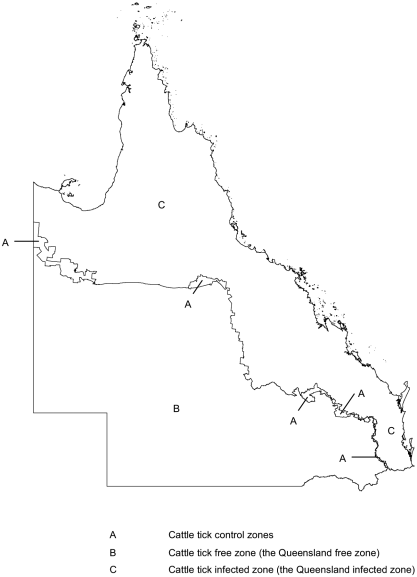
(1)The following zones described in the map called ‘Queensland Cattle Tick Zones’, held by the department are declared for the State—(a)the cattle tick free zone (the Queensland free zone);(b)cattle tick control zones (each called a Queensland control zone);(c)the cattle tick infected zone (the Queensland infected zone).For inspection of the map, see sections 62 and 63.(2)For section 13 of the Act—(a)the Queensland infected zone is an infected area in respect of cattle tick; and(b)any other zone is a declared area in respect of cattle tick.
6Map of Queensland zones—sch 1
As a guide, for illustrative purposes, schedule 1 contains, a map showing the approximate location of the boundaries of the zones declared under section 5.
Subject to sections 8 and 9, the chief inspector may decide a property in a Queensland control zone or the Queensland free zone has one of the following—(a)an infected status;(b)an at risk (high) status;(c)an at risk (low) status.
8Grounds for deciding infected status
The chief inspector may decide the property has an infected status only if—(a)stock on it are infected with cattle tick; or(b)the chief inspector reasonably believes it is infected with cattle tick; or(c)the chief inspector has found stock infected with cattle tick and, based on the age of the cattle ticks on the stock, the chief inspector reasonably believes or suspects the stock became infected on the property.
9Grounds for deciding at risk (high) or at risk (low) status
(1)The chief inspector can not decide the property has an at risk (high) or at risk (low) status if, under section 8, the chief inspector may decide the property has an infected status.(2)The chief inspector may decide the property has an at risk (high) status only if—(a)the chief inspector has carried out a cattle tick risk assessment for the property; and(b)because of the assessment, the chief inspector considers there is a high risk of cattle tick being on the property.(3)The chief inspector may decide the property has an at risk (low) status only if—(a)the chief inspector has carried out a cattle tick risk assessment for the property; and(b)because of the assessment, the chief inspector considers there is only a low risk of cattle tick being on the property.(4)A cattle tick risk assessment under this section may be oral or written.
(1)The chief inspector must, as soon as practicable after deciding the status of the property—(a)cause the status to be registered under section 62; and(b)give the owner of the property a written notice stating—(i)the status; and(ii)that the owner may, within a stated reasonable period, make written submissions to the chief inspector about the registered status.(2)The chief inspector must consider any written submissions made by the owner within the stated period.(3)If, because of the submissions, the chief inspector decides the actual status is different from its registered status, the chief inspector must cause the registered status to be amended to reflect the decision.(4)If the amended status is the same as a status proposed by the owner in the submissions, the chief inspector must give the owner written notice of the amended status.(5)If, after complying with subsections (2) to (4), the registered status is other than any status proposed by the owner in the submissions, the chief inspector must give the owner an information notice about the decision.For changes to information registered under section 10, see the Acts Interpretation Act 1954 , section 24AA (b).
11Stock movements requiring a travel permit
For section 21A (a) of the Act, a travel permit is required for all stock movements mentioned in this notice, other than a movement of stock—(a)into the Queensland free zone or a Queensland control zone from any infected zone if the requirements of part 4, division 2 are complied with in relation to the movement; or(b)from an infected zone if the movement is a direct conveyance through a control or free zone to an infected zone, using an approved route; orSee also section 40.(c)to or from an approved venue if all conditions of the approval for the approved venue are complied with; or(d)to or from an at risk (low) property if the stock are secondary host species for cattle tick.For paragraph (d), see sections 25 (3) and 32 (3).See also section 21 of the Act.
(1)This part imposes particular requirements for the inspection and treatment of stock to be moved into, within and out of the Queensland free zone and the Queensland control zones.(2)The requirements apply—(a)as well as any relevant requirements under part 5; and(b)subject to the exemptions under part 6.
The owner of stock may, without a travel permit, move them into a zone (the destination zone) that is the Queensland free zone or a Queensland control zone from an infected zone only if the following have been complied with in relation to the movement—(a)the requirements under this division;(b)any direction given under division 5.
14Preliminary treatment for primary host species
(1)If the stock are primary host species for cattle tick, before they leave the infected zone—(a)they must have preliminary treatment; and(b)their owner must sign a declaration (a preliminary treatment declaration) that they have had preliminary treatment.(2)The declaration must be in the approved form.
15Presentation of stock at clearing facility
(1)The drover of the stock must present them to a clearing facility in the infected zone.(2)However, the stock may be presented to a clearing facility in the destination zone if—(a)a travel permit for the movement provides that the stock may be presented to that clearing facility; or(b)the movement to the clearing facility is by way of direct conveyance, using an approved route.(3)The period between any preliminary treatment required under section 14 and the presentation must be, at a minimum—(a)4 days; or(b)if the chief inspector directs a longer period—the longer period.
16Presentation of preliminary treatment declaration
The drover must, while the stock are at the clearing facility, give an inspector or approved person the preliminary treatment declaration.
17Inspection and treatment at clearing facility
(1)At the clearing facility, the stock must have a clean inspection followed immediately by supervised treatment.(2)The drover must be given a certificate of inspection or treatment for the stock.See also part 5.
18Movement from clearing facility
(1)If the clearing facility is in the infected zone, the stock must leave the infected zone within the required period.(2)If the clearing facility is not in the infected zone the stock must leave the facility within the required period.(3)In this section—required period means—(a)24 hours after the supervised treatment; or(b)any longer period—(i)provided for under any travel permit for the movement or under the certificate of inspection mentioned in section 17; or(ii)decided by an inspector.
19Application and operation of div 3
This division applies to a person who proposes to move stock from a property in the Queensland free zone or a Queensland control zone to another place in that zone.
The person may move the stock from the property only if all required procedures under this division for the movement are carried out in relation to the stock.
21General requirements for place of required procedure
(1)A required procedure under this division must be carried out at a place decided by an inspector.(2)Unless an inspector otherwise decides, the person must ensure the stock are moved from the place within 24 hours after the required procedure has been carried out.
22Infected property undergoing approved program
For an infected property undergoing an approved program, the required procedure is a clean inspection followed immediately by supervised treatment.
23Infected property not undergoing approved program
(1)For an infected property not undergoing an approved program, the required procedure is—(a)a supervised preliminary treatment; and(b)a clean inspection followed immediately by supervised treatment.(2)The period between the preliminary treatment and when the stock are presented for the clean inspection and supervised treatment must be at least 4 days.
(1)This section applies if the property is an at risk (high) property.(2)For stock other than goats or sheep, the required procedure is a clean inspection followed immediately by supervised treatment.(3)For goats or sheep, the required procedure is a clean inspection.(4)However, a clean inspection is not required for goats or sheep in a consignment moved by direct conveyance to an accredited meatworks if—(a)at the meatworks, they are—(i)not mixed with consignments of other stock; and(ii)held in a hard standing area; and(b)the movement is for the purpose of slaughtering the goats or sheep at the meatworks, within 5 days after leaving the property.
(1)This section applies if the property is an at risk (low) property.(2)For primary host species for cattle tick, the required procedure is a clean inspection.(3)There is no required procedure for a movement of secondary host species for cattle tick.
This division applies to a person who proposes to move stock from a property in the Queensland free zone or a Queensland control zone outside that zone.
The person may move the stock from the property only if all required procedures under this division for the movement are carried out in relation to the stock.
28General requirements for place of required procedure
(1)A required procedure under this division must be carried out at a place decided by an inspector.(2)Unless an inspector otherwise decides, the person must ensure the stock are moved from the place within 24 hours after the required procedure has been carried out.
29Infected property undergoing approved program
(1)This section applies if the property is an infected property undergoing an approved program.(2)For stock moved by direct conveyance to an infected zone, the required procedure is a clean inspection.(3)However, a clean inspection is not required if an approved route is used for the conveyance.(4)For all other movements, the required procedure is a clean inspection followed immediately by supervised treatment.
30Infected property not undergoing approved program
(1)This section applies if the property is an infected property not undergoing an approved program.(2)For stock moved by direct conveyance from a Queensland control zone to an infected zone without passing through a free zone the required procedure is a clean inspection.(3)If—(a)the property adjoins an infected zone and is in a control zone; and(b)stock are moved from the property to the infected zone without passing through another part of the control zone;there is no required procedure for the movement.(4)For all other movements, the required procedure is—(a)a supervised preliminary treatment; and(b)a clean inspection followed immediately by a second supervised preliminary treatment.(5)The period between the preliminary treatment and when the stock are presented for the clean inspection and second supervised preliminary treatment must be at least 4 days.
(1)This section applies if the property is an at risk (high) property.(2)There is no required procedure for stock moved by direct conveyance to an infected zone.(3)For other movements of stock, other than goats or sheep, the required procedure is a clean inspection followed immediately by supervised treatment.(4)For other movements of goats or sheep, the required procedure is a clean inspection.(5)However, a clean inspection is not required for goats or sheep in a consignment moved by direct conveyance to an accredited meatworks if—(a)at the meatworks, they are—(i)not mixed with consignments of other stock; and(ii)held in a hard standing area; and(b)the movement is for the purpose of slaughtering the goats or sheep at the meatworks, within 5 days after leaving the property.
(1)This section applies if the property is an at risk (low) property.(2)For primary host species for cattle tick, the required procedure is a clean inspection.(3)There is no required procedure for a movement of secondary host species for cattle tick.
33Power to direct further preliminary treatment
(1)This division applies if—(a)under this notice, preliminary treatment must be given for the movement of stock; and(b)an inspector or approved person is not satisfied the stock are tick-free.(2)The inspector or approved person may direct the owner of the stock to give them a further preliminary treatment before they have an inspection required under this part.(3)Without limiting subsection (1), an inspector or approved person is taken to be not satisfied stock are tick-free if—(a)there has been a failure by the drover of the stock to comply with section 16 in relation to the stock; or(b)a preliminary treatment declaration in relation to the stock is presented under section 16 and—(i)the declaration does not comply with the approved form; or(ii)the preliminary treatment given to the stock is, in the inspector’s or approved person’s opinion, inadequate; or(iii)the declaration does not give enough detail of the preliminary treatment given to the stock to allow its effectiveness to be assessed.
(1)The direction—(a)may be oral or written; and(b)may be given after consultation with the owner of stock or on presentation of the stock to the inspector or approved person; and(c)must state—(i)that the stock must have further preliminary treatment; and(ii)where the treatment must be carried out.(2)If the direction is written, it must be accompanied by, or include, an information notice about the decision to give the direction.(3)If the direction is oral, the inspector or approved person must, as soon as practicable after giving the direction, give the owner of the stock an information notice about the decision to give the direction.
(1)An inspector or approved person may give the drover of travelling stock a certificate stating that, at a particular clearing facility, the stock underwent a stated type of inspection or treatment for their movement—(a)into the Queensland free zone or a Queensland control zone; or(b)from an infected property, at risk (high) property or at risk (low) property.(2)The certificate must be in the approved form.
36Drover’s obligation to produce certificate
(1)This section applies to the drover of travelling stock who has been given a certificate of inspection or treatment for a movement of the stock mentioned in section 35.(2)The drover must, unless the drover has a reasonable excuse, until the stock reach the final destination for which the stock are being moved—(a)have the certificate or a copy available for immediate inspection by an inspector; and(b)produce it to an inspector if the inspector asks the drover to produce it for inspection.(3)If, at the final destination, the drover delivers the stock to someone else (the consignee), the drover must give the consignee the certificate when the stock are delivered.
37Obligation of drover or consignee to keep and produce certificate
(1)This section applies to the following persons—(a)a consignee of stock to whom a drover has, under section 36 (3), given a certificate of inspection or treatment;(b)if a drover of travelling stock has been given a certificate of inspection or treatment for the movement of the stock and, at the final destination for which they are being moved, they are not delivered to anyone else—the drover.(2)A person to whom this section applies must keep the certificate for 2 years after the person received the certificate, unless the person has a reasonable excuse.(3)If, during the 2 years, an inspector asks the person for the certificate the person must give it to the inspector, unless the person has a reasonable excuse.(4)The inspector may keep the certificate to copy it.(5)However, the inspector must return the certificate as soon as practicable after copying it.
(1)This part provides for exemptions from particular inspection and treatment requirements under part 4 in relation to the movement of stock.(2)More than 1 of the exemptions may apply in relation to a particular movement.(3)The requirements for each of the exemptions are not affected by the requirements for the other exemptions.(4)Unless otherwise stated, the exemptions are from inspection or treatment, and if an exemption only applies to a particular inspection or treatment, all other relevant requirements of part 4 must still be complied with.
39Exemption from preliminary treatment for particular movements from infected property
(1)This section applies to a movement of stock from an infected property if the property is—(a)in the Queensland free zone or a Queensland control zone; and(b)undergoing an approved program.(2)The movement is exempt from preliminary treatment if—(a)the movement is—(i)a direct conveyance to an infected zone, using an approved route; or(ii)to an adjacent infected zone without passing through another property in the Queensland free zone or a Queensland control zone; or(b)a travel permit has been issued for the movement.
40Direct conveyance from and to an infected zone
A movement of stock from an infected zone is exempt if the movement is a direct conveyance through a control or free zone to a place in the same or another infected zone, using an approved route.
41Particular movements to an approved meatworks
(1)The chief inspector may approve a meatworks as an approved meatworks if it is an accredited meatworks and—(a)it is in the Queensland free zone or a Queensland control zone and has a hard standing area that allows stock held for slaughter to be held continuously in the area; or(b)it is in the Queensland infected zone; or(c)it is in another State and has been approved under a designated interstate arrangement.(2)The chief inspector may impose conditions on the approval.(3)A movement of stock to an approved meatworks is exempt if all conditions of the approval of the meatworks applying to the movement are complied with and at least 1 of the following applies—(a)the movement is a direct conveyance from an at risk (high) property or an at risk (low) property in a control or free zone;(b)the stock have, at any place, had a visually clean inspection and dipping or a clean inspection;(c)the movement is—(i)from an infected property that is in a control or free zone and is not undertaking an approved program; and(ii)the stock have, at any place, had a supervised treatment, followed (after at least 4 days but no more than 7 days) by a clean inspection;(d)the approved meatworks is in an infected zone, and the movement is a direct conveyance, using an approved route;(e)a travel permit has been given for the movement and all conditions of the permit have been complied with.(4)In this section—designated interstate arrangement means an arrangement between the chief inspector and an authority or official of another State whose functions under the other State’s laws include functions that are the same, or substantially the same, as the functions of the chief inspector.
42Particular movements to a controlled meatworks
(1)The chief inspector may approve a meatworks as a controlled meatworks if—(a)it is an accredited meatworks; and(b)the chief inspector is satisfied there is a low risk of cattle tick escaping from it to another holding.(2)The chief inspector may impose conditions on the approval.(3)A movement of stock to a controlled meatworks is exempt if—(a)they are from—(i)the Queensland infected zone; or(ii)an infected property undergoing an approved program, in a zone other than the Queensland infected zone; or(iii)an at risk (high) or at risk (low) property in any zone; and(b)if they are from an infected zone—the movement is a direct conveyance to the meatworks, using an approved route; and(c)from when they are unloaded at the meatworks they are held continuously in a hard standing area; and(d)they are, after their arrival at the meatworks, to be slaughtered within the next 5 days during which the meatworks is operational; and(e)all conditions of the approval of the meatworks applying to the movement are complied with.
43Particular movements from an approved feedlot
(1)The chief inspector may approve a feedlot for cattle, goats or sheep as an approved feedlot if—(a)the chief inspector is satisfied there is a low risk of stock in the feedlot being exposed to cattle tick; and(b)the feedlot is in the Queensland infected zone; and(c)if the feedlot is a cattle feedlot—it is an EPA licensed feedlot.(2)The chief inspector may impose conditions on the approval.(3)A movement of cattle from an approved feedlot is exempt if—(a)they have been kept in the approved feedlot for a continuous period of at least 35 days; and(b)the movement is a direct conveyance to an approved meatworks or controlled meatworks or a controlled saleyard; and(c)if the movement is to an approved meatworks or controlled meatworks and the meatworks is in another State—their movement in the other State complies with the other State’s laws; and(d)all conditions of the approval of the feedlot applying to the movement are complied with.(4)A movement of goats or sheep from an approved feedlot is exempt if—(a)they have been kept in the approved feedlot for a continuous period of at least 35 days; and(b)the movement is a direct conveyance to an accredited meatworks or, if they have, at any place, had a clean inspection, another place in the State; and(c)all conditions of the approval of the feedlot applying to the movement are complied with.
44Particular movements to a controlled cattle feedlot
(1)The chief inspector may approve an EPA licensed feedlot as a controlled cattle feedlot if the chief inspector is satisfied there is a low risk of cattle tick escaping from it.(2)The chief inspector may impose conditions on the approval.(3)A movement of stock to a class 1 controlled cattle feedlot is exempt if—(a)the property on which the feedlot is located—(i)is not an infected property; or(ii)is undergoing an approved program; and(b)if the stock are from an infected zone—they have, at any place, had an unsupervised plunge dipping before entering the feedlot; and(c)all conditions of the approval of the feedlot applying to the movement are complied with.(4)A movement of stock to a class 2 controlled cattle feedlot is exempt if—(a)the property on which the feedlot is located—(i)is not an infected property; or(ii)is undergoing an approved program; and(b)if the stock are from an infected zone—within 96 hours before entering the feedlot they have had a visually clean inspection and a supervised plunge dipping at a clearing facility; and(c)all conditions of the approval of the feedlot applying to the movement are complied with.(5)In this section—class 1 controlled cattle feedlot means a controlled cattle feedlot in a Queensland control zone.class 2 controlled cattle feedlot means a controlled cattle feedlot in the Queensland free zone.
45Particular movements from a controlled cattle feedlot
A movement of cattle from a controlled cattle feedlot is exempt if—(a)they have been kept in the controlled cattle feedlot for a continuous period of at least 35 days; and(b)the movement is a direct conveyance to an approved meatworks or controlled meatworks or a controlled saleyard; and(c)if the movement is to an approved meatworks or controlled meatworks and the meatworks is in another State—their movement in the other State complies with the other State’s laws; and(d)all conditions of the approval of the feedlot as a controlled cattle feedlot applying to the movement are complied with.
46Particular movements to a controlled saleyard
(1)The chief inspector may approve a saleyard as a controlled saleyard if the chief inspector is satisfied there is a low risk of cattle tick escaping from it to another holding.(2)The chief inspector may impose conditions on the approval.(3)A movement of stock to a controlled saleyard is exempt if—(a)the controlled saleyard is in a Queensland control zone or the Queensland free zone; and(b)all conditions of the approval of the saleyard applying to the movement are complied with.
47Particular movements of racehorses or trotting horses
A movement of racehorses or trotting horses is exempt if—(a)the movement is a direct conveyance to or from a racecourse for the purpose of racing or training; and(b)the total of the periods of the journeys to and from the racecourse and the period of the stay of the horses at the racecourse is 5 days or less.
48Particular movements of manageable, groomed primary host species
(1)This section applies to a movement of manageable, groomed stock that are primary host species for cattle tick if—(a)the movement is a direct conveyance to or from a scheduled competition event, from any of the following places (the place of origin)—(i)a place in an infected zone;(ii)an infected property undertaking an approved program in another zone;(iii)an at risk (high) property in any zone; and(b)the event is held outside an infected zone; and(c)the stock are returned to the place of origin within 3 days after leaving it.(2)The movement to the event is exempt from supervised treatment.(3)The movement from the event is exempt.
49Particular movements of manageable, groomed secondary host species
(1)This section applies to a movement of manageable, groomed stock that are secondary host species for cattle tick if—(a)the movement is a direct conveyance to or from a scheduled competition event from any of the following places (the place of origin)—(i)a place in an infected zone;(ii)an infected property undertaking an approved program in another zone;(iii)an at risk (high) property in any zone; and(b)the event is held outside an infected zone.(2)If the stock are returned to the place of origin within 5 days after leaving it, each of the movements is exempt.(3)If the stock are returned to the place of origin more than 5 but less than 15 days after leaving it—(a)the movement to the event is exempt from supervised treatment; and(b)the movement from the event is exempt.
50Exemption from supervised treatment for particular horses
(1)A movement of a manageable, groomed horse from an infected zone is exempt from supervised treatment if—(a)the movement is a direct conveyance to a Queensland control zone or the Queensland free zone; and(b)a veterinary surgeon has certified, by written notice to an inspector, that the horse will react adversely to chemical treatment; and(c)the horse is returned to the infected zone within 5 days after it enters the control zone or free zone.(2)A movement of an injured horse from an infected zone is exempt from supervised treatment if—(a)the movement is a direct conveyance to a veterinary clinic for treatment by a veterinary surgeon in a control zone or free zone; and(b)the horse is returned to the infected zone within 15 days after it enters the control zone or free zone.
(1)The chief inspector may approve a scheme based on measures to reduce the risk of spread of cattle tick.(2)The chief inspector may impose conditions on the approval.(3)A movement of stock is exempt if—(a)the scheme applies to them; and(b)they have been treated in accordance with the scheme; and(c)all conditions of the approval applying to the movement are complied with.
52Particular movements from at risk (low) property
A movement of stock from an at risk (low) property is exempt from a clean inspection if the movement is a direct conveyance to—(a)a place in an infected zone; or(b)an accredited meatworks; or(c)an EPA licensed feedlot.
53Particular movements to or from an approved venue
(1)The chief inspector may approve a place as an approved venue if—(a)the place is used by persons to compete, show, sell or train stock; and(b)the chief inspector is satisfied the use will only cause a minimal risk of spreading cattle tick.(2)The chief inspector may impose conditions on the approval.(3)A movement of stock to or from an approved venue is exempt if all conditions of the approval of the place applying to the movement are complied with.
54Movement of particular stock subject to non-chemical treatment
A movement of stock is exempt from a particular inspection or treatment if—(a)the movement is from a property in the Queensland infected zone; and(b)the chief inspector has approved a non-chemical treatment program for the stock for their exemption from the inspection or treatment; and(c)they have been treated in accordance with the program; and(d)the chief inspector is satisfied the movement does not pose a significant risk of spreading cattle tick.
55Particular movements between properties with same owners
(1)This section applies for a movement of stock from one property (the first property) to another (the second property) if—(a)the first property and second property are in the same zone and have the same owner; and(b)the movement is a direct conveyance, or by driving if the driving—(i)is completed as soon as practicable; and(ii)does not go through, or within 20m of, a property, other than the first or second property, that is an infected property.(2)If the first property is an at risk (high) property, the movement is exempt if the second property is—(a)an at risk (high) property; or(b)an infected property undergoing an approved program.(3)If the first property is an at risk (low) property, the movement is exempt if the second property is—(a)an at risk (low) property; or(b)an at risk (high) property; or(c)an infected property undergoing an approved program.
(1)Subject to section 58, the chief inspector, may on the application of any person, approve a type of stock movement to be—(a)exempt from any inspection and treatment requirement under part 4; or(b)subject to another less stringent form of inspection or treatment.(2)If the stock undergo the less stringent form of inspection or treatment under subsection (1) (b), they are, in relation to that type of movement, exempt from any inspection and treatment requirement under part 4.
57Requirements for application
An application under section 56 must—(a)be in the approved form; and(b)state—(i)the type of stock movement the subject of the application; and(ii)the type of approval sought under section 56; and(iii)the proposed period of the approval sought; and(iv)if the approval sought is for a less stringent form of inspection or treatment than that required under part 4—the inspection or treatment sought; and(c)demonstrate that, if the approval is granted, the risk of that type of stock movement spreading cattle tick will be minimal.
(1)The chief inspector may grant an approval under section 56 only if the chief inspector is satisfied the risk of the type of stock movement the subject of the approval spreading cattle tick will be minimal.Example of when the chief inspector may decide the risk is minimal—
the movement is a direct conveyance or to or from the Queensland infected zone or through a control or free zone to the Queensland infected zone, using an approved route(2)Otherwise, the chief inspector must refuse the approval.(3)The chief inspector may impose conditions that must be, or continue to, be complied with for the approval to continue in force.(4)If the chief inspector decides to refuse the approval, or to impose conditions on the approval, the chief inspector must give the applicant an information notice about the decision.
59Additional responsibility of prescribed person under Act, s 27
(1)This section applies to a prescribed person under section 27 of the Act if the notifiable disease is cattle tick.For when cattle tick is a notifiable disease, see schedule 6 of the Stock Regulation 1988.(2)The prescribed person must take all reasonable steps to ensure the stock and the property on which they are held undergo an approved program.
60Notice of particular decisions
(1)This section applies if the chief inspector decides that a place is—(a)an approved feedlot or controlled cattle feedlot; or(b)an approved meatworks or controlled meatworks;(c)an approved venue;(d)a controlled saleyard.(2)The chief inspector must give the owner of the place written notice of the decision.(3)If conditions, other than conditions agreed to by the owner, are imposed on the approval, the notice must be an information notice about the decision.
61Miscellaneous approvals by chief inspector
The chief inspector may—(a)approve a person to inspect or treat, or supervise the inspection or treatment of, stock for cattle tick; and(b)approve a program for the eradication or control of cattle tick; and(c)approve a railway or road for the movement of stock.
(1)The chief inspector must keep—(a)a register that contains the map mentioned in section 5; and(b)registers of the following—(i)approved chemicals;(ii)approved feedlots;(iii)approved meatworks;(iv)approved persons;(v)approved programs;(vi)approved routes;(vii)approved schemes under section 51;(viii)approved venues;(ix)at risk (high) properties;(x)at risk (low) properties;(xi)clearing facilities;(xii)controlled cattle feedlots;(xii)controlled meatworks;(xiv)controlled saleyards;(xv)infected properties in the Queensland free zone or a Queensland control zone;(xvi)approvals granted under section 56.(2)However, the register containing details of approved persons must not contain the persons’ residential addresses.(3)A register under subsection (1) containing details of anything approved by the chief inspector must contain all conditions of the approvals.(4)The chief inspector may also keep other registers for this notice that the chief inspector considers appropriate.
(1)The chief inspector must, for each register that the chief inspector may or must keep under section 62—(a)keep it open for inspection, free of charge, by members of the public, by appointment or the giving of reasonable written or oral notice, at the chief inspector’s office and at the office of each inspector; and(b)allow anyone, on payment of any fee requested, to take extracts from the register; and(c)give, on payment of any fee requested, anyone who asks for it, a copy of the register.(2)However, for information about a property in the registers containing details of at risk (high) properties, at risk (low) properties or infected properties, access under subsection (1) only applies if—(a)the person seeking the access is—(i)an owner of the property; or(ii)an owner of a controlled saleyard; or(iii)a chattel auctioneer under the Motor Dealers and Chattel Auctioneers Act 2014 or an auctioneer under the Property Occupations Act 2014 who has been appointed to sell livestock in connection with a real property auction; or(iv)carrying out functions under the Act, the Exotic Diseases in Animals Act 1981 or a law of another State or the Commonwealth that provides for the same or similar matters as any of the Acts; or(b)an owner of the property consents in writing; or(c)the access is expressly permitted or required under an Act.(3)A fee requested under subsection (1) must not be more than the actual cost of allowing the taking of the extract or giving the copy.s 63 amd 2014 SL No. 251 s 48 sch 2
64Evidentiary aids for registers
(1)This section applies to a proceeding under or relating to the Act.For offences about breaches of this regulation, see section 37 (1) (k) of the Act.(2)A certificate purporting to be signed by the chief inspector stating that a stated document is a copy of all or part of a register kept under section 62 on a stated day or during a stated period, is evidence of the matters stated in the document.
In this part—commencement means the day this notice commences.repealed notice means the repealed Stock (Cattle Tick) Notice 1993 .
On the commencement, a property that was, immediately before the commencement, an infected property under the repealed notice, becomes an infected property under this notice.
67First and second removed properties
(1)On the commencement, a property that was, immediately before the commencement, a first removed property under the repealed notice, becomes an at risk (high) property.(2)On the commencement, a property that was, immediately before the commencement, a second removed property under the repealed notice, becomes an at risk (low) property.
On the commencement, a low risk meatworks under the repealed notice becomes a controlled meatworks.
On the commencement, a low risk saleyard under the repealed notice becomes a controlled saleyard.
On the commencement, an approval under the repealed notice becomes an approval of its corresponding type under this notice.
71Existing dispensations and requirements under repealed notice, s 53
On the commencement—(a)a dispensation under section 53 (1) (a) of the repealed notice becomes an approval under section 56 (1) (a); and(b)a requirement under section 53 (1) (b) of the repealed notice becomes an approval under section 56 (1) (b).
The Stock (Cattle Tick) Notice 1993 SL No. 401 is repealed.
accredited meatworks means a meatworks operated by an entity holding an accreditation under the Food Production (Safety) Act 2000 authorising the holder to process meat at the meatworks.
approved chemical means a chemical product—
(a)registered by the Australian Pesticides and Veterinary Medicines Authority, established under the Agricultural and Veterinary Chemicals (Administration) Act 1992 (Cwlth); and
(b)approved, by the chief inspector, for the treatment of eligible species of stock to control or eradicate cattle tick.
approved feedlot see section 43 (1).
approved meatworks see section 41 (1).
approved person means a person approved under section 61 (a).
approved program means a program approved under section 61 (b).
approved route means a railway or road approved under section 61 (c).
approved venue see section 53 (1).
at risk (high) property means a property that, under part 2, division 2, is decided to have an at risk (high) status.
at risk (low) property means a property that, under part 2, division 2, is decided to have an at risk (low) status.
Australian standard definitions and rules, means the document called ‘Cattle Tick Control in Australia Standard Definitions and Rules’, published by the Primary Industries Standing Committee in August 2000.
A copy of the document is available for inspection during office hours on business days at the department’s office at 80 Ann Street, Brisbane.
cattle tick means the disease cattle tick Boophilus microplus infestation.
certificate of inspection or treatment means a certificate given under section 35.
clean inspection, of stock, means a manual inspection of the stock by an inspector or approved person that satisfies the inspector or approved person that all of them can reasonably be expected to be tick-free.
clearing facility means a place approved by the chief inspector at which stock are inspected or treated as a way of ensuring they are tick-free.
controlled cattle feedlot see section 44 (1).
controlled meatworks see section 42 (1).
controlled saleyard see section 46 (1).
control zone means—
(a)any Queensland control zone; or
(b)an area declared or provided for under a law of another State to be a control zone for cattle tick.
destination zone, for part 4, division 2, see section 13.
dipping, for stock, means plunge dipping them in an approved chemical.
direct conveyance, for the movement of stock, means conveying them to their destination—
(a)by the most practical direct route; and
(b)without loading or unloading any of them.
EPA licensed feedlot means a feedlot, constructed and operated under a development approval under the Sustainable Planning Act 2009 , for the environmentally relevant activity under the Environmental Protection Act 1994 of intensive animal feedlotting.
See the Environmental Protection Regulation 2008 , schedule 2, section 2.
def EPA licensed feedlot amd 2008 SL No. 370 s 160 sch 11; 2009 SL No. 280 s 131
free zone means—
(a)the Queensland free zone; or
(b)an area declared or provided for under a law of another State to be a free zone for cattle tick.
hard standing area means a holding area for stock that—
(a)prevents stock from escaping; and
(b)has a floor made of asphalt, compacted gravel, concrete, paving or another hard material; and
(c)is free of grass or other vegetation; and
(d)is drained in a way that prevents cattle tick from escaping to other holding areas for stock.
infected property means a property that, under part 2, division 2, is decided to have an infected status.
infected zone means—
(a)the Queensland infected zone; or
(b)an area declared or provided for under a law of another State to be an infected zone for cattle tick.
information notice ...
def information notice om 2009 Act No. 24 s 788
manageable, groomed, for stock, means—
(a)that the stock can, for inspection and treatment, be reasonably expected to be capable of being led and restrained to the satisfaction of an inspector or approved person; and
(b)that the stock have been groomed daily for at least 7 days before presentation to an inspector or approved person.
preliminary treatment, for stock, means doing any of the following that can reasonably be expected to ensure they are tick-free when presented to an inspector or approved person—
(a)dipping, spraying or other treatment with an approved chemical;
(b)an approved non-chemical treatment.
preliminary treatment declaration see section 14 (1) (b).
primary host species, for cattle tick, see section 3 (1) (a).
property means a parcel or parcels of land, managed as one unit to graze stock.
Queensland control zone see section 5 (1) (b).
Queensland free zone see section 5 (1) (a).
Queensland infected zone see section 5 (1) (c).
scheduled competition event means an event—
(a)organised by the governing body of an incorporated or unincorporated association, body or club; and
(b)during which persons show stock or compete or train using stock; and
(c)for which records are kept of all persons mentioned in paragraph (b).
secondary host species, for cattle tick, see section 3 (1) (b).
supervised means supervised or carried out by an inspector or approved person.
tick-free means free of cattle tick.
treatment, of stock moved or to be moved, means doing any of the following to them and all other stock with which they were or are to be moved, to the satisfaction of an inspector or approved person—
(a)dipping, spraying or other treatment with an approved chemical;
(b)an approved non-chemical treatment.
veterinary surgeon means a veterinary surgeon under the Veterinary Surgeons Act 1936 .
visually clean inspection, of stock, means a visual inspection of the stock by an inspector or approved person during which no cattle tick are sighted by the inspector or approved person.
zone, without reference to any particular zone or type of zone, means any control zone, free zone or infected zone.