




An Act to amend the Brisbane Olympic and Paralympic Games Arrangements Act 2021, the Building and Construction Industry (Portable Long Service Leave) Act 1991, the Community Services Industry (Portable Long Service Leave) Act 2020, the Contract Cleaning Industry (Portable Long Service Leave) Act 2005, the Industrial Relations Act 2016, the Planning and Environment Court Act 2016, the Workers’ Compensation and Rehabilitation Act 2003 and the Workers’ Compensation and Rehabilitation Regulation 2025 for particular purposes
The Parliament of Queensland enacts—
This Act may be cited as the Industrial Relations and Other Legislation Amendment Act 2026.
(1)The following provisions commence on 1 January 2027—(a)section 135;(b)section 138;(c)section 153;(d)section 175;(e)section 176;(f)section 177;(g)section 178;(h)section 181, to the extent it inserts chapter 40, part 6;(i)section 182(1), to the extent it inserts definition claims history summary.(2)The following provisions commence on a day to be fixed by proclamation—(a)section 95;(b)section 98;(c)section 99;(d)section 136;(e)section 137;(f)section 141;(g)section 143;(h)section 145;(i)section 146;(j)section 147;(k)section 181, to the extent it inserts chapter 40, parts 3 and 5;(l)section 182(1), to the extent it inserts definitions relevant register and relevant specialist;(m)section 182(4).
Part 2 Amendment of Brisbane Olympic and Paralympic Games Arrangements Act 2021
This part amends the Brisbane Olympic and Paralympic Games Arrangements Act 2021.
After section 53DF—
insert—53DFAA Application of liquor legislation in relation to music from relevant venues
(1)This section applies if—(a)an authority venue or other venue is listed in schedule 4AA (a relevant venue); and(b)a licence relates to premises comprising all or part of the relevant venue; and(c)the relevant venue is being used for a games-related use or legacy use.(2)If the licence is subject to a condition about noise coming from the premises, the condition does not apply in relation to noise from amplified music played at the premises.(3)The Liquor Act 1992, sections 46, 46A and 187 do not apply in relation to noise from amplified music played at the premises.(4)This section applies despite the Liquor Act 1992.(5)In this section—licence means a licence under the Liquor Act 1992.
5Amendment of ch 3A, pt 2A, div 2, hdg (Vesting of land)
Chapter 3A, part 2A, division 2, heading, after ‘land’—
insert—in authority
6Insertion of new ch 3A, pt 2A, div 2A
Chapter 3A, part 2A—
insert—53DFEA Definitions for division
In this division—arena-related land means the land comprising part of lot 1291 on SP149280 that is identified as ‘new lot area’ on the plan shown in schedule 4AB.remainder of lot 1291 means the land comprising lot 1291 on SP149280 other than the arena-related land.53DFEB Lodgement of plan of survey for lot 1291 on SP149280
(1)The chief executive must ensure the following documents are lodged before 31 December 2026—(a)a plan of survey of—(i)the arena-related land; and(ii)the remainder of lot 1291;(b)a written notice (a vesting notice) stating that the lot created under this section for the arena-related land is to be recorded in the freehold land register as vested in the cross river rail authority under section 53DFEC.(2)The plan of survey must—(a)generally correspond with the plan shown in schedule 4AB to the extent the plan identifies the arena-related land; and(b)define the arena-related land as 1 lot for the purposes of the Land Title Act; and(c)define the remainder of lot 1291 as 1 lot for the purposes of the Land Act; and(d)comply with the Survey and Mapping Infrastructure Act 2003; and(e)be certified as accurate by a cadastral surveyor within the meaning of the Surveyors Act 2003.(3)Despite any other Act or law, if a plan of survey and vesting notice are lodged in accordance with this section—(a)the lot defined in the plan for the arena-related land is created as a separate lot under the Land Title Act; and(b)the lot defined in the plan for the remainder of lot 1291 is created as a separate lot under the Land Act; and(c)the registrar of titles must, as soon as practicable after the lodgement of the plan, record the particulars of the plan in the freehold land register and the appropriate register under the Land Act; and(d)no fee is payable for—(i)the lodgement of the plan or vesting notice; or(ii)the recording of the particulars mentioned in paragraph (c).53DFEC Vesting of new lot for arena-related land in Cross River Rail Delivery Authority
(1)This section applies in relation to the lot under the Land Title Act that is created for the arena-related land under section 53DFEB(3)(a).(2)Immediately after the lot is created, the lot is vested in the cross river rail authority as an estate in fee simple subject to any Land Act reservations for the land.(3)Sections 53DFF and 53DFG apply in relation to the lot as if—(a)the lot were schedule 4A land; and(b)the lot were vested under division 2; and(c)a reference in section 53DFF to a preserved interest did not apply; and(d)a reference in section 53DFF to a Land Act reservation for the land were a reference to a Land Act reservation within the meaning of this section; and(e)the vesting day for the lot were the day the lot vests in the cross river rail authority under subsection (2); and(f)the reference in section 53DFF(5) to the authority were a reference to the cross river rail authority.(4)Also, on the vesting of the lot under subsection (2), any declaration of the arena-related land as a State-controlled road or motorway under the Transport Infrastructure Act 1994 is revoked.(5)Subsection (4) applies despite any requirement that would otherwise apply under the Transport Infrastructure Act 1994 in relation to the revocation of the declaration.(6)In this section—cross river rail authority means the Cross River Rail Delivery Authority established under the Cross River Rail Delivery Authority Act 2016, section 8.Land Act reservation, for the land comprising the lot under the Land Title Act created for the arena-related land under section 53DFEB(3)(a), means a reservation or condition that—(a)is mentioned in the Land Act, section 21; and(b)would have applied in relation to the land if, instead of vesting under this part, a deed of grant had been issued under the Land Act for the land.53DFED Effect of creation of new lot for remainder of lot 1291
(1)This section applies in relation to the lot created under the Land Act for the remainder of lot 1291 under section 53DFEB(3)(b).(2)The land comprising the lot continues to be dedicated as a reserve under the Land Act on the same terms as the dedication of the land as a reserve immediately before the lot was created.(3)For the purposes of the Land Act, section 31A, the boundaries of the reserve mentioned in subsection (2) are changed, on lodgement of the plan of survey under section 53DFEB(1), to exclude the arena-related land.(4)A declaration of the remainder of lot 1291 as a State-controlled road or motorway in effect under the Transport Infrastructure Act 1994 immediately before the lot was created continues for the lot.
7Amendment of sch 2 (Other venues)
Schedule 2, part 1, section 1, definition arena land, paragraph (d)—
omit, insert—(d)either—(i)if a lot has vested in the cross river rail authority under section 53DFEC—the lot; orSee section 53DFEB in relation to the creation of a lot under the Land Title Act for the arena-related land within the meaning of section 53DFEA.(ii)otherwise—lot 1291 on SP149280.
8Insertion of new schs 4AA and 4AB
After schedule 4—
insert—section 53DFAA
Authority venues•a facility known as the Sunshine Coast Stadium located at 320 Nicklin Way, Bokarina 4575•a facility known as the Toowoomba Showgrounds located at Harvey Road, Glenvale 4350•a facility known as Barlow Park Stadium located on land bounded by Scott Street, Spence Street and Severin Street, Parramatta Park 4870Other venues
•a facility to be known as the Gabba Arena located on the arena land within the meaning of schedule 2, part 1, section 1section 53DFEA, definition arena-related land
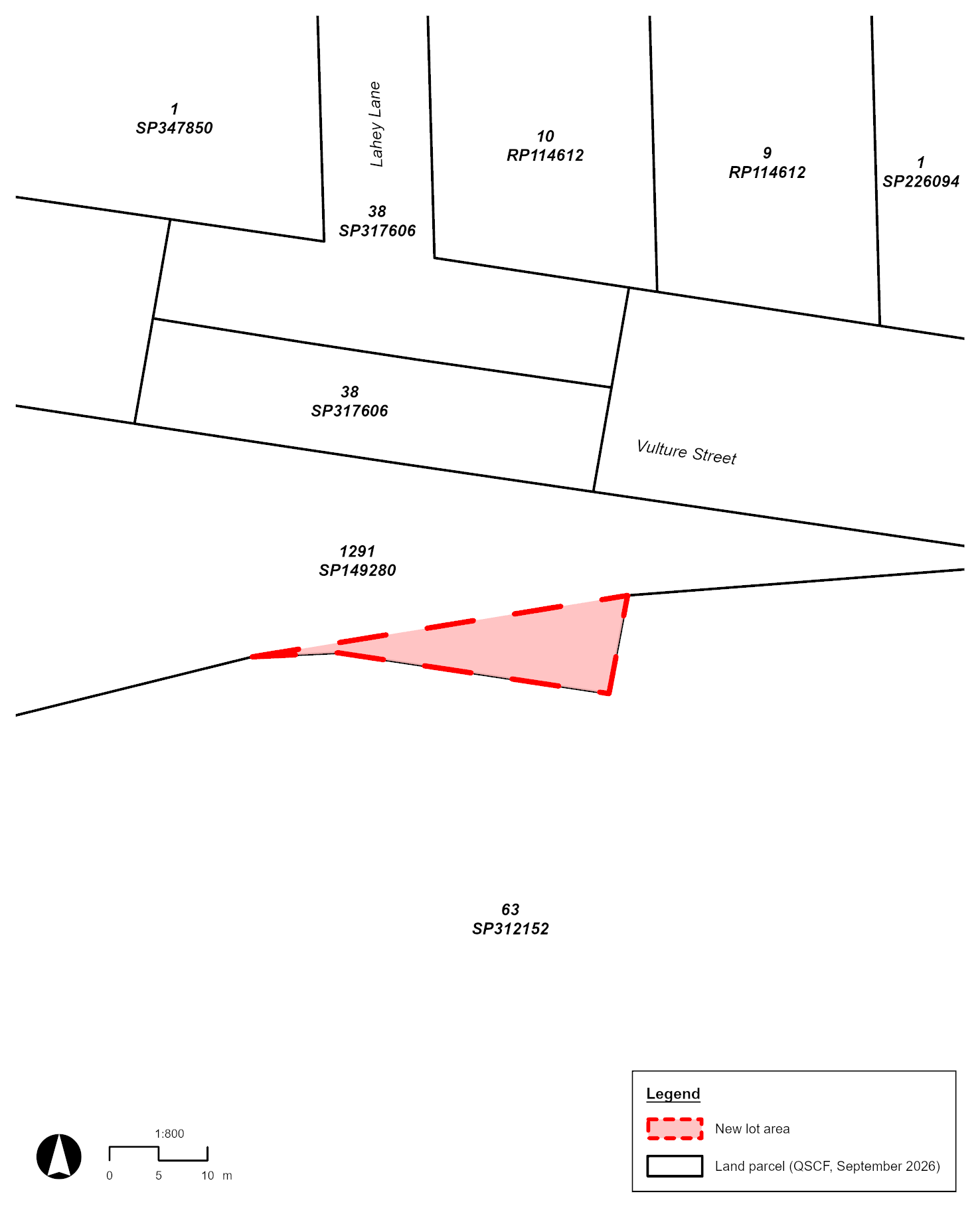
9Amendment of sch 4A, hdg (Vesting of particular land)
Schedule 4A, heading, after ‘land’—
insert—in authority
10Amendment of sch 6 (Dictionary)
Schedule 6—
insert—arena-related land, for chapter 3A, part 2A, division 2A, see section 53DFEA.remainder of lot 1291, for chapter 3A, part 2A, division 2A, see section 53DFEA.
Part 3 Amendment of Building and Construction Industry (Portable Long Service Leave) Act 1991
This part amends the Building and Construction Industry (Portable Long Service Leave) Act 1991.
12Amendment of s 56 (Application for entitlement to long service leave or payment instead of long service leave)
(1)Section 56(3), ‘paid all’—
omit, insert—paid for all
(2)Section 56(3)(b)—
omit, insert—(b)the worker and the authority agree, by signed agreement, that the worker be paid for all or part of the entitlement.
Part 4 Amendment of Community Services Industry (Portable Long Service Leave) Act 2020
This part amends the Community Services Industry (Portable Long Service Leave) Act 2020.
14Amendment of s 52 (Cancellation of registration)
Section 52(1)(d) and (2), ‘section 72(4)’—
omit, insert—section 72(3)
15Amendment of s 72 (Application for long service leave entitlement by registered worker)
(1)Section 72(2) and (3)—
omit, insert—(2)A registered worker may be paid for all or part of the registered worker’s long service leave entitlement, without taking long service leave, only if—(a)either or both of the following apply—(i)an industrial instrument provides for the registered worker to be paid instead of taking the long service leave;(ii)the registered worker has accrued 2,555 days of service in the register of workers; and(b)the registered worker has entered into a written agreement with each of the following entities to be paid for all or part of the entitlement—(i)the authority;(ii)the registered worker’s employer.(2)Section 72(5) and (6), ‘or (4)’—
omit, insert—or (3)
(3)Section 72(4) to (6)—
renumber as section 72(3) to (5).
Part 5 Amendment of Contract Cleaning Industry (Portable Long Service Leave) Act 2005
This part amends the Contract Cleaning Industry (Portable Long Service Leave) Act 2005.
17Amendment of s 71 (Application for long service leave entitlement)
(1)Section 71(2) and (3)—
omit, insert—(2)A registered worker may be paid for all or part of the registered worker’s long service leave entitlement, without taking long service leave, only if—(a)either or both of the following apply—(i)an industrial instrument provides for the registered worker to be paid instead of taking the long service leave;(ii)the registered worker has accrued 3,650 days of service in the register of workers; and(b)the registered worker has entered into a signed agreement with the authority to be paid for all or part of the entitlement.(2)Section 71(6), ‘or (4)’—
omit, insert—or (3)
(3)Section 71(4) to (6)—
renumber as section 71(3) to (5).
Part 6 Amendment of Industrial Relations Act 2016
This part amends the Industrial Relations Act 2016.
19Amendment of s 3 (Main purpose of Act)
Section 3—
insert—(c)encourages productivity in workplaces and supports fair wages and employment conditions.
20Amendment of s 9 (What is an industrial matter)
(1)Section 9—
insert—(2A)Also, a matter is not an industrial matter if it affects or relates to a conversion decision under the Public Sector Act 2022, section 129.(2)Section 9(3), after ‘subsection (2)’—
insert—or (3)
(3)Section 9(2A) and (3)—
renumber as section 9(3) and (4).
21Amendment of s 110 (Payment instead of long service leave)
(1)Section 110(3), from ‘only if’—
omit, insert—only if the employee and employer agree by a signed agreement the payment may be made.
(2)Section 110(4)—
omit.(3)Section 110(5) and (6)—
renumber as section 110(4) and (5).
Sections 145 and 146—
omit.
23Amendment of s 163 (Purpose of chapter)
(1)Section 163(b), from ‘provide for’—
omit, insert—provide for—
(i)the commission to help the parties reach agreement or, if agreement can not be reached, to reduce the matters in dispute; and(ii)the matter to be arbitrated by the commission if conciliation is not successful; and(iii)the balloting of employees by the employer in particular circumstances despite 1 or more negotiating parties not reaching agreement; and(2)Section 163—
insert—(ca)to enable the employer to apply to the commission, in particular circumstances, for certification of an agreement approved by a majority of relevant employees despite 1 or more negotiating parties not reaching agreement; and(3)Section 163(ca) and (d)—
renumber as section 163(d) and (e).
24Amendment of s 165 (Who may make certified agreements)
Section 165(b)(i)—
insert—See also section 174A in relation to direct ballot agreements and employee organisations that are non-approving parties.
25Amendment of s 168 (Definitions for chapter)
Section 168—
insert—direct ballot agreement see section 174A(3).non-approving party, in relation to a direct ballot agreement, see section 174A(5).
After section 170—
insert—170A Relevant employee’s entitlement to representation
(1)This section applies if, during negotiations under this chapter, a relevant employee asks a relevant employee organisation of which the employee is a member to represent the employee in negotiating with the employer about the proposed bargaining instrument.(2)The employer must give the employee organisation a reasonable opportunity to represent the relevant employee in the negotiations before—(a)for a proposed agreement—the agreement is made; or(b)for a proposed bargaining award—an application is made under part 5 for the making of the bargaining award.(3)Subsection (2) stops applying if, after the request mentioned in subsection (1) is made—(a)the relevant employee withdraws the request; or(b)the employee stops being a relevant employee.See also section 242 in relation to certificates about requested representation.
27Amendment of s 171 (Proposed bargaining instrument to be given to employees for approval)
(1)Section 171—
insert—(1A)Also, this section applies if—(a)negotiations under this chapter relate to a proposed agreement, other than an excluded instrument, between an employer and 1 or more employee organisations; and(b)the employer—(i)has reached agreement with at least 1 employee organisation but can not reach agreement with any of the other negotiating parties; and(ii)wishes to proceed with the proposed agreement despite not reaching agreement with all of the negotiating parties.(2)Section 171(2)(c), from ‘employee may’ to ‘the agreement’—
omit, insert—employee may make a request mentioned in section 170A(1)
(3)Section 171(2), note—
omit.(4)Section 171(3)—
omit, insert—(3)The employer must not ask relevant employees to approve the proposed instrument until—(a)if subsection (1A) applies—the day that is 28 days after the day the peace obligation period ended; or(b)otherwise—the day that is 21 days after the later of the following—(i)the day the notice of intention for the negotiations was given;(ii)the day a scope order in relation to the proposed instrument came into effect.(3A)Also, the employer must not ask relevant employees to approve the proposed bargaining instrument in the circumstances mentioned in subsection (1A) after arbitration of the instrument starts.(5)Section 171(4) and (5)—
omit.(6)Section 171(3A) to (9)—
renumber as section 171(4) to (8).
28Amendment of s 173 (Parties must negotiate in good faith)
(1)Section 173—
insert—(4A)Subsection (1) does not require a negotiating party—(a)to make concessions during the negotiations; or(b)to reach agreement on the terms of a proposed bargaining instrument.(4B)If the employer asks the relevant employees to approve a proposed agreement in the circumstances mentioned in section 171(1A), the making of the request does not, of itself, contravene the requirement to negotiate in good faith.(2)Section 173(5), ‘subsections (1) and (2)’—
omit, insert—subsections (1) to (6)
(3)Section 173(4A) to (5)—
renumber as section 173(5) to (7).
29Amendment of s 174 (Peace obligation period to assist negotiations)
(1)Section 174—
insert—(1A)Also, during the peace obligation period the employer can not ask the relevant employees to approve a proposed agreement in the circumstances mentioned in section 171(1A).See also section 171(3).(2)Section 174(2), definition peace obligation period, paragraph (a)—
omit, insert—(a)starting on either—(i)the day the notice of intention for the negotiations is given; or(ii)if a scope order for a proposed bargaining instrument comes into operation and the instrument is a scoped out instrument—the day stated in an order under section 187A(2); and(3)Section 174(2)—
insert—scoped out instrument see section 187A.
After section 174—
insert—(1)This section applies, during negotiations under this chapter for an agreement with 1 or more employee organisations, if—(a)the employer asks relevant employees to approve the agreement in the circumstances mentioned in section 171(1A); and(b)the agreement is approved by a valid majority of the relevant employees at the time in a properly conducted ballot; and(c)at least 7 days before a part 5 application to certify the agreement is made, the employer gives each employee organisation that is a negotiating party an election invitation.(2)An employee organisation mentioned in subsection (1)(c) may, by written notice given to the employer before the part 5 application is made, elect—(a)to agree on the terms of the agreement; or(b)to withdraw as a party to the agreement.(3)The agreement is a direct ballot agreement if at least 1 of the employee organisations elects to agree on the terms of the agreement under subsection (2)(a).(4)If an employee organisation elects to withdraw as a party to the agreement under subsection (2)(b), the organisation must give a copy of the notice to—(a)the commission; and(b)each other negotiating party.(5)If an employee organisation does not make an election under subsection (2), the organisation is a non-approving party in relation to the agreement.A non-approving party is covered by the direct ballot agreement—see section 221(2).(6)The direct ballot agreement does not cover an employee organisation that elects to withdraw as a party to the agreement under subsection (2)(b).(7)In this section—election invitation means a written notice stating—(a)that the agreement has been approved by a valid majority of the relevant employees at the time in a properly conducted ballot; and(b)each employee organisation that is a negotiating party may, before a part 5 application to certify the agreement is made, elect—(i)to agree on the terms of the agreement; or(ii)to withdraw as a party to the agreement; and(c)how an employee organisation may make the election; and(d)if an employee organisation does not make the election—that the employee organisation will be a non-approving party in relation to the agreement.
31Amendment of s 175 (Application of division)
(1)Section 175(1)(a) and (b)—
omit, insert—(a)both of the following periods have ended—(i)the peace obligation period;(ii)the period of 28 days after the last day of the peace obligation period; and(b)a negotiating party asks the commission to help the negotiating parties reach agreement by giving written notice of the request to—(i)the commission; and(ii)each other negotiating party.(2)Section 175—
insert—(3)For this Act, the day conciliation of the matter starts is the day the request mentioned in subsection (1)(b) is given.(3)Section 175—
insert—Industrial action organised, or engaged in, while the commission is conciliating the matter under this division is not protected industrial action—see section 234.
32Amendment of s 176 (Commission’s role in conciliation)
(1)Section 176(4)—
omit.(2)Section 176(5)—
renumber as section 176(4).
After section 176—
insert—176A Direct ballot may be conducted during conciliation
(1)This section applies if the negotiations relate to a proposed agreement between an employer and 1 or more employee organisations.(2)Subject to subsection (3), the employer may ask the relevant employees to approve the proposed agreement in the circumstances mentioned in section 171(1A) during conciliation of the matter.(3)Before making the request, the employer must give written notice of the proposed request to the commissioner conciliating the matter.
34Amendment of s 177 (Referral to arbitration by conciliating member)
(1)Section 177(1)(b)—
omit, insert—(b)the conciliating member is satisfied—(i)the period of 3 months after the nominal expiry date of an existing bargaining instrument or arbitration determination that applies to the parties has ended; or(ii)at any time after the day conciliation of the matter starts, there is no reasonable likelihood that further conciliation or negotiation will result in the negotiating parties reaching agreement on the matters at issue within a reasonable period.(2)Section 177—
insert—(1A)For subsection (1)(b)(ii), the conciliating member must consider the views of the negotiating parties in deciding whether there is no reasonable likelihood that further conciliation or negotiation will result in the negotiating parties reaching agreement on the matters at issue within a reasonable period.(3)Section 177(4)—
omit.
35Amendment of s 178 (Consent application for arbitration)
Section 178(5), examples, third dot point, ‘173(5)’—
omit, insert—173(7)
36Amendment of s 180 (Commission to arbitrate disputed matters)
(1)Section 180(2), note—
omit.(2)Section 180(4)—
omit, insert—(4)In determining the matters in dispute, the commission must consider at least the following—(a)the merits of the case;(b)the interests of the employees and employers to whom the proposed arbitration determination will apply;(c)the significance to the employees or employers of particular terms of an existing bargaining instrument or arbitration determination;(d)the public interest, including the effect of the proposed arbitration determination on the delivery of public services;(e)the extent to which the proposed arbitration determination will support workplace productivity;(f)for a matter involving a public sector employer—(i)the likely effect of the proposed arbitration determination on the State’s economy and the community; and(ii)the State’s financial position and fiscal strategy; and(iii)the financial position of the public sector employer;(g)the extent to which the conduct of the negotiating parties was reasonable during the negotiations;(h)the extent to which the negotiating parties have complied with the requirement under section 173 to negotiate in good faith;(i)incentives to continue to negotiate at a later time.(5)In this section—public sector employer see the Fair Work (Commonwealth Powers) and Other Provisions Act 2009, section 3(1).
37Amendment of s 185 (Making scope orders)
(1)Section 185—
insert—(2A)Without limiting subsection (1)(d), the commission may be satisfied that making the scope order is reasonable in all the circumstances only if satisfied the order—(a)will promote the fair and efficient conduct of the negotiations; and(b)will not adversely affect the business or operational needs of any employer to be covered by the proposed bargaining instrument, having regard to—(i)the nature of the work performed by the group of employees mentioned in subsection (1)(c); and(ii)the likely financial effects of the order on the employer, including effects on productivity.(2)Section 185(2A) and (3)—
renumber as section 185(3) and (4).
After section 187—
insert—187A Order to be made about peace obligation period in particular circumstances
(1)This section applies if—(a)the commission makes a scope order in relation to a proposed bargaining instrument (the scoped out instrument); and(b)the employees stated in the order—(i)comprise some, but not all, of the employees in relation to whom the notice of intention for the negotiations was given; and(ii)because of the scope order, will not be covered by the proposed bargaining instrument that was the subject of the notice of intention.(2)The commission must make an order about the starting day of the peace obligation period for the scoped out instrument.(3)For subsection (2), the starting day must be—(a)if the commission considers it is appropriate to enable the parties to the scoped out instrument to reach agreement about the matters being negotiated after the scope order comes into operation—the day after the day the scope order comes into operation; or(b)otherwise—the day the notice of intention mentioned in subsection (1)(b) was given.(4)This section does not limit section 187.
39Amendment of s 189 (Application for certification of agreement)
(1)Section 189(2)(a)—
omit, insert—(a)either—(i)all parties have agreed on the terms of the agreement; or(ii)the agreement is a direct ballot agreement and all parties other than non-approving parties have agreed on the terms of the agreement; and(2)Section 189(3), after ‘all the parties,’—
insert—other than a non-approving party in relation to a direct ballot agreement,
After section 189—
insert—189A Commission may make order simplifying application process
(1)The commission may, on an application by a party to an agreement, make an order providing for a form requirement to be taken to be satisfied for the purposes of an application to certify the agreement.(2)The order is subject to any conditions stated in it.(3)For subsection (1), a form requirement is a requirement under this part about the form in which information about the agreement must be provided to the commission.Example of a requirement about the form in which information must be provided—
a requirement for the information to be given to the commission by an affidavit or using an approved form(4)Despite subsection (1), the commission may make an order under this section only if satisfied—(a)none of the parties to the agreement objects to the making of the order; and(b)if the order is complied with, the commission will be sufficiently informed to enable it to certify the agreement.
41Amendment of s 192 (Entities that may be heard on application)
Section 192(1), after ‘instrument’—
insert—, including because the organisation is a non-approving party in relation to a direct ballot agreement
42Amendment of s 195 (Compliance with bargaining process requirements)
(1)Section 195(a), after ‘169,’—
insert—170A,
(2)Section 195(b)(i), ‘171(2)(c)’—
omit, insert—170A(1)
43Amendment of s 196 (Proposed bargaining instrument to be in writing and signed by parties)
(1)Section 196—
insert—(2A)Also, subsection (1)(b) does not apply if the commission is satisfied that—(a)the proposed bargaining instrument is a direct ballot agreement; and(b)all parties other than non-approving parties have—(i)signed the agreement; or(ii)agreed on the terms of the agreement; and(c)the part 5 application—(i)was made within a reasonable time after the agreement was approved by a valid majority of the relevant employees at the time in a properly conducted ballot; and(ii)identifies which of the parties are non-approving parties.(2)Section 196(3), from ‘subsection (2)’ to ‘all parties’—
omit, insert—subsections (2) and (3), in deciding whether all parties, other than non-approving parties in relation to a direct ballot agreement,
(3)Section 196—
insert—(4)To remove any doubt, it is declared that a party may sign the proposed bargaining instrument by electronic signature.(4)Section 196(2A) to (4)—
renumber as section 196(3) to (5).
44Amendment of s 200 (Agreements—requirements about parties)
Section 200(2)—
insert—(c)for a direct ballot agreement—has withdrawn as a party to the agreement under section 174A(2)(b).
45Amendment of s 221 (Who is covered by a bargaining instrument)
Section 221(2)(a)—
omit, insert—(a)either—(i)the instrument is made with the organisation; or(ii)the instrument is a direct ballot agreement and the organisation is a non-approving party; or
46Amendment of s 223 (Extension of nominal expiry date)
Section 223(1)(a), ‘the 1 or more’—
omit, insert—1 or more of the
47Amendment of s 225 (Amendment on application)
Section 225(1)(a), ‘and the organisations’—
omit, insert—and 1 or more of the organisations
48Amendment of s 233 (When industrial action is protected industrial action)
(1)Section 233(6)—
omit.(2)Section 233(7)—
renumber as section 233(6).
49Amendment of s 234 (When industrial action is not protected industrial action)
(1)Section 234(1)—
insert—(c)during conciliation or arbitration for the proposed instrument; or(d)after a part 5 application has been made by a negotiating party in relation to the proposed instrument; or(e)while an order of the commission suspending the industrial action is in effect under division 4; or(f)if the industrial action has been terminated by an order of the commission under division 4 or a declaration by the Minister under division 5.(2)Section 234(2)—
omit.(3)Section 234(3), ‘subsection (1) or (2)’—
omit, insert—subsection (1)
(4)Section 234(3)—
renumber as section 234(2).
50Amendment of s 236 (Notice of industrial action must be given)
Section 236(1), from ‘instrument—’—
omit, insert—instrument at least 3 working days before the day the intended action starts.
51Amendment of s 238 (Employer must not prejudice employee for engaging in protected industrial action)
Section 238(2)(b)—
omit, insert—(b)refusing to pay the employee, or reducing payments made to the employee under division 3A;
52Insertion of new ch 4, pt 8, div 3A
Chapter 4, part 8—
insert—(1)This division applies in relation to the payment of wages, allowances and remuneration by an employer to an employee who engages in protected industrial action.(2)This division is not intended to prevent an employer refusing, as permitted under the common law, to pay an employee because the employee has failed or refused to perform work, whether fully or partially.239B Protected industrial action for which employee not entitled to payment
(1)This section applies if an employee engages in protected industrial action that involves—(a)a failure or refusal by the employee to attend for work; or(b)a failure or refusal by the employee who attends for work to perform any work at all.(2)The employee is not entitled to be paid for any day during the period of the protected industrial action.239C Protected industrial action for which employer may reduce payment
(1)This section applies if an employee engages in, or proposes to engage in—(a)protected industrial action that does not involve—(i)a failure or refusal by the employee to attend for work; or(ii)a failure or refusal by the employee who attends for work to perform any work at all; or(iii)a refusal by the employee to work a period of overtime requested or required by the employer; or(b)protected industrial action that involves a refusal mentioned in paragraph (a)(iii) that contravenes an industrial instrument that applies to the employee.(2)The employer may reduce the amount paid to the employee in accordance with subsections (3) to (5) for each day (a relevant day) on which the employee engages in the protected industrial action.(3)The employer may reduce the amount paid to the employee for the relevant day by a proportion that—(a)is reasonable, having regard to the nature and extent of the protected industrial action; and(b)is worked out by carrying out the steps mentioned in subsection (4).(4)For subsection (3)(b), the steps are as follows—(a)identifying the work that is the subject of the protected industrial action;(b)estimating the time the employee would usually spend performing the work during the relevant day;(c)calculating the time estimated under paragraph (b) as a percentage of the employee’s usual hours of work for the relevant day.(5)The employer must not reduce the amount paid to the employee under this section if the employer has not given the employee a notice in accordance with section 239D of the proposed reduction.239D Requirement to give notice before refusing to make, or reducing, payment
(1)This section applies if the employer proposes to refuse to pay, or reduce the amount paid, to an employee under this division.(2)The employer must give the employee a written notice stating that, for each day on which the employee engages in the protected industrial action, either—(a)the employee will not be paid; or(b)the amount paid to the employee will be reduced by a stated proportion.(3)If the notice states that the amount paid to the employee for the day will be reduced by a stated proportion, the notice must also state the basis on which the proportion has been worked out.
After section 241—
insert—241A Suspension or termination if serious disruption to delivery of public services
(1)The commission must, on application by a person mentioned in subsection (3), suspend or terminate protected industrial action for a proposed bargaining instrument being engaged in, or threatened to be engaged in, if satisfied—(a)the industrial action is causing, or is threatening to cause, serious disruption to the delivery of a public service; and(b)the disruption is causing, or would cause, harm to persons who will not be covered by the proposed instrument; and(c)the industrial action is contrary to the public interest.(2)For subsection (1)(c), the factors relevant to deciding whether the protected industrial action is contrary to the public interest include the following—(a)the main purpose of this Act and the purpose of this chapter;(b)the nature of the public services that are being or will be disrupted by the industrial action;(c)the source, nature and degree of the harm mentioned in subsection (1)(b);(d)the likelihood the harm will continue to be caused or will be caused.(3)For subsection (1), an application may be made by—(a)a negotiating party for the proposed bargaining instrument; or(b)the Minister; or(c)another person prescribed by regulation.(4)In this section—harm means a detrimental effect of a significant nature on a person’s physical, psychological or emotional wellbeing.
54Insertion of new ch 4, pt 8, div 5
Chapter 4, part 8—
insert—241B Power of Minister to terminate protected industrial action
(1)This section applies if the Minister is satisfied that—(a)protected industrial action for a proposed bargaining instrument is being engaged in, or is threatened, impending or probable; and(b)the industrial action has threatened, is threatening or would threaten—(i)to endanger the life, personal safety or health, or welfare of the State’s population or part of it; or(ii)to cause significant damage to the State’s economy or an important part of it; or(iii)to significantly disrupt the delivery of a public service and the disruption is contrary to the public interest; or(iv)to otherwise have a significant effect that is contrary to the public interest.(2)The Minister may, on the Minister’s own initiative, terminate the protected industrial action by written declaration.(3)The declaration takes effect on the later of the following days—(a)the day the declaration is made;(b)the day section 241C(2)(b) is complied with.(4)The declaration is a statutory instrument, but is not subordinate legislation.241C Publishing declaration etc.
(1)This section applies if the Minister makes a declaration under section 241B(2).(2)The Minister must—(a)publish the declaration in the gazette; and(b)give a copy of the declaration to—(i)the commission; and(ii)each negotiating party that is an employer; and(iii)if the protected industrial action the subject of the declaration is for a proposed bargaining instrument that is an agreement with 1 or more employee organisations—the employee organisations who are negotiating parties.(3)If the proposed bargaining instrument is an agreement with employees, the employer must give a copy of the declaration to the relevant employees.241D Ministerial directions related to declaration
(1)This section applies if a declaration under section 241B(2) is in effect in relation to a proposed bargaining instrument.(2)The Minister may give a written direction to a relevant person requiring the person to take, or not to take, stated action if satisfied the direction is reasonably required to remove or reduce the threat mentioned in section 241B(1)(b).(3)For subsection (2), a relevant person is—(a)an employee who will be covered by the proposed instrument; or(b)an employee organisation that is a negotiating party for the proposed instrument; or(c)an officer or employee of an employee organisation mentioned in paragraph (b) acting in that capacity; or(d)an employer who will be covered by the proposed instrument.(4)The direction is a statutory instrument, but is not subordinate legislation.241E Contravention of Ministerial direction
A person to whom a direction is given under section 241D(2) must not contravene the direction.This section is a civil penalty provision.
55Amendment of s 242 (Certificate as to requested representation)
(1)Section 242(1), ‘section 171’—
omit, insert—section 170A(1)
(2)Section 242(2), ‘section 171(5)’—
omit, insert—section 170A(3)
After section 243—
insert—243A Conduct of ballot by electoral commission
(1)This section applies in relation to a ballot required under this chapter for the commission to be satisfied that a valid majority of persons employed at a particular time—(a)have made or terminated a bargaining instrument; or(b)have approved a proposed bargaining instrument.(2)The electoral commission may, on request by a relevant party, conduct the ballot for the employer.(3)If the ballot is conducted by the electoral commission under subsection (2), the costs of the ballot are payable by the relevant party who made the request.(4)In this section—electoral commission means the Electoral Commission of Queensland.relevant party means—(a)the employer; or(b)an employee organisation that is a party to the bargaining instrument, or proposed bargaining instrument, mentioned in subsection (1).
57Amendment of s 244 (Coercion)
(1)Section 244(3)(a), ‘section 171(2)(c)’—
omit, insert—section 170A(1)
(2)Section 244—
insert—See also chapter 6, part 4 in relation to particular disputes relating to industrial action.
58Amendment of s 268 (Payments for strikes not compellable)
(1)Section 268, heading—
omit, insert—(2)Section 268(1)—
omit.(3)Section 268(2), ‘a strike’—
omit, insert—industrial action
(4)Section 268(2), ‘make the payment’—
omit, insert—pay the employee for a period when the employee engages in industrial action
(5)Section 268(3), ‘a strike’—
omit, insert—industrial action
(6)Section 268(3), ‘make the payment’—
omit, insert—pay an employee for a period when the employee engages in industrial action
(7)Section 268(7)—
omit, insert—(7)This section applies subject to chapter 4, part 8.(8)Section 268—
insert—See also chapter 4, part 8, division 3A in relation to the payment of an employee who is engaging in protected industrial action.
59Amendment of s 269 (Orders for contravention of s 268)
Section 269(2)(c) and (3)(b), ‘strike’—
omit, insert—industrial action
60Omission of s 270 (Commission must not deal with claims for payments for strikes)
Section 270—
omit.
61Amendment of s 293A (Misrepresentations—right to represent)
Section 293A, heading, after ‘represent’—
insert—(entity other than organisation)
After section 293A—
insert—293B Misrepresentations—person ineligible to be member (organisation)
An organisation, or an officer or employee of the organisation, must not knowingly make a false or misleading representation to another person that the organisation has the right to represent the industrial interests of a person who is not eligible to be a member of the organisation.This section is a civil penalty provision.
63Insertion of new ch 8, pt 1A
Chapter 8—
insert—The purpose of this part is to promote the making of protected disclosures about wrongdoing by or for organisations by providing for protection from reprisals.This part does not limit or otherwise affect—(a)part 1; or(b)the operation of the Public Interest Disclosure Act 2010, chapter 4; or(c)a provision of another Act or law in relation to reprisals.In this part—detriment includes—(a)harm, injury or prejudice to safety, including psychological harm; or(b)property damage or loss; or(c)intimidation or harassment; or(d)adverse discrimination, disadvantage or adverse treatment about career, profession, employment, trade or business; or(e)financial loss; or(f)damage to reputation, including, for example, personal, professional or business reputation.disclosable conduct means an act or omission that—(a)contravenes, or may contravene, a provision of any of the following—(i)an industrial law;(ii)the Commonwealth Fair Work Act;(iii)the Commonwealth Registered Organisations Act;(iv)the Competition and Consumer Act 2010 (Cwlth); or(b)constitutes, or may constitute, an offence against a law of the State or the Commonwealth.discloser, for a protected disclosure, see section 314D(1).protected disclosure see section 314D.reprisal means a reprisal under section 314G(5).314D What is a protected disclosure
(1)A disclosure of information by a person (the discloser) is a protected disclosure if—(a)the discloser is any of the following—(i)an officer or former officer of an organisation or a branch of an organisation;(ii)an employee or former employee of an organisation or a branch of an organisation;(iii)a member or former member of an organisation or a branch of an organisation;(iv)a person who is a party to, or was a party to, a contract for the supply of goods or services to, or has entered into any other transaction with—(A)an organisation or a branch of an organisation; or(B)an officer or employee of an organisation or a branch of an organisation who is, or was, acting on behalf of the organisation or branch;(v)an employee or former employee of a person mentioned in subparagraph (iv);(vi)any other person prescribed by regulation; and(b)the disclosure is made in writing to—(i)the registrar; or(ii)an inspector; and(c)the discloser has reasonable grounds to suspect the information indicates 1 or more instances of disclosable conduct by—(i)the organisation or the branch of the organisation; or(ii)an officer or employee, or a former officer or employee, of the organisation or the branch of the organisation.(2)A disclosure is taken to have been made by the discloser to a person mentioned in subsection (1)(b) if the disclosure is made to the person by a lawyer acting on the discloser’s behalf.314E Protected disclosure made to registrar
(1)If a protected disclosure is made to the registrar, the registrar must—(a)as soon as practicable, decide whether to refer the making of the protected disclosure to an inspector for investigation of the information the subject of the disclosure under chapter 13, part 2; and(b)within 14 days after the day the disclosure is made, inform the discloser or, if the disclosure was made by a lawyer acting on the discloser’s behalf, the lawyer, of the registrar’s decision under paragraph (a); and(c)if the information the subject of the protected disclosure constitutes, or may constitute, an offence punishable by imprisonment—refer the information to a police officer.(2)However, the registrar must refer the making of the protected disclosure to an inspector unless—(a)the registrar considers the information disclosed does not amount to disclosable conduct; or(b)the registrar is satisfied the information the subject of the protected disclosure is the same, or substantially the same, as information that is being or has been investigated under chapter 13, part 2; or(c)it is impracticable for the information the subject of the disclosure to be investigated.It is impracticable for the information to be investigated because the discloser has not provided the discloser’s contact details.314F Protected disclosures made or referred to inspector
(1)If a protected disclosure is made to an inspector, the inspector must, within 14 days after the disclosure was made—(a)give the discloser or the discloser’s lawyer written notice acknowledging the making of the disclosure; and(b)inform the registrar of the making of the disclosure.(2)If a protected disclosure is made, or the making of a protected disclosure is referred under section 314E, to an inspector, the inspector must—(a)commence the investigation within 30 days after the protected disclosure was made or referred to the inspector; and(b)complete the investigation—(i)within 90 days after the protected disclosure was made or referred to the inspector; or(ii)within an extended period decided by the chief inspector; and(c)inform the registrar and the discloser, or the discloser’s lawyer, of—(i)the inspector’s findings; and(ii)any action the inspector intends to take in relation to the information the subject of the protected disclosure.(3)If the chief inspector decides to extend the period for completing the investigation under subsection (2)(b)(ii), the inspector must inform the discloser or the discloser’s lawyer of the extended period.(4)Also, if a protected disclosure is made to an inspector and the information the subject of the protected disclosure constitutes, or may constitute, an offence punishable by imprisonment the inspector must refer the information to a police officer.314G Reprisal and grounds for reprisal
(1)A person must not cause, or attempt or conspire to cause, detriment to another person because, or in the belief that, the other person has made or intends to make a protected disclosure.(2)An attempt to cause detriment includes an attempt to induce a person to cause detriment.(3)Also, a person must not use threats or intimidation to attempt to persuade another person not to make a protected disclosure.(4)Despite subsections (1) and (3), a person does not take a reprisal against another person to the extent the person takes administrative action that is reasonable to protect the other person from detriment.(5)A contravention of subsection (1) or (3) is a reprisal or the taking of a reprisal.(6)A ground mentioned in subsection (1) or (3) as the ground for a reprisal is the unlawful ground for the reprisal.(7)For the contravention mentioned in subsection (5) to happen, it is sufficient if the unlawful ground is a substantial ground for the act or omission that is the reprisal, even if there is another ground for the act or omission.314H Offence for taking reprisal
A person must not take a reprisal.Maximum penalty—200 penalty units.
314I Damages entitlement for reprisal
(1)A reprisal is a tort and a person who takes a reprisal is liable in damages to a person to whom detriment is caused as a result.(2)Any appropriate remedy that may be granted by a court for a tort may be granted by a court for the taking of a reprisal.(3)If the claim for damages goes to trial in the Supreme Court or the District Court, the claim must be decided by a judge sitting without a jury.(4)The right of a person to bring proceedings for damages under this section does not affect any other right or remedy available to the person arising from the reprisal.314J Commission may make orders to prevent, stop or remedy effects of reprisal
(1)The commission may, on application, make 1 or more orders mentioned in subsection (2) the commission considers appropriate to prevent, stop or remedy the effects of a reprisal.(2)For subsection (1), the commission may make any of the following orders—(a)an order for compensation for loss, damage or injury;(b)an order requiring an apology be made to the person the subject of the reprisal;(c)if the reprisal has adversely affected the person’s employment—(i)an order for reinstatement of the person; or(ii)an order for payment of an amount to the person for lost remuneration; or(iii)an order to maintain continuity of the person’s employment; or(iv)an order to maintain the period of the person’s continuous service with the employer;(d)an injunctive order, including an interim injunction;(e)any other order the commission considers appropriate to prevent, stop or remedy the effects of the reprisal.(3)An application may be made by—(a)a person claiming that detriment has been, or may be, caused to the person from the reprisal; or(b)the registrar; or(c)the chief inspector; or(d)an inspector.(4)The commission must start to deal with an application made under this section within 14 days after the application is made.(5)In considering the terms of an order, the commission must take into account—(a)if the commission is aware of any final or interim outcomes arising out of an investigation into the matter that is being, or has been, undertaken by another entity—those outcomes; and(b)any other matter the commission considers relevant.(6)A reference in this section to a reprisal includes a reference to the taking of a reprisal.(7)This section does not limit the commission’s jurisdiction to make orders or grant injunctions.314K Contravention of injunctive order
A person must not contravene an injunctive order under section 314J(2)(d).This section is a civil penalty protection.314L Protection from liability if protected disclosure made
(1)If a person makes a protected disclosure—(a)the person is not subject to any civil or criminal liability, or any liability arising by way of administrative process including disciplinary action, for making the disclosure; and(b)no contractual or other remedy may be enforced, and no contractual or other right may be exercised, against the person on the basis of the disclosure.(2)Without limiting subsection (1)—(a)the person has qualified privilege in relation to the disclosure; and(b)a contract to which the person is a party may not be terminated on the basis that the disclosure constitutes a breach of the contract.(3)For subsection (2)(a), qualified privilege, in relation to the disclosure, means the person—(a)has qualified privilege in relation to the disclosure in proceedings for defamation; and(b)is not, in the absence of malice on the person’s part, liable to an action for defamation at the suit of a person in relation to the disclosure.(4)This section does not limit or otherwise affect any right, privilege or immunity a person has, other than under this section, as a defendant in proceedings for defamation.(5)In this section—malice includes ill will to the person concerned or any other improper motive.
64Amendment of s 336 (Definitions for part)
(1)Section 336, definition authorised officer—
omit.(2)Section 336—
insert—authorised officer means a person who holds an authorised officer’s authority.authorised officer’s authority see section 337(3).
65Replacement of ch 9, pt 1, div 2 (Authorised officers)
Chapter 9, part 1, division 2—
omit, insert—337Application for, and grant of, authority
(1)An organisation, with the consent of an officer or employee of the organisation, may apply to the registrar to authorise the officer or employee to exercise the powers of an authorised officer under this part.(2)The authority must be applied for in the approved form.(3)The registrar may grant an authority under this section (an authorised officer’s authority) to the officer or employee if the registrar is satisfied the officer or employee is a fit and proper person to hold the authority.(4)The registrar may impose the conditions on the authorised officer’s authority that the registrar considers appropriate.See section 560 in relation to the circumstances in which a person aggrieved by a decision of the registrar under this section may appeal against the decision.This subdivision applies in relation to an officer or employee of an organisation for the purposes of deciding—(a)an application by the organisation for an authorised officer’s authority to be granted to the officer or employee under section 337; or(b)an application by the organisation for renewal of an authorised officer’s authority held by the officer or employee under section 338K; or(c)if the officer or employee holds an authorised officer’s authority—whether the officer or employee continues to be a fit and proper person to hold the authority.338A Deciding whether officer or employee is or continues to be fit and proper person
(1)In deciding whether the officer or employee is or continues to be a fit and proper person to hold an authorised officer’s authority, the registrar must have regard to the following matters—(a)whether the officer or employee has completed relevant training within the last 3 years;(b)whether the officer or employee has previously held an authorised officer’s authority or an equivalent authority;(c)if the officer or employee has previously held an authorised officer’s authority or an equivalent authority (each the previous authority)—(i)whether the previous authority was revoked or suspended; and(ii)if conditions were imposed on the previous authority—the conditions;(d)whether the officer or employee holds an equivalent authority;(e)if the officer or employee holds an equivalent authority—(i)whether the authority is or has been suspended; and(ii)if conditions are or have been imposed on the authority—the conditions;(f)whether the officer or employee is disqualified under another Act or law from applying for an equivalent authority;(g)whether the officer or employee has a conviction for an offence against an industrial law, other than a spent conviction for an offence against a law of the State;(h)whether the officer or employee has a conviction for an offence against a law of the State, other than a spent conviction, or another jurisdiction that—(i)involves unlawful entry onto premises; or(ii)involves fraud or dishonesty; or(iii)is a violent offence;(i)whether the officer or employee has been liable to pay a penalty for the contravention of an industrial law;(j)whether, under an administration scheme established under section 876E(2)(a), the officer or employee has—(i)been suspended, or removed from office, as an officer of the C&G division; or(ii)been subject to disciplinary action as a member, officer or former officer of the C&G division; or(iii)been an employee of the C&G division whose employment has been terminated;(k)any other matter the registrar considers relevant in deciding whether the officer or employee is or continues to be a fit and proper person to hold an authorised officer’s authority.(2)Subsection (3) applies if the registrar reasonably believes—(a)the officer or employee is under the control of, or substantially influenced by, another person; and(b)the other person would not be a fit and proper person to hold an authorised officer’s authority.(3)The registrar must decide that the officer or employee is not, or does not continue to be, a fit and proper person to hold the authority.(4)In this section—C&G division see section 876C.corresponding law means a law, or provisions of a law, of another jurisdiction that provides for the same or similar matters as—(a)this part; or(b)the Work Health and Safety Act 2011, part 7.equivalent authority means—(a)a WHS entry permit under the Work Health and Safety Act 2011; or(b)an entry permit under the Commonwealth Fair Work Act; or(c)another authority that—(i)under a corresponding law, permits a person who is an officer or employee, however called, of an organisation to enter a workplace for a lawful purpose under that law; and(ii)is prescribed by regulation.relevant training means—(a)training, provided or approved by the registrar, in relation to the powers of an authorised officer under division 5; or(b)other training prescribed by regulation.338B Registrar may make inquiries
The registrar may make inquiries to decide whether the officer or employee is or continues to be a fit and proper person to hold an authorised officer’s authority.338C Registrar may request criminal history
(1)For the purposes of section 338B, the registrar may ask the police commissioner for—(a)a written report about the criminal history of the officer or employee; and(b)a brief description of the circumstances of a conviction mentioned in the officer or employee’s criminal history.(2)The police commissioner must comply with the request.(3)However—(a)the registrar may make the request under subsection (1) only if the officer or employee has given the registrar written consent for the request; and(b)the duty to comply applies only to information in the possession of the police commissioner or to which the police commissioner has access.(4)If the officer or employee does not give the written consent to the registrar, the officer or employee is taken not to be or not to continue to be a fit and proper person to hold an authorised officer’s authority.(5)The registrar must ensure information provided by the police commissioner under subsection (2) is destroyed as soon as practicable after the information is no longer needed for the purpose for which it was requested.(6)The registrar must give the officer or employee a copy of information given to the registrar under subsection (2).(7)This section does not limit any other inquiry that may be made under section 338B.(8)In this section—criminal history, of a person, means the person’s criminal history as defined under the Criminal Law (Rehabilitation of Offenders) Act 1986, other than spent convictions.338D Registrar may request other information from chief inspector
(1)For the purposes of section 338B, the registrar may ask the chief inspector for information in relation to the officer or employee that is likely to be held by the chief inspector.(2)The chief inspector must comply with a request under subsection (1).(3)However, the duty to comply applies only to information in the possession of the chief inspector or to which the chief inspector has access.(4)This section does not limit any other inquiry that may be made under section 338B.(1)An authorised officer’s authority—(a)has effect for a term of 3 years; and(b)comes into effect on the day it is granted.(2)However, an authorised officer’s authority stops having effect if—(a)the authority is revoked or suspended under this subdivision; or(b)the organisation that applied for the authority gives notice to the registrar under section 338I(1) that the organisation surrenders the authority; or(c)if the holder of the authority holds an entry permit under the Commonwealth Fair Work Act—the entry permit is revoked.(3)An authorised officer’s authority that is suspended stops having effect only for the period of the suspension.338F Application by employer to revoke or suspend authority—abuse of power
(1)A person mentioned in subsection (2) may apply, in writing, to the commission for an authorised officer’s authority to be revoked or suspended if the person reasonably suspects the officer has abused the officer’s powers.(2)For subsection (1), the persons are as follows—(a)an employer;(b)an inspector;(c)the registrar.(3)If the commission is reasonably satisfied the authorised officer has abused the officer’s powers, the commission may, after considering any representations made under section 338H(2)(a)—(a)revoke the authorised officer’s authority; or(b)suspend the authorised officer’s authority for the period stated in subsection (5); or(c)impose conditions on the authorised officer’s authority the commission considers appropriate.(4)For this section, an authorised officer has abused the officer’s powers if the officer has—(a)contravened a condition of the authority; or(b)entered an employer’s workplace other than under section 348; or(c)contravened section 348(5); or(d)exercised the officer’s power to enter in an unreasonable or vexatious way; or(e)made unreasonable, vexatious or inappropriate use of information obtained from inspecting a record made available because of the officer’s powers as an authorised officer.(5)For subsection (3)(b), the period is—(a)if the officer has never held an authorised officer’s authority that was revoked or suspended under subsection (3)—a minimum of 3 months; or(b)if, under subsection (3), 1 or more authorised officer authorities previously held by the officer were revoked or suspended under subsection (3) on not more than 1 occasion—a minimum of 12 months; or(c)if, under subsection (3), 1 or more authorised officer authorities previously held by the officer were revoked or suspended on more than 1 occasion—a minimum of 2 years.(6)Despite subsection (3), the commission may revoke or suspend the authorised officer’s authority only if the proposed action stated in the show cause notice given under section 338H was revocation or suspension of the authority, as applicable.338G Revocation or suspension of authority on commission’s initiative
(1)This section applies if the commission considers a person who holds an authorised officer’s authority is no longer a fit and proper person to hold the authority.See subdivision 2 in relation to deciding whether the person continues to be a fit and proper person to hold an authorised officer’s authority.(2)The commission may, after considering any representations made under section 338H(2)(a)—(a)revoke the authorised officer’s authority; or(b)suspend the authorised officer’s authority for the period stated in subsection (3); or(c)impose conditions on the authorised officer’s authority the commission considers appropriate.(3)For subsection (2)(b), the period is—(a)if the officer has never held an authorised officer’s authority that was revoked or suspended under subsection (2)—a minimum of 3 months; or(b)if, under subsection (2), 1 or more authorised officer authorities previously held by the officer were revoked or suspended on not more than 1 occasion—a minimum of 12 months; or(c)if, under subsection (2), 1 or more authorised officer authorities previously held by the officer were revoked or suspended on more than 1 occasion—a minimum of 2 years.(4)Despite subsection (2), the commission may revoke or suspend the authorised officer’s authority only if the proposed action stated in the show cause notice given under section 338H was revocation or suspension of the authority, as applicable.338H Requirements before deciding to revoke, suspend or impose conditions on authority
(1)This section applies if the commission proposes to revoke, suspend or impose conditions on an authorised officer’s authority under section 338F or 338G.(2)The commission—(a)must give each of the following persons a notice (a show cause notice) inviting the person to show why the authority should not be revoked, suspended or have conditions imposed (the proposed action)—(i)the holder of the authorised officer authority;(ii)the organisation that applied for the authority; and(b)may, if the commission considers it appropriate, immediately suspend the authority until the commission decides to—(i)revoke, suspend or impose conditions on the authority under section 338F or 338G; or(ii)take no action in relation to the authority.(3)For subsection (2)(a), the show cause notice must state each of the following—(a)the proposed action;(b)the grounds for the proposed action;(c)the facts and circumstances forming the basis for the grounds;(d)if the proposed action is to suspend the authority—the proposed period of the suspension;(e)if the proposed action is to impose conditions on the authority—the proposed conditions;(f)that representations may be made to the commission about the proposed action within 21 days after the day the show cause notice is given to the person;(g)how the representations may be made;(h)if the commission has suspended the authority under subsection (2)(b)—that the authority is suspended until the commission decides to—(i)revoke, suspend or impose conditions on the authority; or(ii)take no action in relation to the authority.338I Surrender of authority by organisation
(1) The organisation that applied for the grant of an authorised officer’s authority may give written notice to the registrar that the organisation surrenders the authority.(2)The organisation must give a notice mentioned in subsection (1) to the registrar if the holder of the authority—(a)requests that the authority be surrendered by the organisation; or(b)ceases to be an officer or employee of the organisation.(3)Also, the organisation may give a notice mentioned in subsection (1) at any time because the organisation does not wish the holder to continue to hold the authority.(4)If the organisation gives a notice under subsection (1) in the circumstances mentioned in subsection (3), the organisation must give a copy of the notice to the holder.338J Return of authority to registrar
(1)Subsection (2) applies if an authorised officer’s authority is in the physical possession of the holder or the organisation who applied for the authority.(2)The organisation must return the authority to the registrar no later than 14 days after the day the authority stops having effect under section 338E(2).Maximum penalty for subsection (2)—16 penalty units.
(3)If the authority was returned to the registrar under subsection (2) during a period of suspension that has ended, the organisation may apply to the registrar for the authority to be returned to—(a)the holder of the authority; or(b)the organisation.(1)An organisation may, before an authorised officer’s authority expires, apply to the registrar to renew the authority.(2)Subsection (3) applies if—(a)an application is made under subsection (1); and(b)the registrar has not decided the application before the authorised officer’s authority expires.(3)The authority continues in effect until the registrar decides the application or the application is withdrawn, whichever happens first.(4)The application must be in the approved form.(5)The registrar may renew the authorised officer’s authority if the registrar is satisfied the officer or employee continues to be a fit and proper person to hold the authority.(6)The registrar may impose the conditions on the renewed authorised officer’s authority that the registrar considers appropriate.(1)Renewal of an authority under this subdivision extends the term of the authority by a period of 3 years, starting on—(a)if the application for the renewal is granted before the authority expires—the day after the day the authority would have expired but for the renewal; or(b)otherwise—the day the application for the renewal is granted.(2)Section 338E(2) and (3) applies to an authority renewed under this subdivision.338M Register of authorised officers
(1)The registrar must keep a register of authorised officers.(2)The register must include the following information for each authorised officer—(a)the officer’s name;(b)the name of the organisation of which the authorised officer is an officer or employee;(c)the day the authorised officer’s authority held by the officer expires;(d)if conditions are imposed on the authority—the conditions;(e)if the authority is suspended—the day the period of suspension ends;(f)any other information prescribed by regulation.(3)The register may contain any information about an authorised officer the registrar considers appropriate for inclusion in the register.(4)The register must be kept in the way the registrar considers appropriate, including, for example, in an electronic form.(5)The registrar must publish information contained in the register on the QIRC website.
66Amendment of s 340 (Time and wages record—non-industrial instrument employees)
Section 340(2), ‘458(2)’—
omit, insert—458(1)(b)
67Omission of s 345 (Right to request information about outworkers under code—authorised officer)
Section 345—
omit.
68Amendment of s 348 (Right of entry)
(1)Section 348(1), after ‘subdivision 2’—
insert—if the authorised officer is satisfied—
(a)the exercise of the power is for a purpose that is in the interests of members of the organisation; and(b)a more appropriate course of action is not available under another law to achieve the purpose of the exercise of the power.Examples of a more appropriate course of action for paragraph (b)—
•the making of an application under the Information Privacy Act 2009 or the Right to Information Act 2009 for access to information or a document•the use of a process for the discovery of documents in a proceeding(2)Section 348—
insert—(1A)However, the authorised officer may only enter a workplace to exercise a power under subdivision 2 if the authorised officer has given the employer or the employer’s representative a written notice in compliance with subsections (3) and (4).(1B)The notice must state the following—(a)the name of the authorised officer;(b)the name of the organisation of which the authorised officer is an officer or employee;(c)the authorised officer intends to enter the workplace under this section;(d)the purpose of the entry, including—(i)the powers intended to be exercised; and(ii)the employees, or class of employees, in relation to whom the powers are intended to be exercised;(e)the address of the workplace;(f)the day the authorised officer intends to enter the workplace.(1C)The authorised officer must give the employer or the employer’s representative the notice during working hours at least 24 hours, but not more than 14 days, before the day the authorised officer intends to enter the workplace.(3)Section 348(3), ‘subsection (2)’—
omit, insert—subsection (5)
(4)Section 348(4) and (5), ‘subsection (2)’—
omit, insert—subsections (2) and (5)
(5)Section 348—
insert—See also division 2, subdivision 3 for the circumstances in which an authorised officer’s authority may be revoked or suspended.(6)Section 348(1A) to (5)—
renumber as section 348(2) to (8).
69Amendment of s 350 (Right to inspect particular records)
Section 350(6), definition applicable record—
omit, insert—applicable record means the time and wages record of—(a)a member employee; or(b)a person who is eligible to become a member employee.
70Amendment of s 355 (Definitions for part)
Section 355, definitions mine, mortgagee and mortgagor—
omit.
71Amendment of s 380 (Enforcement of magistrate’s order)
Section 380(6), definition employer—
omit.
72Omission of ch 9, pt 2, divs 4 and 5
Chapter 9, part 2, divisions 4 and 5—
omit.
73Amendment of s 409 (Membership)
(1)Section 409(c), ‘the’—
omit, insert—each
(2)Section 409—
insert—(2)Each member of the court is a judge of the court.
74Amendment of s 416 (Acting president)
(1)Section 416—
insert—(2A)If the Governor in Council does not appoint a person under subsection (2), the vice-president of the court may act as the president.(2)Section 416(5), ‘to the person’—
omit, insert—to a person appointed under subsection (2)
(3)Section 416(2A) to (5)—
renumber as section 416(3) to (6).
75Amendment of s 417 (Functions of the vice-president)
(1)Section 417, heading, ‘the’—
omit.(2)Section 417—
insert—(1A)Subject to section 412, the vice-president is responsible to the president for the administration of the court and for ensuring the orderly and expeditious exercise of the jurisdiction and powers of the court.(3)Section 417(1A) to (4)—
renumber as section 417(2) to (5).
76Amendment of s 418 (Appointment of vice-president)
(1)Section 418, ‘gazette notice’—
omit, insert—commission
(2)Section 418(2)(b)—
omit, insert—(b)have suitable experience, qualifications and standing in the community to be appointed as the vice-president of the court.(3)Section 418(4)—
omit.
77Amendment of s 421 (Deputy presidents (court))
(1)Section 421(1), after ‘may’—
insert—, by commission,
(2)Section 421(2)(b)—
omit, insert—(b)have suitable experience, qualifications and standing in the community to be appointed as a deputy president (court).(3)Section 421(4)—
omit.
78Amendment of s 428 (Contempt of court)
(1)Section 428(1)—
omit, insert—(1)The court has, for itself, all the protection, powers, jurisdiction and authority the Supreme Court has, for that court, in relation to contempt.(2)Section 428(2), after ‘changes’—
insert—, including changes prescribed by the rules.
79Insertion of new ss 456A and 456B
After section 456—
insert—456A Consolidation of proceedings
(1)This section applies if 2 or more proceedings before the commission—(a)involve the same or related facts and circumstances; or(b)the decision in 1 proceeding will decide or affect the other proceeding or proceedings.(2)The commission may—(a)order that the proceedings be consolidated; or(b)order that the proceedings be heard together or in a particular sequence; or(c)give a direction the commission considers appropriate for the conduct of the proceeding or proceedings.(1)The commission has, for itself, all the protection, powers, jurisdiction and authority the Supreme Court has, for that court, in relation to contempt.(2)The commission must comply with the Uniform Civil Procedure Rules 1999 relating to contempt of court, with necessary changes, including changes prescribed by the rules.(3)The registrar or another officer of the commission may apply to the commission for an order that a person be committed to prison for contempt of the commission.(4)The commission’s jurisdiction and powers to punish a contempt of the commission may be exercised on the application of a person or on the commission’s own initiative.(5)The commission’s jurisdiction and powers to punish a contempt of the commission may be exercised only by the president, the vice-president or a deputy president holding office under section 440(1).(6)Subsection (7) applies if the commission is constituted by either of the following sitting alone—(a)a deputy president holding office under section 441(1);(b)an industrial commissioner.(7)The deputy president or industrial commissioner may certify the contempt in writing to the president and, for that purpose, it is enough for the deputy president or industrial commissioner to be satisfied there is evidence of contempt.(8)The commission has jurisdiction to punish an act or omission as a contempt of the commission in addition to any penalty that may be imposed for the act or omission.
80Amendment of s 458 (Power to make general rulings)
(1)Section 458(1)—
insert—See subdivision 1A for provisions about the State wage case.(2)Section 458(2)—
omit.(3)Section 458—
insert—(4)This section applies subject to subdivision 1A.(4)Section 458(3) and (4)—
renumber as section 458(2) and (3).
81Amendment, relocation and renumbering of s 459A (Provision about general ruling for State wage case)
(1)Section 459A, heading, ‘general ruling for State wage case’—
omit, insert—increase of wages in relation to particular employees
(2)Section 459A, as amended by this section—
relocate to chapter 11, part 2, division 4, subdivision 1A, as inserted by this Act, and renumber as section 460C.
82Insertion of new ch 11, pt 2, div 4, sdiv 1A
Chapter 11, part 2, division 4—
insert—460A Requirement to make annual ruling
The full bench must ensure a general ruling about a Queensland minimum wage for all employees is made at least once each year.460B Adoption of outcomes of FWC’s annual wage review
(1)Unless an interested person objects, the full bench must make a ruling mentioned in section 460A adopting the outcomes of a federal wages review without receiving evidence or submissions or conducting a hearing.(2)At least 21 days before making a ruling under subsection (1), the full bench must give notice in the way the full bench considers appropriate of the following matters—(a)the terms of the proposed ruling;(b)that, in the absence of an objection by an interested person, the full bench will make the ruling on its own initiative under this section.(3)If an objection is made by an interested person, the full bench must conduct a hearing, and receive evidence and submissions, in relation to the objection before making a ruling.(4)In this section—federal wages review means an annual wage review conducted and completed by the FWC under the Fair Work Act 2009 (Cwlth), section 285.interested person means—(a)the Minister; or(b)an employer or employer organisation; or(c)an employee organisation.
83Amendment of s 476 (Requirements for application)
Section 476(3), ‘, 386’—
omit.
84Amendment of s 529 (Representation of parties generally)
(1)Section 529(1), after ‘to proceedings’—
insert—before an industrial tribunal
(2)Section 529(1)(e), ‘conducting the proceedings’—
omit.(3)Section 529(2), from ‘who—’—
omit, insert—who directly or indirectly demands or receives a fee for representing the party or person.
(4)Section 529(4), definition industrial tribunal—
omit, insert—industrial tribunal means—(a)the Court of Appeal, court, full bench, commission or Industrial Magistrates Court; or(b)for proceedings before the registrar, including interlocutory proceedings—the registrar; or(c)for proceedings before a conciliator—the conciliator.
85Amendment of s 530 (Legal representation)
(1)Section 530(1)—
omit, insert—(1)A party to proceedings before an industrial tribunal, or person ordered or permitted to appear or to be represented in the proceedings, may be represented by a lawyer only if—(a)all parties consent; or(b)the industrial tribunal gives leave; or(c)the proceedings are for the prosecution of an offence.(2)Section 530(2)(a)—
omit.(3)Section 530(2)(b) and (c)—
renumber as section 530(2)(a) and (b).(4)Section 530(6), ‘under subsection (1)(f)’—
omit.(5)Section 530(7), definitions industrial tribunal and relevant provision—
omit.(6)Section 530(7)—
insert—industrial tribunal means—(a)the Court of Appeal, court, full bench, commission or Industrial Magistrates Court; or(b)for proceedings before the registrar, including interlocutory proceedings—the registrar; or(c)for proceedings before a conciliator—the conciliator.
86Amendment of s 531 (Decisions of the commission and magistrates)
Section 531(6), definition relevant amount, ‘, 386’—
omit.
87Replacement of s 541 (Decisions generally)
Section 541—
omit, insert—(1)The court or commission may, in an industrial cause do either or both of the following—(a)make a decision it considers just, and include provision for preventing or settling the industrial dispute or dealing with the industrial matter to which the cause relates, without being restricted to any specific relief claimed by the parties to the cause;(b)order a party to the cause to pay another party the expenses, including witness expenses, it considers appropriate.(2)Also, the court or commission may, in a proceeding for any matter before the court or commission, dismiss the proceeding, or refrain from hearing, further hearing, or deciding the proceeding, if the court or commission considers—(a)the proceeding is trivial; or(b)the applicant has unreasonably failed to discontinue the proceeding after a settlement agreement has been concluded; or(c)further proceedings by the court or commission are not necessary or desirable in the public interest; or(d)the proceeding is frivolous or vexatious.(3)Further, without limiting subsection (2), if the applicant fails unreasonably to comply with a step required under this Act, another Act or the rules or any direction or order of the court or the commission, the court or commission may dismiss the proceeding for want of prosecution.(4)The president may delegate to the registrar the power of the court or commission under subsection (2)(b) or (3) to dismiss a proceeding.541A Orders about further applications after dismissal
(1)This section applies if the court or commission dismisses a proceeding (the substantive proceeding), or refrains from hearing, further hearing or deciding a proceeding (also the substantive proceeding) under section 541(2).(2)The court or commission may make an order that the applicant in the proceeding must not make a further application to the court or commission of a stated type without the permission of the court or commission.(3)The commission must be constituted by a full bench to give an order under subsection (2).(4)The court or commission must not make an order under subsection (2) unless—(a)the applicant has been given a reasonable opportunity to make submissions to the court or commission in relation to whether the order should be made; and(b)the court or commission has taken into account any submissions made.(5)The court or commission may make an order under subsection (2)—(a)on its own initiative; or(b)on application by a party to a matter dealt with by the substantive proceeding.(6)An order under subsection (2) has effect despite any other provision of this Act or any other Act.(7)An application made in contravention of an order made under subsection (2) is of no effect.(8)Section 554 does not apply in relation to a decision made by the court or commission under subsection (2).(9)The court or the full bench may vary or set aside an order made under subsection (2)—(a)on its own initiative; or(b)on application by the person subject to the order.
88Amendment of s 545 (General power to award costs)
Section 545(2)(a)—
insert—(iii)the party caused costs, including witness expenses and other expenses, to be incurred by the other party because of an unreasonable act or omission in connection with the conduct of the proceeding; or
89Amendment of s 547B (Definitions for division)
Section 547B, definition unpaid amount claim, ‘386,’—
omit.
90Amendment of s 554 (Appeal from court or commission in certain circumstances)
(1)Section 554(1), from ‘, or the full bench’ to ‘other members,’—
omit, insert—or the full bench
(2)Section 554(2), from ‘constituted’ to ‘other members’—
omit.(3)Section 554—
insert—(5)In this section—full bench means the full bench constituted by at least 3 members 1 of whom is a presidential member.
91Amendment of s 557 (Appeal from commission)
Section 557(5), definition commission, from ‘full bench’ to ‘other members’—
omit, insert—full bench within the meaning of section 554(5)
92Amendment of s 595 (Definitions for chapter)
Section 595, definition register, from ‘means’—
omit, insert—means the register the registrar keeps under section 614(1) of—
(a)organisations; and(b)a copy of each organisation’s rules.
93Amendment of s 614 (Registrar’s functions for register and rules)
(1)Section 614(1), from ‘keep’—
omit, insert—keep a register of—
(a)organisations; and(b)a copy of each organisation’s rules.(2)Section 614(2)—
omit, insert—(2)The register must be kept in the way the registrar considers appropriate, including, for example, in an electronic form.(3)The registrar must publish information contained in the register on the QIRC website.
94Amendment of s 616 (Organisation must have complying rules)
(1)Section 616(1)—
insert—See section 614 for the requirement for the registrar to publish a copy of the organisation’s rules on the QIRC website.(2)Section 616(2)—
omit.
95Amendment of s 633 (Required contents—ballots)
Section 633(a), after ‘postal ballot’—
insert—, secret electronic ballot
96Replacement of s 668 (Part does not apply to corporations)
Section 668—
omit, insert—Divisions 2 to 4 do not apply to a corporation.
97Amendment of s 671 (Electoral commission to conduct elections)
Section 671, note—
omit.
98Amendment of s 672 (Organisation’s rules generally to be complied with)
Section 672, ‘section 673’—
omit, insert—sections 672A and 673
After section 672—
insert—672A Prescribed procedures for electronically assisted voting
(1)The electoral commission may make procedures about how an elector may cast an electronically assisted vote for an election.(2)The procedures must provide for the following—(a)the registration of electors;(b)the authentication of each electronically assisted vote;(c)the recording of each elector who uses electronically assisted voting;(d)ensuring the secrecy of each electronically assisted vote;(e)the secure transmission of each electronically assisted vote to the electoral commission, and secure storage of each electronically assisted vote by the electoral commission, until printing;(f)the printing, for scrutiny and counting, of a ballot paper for each electronically assisted vote;(g)the secure delivery of each printed ballot paper to the returning officer.(3)The procedures—(a)do not take effect until approved by a regulation; and(b)must be tabled in the Legislative Assembly with the regulation approving the procedures; and(c)must be published on the electoral commission’s website.
100Replacement of s 677 (Election costs to be paid by State)
Section 677—
omit, insert—The costs of an election or a step in the election conducted by the electoral commission under this part are payable by the organisation or branch of the organisation for which the election or step is conducted.
101Insertion of new ch 12, pt 7, div 5
Chapter 12, part 7—
insert—685A Corporation may request election be conducted
(1)This section applies if an organisation is a corporation.(2)The electoral commission may, on request by the corporation, conduct an election for the corporation.(3)The costs of an election or a step in the election conducted by the electoral commission under subsection (2) are payable by the corporation.
102Amendment of s 763 (Reporting unit to prepare general purpose financial report)
(1)Section 763(2)—
insert—(ba)a report showing the total expenditure incurred by the reporting unit during the financial year in relation to each of the following—(i)remuneration and other employment-related expenses in relation to employees;(ii)advertising costs;(iii)operating costs;(iv)donations to political parties;(v)legal costs and other expenses related to litigation or other legal matters; and(2)Section 763(2)(c), ‘765(2)(d)’—
omit, insert—765(2)(e)
(3)Section 763(2)(ba) and (c)—
renumber as section 763(2)(c) and (d).
103Amendment of s 765 (Reporting guidelines)
(1)Section 765(2)—
insert—(ca)specify the form of a report or statement required to be included in a general purpose financial report under section 763(2)(d); and(2)Section 765(2)(d), after ‘any’—
insert—other
(3)Section 765(2)(ca) and (d)—
renumber as section 765(2)(d) and (e).(4)Section 765(3)(b)—
omit, insert—(b)require the general purpose financial report to be prepared under section 785(5) to show the total expenditure incurred by a reporting unit during a financial year in relation to each of the following—(i)remuneration and other employment-related expenses in relation to employees;(ii)advertising costs;(iii)operating costs;(iv)donations to political parties;(v)legal costs and other expenses related to litigation or other legal matters; and(c)specify—(i)the form of the general purpose financial report to be prepared under section 785(5); and(ii)any other content of the report.
104Amendment of s 785 (Organisations with receipts of less than a particular amount)
Section 785(5), ‘765(3)(b)’—
omit, insert—765(3)(b) and (c)
105Omission of ch 12, pt 12, div 2 (Exemptions from requirement that electoral commission conduct election)
Chapter 12, part 12, division 2—
omit.
106Amendment of s 824 (Cancellation grounds)
(1)Section 824(2)(c), ‘or 2’—
omit.(2)Section 824(2)(e)—
omit.
107Amendment of s 827 (Limitation on validations if substantial injustice)
Section 827(2), ‘to 831’—
omit, insert—and 830
108Omission of s 831 (Election not invalid because of contravention of pt 12, div 2, sdiv 2)
Section 831—
omit.
109Amendment of s 854 (Costs of ballot conducted by electoral commission)
Section 854, from ‘the State’—
omit, insert—the entity for whom the ballot is conducted.
110Amendment of s 900 (Functions)
(1)Section 900(1)—
insert—(ca)to investigate information the subject of protected disclosures made, or referred, to the inspector under chapter 8, part 1A, division 2;(2)Section 900(1)(ca) to (e)—
renumber as section 900(1)(d) to (f).
111Insertion of new ch 18, pt 8
Chapter 18—
insert—In this part—amendment Act means the Industrial Relations and Other Legislation Amendment Act 2026.former, in relation to a provision of this Act, means the provision as in force from time to time before the commencement.introduction day means the day the Bill for the amendment Act was introduced into the Legislative Assembly.new, in relation to a provision of this Act, means the provision as in force from the commencement.1105 Applications for flow-on of provisions made on or before introduction day
(1)This section applies if—(a)an application was made under former section 145 or 146 on or before the introduction day; and(b)the application had not been decided by the commission immediately before the commencement.(2)The application must be decided under former chapter 3, part 2 as if the amendment Act had not been enacted.1106 Flow-on applications made after introduction day taken to have been withdrawn
(1)This section applies to an application made after the introduction day under former section 145 or 146.(2)On the commencement, the application is taken to have been withdrawn.1107 Existing negotiations—commission not conciliating or arbitrating
(1)This section applies in relation to negotiations for a proposed bargaining instrument if—(a)the notice of intention for the negotiations was given before the commencement; and(b)immediately before the commencement—(i)the parties had not reached agreement on a proposed bargaining instrument; and(ii)conciliation of the matter by the commission had not started under former section 175.(2)From the commencement, new chapter 4 applies in relation to the proposed bargaining instrument, including, for example, for the purposes of—(a)conducting a ballot in the circumstances mentioned in new section 171(1A); and(b)conciliation or arbitration of the matter by the commission; and(c)the making of a scope order in relation to the proposed instrument; and(d)certification or making of the proposed bargaining instrument; and(e)the taking of protected industrial action by a negotiating party.1108 Existing negotiations in conciliation
(1)This section applies in relation to negotiations for a proposed bargaining instrument if—(a)the notice of intention for the negotiations was given before the commencement; and(b)immediately before the commencement—(i)the parties had not reached agreement on a proposed bargaining instrument; and(ii)the commission was conciliating the matter under former chapter 4, part 3, division 1.(2)From the commencement, former chapter 4 continues to apply in relation to the proposed bargaining instrument.(3)However—(a)new sections 171(1A) and (3), 173(6), 174A and 176A apply in relation to the proposed bargaining instrument; and(b)if the matter is referred to arbitration under former section 177 or an application for arbitration is granted by the commission under former section 178—new chapter 4, part 3, division 2 applies for the arbitration; and(c)new chapter 4, part 5 applies for certifying or making the proposed bargaining instrument; and(d)if a negotiating party engages in protected industrial action under former chapter 4, part 8—the Minister may terminate the action under new chapter 4, part 8, division 5.(4)Subsections (2) and (3) do not apply to the extent a scope order is made, after the commencement, under former chapter 4, part 4 for a proposed bargaining instrument (a scoped out instrument) if the employees stated in the scope order—(a)comprise some, but not all, of the employees in relation to whom the notice of intention mentioned in subsection (1)(a) was given; and(b)because of the scope order, will not be covered by the proposed bargaining instrument that was the subject of the notice of intention.(5)New chapter 4 applies in relation to the scoped out instrument.1109 Existing negotiations in arbitration
(1)This section applies in relation to negotiations for a proposed bargaining instrument if—(a)the notice of intention for the negotiations was given before the commencement; and(b)immediately before the commencement—(i)the parties had not reached agreement on a proposed bargaining instrument; and(ii)the commission was arbitrating the matter under former chapter 4, part 3, division 2.(2)From the commencement, former chapter 4, part 3, division 2 continues to apply for the arbitration of the matter.See also section 1114 in relation to legal representation for the arbitration.1110 Vice-president appointed before commencement
(1)This section applies to a person who, immediately before the commencement, held an appointment as vice-president of the court.(2)The gazette notice by which the person was appointed under former section 418 is taken to be a commission under new section 418.1111 Deputy-president (court) appointed before commencement
(1)This section applies to a person who, immediately before the commencement, held an appointment as a deputy president (court) of the court.(2)The instrument by which the person was appointed under former section 421 is taken to be a commission under new section 421.1112 Consolidation of proceedings
New section 456A applies in relation to 2 or more proceedings before the commission whether the proceedings were started before or after the commencement.1113 Punishment of contempt by commission
New section 456B applies in relation to a contempt of the commission committed after the commencement relating to a proceeding before the commission whether the proceeding was started before or after the commencement.1114 Representation of parties in proceedings
New sections 529 and 530 apply in relation to proceedings mentioned in the sections whether the proceedings were started before or after the commencement.1115 Dismissal etc. of proceedings
New section 541(2) applies in relation to a proceeding before the court or commission whether the proceeding was started before or after the commencement.(1)New section 545 applies in relation to a proceeding before the court or commission only if the proceeding is started after the commencement.(2)Despite the amendment of section 545 by the amendment Act, former section 545 continues to apply in relation to proceedings before the court or commission that were started before the commencement.(1)New chapter 8, part 1A applies in relation to a protected disclosure made after the commencement, whether the disclosable conduct to which the disclosure relates happened before or after the commencement.(2)However, if a protected disclosure relates to disclosable conduct that happened more than 2 years before the day of the commencement—(a)for a disclosure made to the registrar under new section 314E—the registrar must take no further action in relation to the disclosable information; or(b)for a disclosure made to an inspector under new section 314F—the inspector must take no further action in relation to the disclosable information.(3)If a protected disclosure relates to disclosable conduct that happened before the commencement—(a)new sections 314G to 314I do not apply in relation to the taking of a reprisal; and(b)the commission may make an order under new section 314J in relation to a reprisal; and(c)new section 314K applies in relation to a contravention of an injunctive order under new section 314J(2)(d); and(d)new section 314L applies in relation to the person who made the disclosure.(1)This section applies to an authority in effect under former section 337 immediately before the commencement.(2)From the commencement, the authority—(a)continues in effect as an authorised officer’s authority under new chapter 9, part 1, division 2 until the earlier of—(i)the day that is the end of the term of the authority stated in the authority; or(ii)31 December 2027; and(b)is subject to the conditions to which it was subject immediately before the commencement.(3)However, the authority may be suspended or revoked, and the commission may impose conditions on the authority, under new chapter 9, part 1, division 2, subdivision 3.(4)The authority may be renewed under new chapter 9, part 1, division 2, subdivision 4.(5)This section applies subject to section 1121.1119 Existing authority suspended—suspension ending before 31 December 2027
(1)This section applies if—(a)before the commencement, an authority was suspended under former section 338; and(b)the period of the suspension had not ended before the commencement; and(c)if the amendment Act had not commenced, the period of the suspension would have ended before 31 December 2027.(2)From the commencement, the authority continues to be suspended until the end of the period of the suspension.(3)Section 1118(2) to (4) applies in relation to the authority as if a reference in the section to the commencement were a reference to the day after the period of the suspension ends.1120 Existing authority suspended—suspension ending on or after 31 December 2027
(1)This section applies if—(a)before the commencement, an authority was suspended under former section 338; and(b)the period of the suspension had not ended before the commencement; and(c)if the amendment Act had not commenced, the period of the suspension would have ended on or after 31 December 2027.(2)On the commencement, the authority is taken to be revoked.1121 Existing application for authority
(1)This section applies to an application made, but not decided, under former section 337(1) before the commencement.(2)The application is taken to be an application under new section 337(1).(3)Anything done in relation to the application under former section 337 is taken to have been done in relation to the application under new section 337.(4)If the officer or employee to whom the application relates refuses to give written consent for a request under new section 338C(1), the application is taken to have been withdrawn.(5)Subsection (4) applies despite new section 338C(4).1122 Existing application for suspension or revocation of authority
(1)This section applies in relation to an application made, but not decided, under former section 338(1) before the commencement.(2)From the commencement, former section 338 continues to apply, despite the commencement of the amendment Act, for deciding the application.(3)Despite former section 338(2)(b), if the commission decides to suspend the authority the period of the suspension must be—(a)the period mentioned in new section 338F(5); or(b)if a shorter period is considered appropriate by the commission—the shorter period.(4)If the commission decides to suspend the authority under former section 338 as it continues to apply under subsection (2), the suspension takes effect as if it were a suspension under new section 338F.1123 Application of fit and proper person test
For applying new section 338A, the registrar must have regard to the matters mentioned in new section 338A(1) regardless of whether the matters arose before or after the commencement.1124 Application of new ss 338F and 338G
For applying new sections 338F(5) and 338G(3), a reference in those sections to revocation or suspension of an authority includes a reference to revocation or suspension of an authority under former section 338 before the commencement.1125 Existing exemptions under former ch 12, pt 12, div 2
(1)This section applies if, immediately before the commencement, an exemption was in effect under former chapter 12, part 12, division 2.(2)The exemption continues to apply, as if the amendment Act had not commenced, for the period of 6 months from the day of the commencement.(3)Subsection (2) does not prevent the exemption otherwise ending under former section 824 before the end of the 6-month period.1126 Existing application for exemption
(1)This section applies if—(a)an application was made under former section 812 no later than the introduction day; and(b)the application had not been decided by the registrar immediately before the commencement.(2)Also, this section applies if an application is made after the introduction day under former section 812.(3)On the commencement, the application is taken to have been withdrawn.1127 Application of reporting amendments
New sections 763 and 765 apply in relation to the financial year starting on 1 July 2027 and later financial years.1128 Application of amendments about costs of elections conducted by electoral commission
New section 677 applies only in relation to an election, or a step in an election, if the information prescribed by regulation for the election under section 669 is filed in the registry after the commencement.1129 Proceedings for particular repealed offences
(1)This section applies in relation to an offence against a relevant former provision committed by a person before the commencement.(2)Without limiting the Acts Interpretation Act 1954, section 20, a proceeding for the offence may be continued or started, and the person may be convicted of and punished for the offence, as if the relevant former provision had not been repealed by the amendment Act.(3)Subsection (2) applies despite the Criminal Code, section 11.(4)In this section—relevant former provision means former section 337(5), 817(1), 818 or 819.1130 Transitional regulation-making power
(1)A regulation (a transitional regulation) may make provision about a matter for which—(a)it is necessary to make provision to allow or facilitate the doing of anything to achieve the transition—(i)from the operation of this Act as in force immediately before the commencement; and(ii)to the operation of this Act as in force from the commencement; and(b)this Act does not provide or sufficiently provide.(2)A transitional regulation may have retrospective operation to a day not earlier than the day this section commences.(3)A transitional regulation must declare it is a transitional regulation.1131 Expiry of division and transitional regulation
This division and any transitional regulation under section 1130 expire on the day that is 1 year after the day this section commences.
112Amendment of sch 1 (Industrial matters)
Schedule 1—
insert—32payment for all or part of an entitlement to long service leave instead of taking the leave
113Amendment of sch 3 (Civil penalties)
(1)Schedule 3, entry for section 234(3), ‘s 234(3)’—
omit, insert—s 234(2)
(2)Schedule 3, after entry for section 238(1)—
insert—
s 241E (Contravention of Ministerial direction)
the commission
27 penalty units
(3)Schedule 3, entry for chapter 8, column 1, ‘(Misrepresentations—right to represent)’—
omit, insert—(Misrepresentations—right to represent (entity other than organisation)), 293B (Misrepresentations—person ineligible to be member (organisation))
(4)Schedule 3, entry for chapter 8—
insert—
s 314K (Contravention of injunctive order)
the commission
90 penalty units
114Amendment of sch 5 (Dictionary)
(1)Schedule 5, definitions apparent employer, mine, mortgagee, mortgagor, referred claim, referred employer, superannuation contributions and unpaid wages claim—
omit.(2)Schedule 5—
insert—authorised officer’s authority, for chapter 9, part 1, see section 336.detriment, for chapter 8, part 1A, see section 314C.direct ballot agreement, for chapter 4, see section 174A(3).disclosable conduct, for chapter 8, part 1A, see section 314C.discloser, for a protected disclosure, for chapter 8, part 1A, see section 314D(1).non-approving party, in relation to a direct ballot agreement, for chapter 4, see section 174A(5).protected disclosure, for chapter 8, part 1A, see section 314D.reprisal, for chapter 8, part 1A, see section 314C.(3)Schedule 5, definition industrial instrument, paragraph (d)—
omit.(4)Schedule 5, definition industrial instrument, paragraph (e)—
renumber as paragraph (d).(5)Schedule 5, definition violent offence, after ‘for’—
insert—chapter 9, part 1, division 2 and
Part 7 Amendment of Planning and Environment Court Act 2016
This part amends the Planning and Environment Court Act 2016.
116Amendment of pt 2, hdg (Establishment and jurisdiction)
Part 2, heading, after ‘Establishment’—
insert—, judges
117Insertion of new pt 2, div 1A, hdg
Before section 6—
insert—
After section 6—
insert—(1)The Chief Judge is senior to all other P&E Court judges.(2)The P&E Court Judge Administrator is senior to all other P&E Court judges apart from the Chief Judge.(3)The remaining P&E Court judges have seniority in relation to each other according to the date on which their appointment as a P&E Court judge took effect.(4)If the appointments of 2 or more P&E Court judges took effect on the same day, the judges have seniority in relation to each other according to their seniority as a District Court judge under the District Court of Queensland Act 1967, section 10A.(5)In subsections (3) and (4), a reference to a P&E Court judge includes a reference to a P&E Court judge who has ceased to be the P&E Court Judge Administrator.6BAppointment of P&E Court Judge Administrator
(1)The Governor in Council may, by gazette notice, appoint a P&E Court judge to be P&E Court Judge Administrator.(2)The appointment of a P&E Court Judge Administrator may be for a term, of not less than 5 years, stated in the gazette notice.(3)A P&E Court judge may be appointed P&E Court Judge Administrator either at the time of the person’s appointment as a P&E Court judge or at any time afterwards.(4)The P&E Court Judge Administrator may be reappointed.6CAppointment of acting P&E Court Judge Administrator
The Governor in Council may, by gazette notice, appoint a P&E Court judge to act as P&E Court Judge Administrator during any period, or all periods, when the P&E Court Judge Administrator is absent from duty or from the State or is, for another reason, unable to perform the duties of office.6DP&E Court Judge Administrator continues to be P&E Court judge
The P&E Court Judge Administrator continues to be a P&E Court judge, and may sit as, and exercise any of the powers of, a P&E Court judge.6EP&E Court Judge Administrator continues in office while P&E Court judge
(1)Subject to subsection (2), the P&E Court Judge Administrator holds office as P&E Court Judge Administrator while the person holds office as a P&E Court judge.(2)A person who is the P&E Court Judge Administrator vacates the office—(a)if the person is appointed as Chief Magistrate, Chief Judge or a judge of the Supreme Court; or(b)if the person was appointed as P&E Court Judge Administrator for a stated term—when the term ends.(3)The P&E Court Judge Administrator may resign office as P&E Court Judge Administrator without resigning office as a P&E Court judge.6FFunctions of P&E Court Judge Administrator
(1)Subject to section 6, the P&E Court Judge Administrator is responsible for the administration of the P&E Court and for ensuring the orderly and expeditious exercise of the jurisdiction and powers of the P&E Court.(2)The P&E Court Judge Administrator must consult with the Chief Judge in carrying out the functions of the P&E Court Judge Administrator under subsection (1).(3)Subject to this Act and other Acts, the P&E Court Judge Administrator has power to do all things necessary or convenient to be done for the administration of the P&E Court and for ensuring the orderly and expeditious exercise of the jurisdiction and powers of the P&E Court, including, for example, listing matters for hearing.
119Insertion of new pt 10, div 4
Part 10—
insert—(1)New section 6A applies in relation to a P&E Court judge holding office after the commencement, whether the P&E Court judge was appointed before or after the commencement.(2)In this section—new section 6A means section 6A as in force from the commencement.
Part 8 Amendment of Workers’ Compensation and Rehabilitation Act 2003
This part amends the Workers’ Compensation and Rehabilitation Act 2003.
121Amendment of s 32 (Meaning of injury)
(1)Section 32(1)—
omit, insert—(1)An injury is personal injury arising out of, or in the course of, employment if—(a)for an injury other than a psychiatric or psychological disorder—the employment is a significant contributing factor to the injury; or(b)for a psychiatric or psychological disorder—the employment is the major significant contributing factor to the injury.(2)Section 32(3)(b)(i), after ‘personal injury’—
insert—other than a psychiatric or psychological disorder
(3)Section 32(3)(b)(iii), after ‘medical condition’—
insert—other than a psychiatric or psychological disorder
(4)Section 32(3)—
insert—(ba)an aggravation of a psychiatric or psychological disorder, if the aggravation arises out of, or in the course of, employment and the employment is the major significant contributing factor to the aggravation;(5)Section 32(4), after ‘subsection (3)(b)’—
insert—and (ba)
(6)Section 32(5), examples, before first dot point—
insert—•action taken to investigate alleged misconduct by the worker(7)Section 32—
insert—(6)For subsection (5)(a), management action or the way the action is taken is not unreasonable merely because—(a)the employer incorrectly does or fails to do a thing as part of the management action; and(b)the thing mentioned in paragraph (a) is minor in nature, having regard to the reasonableness of the management action, or the way the action is taken, as a whole.
122Amendment of s 36B (Definitions for sdiv 3B)
(1)Section 36B—
insert—firefighting duties means duties that involve—(a)extinguishing, controlling or preventing the spread of fires; or(b)exposure to substances used in, or other hazards arising from, extinguishing, controlling or preventing the spread of fires.(2)Section 36B, definition firefighter—
insert—(f)a person employed in the department in which the Nature Conservation Act 1992 is administered for the purpose of performing duties that include firefighting duties.
123Amendment of s 36E (Deciding number of years)
(1)Section 36E(2)(a) and (b), ‘relevant duties’—
omit, insert—firefighting duties
(2)Section 36E(4)—
omit.
124Amendment of s 36ED (Presumption of injury)
Section 36ED(4)(b), ‘a significant contributing factor’—
omit, insert—the major significant contributing factor
125Omission of s 46B (Employer must give worker information statement)
Section 46B—
omit.
126Amendment of s 62 (Further additional premium payable after appeal to industrial magistrate)
(1)Section 62, heading, ‘to industrial magistrate’—
omit.(2)Section 62(1)(a) and (b), ‘an industrial magistrate’—
omit, insert—the industrial commission
127Amendment of s 71 (Issue or renewal of licence to a single employer)
Section 71(1)(g)(ii)(A), ‘in Queensland and’—
omit.
128Amendment of s 72 (Issue or renewal of licence to a group employer)
Section 72(1)(h)(ii)(A), ‘in Queensland and’—
omit.
129Amendment of s 75 (Whether applicant fit and proper)
Section 75(2)(c), ‘in Queensland’—
omit.
130Amendment of s 78 (Duration of licence)
Section 78(2), ‘4 years’—
omit, insert—5 years
131Amendment of ch 2, pt 4, div 4, hdg (Powers, functions and obligations of self-insurers)
(1)Chapter 2, part 4, division 4, heading, ‘Powers, functions and obligations’—
omit, insert—Functions and powers
(2)Chapter 2, part 4, division 4, heading—
insert—See chapter 14, part 1AA for obligations of insurers relating to documents.
132Amendment of s 92 (Powers of self-insurers)
(1)Section 92, heading—
omit, insert—(2)Section 92(4), ‘who is in Queensland, and’—
omit.(3)Section 92(4), ‘, to’—
omit, insert—to
133Amendment of s 92A (Powers of local government self-insurers)
(1)Section 92A, heading, ‘Powers of local’—
omit, insert—Local
(2)Section 92A(2), before ‘self-insurer’—
insert—local government
Sections 93 to 94—
omit.
135Amendment of s 134 (Decision about application for compensation)
Section 134—
insert—(3A)If the insurer allows the application, the insurer must, as soon as practicable after notifying the claimant of its decision, give the claimant—(a)a copy of the approved form mentioned in section 136; and(b)written notice of the day on which a work notice must be given to the insurer under that section for each month in which the claimant receives compensation.
136Amendment of s 135 (Examination by registered person)
Section 135(1), from ‘personal examination’—
omit, insert—personal examination, at a place reasonably convenient for the claimant or worker, by—
(a)a registered person who—(i)is a relevant specialist or audiologist; and(ii)is authorised under section 329C to carry out the examination; or(b)another registered person, other than a doctor or an audiologist.
137Amendment of s 135A (Examination of particular claimants by psychiatrist)
Section 135A(2)(a)—
omit, insert—(a)to obtain a diagnosis, arrange for the claimant to be examined by a psychiatrist who is authorised under section 329C to carry out the examination; and
138Replacement of s 136 (Worker must notify return to work or engagement in a calling)
Section 136—
omit, insert—136Periodic work notices by workers receiving compensation
(1)A worker receiving compensation for an injury from an insurer must give the insurer 1 or more work notices, in the way required under subsection (2), unless the worker has a reasonable excuse.Maximum penalty—50 penalty units.
(2)A work notice must be given—(a)in the approved form; andSee section 586(2A) for the statement the approved form must include in relation to this section.(b)for each month in which the worker receives compensation; and(c)on the next business day after the end of the month.(3)The insurer must, if asked by the worker, give the worker a copy of the approved form.(4)The insurer may, by written notice given to the worker, suspend the worker’s entitlement to compensation if the worker fails, without a reasonable excuse, to give the insurer a work notice in the way required under subsection (2).(5)The insurer must end any suspension of the worker’s entitlement under subsection (4) if the worker gives the insurer the required work notice.(6)If the insurer suspends the worker’s entitlement to compensation, the worker may have the decision reviewed under chapter 13.(7)In this section—work notice, given by a worker, means a notice stating whether the worker has returned to work or engaged in a calling.
After section 168—
insert—168A Review of ongoing compensation based on material information
(1)This section applies if—(a)an insurer allows a worker’s application for compensation for an injury; and(b)during the payment period of the worker’s compensation, the insurer obtains material information about the worker; and(c)the material information was not known by, or reasonably available to, the insurer at the time the worker’s application for compensation was decided; and(d)the insurer is satisfied the application would not have been allowed if the insurer had considered the material information when the application was decided.(2)No more than once during the payment period of compensation, the insurer may, under this section—(a)review the worker’s entitlement to compensation, taking into account the material information; and(b)decide to end the worker’s entitlement to compensation for the injury.(3)However, the insurer must not end the entitlement under subsection (2) if the insurer did not make reasonable enquiries to obtain the material information at the time the worker’s application for compensation was decided.(4)Also, the insurer must not end the entitlement under subsection (2) merely because the material information—(a)is a medical opinion or of a medical nature; and(b)is different from the information considered at the time the worker’s application for compensation was decided.(5)This section does not limit another provision of this Act that provides for a review of the worker’s entitlement.1See also section 168 and chapter 4A, part 4 for reviews of entitlement to compensation.2See section 183 for the effect of ending a worker’s entitlement under this section on assessments of permanent impairment under chapter 3, part 10.(6)In this section—material information, about a worker, means information affecting a worker’s entitlement to compensation under this Act.payment period, of a worker’s compensation for an injury, means the period—(a)starting when the worker’s application for compensation for the injury is allowed; and(b)ending when the worker is no longer entitled to compensation for the injury.
140Amendment of s 170 (Recovery of compensation overpaid)
Section 170—
insert—(4)However, the insurer must not recover an overpaid amount to a worker or another person that arises as a result of a decision by an insurer under section 168A to review the worker’s entitlement to compensation, other than if the overpayment arose because the worker committed an offence under chapter 12, part 2.
141Amendment of s 179 (Assessment of permanent impairment)
(1)Section 179(2)—
omit, insert—(2)The insurer must have the assessment made by—(a)for industrial deafness—an audiologist who is authorised under section 329C to make the assessment; or(b)for a psychiatric or psychological injury—a psychiatrist who is authorised under section 329C to make the assessment; or(c)for another injury—a relevant specialist who is authorised under section 329C to make the assessment.(2)Section 179(6)(a) and (b)—
omit.(3)Section 179(6)(c) and (d)—
renumber as section 179(6)(a) and (b).
142Insertion of new s 183
After section 182—
insert—183Assessment when entitlement to compensation ended or suspended
(1)This section applies if a person’s entitlement to compensation for an injury is—(a)ended under section 168A or 536D; or(b)suspended under section 536C.(2)The ending or suspension of the entitlement does not prevent any of the following—(a)the making of an assessment under section 179;(b)the preparation or giving of a report of the assessment;(c)the giving of a notice of assessment for the injury.(3)However, if the entitlement is ended under section 168A or 536D, sections 180, 181, 182, 185(3)(b)(ii) and (c), 187 and 189(2) do not apply in relation to the calculation of lump sum compensation, and the giving of a notice of assessment, for the injury.(4)If the entitlement is suspended under section 536C, for applying subsection (2), a reference to an entitlement to lump sum compensation in sections 180(1), 185(3)(b)(ii) and (c), 187, 188(1)(b) and 189(1)(a)(ii) is taken to be a reference to the suspended entitlement.See also section 536C(2) in relation to the application of sections 188(4) and 189(5) when an entitlement to lump sum compensation is suspended.
143Amendment of s 186 (Worker’s disagreement with assessment of permanent impairment)
Section 186(1)—
omit, insert—(1)This section applies if the worker does not agree with the degree of permanent impairment stated in the notice of assessment (the original notice).
144Amendment of s 226 (Employer’s obligation to appoint rehabilitation and return to work coordinator)
Section 226(2), ‘be in Queensland and’—
omit.
Before section 327—
insert—In this part—relevant register means—(a)for an authorisation mentioned in section 329C(1)(a)—the register kept under section 329B(1)(a); or(b)for an authorisation mentioned in section 329C(1)(b)—the register kept under section 329B(1)(b); or(c)for an authorisation mentioned in section 329C(1)(c)—the register kept under section 329B(1)(c).
146Amendment of s 329B (Scheme registers)
(1)Section 329B(1), before paragraph (a)—
insert—(aa)a register of relevant specialists and audiologists who have been authorised under section 329C to carry out personal examinations under section 135;(ab)a register of psychiatrists who have been authorised under section 329C to carry out examinations under section 135A;(2)Section 329B(1)(a), ‘persons authorised’—
omit, insert—relevant specialists and audiologists who have been authorised under section 329C
(3)Section 329B(1)(aa) to (c)—
renumber as section 329B(1)(a) to (e).(4)Section 329B(2)—
omit, insert—(2)The Regulator must make each register—(a)publicly available on the Regulator’s website; or(b)available to insurers or employers by other means the Regulator considers appropriate.
147Insertion of new ss 329C–329E
After section 329B—
insert—329C Authorisation to carry out examinations under s 135 or 135A or make assessments under s 179
(1)The Regulator may decide, under this section—(a)to authorise a registered person who is a relevant specialist or audiologist to carry out personal examinations under section 135; or(b)to authorise a psychiatrist to carry out examinations under section 135A; or(c)to authorise a registered person who is a relevant specialist or audiologist to make assessments under section 179.(2)The Regulator may decide to authorise a person for a purpose under subsection (1) only if the Regulator is satisfied the person meets the requirements prescribed by regulation for the authorisation.(3)An authorisation under subsection (1)(a) or (b) may be limited to carrying out examinations for an injury of a stated type.(4)An authorisation under subsection (1)(c) may be limited to making assessments of a stated type.(5)If the Regulator decides to give an authorisation in relation to a person under subsection (1), the Regulator must record the following information about the person in the relevant register—(a)the person’s name;(b)a description of the person’s profession;(c)if the person is a relevant specialist—the person’s specialty;(d)for an authorisation mentioned in subsection (1)(a) or (b) that is subject to a limitation under subsection (3)—the type of injury for which the person is authorised to make an examination;(e)for an authorisation mentioned in subsection (1)(c) that is subject to a limitation under subsection (4)—the type of assessment the person is authorised to make.(6)A person is authorised under this section for a purpose mentioned in subsection (1) when the Regulator records in the relevant register the information required under subsection (5).(7)A regulation may prescribe—(a)a procedure for giving authorisations under this section, including, for example, an application process; or(b)a procedure for the review of a decision of the Regulator under this section.329D Variation of authorisation under s 329C
(1)The Regulator may, on the grounds and in the way prescribed by regulation, decide to vary an authorisation of a person under section 329C.(2)If the Regulator decides to vary the authorisation of a person under subsection (1), the Regulator must in the relevant register—(a)make the necessary changes to reflect the variation in the entry for the person; and(b)record any details prescribed by regulation.(3)A regulation may prescribe—(a)a procedure for the variation of an authorisation under this section; or(b)a procedure for the review of a decision of the Regulator under this section.329E Suspension or cancellation of authorisation under s 329C
(1)The Regulator may—(a)on the grounds and in the way prescribed by regulation, decide to suspend or cancel the authorisation of a person under section 329C; or(b)in the circumstances and in the way prescribed by regulation, decide to end the suspension of a person under paragraph (a).(2)If the Regulator decides to suspend or cancel the authorisation of a person under subsection (1), the Regulator must in the relevant register—(a)for a suspension—record the suspension in the entry for the person, including the day the suspension begins; or(b)for a cancellation—record the cancellation in the entry for the person, including the day the authorisation is cancelled.(3)If the Regulator decides to end the suspension of the authorisation, the Regulator must in the relevant register record the ending of the suspension in the entry for the person, including the day the suspension ends.(4)A regulation may prescribe—(a)a procedure for the suspension or cancellation of an authorisation under this section; or(b)a procedure for the review of a decision of the Regulator under this section.
148Amendment of s 336 (Functions of authorised persons)
Section 336—
insert—(d)to make directions under section 536.
149Amendment of ch 8, pt 3, hdg (Obligations)
Chapter 8, part 3, heading—
insert—See chapter 14, part 1AA for obligations of insurers relating to documents.
Before section 533—
insert—In this part—fraud offence means—(a)an offence against section 533; or(b)an offence or an attempt to commit an offence against the Criminal Code, section 123, 408C or 488.pre-proceeding process, for a claim for damages, means each of the following—(a)a process under this Act, however described, that must be completed or complied with in relation to the starting of a proceeding in a court for the claim for damages;(b)a time requirement applying in relation to a process mentioned in paragraph (a).time requirement means a requirement, under this or another Act, for a thing to be done—(a)during a particular period; or(b)before or after a particular day.
151Amendment of s 533 (Offences involving fraud)
Section 533(1), penalty, ‘500 penalty units or 5’—
omit, insert—10
152Amendment of s 534 (False or misleading information or documents)
Section 534(2) and (3), penalty, ‘150 penalty units or 1 year’s’—
omit, insert—300 penalty units or 2 years
153Replacement of s 535 (Particular acts taken to be fraud)
Section 535—
omit, insert—535Particular acts taken to be fraud
(1)This section applies if—(a)a person lodges an application for compensation with an insurer; and(b)the person returns to work or engages in a calling during a month in which the person receives compensation from the insurer (the relevant work); and(c)the person—(i)gives the insurer a work notice under section 136 for the month—(A)stating that the person has not returned to work or engaged in a calling during the month; or(B)containing information about the return to work or engagement in the calling the person knows is false or misleading in a material particular; or(ii)fails, without a reasonable excuse, to give the insurer a work notice in the way required under section 136(2) for the month.(2)If compensation is paid by the insurer under the application to the person or anyone else after the start of the return to work or the engagement in the calling, the person is taken to have defrauded the insurer of the payments under section 533.(3)If payments to which subsection (2) applies are not made, the person is taken to have attempted to defraud the insurer under section 533.
154Insertion of new ss 536–536D
After section 535—
insert—536Powers of authorised persons in relation to fraud
(1)If an authorised person reasonably believes a person is committing, or has committed, a fraud offence involving an insurer in relation to an application for compensation, or a claim for damages, for an injury, the authorised person may direct that section 536B applies to stay pre-proceeding processes, for any claim for damages for the injury, for a period of not more than 3 months.(2)If an authorised person reasonably believes a person is committing, or has committed, a fraud offence involving an insurer in relation to an application for compensation for an injury, the authorised person may direct that an entitlement a person has, or may have, to the lump sum compensation is suspended for a period of not more than 3 months.(3)Subsection (4) applies if an authorised person reasonably believes—(a)a person is committing, or has committed, a fraud offence involving an insurer in relation to an application for compensation for an injury; and(b)compensation is being, or will be, paid for the injury.(4)The authorised person may direct that an entitlement a person has, or may have, to compensation for the injury ends on the day the direction is given or a stated later day.536A Requirements for directions
(1)A direction given by an authorised person under section 536 must—(a)be in writing; and(b)state the reasonable belief mentioned in section 536(1), (2) or (3); and(c)state the particulars identifying the application for compensation or claim for damages; and(d)for a direction mentioned in section 536(1)—state—(i)that section 536B applies to stay the pre-proceeding processes for the claim; and(ii)the period, of not more than 3 months, for which the pre-proceeding processes are stayed; and(iii)the reasons why the authorised person considers the stay, and the duration of the stay, are appropriate; and(e)for a direction mentioned in section 536(2)—state—(i)the entitlement to lump sum compensation is suspended; and(ii)the period, of not more than 3 months, for which the entitlement is suspended; and(iii)the reasons why the authorised person considers the suspension, and the duration of the suspension, are appropriate; and(f)for a direction mentioned in section 536(4)—(i)state the entitlement to compensation ends on the later of the following days—(A)the day the direction is given;(B)a day stated in the direction; and(ii)state the reasons why the authorised person considers the ending of the entitlement to compensation is appropriate; and(iii)be accompanied by information about the rights of review under this Act for the decision.(2)The direction must be given to—(a)the insurer; and(b)each person who has, or may have, an entitlement to the compensation or damages.(3)The direction ends on the earlier of the following days—(a)the day an authorised person revokes the direction;(b)for a direction mentioned in section 536(1) or (2)—the day the period mentioned in subsection (1)(d)(ii) or (e)(ii) ends.536B Stay of relevant processes for claims
(1)This section applies if—(a)an authorised person gives a direction under section 536(1) in relation to a claim for damages for an injury; or(b)a proceeding (a fraud proceeding) is started for a fraud offence committed by a person involving an insurer in relation to an application for compensation or claim for damages for an injury.(2)If a relevant process for the claim has not yet started, the process must not be started before the recommencement day.(3)If a relevant process for the claim has started but not ended, the process—(a)for a pre-proceeding process—(i)must stop on the stay day; and(ii)must, subject to section 537, restart on the recommencement day from the point in the process at which it stopped under subparagraph (i); and(b)for a court process—is stayed from the stay day to the recommencement day.(4)However—(a)a claimant may, despite subsection (3)(a), give a notice of claim under section 275(2); and(b)if the claimant gives the notice of claim under paragraph (a), subsection (3)(a) applies to pre-proceeding processes following the giving of the notice of claim.(5)A limitation period for a claim for damages to which this section applies is taken to end 6 months after the recommencement day if, on the recommencement day, the limitation period for the claim would, other than for this subsection—(a)have ended; or(b)have less than 6 months remaining.(6)In this section—court process, for a claim for damages to which subsection (1)(b) applies, each of the following—(a)a proceeding, or part of a proceeding, in a court for the claim for damages;(b)a time requirement applying in relation to a proceeding or part mentioned in paragraph (a).limitation period, for a claim for damages, means a period mentioned in section 302(1) that applies in relation to the claim.recommencement day means—(a)if subsection (1)(a) applies—the day on which the direction ends under section 536A(3); or(b)if subsection (1)(b) applies—the day on which the fraud proceeding is finally decided or otherwise ends.relevant process means the following—(a)a pre-proceeding process;(b)a court process.stay day means—(a)if subsection (1)(a) applies—the day on which the authorised person gives the direction; or(b)if subsection (1)(b) applies—the day on which the fraud proceeding is started.536C Suspension of entitlement to lump sum compensation or damages
(1)This section applies if—(a)an authorised person gives a direction under section 536(2) in relation to an entitlement a person has, or may have, to lump sum compensation for an injury; or(b)a proceeding (a fraud proceeding) is started for a fraud offence committed by a person involving an insurer in relation to an application for compensation or claim for damages for an injury.(2)If subsection (1)(a) applies—(a)any entitlement a person has, or may have, to lump sum compensation for the injury is suspended until the day on which the direction ends under section 536A(3); and(b)despite sections 188(4) and 189(5), the lump sum compensation must not be paid to the person while the direction is in effect.See section 183 for the effect of this subsection on assessments of permanent impairment under chapter 3, part 10.(3)If subsection (1)(b) applies, any entitlement a person has, or may have, to lump sum compensation or damages for the injury is suspended until the day on which the fraud proceeding is finally decided or otherwise ends.536D Ending of entitlement to compensation
(1)This section applies if an authorised person gives a direction under section 536(4) in relation to an entitlement a person has, or may have, to compensation for an injury.(2)The person’s entitlement ends on—(a)the day the direction is given; or(b)if a later day is stated in the direction—the later day.See section 183 for the effect of this subsection on assessments of permanent impairment under chapter 3, part 10.(3)However, the entitlement is taken never to have ended under subsection (2) if the direction—(a)is revoked under section 536A(3)(a); or(b)is set aside under chapter 13.(4)The ending of the entitlement under this section does not affect the starting of a proceeding for a fraud offence committed by a person involving an insurer in relation to an application for compensation or claim for damages for the injury.
155Amendment of s 537 (Fraud and related offences end entitlement to compensation and damages)
(1)Section 537, heading, ‘Fraud and related’—
omit, insert—Conviction for fraud
(2)Section 537(1), from ‘any of the following offences’—
omit, insert—a fraud offence involving an insurer in relation to an application for compensation, or a claim for damages.
(3)Section 537(3), after ‘for the’—
insert—fraud
156Amendment of s 537C (Compliance notice)
(1)Section 537C(1) and (2)—
omit, insert—(1)This section applies if an authorised person appointed by the Regulator is satisfied on reasonable grounds that a person—(a)is contravening a provision of this Act; or(b)has contravened a provision of this Act in circumstances that make it likely—(i)the contravention will continue; or(ii)the person will, in the same or similar circumstances, contravene the provision again.(2)The authorised person may give the person a written notice (a compliance notice) requiring the person to take stated action, or to refrain from taking stated action, to—(a)remedy the contravention; or(b)prevent a likely contravention from occurring; or(c)remedy the things or operations causing the contravention or likely contravention.If the contravention constitutes an offence, compliance with the compliance notice does not prevent prosecution for the alleged offence.(2)Section 537C(3)(b)(ii), ‘subsection (2)’—
omit, insert—subsection (1)
(3)Section 537C(3)(c)—
omit, insert—(c)the action required to be taken, or refrained from being taken, to remedy the contravention, prevent the likely contravention or remedy the things or operations causing the contravention or likely contravention; and
157Insertion of new ch 12, pt 5
Chapter 12—
insert—537G Regulator may accept WCR undertakings
(1)The Regulator may accept a written undertaking (a WCR undertaking) given by an insurer in connection with a matter relating to a contravention or alleged contravention by the insurer of this Act.(2)A WCR undertaking can not be accepted for a contravention or alleged contravention that is an offence against section 537F.(3)The giving of a WCR undertaking does not constitute an admission of guilt by the insurer giving it in relation to the contravention or alleged contravention to which the undertaking relates.537H Notice of decision and reasons for decision
(1)The Regulator must give an insurer seeking to give a WCR undertaking written notice of—(a)the Regulator’s decision to accept or reject the WCR undertaking; and(b)the reasons for the decision.(2)The Regulator must publish, on the Regulator’s website, notice of a decision to accept a WCR undertaking and the reasons for the decision.537I When a WCR undertaking is enforceable
A WCR undertaking takes effect and becomes enforceable—(a)when the insurer who gave the undertaking receives written notice, under section 537H(1), of the Regulator’s decision to accept the undertaking; or(b)at a later time stated in the notice.537J Compliance with WCR undertaking
An insurer must not contravene a WCR undertaking given by the insurer that is in effect.Maximum penalty—500 penalty units.
537K Contravention of WCR undertaking
(1)The Regulator may apply to a Magistrates Court for an order if an insurer contravenes a WCR undertaking given by the insurer that is in effect.(2)If the court is satisfied that the insurer has contravened the undertaking, the court, in addition to the imposition of any penalty, may make 1 or both of the following orders—(a)an order directing the insurer to comply with the undertaking;(b)an order discharging the undertaking.(3)In addition to the orders mentioned in subsection (2), the court may make any other order that the court considers appropriate in the circumstances, including orders directing the insurer to pay to the State—(a)the costs of the proceedings; and(b)the reasonable costs of the Regulator in monitoring compliance with the WCR undertaking in the future.(4)Nothing in this section prevents proceedings being taken for the contravention or alleged contravention of this Act to which the WCR undertaking relates.See also section 537M in relation to circumstances affecting proceedings for a contravention for which a WCR undertaking has been given.537L Withdrawal or variation of WCR undertaking
(1)An insurer who has given a WCR undertaking may at any time, with the written agreement of the Regulator—(a)withdraw the undertaking; or(b)vary the undertaking.(2)However, the provisions of the undertaking can not be varied to provide for a different contravention or alleged contravention of the Act.(3)The Regulator must publish, on the Regulator’s website, notice of the withdrawal or variation of a WCR undertaking.537M Proceeding for alleged contravention
(1)No proceedings for a contravention or alleged contravention of this Act may be taken against an insurer if—(a)a WCR undertaking is in effect in relation to the contravention; or(b)the insurer has completely discharged a WCR undertaking given by the insurer in relation to the contravention.(2)The Regulator may accept a WCR undertaking in relation to a contravention or alleged contravention of this Act, other than a contravention or alleged contravention mentioned in section 537G(2), before proceedings in relation to the contravention have been finalised.(3)However, if the proceedings were taken on the complaint of the Attorney-General, the Regulator may accept the WCR undertaking only with the Attorney-General’s consent.(4)If the Regulator accepts a WCR undertaking before the proceedings are finalised, the Regulator must take all reasonable steps to have the proceedings discontinued as soon as possible.
158Amendment of s 540 (Application of pt 2)
(1)Section 540(1)(a)—
insert—(ixb)to end an entitlement under section 168A; or(2)Section 540(1)(b)—
insert—(iiib)to end an entitlement under section 168A; or(3)Section 540(1)—
insert—(d)a decision by an authorised person to give a direction under section 536(4).(4)Section 540(2), ‘WorkCover or the self-insurer’
omit, insert—WorkCover, the self-insurer or the authorised person
(5)Section 540—
insert—(4A)If the decision is a direction by an authorised person that complies with section 536A(2), the authorised person is taken to have complied with subsections (2) and (4) in relation to the decision.(6)Section 540(4A) and (5)—
renumber as section 540(5) and (6).
159Amendment of s 541 (Who may apply for review)
Section 541—
insert—(2)However, for a decision of an authorised person mentioned in section 540(1)(d), only the person whose entitlement to compensation was ended may apply for review.
160Amendment of s 542 (Applying for review)
Section 542(1) and (4)(c), ‘3 months’—
omit, insert—20 business days
161Amendment of s 546 (Notice of review decision)
(1)Section 546(2), ‘(1)(b) or (c)’—
omit, insert—(1)(b), (c) or (d)
(2)Section 546(3)(b), ‘20 business days’—
omit, insert—30 business days
(3)Section 546(4), ‘industrial magistrate’—
omit, insert—industrial commission
162Amendment of s 546A (Matter returned to decision-maker)
Section 546A(2)(c), ‘(1)(b) or (c)’—
omit, insert—(1)(b), (c) or (d)
163Amendment of ch 13, pt 3, div 1, hdg (Appeal to industrial magistrate or industrial commission)
Chapter 13, part 3, division 1, heading, ‘industrial magistrate or’—
omit.
164Amendment of s 548A (Meaning of appeal body)
Section 548A(2)—
omit.
165Amendment of s 549 (Who may appeal)
(1)Section 549—
insert—(2A)However, for a review decision of the Regulator to confirm, vary or set aside a decision of an authorised person mentioned in section 540(1)(d), only the person whose entitlement to compensation was ended may appeal to an appeal body against the review decision.(2)Section 549(2A) to (4)—
renumber as section 549(3) to (5).
166Amendment of s 550 (Procedure for appeal)
(1)Section 550(1)(a) and (b), ‘20 business days’—
omit, insert—30 business days
(2)Section 550(4), after ‘body’—
insert—in the industrial registry
(3)Section 550(4A) to (10)—
omit, insert—(5)The appellant must, within 10 business days after filing the notice of appeal, serve a copy of the notice on the following persons—(a)for an appeal about a review decision other than a decision mentioned in paragraph (b)—the Regulator;(b)for an appeal about a review decision of the Regulator to confirm, vary or set aside a decision of an authorised person mentioned in section 540(1)(d)—the Regulator and the insurer;(c)for an appeal about a non-reviewable decision—the insurer;(d)if the appellant is an employer—the claimant or worker.
167Amendment of s 552 (Notice of time and place for hearing)
Section 552, ‘or the Magistrates Court’—
omit.
168Replacement of s 555 (Adjourned hearing)
Section 555—
omit, insert—The appeal body may, at any time before or after the start of the hearing, adjourn the hearing if the appeal body is satisfied the hearing could be held more conveniently at a future time.
169Amendment of s 558 (Powers of appeal body)
Section 558(2), ‘insurer’—
omit, insert—decision-maker
170Replacement of s 560A (Application of div 1A)
Section 560A—
omit, insert—This division applies to a decision of the industrial commission under chapter 4, part 6 or division 1.
171Amendment of s 561 (Appeal to industrial court)
(1)Section 561(1), ‘the industrial magistrate’s or’—
omit.(2)Section 561(3), ‘the industrial magistrate or’—
omit.
172Amendment of s 562 (Powers of industrial court)
(1)Section 562(2), ‘mentioned in section 560A(a)’—
omit, insert—of the industrial commission under chapter 4, part 6
(2)Section 562(3), from ‘mentioned in section 560A(b)’—
omit, insert—of the industrial commission under division 1, the court acts under subsection (1)(b) or (c), the decision of the court is taken for this Act, other than this division, to be the decision of the decision-maker.
173Amendment of s 565 (Decision about amount of premium)
(1)Section 565(1), ‘an industrial magistrate or’—
omit.(2)Section 565(2), from ‘an industrial magistrate’ to ‘industrial court’—
omit, insert—the industrial court is more than the premium assessed by the industrial court
174Insertion of new ch 14, pt 1AA
Chapter 14, before part 1—
insert—571AA Documents that must be kept by insurer
(1)An insurer must keep the following documents—(a)documents relating to all claims made that involve the insurer, including, for example, documents about—(i)a worker’s application for compensation; or(ii)compensation paid for injury sustained by a worker; or(iii)medical management of an injured worker; or(iv)rehabilitation of an injured worker;(b)documents that may assist in assessing the quality and timeliness of the claims and rehabilitation management;(c)documents that may assist in assessing the insurer’s financial situation;(d)if the insurer is a self-insurer—any other documents required to be kept under the conditions of the insurer’s licence.(2)If the insurer is a local government self-insurer whose licence also covers councillors, this section applies to the insurer as if a reference in subsection (1)(a) to a worker included a reference to a councillor of the insurer.(3)An insurer may only dispose of a document required to be kept under subsection (1) with the Regulator’s written consent.(4)In this section—licence means licence as a self-insurer under chapter 2, part 4.571AB Documents must be given to Regulator on request
(1)The Regulator may, by written notice, ask an insurer to give the Regulator—(a)a document mentioned in section 571AA(1) that is in the possession or under the control of the insurer; or(b)a copy of, or details from, a document mentioned in paragraph (a).(2)The notice must state—(a)the document, copy or details required; and(b)a time by which the document, copy or details must be given to the Regulator.(3)The insurer must comply with the notice, unless the insurer has a reasonable excuse.Maximum penalty—100 penalty units.
175Amendment of ch 14, pt 1, div 1, hdg (Information and documents about pre-existing injuries and medical conditions of prospective worker)
Chapter 14, part 1, division 1, heading, ‘and medical conditions’—
omit, insert—, medical conditions and claims history
176Amendment of s 571A (Definitions for div 1)
Section 571A—
insert—claims history summary, for a prospective worker, means a document prepared by the Regulator that states the number and nature of current or previous applications for compensation, or claims for damages, made by the person under this Act or a former Act.
177Insertion of new ss 571D and 571E
After section 571C—
insert—571D Applying for claims history summary for prospective worker
(1)A prospective employer may apply to the Regulator for a claims history summary for a prospective worker.(2)However, subsection (1) applies only if the prospective worker has given the prospective employer written consent for the Regulator to give the prospective employer a claims history summary for the prospective worker.(3)The application must—(a)be in the approved form; and(b)be accompanied by the written consent of the prospective worker as mentioned in subsection (2).(4)The Regulator must, within 10 business days after receiving the application, give the prospective employer a claims history summary for the prospective worker.571E Confidentiality of claims history information
(1)This section applies to a prospective employer who is given a claims history summary for a prospective worker under section 571D.(2)The prospective employer must not disclose the prospective worker’s claims history information to anyone else, or use the claims history information, other than under this section.Maximum penalty—100 penalty units.
(3)The prospective employer may—(a)use the claims history information for a purpose of the employment process, to the extent the purpose is permitted by law; or(b)disclose the claims history information, to the extent the disclosure is required by law.(4)In this section—claims history information, for a prospective worker, means—(a)a claims history summary for the prospective worker; or(b)information contained in a claims history summary for the prospective worker.disclose includes give access to.
178Amendment of s 572A (Access to particular documents for employment purposes prohibited)
(1)Section 572A—
insert—(2A)Also, subsection (1) does not apply to a person to the extent—(a)the person is a prospective employer within the meaning of section 571A; and(b)the workers’ compensation document about the worker is a claims history summary obtained or attempted to be obtained by the prospective employer under section 571D.(2)Section 572A(2A) and (3)—
renumber as section 572A(3) and (4).
179Replacement of ss 578 and 579
Sections 578 and 579—
omit, insert—(1)An offence against this Act is—(a)if the offence has a maximum penalty of 5 or more years imprisonment—a crime; or(b)if the offence has a maximum penalty of 2 or more years imprisonment but less than 5 years imprisonment—a misdemeanour.(2)A proceeding for an offence against this Act—(a)may only be taken by—(i)the Regulator; or(ii)a person authorised for the purpose by the Regulator; or(iii)the Attorney-General; and(b)if the offence is not an indictable offence—is to be heard and decided summarily; and(c)if the offence is an indictable offence—subject to section 579, may, at the prosecution’s election, be heard and decided summarily.(3)A Magistrates Court summarily hearing and deciding a proceeding for an offence against this Act must be constituted by a magistrate.(4)A person mentioned in subsection (2)(a) must, in deciding whether to bring a prosecution for an offence under this Act, have regard to a guideline issued under the Director of Public Prosecutions Act 1984, section 11.(5)A proceeding for an offence against this Act, other than an indictable offence, must start on or before—(a)for a proceeding for an offence against chapter 6B—the later of the following days—(i)the day that is 2 years after the commission of the offence;(ii)the day that is 6 months after the commission of the offence comes to the knowledge of the Regulator; or(b)for a proceeding for an offence for which a WCR undertaking has been given by an insurer—the day that is 6 months after the later of the following days—(i)if the insurer contravenes the undertaking—the day the WCR undertaking is contravened;(ii)the day the Regulator becomes aware of the contravention;(iii)the day the Regulator agrees, under section 537L, to the withdrawal of the undertaking; or(c)for a proceeding for another offence—the later of the following days—(i)the day that is 1 year after the commission of the offence;(ii)the day that is 6 months after the commission of the offence comes to the knowledge of the Regulator.(6)A Magistrates Court summarily hearing and deciding a charge of an indictable offence against this Act has jurisdiction despite the time that has elapsed from the time when the matter of complaint of the charge arose.(7)The maximum penalty that may be imposed on a summary conviction for an indictable offence against this Act is—(a)for an offence against section 533(1)—500 penalty units or 3 years imprisonment; or(b)for an offence against section 534(2) or (3)—300 penalty units or 2 years imprisonment; or(c)for another offence—100 penalty units or 1 years imprisonment.(8)All penalties recovered as a result of proceedings for offences against this Act, brought by the Regulator, must be ordered to be paid to the Regulator.(9)Nothing in this section affects the ability of the director of public prosecutions to bring proceedings for an offence against this Act.579Limitations on hearing and deciding indictable offences summarily
(1)This section applies if, under section 578(2)(c), the prosecution elects for an indictable offence against this Act to be heard and decided summarily.(2)A magistrate must not hear or decide the offence summarily—(a)if, at the start of the hearing, the defendant asks that the charge for the offence be prosecuted on indictment; or(b)if satisfied, at any stage of the hearing and after hearing any submissions by the prosecution and defence, that because of the nature or seriousness of the offence or any other relevant consideration the defendant, if convicted, may not be adequately punished on summary conviction.(3)If subsection (2) applies—(a)the magistrate must proceed by way of an examination of witnesses for an indictable offence; and(b)a plea of the defendant at the start of the proceeding must be disregarded; and(c)evidence brought in the proceeding before the magistrate decided to act under subsection (2) is taken to be evidence in the proceeding for the committal of the defendant for trial or sentence; and(d)before committing the defendant for trial or sentence, the magistrate must make a statement to the defendant as required under the Justices Act 1886, section 104(2)(b).
180Amendment of s 586 (Approval of forms)
(1)Section 586—
insert—(2A)A form approved for section 136 must include information explaining the obligations to give work notices under that section.(2)Section 586(3)(a), after ‘133A,’—
insert—136,
Before schedule 1—
insert—Chapter 40 Transitional provisions for Industrial Relations and Other Legislation Amendment Act 2026
In this chapter—amendment Act means the Industrial Relations and Other Legislation Amendment Act 2026.former, in relation to a provision of this Act, means the provision as in force immediately before the commencement of the transitional provision in which the term is used.new, in relation to a provision of this Act, means the provision as in force from the commencement of the transitional provision in which the term is used.transitional provision means a provision of this chapter.756Requirement for employment to be major significant contributing factor to psychiatric or psychological disorder
(1)Former section 32 continues to apply, as if the amending Act had not been enacted, in relation to a psychiatric or psychological disorder if the injury to which the disorder relates was sustained by a worker before the commencement.(2)New section 32 applies in relation to a psychiatric or psychological disorder if the injury to which the disorder relates was sustained by a worker after the commencement.757Particular firefighters diagnosed with specified disease before commencement
(1)Section 36D does not apply in relation to a specified disease of a person who is, or has been, a relevant firefighter if the person was diagnosed by a doctor for the first time as having the disease before the commencement.(2)In this section—relevant firefighter means a firefighter under new section 36B, definition firefighter, paragraph (f).In this part—transitional period means the period of 12 months starting on the commencement of this part.759Assessment of psychiatric or psychological injuries by medical assessment tribunal
(1)This section applies if—(a)before the commencement, a referral under section 500(1)(e) was made to a medical assessment tribunal in relation to a psychiatric or psychological injury of a worker; and(b)immediately before the commencement, the worker had not been given a notice of assessment for the injury under section 185.(2)Former section 179 continues to apply in relation to the assessment as if the amendment Act had not been enacted.760Examinations under new s 135 or 135A during transitional period
(1)This section applies for the purpose of doing either of the following during the transitional period—(a)carrying out a personal examination under new section 135 whether the requirement for the examination was made before or after the commencement;(b)carrying out an examination under new section 135A whether the examination was arranged before or after the commencement.(2)Every registered person who is a relevant specialist or audiologist is taken to be authorised under new section 329C to carry out a personal examination mentioned in subsection (1)(a).(3)Every psychiatrist is taken to be authorised under new section 329C to carry out an examination mentioned in subsection (1)(b).761Assessments under new s 179 during transitional period
(1)Subsection (2) applies for making an assessment under new section 179, during the transitional period, of an injury other than a psychiatric or psychological injury.(2)Each registered person recorded in the former register is taken to be authorised under new section 329C to make an assessment of a type for which the person was authorised immediately before the commencement.(3)Subsection (4) applies for making an assessment under new section 179, during the transitional period, of a psychiatric or psychological injury other than an injury to which section 759 applies.(4)Each psychiatrist who may, under the scheme directions, make an assessment of a psychiatric or psychological injury is taken to be authorised under new section 329C to make the assessment.(5)In this section—former register means the register kept by the Regulator immediately before the commencement under former section 329B(1)(a).762Existing applications for renewal of licences
(1)This section applies to an application for the renewal of a licence to be a self-insurer made, but not decided, before the commencement.(2)From the commencement, new section 78(2) applies in relation to the renewal as if the application were made on or after the commencement.763Worker’s disagreement with assessment of permanent impairment by medical assessment tribunal
Despite the amendment of section 186 by the amendment Act, new section 186 does not apply in relation to a worker for an injury sustained before the commencement if the worker’s degree of permanent impairment is assessed by a medical assessment tribunal before or after the commencement.764Notice requirements for workers receiving compensation immediately before commencement
(1)This section applies if, immediately before the commencement, a worker was receiving, or was entitled to receive, compensation for an injury from an insurer.(2)From the commencement, new sections 136 and 535 do not apply to the worker in relation to the compensation.(3)Subsection (4) applies if—(a)before the commencement, the worker returned to work or engaged in a calling; and(b)immediately before the commencement, the worker had not given the insurer notice of the return or engagement under former section 136.(4)From the commencement, former sections 136 and 535 continue to apply to the worker in relation to the return or engagement as if the amendment Act had not been enacted.765References in new s 532ZD, definition fraud offence to Criminal Code offences
New section 532ZD, definition fraud offence applies as if that definition included a reference to the provisions of the Criminal Code mentioned in section 655.766Application of new ss 536–536D to existing applications, claims, proceedings and entitlements
(1)New sections 536, 536A and 536B apply in relation to an application for compensation or a claim for damages for an injury, or a proceeding started in relation to a claim for damages for an injury—(a)whether the injury was suffered before or after the commencement; and(b)whether the application was made, or the claim arose, before or after the commencement; and(c)whether the proceeding was started before or after the commencement.(2)New sections 536, 536A, 536C and 536D apply in relation to an entitlement a person has, or may have, to compensation or damages for an injury—(a)whether the injury was suffered before or after the commencement; and(b)whether the entitlement arose before or after the commencement.767Application of new ss 578 and 579
(1)This section applies in relation to a proceeding for an offence against this Act that was committed before the commencement if, immediately before the commencement, a proceeding for the offence had not started.(2)On the commencement, new sections 578 and 579, other than new section 578(7), apply in relation to the offence.(3)To remove any doubt, it is declared that subsection (2) applies to an offence against section 533(1) to which section 533(2) applies, if instances of the recurrent conduct constituting the offence occur both before and after the commencement.768Existing compliance notices
(1)This section applies if—(a)before the commencement, a compliance notice was given to a person under former section 537C for a contravention of the Act (the old contravention); and(b)immediately before the commencement, the notice had not been complied with.(2)From the commencement, the compliance notice continues to be enforceable against the person for the old contravention as if the amendment Act had not been enacted.769Application of new s 537G to contraventions or alleged contraventions before commencement
New section 537G applies in relation to a contravention or alleged contravention of this Act, whether the contravention or alleged contravention happened before or after the commencement.770Reviews under s 168A apply to applications allowed after commencement
Section 168A applies only in relation to a worker’s application for compensation allowed by an insurer after the commencement.(1)This section applies if, immediately before the commencement—(a)a person could have, but had not, applied to the Regulator under former section 542 for a review of a matter; and(b)the period within which the person could apply for the review under the former section had not ended.(2)The person may, within the period mentioned in subsection (1)(b), apply for the review, and the Regulator may hear and decide the review, under former chapter 13, part 2 as if the amendment Act had not been enacted.(1)This section applies in relation to an appeal under this Act to an appeal body started, but not decided, before the commencement.(2)The appeal body may continue to hear, and decide, the appeal under former chapter 13 as if the amendment Act had not been enacted.(3)In this section—appeal body means—(a)an industrial magistrate; or(b)the industrial commission; or(c)the industrial court.(1)This section applies if—(a)immediately before the commencement—(i)a person could have, but had not, appealed against a decision of the Regulator or an insurer under former section 549; or(ii)an insurer could have, but had not, appealed against a decision of the Regulator under former section 549; and(b)the period within which the person or insurer could appeal the decision under former section 550 had not ended.(2)The person or insurer may, within the period mentioned in subsection (1)(b), appeal against the decision, and the appeal body may hear and decide the appeal, under former chapter 13 as if the amendment Act had not been enacted.774Existing requests for documents, copies of documents or details from self-insurers
(1)This section applies if—(a)before the commencement, the Regulator had, under former section 94, given a self-insurer a written notice in relation to documents required to be kept by the insurer under former section 93(1); and(b)immediately before the commencement, the self-insurer had not complied with the notice.(2)From the commencement, the written notice is taken to have been given under new section 571AB to the self-insurer in relation to the documents.775Particular matters about requirements for the keeping and giving of documents
(1)A reference in new section 571AA to a document required to be kept by an insurer includes a reference to a document that—(a)was created before the commencement; and(b)immediately before the commencement—(i)was being kept by the insurer under former section 93; or(ii)was otherwise in the possession or under the control of the insurer.(2)For new section 571AB(3), it is not a reasonable excuse for an insurer to fail to comply with a notice given to the insurer under new section 571AB(1) on the basis that the document to which the notice relates was created before the commencement.776Transitional regulation-making power
(1)A regulation (a transitional regulation) may make provision about a matter for which—(a)it is necessary to make provision to allow or facilitate the doing of anything to achieve the transition—(i)from the operation of this Act as in force immediately before the commencement; and(ii)to the operation of this Act as in force from the commencement; and(b)this Act does not provide or sufficiently provide.(2)A transitional regulation may have retrospective operation to a day not earlier than the day this section commences.(3)A transitional regulation must declare it is a transitional regulation.777Expiry of part and transitional regulation
This part and any transitional regulation under section 776 expire on the day that is 1 year after the day this section commences.
182Amendment of sch 6 (Dictionary)
(1)Schedule 6—
insert—claims history summary, for a prospective worker, for chapter 14, part 1, division 1, see section 571A.firefighting duties, for chapter 1, part 4, division 6, subdivision 3B, see section 36B.fraud offence, for chapter 12, part 2, see section 532ZD.pre-proceeding process, for chapter 12, part 2, see section 532ZD.relevant register, for chapter 7, part 2, see section 326A.relevant specialist means—(a)a specialist, other than a person registered under the Health Practitioner Regulation National Law to practise in the medical profession as a specialist registrant only in the recognised specialty of general practice; or(b)another doctor of a class prescribed by regulation for this definition.time requirement, for chapter 12, part 2, see section 532ZD.WCR undertaking means an undertaking given under section 537G(1).(2)Schedule 6, definition authorised person, paragraph (a), ‘chapter 7’—
omit, insert—chapters 7 and 12, part 2
(3)Schedule 6, definition compliance notice, ‘section 537C(1)’—
omit, insert—section 537C(2)
(4)Schedule 6, definition registered, paragraph (b), from ‘audiologist—’—
omit, insert—audiologist, registered—
(i)in the way described in paragraph (a); or(ii)as an Audiology Australia Accredited Audiologist; or(iii)as a full member of the Australian College of Audiology who holds a clinical certificate of practice.
Part 9 Amendment of Workers’ Compensation and Rehabilitation Regulation 2025
This part amends the Workers’ Compensation and Rehabilitation Regulation 2025.
184Amendment of s 209 (Information statements—Act, ss 46B and 132AA)
(1)Section 209, heading, ‘ss 46B and 132AA’—
omit, insert—s 132AA
(2)Section 209(1), from ‘For’ to ‘worker’s employer,’—
omit, insert—For section 132AA(2) of the Act, a statement given by an insurer to a worker, or a worker’s employer,
185Amendment of sch 10 (First responders)
Schedule 10—
insert—7Aa person employed in the department in which the Nature Conservation Act 1992 is administered for the purpose of performing duties that include firefighting duties within the meaning of section 36B of the Act
© State of Queensland 2026