




This regulation may be cited as the Transport and Other Legislation Amendment Regulation 2026.
(1)This regulation, other than section 38, commences on 20 February 2026.(2)Section 38 commences on 20 August 2026.
Part 2 Amendment of State Penalties Enforcement Regulation 2014
This part amends the State Penalties Enforcement Regulation 2014.
4Amendment of sch 1 (Infringement notice offences and fines for nominated laws)
(1)Schedule 1, entry for Transport Operations (Passenger Transport) Act 1994, entries for sections 91ZO, 91ZQ(5) and 100(7)—
omit.(2)Schedule 1, entry for Transport Operations (Passenger Transport) Act 1994—
insert—
s 67ZF
16
s 67ZH(5)
in the circumstances in paragraph (b) of the penalty
16
(3)Schedule 1, entry for Transport Operations (Passenger Transport) Regulation 2018, entries for sections 101(1) and 102(2)—
omit.(4)Schedule 1, entry for Transport Operations (Passenger Transport) Regulation 2018—
insert—
s 18I(1)
2
s 18I(3)
2
s 18I(6)
2
s 18J(1)
4
s 18J(2)
4
s 18J(3)
2
s 18J(4)
4
s 18J(5)
2
s 77C(2)
8
s 77D(2)
8
(5)Schedule 1, entry for Transport Operations (Road Use Management—Road Rules) Regulation 2009, entries for section 222A(2) and (3)—
omit, insert—
s 222A(5)
2/5
s 222A(6)
2/5
Part 3 Amendment of Transport Operations (Passenger Transport) Regulation 2018
This part amends the Transport Operations (Passenger Transport) Regulation 2018.
6Amendment of s 4 (Definitions for part)
(1)Section 4—
insert—prescribed operator accreditation requirement means a requirement about operator accreditation under division 3A, subdivision 3 or 4.(2)Section 4, definition accreditation requirements—
insert—Example of an accreditation requirement—
a requirement about training under section 18B
7Amendment of s 9 (Refusal of operator accreditation—Act, s 17)
(1)Section 9(1), after paragraph (b)—
insert—(ba)the applicant has not complied with—(i)all of the accreditation requirements; or(ii)if the applicant has been granted provisional operator accreditation under section 8—a condition of the provisional operator accreditation; or(2)Section 9(1)(c), ‘standard’—
omit, insert—prescribed operator accreditation requirement
(3)Section 9(1), after paragraph (c)—
insert—(ca)the chief executive is satisfied—(i)if the applicant has a safety duty under chapter 6A, part 2 of the Act—the applicant has contravened, or is contravening, the duty and the contravention exposes an individual, or class of individuals, to a risk of death or serious injury or illness; or(ii)the applicant has contravened, or is contravening, section 67ZC of the Act and the contravention exposes an individual, or class of individuals, to a risk of death or serious injury or illness; or(4)Section 9(1)(d)(ii)—
insert—Example for subparagraph (ii)—
the applicant has contravened a written direction given to the applicant under section 67ZH(2) of the Act without reasonable excuse(5)Section 9(1)(ba) to (d)—
renumber as section 9(1)(c) to (f).
8Amendment of s 12 (Grounds for amendment, suspension or cancellation—Act, s 20)
(1)Section 12(1), from ‘if the person’—
omit, insert—if—
(a)the person, or a relevant associate of the person, is convicted of a disqualifying offence; or(b)the person, or a relevant associate of the person, has not complied, or is not complying, with a prescribed operator accreditation requirement applying to the operator accreditation; or(c)the chief executive is satisfied the person—(i)if the person has a safety duty under chapter 6A, part 2 of the Act—has contravened, or is contravening, the duty, and the contravention exposes an individual, or class of individuals, to a risk of death or serious injury or illness; or(ii)has contravened, or is contravening, section 67ZC of the Act and the contravention exposes an individual, or class of individuals, to a risk of death or serious injury or illness.(2)Section 12(3)(b)—
insert—a person has contravened a written direction given to the person under section 67ZH(2) of the Act without reasonable excuse
9Amendment of s 15 (Immediate suspension)
(1)Section 15(1)(b)—
insert—Example of the public interest—
The chief executive considers the person has engaged in conduct causing, or likely to cause, harm to another person, including, for example, a driver or passenger of a vehicle used to provide the public passenger service provided by the operator.(2)Section 15(2)(b)—
insert—(iii)the chief executive gives the person written notice ending the immediate suspension.
10Insertion of new pt 2, div 3A
Part 2—
insert—For section 14(1) of the Act, this division prescribes requirements about operator accreditation.18BApplicants must complete training
(1)An applicant for operator accreditation or renewal of operator accreditation must complete the training, if any, stated in an operator accreditation training notice.(2)In this section—operator accreditation training notice means a notice published by the chief executive on the department’s website stating—(a)the training, or a relevant part of the training, that a person applying for a grant or renewal of operator accreditation must complete; and(b)any matters to be addressed in the training; and(c)any minimum standards for the training.In this subdivision—injured means injured in a way that requires immediate medical attention or hospitalisation.18DMeaning of prescribed incident for subdivision
(1)For this subdivision, a prescribed incident is an event involving a relevant vehicle, or the driver of, or a passenger in, a relevant vehicle, and a relevant service if the event—(a)disrupts the provision of the relevant service for more than 30 minutes after the scheduled or agreed time for the provision of the relevant service; or(b)prevents the provision of the relevant service.(2)A prescribed incident includes any of the following—(a)an event involving the relevant vehicle in which a person is injured or killed;(b)the breakdown of, or an accident involving, the relevant vehicle;(c)a fire in the relevant vehicle;(d)a change in road conditions making it unsafe for the relevant vehicle to drive on a road;(e)a terrorist act or terrorism, within the meaning of the Police Powers and Responsibilities Act 2000, section 211, involving the relevant vehicle or the driver of, or a passenger in, the relevant vehicle;(f)the use, or attempted or threatened use, of a chemical, explosive or weapon by a person in a way that involves the relevant vehicle or the driver of, or a passenger in, the relevant vehicle;(g)an assault or threat to the driver of, or a passenger in, the relevant vehicle;(h)a medical emergency involving the driver of, or a passenger in, the relevant vehicle.(3)In this section—weapon see the Weapons Act 1990, schedule 2.This subdivision applies to an operator of a relevant service.For possible consequences for a failure to comply with a requirement under this subdivision, see sections 9 and 12. See also section 67ZH of the Act.18FCompliance with relevant vehicle standards
The operator must ensure that each vehicle used to provide the service—(a)for a heavy vehicle—complies with the heavy vehicle standards under the Heavy Vehicle National Law (Queensland); or(b)for another vehicle—is not defective under the Transport Operations (Road Use Management—Vehicle Standards and Safety) Regulation 2021.18GCompliance with Transport Operations (Road Use Management—Vehicle Standards and Safety) Regulation 2021, s 71
The operator must ensure that the owner of each vehicle used to provide the service complies with the Transport Operations (Road Use Management—Vehicle Standards and Safety) Regulation 2021, section 71.18HRequirements in relation to seating
(1)The operator must take reasonable steps to ensure that no more than 1 passenger sits in any adult seat in a vehicle used to provide the service.(2)However, if the vehicle is a bus, 3 children who are all 12 years of age or under may sit in a bench type bus seat designed for 2 adults if—(a)either—(i)the seat is not fitted with any seatbelts or approved child restraints; or(ii)the seat is fitted with either a seatbelt or an approved child restraint for each of the 3 children; and(b)the placement and construction of the seat allows the children to sit in the seat.(3)Also, an infant passenger may occupy the same seat as another passenger if the vehicle is a bus.18I Requirements for documented maintenance programs
(1)The operator must have, and comply with, a documented maintenance program that complies with subsection (2) in relation to each vehicle used to provide the service.Maximum penalty—20 penalty units.
(2)A documented maintenance program must provide—(a)for the servicing and other maintenance of the vehicle to a standard that complies with, or exceeds, the servicing and maintenance program specified by the vehicle’s manufacturer; and(b)for a daily pre-trip inspection of the vehicle, to a standard appropriate to an experienced driver of that general type of vehicle, to identify defects in the vehicle that may endanger public safety or substantially reduce passenger comfort; and(c)a system to ensure—(i)defects in relation to the vehicle that come to the notice of the driver, or anyone else involved in providing the service, are reported to the operator and recorded; and(ii)the vehicle is not returned to service until a reported defect that may endanger public safety has been fixed; and(iii)reported defects in the vehicle that substantially reduce passenger comfort are fixed within a reasonable time; and(iv)action taken to fix defects in relation to the vehicle is recorded.(3)The operator must make and keep a written record of all servicing or other maintenance performed on each vehicle used to provide the service, including—(a)a record of the daily pre-trip inspection of the vehicle; and(b)if the operator uses a bus to provide the service—a statement or endorsement obtained by the operator in relation to the written record required under schedule 1AA, part 5.Maximum penalty—20 penalty units.
(4)Subsection (3) applies to all maintenance, whether or not performed under the documented maintenance program.(5)A written record under subsection (3) must be kept—(a)for a bus used to provide the service—for a period of 5 years after the last maintenance is done on the bus; or(b)for another vehicle—for the period the vehicle is used to provide the service.Maximum penalty—20 penalty units.
(6)The operator must produce for inspection a copy of a documented maintenance program for a vehicle used to provide the service, or a record kept under subsection (3), if asked by the chief executive or an authorised person.Maximum penalty—20 penalty units.
18JRequirements for driver training
(1)The operator must ensure each person who is to drive a vehicle used to provide the service is given introductory training before the person starts to drive any vehicle used to provide the service.Maximum penalty—40 penalty units.
(2)Also, the operator must ensure each driver of a vehicle used to provide the service is given supplementary training within 2 months after the person is given introductory training.Maximum penalty—40 penalty units.
(3)The operator must make and keep the following records—(a)evidence of introductory training given to each person under subsection (1);Example of evidence of introductory training—
a training book showing the date, time and place the driver was given introductory training(b)evidence of supplementary training given to each driver under subsection (2).Maximum penalty—20 penalty units.
(4)If the operator—(a)intends to drive a vehicle used to provide the service—the operator must undertake introductory training before the operator starts to drive any vehicle used to provide the service; and(b)drives a vehicle used to provide the service—the operator must undertake supplementary training within 2 months after undertaking introductory training.Maximum penalty—40 penalty units.
(5)The operator must make and keep evidence of the operator’s completion of training under subsection (4).Maximum penalty—20 penalty units.
(6)In this section—driver training notice means a notice published by the chief executive on the department’s website stating—(a)the training that must be given by an operator—(i)for introductory training—to a person who is to drive a vehicle used to provide the service; and(ii)for supplementary training—to a driver of a vehicle used to provide the service; and(b)any matters to be addressed in the training; and(c)any minimum standards for the training.introductory training, for a person, means the training stated in a driver training notice about the obligations of a driver under the Act.supplementary training, for a driver, means the training stated in a driver training notice about the driver’s obligations under the Act.18KRequirements for incident reports
(1)The operator must ensure an incident report about a prescribed incident is completed within 24 hours after the incident happens.See also section 77K(2)(b).(2)The operator must keep each incident report.(3)An incident report must—(a)be in writing; and(b)describe the prescribed incident by including all of the following—(i)the date, time and location of the incident;(ii)the type of incident;(iii)if the operator is able to ascertain whether a passenger involved in the incident was standing or seated—whether the passenger was standing or seated;(iv)whether a relevant vehicle involved in the incident was moving or stationary at the time of the incident;(v)the estimated number of persons involved, injured or killed in the incident;(vi)if a person was injured in the incident—the apparent nature and extent of the person’s injuries;(vii)if a relevant vehicle was damaged in the incident—the apparent nature and extent of the damage to the relevant vehicle;(viii)if help was required because of the incident—the nature of the help; andattendance of an ambulance, fire brigade, police officer or mechanic(c)describe the course of action taken in response to the prescribed incident; and(d)outline any measures that could be taken to prevent a similar prescribed incident from happening in the future; and(e)state all of the following—(i)the operator’s name and accreditation number for the operator accreditation;(ii)the relevant vehicle’s certificate of inspection number;(iii)the name and driver authorisation number of the relevant vehicle’s driver;(iv)the registration number assigned to the relevant vehicle under the Transport Operations (Road Use Management—Vehicle Registration) Regulation 2021, section 117(1)(a).(4)In this section—certificate of inspection number, for a certificate of inspection issued under the Transport Operations (Road Use Management—Vehicle Standards and Safety) Regulation 2021, means the unique number, under that regulation, for the certificate.18LRequirements in relation to prescribed incidents involving school services
(1)This section applies if a prescribed incident happens involving a relevant service that is a school service.(2)As soon as reasonably practicable, the operator of the school service must speak with a staff member of each affected school and give the staff member the following information about the service (the prescribed information)—(a)that the provision of the service has been disrupted or prevented;(b)the reason for the disruption or prevention of the provision of the service;(c)if the provision of the service is to be completed—the arrangements being made for the completion of the service.(3)However, subsection (4) applies if the operator of the school service—(a)can not speak with a staff member of an affected school under subsection (2) because the school is unattended; and(b)has reasonable access to the contact details of a parent of a school student attending the school who is a passenger on the relevant vehicle used to provide the service.(4)The operator of the school service must give the parent the prescribed information in the way the operator considers appropriate having regard to the circumstances, including, for example, by way of phone, SMS message or email.(5)In this section—affected school, for a school service, means a school to which both of the following apply—(a)school students are transported to or from the school by the school service;(b)a prescribed incident disrupts or prevents the transport of a school student to or from the school.parent, of a school student, means a person who is the student’s parent as defined under the Education (General Provisions) Act 2006, section 10.staff member, of an affected school, means a person involved in the administration or operation of the school.This subdivision applies if an operator of a relevant service uses a bus to provide the service.For possible consequences for a failure to comply with a requirement under this subdivision, see sections 9 and 12. See also section 67ZH of the Act.18NRequirements in relation to age of buses and structural inspection and repairs
(1)The operator must—(a)use a bus that is of an age suitable to provide the service; and(b)comply with the requirements that apply in relation to the bus under schedule 1AA, sections 22(1), (3) and (7), 23 and 24.(2)The operator is taken to comply with subsection (1)(a) if the bus complies with the requirements for the bus stated in schedule 1AA, part 2.18ORequirements in relation to standing passengers
(1)This section applies if the bus carries standing passengers.(2)The operator must take reasonable steps to ensure—(a)the bus is specifically designed and constructed to carry standing passengers; and(b)the bus does not travel on a no standing passenger road while the bus is carrying standing passengers.18PRequirements in relation to buses carrying school students on certain roads
(1)This section applies if the bus is—(a)travelling on a no standing passenger road; and(b)carrying school students on a general route service, or school service, on a journey that is, or is part of, a journey to or from a school.(2)The operator must ensure the bus complies with the requirements stated in schedule 1AA, part 6.18QRequirements in relation to suitability of buses
(1)The operator may only use a bus that is of a type suitable to provide the service.(2)The operator is taken to comply with subsection (1) if the bus complies with the requirements stated in schedule 1AA, parts 7 and 8.18RCompliance with code of conduct
If a school student is travelling on the bus, the operator must comply with the code of conduct.
11Amendment of s 21 (Definitions for part)
Section 21—
insert—authorisation requirement means a requirement under the Act about granting or renewing driver authorisation.Examples of an authorisation requirement—
•a licence requirement under section 24•a requirement for a current medical certificate under section 56prescribed driver authorisation requirement means a requirement about driver authorisation under division 6, subdivision 3.
12Amendment of s 24 (Licence requirements)
Section 24(1), note—
omit.
13Amendment of s 25 (Deciding application)
Section 25(a) and (b), from ‘requirements’ to ‘renewing driver authorisation’—
omit, insert—authorisation requirements
14Amendment of s 30 (Provisional driver authorisation—Act, s 30)
(1)Section 30(1)(a) and (b)—
omit, insert—(a)the authorisation requirements; and(b)the prescribed driver authorisation requirements applying to the driver authorisation.(2)Section 30(2), ‘and standards’—
omit, insert—mentioned in subsection (1)(a) and (b)
(3)Section 30(3), from ‘under’ to ‘renewing driver authorisation’—
omit, insert—mentioned in subsection (1)(a) and (b)
15Amendment of s 32 (Refusal of driver authorisation—Act, s 29)
(1)Section 32(1)(a)(i) and (ii)—
omit, insert—(i)the authorisation requirements; or(ii)the prescribed driver authorisation requirements applying to the driver authorisation; or(2)Section 32(1), after paragraph (a)—
insert—(aa)the chief executive is satisfied—(i)if the person has a safety duty under chapter 6A, part 2 of the Act—the person has contravened, or is contravening, the duty and the contravention exposes an individual, or class of individuals, to a risk of death or serious injury or illness; or(ii)the person has contravened, or is contravening, section 67ZC(4) of the Act and the contravention exposes an individual, or class of individuals, to a risk of death or serious injury or illness; or(3)Section 32(1)(e)—
insert—Example of the public interest—
The chief executive considers a person has contravened a written direction given to the person under section 67ZH(2) of the Act without reasonable excuse.(4)Section 32(1)(aa) to (g)—
renumber as section 32(1)(b) to (h).
16Amendment of s 35 (Licence requirements)
Section 35, note—
omit.
17Amendment of s 37 (Restrictions on grant)
Section 37(a), ‘standards’—
omit, insert—prescribed driver authorisation requirements
18Amendment of s 40 (Grounds for amendment, suspension or cancellation—Act, s 32)
(1)Section 40(1)(c), ‘standard’—
omit, insert—prescribed driver authorisation requirement
(2)Section 40(1), after paragraph (c)—
insert—(ca)the chief executive is satisfied—(i)if the person has a safety duty under chapter 6A, part 2 of the Act—the person has contravened, or is contravening, the duty and the contravention exposes an individual, or class of individuals, to a risk of death or serious injury or illness; or(ii)the person has contravened, or is contravening, section 67ZC(4) of the Act and the contravention exposes an individual, or class of individuals, to a risk of death or serious injury or illness; or(3)Section 40(1)(ca) to (e)—
renumber as section 40(1)(d) to (f).(4)Section 40(3)(b), ‘standard’—
omit, insert—prescribed driver authorisation requirement
(5)Section 40(3), after paragraph (b)—
insert—(ba)the chief executive is satisfied—(i)if the person has a safety duty under chapter 6A, part 2 of the Act—the person has contravened, or is contravening, the duty and the contravention exposes an individual, or class of individuals, to a risk of death or serious injury or illness; or(ii)the person has contravened, or is contravening, section 67ZC(4) of the Act and the contravention exposes an individual, or class of individuals, to a risk of death or serious injury or illness; or(6)After section 40(3)(h)—
insert—Example of the public interest for subsections (1)(e) and (3)(d)—
The chief executive considers a person has contravened a written direction given to the person under section 67ZH(2) of the Act without reasonable excuse.(7)Section 40(3)(ba) to (h)—
renumber as section 40(3)(c) to (i).
19Amendment of s 43 (Immediate amendment or suspension)
After section 43(2)(f)—
insert—Example of the public interest for subsections (1)(b) and (2)(d)—
The chief executive considers the person has engaged in conduct causing, or likely to cause, harm to another person, including, for example, a passenger using a public passenger service.
20Replacement of pt 3, div 6, hdg (Medical fitness)
Part 3, division 6, heading—
omit, insert—
21Insertion of new pt 3, div 6, sdiv 1 and sdiv 2, hdg
Part 3, division 6—
insert—For section 26(1) of the Act, this division prescribes requirements about driver authorisation.
22Insertion of new pt 3, div 6, sdiv 3
Part 3, division 6—
insert—For possible consequences for a failure to comply with a requirement under this subdivision, see sections 30, 32 and 40. See also section 67ZH of the Act.59ACompliance with code of conduct
(1)This section applies in relation to a relevant vehicle that is a bus.(2)The driver of the bus must comply with the code of conduct if a school student is travelling on the bus.59BRequirements in relation to standing passengers
(1)This section applies in relation to a relevant vehicle if the vehicle is a bus that carries standing passengers.(2)The driver of the bus must ensure—(a)the bus is specifically designed and constructed to carry standing passengers; and(b)the bus does not travel on a no standing passenger road while the bus is carrying standing passengers.(3)The driver of the bus is taken to have complied with subsection (2)(a) if the operator of a relevant service that uses the bus to provide the service has advised the driver the bus is specifically designed and constructed to carry standing passengers.59CRequirements in relation to seating
(1)A driver of a relevant vehicle must take reasonable steps to ensure that no more than 1 passenger sits in any adult seat in the vehicle.(2)However, if the vehicle is a bus, 3 children who the driver believes are all 12 years of age or under may sit in a bench type bus seat designed for 2 adults if—(a)either—(i)the seat is not fitted with any seatbelts or approved child restraints; or(ii)the seat is fitted with either a seatbelt or an approved child restraint for each of the 3 children; and(b)the placement and construction of the seat allows the children to sit in the seat.(3)Also, an infant passenger may occupy the same seat as another passenger if the vehicle is a bus.
After part 5—
insert—77AMeaning of fatigue-regulated duty holder and fatigue-regulated service
(1)For this division, a duty holder for a road-based public passenger service is a fatigue-regulated duty holder if the duty holder is—(a)a booking service provider for the service that is an authorised booking entity that provides booking services for a booked hire service; or(b)an operator of the service that is—(i)an operator of a booked hire service provided using a taxi or a taxi service; or(ii)an operator of a relevant service.(2)For this division, a fatigue-regulated service is—(a)for a fatigue-regulated duty holder mentioned in subsection (1)(a)—(i)the booked hire service for which the duty holder provides booking services; or(ii)another public passenger service for which the duty holder arranges bookings using a booked hire vehicle, limousine or taxi; or(b)for a fatigue-regulated duty holder mentioned in subsection (1)(b)(i)—the booked hire service provided using a taxi or a taxi service; or(c)for a fatigue-regulated duty holder mentioned in subsection (1)(b)(ii)—the relevant service.For section 67Y(1) of the Act, this division states requirements for a fatigue-regulated duty holder about managing driver fatigue.77CRecording fatigue management information
(1)This section does not apply to a fatigue-regulated duty holder if—(a)a motor vehicle used to provide a fatigue-regulated service is a heavy vehicle; and(b)the fatigue-regulated duty holder complies with the Heavy Vehicle National Law (Queensland), chapter 6, part 6.4, divisions 3 and 6A in relation to the driver of the heavy vehicle.(2)A fatigue-regulated duty holder must keep a written record of the following information about each driver of a motor vehicle used to provide a fatigue-regulated service—(a)the driver’s driver authorisation number;(b)the days and times the driver is driving, or is available to drive, the motor vehicle used to provide the service.Examples of a driver being available to drive—
•a driver of a motor vehicle used to provide a fatigue-regulated service starts a work shift and is on duty to drive the vehicle•a driver of a motor vehicle that is a booked hire vehicle used to provide a fatigue-regulated service is on duty to accept or receive bookings for a booked hire service, including, for example, by being connected to a booking service or app to accept bookings•a driver of a motor vehicle used to provide a fatigue-regulated service is travelling to pick up a passenger for a journeyMaximum penalty—80 penalty units.
(3)The fatigue-regulated duty holder must ensure a written record is kept for 2 years after the day on which the driver to whom the record relates drove, or was available to drive, the motor vehicle.Maximum penalty—80 penalty units.
77DReporting fatigue management information and other records
(1)The chief executive may give written notice to a fatigue-regulated duty holder requiring the duty holder to provide the following, for a stated period, to the chief executive—(a)information recorded under section 77C(2);(b)a record kept by the fatigue-regulated duty holder under another safety law about managing driver fatigue.a record kept under the Heavy Vehicle National Law (Queensland), chapter 6, part 6.4, division 3 relating to drivers of a fatigue-related heavy vehicle, within the meaning of that Law(2)The fatigue-regulated duty holder must comply with the requirement within 28 days after the written notice is given.Maximum penalty—80 penalty units.
77EFalse or misleading fatigue management information
A person must not give information to a fatigue-regulated duty holder responsible for keeping a record under section 77C(2) if the person knows the information is false, misleading or incomplete in a material particular.Maximum penalty—80 penalty units.
For section 67ZB(2) of the Act, this division prescribes requirements for a safety management plan.Under section 67ZC(1) of the Act, a responsible duty holder must have a safety management plan that complies with the requirements of section 67ZB. The maximum penalty for a contravention of section 67ZC(1) of the Act is 100 penalty units for an individual or 1,000 penalty units for a corporation. See also section 67ZH of the Act.77GDevelopment of safety management plans
A safety management plan for a responsible duty holder must be developed having regard to each of the following matters—(a)the people involved in providing the road-based public passenger service;(b)the vehicles used to provide the road-based public passenger service;(c)any other matter relevant to the activities carried out by the duty holder in the course of providing the road-based public passenger service.77HForm of safety management plans
(1)A safety management plan for a responsible duty holder must be in writing.(2)Another document, or a part of another document (an associated document) may be attached to a safety management plan for a responsible duty holder.(3)Also, a safety management plan for a responsible duty holder may refer to another document, or a part of another document (also an associated document).(4)However, an associated document forms part of the safety management plan for the responsible duty holder only to the extent that the associated document is relevant to the matters mentioned in section 67ZB(1) of the Act.77IStart date for safety management plans
A safety management plan for a responsible duty holder must state the day on which the plan takes effect.77JAccessibility of safety management plans
(1)A safety management plan for a responsible duty holder and any associated document, to the extent the associated document forms part of the safety management plan under section 77H(4), must be—(a)accessible to all other duty holders for the road-based public passenger service; and(b)made accessible, on request, to the chief executive or an authorised person.(2)Without limiting subsection (1), a safety management plan and any associated document, to the extent the associated document forms part of the safety management plan under section 77H(4), are taken to be—(a)accessible to all other duty holders for the road-based public passenger service if a responsible duty holder—(i)publishes the safety management plan and any associated document on a website maintained by the responsible duty holder that is accessible to all other duty holders; or(ii)provides a copy of the safety management plan and any associated document to each duty holder in hard copy or electronic form; or(b)made accessible, on request, to the chief executive or an authorised person if a responsible duty holder—(i)provides a copy of the safety management plan and any associated document to the chief executive or the authorised person, in hard copy or electronic form, as soon as reasonably practicable after the request is made; or(ii)allowing the chief executive or the authorised person to inspect the safety management plan and any associated document as soon as reasonably practicable after the request is made.77KReview of safety management plans
(1)A comprehensive review of a safety management plan for a responsible duty holder must be conducted at least every 3 years from the day on which the plan takes effect.(2)However, a safety management plan for a responsible duty holder must be reviewed, to the extent necessary, at any time before the comprehensive review required under subsection (1) if—(a)there has been, or will be, a material change in the provision of the road-based public passenger service provided by the responsible duty holder; orExample of a material change in the provision of a road-based public passenger service—
a new vehicle using different technology will be used to provide the road-based public passenger service(b)for a responsible duty holder who is an operator of a relevant service—the operator has completed an incident report under section 18K(1); or(c)a duty holder has reported a notifiable incident to the regulator under the Work Health and Safety Act 2011, section 38 in relation to—(i)a motor vehicle used to provide the road-based public passenger service; or(ii)the driver of, or a passenger in, a motor vehicle used to provide the road-based public passenger service; or(d)a duty holder has reported, in writing, to the responsible duty holder a hazard arising from the work carried out by the responsible duty holder in providing the service and—(i)the hazard is not identified and described in the responsible duty holder’s safety management plan; or(ii)the hazard is identified and described in the responsible duty holder’s safety management plan but the plan may not comply with section 67ZB(1)(b) to (d) of the Act in relation to the hazard; or(e)a responsible duty holder otherwise becomes aware, or ought reasonably to be aware, the safety management plan may not comply with section 67ZB(1) of the Act.(3)If a safety management plan needs to be amended or replaced as a result of a review conducted under this section, the plan must be amended or replaced as soon as reasonably practicable after the review is completed.See also section 276A.(4)In this section—notifiable incident, in relation to a road-based public passenger service, has the meaning given under the Work Health and Safety Act 2011, section 35.regulator see the Work Health and Safety Act 2011, schedule 2, part 1.77LConsultation about safety management plans
(1)A safety management plan for a responsible duty holder must, so far as reasonably practicable, be developed and reviewed in consultation with each other duty holder for the road-based public passenger service.(2)Subsection (1) is taken to have been complied with if each other duty holder has been consulted on the safety management plan as part of the responsible duty holder’s duty under the Work Health and Safety Act 2011, section 46.77MRecord keeping in relation to safety management plans
If a safety management plan for a responsible duty holder is amended under section 77K(3), the responsible duty holder must ensure the amendment is recorded in the safety management plan.See also section 276A.77N Prescribed matters for audit notices—Act, s 67ZE
For section 67ZE(2)(d) of the Act, the following matters are prescribed—(a)the way the audit is to be carried out;Examples of ways an audit may be carried out—
•in person at the premises of the person being audited•a desktop audit at the auditor’s place of work(b)the name of the person who will carry out the audit;(c)if the person to carry out the audit is an authorised person—a summary of the authorised person’s powers under the Act that are relevant to carrying out the audit.77OPrescribed matters for audit reports—Act, s 67ZG
For section 67ZG(2) of the Act, the following matters are prescribed—(a)the name of the person who carried out the audit;(b)when, or the period during which, the audit was carried out;(c)each place where the audit was carried out;(d)the name and address of each person whose business activities were audited;(e)the findings made by the person who carried out the audit and the person’s reasons for the findings, including a summary of the evidence or other material on which the findings are based.
24Omission of pt 6, div 4, sdiv 2 (Fatigue management information)
Part 6, division 4, subdivision 2—
omit.
25Omission of pt 6, div 5 (Audits of persons in the chain of responsibility for booked hire services or taxi services)
Part 6, division 5—
omit.
26Amendment of s 167 (Immediate suspension—Act, s 91T)
Section 167(3)—
insert—(c)the chief executive gives the person written notice ending the immediate suspension.
27Amendment of s 194 (Immediate suspension)
Section 194(3)—
insert—(c)the chief executive gives the person written notice ending the immediate suspension.
28Amendment of s 221(Accreditation certificates and accreditation numbers)
(1)Section 221(1) and (3), from ‘public passenger service’ to ‘is required’—
omit, insert—relevant service
(2)Section 221(7), definition accreditation number—
omit.
29Amendment of s 223 (Providing safe vehicles)
Section 223, after ‘public passenger service’—
insert—, other than an operator of a road-based public passenger service,
30Amendment of s 226 (Record to be kept about each use of vehicle used to provide public passenger service)
(1)Section 226(1), from ‘public passenger service’ to ‘is required’—
omit, insert—relevant service
(2)Section 226(2), after ‘20 penalty units.’—
insert—See also section 77C.
31Amendment of s 230 (Particular public passenger service not to be provided using particular vehicle)
Section 230, from ‘public passenger service’ to ‘is required’—
omit, insert—relevant service
Sections 261 and 262—
omit.
33Amendment of s 276 (Records to be maintained)
Section 276(2)(b)—
omit, insert—(b)section 18I(3); or(c)section 77C(2); or(d)part 6, division 4; or(e)section 224(2).
After section 276—
insert—276A Record keeping requirements in relation to reviews of safety management plans
(1)This section applies in relation to a review of a safety management plan for a responsible duty holder conducted under section 77K.(2)The responsible duty holder must ensure the outcomes of the review, and the reason for conducting the review, are included in a written report to be kept by the responsible duty holder.Maximum penalty—20 penalty units.
(3)Also, a written report mentioned in subsection (2) must include a copy of a report given to a responsible duty holder under section 77K(2)(d).(4)If the safety management plan is replaced under section 77K(3), the responsible duty holder must ensure a copy of the superseded safety management plan is kept for at least 5 years from the day on which the safety management plan was replaced.Maximum penalty—20 penalty units.
(5)In this section—responsible duty holder see section 67Z of the Act.
35Amendment of pt 17, hdg (Transitional provisions)
Part 17, heading, ‘Transitional’—
omit, insert—Repeal and transitional
36Insertion of new pt 17, div 6
Part 17—
insert—Division 6 Repeal and transitional provisions for Transport and Other Legislation Amendment Regulation 2026
Subdivision 1 Repeal of Transport Operations (Passenger Transport) Standard 2010
The Transport Operations (Passenger Transport) Standard 2010, SL No. 224 is repealed.309Definitions for subdivision
In this subdivision—amendment regulation means the Transport and Other Legislation Amendment Regulation 2026.former, in relation to a provision of this regulation, means the section as in force from time to time before the commencement.incident report means a report complying with the repealed standard, section 36.new, in relation to a provision of this regulation, means the section as in force from the commencement.repealed standard means the repealed Transport Operations (Passenger Transport) Standard 2010.310Existing applications—operator accreditation
(1)This section applies if—(a)before the commencement, a person applied, under section 6, to the chief executive for the grant or renewal of operator accreditation; and(b)immediately before the commencement, the chief executive—(i)had not considered and decided the application under section 7; or(ii)had considered the application under section 7 and decided to grant operator accreditation to the person on a provisional basis under section 8.(2)Former part 2, division 2 continues to apply in relation to the application as if the amendment regulation had not been made.(3)Also, an accreditation requirement under the repealed standard, section 19 that applied in relation to an application mentioned in subsection (2) under former part 2, division 2 continues to apply in relation to the application as if the amendment regulation had not been made and the repealed standard were still in force.(4)A decision made by the chief executive under former part 2, division 2 after the commencement in relation to the application is taken to have been made under new part 2, division 2.311Existing grounds for amendment, suspension or cancellation—operator accreditation
(1)This section applies if—(a)before the commencement, grounds for amendment, suspension or cancellation of a person’s operator accreditation existed under former section 12; and(b)immediately before the commencement, the chief executive had not given the person written notice under section 13.(2)Former part 2, division 3 continues to apply in relation to the grounds as if the amendment regulation had not been made.(3)A decision made by the chief executive under former part 2, division 3 after the commencement in relation to the grounds is taken to have been made under new part 2, division 3.312Existing applications—driver authorisation
(1)This section applies if—(a)before the commencement, a person applied, under section 23, to the chief executive for the grant or renewal of driver authorisation; and(b)immediately before the commencement, the chief executive—(i)had not considered and decided the application under former section 25; or(ii)had considered the application under former section 25 and decided to grant driver authorisation to the person on a provisional basis under former section 30.(2)Former part 3, division 2 continues to apply in relation to the application as if the amendment regulation had not been made.(3)A decision made by the chief executive under former part 3, division 2 after the commencement in relation to the application is taken to have been made under new part 3, division 2.313Existing applications—restricted driver authorisation
(1)This section applies if—(a)before the commencement, a person who is an individual applied, under section 36, to a prescribed operator for the grant of a restricted driver authorisation; and(b)immediately before the commencement, the application had not been decided.(2)Former part 3, division 3 continues to apply in relation to the application as if the amendment regulation had not been made.(3)A decision made by a prescribed operator under former part 3, division 3 after the commencement in relation to the application is taken to have been made under new part 3, division 3.314Existing grounds for amendment, suspension or cancellation—driver authorisation
(1)This section applies if—(a)before the commencement, grounds for amendment, suspension or cancellation of a person’s driver authorisation existed under former section 40; and(b)immediately before the commencement, the chief executive had not given the person written notice under section 41.(2)Former part 3, division 4 continues to apply in relation to the grounds as if the amendment regulation had not been made.(3)A decision made by the chief executive under former part 3, division 4 after the commencement in relation to the grounds is taken to have been made under new part 3, division 4.315Application of new provisions about ending immediate suspensions
New sections 15(2)(b)(iii), 167(3)(c) and 194(3)(c) apply in relation to an immediate suspension whether the suspension started before or after the commencement of this section.316Records about fatigue management under former pt 6, div 4, sdiv 2
(1)This section applies if—(a)before the commencement—(i)an authorised booking entity provided booking services for a booked hire service; or(ii)an operator of a booked hire service provided the booked hire service using a taxi or a taxi service; and(b)immediately before the commencement—(i)the authorised booking entity or operator was required, under former section 101, to keep a written record about a driver of a relevant public passenger vehicle used to provide a relevant public passenger service; and(ii)the period for keeping the record under former section 102(2) had not ended.(2)New part 5A, division 1 applies in relation to the authorised booking entity and operator as if—(a)the entity or operator were a fatigue-regulated duty holder to which that division applies; and(b)the driver of a relevant public passenger vehicle used to provide the relevant public passenger service were a driver of a motor vehicle used to provide a fatigue-regulated service provided by a fatigue-regulated duty holder to whom that division applies.(3)In this section—relevant public passenger service means—(a)for the authorised booking entity—(i)the booked hire service; or(ii)another public passenger service for which the entity arranges bookings using a relevant vehicle; or(b)for an operator—the booked hire service provided using the taxi or the taxi service.relevant public passenger vehicle means a booked hire vehicle, limousine or taxi.317Notices given under former s 102
(1)This section applies if—(a)before the commencement—(i)an authorised booking entity provided booking services for a booked hire service; or(ii)an operator of a booked hire service provided the booked hire service using a taxi or taxi service; and(b)before the commencement, the chief executive gave a written notice to the entity or operator under former section 102(1); and(c)immediately before the commencement, the time for complying with the requirement under former section 102(2) had not ended.(2)Former section 102(2) continues to apply in relation to the notice as if the amendment regulation had not been made.318Safety management plans developed during transitional period
(1)This section applies if—(a)a safety management plan for a responsible duty holder is developed during the transitional period in compliance with the requirements under new part 5A, division 2; and(b)the safety management plan states that the plan takes effect on a day that is during the transitional period.(2)To remove any doubt, it is declared that the 3 year period mentioned in new section 77K(1) for a comprehensive review of the safety management plan starts from the day on which the safety management plan takes effect during the transitional period.See also section 223 of the Act.(3)In this section—transitional period see section 219 of the Act.319Existing no standing passenger roads
(1)This section applies if, immediately before the commencement, a road had been notified by the chief executive, by gazette notice, as a road on which a relevant vehicle that is a bus must not carry standing passengers under the repealed standard, schedule 4, definition no standing passenger road.(2)On and after the commencement, the road continues to be a no standing passenger road under this regulation as amended by the amendment regulation until the gazette notice is amended or repealed by another gazette notice.320Driver training under repealed standard
(1)This section applies to an operator of a relevant service if—(a)before the commencement, the operator was giving a driver of a vehicle used to provide the service an introduction to the driver’s obligations under the Act, or training under a documented training program, under the repealed standard, section 20; and(b)immediately before the commencement, the introduction or training was not complete.(2)The operator may continue to give the introduction or training to the driver as if the amendment regulation had not been made and the repealed standard, section 20 were still in force.(3)The introduction or training given in compliance with the repealed standard, section 20 is taken to be introductory training or driver training given under new section 18J(1) or (2).321Driver training records to be kept under repealed standard
(1)This section applies if, before the commencement, an operator of a relevant service was required to keep a record under the repealed standard, section 20(5).(2)The repealed standard, section 20(5) continues to apply to the operator in relation to the record as if the amendment regulation had not been made and the repealed standard, section 20(5) were still in force.See also section 276.322Servicing and other maintenance being performed under repealed standard
(1)This section applies if immediately before the commencement, servicing or other maintenance on a vehicle used to provide a relevant service was being performed.(2)New section 18I applies in relation to the servicing and maintenance performed on the vehicle.323Record keeping for servicing and other maintenance under repealed standard
(1)This section applies if—(a)before the commencement, an operator of a relevant service was required to keep a record of servicing or other maintenance, including a record of the daily pre-trip inspection, on a vehicle used to provide the service under the repealed standard, section 29(3); and(b)immediately before the commencement, the period for maintaining the record under former section 276 had not ended.(2)Former section 276 continues to apply to the operator as if the amendment regulation had not been made.324Requirement to keep incident reports under repealed standard
(1)This section applies if, before the commencement, an operator filled in an incident report under the repealed standard, section 34(2).(2)The repealed standard, section 34(3) continues to apply in relation to the operator as if the amendment regulation had not been made and the repealed standard, section 34(3) were still in force.See also section 276.325Requirement to fill in incident reports under repealed standard
(1)This section applies if—(a)before the commencement, an operator of a relevant service was required to ensure an incident report was filled in under the repealed standard, section 34(2); and(b)immediately before the commencement—(i)the period for filling in the incident report had not ended; and(ii)the incident report had not been filled in or was incomplete.(2)The repealed standard, section 34(2) continues to apply to the operator as if the amendment regulation had not been made and the repealed standard, section 34(2) were still in force.(3)If an incident report is filled in or completed under the repealed standard, section 34(2) as continued under subsection (2), the incident report is taken to be an incident report under new section 18K(2).326Directions for review of incident management plan under repealed standard
(1)This section applies if, before the commencement, the chief executive gave an operator of a relevant service a direction under the repealed standard, section 37(2) to review the operator’s current incident management plan.(2)The repealed standard, section 37(3) continues to apply in relation to the direction as if the amendment regulation had not been made and the repealed standard, section 37(3) were still in force.(3)In this section—incident management plan means a plan complying with the repealed standard, section 35.327Requirement to keep maintenance records under repealed standard
(1)This section applies if—(a)before the commencement, an operator of a relevant service that used a bus to provide the service was required to keep a written record of the maintenance done on the bus under the repealed standard, schedule 1, section 33; and(b)immediately before the commencement, the period for keeping the record under the repealed standard, schedule 1, section 33(1) had not ended.(2)The repealed standard, schedule 1, section 33(1) continues to apply in relation to the operator as if the amendment regulation had not been made and the repealed standard, schedule 1, section 33(1) were still in force.328Service life extension applications under repealed standard
(1)This section applies in relation to an operator of a relevant service if—(a)before the commencement—(i)the operator used a heavy bus to provide the service; and(ii)the operator had applied for a 5-year service life extension under the repealed standard, schedule 2, part 1 for the bus, or an age zero refurbishment service life extension under the repealed standard, schedule 2, part 2 for the bus (each a service life extension application); and(b)immediately before the commencement, the service life extension application had not been decided.(2)The repealed standard, schedule 2 continues to apply to the service life extension application for the purpose of obtaining the 5-year service life extension, or the age zero refurbishment service life extension, as if the amendment regulation had not been made and the repealed standard, schedule 2 were still in force.(3)If the service life extension application is granted, the 5-year service life extension, or the age zero refurbishment service life extension, is taken to have been granted under new schedule 1AA, part 3.329Service life extensions under repealed standard
(1)This section applies if—(a)before the commencement, the chief executive had granted an operator of a relevant service—(i)a 5-year service life extension (a service life extension) for a heavy bus under the repealed standard, schedule 2, section 1; or(ii)an age zero refurbishment service life extension (also a service life extension) for a heavy bus under the repealed standard, schedule 2, section 10; and(b)immediately before the commencement, the service life extension had not ended.(2)For new schedule 1AA, section 4, the service life of the heavy bus is taken to have been extended under new schedule 1AA, part 3.330References to repealed standard
(1)In an instrument—(a)a reference to the repealed standard may, if the context permits, be taken to be a reference to this regulation; and(b)a reference to a provision of the repealed standard may, if the context permits, be taken to be a reference to the equivalent provision of this regulation.(2)In this section—equivalent provision, for a provision of the repealed standard, means the provision of this regulation dealing with the same subject matter as the provision of the repealed standard.
Before schedule 1—
insert—sections 18I, 18N, 18P and 18Q
In this schedule—ADR means a national road vehicle standard determined under the Road Vehicle Standards Act 2018 (Cwlth), section 12.approved person means a person accredited as an approved person under the Transport Operations (Road Use Management—Accreditation and Other Provisions) Regulation 2015.high-back seat, for a bus, means a seat having a height of 1m or more when measured from the floor of the bus, where the passenger’s heels touch, to the top of the seat back, excluding any head restraint.light bus means a bus with a gross vehicle mass of not more than 5t.local classification bus has the meaning given by section 2(3).maintenance record, for part 5, see section 25.minimum padded zone, for part 8, see section 34.non-route service bus means a bus that is not designed with spaces for standing passengers.open classification bus has the meaning given by section 2(1).prescribed inspection entity means—(a)an approved person; or(b)an authorised officer under the Transport Operations (Road Use Management) Act 1995, section 20, other than a police officer.regional classification bus has the meaning given by section 2(2).route service bus means a bus designed with spaces for standing passengers.2Meaning of particular classifications of buses
(1)A bus is an open classification bus if it operates over an unlimited distance.(2)A bus is a regional classification bus if it operates within a radius of 350km from the first passenger pick-up point.(3)A bus is a local classification bus if it operates—(a)within a radius of 40km from the first passenger pick-up point; or(b)if the journey is entirely within a single or contiguous urban area—within a radius of more than 40km from the first passenger pick-up point.This schedule applies if an operator of a relevant service uses a bus to provide the service.(1)The bus must not be older than the maximum age for the bus stated in subsection (2) unless—(a)the service life of the bus has been extended under part 3; and(b)the extension has not ended.(2)For subsection (1), the maximum age is—(a)for a heavy bus that is—(i)an open classification bus—(A)if the bus was manufactured on or after 1 January 1990 and is a bus for which the chief executive granted a 5-year service life extension under the repealed Transport Operations (Passenger Transport) Standard 2010 as in force immediately before 9 December 2011—30 years; orOn 9 December 2011 the Transport Operations (Passenger Transport) Amendment Standard (No. 1) 2011 amended the Transport Operations (Passenger Transport) Standard 2010, schedule 2, part 1 as it was then in force.(B)if the bus was manufactured on or after 1 January 1995 and is a bus for which the chief executive did not grant a 5-year service life extension under the repealed Transport Operations (Passenger Transport) Standard 2010 as in force immediately before 9 December 2011—25 years; or(C)otherwise—15 years; or(ii)a regional classification bus—25 years; or(iii)a local classification bus—25 years; or(b)for a light bus that is—(i)an open classification bus—10 years; or(ii)a regional classification bus—20 years; or(iii)a local classification bus—20 years.(1)For this schedule—(a)the age of a bus is worked out starting on the following date (the starting date)—(i)if the date of first registration of the bus in Queensland or elsewhere is available—that date;(ii)if the date of first registration is not available and a dated receipt for the first or only sale of the bus is available—the date of the receipt;(iii)if neither of the dates mentioned in subparagraph (i) or (ii) is available—the date of manufacture of the bus’s original body;(iv)if none of the dates mentioned in subparagraph (i), (ii) or (iii) is available—the date of manufacture of the bus’s original chassis; and(b)a bus is an age in years at the beginning of the anniversary, for the age, of the starting date.(2)Subsection (1)(a) applies subject to section 15(4).6How to obtain a 5-year service life extension
(1)An operator that uses a heavy bus to provide the service may obtain a 5-year service life extension from the chief executive if sections 7 to 14 and division 3 have been complied with for the bus.(2)Sections 7 to 13, 19(1) and 21 are taken to have been complied with for the heavy bus if the operator gives the chief executive—(a)a copy of a certificate from a prescribed inspection entity, in relation to the 5-year service life extension being sought by the operator, stating that on a particular day the prescribed inspection entity inspected the frame of the bus and found the bus to be in a satisfactory structural condition; and(b)a copy of a certificate from a prescribed inspection entity, in relation to the 5-year service life extension being sought by the operator, stating that on a particular day the prescribed inspection entity inspected the bus and found no defect that would affect the bus’s safe use on the road.(3)If the operator satisfies the chief executive that sections 7 to 14 and division 3 have been complied with for the bus, the chief executive must, by written notice given to the operator —(a)grant the 5-year service life extension; and(b)state the date the 5-year service life extension is granted.(4)However, the chief executive may grant a 5-year service life extension for the bus only if—(a)the bus is an open classification bus, regional classification bus or local classification bus that is at least 18 but not more than 25 years old; and(b)a 5-year service life extension has not previously been granted for the bus under the Act.(5)If a 5-year service life extension is granted for a heavy bus, the maximum age of the bus under section 4(2) is extended by 5 years.1If an open classification bus mentioned in section 4(2)(a)(i)(B) is granted a 5-year service life extension, it may continue to be used as an open classification bus until it is 30 years old.2If a regional classification bus is granted a 5-year service life extension, it may continue to be used as a regional classification bus until it is 30 years old.3If a local classification bus is granted a 5-year service life extension, it may continue to be used as a local classification bus until it is 30 years old.A heavy bus must comply with the ADRs that applied to the bus when it was 5 years old, other than ADRs for the control of exhaust emissions.(1)The body of the heavy bus must be in good structural condition.(2)A body framework inspection must be performed if—(a)the body of the heavy bus shows signs of structural damage, or signs of corrosion of the frame, for example, rust stains, loose rivets or loose or rusted panels; or(b)the heavy bus has not been inspected under section 22, and found to be satisfactory, within the last 5 years.(3)Interior trim material of the heavy bus must be in good condition and not be damaged.(4)If the heavy bus is a regional classification bus, any side facing seats must be replaced with forward or rearward facing seats.(5)Seats, partitions and exposed handrails of the heavy bus must be padded to the extent required under part 8 of this schedule.(6)Floor coverings of the heavy bus that are damaged or not non-slip must be replaced with suitable non-slip floor coverings.(7)Windows and window sealing must be in good condition.(8)Paintwork must be in good condition.(1)All components of the chassis or suspension of the heavy bus must be cleaned and inspected to ensure they are rust-free, structurally sound and within safe service wear limits.(2)Also, a component of the chassis or suspension of the heavy bus must be crack tested if the inspection gives rise to a suspected crack in the component.(1)Power steering components of the heavy bus must be free of leaks.(2)Cracked or oil-affected hydraulic hoses of power steering components must be replaced.(3)Stub axles and steering arms, including pitman arms and drag links—(a)must be crack tested; and(b)must be replaced if they are defective; and(c)must not be repaired using a heating or welding process.(1)The braking system of the heavy bus must be fully refurbished, including replacement of flexible air or hydraulic lines, valve seals and diaphragms.(2)All replacement braking system components must comply with the Heavy Vehicle (Vehicle Standards) National Regulation, schedule 2, section 84(2).(3)The parking brakes of the heavy bus must be tested to ensure they comply with the Heavy Vehicle (Vehicle Standards) National Regulation, schedule 2, section 87(5).(1)Electrical fittings, lights, reflectors, lenses and wiring of the heavy bus must be in a serviceable condition.(2)Light or reflector lenses must be free of cracks, and have serviceable reflective surfaces.Discoloured or cracked lenses must be replaced.(3)Electrical wiring and wiring conduit must be secure, shielded from the effects of excessive heat, and in a serviceable condition.(4)The voltage under load, with the engine running, at each lamp must not be more than 10% below the nominal voltage of the electrical system of the heavy bus.For a system with a nominal voltage of 12V, the voltage at each lamp must be at least 10.8V.(1)Each component of the engine and driveline of the heavy bus must be inspected and may require dismantling if necessary to ensure the component is reliable and mechanically sound.(2)Without limiting subsection (1), ensuring each component of the engine and driveline is reliable and mechanically sound, includes ensuring—(a)there is adequate engine power output; and(b)the engine and driveline are free of oil, water, air, vacuum and exhaust leaks; and(c)the engine and driveline are not excessively noisy; and(d)the engine does not emit visible smoke continuously for more than 10 seconds when operated under load; and(e)each component of the transmission or driveline is free of oil leaks and excessive wear; and(f)the driveline is free of excessive backlash; and(g)rubber mounts and dampers are free of oil impregnation, cracking and deterioration.(3)Each axle hub assembly must be removed, dismantled, cleaned and inspected to ensure it is reliable and mechanically sound.(4)Each hub oil seal or gasket must be replaced.(5)Wheel bearings that are excessively worn must be replaced.14Certificate by prescribed inspection entity
The operator must obtain a certificate from a prescribed inspection entity stating that—(a)the body, chassis, suspension, steering and brake components of the heavy bus are structurally sound and serviceable; and(b)the heavy bus complies with the ADRs that applied to the heavy bus when it was 5 years old, other than ADRs for the control of exhaust emissions.15How to obtain an age zero refurbishment service life extension
(1)An operator that uses a heavy bus to provide the service may obtain a service life extension for the bus (an age zero refurbishment service life extension) from the chief executive if sections 16 to 18 and division 3 are complied with for the bus.(2)Sections 16, 17(1), (3), (4) and (5), 19(1) and 21 are taken to have been complied with for the heavy bus if the operator gives the chief executive—(a)a copy of a certificate from a prescribed inspection entity, in relation to the age zero refurbishment service life extension being sought by the operator, stating that on a particular day the prescribed inspection entity inspected the frame of the heavy bus and found it to be in a satisfactory structural condition; and(b)a copy of a certificate from a prescribed inspection entity, in relation to the age zero refurbishment service life extension being sought by the operator, stating that on a particular day the prescribed inspection entity inspected the heavy bus and it had no defect that would affect its safe use on the road.(3)If the operator satisfies the chief executive that sections 16 to 18 and division 3 have been complied with for the heavy bus, the chief executive must, by written notice given to the operator—(a)grant the age zero refurbishment service life extension; and(b)state the date the age zero refurbishment service life extension is granted.(4)If an age zero refurbishment service life extension is granted for a heavy bus, the age of the bus is to be worked out starting on the day of the grant.The heavy bus must—(a)if the operator intends the bus to be used as an open classification bus or regional classification bus—comply with the ADRs applying to a non-route service bus that are in force when the refurbishment of the bus for the extension is finished; or(b)if the operator intends the bus to be used as a local classification bus—comply with the ADRs applying to a route service bus that are in force when the refurbishment of the bus for the extension is finished.17Body, brakes and mechanical or structural components
(1)A new body, including all interior and exterior fittings and equipment, must be fitted to the heavy bus.(2)The operator must give a prescribed inspection entity written evidence verifying that all mechanical components, including the engine, gearbox, steering, suspension and axles, have been rebuilt, including the replacement of all gaskets, seals, bearings and wearing components.(3)Each structural component of the heavy bus, including, for example, the chassis or spring hangers—(a)must be dismantled, inspected and crack tested if necessary to ensure the component is structurally sound; and(b)must then be replaced or refurbished if necessary to ensure the component is structurally sound.(4)The braking system of the heavy bus must be fully rebuilt, including—(a)replacement or refurbishment of all wearing components; and(b)replacement of all flexible air or hydraulic lines, valve seals, diaphragms and springs.(5)Each component of the braking system must comply with the Heavy Vehicle (Vehicle Standards) National Regulation, schedule 2, section 84(2).18Certificate by prescribed inspection entity
The operator must obtain a certificate from a prescribed inspection entity stating that—(a)the body, chassis, suspension, steering and brake components of the heavy bus are structurally sound, and serviceable; and(b)the heavy bus complies with the ADRs required to be complied with under this regulation for an age zero refurbishment service life extension for the bus.Division 3 Further provisions applying to 5-year service life extensions and age zero refurbishment service life extensions
19Inspection and testing of critical components
(1)Each mechanical component and each structural component that is critical to the safety of the heavy bus must be—(a)inspected; and(b)crack tested if necessary to ensure the component is mechanically or structurally sound.(2)The operator of a heavy bus mentioned in division 1 or 2 must obtain a certificate from a prescribed inspection entity stating that each mechanical component and each structural component that is critical to the safety of the heavy bus has been—(a)inspected by the prescribed inspection entity; and(b)crack tested if necessary to ensure the component is mechanically or structurally sound.20Previous refurbishment or replacement
(1)If a vehicle system or component of the heavy bus is required to be refurbished or replaced under this part for a 5-year service life extension or an age zero service life extension, the system or component need not be refurbished or replaced if it has been refurbished or replaced within—(a)1 year immediately before the extension is obtained; and(b)the last 50,000km travelled by the bus.(2)However, written evidence of the replacement or refurbishment must be given to a prescribed inspection entity.21Rating of particular components of heavy bus, and evaluation of heavy bus, under code
(1)The operator of a heavy bus mentioned in division 1 or 2 must—(a)have an approved person perform a rating of particular components of the heavy bus, and approve the rating, under section S4 or S5 of the code; and(b)have an approved person perform an evaluation of the heavy bus, and approve the evaluation, under section S6 of the code.(2)In this section—code means the NHVR Code of Practice for the Approval of Heavy Vehicle Modifications.1The code is available on the National Heavy Vehicle Regulator’s website.2At the commencement of this definition, the code was prescribed under the Heavy Vehicle (Vehicle Standards) National Regulation, section 12.(1)An operator that uses a heavy bus to provide the service must, when the bus is 20 years old but before it is 21 years old, ensure a prescribed inspection entity inspects the body framework of the bus for signs of weakening caused by rust or incorrect repair.See section 5 for how to work out the age of a heavy bus.(2)Subsection (3) applies if an operator wants to introduce a heavy bus that is at least 21 years old into service in Queensland.(3)Before introducing the heavy bus into service in Queensland, the operator must ensure a prescribed inspection entity inspects the body framework of the bus for signs of weakening caused by rust or incorrect repair.(4)Subsection (1) does not apply if—(a)a prescribed inspection entity inspected the body framework of the heavy bus—(i)when the bus was 19 years old but before it was 20 years old; and(ii)within the last 50,000km travelled by the bus; and(b)the inspection showed that the body framework was in a satisfactory structural condition.(5)Subsection (3) does not apply if—(a)a prescribed inspection entity has inspected the body framework of the heavy bus—(i)within 1 year immediately before the operator introduces the bus into service in Queensland; and(ii)within the last 50,000km travelled by the bus; and(b)the inspection shows that the body framework is in a satisfactory structural condition.(6)Subsections (1) to (3) do not apply if an age zero refurbishment service life extension has been obtained for the bus under part 3 and the extension is in force.(7)An operator that uses a heavy bus to provide the service must ensure a prescribed inspection entity inspects the body framework of the bus for signs of weakening caused by rust if the bus has substantial rust that may affect the structural integrity of the bus.The operator must ensure that a repair to the frame, bows or sheeting of the bus is performed by a qualified tradesperson in the trade to which the repair relates.24Inspection of structural repairs
(1)This section applies if, because of corrosion or accident damage, it is necessary to carry out structural repairs to the bus.(2)The operator must ensure a prescribed inspection entity inspects the repairs.(3)The operator must arrange for the inspection before any painting of the frame or refitting of the body panels.(4)After the inspection, the operator must obtain a written statement from the prescribed inspection entity that states the name and qualifications of each person who performed the repairs.In this part—maintenance record, for a bus, means a written record of all servicing and other maintenance performed on the bus that must be made under section 18I(3) of this regulation.26Maintenance record to include statement by prescribed inspection entity
The operator must ensure the maintenance record for the bus includes a statement obtained by the operator under section 24(4).27Operator to obtain endorsement on maintenance record
(1)This section applies if a prescribed inspection entity—(a)inspects a bus under part 4; and(b)considers the bus is in a satisfactory condition.(2)The operator must obtain from the prescribed inspection entity an endorsement on the maintenance record for the bus that the bus has been inspected and is a satisfactory condition.(3)The endorsement must be signed and dated by the prescribed inspection entity.28Light buses built to carry not more than 16 passengers and used to provide school services
(1)This section applies if the bus—(a)is a light bus built to carry not more than 16 passengers, whether seated or standing, not including the driver and crew; and(b)is being used to provide a school service.(2)Each passenger seat fitted to the bus must comply with ADR 68/00.29Light buses built to carry more than 16 passengers
(1)This section applies if the bus is a light bus built to carry more than 16 passengers, whether seated or standing, not including the driver and crew.(2)The bus must comply with ADR 59/00.(3)If the bus is being used to provide a school service, each passenger seat fitted to the bus must comply with ADR 68/00.(1)If the bus is a heavy bus, it must—(a)be a single-decked bus; and(b)comply with ADR 59/00.(2)If the bus is being used to provide a school service, each passenger seat fitted to the bus must comply with ADR 68/00.31Requirements about design generally
(1)Subject to subsection (2), the bus must comply with the following ADRs as in force when the bus was manufactured—(a)if it is an open classification bus—the ADRs applying to a non-route service bus with high-back seats;(b)if it is a regional classification bus—the ADRs applying to a non-route service bus with high-back seats or low-back seats;(c)if it is a local classification bus—the ADRs applying to a route service bus.(2)If the bus is used in the wilderness, it must comply with the ADRs applying to a non-route service bus that were in force when the bus was manufactured.(3)The seating of the bus must be—(a)if it is an open classification bus—forward or rearward facing, coach-style, high-back seats; or(b)if it is a regional classification bus or local classification bus—forward, rearward or side facing seats.(4)The brakes of the bus must be a dual circuit system.(5)If the bus is a regional classification bus and has side facing seats, the seats must be fitted with lap seatbelts complying with ADR 4/00 and ADR 5/00.(6)In this section—low-back seat, for a bus, means a seat having a height of less than 1m when measured from the floor of the bus, where the passenger’s heels touch, to the top of the seat back, excluding any head restraint.wilderness see the Nature Conservation Act 1992, schedule.The purpose of this part is to ensure padding is fitted to each hard surface in a bus that is likely to be struck by the head of a seated passenger if the bus is involved in a frontal collision.This part applies to each of the following—(a)a regional classification bus;(b)a local classification bus if the bus was introduced into service in Queensland after 31 December 1996;(c)a school bus that—(i)was introduced into service in Queensland after 31 December 1996; or(ii)is a light bus and was less than 18 years old as at 5 July 2005; or(iii)is a heavy bus and was less than 23 years old as at 5 July 2005.See section 5 for how to work out the age of a bus.In this part—minimum padded zone means the minimum padded zone for bus seating—(1)If the top face or the rear face of the seat of the bus is a hard surface, padding must be fitted to the face.Example of when padding need not be fitted under this subsection—
if the seat of the bus is a coach-style, high-back seat that has foam-backed upholstery or moulded foam coverings and does not have hard surfaces(2)The padding of the rear face of the seat must extend at least 50mm down the back of the seat from the top face of the seat.(3)The top face and the upper 50mm of the rear face of the seat must be padded at least across the minimum padded zone to within—(a)80mm of the outside edge of the seat; and(b)80mm of the aisle side of the seat.(1)An exposed handrail directly in front of a seat of the bus must be padded at least on the top, rear and front faces of the handrail at least across the minimum padded zone to within—(a)80mm of the outside edge of the seat; and(b)80mm of the aisle side of the seat.This allows for the handrail at the aisle to be retained as a handgrip—see the figure in section 34.(2)However, handrails with a bend may be padded up to the start of the bend if the padding—(a)is not more than 120mm or not less than 80mm from the outside edge of the seat; or(b)is not more than 120mm or not less than 80mm from the aisle side of the seat.(1)Partitions directly in front of a seat of the bus must be padded so that the top face and the upper 50mm of the rear face of the partition are padded at least across the minimum padded zone.(2)If the aisle side of the partition has a bend, the bend need not be padded.38Padding materials and fastening
(1)The padding must be—(a)semi-rigid moulded polyurethane, self-skinning rigid moulded polyurethane, closed-cell polyethylene foam or closed-cell EVA foam that—(i)is at least 25mm, but not more than 30mm, thick; and(ii)has a density of at least 270kg/m3, but not more than 300kg/m3; or(b)a material that is of a thickness and density that gives at least the same level of protection as is given under paragraph (a).(2)The padding must be securely fastened to the seat, handrail or partition with fastenings that are protected to ensure they do not cause injury.39Fittings on back of seat or partition
Each fitting, on the back of a seat or partition of the bus, that is outside the minimum padded zone must not be likely to cause injury to a passenger from an impact from a frontal collision.
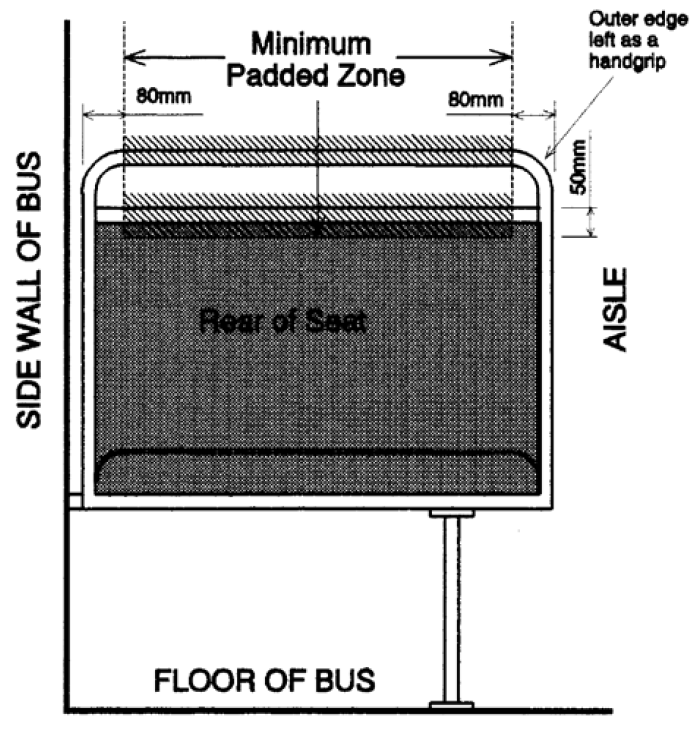
38Amendment of sch 5 (Equipment requirements for particular public passenger vehicles)
(1)Schedule 5, item 1—
omit.(2)Schedule 5, item 2—
renumber as item 1.
39Amendment of sch 9 (Dictionary)
Schedule 9—
insert—accreditation number, for an operator accreditation, means the unique identification number issued by the chief executive for the operator accreditation.ADR, for schedule 1AA, see schedule 1AA, section 1.approved person, for schedule 1AA, see schedule 1AA, section 1.associated document, for part 5A, division 2, see section 77H(2) and (3).authorisation requirement, for part 3, see section 21.code of conduct means a code of conduct approved by the chief executive under section 272.defined urban area means—(a)the area of the City of Brisbane under the City of Brisbane Act 2010; or(b)an area for which a service contract is required under section 42 of the Act for the provision of road-based general route services that are not—(i)school services only; or(ii)services only for the carriage of eligible school students.eligible school students means students who travel to and from school or another educational establishment under an arrangement made by the chief executive under section 144 of the Act.fatigue-regulated duty holder, for part 5A, division 1, see section 77A(1).fatigue-regulated service, for part 5A, division 1, see section 77A(2).heavy bus means a bus with a gross vehicle mass of more than 5t.heavy vehicle means a heavy vehicle for the purposes of the Heavy Vehicle National Law (Queensland), as provided for in section 6 of that Law.high-back seat, for schedule 1AA, see schedule 1AA, section 1.incident report means a report complying with section 18K(3).infant passenger means a passenger under 1 year old.injured, for part 2, division 3A, subdivision 3, see section 18C.light bus, for schedule 1AA, see schedule 1AA, section 1.local classification bus, for schedule 1AA, has the meaning given by schedule 1AA, section 2(3).maintenance record, for schedule 1AA, part 5, see schedule 1AA, section 25.minimum padded zone, for schedule 1AA, part 8, see schedule 1AA, section 34.non-route service bus, for schedule 1AA, see schedule 1AA, section 1.no standing passenger road means a road notified by the chief executive, by gazette notice, as a road on which a relevant vehicle that is a bus must not carry standing passengers.open classification bus, for schedule 1AA, has the meaning given by schedule 1AA, section 2(1).prescribed driver authorisation requirement, for part 3, see section 21.prescribed incident, for part 2, division 3A, subdivision 3, see section 18D.prescribed inspection entity, for schedule 1AA, see schedule 1AA, section 1.prescribed operator accreditation requirement, for part 2, see section 4.regional classification bus, for schedule 1AA, has the meaning given by schedule 1AA, section 2(2).relevant service means a public passenger service for which operator accreditation is required.relevant vehicle means a vehicle used to provide a public passenger service, other than a booked hire service or taxi service, for which driver authorisation is required.route service bus, for schedule 1AA, see schedule 1AA, section 1.school means—(a)a State school under the Education (General Provisions) Act 2006; or(b)an accredited school under the Education (Accreditation of Non-State School) Act 2017.school bus means a bus that is used to provide a school service outside, or partly outside, a defined urban area, even though the bus may be used for other purposes at other times.
Part 4 Amendment of Transport Operations (Road Use Management—Road Rules) Regulation 2009
This part amends the Transport Operations (Road Use Management—Road Rules) Regulation 2009.
41Amendment of s 222 (School bus not to be driven without warning lights and warning signs)
(1)Section 222(1), ‘passenger transport standard, schedule 1, section 19’—
omit, insert—Transport Operations (Road Use Management—Vehicle Standards and Safety) Regulation 2021, schedule 1, part 7, division 19
(2)Section 222—
insert—(3)A person does not commit an offence under subsection (1) if the person drives a school bus that is a relevant vehicle to which the Transport Operations (Road Use Management—Vehicle Standards and Safety) Regulation 2021, section 130 or 131 applies.(4)In this section—relevant vehicle see the Transport Operations (Passenger Transport) Regulation 2018, schedule 9.
42Replacement of s 222A (Use of warning lights—picking up or setting down school children)
Section 222A—
omit, insert—222A Use of warning lights—picking up or setting down children
(1)This section applies to the driver of a vehicle, whether or not a school bus—(a)fitted with warning lights under the Heavy Vehicle (Vehicle Standards) National Regulation, schedule 2, section 76; or(b)fitted with warning lights under the Transport Operations (Road Use Management—Vehicle Standards and Safety) Regulation 2021, schedule 1, section 111; or(c)fitted with warning lights in compliance with the repealed Transport Operations (Passenger Transport) Standard 2010, schedule 1, section 19 or 25 as in force from time to time before the commencement of the amendment regulation; orSee also the Transport Operations (Road Use Management—Vehicle Standard and Safety) Regulation 2021, section 131.(d)that has warning lights consisting of flashing yellow lamps mounted in compliance with the Traffic Regulation 1962, schedule 1, section 18B(a) as it was in force immediately before 1 October 1999.See also the Transport Operations (Road Use Management—Vehicle Standard and Safety) Regulation 2021, section 130.(2)Subsection (3) applies if—(a)the vehicle is fitted with warning lights that operate automatically; and(b)the driver of the vehicle intends to stop to pick up or set down children.(3)The driver may use a switch that allows the driver, from the driver’s normal driving position, to turn on the warning lights before the vehicle stops for a period that is no longer than is reasonably necessary in the circumstances.(4)Subsection (5) applies if—(a)the vehicle is not fitted with warning lights that operate automatically; and(b)the vehicle is fitted with a switch that allows the driver, from the driver’s normal driving position, to turn on simultaneously all warning lights fitted to the vehicle; and(c)the driver of the vehicle intends to stop to pick up or set down children.(5)The driver must—(a)turn on the warning lights at least 5 seconds before the vehicle stops; and(b)keep the warning lights on for at least 5 seconds after the vehicle has started to move off after stopping.Maximum penalty—20 penalty units.
(6)The driver must ensure the warning lights are not operating, other than under subsection (3) or (5), or in compliance with a relevant law, while the vehicle is on a road, unless the driver has a reasonable excuse.Example of a reasonable excuse—
The driver is testing the lights to ensure their satisfactory operation.Maximum penalty—20 penalty units.
(7)For a vehicle mentioned in subsection (1)(c), a reference in subsection (6) to a relevant law is taken to include a reference to the repealed Transport Operations (Passenger Transport) Standard 2010, schedule 1, section 24(3) as if the amendment regulation had not been made and that section were still in force.(8)In this section—amendment regulation means the Transport and Other Legislation Amendment Regulation 2026.relevant law means—(a)for a vehicle mentioned in subsection (1)(a)—the Heavy Vehicle (Vehicle Standards) National Regulation, schedule 2, section 77(3); or(b)for a vehicle mentioned in subsection (1)(b)—the Transport Operations (Road Use Management—Vehicle Standards and Safety) Regulation 2021, schedule 1, section 112(3).
43Amendment of s 267 (Exemptions from wearing seatbelts)
Section 267(8B), ‘Transport Operations (Passenger Transport) Standard 2010, section 11(2)(c) and (d)’—
omit, insert—Transport Operations (Passenger Transport) Regulation 2018, section 59B
44Amendment of sch 5 (Dictionary)
(1)Schedule 5, definitions passenger transport standard and school bus—
omit.(2)Schedule 5—
insert—school bus see the Transport Operations (Passenger Transport) Regulation 2018, schedule 9.
Part 5 Amendment of Transport Operations (Road Use Management—Vehicle Standards and Safety) Regulation 2021
This part amends the Transport Operations (Road Use Management—Vehicle Standards and Safety) Regulation 2021.
46Insertion of new pt 10, div 3
Part 10—
insert—In this division—relevant vehicle see the Transport Operations (Passenger Transport) Regulation 2018, schedule 9.repealed standard means the repealed Transport Operations (Passenger Transport) Standard 2010.130Warning signs and warning lights fitted to school bus immediately before 1 October 1999
(1)Schedule 1, part 7, division 19 does not apply to a relevant vehicle if—(a)immediately before the commencement—(i)the vehicle was a school bus within the meaning of the repealed standard, schedule 4; and(ii)the bus complied with the repealed standard, section 44; and(b)from the commencement, the vehicle continues to comply with former section 18B as if that section were still in force.See also the Queensland Road Rules, sections 222 and 222A.(2)In this section—former section 18B means the Traffic Regulation 1962, schedule 1, section 18B, as it was in force immediately before 1 October 1999.131Warning signs and lights fitted to bus under repealed standard
(1)Schedule 1, part 7, division 19 does not apply to a relevant vehicle if—(a)immediately before the commencement—(i)the vehicle was a bus within the meaning of the repealed standard; and(ii)the bus complied with the repealed standard, schedule 1, part 4; and(b)from the commencement, the vehicle continues to comply with the repealed standard, schedule 1, part 4 as if the amendment regulation had not been made and the repealed standard, schedule 1, part 4 were still in force.See also the Queensland Road Rules, sections 222 and 222A.(2)In this section—amendment regulation means the Transport and Other Legislation Amendment Regulation 2026.
47Replacement of sch 1, pt 7, div 19 (Division 19 not used)
Schedule 1, part 7, division 19—
omit, insert—This division applies to a vehicle that is a bus used mainly for carrying children other than a bus fitted with warning lights before July 1999.See also the Queensland Road Rules, sections 222 and 222A.111Fitting of warning lights and signs
(1)Two warning lights and a warning sign must be fitted to the front and rear of the bus.(2)The warning lights must be fitted—(a)on each side of, and the same distance from, the centre of the warning sign; and(b)with the edge of the warning sign not over 100 mm from the nearest point on the lens of the warning lights; and(c)with the distance between the warning lights at least 300 mm at the nearest point; and(d)so no part of the bus obstructs the light displayed—(i)30° to the left and right of the centre of each light; and(ii)10° above and below the centre of each light.(3)The warning lights may be on the warning sign if the words or image on the sign are not obscured.(4)The warning lights at the same end of the bus must be fitted—(a)at the same height; and(b)as high as practicable; and(c)with the lowest point on the lens of each light not lower than midway between the highest and lowest points on the bus body.(5)If the centres of the warning lights are under 1.8 metres above ground level, no part of the warning lights or warning sign may be on the left of the bus.(6)Any requirement of a third edition ADR about warning lights and warning signs does not apply to a bus to which this division applies.112Operation and performance of warning lights
(1)A warning light attached to the bus, when operating, must emit a flashing yellow light.(2)The warning lights at the same end of the bus must flash alternately between 90 and 180 times each minute.(3)Unless the driver has turned the warning lights off, they must operate automatically when a passenger door on the bus opens and for at least 10, and not more than 20 seconds, after all the doors on the bus have closed.(4)The bus must have an audible or visible signal that tells the driver of the bus in the normal driving position when the warning lights are flashing.(5)The bus must be fitted with a switch that allows the driver of the bus to turn the warning lights off from the normal driving position.(6)A warning light must have—(a)an effective lit lens area of at least 60cm2; and(b)a luminous intensity (in candela) of at least the values mentioned in the following table when measured at the angles mentioned in the table.
Vertical angle from centre of light
Horizontal angle from centre of light
-30°
-20°
-10°
-5°
0°
5°
10°
20°
30°
10°
50
80
50
5°
180
320
350
450
350
320
180
0°
75
450
1000
1250
1500
1250
1000
450
75
-5°
40
270
450
570
600
570
450
270
40
-10°
75
75
75
(7)For the purposes of subsection (6)(b), the luminous intensity of a light is to be measured in accordance with the test method mentioned in third edition ADR 6.113Specifications for warning signs
(1)A warning sign at the front of the bus must—(a)display the words ‘SCHOOL BUS’ in capital letters at least 100mm high; or(b)the required image.(2)A warning sign at the rear of the bus must show the required image.(3)The warning sign showing the required image must—(a)be a rectangular shape at least—(i)if warning lights are on the warning sign—550mm long and 400mm high; or(ii)otherwise—400mm long and 250mm high; and(b)have a black border; and(c)have black graphics; and(d)have a yellow surface complying with class 1, 2, 400 or 100 of the version of AS/NZS 1906 ‘Retroreflective materials and devices for road traffic control purposes’ applying to the warning sign at the sign’s date of manufacture.(4)In this section—required image means an image of 2 children in the same proportions as the children in AS 1743 ‘Road Signs—Specifications’, image W6-3, with the image of the taller child at least 230mm high.
48Amendment of sch 4 (Dictionary)
Schedule 4, definition heavy bus—
omit, insert—heavy bus means a bus with a gross vehicle mass of more than 5t.