Transport Operations (Road Use Management—Mass, Dimensions and Loading) Regulation 2005
Transport Operations (Road Use ManagementóMass, Dimensions
and Loading) Regulation 2005
QueenslandTransport
Operations (Road Use Management) Act 1995TransportOperations(RoadUseManagement—Mass,DimensionsandLoading)Regulation2005Current as at 1 July 2013NOTE—This is the last reprint before
repeal.Repealed on 10 February 2014 by 2014
SLNo. 8 s 129
Information about this reprintThis
reprint shows the legislation current as at the date on the cover
and is authorised bythe Parliamentary Counsel.AnewreprintofthelegislationwillbepreparedbytheOfficeoftheQueenslandParliamentary
Counsel when any change to the legislation takes effect. This
change maybe because a provision of the original
legislation, or an amendment to it, commences orbecause a particular provision of the
legislation expires or is repealed.When a new reprint
is prepared, this reprint will become a historical reprint. Also,
if it isnecessary to replace this reprint before a
new reprint is prepared, for example, to includeamendments with a retrospective commencement,
an appropriate note would be includedonthecoverofthereplacementreprintandonthecopyofthisreprintatwww.legislation.qld.gov.au.The
endnotes to this reprint contain detailed information about the
legislation and reprint.For example—•The
table of reprints endnote lists any previous reprints and, for this reprint, givesdetails of any discretionary editorial powers under theReprints Act 1992used by theOffice of the Queensland Parliamentary Counsel in preparing it.•Thelistoflegislationendnotegiveshistoricalinformationabouttheoriginallegislationandthelegislationwhichamendedit.Italsogivesdetailsofuncommencedamendmentstothislegislation.Forinformationaboutpossibleamendments to the
legislation by Bills introduced in Parliament, see the
QueenslandLegislation Current Annotations at
www.legislation.qld.gov.au/information.•The
list of annotations endnote gives historical information at section
level.All Queensland reprints
are
dated
and
authorised
by
the
Parliamentary
Counsel.
Theprevious numbering system and distinctions
between
printed
and
electronic
reprints
arenot
continued.
Transport Operations (Road Use
Management—Mass, Dimensions and Loading)Regulation
2005Part 1 Preliminary[s 1]Transport Operations (Road UseManagement—Mass, Dimensions and
Loading)Regulation 2005[as amended by
all amendments that commenced on or before 1 July 2013]Part
1Preliminary1Short
titleThisregulationmaybecitedastheTransportOperations(RoadUseManagement—Mass,DimensionsandLoading)Regulation
2005.2CommencementThis regulation
commences on 1 September 2005.3DefinitionsThe dictionary
in schedule 11 defines particular terms used inthis
regulation.4Measurement of distance between
axlesForthisregulation,thedistancebetweenaxlesismeasuredbetween the
centres of the wheels mounted on the axles andparallel to the
length of the vehicle.Current as at 1 July 2013Page
9
Transport Operations (Road Use
Management—Mass, Dimensions and Loading)Regulation
2005Part 2 Mass[s 5]Part
2MassDivision 1Preliminary5Application of pt 2This part
applies to a heavy vehicle when on a road.6Mass
requirementsSchedules1and4setoutmassrequirementsapplyingtoheavy vehicles.Division 2Mass
requirements7Compliance with
requirements—vehicles(1)Thepersonincontrolofavehiclemustensurethevehiclecomplies with a
mass requirement applying to it.Maximum
penalty—(a)for a minor risk breach—371/2penalty units; or(b)for
a substantial risk breach—60 penalty units.(2)A
person charged with an offence under this section has thebenefit of the reasonable steps
defence.Notes—1See part 6B for the reasonable steps
defence.2See section 57H(1)(e) of the Act,
which provides that the CriminalCode, section 24
(Mistake of fact) does not apply to an offenceagainst a mass,
dimension, loading or container weight declarationrequirement in relation to which a person
charged has the benefit ofthe reasonable steps defence.Page
10Current as at 1 July 2013
Transport Operations (Road Use
Management—Mass, Dimensions and Loading)Regulation
2005Part 2 Mass[s 8]8Compliance with
requirements—trailers(1)The person in
control of a vehicle towing a trailer must ensurethe
trailer complies with a mass requirement applying to it.Maximum penalty—(a)for
a minor risk breach—371/2penalty units; or(b)for
a substantial risk breach—60 penalty units.(2)A
person charged with an offence under this section has thebenefit of the reasonable steps
defence.Notes—1See part 6B for the reasonable steps
defence.2See section 57H(1)(e) of the Act,
which provides that the CriminalCode, section 24
(Mistake of fact) does not apply to an offenceagainst a mass,
dimension, loading or container weight declarationrequirement in relation to which a person
charged has the benefit ofthe reasonable steps defence.9Compliance with
requirements—combinations(1)Thepersonincontrolofacombinationmustensureitcomplies with a mass requirement applying to
it.Maximum penalty—(a)for
a minor risk breach—371/2penalty units; or(b)for
a substantial risk breach—60 penalty units.(2)A
person charged with an offence under this section has thebenefit of the reasonable steps
defence.Notes—1See part 6B for the reasonable steps
defence.2See section 57H(1)(e) of the Act,
which provides that the CriminalCode, section 24
(Mistake of fact) does not apply to an offenceagainst a mass,
dimension, loading or container weight declarationrequirement in relation to which a person
charged has the benefit ofthe reasonable steps defence.Current as at 1 July 2013Page
11
Transport Operations (Road Use
Management—Mass, Dimensions and Loading)Regulation
2005Part 2 Mass[s 10]10Alternative compliance(1)Sections7to9areprovisionsforwhichanalternativecompliance
scheme may be approved under section 15 of theAct.(2)Thepurposeofprescribingtheprovisionsistoensurethemassofavehicle,trailerorcombinationmentionedintheprovision, and
the mass placed on components of the vehicle,trailer or
combination is safe.Division 3Other provisions
about mass11Vehicle tareThe tare of a
vehicle may be determined—(a)by weighing the
vehicle on a weighing device; or(b)fromthecertificateofregistrationinforceforthevehicle under State or Commonwealth
law.12Tyre massThetyremassofavehicletyremaybedeterminedbyweighing on a weighing device.13Axle mass(1)An
axle mass of a vehicle may be determined—(a)for
a single axle that is not part of a group of axles—byweighing with the tyres of the axle
simultaneously on aweighing device; or(b)for
a group of axles—by weighing with the tyres of thegroup of axles simultaneously on a weighing
device.(2)However, the axle mass of an axle
fitted with dual tyres maybedeterminedbyplacingonlytheoutsidetyresontheweighing
device.Page 12Current as at 1
July 2013
Transport Operations (Road Use
Management—Mass, Dimensions and Loading)Regulation
2005Part 2 Mass[s 14]14Axle mass—complying buses(1)This section applies despite schedule
1, section 1(6).(2)The total mass on the axles of a
complying bus must not bemore than—(a)for
a bus with 2 axles—16t; or(b)for a bus with a
rear tandem axle group fitted with singletyres on 1 axle
and dual tyres on the other axle—20t; or(c)for
a bus with a rear tandem axle group fitted with dualtyres on both axles—22.5t.(3)The total mass on the axles of a
complying bus with a trailermust not be more
than the total of—(a)the mass for the bus allowed under
subsection (2); and(b)the mass for the trailer allowed under
schedule 2.(4)In this section—air suspension
systemfor a bus means a suspension system
inwhich—(a)vertical movement between each axle, and the
body, ofthe bus is controlled by variations in the
air pressure inan air spring; and(b)the
proportion of the bus’s mass that is borne by the airspring remains substantially constant
despite variationsin the air pressure in the air
spring.complyingbusmeansabuswith2or3axles,includingasingle steer axle, that is fitted with an
air suspension systemand—(a)for
a bus manufactured on or after 1 July 1994—(i)has
a compliance plate; and(ii)meetstheoccupantprotectionspecificationsinADR
68; or(b)for another bus, meets—(i)the emergency exit specifications in
ADR 44; andCurrent as at 1 July 2013Page
13
Transport Operations (Road Use
Management—Mass, Dimensions and Loading)Regulation
2005Part 2 Mass[s 15](ii)the rollover
strength specifications in ADR 59; and(iii)the
occupant protection specifications in ADR 68.15Axle
mass for ultra-low floor route bus(1)This
section applies despite schedule 1, section 1(6).(2)Thetotalmassontheaxlesofanultra-lowfloorroutebusmust
not be more than 16t.(3)Thetotalmassontheaxlesofanultra-lowfloorroutebuswith a trailer must not be more than
the total of—(a)the mass for the bus allowed under
subsection (2); and(b)the mass for the trailer allowed under
schedule 2.16Vehicle massThemassofavehicleorvehiclecombinationmaybedetermined—(a)byweighingallaxlessimultaneouslyonaweighingdevice;
or(b)by totalling the axle mass of each
axle of the vehicle orvehicle combination.17Other ways of determining mass may be
usedThis part does not limit the way a vehicle’s
tare or mass or avehicle’s tyre or axle mass may be
determined.18Way of stating GVMForthedefinitionGVMinschedule4oftheAct,themaximum loaded mass of a vehicle may
be—(a)iftheGVMisnotstatedonthevehicle’scomplianceplate, the
compliance plate is illegible, or the vehicle hasno
compliance plate—stated in writing by the vehicle’smanufacturer; orPage 14Current as at 1 July 2013
Transport Operations (Road Use
Management—Mass, Dimensions and Loading)Regulation
2005Part 2 Mass[s 19](b)for a vehicle registered—(i)in Queensland—stated in the vehicle’s
registrationcertificate issued under a transport Act;
or(ii)inanotherState—statedinwritingbytheState’sregistration
authority; or(c)stated in a certificate of
modification for the vehicle, orinamodificationplateattachedtothevehicle,issuedunder—(i)a
transport Act; or(ii)a corresponding
law; or(d)if the GVM has not been stated in a
way mentioned inparagraph(a),(b)or(c)—statedbythevehicleregistration
authority.19Proof of GCM or GVMA
certificate purporting to be signed by the chief executive
orcommissioner and stating the following
matters for a vehicleis evidence of the matters—(a)a vehicle’s GCM and the way it has
been stated for thedefinitionGCMin
schedule 11;(b)a vehicle’s GVM and the way it has
been stated underthe Act.20Proof
of mass(1)Inaproceedingunderthisregulation,acertificateofaservicing licensee or trade
measurement inspector, stating thata weighing
device was tested on a stated date, is, within 1 yearafterthatdate,evidencethatthemassindicatedbytheweighingdeviceisaccuratetotheextentstatedinthecertificate.(2)In
this section—servicing licenseemeans a licensee
under a servicing licencegranted under theNational
Measurement Act 1960(Cwlth).Current as at 1
July 2013Page 15
Transport Operations (Road Use
Management—Mass, Dimensions and Loading)Regulation
2005Part 2A Container weight declarations[s
21]trademeasurementinspectormeansatrademeasurementinspector under
theNational Measurement Act 1960(Cwlth).21Offences against this partAn
offence against this part is an information offence for theAct,
section 50.Part 2AContainer weight
declarations21AApplication of pt 2AThis
part applies to a freight container that is consigned fortransport by road, or for transport partly
by road and partly bysome other means.21BMeaning ofcomplying
container weight declarationAcontainerweightdeclarationforafreightcontainerisacomplying
container weight declarationif—(a)it contains the following additional
information—(i)thenumberandotherparticularsofthefreightcontainer
necessary to identify the container;(ii)thenameandresidentialaddressorbusinessaddressinAustraliaoftheresponsibleentityforthe freight container;(iii)the date of the
declaration; and(b)it is written and easily legible;
andNote—UndertheActsInterpretationAct1954,section36,writingincludes any mode
of representing or reproducing words in avisible
form.Page 16Current as at 1
July 2013
Transport Operations (Road Use
Management—Mass, Dimensions and Loading)Regulation
2005Part 2A Container weight declarations[s
21C](c)the information in the container
weight declaration is ina form that is readily available to an
authorised officerwhoseekstoascertainitwhileinthepresenceofthefreight container, including, for
example, by—(i)examiningdocumentslocatedinorontheheavyvehicle on which
the freight container is loaded orto be loaded;
or(ii)obtainingtheinformationbyradioormobiletelephone or by
other means.21CDuty of responsible entity(1)This section applies in relation to
the transport in Queenslandof a freight
container by a heavy vehicle.(2)The
responsible entity must not permit the operator or driveroftheheavyvehicletotransportthefreightcontaineronaroad in
Queensland unless the operator or driver of the heavyvehicle has been provided with a complying
container weightdeclaration for the freight
container.Maximum penalty—60 penalty units.(3)A person charged with an offence under
this section has thebenefit of the reasonable steps
defence.Notes—1See part 6B for the reasonable steps
defence.2See section 57H(1)(e) of the Act,
which provides that the CriminalCode, section 24
(Mistake of fact) does not apply to an offenceagainst a mass,
dimension, loading or container weight declarationrequirement in relation to which a person
charged has the benefit ofthe reasonable steps defence.21DDuty of operator(1)This
section applies in relation to the transport in Queenslandof a
freight container by a heavy vehicle.(2)The
operator must not permit the driver of the heavy vehicletotransportthefreightcontaineronaroadinQueenslandCurrent as at 1
July 2013Page 17
Transport Operations (Road Use
Management—Mass, Dimensions and Loading)Regulation
2005Part 2A Container weight declarations[s
21E]unlessthedriverhasbeenprovidedwithacomplyingcontainer weight
declaration for the freight container.Maximum
penalty—60 penalty units.(3)If the freight
container is to be transported by another carrier,the
operator must not give the freight container to the carrierunlessthecarrierhasbeenprovidedwithacomplyingcontainer weight
declaration for the freight container (or theprescribed
particulars contained in the declaration).Maximum
penalty—60 penalty units.(4)Ifthedriverdoesnothavethecomplyingcontainerweightdeclaration when
transporting the freight container on a roadinQueensland,theoperatoristakentohavecontravenedsubsection (2)
unless the operator establishes that the driverwas provided
with the declaration.(5)A person charged
with an offence under this section has thebenefit of the
reasonable steps defence.Notes—1See part 6B for the reasonable steps
defence.2See section 57H(1)(e) of the Act,
which provides that the CriminalCode, section 24
(Mistake of fact) does not apply to an offenceagainst a mass,
dimension, loading or container weight declarationrequirement in relation to which a person
charged has the benefit ofthe reasonable steps defence.(6)In this section—prescribedparticulars,containedinacomplyingcontainerweight declaration for a freight container,
means—(a)informationabouttheweightofthefreightcontainerand
its contents; and(b)the information mentioned in section
21B(a).21EDuty of driver(1)A
person must not drive a heavy vehicle loaded with a freightcontaineronaroadinQueenslandunlessthepersonhasacontainer weight declaration for the
container.Page 18Current as at 1
July 2013
Transport Operations (Road Use
Management—Mass, Dimensions and Loading)Regulation
2005Part 3 Vehicle dimensions[s 22]Maximum penalty—60 penalty units.(2)The driver of a heavy vehicle loaded
with a freight containermust,whendrivingtheheavyvehicleonaroadinQueensland, keep the complying
container weight declarationfor the
container in or about the heavy vehicle in a way thatenables the information in the container
weight declaration tobereadilyavailabletoanauthorisedofficerwhoseekstoascertain it while in the presence of the
freight container.Maximum penalty—60 penalty units.(3)A person charged with an offence under
subsection (1) or (2)has the benefit of the reasonable
steps defence.Notes—1See part 6B for the reasonable steps
defence.2See section 57H(1)(e) of the Act,
which provides that the CriminalCode, section 24
(Mistake of fact) does not apply to an offenceagainst a mass,
dimension, loading or container weight declarationrequirement in relation to which a person
charged has the benefit ofthe reasonable steps defence.Part
3Vehicle dimensionsDivision 1Preliminary22Meaning ofrear
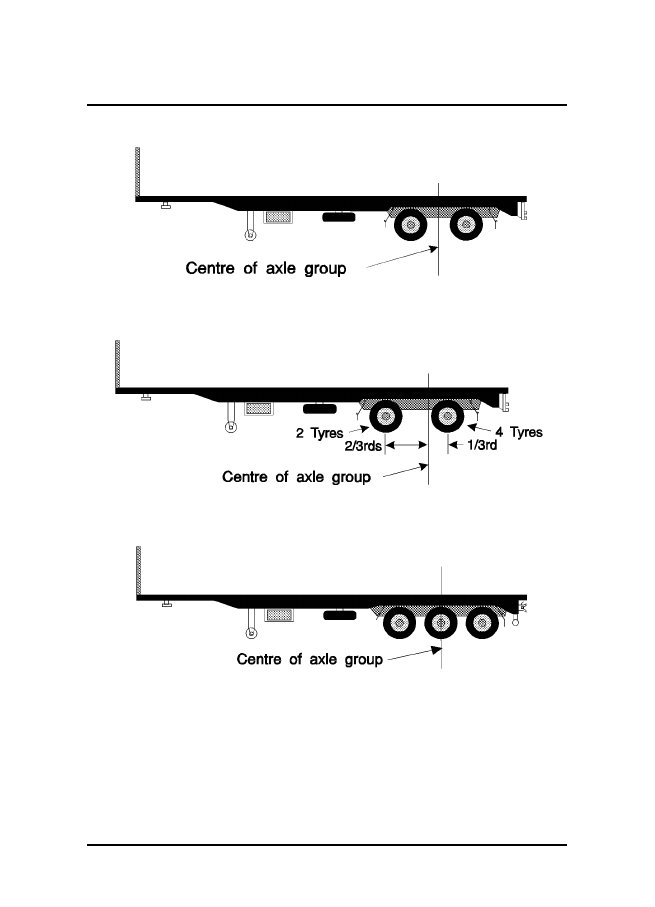
overhangandrear overhang linefor pt 3(1)Thissectiondefinesrearoverhangandrearoverhanglinefor this
part.(2)Therear
overhangof a vehicle is the distance between
therear of the vehicle and the rear overhang
line of the vehicle.(3)For a vehicle
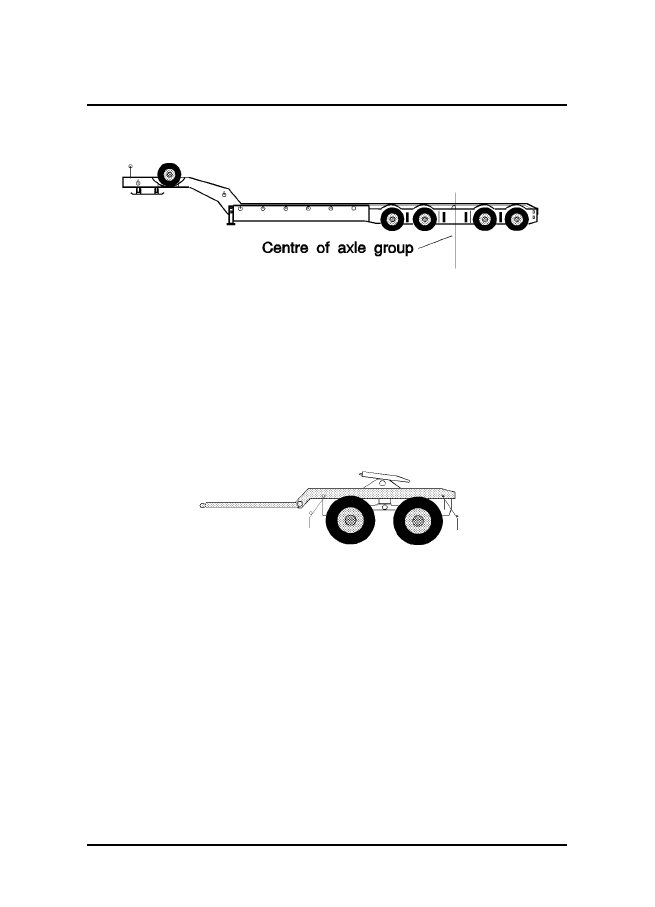
with an axle group at the rear comprising only 1axle, therear overhang
lineis a line running along the centreof
the axle.Current as at 1 July 2013Page
19
Transport Operations (Road Use
Management—Mass, Dimensions and Loading)Regulation
2005Part 3 Vehicle dimensions[s 23](4)Foravehiclewithanaxlegroupattherearcomprising2axles, 1 of which is fitted with twice the
number of tyres asthe other, therear overhang
lineis a line running parallel tothe
axles that is—(a)closer to the axle carrying the
greater number of tyresthan it is to the other axle;
and(b)located at one-third of the distance
between the 2 axles.(5)For a vehicle
with an axle group at the rear that is not an axlegroup mentioned in subsection (3) or (4),
therear overhanglineis a
line running parallel to the axles down the centre ofthe
axle group.(6)For applying subsection (3), (4) or
(5) to a vehicle—(a)an axle group is taken to comprise
only the fixed andretractableaxlesincontactwiththegroundattheparticular time the subsection is
applied to the vehicle;and(b)an
axle group is taken not to comprise any steerable axleunless—(i)the
group comprises only 1 axle and that axle is asteerable axle;
or(ii)all the axles in
the group are steerable axles.23Load
and other things are part of vehicle’s dimensionsfor
pt 3Inthispart,avehicleistakentoincludeanythingonthevehicle, unless
otherwise stated.Division 2Particular
dimensions24Length—motor vehicles(1)A person must not drive a vehicle on a
road if the vehicle islonger than—Page 20Current as at 1 July 2013
Transport Operations (Road Use
Management—Mass, Dimensions and Loading)Regulation
2005Part 3 Vehicle dimensions[s 25](a)foracombination,otherthanaB-doubleorroadtrain—19m;
or(b)for an articulated bus—18m; or(c)for any other vehicle—12.5m.Maximum penalty—(a)foravehicleotherthanaheavyvehicle—30penaltyunits; or(b)for
a minor risk breach for a heavy vehicle—30 penaltyunits; or(c)forasubstantialriskbreachforaheavyvehicle—50penalty
units.(2)Inaproceedingforanoffenceagainstsubsection(1)inrelation to a heavy vehicle, the
person charged has the benefitof the
reasonable steps defence for the offence.Notes—1See part 6B for
the reasonable steps defence.2See
section 57H(1)(e) of the Act, which provides that the
CriminalCode, section 24 (Mistake of fact) does not
apply to an offenceagainst a mass, dimension, loading or
container weight declarationrequirement in
relation to which a person charged has the benefit ofthe
reasonable steps defence.25Width(1)A person must not drive a vehicle on a
road if the vehicle iswider than 2.5m.Maximum
penalty—(a)foravehicleotherthanaheavyvehicle—30penaltyunits; or(b)for
a minor risk breach for a heavy vehicle—30 penaltyunits; or(c)forasubstantialriskbreachforaheavyvehicle—50penalty
units.Current as at 1 July 2013Page
21
Transport Operations (Road Use
Management—Mass, Dimensions and Loading)Regulation
2005Part 3 Vehicle dimensions[s 26](2)When measuring the width of a vehicle
for subsection (1), anyof the following items that may be
fitted to the vehicle are tobe
disregarded—(a)anti-skid devices mounted on
wheels;(b)central tyre inflation systems;(c)lights,mirrors,reflectors,signallingdevicesortyrepressure
gauges.(3)Inaproceedingforanoffenceagainstsubsection(1)inrelation to a heavy vehicle, the
person charged has the benefitof the
reasonable steps defence for the offence.Notes—1See part 6B for
the reasonable steps defence.2See
section 57H(1)(e) of the Act, which provides that the
CriminalCode, section 24 (Mistake of fact) does not
apply to an offenceagainst a mass, dimension, loading or
container weight declarationrequirement in
relation to which a person charged has the benefit ofthe
reasonable steps defence.(4)Nothinginthissectionaffectsaperson’sliabilityforacontravention of
section 34.26Height(1)A
person must not drive a vehicle on a road if the vehicle ishigher than—(a)foravehiclebuilttocarrycattle,horses,pigsorsheep—4.6m; or(b)foravehiclebuiltwithatleast2decksforcarryingvehicles,whencarryingavehicleontheupperdeck—4.6m;
or(c)for a double-decker bus—4.4m;
or(d)for another vehicle—4.3m.Maximum penalty—(a)foravehicleotherthanaheavyvehicle—30penaltyunits; orPage 22Current as at 1 July 2013
Transport Operations (Road Use
Management—Mass, Dimensions and Loading)Regulation
2005Part 3 Vehicle dimensions[s 27](b)for a minor risk breach for a heavy
vehicle—30 penaltyunits; or(c)forasubstantialriskbreachforaheavyvehicle—50penalty
units.(2)Inaproceedingforanoffenceagainstsubsection(1)inrelation to a heavy vehicle, the
person charged has the benefitof the
reasonable steps defence for the offence.Notes—1See part 6B for
the reasonable steps defence.2See
section 57H(1)(e) of the Act, which provides that the
CriminalCode, section 24 (Mistake of fact) does not
apply to an offenceagainst a mass, dimension, loading or
container weight declarationrequirement in
relation to which a person charged has the benefit ofthe
reasonable steps defence.27Ground
clearance(1)A person must not drive a vehicle on a
road if the vehicle has aground clearance of less than—(a)at a point within 1m of an axle—100mm;
and(b)at the midpoint between adjacent
axles—one-thirtieth ofthe distance between the centre of
each axle; and(c)at any other point—the distance that
allows the vehicleto pass over a peak in the road if the
gradient on eitherside of the peak is 1:15.Maximum penalty—30 penalty units.(2)In this section—ground
clearanceof a vehicle means the minimum
distancebetween the ground and the vehicle’s
underside, other than itstyres,wheels,wheelhubs,brakebackingplates,flexiblemudguards and mudflaps.Current as at 1
July 2013Page 23
Transport Operations (Road Use
Management—Mass, Dimensions and Loading)Regulation
2005Part 3 Vehicle dimensions[s 28]28Length—trailers(1)A
person must not drive a vehicle towing a semitrailer or dogtraileronaroadifthesemitrailerordogtrailerdoesnotcomply with this section.Maximum penalty—30 penalty units.(2)Onasemitrailerordogtrailer,thedistancefromthefrontarticulation
point to—(a)the rear overhang line must not be
more than 9.5m; and(b)the rear of the trailer must not be
more than 12.3m.(3)The part of a semitrailer or anything
attached to a semitrailerinfrontofthetrailer’sfrontarticulationpoint,otherthananothervehicle,mustnotprotrudebeyondtheprescribedlimit.(4)The prescribed limit is an imaginary
line created by drawing asemicircle of 1.9m radius from the
centre of, and forward of,the front articulation point.(5)A semitrailer with more than 1 front
articulation point mustcomply with subsections (2) and (3)
when measured at one ofthe points.(6)A
trailer built to carry cattle, horses, pigs or sheep (animals)on 2
or more partly or completely overlapping decks must nothave
more than 12.5m of its length available to carry animals.(7)In a B-double built to carry animals,
the 2 semitrailers mustnot have more than 18.8m of their
combined length availableto carry animals.(8)Forsubsections(6)and(7),thelengthavailableforthecarriage of
animals on a trailer is measured from the inside ofthe
front wall or door of the trailer to the inside of the rearwallordoorofthetrailer,withanyinterveningpartitionsdisregarded.29Length—rear overhang(1)A
person must not drive a vehicle on a road if the vehicle
doesnot comply with this section.Page
24Current as at 1 July 2013
Transport Operations (Road Use
Management—Mass, Dimensions and Loading)Regulation
2005Part 3 Vehicle dimensions[s 30]Maximum penalty—30 penalty units.(2)Therearoverhangofavehiclemustnotbemorethanthelesser of 3.7m and—(a)forasemitrailerordogtrailer—60%ofthedistancebetweenthefrontarticulationpointandtherearoverhang line; or(b)for
any other trailer—the distance between the front ofthebodyorloadcarryingareaandtherearoverhangline; or(c)foranothervehicle—60%ofthedistancebetweenthecentre of the front axle and the rear
overhang line.(3)A semitrailer with more than 1 front
articulation point mustcomplywithsubsection(2)(a)whenmeasuredatthesamepointthatisusedformeasurementforcomplianceundersection 28(5).(4)Despite subsection (2), if a vehicle built
to carry vehicles hasat least 2 decks and a vehicle it is
carrying overhangs its rear,the rear
overhang of the vehicle built to carry vehicles mustnot
be more than 4.9m.30Length—trailer drawbars(1)A person must not drive a vehicle
towing a trailer on a road ifthe trailer does
not comply with this section.Maximum
penalty—30 penalty units.(2)On a dog
trailer, the distance between the coupling pivot pointon
the drawbar and the centre of the front axle group—(a)must not be more than 5m; and(b)if the trailer is used in a road train
that is longer than19m—must not be less than 3m.(3)On a trailer, other than a
semitrailer, with only a single axlegroup, the
distance between the coupling pivot point on thedrawbar and the centre of the axle group
must not be morethan 8.5m.Current as at 1
July 2013Page 25
Transport Operations (Road Use
Management—Mass, Dimensions and Loading)Regulation
2005Part 3 Vehicle dimensions[s 31]Division 3Projections31Meaning ofloadfor
div 3In this division—loadincludes equipment and the pole of a pole
type trailer orjinker.32Measuring width for div 3Whenmeasuringavehicle’swidthforthisdivision,aback-vision mirror, light or reflector
attached to the vehicle isnot to be taken into account.33Limits on projections of
loads—motorbikes(1)This section applies only in relation
to loads on motorbikes.(2)A person must
not drive, park or stop a motorbike on a road ifany
load on the motorbike projects—(a)for
a motorbike without a sidecar—(i)more
than 150mm in front of the outer extremity ofthe motorbike’s
front wheel; or(ii)morethan300mmbehindtheouterextremityofthe motorbike’s back wheel; or(iii)past the outer
extremity of the motorbike on eitherside; or(b)for a motorbike with a sidecar—(i)more than 600mm in front of the outer
extremity ofthe motorbike’s front wheel; or(ii)morethan900mmbehindtheouterextremityofthe motorbike’s back wheel; or(iii)pasttheouterextremityofthevehicleoneitherside; or(c)for a motorbike trailer—Page
26Current as at 1 July 2013
Transport Operations (Road Use
Management—Mass, Dimensions and Loading)Regulation
2005Part 3 Vehicle dimensions[s 34](i)more than 300mm behind the trailer;
or(ii)past the outer
extremity of the trailer on either side.Maximum
penalty—20 penalty units.(3)If part of the
load on a motorbike, or on a trailer towed by amotorbike,projectsinawaythatitwouldnotbereadilyvisibletoapersonfollowingimmediatelybehindthemotorbike, the driver of the motorbike
must ensure—(a)a brightly coloured red, red and
yellow, or yellow flag atleast 450mm by 450mm is fixed to the
extreme back ofthe load; and(b)at
night—(i)a light showing a clear red light to
the back, visibleunder normal atmospheric conditions at a
distanceof at least 200m, is fixed to the extreme
back of theload; or(ii)atleast2reflectors,capableofprojectingaredreflectionoflightfromtheheadlightofanyfollowing vehicle, are fixed to the
extreme back ofthe load.Maximum
penalty—20 penalty units.34Limits on
projection of loads—motor vehicles other thanmotorbikes(1)Thissectionappliesinrelationtoloadsonmotorvehiclesother than motorbikes.(2)A
person must not drive, park or stop a motor vehicle on aroad
if any load on the vehicle projects—(a)for
a motor vehicle without a trailer—(i)morethan1.2minfrontofthemotorvehicle’sheadlights; or(ii)more
than 1.2m behind the motor vehicle; or(iii)more
than 150mm past the outer extremity of themotor vehicle on
either side; orCurrent as at 1 July 2013Page
27
Transport Operations (Road Use
Management—Mass, Dimensions and Loading)Regulation
2005Part 3 Vehicle dimensions[s 34](b)for a motor vehicle with a
trailer—(i)morethan1.2minfrontofthemotorvehicle’sheadlights; or(ii)more
than 1.2m behind either the motor vehicle orthe trailer;
or(iii)morethan150mmpasttheouterextremityofeither the motor vehicle or the
trailer on either side.Maximum penalty—(a)foravehicleotherthanaheavyvehicle—20penaltyunits; or(b)for
a minor risk breach for a heavy vehicle—25 penaltyunits; or(c)forasubstantialriskbreachforaheavyvehicle—50penalty
units.(3)Despitesubsection(2),aloadmayprojectmorethan1.2mbehind either a motor vehicle or a trailer
if—(a)a brightly coloured red, red and
yellow, or yellow flag atleast 450mm by 450mm is fixed to the
extreme back ofthe load; and(b)at
night—(i)a light showing a clear red light to
the back, visibleunder normal atmospheric conditions at a
distanceof at least 200m, is fixed to the extreme
back of theload; or(ii)atleast2reflectors,capableofprojectingaredreflectionoflightfromtheheadlightofanyfollowing vehicle, are fixed to the
extreme back ofthe load.(4)If
part of the load on a motor vehicle, or on a trailer towed
bya motor vehicle, projects in a way that it
would not be readilyvisible to a person following
immediately behind the vehicle,the driver of
the vehicle must ensure—Page 28Current as at 1
July 2013
Transport Operations (Road Use
Management—Mass, Dimensions and Loading)Regulation
2005Part 3 Vehicle dimensions[s 35](a)a brightly coloured red, red and
yellow, or yellow flag atleast 450mm by 450mm is fixed to the
extreme back ofthe load; and(b)at
night—(i)a light showing a clear red light to
the back, visibleunder normal atmospheric conditions at a
distanceof at least 200m, is fixed to the extreme
back of theload; or(ii)atleast2reflectors,capableofprojectingaredreflectionoflightfromtheheadlightofanyfollowing vehicle, are fixed to the
extreme back ofthe load.Maximum
penalty—20 penalty units.(5)Inaproceedingforanoffenceagainstsubsection(2)inrelation to a heavy vehicle, the
person charged has the benefitof the
reasonable steps defence for the offence.Notes—1See part 6B for
the reasonable steps defence.2See
section 57H(1)(e) of the Act, which provides that the
CriminalCode, section 24 (Mistake of fact) does not
apply to an offenceagainst a mass, dimension, loading or
container weight declarationrequirement in
relation to which a person charged has the benefit ofthe
reasonable steps defence.35Limits on
projections of loads—vehicles drawn by ananimal(1)A person must not drive, park or stop
a vehicle drawn by ananimal on a road if any load on the
vehicle projects—(a)past the animal’s head; or(b)ifthevehicleisa2-wheeledvehicle—morethan1mbehind the vehicle’s body; or(c)ifthevehicleisa4-wheeledvehicle—morethan1mbehind the vehicle’s body or the back
wheels; orCurrent as at 1 July 2013Page
29
Transport Operations (Road Use
Management—Mass, Dimensions and Loading)Regulation
2005Part 3 Vehicle dimensions[s 36](d)if the vehicle is a pole type
jinker—behind the back endof the pole; or(e)morethan300mmpasttheouterextremityofthevehicle’s body
or wheels on either side.Maximum penalty—20 penalty
units.(2)Despitesubsection(1),aloadmayprojectmorethan1mbehind a vehicle drawn by an animal,
if—(a)a brightly coloured red, red and
yellow, or yellow flag atleast 450mm by 450mm is fixed to the
extreme back ofthe load; and(b)at
night—(i)a light showing a clear red light to
the back, visibleunder normal atmospheric conditions at a
distanceof at least 200m, is fixed to the extreme
back of theload; or(ii)atleast2reflectors,capableofprojectingaredreflectionoflightfromtheheadlightofanyfollowing vehicle, are fixed to the
extreme back ofthe load.36Division does not affect div 2Nothing in this division authorises a person
to drive a vehicleon a road other than in compliance with the
requirements of aprovision of division 2.Division 4Information offences37Offences against this partAn
offence against this part is an information offence for theAct,
section 50.Page 30Current as at 1
July 2013
Transport Operations (Road Use
Management—Mass, Dimensions and Loading)Regulation
2005Part 4 Loading[s 38]Part
4LoadingDivision 1Preliminary38Application of partThis part
applies to a load on a vehicle or combination on aroad.39Definition for pt 4In this
part—schedule7loadingrequirement,foravehicle,meansaprovision of schedule 7 applying to
it.Division 2Loading
requirements40Compliance with
requirements—vehicles(1)The person in
control of a vehicle must ensure a load on itcomplies with a
schedule 7 loading requirement applying to it.Maximum
penalty—(a)for a private vehicle—20 penalty
units; or(b)foraprescribedheavyvehicleotherthanaheavyvehicle—30
penalty units; or(c)for a minor risk breach for a heavy
vehicle—30 penaltyunits; or(d)forasubstantialriskbreachforaheavyvehicle—50penalty
units.(2)Inaproceedingforanoffenceagainstsubsection(1)inrelation to a heavy vehicle, the
person charged has the benefitof the
reasonable steps defence for the offence.Current as at 1
July 2013Page 31
Transport Operations (Road Use
Management—Mass, Dimensions and Loading)Regulation
2005Part 4 Loading[s 41]Notes—1See part 6B for the reasonable steps
defence.2See section 57H(1)(e) of the Act,
which provides that the CriminalCode, section 24
(Mistake of fact) does not apply to an offenceagainst a mass,
dimension, loading or container weight declarationrequirement in relation to which a person
charged has the benefit ofthe reasonable steps defence.41Compliance with
requirements—trailers(1)The person in
control of a vehicle towing a trailer must ensurethetrailercomplieswithaschedule7loadingrequirementapplying to
it.Maximum penalty—(a)for
a private vehicle—20 penalty units; or(b)foraprescribedheavyvehicleotherthanaheavyvehicle—30
penalty units; or(c)for a minor risk breach for a heavy
vehicle—30 penaltyunits; or(d)forasubstantialriskbreachforaheavyvehicle—50penalty
units.(2)Inaproceedingforanoffenceagainstsubsection(1)inrelation to a heavy vehicle, the
person charged has the benefitof the
reasonable steps defence for the offence.Notes—1See part 6B for
the reasonable steps defence.2See
section 57H(1)(e) of the Act, which provides that the
CriminalCode, section 24 (Mistake of fact) does not
apply to an offenceagainst a mass, dimension, loading or
container weight declarationrequirement in
relation to which a person charged has the benefit ofthe
reasonable steps defence.42Compliance with
requirements—combinations(1)Thepersonincontrolofacombinationmustensureitcomplies with a schedule 7 loading
requirement applying to it.Page 32Current as at 1 July 2013
Transport Operations (Road Use
Management—Mass, Dimensions and Loading)Regulation
2005Part 4 Loading[s 43]Maximum penalty—(a)for
a private vehicle—20 penalty units; or(b)foraprescribedheavyvehicleotherthanaheavyvehicle—30
penalty units; or(c)for a minor risk breach for a heavy
vehicle—30 penaltyunits; or(d)forasubstantialriskbreachforaheavyvehicle—50penalty
units.(2)Inaproceedingforanoffenceagainstsubsection(1)inrelation to a heavy vehicle, the
person charged has the benefitof the
reasonable steps defence for the offence.Notes—1See part 6B for
the reasonable steps defence.2See
section 57H(1)(e) of the Act, which provides that the
CriminalCode, section 24 (Mistake of fact) does not
apply to an offenceagainst a mass, dimension, loading or
container weight declarationrequirement in
relation to which a person charged has the benefit ofthe
reasonable steps defence.Division 3Other
provisions43Proof of schedule 7 loading
offencesIn a proceeding for an offence against a
schedule 7 loadingrequirement—(a)evidence that a load on a vehicle was not
placed, securedor restrained in a way that met a
performance standardunderthe‘Loadrestraintguide’isevidenceofacontravention of a schedule 7 loading
requirement; and(b)evidence that a load, or part of a
load, has fallen off avehicleisevidencethattheloadwasnotproperlysecured;
andCurrent as at 1 July 2013Page
33
Transport Operations (Road Use
Management—Mass, Dimensions and Loading)Regulation
2005Part 5 Protection of roads and
structures[s 44](c)a
court must presume a document purporting to be the‘Load restraint guide’ is the ‘Load
restraint guide’, untilthe contrary is proved.Editor’s note—The‘Loadrestraintguide’ispublishedbytheNationalTransportCommissionandmaybeaccessedonthecommission’s
website at <www.ntc.gov.au>.44Offences against this partAn
offence against this part is an information offence for theAct,
section 50.Part 5Protection of
roads andstructures45Damage to road transport
infrastructure(1)Apersonmustnotuse,orpermittobeused,onaState-controlledroad,whetherwithagravelformationorsealed surface, a vehicle or other
kind of equipment that maydamagetheroad,otherthanunderapermitissuedundersection
46.Maximum penalty—80 penalty units.(2)Apersonmustnotuse,orpermittobeused,onaState-controlledroad,avehicleorotherkindofequipmentthat is not
fitted with pneumatic or rubber tyres, other than—(a)under a permit issued under section
46; or(b)for the construction of works for, or
the maintenance of,road transport infrastructure.Maximum penalty—80 penalty units.Page
34Current as at 1 July 2013
Transport Operations (Road Use
Management—Mass, Dimensions and Loading)Regulation
2005Part 5 Protection of roads and
structures[s 46]46Application for, and issue of, permit(1)A person who proposes to use a vehicle
or other equipmentfor which a permit is required under section
45 may apply tothe chief executive for a permit under this
section.(2)The application—(a)must
be written; and(b)must be made to the chief executive at
least 10 businessdays before the vehicle or other equipment
is used onthe State-controlled road.(3)Thechiefexecutivemayissuethepermit,withorwithoutconditions, or
refuse to issue the permit.(4)A
permit may include conditions about—(a)the
State-controlled roads on which the vehicle or otherequipment may be used; and(b)the period for which the vehicle or
other equipment maybe used on State-controlled roads;
and(c)themaximummassanddimensionsforthevehicleorother equipment; and(d)preparing or strengthening road transport
infrastructure;and(e)therepair,replacementorreconstructionofroadtransport
infrastructure; and(f)other matters the chief executive
considers necessary orappropriate.(5)Before granting the permit, or as a
condition of it, the chiefexecutivemayrequiretheapplicanttopaythechiefexecutive’s costs or estimated costs of the
following—(a)assessing the vehicle’s route and
preparing the relevantplans and estimates;(b)preparingandstrengtheningroadtransportinfrastructure
on the route;Current as at 1 July 2013Page
35
Transport Operations (Road Use
Management—Mass, Dimensions and Loading)Regulation
2005Part 5 Protection of roads and
structures[s 47](c)repairing,replacingorreconstructingroadtransportinfrastructure
on the route;(d)ensuringcompliancewithaconditionoraproposedcondition of the
permit.(6)Apermitissuedunderthissectionisvoidifaconditionincluded in the
permit is contravened.47Restriction of
loads on structures(1)The chief executive may—(a)decide the maximum loaded mass for a
vehicle that mayuse a bridge or culvert forming part of a
State-controlledroad; and(b)erectonorinthevicinityofthebridgeorculvertaconspicuous notice stating—(i)the maximum loaded mass for a vehicle
that mayuse the bridge or culvert; and(ii)anyreasonableandrelevantconditionsthechiefexecutive
considers should apply for the safe use ofthe bridge or
culvert by a vehicle.(2)A person must
not drive a vehicle over a bridge or culvert if—(a)anoticehasbeenerectedundersubsection(1)(b)inrelation to the bridge or culvert;
and(b)at least 1 of the following
applies—(i)the loaded mass of the vehicle is
greater than themass stated on the notice as the maximum
loadedmassforavehiclethatmayusethebridgeorculvert;(ii)thevehicleisdriveninawaythatcontravenesaconditionstatedinthenoticeasapplyingforthesafe use of the bridge or culvert by a
vehicle.Maximum penalty—80 penalty units.(3)A person does not contravene
subsection (2) if the person—Page 36Current as at 1 July 2013
Transport Operations (Road Use
Management—Mass, Dimensions and Loading)Regulation
2005Part 6 Guidelines and permits[s
48](a)beforedrivingthevehicleoverthebridgeorculvert,obtainsthewrittenconsentofthechiefexecutivetodrive the vehicle over the bridge or
culvert; and(b)indrivingthevehicleoverthebridgeorculvert,complieswithallconditionstowhichthechiefexecutive
subjects the written consent.Part 6Guidelines and permitsDivision 1Guidelines48Guidelines for safe movement of
vehicles(1)The chief executive may, by gazette
notice, issue a guidelinefor the safe movement on a road of a
type of vehicle.(2)A guideline can not allow a
combination to be more than—(a)foracombinationconsistingof1motorvehicle—themotor vehicle’s
GCM; or(b)foracombinationconsistingofmorethan1motorvehicle—the
total of each motor vehicle’s GCM.(3)The
matters a guideline may relate to include the following—(a)the roads on which the type of vehicle
may be driven;(b)themaximumpermissibledimensionsofthetypeofvehicle together with any load;(c)the maximum permissible mass
of—(i)the type of vehicle together with any
load; or(ii)parts of the
type of vehicle;(d)any permissible or requisite
modifications to the type ofvehicle;Current as at 1 July 2013Page
37
Transport Operations (Road Use
Management—Mass, Dimensions and Loading)Regulation
2005Part 6 Guidelines and permits[s
49]Example of paragraph (d)—Extra
lighting maybe required to be added tothe
side of avehicle carrying a wide load.(e)the times when the type of vehicle may
be driven;(f)signs and warning devices to be
displayed on the type ofvehicle;(g)when
the type of vehicle must travel with a pilot vehicleor
escort vehicle;(h)requirements for pilot vehicles and
pilot vehicle drivers,and escort vehicles and escort vehicle
drivers;(i)the maximum speeds at which the type
of vehicle maybe driven;(j)operating the type of vehicle under the
IAP;(k)other matters relevant to the safe
movement of the typeof vehicle.(4)The
roads on which the type of vehicle may be driven may beshown on a map in the guideline.(5)If a guideline relates to operating a
type of vehicle under theIAP, the guideline must state that the
operator of a vehicle ofthat type must obtain a certificate
under section 55B beforeoperating the vehicle under the
IAP.49Statutory condition on guidelines for
oversize vehicles(1)Aguidelineforatypeofoversizevehicleisissuedontheconditions stated in schedule 8 for
the guideline.(2)A condition imposed under subsection
(1) applies despite anyother provision of the
guideline.50Driving under guideline(1)A person who is driving a type of
vehicle in accordance with acurrent
guideline issued for the type of vehicle is exempt fromcomplying with the provisions of this
regulation for which theguideline states it is a means of
alternative compliance.Page 38Current as at 1
July 2013
Transport Operations (Road Use
Management—Mass, Dimensions and Loading)Regulation
2005Part 6 Guidelines and permits[s
51](2)However, a guideline that is a means
of alternative compliancefor driving a pilot or escort vehicle
need not state that fact.(3)A person must
ensure a sign or warning device that is requiredunder a guideline is not displayed on a
vehicle being driven bythepersonunlessthepersonisdrivingthevehicleforthepurpose for which the guideline was
issued.Maximum penalty—40 penalty units.Division 2Permits51Permits for safe movement of
vehicles(1)The chief executive may issue a permit
for the safe movementon a road of a particular vehicle or
type of vehicle.(2)The commissioner may issue a permit
for the safe movementon a road of a particular oversize
vehicle or type of oversizevehicle.(3)The chief executive or commissioner
may issue a permit byphone,fax,radiooranotherformofcommunicationifthechiefexecutiveorcommissionerconsidersitnecessarybecause of
urgent circumstances.(4)A permit can not
allow a combination to be more than—(a)foracombinationconsistingof1motorvehicle—themotor vehicle’s
GCM; or(b)foracombinationconsistingofmorethan1motorvehicle—the
total of each motor vehicle’s GCM.(5)The
matters a permit may relate to include the following—(a)the roads on which the vehicle or type
of vehicle may bedriven;(b)the
maximum permissible dimensions of the vehicle ortype
of vehicle together with any load;(c)the
maximum permissible mass of—Current as at 1
July 2013Page 39
Transport Operations (Road Use
Management—Mass, Dimensions and Loading)Regulation
2005Part 6 Guidelines and permits[s
52](i)thevehicleortypeofvehicletogetherwithanyload; or(ii)parts of the vehicle or type of
vehicle;(d)any permissible or requisite
modifications to the vehicleor type of
vehicle;Example of paragraph (d)—Extra
lighting maybe required to be added tothe
side of avehicle or type of vehicle carrying a wide
load.(e)thetimeswhenthevehicleortypeofvehiclemaybedriven;(f)signs and warning devices to be displayed on
the vehicleor type of vehicle;(g)when
the vehicle or type of vehicle must travel with apilot vehicle or escort vehicle;(h)requirements for pilot vehicles and
pilot vehicle drivers,and escort vehicles and escort vehicle
drivers;(i)themaximumspeedsatwhichthevehicleortypeofvehicle may be driven;(j)operating the vehicle or type of vehicle
under the IAP;(k)othermattersrelevanttothesafemovementofthevehicle or type
of vehicle.(6)Theroadsonwhichthevehicleortypeofvehiclemaybedriven may be shown on a map in the
permit.(7)If a permit relates to operating a
vehicle, or type of vehicle,under the IAP,
the permit must state that the operator of thevehicle,oravehicleofthattype,mustobtainacertificateunder section
55B before operating the vehicle under the IAP.52Statutory condition on permits for oversize
vehicles(1)A permit for a particular oversize
vehicle or type of oversizevehiclementionedinsection51isissuedontheconditionsstated in
schedule 8 for the permit.Page 40Current as at 1
July 2013
Transport Operations (Road Use
Management—Mass, Dimensions and Loading)Regulation
2005Part 6 Guidelines and permits[s
53](2)A condition imposed under subsection
(1) applies despite anyother provision of the permit.53Permit contents and conditions(1)Apermit,otherthanapermitissuedunderalternativearrangements
under section 54, must state—(a)ifthepermitrelatestoaparticularvehicle,theregistration number of the vehicle it
relates to; and(b)the name and address of the person to
whom the permitis issued; and(c)how
long the permit is in force for; and(d)the
conditions of the permit.(2)The conditions
of a permit may include a condition requiringthe permit
holder—(a)topaythereasonablecostsincurredbytheStateinrelationtotheissueofthepermit,including,forexample, the costs of—(i)assessing the roads the vehicle is to be
driven on;and(ii)preparinganyrelevantplansandcostestimates;and(iii)preparingorstrengtheningroadtransportinfrastructure;
and(iv)repairing,replacingorreconstructingroadtransport infrastructure; and(v)ensuring the permit conditions are
observed; and(b)to deposit an amount reasonably
required by the chiefexecutiveassecurityforthecostsmentionedinparagraph (a).(3)If,nolaterthan28daysafterthepermitends,thechiefexecutive
decides an amount deposited as a condition of thepermitisnotsufficientsecurityforthecosts,thechiefCurrent as at 1
July 2013Page 41
Transport Operations (Road Use
Management—Mass, Dimensions and Loading)Regulation
2005Part 6 Guidelines and permits[s
54]executive may require a further amount to be
deposited withina reasonable stated time.(4)Thechiefexecutivemust,within28daysafterthepermitends—(a)calculate the costs incurred by the
State; and(b)if the costs incurred are less than
the amount depositedas security for costs, refund the
difference to the permitholder.54Alternative arrangements for permits(1)Thechiefexecutivemayenterintoanarrangementwithaperson for the issue to the person of
a permit other than inaccordance with the requirements of
sections 51 and 53.(2)The arrangement—(a)mayonlybemadeincircumstancesinwhichitisimpracticable for the requirements of
sections 51 and 53to be fully complied with; and(b)must provide for compliance with
sections 51 and 53 tothe greatest practicable
extent.Example of arrangement under subsections (1)
and (2)—The issue of a permit for a particular
journey using a 2-stage process forthe issue of the
permit that involves—(a)theidentification,inadocumentofgeneralapplication,ofthecontents of permits to apply for all
journeys of a particular type; and(b)completing the issue of the permit for the
particular journey by theelectronic issue of a ticket.55Driving under permit(1)Apersonisexemptfromcomplyingwiththeprovisionsofthis
regulation for which a current permit states it is a meansof
alternative compliance if the person is—(a)driving a vehicle in accordance with the
permit; and(b)carrying the permit in the
vehicle.Page 42Current as at 1
July 2013
Transport Operations (Road Use
Management—Mass, Dimensions and Loading)Regulation
2005Part 6 Guidelines and permits[s
55A](2)However, a permit that is a means of
alternative compliancefor driving a pilot or escort vehicle
need not state that fact.(3)A person must
ensure a sign or warning device that is requiredunder a permit is not displayed on a vehicle
being driven bythepersonunlessthepersonisdrivingthevehicleforthepurpose for which the permit was
issued.Maximum penalty—40 penalty units.Division 3IAP conditions
and procedurebefore operating under IAP etc.55AIAP conditions(1)This
section applies if—(a)a guideline relates to operating a
type of vehicle underthe IAP; or(b)a
permit relates to operating a vehicle or type of vehicleunder the IAP.(2)TheIAPconditionsforvehiclesoperatingundertheIAPare—(a)the
conditions stated in schedule 8 for the guideline orpermit; and(b)the
conditions stated in the guideline or permit about aheavy vehicle’s access, or improved access,
to the roadnetwork under the IAP.(3)The
IAP conditions—(a)must state at least 1 IAP road
(spatial data); and(b)may state 1 or more of the
following—(i)periods during which IAP vehicles are
permitted touse the stated IAP road (temporal data);(ii)maximum speeds
at which IAP vehicles may travelduring that use
(speed data);Current as at 1 July 2013Page
43
Transport Operations (Road Use
Management—Mass, Dimensions and Loading)Regulation
2005Part 6 Guidelines and permits[s
55B](iii)any other
condition of access to the IAP road, forexample, a
condition about mass limits.(4)IftheIAPconditionsdonotstatespeeddata,theIAPconditions are taken to authorise the
use of IAP vehicles onthe IAP road at any speed at which a
non-IAP vehicle of thesame class could be used on the IAP
road.(5)If the IAP conditions state speed
data, the IAP conditions donot authorise an
IAP vehicle to travel at a speed in excess of aspeed limit that
applies to vehicles generally.(6)IftheIAPconditionsdonotstatetemporaldata,theIAPconditions are taken to authorise the
use of IAP vehicles onthe IAP road at any time at which a
non-IAP vehicle of thesame class could be used on the IAP
road.(7)TheIAPconditionsmayrequireanIAPvehicletobemonitored whether or not it uses an
IAP road.(8)In this section—IAP roadmeans a road or road-related area for use by
an IAPvehicle.55BProcedure to obtain certificate relating to
IAP vehicle(1)This section applies if—(a)undersection48(5),theoperatorofavehicleofaparticulartypemustobtainacertificateunderthissection before
operating the vehicle under the IAP; or(b)undersection51(7),theoperatorofavehicle,oravehicleofaparticulartype,mustobtainacertificateunder this
section before operating the vehicle under theIAP.(2)Theoperatorofthevehiclemustgivethechiefexecutivearequest,intheapprovedform,foranoticefromthechiefexecutivestatingthattheoperatormayenterintoanIAPagreement for
the vehicle.(3)Theapprovedformmaybecombinedwiththeapprovedforms under
sections 55C and 55D.Page 44Current as at 1
July 2013
Transport Operations (Road Use
Management—Mass, Dimensions and Loading)Regulation
2005Part 6 Guidelines and permits[s
55C](4)Iftheoperatorofthevehiclegivesthechiefexecutivearequestundersubsection(2)forthevehicle,thechiefexecutive must
give the operator a written notice stating thatthe operator may
enter into an IAP agreement for the vehicle.(5)After the operator of the vehicle has
received written noticeundersubsection(4),theoperatormayenterintoanIAPagreement for
the vehicle.(6)Ifan IAPserviceprovidergivesthechiefexecutivewrittennotice that the
IAP service provider has entered into an IAPagreement with
the operator of the vehicle, the chief executivemust
give the operator a certificate under subsection (7) forthe
vehicle.(7)The certificate must—(a)identifytheIAPconditionstowhichthevehicleissubject, by reference to the guideline or
permit; and(b)state the effect of section 55A(4) and
(6).55CNotice of change of information
contained in requestIf there is a change in any of the
information contained in arequestundersection55B(2)madebytheoperatorofavehicle, the operator must give the
chief executive notice intheapprovedformofthechangewithin14daysafterthechange.Maximum
penalty—15 penalty units.55DNotice that
operator no longer wants to operate vehicleunder IAP(1)The operator of an IAP vehicle may
give the chief executivenotice, in the approved form, that the
operator no longer wantsto operate the vehicle under the
IAP.(2)On receipt of the notice by the chief
executive, the operatorcan no longer operate the vehicle
under the IAP.(3)Subsection(2)appliesdespiteanythingstatedinthisregulation or a
guideline or permit under part 6.Current as at 1
July 2013Page 45
Transport Operations (Road Use
Management—Mass, Dimensions and Loading)Regulation
2005Part 6A Intelligent access program[s
55E]Part 6AIntelligent
access programDivision 1Preliminary55EWhat
this part is aboutThis part states the powers, functions,
duties and obligationsapplying to a person in relation to
the IAP.55FMeaning ofmalfunctionsAn approved
intelligent transport systemmalfunctionsif—(a)it ceases to work at all, or works
only intermittently; or(b)it does not
perform a function required under the IAP, orperforms the
function only intermittently; or(c)it
performs a function required under the IAP in a waythattheresultsofitdoingsoareinaccurateorunreliable,includingintermittentlyinaccurateorunreliable.55GMeaning ofnoncompliance
report(1)Anoncompliancereportisareport,madebyanapprovedintelligenttransportsystem,ofacontraventionbyanIAPvehicle of the
IAP conditions.(2)Anoncompliance
reportmay include information generatedbyanapprovedintelligenttransportsystemaboutapparenttampering with,
or malfunctioning of, the system.Page 46Current as at 1 July 2013
Transport Operations (Road Use
Management—Mass, Dimensions and Loading)Regulation
2005Part 6A Intelligent access program[s
55H]Division 2Powers and
duties of chiefexecutive in relation to IAP55HIssue of IAP identifiers(1)The chief executive may issue an IAP
identifier for an IAPvehicle.(2)If
an IAP identifier is, or becomes, known to a person or
entitythat has the ability to associate it with a
particular individual,thepersonorentitymusttreattheidentifieraspersonalinformation for
the purposes of a law relating to privacy.Division 3Duties and obligations of operatorsof
IAP vehicles55IOperator of an IAP vehicle providing
false or misleadinginformation to IAP service provider(1)The operator of an IAP vehicle commits
an offence if—(a)theoperatorgivesinformationtoanIAPserviceproviderwithwhomtheoperatorhasenteredintoanIAP agreement; and(b)the
information is relevant to the operation of the IAPvehicle; and(c)the
operator knows, or could reasonably be expected toknow,theinformationisfalseormisleadinginamaterial particular.Maximum penalty—60 penalty units.(2)Subsection(1)doesnotapplyiftheoperatorgivestheinformation in writing and, when
giving the information—(a)tellstheIAPserviceprovider,tothebestoftheoperator’s ability, how it is false or
misleading; and(b)if the operator has, or can reasonably
obtain, the correctinformation—gives the correct information in
writing.Current as at 1 July 2013Page
47
Transport Operations (Road Use
Management—Mass, Dimensions and Loading)Regulation
2005Part 6A Intelligent access program[s
55J](3)Without limiting subsection (1)(b),
information about the IAPconditions that apply, or are capable
of applying, to an IAPvehicle is relevant to the operation
of the IAP vehicle.(4)The operator of a vehicle commits an
offence if—(a)theoperatorgivesinformationtoanIAPserviceprovider; and(b)the
operator intends that the IAP service provider willenterintoanIAPagreementwiththeoperatorinreliance on the information; and(c)the operator knows, or could
reasonably be expected toknow,theinformationisfalseormisleadinginamaterial particular.Maximum penalty—60 penalty units.(5)Subsection(4)doesnotapplyiftheoperatorgivestheinformation in writing and, when
giving the information—(a)tellstheIAPserviceprovider,tothebestoftheoperator’s ability, how it is false or
misleading; and(b)if the operator has, or can reasonably
obtain, the correctinformation—gives the correct information in
writing.(6)It is enough for a complaint against
an operator for an offenceagainst subsection (1) or (4) to state
that the information givenwas false or misleading to the
operator’s knowledge.55JParticipating
operators’ obligation to tell IAP vehicledrivers about
collection of personal information andother
matters(1)AparticipatingoperatorwhooperatesanIAPvehiclemusttakereasonablestepstogivetheIAPvehicle’sdriverthefollowinginformation,beforetheIAPvehiclebeginsajourney—(a)that
the IAP vehicle will be monitored by an IAP serviceprovider;(b)the
information that will be collected by the IAP serviceprovider;Page 48Current as at 1 July 2013
Transport Operations (Road Use
Management—Mass, Dimensions and Loading)Regulation
2005Part 6A Intelligent access program[s
55J](c)thepurposesforwhichtheinformationwillbecollected;(d)thepersonsandentitiestowhomtheinformationcollected may be
disclosed;(e)that the collection of the information
is authorised underthis part;(f)that, under this part, the driver has rights
of access to theinformationortohavetheinformationchangedtoensure it is accurate, up to date and
complete;(g)howtherightsmentionedinparagraph(f)canbeexercised;(h)the
name and address of the IAP service provider.Maximum
penalty—60 penalty units.(2)AparticipatingoperatorwhooperatesanIAPvehiclemusttake
reasonable steps to tell the IAP vehicle’s driver before theIAP
vehicle begins a journey—(a)about the IAP
vehicle driver’s obligation under section55L; and(b)howtheIAPvehicledrivercanmakethereportsrequired by that
obligation.Maximum penalty—60 penalty units.(3)A participating operator who operates
an IAP vehicle is takento comply with subsections (1) and (2)
if the operator—(a)places a notice that gives the
information mentioned insubsections (1) and (2) in a place in
the IAP vehicle’sdriving cab where it is clearly visible;
or(b)gives the information mentioned in
subsections (1) and(2)totheIAPvehicle’sdriverinwritingaspartofawritten contract of employment between
the IAP vehicledriver and the participating
operator.(4)TCA may approve—(a)aformofnoticethatmaybeusedundersubsection(3)(a);
andCurrent as at 1 July 2013Page
49
Transport Operations (Road Use
Management—Mass, Dimensions and Loading)Regulation
2005Part 6A Intelligent access program[s
55K](b)for subsection (3)(b), a standard form
of words that maybe used as part of a written contract of
employment.(5)IfTCAapprovesaformofnoticethatmaybeusedundersubsection
(3)(a), TCA must make the form available on theIAP
website.(6)If TCA approves a standard form of
words as mentioned insubsection (4)(b), TCA must make the
standard form of wordsavailable on the IAP website.55KSystem malfunctions—obligations of
participatingoperators(1)IfaparticipatingoperatorwhooperatesanIAPvehiclebecomes aware
that an approved intelligent transport systemfitted to the
IAP vehicle is malfunctioning, the participatingoperator must immediately report the
malfunction to the chiefexecutive in person or by telephone,
fax or email.Maximum penalty—371/2penalty
units.(2)The participating operator must keep,
for at least 4 years, awritten record of a report of a
malfunction under subsection(1), containing
the following particulars—(a)the type of
malfunction to which the report relates;(b)the
date and time the person making the report becameaware of the malfunction;(c)the location of the vehicle when the
person making thereport became aware of the
malfunction;(d)the date and time the report was
made;(e)the location of the vehicle when the
report was made;(f)the way, by telephone, fax, email or
in person, that thereport was made;(g)the
name of the individual who made the report;Page 50Current as at 1 July 2013
Transport Operations (Road Use
Management—Mass, Dimensions and Loading)Regulation
2005Part 6A Intelligent access program[s
55L](h)thenameoftheindividualtowhomthereportwasmade.Maximum
penalty—371/2penalty units.Division 4Obligations of IAP vehicle drivers55LSystem malfunctions—obligations of IAP
vehicle driversIfthedriverofanIAPvehiclebecomesawarethatanapproved intelligent transport system
fitted to the IAP vehicleismalfunctioning,thedrivermustimmediatelyreportthemalfunctiontotheIAPvehicle’sparticipatingoperatorinperson or by radio, telephone, fax or
email.Maximum penalty—371/2penalty
units.Division 5Duties, powers
and obligations ofIAP service providers55MIAP
service providers’ duties in relation to use anddisclosure of IAP informationAnIAPserviceprovidermustnotuseordiscloseIAPinformationotherthanasrequiredorauthorisedunderthisregulation or
another law.Maximum penalty—60 penalty units.55NIAP service providers’ powers to
collect information thatwill become IAP information and hold,
store, use anddisclose IAP information(1)An
IAP service provider may, for compliance purposes—(a)collectinformationthatwhencollectedwillbecomeIAP
information; and(b)hold, store and use IAP
information.Current as at 1 July 2013Page
51
Transport Operations (Road Use
Management—Mass, Dimensions and Loading)Regulation
2005Part 6A Intelligent access program[s
55N](2)An IAP service provider may disclose
IAP information to thechief executive, or to TCA, for
compliance purposes.(3)With the consent
of a participating operator, an IAP serviceprovider may
disclose IAP information about the participatingoperator to a person other than the
participating operator forany purpose if the information—(a)does not identify any individual;
and(b)contains nothing by which the identity
of any individualcan reasonably be found out.(4)An IAP service provider may disclose
IAP information, otherthan the following information, about
a participating operatorto the participating operator—(a)a report under section 55U;(b)informationthatareportundersection55Uhasbeenmade;(c)anyinformationfromwhichtheparticipatingoperatorcould reasonably infer that a report under
section 55Uhas been made.(5)Also,anIAPserviceprovidermayuseordiscloseIAPinformation—(a)iftheIAPinformationispersonalinformation—withtheconsentoftheindividualthatthepersonalinformation is
about; or(b)as otherwise authorised by this
regulation or any otherlaw.(6)In
this section—compliance purposesmeans—(a)decidingwhetheratransportActoranalternativecompliance
scheme has been contravened; or(b)checkingcompliancewithatransportActoranalternative
compliance scheme.Page 52Current as at 1
July 2013
Transport Operations (Road Use
Management—Mass, Dimensions and Loading)Regulation
2005Part 6A Intelligent access program[s
55O]Example of checking compliance with a
transport Act—checkingwhetherapersonisdrivinginaccordancewithaguideline or permit issued under part
655OIAP service provider must give IAP
auditor and TCAaccess to recordAn IAP service
provider must give an IAP auditor and TCAaccesstoarecordkeptbytheIAPserviceproviderforthepurposes of this part.Maximum penalty—60 penalty units.55PIAP service providers’ duties in
relation to recording useand disclosure of IAP
information(1)If an IAP service provider uses or
discloses IAP information,otherthaninrelationtotheIAPorforlawenforcementpurposes, the
IAP service provider must make a record of theuse or
disclosure in a way complying with subsection (2) andcontaining the following information—(a)the name of the person who used or
disclosed the IAPinformation;(b)the
date of the use or disclosure;(c)forauseofIAPinformationbytheIAPserviceprovider, a brief description of how the
information wasused;(d)for
a disclosure of IAP information by the IAP serviceprovider, the person or entity to whom the
informationwas disclosed;(e)theprovisionofthisregulationortheotherlawthatauthorised the
use or disclosure;(f)iftheuseordisclosureisauthorisedonlywithaparticulardocument,forexample,awarrant,acertificate or a consent, a copy of the
document.Maximum penalty—60 penalty units.Current as at 1 July 2013Page
53
Transport Operations (Road Use
Management—Mass, Dimensions and Loading)Regulation
2005Part 6A Intelligent access program[s
55Q](2)An IAP service provider must make a
record under subsection(1)—(a)within5businessdaysaftertherelevantuseordisclosure; and(b)in a
form that allows the record to be readily inspected.(3)AnIAPserviceprovidermustkeeparecordmadeundersubsection (1)
for at least 2 years.Maximum penalty for subsection (3)—60
penalty units.55QIAP service providers’ obligations
relating to quality andsecurity of IAP information(1)An IAP service provider must take
reasonable steps to ensurethat the IAP information the IAP
service provider collects—(a)is necessary
for, or is directly related to, the purpose forwhich it is
collected, or a directly related purpose; and(b)is
not excessive for that purpose; and(c)is
accurate, up to date and complete.Maximum
penalty—371/2penalty units.(2)An
IAP service provider must take reasonable steps to ensurethat
the collection of IAP information does not intrude to anunreasonable extent on the personal privacy
of any individualto whom the information relates.Maximum penalty—371/2penalty
units.(3)If asked by an individual about whom
an IAP service providerholds personal information to make a
particular change to thepersonal information, the IAP service
provider must make thechange if it is satisfied the change
is appropriate to ensure thepersonal
information is accurate, up to date and complete.Maximum penalty—371/2penalty
units.(4)IfanIAPserviceproviderisnotsatisfiedasmentionedinsubsection (3) in relation to a request
under the subsection, theIAP service provider may refuse to
comply with the request.Page 54Current as at 1
July 2013
Transport Operations (Road Use
Management—Mass, Dimensions and Loading)Regulation
2005Part 6A Intelligent access program[s
55R](5)If,undersubsection(4),anIAPserviceproviderrefusestocomply with an individual’s request
under subsection (3), theIAP service provider must—(a)givetheindividualawrittenstatementoftheIAPservice provider’s reasons for refusing;
and(b)if asked by the individual, attach to
or include with thepersonalinformationtherequestorarecordoftherequest.Maximum penalty
for subsection (5)—371/2penalty units.55RIAP
service providers’ obligations relating to records ofmonitoring(1)An
IAP service provider must keep, in a way complying withsubsection(2),recordsoftheIAPinformationthattheIAPservice provider
collects.Maximum penalty—60 penalty units.(2)Records kept under subsection (1) must
be organised in a waythatallowstherecordstobeconvenientlyandproperlyaudited.(3)An IAP service provider must
keep—(a)a copy of a noncompliance report made
by an approvedintelligenttransportsystemusedbytheIAPserviceprovider;
and(b)the information that was relied on to
make the report;for at least 4 years after the report is
made.Example of information that was relied on to
make the report—GPS information about a vehicle’s
position at a particular timeMaximum
penalty—60 penalty units.(4)An IAP service
provider must take reasonable steps to protectIAP information
collected by the IAP service provider againstunauthorisedaccess,unauthoriseduse,misuse,loss,modification or unauthorised
disclosure.Current as at 1 July 2013Page
55
Transport Operations (Road Use
Management—Mass, Dimensions and Loading)Regulation
2005Part 6A Intelligent access program[s
55S]Maximum penalty—60 penalty units.(5)An IAP service provider must take
reasonable steps to destroyIAP information
held by the IAP service provider, other thaninformation
required to be kept under subsection (3), 1 yearafter the information is collected by the
IAP service provider.Maximum penalty for subsection (5)—60
penalty units.55SIAP service providers’ obligation to
make individualsaware of personal information held(1)AnIAPserviceprovidermustprepare,andmakepubliclyavailable,adocumentthatsetsoutitspoliciesonthemanagement of personal information
held by it.Examples of how a document is made publicly
available—•makingadocumentavailableatanofficeoftheIAPserviceprovider•making a document available on the IAP
service provider’s websiteMaximum penalty—60 penalty
units.(2)If asked by an individual about whom
an IAP service providerholdspersonalinformation,theIAPserviceprovidermust,within 28 days
after receiving the request, give the individualthefollowinginformationiftheIAPserviceprovidercanreasonably give the information—(a)the kinds of information the IAP
service provider holdsabout the individual;(b)the purpose for which the information
is held;(c)thewayinwhichtheIAPserviceprovidercollects,holds, uses and
discloses the information;(d)the persons and
entities to whom the information maybe
disclosed;(e)that the collection of the information
is authorised underthis part;Page 56Current as at 1 July 2013
Transport Operations (Road Use
Management—Mass, Dimensions and Loading)Regulation
2005Part 6A Intelligent access program[s
55S](f)that, under this part, the individual
has rights of accessto the information or to have the
information changed toensure it is accurate, up to date and
complete;(g)howtherightsmentionedinparagraph(f)canbeexercised.Maximum
penalty—60 penalty units.(3)An IAP service
provider does not commit an offence againstsubsection (2)
if—(a)it is not possible for the IAP service
provider to give theindividualtheinformationrequiredtobegivenundersubsection(2)(therequiredinformation)within28days
after receiving the request; and(b)the
IAP service provider—(i)within 28 days
after receiving the request, gives theindividual an
interim reply that—(A)gives the individual as much of the
requiredinformation as the IAP service provider
cangive within the 28 days; and(B)statesthereasontheIAPserviceprovidercannotgivetheindividualtherestoftherequired information; and(C)states an estimate of how long it will
take theIAPserviceprovidertogivetheindividualthe rest of the
required information; and(ii)as soon as
possible after the interim reply is givento the
individual, takes reasonable steps to give theindividual the
rest of the required information.(4)An
IAP service provider must, if asked by an individual aboutwhomtheIAPserviceproviderholdspersonalinformation,give the
individual access to the personal information withoutundue delay or cost.Maximum
penalty—60 penalty units.(5)Subsection(2),(3)or(4)doesnotrequireanIAPserviceprovider—Current as at 1 July 2013Page
57
Transport Operations (Road Use
Management—Mass, Dimensions and Loading)Regulation
2005Part 6A Intelligent access program[s
55T](a)to inform an individual that a report
under section 55Tor 55U exists or has been made; or(b)to give an individual access to the
report.55TIAP service providers’ obligation to
give noncompliancereports(1)An
IAP service provider commits an offence if—(a)an
approved intelligent transport system used by the IAPservice provider has detected a breach by a
participatingoperator of the IAP conditions; and(b)the IAP service provider does not give
a noncompliancereportcomplyingwithsubsection(2)tothechiefexecutive within the time allowed under
subsection (3).Maximum penalty—60 penalty units.(2)A noncompliance report given under
subsection (1) must—(a)be in the form
approved for the purpose by TCA; and(b)contain any information reasonably required
by TCA.(3)AnIAPserviceprovidermustgiveanoncompliancereportunder subsection (1) within the time
required by TCA.(4)TCAmust,aspartofthecertificationoftheIAPserviceprovider as a service provider for the IAP,
notify, in writing,the IAP service provider of the
following—(a)details of the form approved for
subsection (2)(a); and(b)the information
required under subsection (2)(b); and(c)the
time within which a noncompliance report must begiven under subsection (3).55UIAP service providers’ obligations
relating to reportingtampering(1)For
subsections (2) and (3), an IAP service provider does notknow
or suspect an approved intelligent transport system hasPage
58Current as at 1 July 2013
Transport Operations (Road Use
Management—Mass, Dimensions and Loading)Regulation
2005Part 6A Intelligent access program[s
55U]beentamperedwithonlybecausetheIAPserviceproviderhas—(a)accessedareportmadebyanapprovedintelligenttransportsystem,includingareportcontainedinanoncompliancereport,oftheelectronicdetectionofapparent tampering with the system;
or(b)analysedinformationgeneratedbyanapprovedintelligent transport system.(2)AnIAPserviceprovidercommitsanoffenceiftheIAPservice
provider—(a)either—(i)knowsthatanapprovedintelligenttransportsystem fitted to an IAP vehicle has been
tamperedwith; or(ii)has
reasonable grounds to suspect that an approvedintelligent
transport system fitted to an IAP vehiclehas been
tampered with; and(b)does not report the tampering or
suspected tampering, inawaycomplyingwithsubsection(4),tothechiefexecutive immediately.Maximum
penalty—60 penalty units.(3)AnIAPserviceprovidercommitsanoffenceiftheIAPservice
provider—(a)either—(i)knowsthatanapprovedintelligenttransportsystem, other than an approved intelligent
transportsystem fitted to an IAP vehicle, has been
tamperedwith; or(ii)has
reasonable grounds to suspect that an approvedintelligent
transport system, other than an approvedintelligenttransportsystemfittedtoanIAPvehicle, has been tampered with; andCurrent as at 1 July 2013Page
59
Transport Operations (Road Use
Management—Mass, Dimensions and Loading)Regulation
2005Part 6A Intelligent access program[s
55U](b)does not report the tampering or
suspected tampering, inawaycomplyingwithsubsection(4),toTCAimmediately.Maximum
penalty—60 penalty units.(4)A report under
subsection (2)(b) or (3)(b) must be in the formapproved for the
purpose by TCA, if any.(5)TCAmustmakeaformapprovedundersubsection(4)available on the IAP website.(6)If an IAP service provider knows, or
has reasonable groundsto suspect, that an approved
intelligent transport system hasbeentamperedwith,theIAPserviceprovidermustnotdisclose to any person other than the
chief executive or TCAany of the following
information—(a)thattheIAPserviceproviderhasthatknowledgeorsuspicion;(b)anyinformationfromwhichthepersontowhomthedisclosure is made could reasonably infer
that the IAPservice provider has that knowledge or
suspicion;unless the disclosure is authorised under
another law.Maximum penalty—60 penalty units.(7)IfanIAPserviceproviderhasmadeareporttothechiefexecutiveorTCAundersubsection(2)or(3)ofapparenttampering or
suspicion of tampering, the IAP service providermust
not disclose to any person other than the chief executiveor
TCA any of the following information—(a)that
the report has been made;(b)anyinformationfromwhichthepersontowhomthedisclosure is made could reasonably infer
that the IAPservice provider has made the report;unless the disclosure is authorised under
another law.Maximum penalty for subsection (7)—60
penalty units.Page 60Current as at 1
July 2013
Transport Operations (Road Use
Management—Mass, Dimensions and Loading)Regulation
2005Part 6A Intelligent access program[s
55V]55VIAP service providers’ obligation to
report malfunctions(1)Forthissection,anIAPserviceproviderdoesnotknoworsuspectanapprovedintelligenttransportsystemhasmalfunctioned only because the IAP service
provider has—(a)accessedareportmadebyanapprovedintelligenttransportsystem,includingareportcontainedinanoncompliancereport,oftheelectronicdetectionofmalfunctioning of the system;
or(b)analysedinformationgeneratedbyanapprovedintelligent transport system.(2)AnIAPserviceprovidercommitsanoffenceiftheIAPservice
provider—(a)either—(i)knowsthatanapprovedintelligenttransportsystem fitted to an IAP vehicle has
malfunctioned;or(ii)has reasonable
grounds to suspect that an approvedintelligent
transport system fitted to an IAP vehiclehas
malfunctioned; and(b)doesnotreportthemalfunctionorsuspectedmalfunction, in
a way complying with subsection (4), tothe chief
executive immediately.Maximum penalty—60 penalty
units.(3)AnIAPserviceprovidercommitsanoffenceiftheIAPservice
provider—(a)either—(i)knowsthatanapprovedintelligenttransportsystem, other than an approved intelligent
transportsystem fitted to an IAP vehicle, has
malfunctioned;or(ii)has reasonable
grounds to suspect that an approvedintelligent
transport system, other than an approvedintelligent
transport system fitted to an IAP vehiclehas
malfunctioned; andCurrent as at 1 July 2013Page
61
Transport Operations (Road Use
Management—Mass, Dimensions and Loading)Regulation
2005Part 6A Intelligent access program[s
55W](b)doesnotreportthemalfunctionorsuspectedmalfunction, in
a way complying with subsection (4), toTCA
immediately.Maximum penalty—60 penalty units.(4)A report under subsection (2)(b) or
(3)(b) must be in the formapproved for the purpose by TCA, if
any.(5)TCAmustmakeaformapprovedundersubsection(4)available on the IAP website.55WIAP service provider providing false
or misleadinginformation to TCA or IAP auditor(1)An IAP service provider commits an
offence if—(a)the IAP service provider gives
information to TCA or anIAP auditor; and(b)theinformationisrelevanttoafunctionofanIAPserviceproviderundertheIAP,includinginformationthat is relevant
to the operation of an IAP vehicle; and(c)the
IAP service provider knows, or could reasonably beexpected to know, the information is false
or misleadingin a material particular.Maximum penalty—60 penalty units.(2)Subsection(1)doesnotapplyiftheIAPserviceprovidergivestheinformationinwritingand,whengivingtheinformation—(a)tellsTCAortheIAPauditor,tothebestoftheIAPservice
provider’s ability, how it is false or misleading;and(b)iftheIAPserviceproviderhas,orcanreasonablyobtain,thecorrectinformation—givesthecorrectinformation in
writing.(3)It is enough for a complaint against
an IAP service providerforanoffenceagainstsubsection(1)tostatethattheinformation given was false or
misleading to the IAP serviceprovider’s
knowledge.Page 62Current as at 1
July 2013
Transport Operations (Road Use
Management—Mass, Dimensions and Loading)Regulation
2005Part 6A Intelligent access program[s
55X]Division 6Functions,
powers and obligationsof TCA55XFailure to comply with particular provisions
not anoffenceTCA does not
commit an offence only by failing to complywith any of the
following provisions—(a)section 55Z(3),
(4) or (5);(b)section 55ZC(1) or (2);(c)section 55ZD(1) or (2);(d)section 55ZE(1), (2) or (4);(e)section 55ZF(1), (2), (3) or
(4);(f)section 55ZG(1) or (3);(g)section 55ZH(2), (3) or (4).55YFunctions of TCAFor this part,
the functions of TCA are—(a)to manage the
certification and audit regime for the IAP;and(b)to certify and audit, and repeal the
certification of, IAPservice providers; and(c)to engage IAP auditors to help it in
its certification andaudit activities.55ZTCA’s
duties in relation to use and disclosure of IAPinformation(1)For
section 143 of the Act, TCA may—(a)use
or disclose IAP information for a purpose for whichthe
information was collected by TCA; and(b)discloseIAPinformationrelatingtoaparticularparticipating
operator to—Current as at 1 July 2013Page
63
Transport Operations (Road Use
Management—Mass, Dimensions and Loading)Regulation
2005Part 6A Intelligent access program[s
55Z](i)the participating operator; or(ii)an IAP auditor;
or(iii)the chief
executive; or(iv)theIAPserviceproviderwithwhomtheparticipatingoperatorhasenteredintoanIAPagreement;
and(c)disclose IAP information relating to a
breach of an IAPservice provider’s obligations under
division 5 or 8 to—(i)the chief executive; or(ii)an IAP auditor;
and(d)disclose a noncompliance report, or a
report made undersection 55U or 55V, to—(i)the
chief executive; or(ii)an IAP auditor;
or(iii)for a
noncompliance report—(A)theIAPserviceproviderwhousestheapprovedintelligenttransportsystemthatmade
the report; or(B)theparticipatingoperatorwhooperatesthevehicle to which the report relates;
or(iv)for a report
made under section 55U or 55V—theIAP service
provider who made the report; or(v)forareportmadeundersection55V—theparticipating operator to which the report
relates.(2)Subsection(1)appliesonlyifTCAisreasonablysatisfied,having regard to
the purpose for which the information is tobe used or
disclosed, that the information is accurate, up todate
and complete.(3)IfTCAusesordisclosesIAPinformation,otherthaninrelationtotheIAPorforlawenforcementpurposes,TCAmustmakearecordoftheuseordisclosureinawayPage 64Current as at 1 July 2013
Transport Operations (Road Use
Management—Mass, Dimensions and Loading)Regulation
2005Part 6A Intelligent access program[s
55ZA]complying with subsection (4) and containing
the followinginformation—(a)the
name of the person who used or disclosed the IAPinformation;(b)the
date of the use or disclosure;(c)for
a use of IAP information by TCA, a brief descriptionof
how the information was used;(d)for
a disclosure of IAP information by TCA, the personor
entity to whom the information was disclosed;(e)theprovisionofthisregulationortheotherlawthatauthorised the
use or disclosure;(f)iftheuseordisclosureisauthorisedonlywithaparticulardocument,forexample,awarrant,acertificate or a consent, a copy of the
document.(4)TCA must make a record under
subsection (3)—(a)within5businessdaysaftertherelevantuseordisclosure; and(b)in a
form that allows the record to be readily inspected.(5)TCAmustkeeparecordmadeundersubsection(3)foratleast 2
years.55ZATCA’s powers to collect information
that will become IAPinformation and hold, store, use and
disclose IAPinformation(1)TCAmaycollectinformationthatwhencollectedwillbecomeIAPinformation,andholdorstoreIAPinformation—(a)for
the performance of its functions; and(b)for
law enforcement purposes.(2)Forsection143oftheAct,TCAmayuseordiscloseIAPinformation—(a)for
the performance of its functions; andCurrent as at 1
July 2013Page 65
Transport Operations (Road Use
Management—Mass, Dimensions and Loading)Regulation
2005Part 6A Intelligent access program[s
55ZB](b)for law enforcement purposes.(3)For section 143 of the Act, TCA may,
with the consent of aparticipatingoperator,discloseIAPinformationabouttheparticipating operator to a person
other than the participatingoperator for any
purpose if the information—(a)does
not identify any individual; and(b)contains nothing by which the identity of
any individualcan reasonably be found out.(4)Forsection143oftheAct,TCAmayuseordiscloseIAPinformation—(a)iftheIAPinformationispersonalinformation—withtheconsentoftheindividualthatthepersonalinformation is
about; or(b)as otherwise authorised by this
regulation or any otherlaw.55ZBUse
of IAP information for researchForsection143oftheAct,TCAmayuseordiscloseIAPinformation for research purposes, but only
if the informationcontains no personal information.55ZCTCA’s obligations in relation to
collecting IAP information(1)TCAmusttakereasonablestepstoensurethatIAPinformation that TCA collects—(a)is necessary for, or is directly
related to, the purpose forwhich it is
collected, or a directly related purpose; and(b)is
not excessive for that purpose; and(c)is
accurate, up to date and complete.(2)TCA
must take reasonable steps to ensure that the collectionof
IAP information does not intrude to an unreasonable extentonthepersonalprivacyofanyindividualtowhomtheinformation relates.Page 66Current as at 1 July 2013
Transport Operations (Road Use
Management—Mass, Dimensions and Loading)Regulation
2005Part 6A Intelligent access program[s
55ZD]55ZDTCA’s obligations to keep IAP
information secure anddestroy IAP information(1)TCA must take reasonable steps to
protect IAP informationcollected by it against unauthorised
access, unauthorised use,misuse, loss, modification or
unauthorised disclosure.(2)TCA must take
reasonable steps to destroy IAP informationcollected by it
1 year after the information is collected by itunless the
information is required as evidence.(3)TCAistakentohavecompliedwithsubsection(2)ifitpermanently
removes anything by which an individual can beidentified from
the IAP information that it holds.55ZETCA’s
obligation to make individuals aware of personalinformation held(1)TCA
must prepare, and make publicly available, a documentthatsetsoutitspoliciesonthemanagementofpersonalinformation held
by it.Examples of how a document is made publicly
available—•making a document
available at TCA’s office•making a document
available on the IAP website(2)IfaskedbyanindividualaboutwhomTCAholdspersonalinformation,itmust,within28daysafterreceivingtherequest, give the individual the following
information if it canreasonably give the
information—(a)the kinds of information it holds
about the individual;(b)the purpose for
which the information is held;(c)the
way in which it collects, holds, uses and disclosesthe
information;(d)the persons and entities to whom the
information maybe disclosed;(e)that
the collection of the information is authorised underthis
part;Current as at 1 July 2013Page
67
Transport Operations (Road Use
Management—Mass, Dimensions and Loading)Regulation
2005Part 6A Intelligent access program[s
55ZE](f)that, under this part, the individual
has rights of accessto the information or to have the
information changed toensure it is accurate, up to date and
complete;(g)howtherightsmentionedinparagraph(f)canbeexercised.(3)TCA
does not fail to comply with subsection (2) if—(a)itisnotpossibleforTCAtogivetheindividualtheinformationrequiredtobegivenundersubsection(2)(therequiredinformation)within28daysafterreceiving the request; and(b)TCA—(i)within 28 days after receiving the request,
gives theindividual an interim reply that—(A)gives the individual as much of the
requiredinformation as TCA can give within the
28days; and(B)statesthereasonTCAcannotgivetheindividualtherestoftherequiredinformation;
and(C)statesanestimateofhowlongitwilltakeTCAtogivetheindividualtherestoftherequired information; and(ii)as soon as
possible after the interim reply is givento the
individual, takes reasonable steps to give theindividual the
rest of the required information.(4)TCA
must, if asked by an individual about whom TCA holdspersonalinformation,givetheindividualaccesstothepersonal
information without undue delay or cost.(5)Subsection (2), (3) or (4) does not require
TCA—(a)to inform an individual that a report
under section 55Tor 55U exists or has been made; or(b)to give an individual access to the
report.Page 68Current as at 1
July 2013
Transport Operations (Road Use
Management—Mass, Dimensions and Loading)Regulation
2005Part 6A Intelligent access program[s
55ZF]55ZFTCA’s obligation to keep records
relating to itstransactions(1)TCA
must keep records, in a way complying with subsections(2)
to (4), relating to its transactions with the chief
executive,IAP service providers or IAP
auditors.(2)Records kept under subsection (1) must
be organised in a waythat will enable them to be
conveniently and properly audited.(3)TCA
must keep any noncompliance report received by it for atleast 4 years after its receipt.(4)TCAmustkeepanyotherrecordtowhichsubsection(1)applies for at least 1 year after the record
is made.55ZGTCA’s obligation to correct errors
etc.(1)If asked by a participating operator
or an IAP service provideraboutwhomTCAholdspersonalinformationtomakeaparticularchangetothepersonalinformation,TCAmustmake the change
if it is satisfied the change is appropriate toensurethepersonalinformationisaccurate,uptodateandcomplete.(2)If
TCA is not satisfied as mentioned in subsection (1), it mayrefuse to comply with the request.(3)IfTCArefuses,undersubsection(2),tocomplywiththerequest, it must—(a)give
the participating operator or IAP service provider awritten statement of TCA’s reasons for
refusing; and(b)ifaskedbytheparticipatingoperatororIAPserviceprovider,attachtoorincludewiththepersonalinformation the
request or a record of the request.55ZHTCA’s
obligations relating to reporting tampering ormalfunction(1)For
this section, TCA does not know or suspect an approvedintelligenttransportsystemhasbeentamperedwithorhasmalfunctioned only because it
has—Current as at 1 July 2013Page
69
Transport Operations (Road Use
Management—Mass, Dimensions and Loading)Regulation
2005Part 6A Intelligent access program[s
55ZH](a)accessedareportmadebyanapprovedintelligenttransportsystem,includingareportcontainedinanoncompliancereport,oftheelectronicdetectionofapparenttamperingwith,ormalfunctioningof,thesystem; or(b)analysedinformationgeneratedbyanapprovedintelligent transport system.(2)If TCA knows, or has reasonable
grounds to suspect, that anapproved
intelligent transport system fitted to an IAP vehiclehasbeentamperedwithorhasmalfunctioned,TCAmustreport the
matter to the chief executive within 5 business days.(3)If TCA knows, or has reasonable
grounds to suspect, that anapproved
intelligent transport system fitted to an IAP vehiclehas
been tampered with, TCA must not disclose to any personotherthanthechiefexecutiveanyofthefollowinginformation—(a)that
TCA has that knowledge or suspicion;(b)anyinformationfromwhichthepersontowhomthedisclosure is made could reasonably infer
that TCA hasthat knowledge or suspicion;unless the disclosure is authorised under
another law.(4)IfTCAhasmadeareporttothechiefexecutiveundersubsection(2)ofapparenttamperingorsuspicionoftampering, TCA must not disclose to any
person other thanthe chief executive any of the following
information—(a)that the report has been made;(b)anyinformationfromwhichthepersontowhomthedisclosure is made could reasonably infer
that TCA hasmade the report;unless the
disclosure is authorised under another law.Page 70Current as at 1 July 2013
Transport Operations (Road Use
Management—Mass, Dimensions and Loading)Regulation
2005Part 6A Intelligent access program[s
55ZI]Division 7Duties, powers
and obligations ofIAP auditors55ZIWhatIAP auditisAnIAPauditistheprocessofdoing1ormoreofthefollowing—(a)reviewingIAPinformationheldbyanIAPserviceprovider to
decide its completeness and reliability;(b)reviewingtheprocessesbywhichIAPinformationcollectedbyanIAPserviceproviderisgenerated,recorded,stored,displayed,analysed,transmittedandreported;(c)examining how IAP information held by an IAP
serviceproviderisusedanddisclosedbytheIAPserviceprovider;(d)examininganintelligenttransportsystembeforeitsapproval as an approved intelligent
transport system;(e)examining an approved intelligent
transport system.55ZJIAP auditors’ duties in relation to
use and disclosure ofIAP information(1)AnIAPauditormustnotuseordiscloseIAPinformationunless the IAP
auditor is reasonably satisfied, having regard tothepurposeforwhichtheinformationistobeusedordisclosed,thattheinformationisaccurate,uptodateandcomplete.Maximum
penalty—60 penalty units.(2)An IAP auditor
must not use or disclose IAP information for apurpose other
than the purpose for which the information wascollected by the
IAP auditor, unless the use or disclosure isauthorised under
another law.Maximum penalty—60 penalty units.Current as at 1 July 2013Page
71
Transport Operations (Road Use
Management—Mass, Dimensions and Loading)Regulation
2005Part 6A Intelligent access program[s
55ZJ](3)An IAP auditor must not disclose IAP
information relating toa particular participating operator
other than to—(a)the participating operator; or(b)TCA; or(c)the
chief executive; or(d)if for an audit of the IAP service
provider with whomtheparticipatingoperatorhasenteredintoanIAPagreement, the
IAP service provider;unlessthedisclosureisauthorisedunderthisregulationoranother law.Maximum
penalty—60 penalty units.(4)An IAP auditor
must not disclose IAP information relating tononcompliance,ortamperingwithormalfunctioningofanapproved intelligent transport system,
other than to any of thefollowing—(a)the
chief executive;(b)TCA;(c)for
IAP information relating to noncompliance revealedbyanapprovedintelligenttransportsystem,theIAPservice provider who uses the
system;(d)forIAPinformationrelatingtotamperingwithanapprovedintelligenttransportsystem,theIAPserviceproviderwhoreportedthetamperingtothechiefexecutive or
TCA;(e)forIAPinformationrelatingtomalfunctioningofanapprovedintelligenttransportsystem,theIAPserviceprovider who
uses the system;unless the disclosure is authorised under
another law.Maximum penalty—60 penalty units.(5)IfanIAPauditorusesordisclosesIAPinformation,otherthan
in relation to the IAP or for law enforcement purposes,the
IAP auditor must make a record of the use or disclosure inPage
72Current as at 1 July 2013
Transport Operations (Road Use
Management—Mass, Dimensions and Loading)Regulation
2005Part 6A Intelligent access program[s
55ZK]awaycomplyingwithsubsection(6)andcontainingthefollowing information—(a)the
name of the person who used or disclosed the IAPinformation;(b)the
date of the use or disclosure;(c)for
a use of IAP information by the IAP auditor, a briefdescription of how the information was
used;(d)for a disclosure of IAP information by
the IAP auditor,thepersonorentitytowhomtheinformationwasdisclosed;(e)theprovisionofthisregulationortheotherlawthatauthorised the
use or disclosure;(f)iftheuseordisclosureisauthorisedonlywithaparticulardocument,forexample,awarrant,acertificate or a consent, a copy of the
document.Maximum penalty—60 penalty units.(6)An IAP auditor must make a record
under subsection (5)—(a)within5businessdaysaftertherelevantuseordisclosure; and(b)in a
form that allows the record to be readily inspected.(7)An IAP auditor must keep a record made
under subsection (5)for at least 7 years.Maximum penalty for subsection (7)—60
penalty units.55ZKIAP auditors’ powers to collect
information that willbecome IAP information and hold,
store, use anddisclose IAP information(1)An
IAP auditor may collect information that when collectedwillbecomeIAPinformation,andhold,store,useanddisclose IAP
information, for—(a)the performance of the IAP auditor’s
functions under theIAP; orCurrent as at 1
July 2013Page 73
Transport Operations (Road Use
Management—Mass, Dimensions and Loading)Regulation
2005Part 6A Intelligent access program[s
55ZL](b)reporting, to TCA, noncompliance or
tampering with anapproved intelligent transport system by a
participatingoperator; or(c)reporting,toTCA,tamperingwithanapprovedintelligent
transport system by an IAP service provider,or a failure by
an IAP service provider to comply withthe IAP service
provider’s obligations under this part.(2)An
IAP auditor may use or disclose IAP information—(a)iftheIAPinformationispersonalinformation—withtheconsentoftheindividualthatthepersonalinformation is
about; or(b)as otherwise authorised by this
regulation or any otherlaw.55ZLIAP
auditors’ obligations in relation to collecting IAPinformation(1)AnIAPauditormaycollectIAPinformationthatisreasonably necessary to enable the IAP
auditor to prepare areport about an IAP audit conducted by
the IAP auditor.(2)Subsection (1) does not limit section
55ZK.(3)An IAP auditor must take reasonable
steps to ensure that IAPinformation that the IAP auditor
collects—(a)is necessary for, or is directly
related to, the purpose forwhich it is
collected, or a directly related purpose; and(b)is
not excessive for that purpose; and(c)is
accurate, up to date and complete.Maximum
penalty—371/2penalty units.(4)An
IAP auditor must take reasonable steps to ensure that thecollectionofIAPinformationdoesnotintrudetoanunreasonable extent on the personal
privacy of any individualto whom the information
relates.Maximum penalty for subsection (4)—371/2penalty units.Page 74Current as at 1 July 2013
Transport Operations (Road Use
Management—Mass, Dimensions and Loading)Regulation
2005Part 6A Intelligent access program[s
55ZM]55ZMIAP auditors’ obligations to keep IAP
information secureand destroy or remove personal
information(1)AnIAPauditormusttakereasonablestepstoprotectIAPinformation collected by the IAP auditor
against unauthorisedaccess,unauthoriseduse,misuse,loss,modificationorunauthorised disclosure.Maximum
penalty—60 penalty units.(2)An IAP auditor
must take reasonable steps to—(a)destroypersonalinformationnolongerneededforanIAP audit
conducted by the IAP auditor; or(b)remove permanently from the information
anything bywhich an individual can be
identified.Maximum penalty—60 penalty units.55ZNIAP auditors’ obligation to make
individuals aware ofpersonal information held(1)If asked by an individual about whom
an IAP auditor holdspersonalinformation,theIAPauditormust,within28daysafter receiving
the request, give the individual the followinginformationiftheIAPauditorcanreasonablygivetheinformation—(a)the
kinds of information the IAP auditor holds about theindividual;(b)the
purpose for which the information is held;(c)the
persons and entities to whom the information maybe
disclosed;(d)that the collection of the information
is authorised underthis part;(e)that, under this part, the individual has
rights of accessto the information or to have the
information changed toensure it is accurate, up to date and
complete;(f)howtherightsmentionedinparagraph(e)canbeexercised.Current as at 1
July 2013Page 75
Transport Operations (Road Use
Management—Mass, Dimensions and Loading)Regulation
2005Part 6A Intelligent access program[s
55ZN]Maximum penalty—60 penalty units.(2)AnIAPauditordoesnotcommitanoffenceagainstsubsection (1) if—(a)itisnotpossiblefortheIAPauditortogivetheindividualtheinformationrequiredtobegivenundersubsection(1)(therequiredinformation)within28days
after receiving the request; and(b)the
IAP auditor—(i)within 28 days after receiving the
request, gives theindividual an interim reply that—(A)gives the individual as much of the
requiredinformationastheIAPauditorcangivewithin the 28
days; and(B)states the reason the IAP auditor can
not givetheindividualtherestoftherequiredinformation;
and(C)states an estimate of how long it will
take theIAP auditor to give the individual the rest
ofthe required information; and(ii)as soon as
possible after the interim reply is givento the
individual, takes reasonable steps to give theindividual the
rest of the required information.(3)An
IAP auditor must, if asked by an individual about whomtheIAPauditorholdspersonalinformation,givetheindividual access to the information
without undue delay orcost.Maximum
penalty—60 penalty units.(4)Subsection (1),
(2) or (3) does not require an IAP auditor—(a)to
inform an individual that a report under section 55Tor
55U exists or has been made; or(b)to
give an individual access to the report.Page 76Current as at 1 July 2013
Transport Operations (Road Use
Management—Mass, Dimensions and Loading)Regulation
2005Part 6A Intelligent access program[s
55ZO]55ZOIAP auditors’ obligation to keep
records of transactions(1)AnIAPauditormustkeep,inawaycomplyingwithsubsection(2),recordsrelatingtoitstransactionswithIAPservice providers or TCA.Maximum penalty—60 penalty units.(2)Records kept under subsection (1) must
be organised in a waythat will enable them to be
conveniently and properly audited.(3)An
IAP auditor must keep each record to which subsection (1)applies for at least 7 years after the
record is made.Maximum penalty for subsection (3)—60
penalty units.55ZPIAP auditors’ obligation to correct
errors etc.(1)AnIAPauditormusttakereasonablestepstoensurethatinformationthattheIAPauditorcollectsisaccurate,uptodate and complete.Maximum
penalty—371/2penalty units.(2)If
asked by a participating operator or an IAP service provideraboutwhomanIAPauditorholdspersonalinformationtomake
a particular change to the personal information, the IAPauditor must make the change if it is
satisfied the change isappropriate to ensure the personal
information is accurate, upto date and
complete.Maximum penalty—371/2penalty
units.(3)If an IAP auditor is not satisfied as
mentioned in subsection(2)inrelationtoarequestunderthesubsection,theIAPauditor may refuse to comply with the
request.(4)If,undersubsection(3),anIAPauditorrefusestocomplywithaparticipatingoperator’sorIAPserviceprovider’srequest under
subsection (2), the IAP auditor must—(a)give
the participating operator or IAP service provider awrittenstatementoftheIAPauditor’sreasonsforrefusing; andCurrent as at 1
July 2013Page 77
Transport Operations (Road Use
Management—Mass, Dimensions and Loading)Regulation
2005Part 6A Intelligent access program[s
55ZQ](b)ifaskedbytheparticipatingoperatororIAPserviceprovider,attachtoorincludewiththepersonalinformation the
request or a record of the request.Maximum penalty
for subsection (4)—371/2penalty units.55ZQIAP
auditors’ obligation to report breaches by IAP serviceprovidersIfanIAPauditorknowsofabreachbyanIAPserviceprovider of an obligation under this part,
or of anything thatindicates that an IAP service provider may
have breached anobligation under this part, the IAP auditor
must, as soon aspracticable, report the matter to
TCA.Maximum penalty—60 penalty units.55ZRIAP auditors’ obligation to report
tamperingIf an IAP auditor knows, or has reasonable
grounds to suspect,thatanapprovedintelligenttransportsystemhasbeentampered with,
the IAP auditor must, immediately, report thematter to
TCA.Maximum penalty—60 penalty units.Division 8Tampering with
approved intelligenttransport systems55ZSMeaning oftampers(1)Apersontamperswithanapprovedintelligenttransportsystem if—(a)the
person engages in conduct that has the result that—(i)the system is changed; or(ii)the system is
installed or used in a way that is notinaccordancewiththeconditionsofitscertification by TCA; orPage
78Current as at 1 July 2013
Transport Operations (Road Use
Management—Mass, Dimensions and Loading)Regulation
2005Part 6A Intelligent access program[s
55ZT](iii)anyoperatingsoftwarethatthesystemusesinternally is changed; and(b)the person—(i)doessowiththeintentionofcausingthesystemto—(A)failtogenerate,record,store,display,analyse, transmit, or report IAP
information;or(B)failtogenerate,record,store,display,analyse, transmit, or report IAP
informationcorrectly; or(ii)is
negligent or reckless as to whether, as a result ofthe
conduct, the system may—(A)failtogenerate,record,store,display,analyse, transmit, or report IAP
information;or(B)failtogenerate,record,store,display,analyse, transmit, or report IAP
informationcorrectly.(2)For
subsection (1),fail—(a)meansdoesnotperformasintendedintermsofaccuracy, timeliness, reliability,
verifiability or any otherperformance parameter; and(b)includesfailpermanently,failtemporarily,failonaparticular
occasion, and fail in particular circumstances.55ZTTampering with approved intelligent
transport systemApersonmustnottamperwithanapprovedintelligenttransport
system.Maximum penalty—(a)if
section 55ZS(1)(b)(i) applies—60 penalty units; or(b)if section 55ZS(1)(b)(ii)
applies—371/2penalty units.Current as at 1
July 2013Page 79
Transport Operations (Road Use
Management—Mass, Dimensions and Loading)Regulation
2005Part 6B Reasonable steps defence[s
55ZU]Part 6BReasonable steps
defence55ZUWhat is thereasonable steps
defenceIf,underthisregulation,apersonhasthebenefitofthereasonablestepsdefenceinrelationtoanoffenceagainstaprovision of this regulation, it is a
defence to a charge for anoffence against the provision if the
person charged establishesthat—(a)the person did not know, and could not
reasonably beexpectedtohaveknown,ofthecontraventionconcerned;
and(b)either—(i)the
person took all reasonable steps to prevent thecontravention;
or(ii)there were no
steps the person could reasonably beexpectedtohavetakentopreventthecontravention.55ZVMatters court may consider for deciding
whether persontook all reasonable steps(1)This section applies in relation to
proceedings for an offenceagainst a provision of this regulation
if the person charged hasthe benefit of the reasonable steps
defence.(2)Withoutlimitingsection55ZU,indecidingwhetherthingsdoneoromittedto bedoneby theperson charged withtheoffence to which the proceedings relate
constitute reasonablesteps, the court may have regard to
the matters mentioned insection 57DA(1)(a) to (e) of the
Act.(3)For applying the matters mentioned in
section 57DA(1)(a) to(e)oftheActtotheproceedings,areferenceinsection57DA(1)(a) to
(e) of the Act to a contravention is taken to be areferencetothecontraventionconstitutingtheoffencetowhich the proceedings relate.Page
80Current as at 1 July 2013
Transport Operations (Road Use
Management—Mass, Dimensions and Loading)Regulation
2005Part 7 Miscellaneous[s 55ZW]55ZWApplication of s 57E of Act to
offences against thisregulationSection57EoftheActalsoappliestoaprovisionofthisregulation that
provides that a person may avoid liability, or isnotliable,foranoffenceifthepersontookallreasonablesteps in
relation to a matter.55ZXApplication of s
57F of Act to offences against thisregulation(1)Section57F(2)to(4)oftheActalsoappliesfordecidingwhether a person
charged with an offence against a provisionof this
regulation, if the person charged has the benefit of thereasonable steps defence, took all
reasonable steps to preventthe
contravention constituting the offence.(2)Section57F(2)to(4)oftheActasappliedtoanoffenceagainstaprovisionofthisregulationundersubsection(1)does
not limit the circumstances in which the person chargedwiththeoffenceistoberegardedashavingtakenallreasonable steps.Part 7Miscellaneous56Fees
generallyThe fees payable under this regulation are
in schedule 9.57Indivisible load permit fees(1)This section applies to a motor
vehicle with at least 1 trailer (avehicle
combination) that—(a)is
loaded with an indivisible load; and(b)has
a loaded mass of more than 125t.Current as at 1
July 2013Page 81
Transport Operations (Road Use
Management—Mass, Dimensions and Loading)Regulation
2005Part 7 Miscellaneous[s 58](2)Thefeeforthegrantofapermittooperatethevehiclecombination is
worked out using the formula—journey length x
total esa x $0.04(3)In this section—average load per
rowmeans the mass, in tonnes, of the
loadedtrailerthatistransmittedtothegroundthroughitstyres,divided by the
number of rows of tyres on the trailer.equivalentstandardaxlesmeansthenumbershowninschedule 10 opposite the number for
the average load per row.journey lengthmeans the number
of kilometres involved inthe journey for which the permit is
granted.totalesameanstheequivalentstandardaxlesmultipliedbythe
number of rows of tyres on the trailer.Example—For a trailer with a loaded mass of
129.5t and 7 rows of tyres, theaverage load per
row is 18.5t (i.e. 129.5t ÷ 7).According to
schedule 10, the equivalent standard axles of a trailer thathas
an average load per row of 18.5t is 4.6.The total esa for
a trailer with equivalent standard axles of 4.6 andhaving 7 rows of tyres is 32.2 (i.e. 4.6 x
7).So the fee for a journey of 100km for a
vehicle with a total esa of 32.2 is$128.80 (i.e. 100
x 32.2 x $0.04).58Regulation repealedTheTransportOperations(RoadUseManagement)Regulation 1995
SL No. 157 is repealed.Page 82Current as at 1
July 2013
Transport Operations (Road Use
Management—Mass, Dimensions and Loading)Regulation
2005Part 8 Transitional provisions[s
59]Part 8Transitional
provisionsDivision 1Transitional
provisions forTransport Operations (Road UseManagement—Mass, Dimensionsand
Loading) Regulation 200559Definition for
div 1In this part—former
regulationmeans the repealedTransport
Operations(Road Use Management) Regulation 1995.60GuidelinesA
guideline issued under the former regulation and in forceimmediately before 1 September 2005
continues in force as aguideline issued under this
regulation.61PermitsA permit issued
under section 11A of the former regulationand in force
immediately before 1 September 2005 continuesin force
according to its terms as if it were a permit issuedunder part 6, division 2.Current as at 1 July 2013Page
83
Transport Operations (Road Use
Management—Mass, Dimensions and Loading)Regulation
2005Part 8 Transitional provisions[s
62]Division 2Transitional
provision for TransportOperations (Road UseManagement—Mass, Dimensionsand
Loading) and Other LegislationAmendment
Regulation (No. 1) 200862Offences against
pre-amended regulation(1)Ifapersonwasorischargedwithanoffenceagainstthepre-amendedregulationforanactdoneoromissionmadebefore the commencement of theTransport Operations (RoadUseManagement—Mass,DimensionsandLoading)andOtherLegislationAmendmentRegulation(No.1)2008andthe
offence, or the penalty for the offence, has been amendedby
that regulation, the amendment does not affect the liabilityof
the person for the act or omission.(2)In
this section—pre-amendedregulationmeansthisregulationasinforcebefore the
commencement of theTransport Operations (RoadUseManagement—Mass,DimensionsandLoading)andOther Legislation Amendment Regulation (No.
1) 2008.Page 84Current as at 1
July 2013
Transport Operations (Road Use
Management—Mass, Dimensions and Loading)Regulation
2005Schedule 1Schedule 1Mass
requirementssection 61Mass
limits for tyres, wheels and axles(1)The
mass on a wheel or axle must not be more than the limitset
by its manufacturer.(2)The mass on a
tyre must not be more than the highest loadcapacity
determined for the tyre by the manufacturer at a coldinflation pressure of not more than—(a)for a radial ply tyre—825kPa;
or(b)for another type of
tyre—700kPa.(3)The mass on an axle group or single
axle must not be morethan the limit for the axle group or
axle in schedule 2.(4)Forsubsection(3),themasslimitforanaxlegroupthatincludes a retractable axle must be
determined as if the axledid not exist.(5)However,aretractableaxleispartofanaxlegroupforschedule 2 if—(a)the
mass on the group is more than—(i)for
a tandem axle group fitted with single tyres of asection width of—(A)less
than 375mm—4t; or(B)at least 375mm—6.5t; or(ii)foratandemaxlegroupfittedwithdualtyres—6.5t; or(iii)for
a triaxle axle group fitted with single tyres of asection width of—(A)less
than 375mm—10t; or(B)at least 375mm—13t; orCurrent as at 1 July 2013Page
85
Transport Operations (Road Use
Management—Mass, Dimensions and Loading)Regulation
2005Schedule 1(iv)for
a triaxle axle group fitted with dual tyres—13t;and(b)the tyres on the
axle are in contact with the ground andthe load-sharing
suspension system is operating on eachaxle, including
the retractable axle, and each tyre in thegroup.(6)The sum of the mass on the axle groups
and single axles on asingle vehicle or combination must not
be more than the sumof the mass limits in schedule 2 for
the axle groups and singleaxles.2Mass
limits relating to axle spacing(1)If
the total mass of a vehicle or combination and a load on itcannotlawfullybemorethan42.5t,themasslimitforthevehicle or
combination must not be more than the mass limitin
the table in schedule 3 for the axle spacing distance for
thevehicle or combination.(2)Each
distance is—(a)the distance from the centre of a
single axle to the centreof another single axle; or(b)the distance from the centre of a
single axle to the centreof the furthest axle in any axle
group; or(c)the greatest distance between the
centres of axles in any2 axle groups.Page 86Current as at 1 July 2013
Transport Operations (Road Use
Management—Mass, Dimensions and Loading)Regulation
2005Schedule 1Measurement of
distances for schedule 3(3)The mass limits
apply to the sum of the mass on each axlegroup or single
axle in the distance in the table, including theaxles between which the distance is
measured.(4)Ifthedistancebetween
any2axlesthatarenotpartofthesame axle group
is less than 2.5m, the total mass of a vehicleor combination
and any load on it must not be more than 15t.3Mass
limit for a single vehicleThe total mass of a single vehicle and
a load on it must not bemore than the vehicle’s GVM.Current as at 1 July 2013Page
87
Transport Operations (Road Use
Management—Mass, Dimensions and Loading)Regulation
2005Schedule 14Mass
limits for combinations(1)The total mass
of a combination (other than a road train orB-double) and a
load on it must not be more than 42.5t.(2)Theloadedmassofadogtrailerorpigtrailermustnotbemore than the
loaded mass of the towing vehicle.(3)The
total axle mass of a tag trailer must not be more than thetotal axle mass of the towing
vehicle.(4)The total mass of a combination and a
load on it must not bemore than the towing vehicle’s
GCM.5Load-sharing suspensionTheaxlesineachaxlegroup(otherthanatwinsteeraxlegroup)mustrelatetoeachotherthroughaload-sharingsuspension
system.6Non-complying vehiclesIf
an axle or axle group on a vehicle or combination does nototherwise comply with this schedule,
schedule 4 applies to theaxle or axle group.Page
88Current as at 1 July 2013
Transport Operations (Road Use
Management—Mass, Dimensions and Loading)Regulation
2005Schedule 2Schedule 2Mass
limits for single axles andaxle groupsschedule 1,
section 1(3), (5) and (6)Description of single axle or axle
groupMass limit(tonnes)Single axles and single axle groupsSingle steer axles on—(a)a
complying bus . . . . . . . . . . . . . . . . . . . . . . . . . . .
. .(b)any other motor vehicle . . . . . . .
. . . . . . . . . . . . . . . .Single axle or
single axle group fitted with single tyreswith section
width of—(a)less than 375mm. . . . . . . .
. . . . . . . . . . . . . . . . . . . .(b)at
least 375mm but less than 450mm. . . . . . . . . . . . .(c)at least 450mm. . . . . . . . . . . .
. . . . . . . . . . . . . . . . . .Singleaxleorsingleaxlegroupfittedwithdualtyreson—(a)a pig trailer. . . . . . . . . . . . .
. . . . . . . . . . . . . . . . . . . .(b)a
complying bus, or a bus allowed to carry standingpassengers (other than an ultra-low floor
route bus)(c)an ultra-low floor route bus . . . . .
. . . . . . . . . . . . . . .(d)another vehicle. . . . . . . . . . . . . . .
. . . . . . . . . . . . . . .Twinsteer axle
groupsTwinsteer axle group without a load-sharing
suspension.Twinsteer axle group with a
load-sharing suspension . . . .Tandem axle
groupTandem axle group fitted with single tyres
with sectionwidth of—(a)less
than 375mm. . . . . . . . . . . . . . . . . . . . . .
. . . . . .(b)at least 375mm but less than 450mm. .
. . . . . . . . . . .6.56.06.06.77.08.510.011.09.010.011.011.013.3Current as at 1 July 2013Page
89
Transport Operations (Road Use
Management—Mass, Dimensions and Loading)Regulation
2005Schedule 2Description of
single axle or axle groupMass limit(tonnes)(c)at least 450mm. . . . . . . . . . . .
. . . . . . . . . . . . . . . . . .Tandem axle group
fitted with single tyres on 1 axle anddual tyres on the
other axle on—(a)a complying bus . . . . . . . . . . .
. . . . . . . . . . . . . . . . . .(b)any
other motor vehicle . . . . . . . . . . . . . . . . . . . . . .
.Tandem axle group fitted with dual tyres
on—(a)a pig trailer. . . . . . . . . . . . .
. . . . . . . . . . . . . . . . . . . .(b)another vehicle. . . . . . . . . . . . . . .
. . . . . . . . . . . . . . .14.014.013.015.016.5Triaxle groupsTriaxlegrouponavehiclefittedwithsingletyreswithsection width of less than 375mm on all
axles, or singletyres on 1 or 2 axles and dual tyres on the
other axle oraxles . . . . . . . . . . . . . . . . . . . .
. . . . . . . . . . . . . . . . . . . . . .Triaxle group on
a pig trailer with either single tyres withsection width of
at least 375mm, dual tyres on all axles,or a combination
of the tyres . . . . . . . . . . . . . . . . . . . . . . .Triaxle group, on a vehicle other than a pig
trailer, witheither single tyres with section width of at
least 375mm,dual tyres, or a combination of the tyres . .
. . . . . . . . . . . .15.018.020.0Quadaxle
groupsQuadaxlegroupfittedwithsingletyreswithsectionwidth
of less than 375mm . . . . . . . . . . . . . . . . . . . . . . . .
.Quadaxlegroupfittedwithsingletyreswithsectionwidth
of at least 375mm or dual tyres . . . . . . . . . . . . . . .
.15.020.0Page
90Current as at 1 July 2013
Transport Operations (Road Use
Management—Mass, Dimensions and Loading)Regulation
2005Schedule 3Schedule 3Mass
limits relating to axlespacingschedule 1,
section 2(1)Distance (metres)more thannot
more than0.03.73.73.83.84.04.04.24.24.34.34.54.54.74.74.84.85.05.05.25.25.35.35.55.55.75.75.85.86.06.06.26.26.36.36.56.56.76.76.86.87.07.07.27.27.37.37.57.57.7Current as at 1
July 2013Mass limit (tonnes)23.023.524.024.525.025.526.026.527.027.528.028.529.029.530.030.531.031.532.032.533.033.534.034.535.0Page
91
Transport Operations (Road Use
Management—Mass, Dimensions and Loading)Regulation
2005Schedule 3Distance
(metres)more thannot more
than7.77.87.88.08.08.28.28.38.38.58.58.78.78.88.89.09.09.29.29.39.39.59.59.79.79.89.810.010.0Mass
limit (tonnes)35.536.036.537.037.538.038.539.039.540.040.541.041.542.042.5Page 92Current as at 1 July 2013
Transport Operations (Road Use
Management—Mass, Dimensions and Loading)Regulation
2005Schedule 4Schedule 4Mass
limits for nonconformingvehicles with single axlesor
axle groupsschedule 1, section 61Mass
limits for single axles and axle groupsThe mass on a
single axle or axle group must not be more thanthe limit for
the axle or axle group in schedule 5.2Mass
limits for vehicles and vehicle combinations(1)Theloadedmassofavehicleorcombinationmustnotbemore than the
mass in schedule 6.(2)The total mass of a single vehicle
must not be more than thevehicle’s GVM.(3)The
total mass of a combination and a load on it must not bemore
than the towing vehicle’s GCM.(4)The
sum of the mass on the single axles and axle groups on asingle vehicle or combination must not be
more than the sumof the mass limits in schedule 6 for the
single axles and axlegroups.Current as at 1
July 2013Page 93
Transport Operations (Road Use
Management—Mass, Dimensions and Loading)Regulation
2005Schedule 5Schedule 5Mass
limits for nonconformingsingle axles and axle groupsschedule 4, section 1Column 1Axle
configurationColumn 2Axle mass
(tonnes)Single axles1Single axle fitted with 2 tyres. .
. . . . . . . . . . . . .2Singleaxlefittedwithdualtyresor4ormoretyres (however arranged) . . . . . . . . . .
. . . . . . . . .4.68.1Axle groups
without retractable axles3A group of 2
axles with a load-sharing system,bothaxlesfittedwithdualtyresor4ormoretyres (however arranged), and a distance
betweenaxles of more than 2.4m. . . . . . . . . . .
. . . . . . . . .15.04A
group of 2 axles with a load-sharing system,bothaxlesfittedwithdualtyresor4ormoretyres (however arranged), and a distance
betweenaxles of not more than 2.4m. .
. . . . . . . . . . . . . .13.25A group of 2 axles with a load-sharing
system, 1axlefittedwithdualtyres,theotheraxlewithsingletyres,andadistancebetweenaxlesofmore
than 2.4m . . . . . . . . . . . . . . . . . . . . . . . . .
.12.06A
group of 2 axles with a load-sharing system, 1axlefittedwithdualtyres,theotheraxlewithsingle tyres,
and a distance between axles of notmore than 2.4m .
. . . . . . . . . . . . . . . . . . . . . . . . .11.27Tandemaxlegroupwithbothaxlesfittedwithsingle tyres . . . . . . . . . . . . . . . .
. . . . . . . . . . . . . .9.08Twinsteer axle group with both axles
fitted withsingle tyres . . . . . . . . . . . . . . . .
. . . . . . . . . . . . . .9.09Triaxlegroupwitheachaxlefittedwithdualtyres or 4 or more tyres (however arranged)
. . . .18.0Page 94Current as at 1 July 2013
Transport Operations (Road Use
Management—Mass, Dimensions and Loading)Regulation
2005Schedule 5Column 1Column 2Axle
configurationAxle mass (tonnes)10Triaxle group with 2 axles fitted with dual
tyresand the other axle with single tyres . . . .
. . . . . . .11Triaxle group with 2 axles fitted with
single tyresand the other axle with dual tyres . . . . .
. . . . . . .12Triaxlegroupwitheachaxlefittedwithsingletyre
. . . . . . . . . . . . . . . . . . . . . . . . . . . . . . . . . .
. .13Quadaxle group or a group of more than
4 axleswith each axle fitted with dual tyres or 4
or moretyres (however arranged) . . . . . . . . . .
. . . . . . . . .17.515.013.818.0Axle
groups with retractable axles14Tandem axle group with 1 axle a retractable
axleand the other fitted with—(a)dual tyres . . . . . . . . . . . . . .
. . . . . . . . . . . . . .8.1(b)single tyres . . . . . . . . . . . . .
. . . . . . . . . . . . . .4.615Triaxle group with 1 axle a
retractable axle andthe other axles fitted with—(a)dual tyres . . . . . . . . . . . . . .
. . . . . . . . . . . . . .13.2(b)single tyres . . . . . . . . . . . . .
. . . . . . . . . . . . . .9.0(c)dual tyres on 1 axle and single tyres
on theother axle . . . . . . . . . . . . . . . . .
. . . . . . . . . . .11.2Current as at 1
July 2013Page 95
Transport Operations (Road Use
Management—Mass, Dimensions and Loading)Regulation
2005Schedule 6Schedule 6Nonconforming vehicle loadedmassschedule 4, section 2(1) and
(4)Column 1Distance
betweenextreme axles(metres)fromto lessthan2.03.33.33.63.63.93.94.24.24.54.54.84.85.15.15.45.45.75.76.06.06.36.36.66.66.96.97.27.27.57.57.87.88.18.18.48.48.78.79.09.09.32 axles16.416.7......................................Column 2Loaded mass
(tonnes)3 axles4 axles5
axles18.6....19.021.3..19.321.6..19.721.9..20.022.2..20.322.524.920.622.825.121.023.125.421.323.425.721.623.726.021.924.026.322.324.326.622.624.626.823.024.927.123.325.227.423.625.627.7..25.927.9..26.228.2..26.528.5..26.828.8..27.129.16
axles..........24.925.125.425.726.026.326.626.827.127.427.727.928.228.528.831.5Page 96Current as at 1 July 2013
Transport Operations (Road Use
Management—Mass, Dimensions and Loading)Regulation
2005Schedule 6Column 1Distance betweenextreme
axles(metres)9.3from9.6to
lessthan9.69.99.910.210.210.510.510.810.811.111.111.411.411.711.712.012.012.312.312.612.612.912.913.213.213.513.513.813.814.114.114.414.414.714.715.015.015.315.315.615.615.915.916.216.216.5..2 axles..............................................Column 2Loaded mass
(tonnes)..27.429.43
axles4 axles5 axles..27.729.6..28.029.9..28.330.2..28.630.5..28.930.7..29.231.0..29.531.3..29.831.6..30.131.9..30.432.2..30.732.4....32.7....33.0....33.3....33.5....33.8....34.1....34.4....34.7....35.0....35.3....35.5....35.831.86 axles32.132.232.632.933.133.433.733.934.234.534.735.135.335.635.936.036.036.036.036.036.036.036.0Current as at 1
July 2013Page 97
Transport Operations (Road Use
Management—Mass, Dimensions and Loading)Regulation
2005Schedule 7Schedule 7Loading requirementssection 391Loading(1)A
load on a vehicle must not be placed in a way that makesthe
vehicle unstable or unsafe.(2)A
load on a vehicle must be secured so it is unlikely to fall
orbe dislodged from the vehicle.(3)An appropriate method must be used to
restrain the load on avehicle.Editor’s
note—See the ‘Load restraint guide’ for
examples of safe ways of loadingvehicles.The‘Loadrestraintguide’ispublishedbytheNationalTransportCommissionandmaybeaccessedonthecommission’swebsite at
<www.ntc.gov.au>.2Trailers(1)Atrailerinacombinationmustbesecurelycoupledtothevehicle in front
of it.(2)The components of a coupling used
between vehicles must becompatible and properly connected to
each other.Page 98Current as at 1
July 2013
Transport Operations (Road Use
Management—Mass, Dimensions and Loading)Regulation
2005Schedule 8Schedule 8Statutory conditions onguidelines and
permits foroversize vehiclessections 49 and
521Driving restrictions on guidelines or
permits for oversizevehicles(1)Thissectionappliestoaguidelineorpermitissuedbythechiefexecutiveorthecommissioner(issuer)foratypeofoversize vehicle or a particular
oversize vehicle under part 6 ifthe
issuer—(a)reasonablybelievesthatdrivingthetypeofvehicleunder the
guideline or the particular vehicle or type ofvehicleunderthepermitduringaparticularperiodorperiods or along a particular road or
roads would—(i)unduly hinder or obstruct other road
users; or(ii)compromise road
safety; and(b)publishes a gazette notice (restriction notice)
stating—(i)the type of vehicle or particular
vehicle; and(ii)the dimensions
of the type of vehicle or particularvehicle
mentioned in paragraph (b)(i); and(iii)the
period and road;to which the restriction notice
applies.(2)Apersonmustnotdrivethetypeofvehicleundertheguideline or the particular vehicle or
type of vehicle under thepermit contrary to the provisions of
the restriction notice.(3)However, the
issuer may by signed notice (waiver
notice) toaneligiblepersonwaivetherequirementsofarestrictionnoticeapplyingtoaguidelineorpermitiftheissuerissatisfied that—(a)special circumstances exist; andCurrent as at 1 July 2013Page
99
Transport Operations (Road Use
Management—Mass, Dimensions and Loading)Regulation
2005Schedule 8(b)in
the circumstances the driving of the type of oversizevehicleundertheguidelineortheparticularoversizevehicleortypeofoversizevehicleunderthepermitwould not
compromise road safety.(4)The issuer may
impose reasonable and relevant conditions inthewaivernoticefordrivingthetypeofvehicleundertheguideline or the particular vehicle or
type of vehicle under thepermit in addition to the conditions,
if any, in the guideline orpermit.(5)The waiver notice is taken to be
included in, and a part of, theguideline or
permit for section 48 or 51.(6)In
this section—eligible personmeans—(a)for a guideline—a person who, apart
from a restrictionnotice, would be authorised to drive the
type of oversizevehicle under the guideline; or(b)for a permit—the holder of the
permit.Page 100Current as at 1
July 2013
Transport Operations (Road Use
Management—Mass, Dimensions and Loading)Regulation
2005Schedule 9Schedule 9Feessection 561Overmass vehicleThe fee for a
permit under section 51 for an overmass vehicleis—(a)for a single trip—$83.75; or(b)for a stated period—$318.15.2Alternative compliance(1)Thefeeforapproval,undersection15oftheAct,ofanalternative
compliance scheme for section 7, 8 or 9 is $86.15.(2)Thefeeforeachvehicleaccreditedtoparticipateinanalternative compliance scheme
mentioned in subsection (1) is$28.60.Current as at 1 July 2013Page
101
Transport Operations (Road Use
Management—Mass, Dimensions and Loading)Regulation
2005Schedule 10Schedule 10Equivalent standard axlessection 57Part 1Trailers with rows of 8 tyresAverage load per row (tonnes)10 or
more but less than 1111 or more but less than 1212 or
more but less than 1313 or more but less than 1414 or
more but less than 1515 or more but less than 1616 or
more but less than 1717 or more but less than 1818 or
more but less than 1919 or more but less than 2020 or
more but less than 2121 or more but less than 2222 or
more but less than 2323 or more but less than 2424 or
moreEquivalent standard axles per row0.40.60.91.21.72.22.83.64.65.76.98.410.212.114.4Part 2Trailers with
rows of 4 tyresAverage load per row (tonnes)5 or
more but less than 66 or more but less than 77 or
more but less than 8Page 102Equivalent
standard axles per row0.10.30.5Current as at 1 July 2013
Transport Operations (Road Use
Management—Mass, Dimensions and Loading)Regulation
2005Schedule 10Average load per
row (tonnes)8 or more but less than 99 or more but
less than 1010 or more but less than 1111 or
more but less than 1212 or moreEquivalent
standard axles per row0.91.52.23.24.6Current as at 1 July 2013Page
103
Transport Operations (Road Use
Management—Mass, Dimensions and Loading)Regulation
2005Schedule 11Schedule 11Dictionarysection 3ADRmeansanationalstandardundertheMotorVehicleStandards Act 1989(Cwlth), section
7.articulated busmeans a bus with
2 or more rigid sections thatare connected to
one another in a way that allows—(a)passenger access between the sections;
and(b)rotary movement between the
sections.average load per rowsee section
57.axlemeanstheaxisofrotationofarowoftyresacrossavehicle.axle
groupmeans 1 axle or consecutive axles connected
by aload-sharing suspension system or steering
mechanism.B-doublemeans a
combination consisting of a prime movertowing 2
semitrailers.Page 104Typical
B-doublebusmeans a motor vehicle built mainly to
carry more than 12seated adults.centre of an
axle groupmeans—(a)alinelocatedmidwaybetweenthecentre-linesoftheoutermost axles of the group;
or(b)if there are 2 axles in the group and
one of them is fittedwith twice the number of tyres as the
other axle—a linelocated one-third of the way from the
centre-line of theaxle with more tyres towards the centre-line
of the axlewith fewer tyres.Current as at 1
July 2013
Transport Operations (Road Use
Management—Mass, Dimensions and Loading)Regulation
2005Schedule 11Centre of a
typical tandem axle group fitted with an equal number of
tyreson each axleCentre of a
typical tandem axle group fitted with a different number of
tyreson each axleCentre of a
typical triaxle groupCurrent as at 1 July 2013Page
105
Transport Operations (Road Use
Management—Mass, Dimensions and Loading)Regulation
2005Schedule 11Centre of a
typical quadaxle groupcombinationmeans a motor
vehicle connected to one or moretrailers.compliance platesee theMotor Vehicle Standards Act 1989(Cwlth).complying
container weight declarationsee section
21B.converter dollymeans a trailer
with one axle group or singleaxleandafifthwheelcouplingdesignedtoconvertasemitrailer into a dog trailer.Typical converter dollydog
trailermeans a trailer that has 2 axle groups with
the frontaxle group being steered by connection to
the towing vehicle.dollymeans a
specially designed pig trailer used to convert asemitrailer into a dog trailer.drawbarmeans a part of
a trailer (other than a semitrailer) thatconnects the
trailer body to a coupling for towing purposes.drivermeansthepersondrivingorincontrolofamotorvehicle.escort
vehiclemeans a vehicle that—(a)travels with an oversize vehicle to warn
other road usersof the oversize vehicle’s presence;
andPage 106Current as at 1
July 2013
Transport Operations (Road Use
Management—Mass, Dimensions and Loading)Regulation
2005Schedule 11(b)is
required to be driven by an escort vehicle driver undera
guideline or permit under part 6.escortvehicledrivermeansapersonwhoholdsanappointmentundertheTransportOperations(RoadUseManagement—AccreditationandOtherProvisions)Regulation
2005as an accredited person with the functions
ofan escort vehicle driver.fifthwheelcouplingmeansadevice,otherthantheupperrotatingelementandthekingpin(whicharepartsofasemitrailer),usedwithaprimemover,semitraileroraconverter dolly to permit quick
coupling and uncoupling andto provide for a
point of rotation.frontarticulationpointofatrailermeansthepointofarticulation at the front of the
trailer.GCM(gross combination mass) means the
maximum loadedmassofamotorvehicleandanyvehiclesitmaylawfullytow—(a)stated by the vehicle’s manufacturer—(i)on the vehicle’s compliance plate;
or(ii)if there is no
compliance plate—in another place;or(b)stated by the vehicle registration
authority if—(i)themanufacturerhasnotstatedthevehicle’smaximum loaded
mass; or(ii)the manufacturer
can not be identified; or(iii)thevehiclehasbeenmodifiedandthemaximumloadedmassstatedbythemanufacturerisnolonger appropriate.IAPmeans intelligent access
program.IAP agreementmeans an
agreement between the operator ofa vehicle and an
IAP service provider under which the IAPserviceprovideragreestomonitorthevehicle’scompliancewith IAP
conditions.IAP auditsee section
55ZI.Current as at 1 July 2013Page
107
Transport Operations (Road Use
Management—Mass, Dimensions and Loading)Regulation
2005Schedule 11IAP
auditorsee section 61D(4) of the Act.IAP
conditionssee section 55A.IAPinformationmeansinformation,includingpersonalinformation,thathasbeengeneratedorcollectedforanypurpose relating to the IAP.IAP
service providersee section 61D(4) of the Act.IAP
vehiclemeans a vehicle that is subject to IAP
conditions,is equipped for monitoring under the IAP,
and is covered byan IAP agreement.IAP
websitemeans the website on the internet maintained
byTCA for use for the IAP.Editor’s
note—Atthecommencementofthisdefinition,theIAPwebsitewasat<www.iap.gov.au>.indivisibleloadmeansaloadthatcannot,withoutdisproportionate effort, expense or risk of
damage, be dividedinto 2 or more smaller loads for
transportation.journey lengthsee section
57.lawenforcementpurposesmeansthepurposesofinvestigating or prosecuting an offence,
whether summary orindictable, against a transport Act.load, of a
vehicle—(a)for part 3, division 3, see section
31; or(b)otherwise, includes—(i)anything normally removed from the
vehicle whenit is not in use; and(ii)anything that may fall from the vehicle when
it isin motion.load carrying
vehiclemeans a vehicle designed and built tocarry goods in addition to any fuel, water,
lubricants, tools andany other equipment or accessories
necessary for the vehicle’snormal
operation.Page 108Current as at 1
July 2013
Transport Operations (Road Use
Management—Mass, Dimensions and Loading)Regulation
2005Schedule 11loaded
massof a vehicle means the vehicle’s mass
togetherwith the mass of the vehicle’s load that is
transmitted to theground.loading
requirement, for part 4, see section 39.load-sharingsuspensionsystemmeansanaxlegroupsuspension system—(a)built to divide the load between the tyres
on the group sono tyre carries a mass more than 10% above
the mass itwould carry if the load were divided
equally; and(b)with effective damping characteristics
on all axles of thegroup.malfunction, of an approved
intelligent transport system, seesection
55F.mass requirement, for part 2,
see section 6.noncompliancemeans a
contravention by an IAP vehicle ofthe IAP
conditions.noncompliance reportsee section
55G.overmass vehiclemeans a vehicle
that, together with any load,does not comply
with part 2.oversize vehiclemeans a vehicle
that, together with any load,does not comply
with part 3.participatingoperatormeansanoperatorofavehiclewhohas
entered into an IAP agreement, and operates at least 1 IAPvehicle.personalinformationmeansinformationoranopinion,includinginformationoranopinionformingpartofadatabase,whethertrueornot,andwhetherrecordedinamaterialformornot,aboutanindividualwhoseidentityisapparent,orcanreasonablybefoundout,fromtheinformation or opinion.pig
trailermeans a trailer—(a)with
1 axle group near the middle of its load carryingsurface; and(b)connected to the towing vehicle by a
drawbar.Current as at 1 July 2013Page
109
Transport Operations (Road Use
Management—Mass, Dimensions and Loading)Regulation
2005Schedule 11pilot
vehiclemeans a vehicle that—(a)travels with an oversize vehicle to warn
other road usersof the oversize vehicle’s presence;
and(b)under a guideline or permit under part
6, is required tobe driven by—(i)a
pilot vehicle driver; or(ii)an escort
vehicle driver; or(iii)another person
stated in the guideline or permit.pilot vehicle
drivermeans a person who holds an
appointmentundertheTransportOperations(RoadUseManagement—AccreditationandOtherProvisions)Regulation
2005as an accredited person with the functions
ofa pilot vehicle driver.pole type
trailermeans a trailer—(a)attached to a towing vehicle by a pole or by
somethingfitted to a pole; and(b)usedtotransportloadsthatarecapableofsupportingthemselves as
beams between supports.Example of loads transported by pole
type trailers—logs or pipesquadaxle
groupmeans a group of 4 axles with a
horizontaldistancebetweenthecentre-linesoftheoutermostaxlesofmore than 3.2m but not more than
4.9m.rear overhang, for part 3,
see section 22.rear overhang line, for part 3,
see section 22.registration authoritymeans the
authority that is responsiblefor registering
vehicles.retractable axlemeans an axle
that can be raised so the tyreson it do not
touch the ground.roadtrainmeansacombination(otherthanaB-double)consistingofamotorvehicletowingatleast2trailersPage 110Current as at 1 July 2013
Transport Operations (Road Use
Management—Mass, Dimensions and Loading)Regulation
2005Schedule 11(countingasonetraileraconverterdollysupportingasemitrailer).Typical triple
road trainroad transport infrastructuresee
theTransport InfrastructureAct 1994.semitrailermeans a trailer
(including a pole type trailer) thathas—(a)1 axle group towards the rear;
and(b)a way of attaching to a prime mover
that results in someof the load being imposed on the prime
mover.single axle groupmeans a group of
2 or more axles with ahorizontal distance between the
centre-lines of the outermostaxles of less
than 1m.State-controlled roadmeans a road or
land, or part of a roadorland,declaredtobeaState-controlledroadundertheTransport Infrastructure Act 1994,
section 24.tag trailermeans a
semitrailer that does not impose a load onthe front axle
or axle group of the towing vehicle.tampers,withanapprovedintelligenttransportsystem,seesection 55ZS.tandem axle
groupmeans a group of at least 2 axles with
ahorizontal distance between the centre-lines
of the outermostaxles of at least 1m but not more than
2m.trailerdoes not include
a vehicle that is not a load carryingvehicle.triaxlegroupmeansagroupofatleast3axleswithahorizontal distance between the
centre-lines of the outermostaxle of more
than 2m but not more than 3.2m.twinsteer axle
groupmeans a group of 2 axles connected tothe
same steering mechanism on a motor vehicle fitted withCurrent as at 1 July 2013Page
111
Transport Operations (Road Use
Management—Mass, Dimensions and Loading)Regulation
2005Schedule 11singletyres,andwithahorizontaldistancebetweenthecentre-lines of the axles of at least 1m but
not more than 2m.Typical twinsteer axle group on a motor
vehicleultra-lowfloorroutebusmeansabuswith2axlesthatisspecially designed to incorporate the
following—(a)places for standing passengers;(b)stairless entry of passengers.vehicleincludes
anything the vehicle carries that is essentialfor its
operation.Page 112Current as at 1
July 2013
Transport Operations (Road Use
Management—Mass, Dimensions and Loading)Regulation
2005Endnotes3KeyKey to abbreviations in list of
legislation and annotationsKeyAIAamdamdtchdefdivexpgazhdginslapnotfdnumo in comorigpparaprecpresprevExplanation=Acts
Interpretation Act 1954=amended=amendment=chapter=definition=division=expires/expired=gazette=heading=inserted=lapsed=notified=numbered=order in council=omitted=original=page=paragraph=preceding=present=previousKey(prev)procprovptpubdR[X]RArelocrenumrep(retro)rvsschsdivSIASIRSLsubunnumExplanation=previously=proclamation=provision=part=published=Reprint No. [X]=Reprints Act 1992=relocated=renumbered=repealed=retrospectively=revised version=section=schedule=subdivision=Statutory Instruments Act 1992=Statutory Instruments Regulation
2002=subordinate legislation=substituted=unnumbered4Table of reprintsA new reprint of
the legislation is prepared by the Office of the Queensland
ParliamentaryCounsel each time a change to the legislation
takes effect.The notes column for this reprint gives
details of any discretionary editorial powers undertheReprints Act 1992used by the
Office of the Queensland Parliamentary Counsel inpreparing it. Section 5(c) and (d) of the Act
are not mentioned as they contain mandatoryrequirementsthatallamendmentsbeincludedandallnecessaryconsequentialamendments be
incorporated, whether of punctuation, numbering or another kind.
Furtherdetails of the use of any discretionary
editorial power noted in the table can be obtained bycontacting the Office of the Queensland
Parliamentary Counsel by telephone on 32370466 or email
legislation.queries@oqpc.qld.gov.au.From29January2013,allQueenslandreprintsaredatedandauthorisedbytheParliamentary Counsel. The previous
numbering system and distinctions between printedand
electronic reprints is not continued with the relevant details for
historical reprintsincluded in this table.ReprintNo.11A1B1C rv1D rvAmendments includednone2006
SL No. 282006 SL No. 902006 SL No.
1732007 SL No. 83Effective1
September 20051 March 20061 July
20067 July 20061 July
2007NotesPage 114Current as at 1 July 2013
Transport Operations (Road Use
Management—Mass, Dimensions and Loading)Regulation
2005EndnotesReprintNo.22A2B2C2D2E2F2G33AAmendments
included2008 SL No. 1142008 SL No.
1312008 SL No. 3132008 SL No.
4252009 SL No. 642009 SL No.
2222009 Act No. 502010 SL No.
1002011 SL No. 64—2012
SL No. 55Effective15 May
20081 July 200829 September
20081 January 20091 July
200919 October 20091 July
20101 July 20111 July
20111 July 2012NotesR2G
withdrawn, see R3Current as at1 July 2013Amendments included2013 SL No.
75Notes5List
of legislationRegulatory impact statementsFor
subordinate legislation that has a regulatory impact statement,
specific reference to the statementis included in
this list.Explanatory notesAll subordinate
legislation made on or after 1 January 2011 has an explanatory
note. For subordinatelegislation made before 1 January 2011
that has an explanatory note, specific reference to the note
isincluded in this list.Transport
Operations (Road Use Management—Mass, Dimensions and
Loading)Regulation 2005 SL No. 188made
by the Governor in Council on 11 August 2005notfd gaz 12
August 2005 pp 1297–1303ss 1–2 commenced on date of
notificationremaining provisions commenced 1 September
2005 (see s 2)exp 1 September 2015 (see SIA s 54)Note—The expiry date may have changed since
this reprint was published. See thelatest reprint of
the SIR for any change.amending legislation—Transport Legislation Amendment Regulation
(No. 1) 2006 SL No. 28 pts 1, 5notfd gaz 24
February 2006 pp 798–801ss 1–2 commenced on date of
notificationremaining provisions commenced 1 March 2006
(see s 2(2))Transport Legislation and Another Regulation
Amendment Regulation (No. 1) 2006SL No. 90 ss 1,
2(1), pt 16notfd gaz 19 May 2006 pp 252–4ss
1–2 commenced on date of notificationCurrent as at 1
July 2013Page 115
Transport Operations (Road Use
Management—Mass, Dimensions and Loading)Regulation
2005Endnotesremaining
provisions commenced 1 July 2006 (see s 2(1))Transport
Legislation and Another Regulation Amendment Regulation (No. 2)
2006SL No. 173 pts1, 8notfd
gaz 7 July 2006 pp 1167–9commenced on date of
notificationTransport Legislation (Fees) Amendment
Regulation (No. 1) 2007 SL No. 83 pts 1, 15notfd gaz 18 May
2007 pp 345–8ss 1–2 commenced on date of
notificationremaining provisions commenced 1 July 2007
(see s 2)Transport Operations (Road Use
Management—Mass, Dimensions and Loading)Amendment
Regulation (No. 1) 2008 SL No. 114notfd gaz 9 May
2008 pp 277–8ss 1–2 commenced on date of
notificationremaining provisions commenced 15 May 2008
(see s 2)Transport Legislation (Fees) Amendment
Regulation (No. 1) 2008 SL No. 131 pts 1,15notfd
gaz 23 May 2008 pp 543–5ss 1–2 commenced on date of
notificationremaining provisions commenced 1 July 2008
(see s 2)Transport Operations (Road Use
Management—Mass, Dimensions and Loading)and Other
Legislation Amendment Regulation (No. 1) 2008 SL No. 313 pts1–2notfd gaz 19 September 2008 pp
407–9ss 1–2 commenced on date of
notificationremaining provisions commenced 29 September
2008 (see s 2)Transport and Other Legislation Amendment
Regulation (No. 3) 2008 SL No. 425notfd gaz 12
December 2008 pp 2044–53ss 1–2 commenced on date of
notificationremaining provisions commenced 1 January
2009 (see s 2)Transport Legislation (Fees) Amendment
Regulation (No. 1) 2009 SL No. 64 pts 1, 15notfd gaz 22 May
2009 pp 331–3ss 1–2 commenced on date of
notificationremaining provisions commenced 1 July 2009
(see s 2)Transport Legislation and Another Regulation
Amendment Regulation (No. 1) 2009No. 222 pts 1,
4notfd gaz 16 October 2009 pp 523–4ss
1–2 commenced on date of notificationremaining
provisions commenced 19 October 2009 (see s 2)Trade Measurement
Legislation Repeal Act 2009 No. 50 ss 1–2, 18 schdate
of assent 19 November 2009ss 1–2 commenced on date of
assentremaining provisions commenced 1 July 2010
(2010 SL No. 127)Page 116Current as at 1
July 2013
Transport Operations (Road Use
Management—Mass, Dimensions and Loading)Regulation
2005EndnotesTransport
Legislation (Fees) Amendment Regulation (No. 1) 2010 SL No. 100 ss
1,2(1), pt 15notfd gaz 28 May
2010 pp 290–2ss 1–2 commenced on date of
notificationremaining provisions commenced 1 July 2010
(see s 2(1))Transport Legislation (Fees) Amendment
Regulation (No. 1) 2011 SL No. 64 pts 1, 16notfd gaz 20 May
2011 pp 142–3ss 1–2 commenced on date of
notificationremaining provisions commenced 1 July 2011
(see s 2)Transport Legislation (Fees) Amendment
Regulation (No. 1) 2012 SL No. 55 pts 1, 16notfd gaz 18 May
2012 pp 74–6ss 1–2 commenced on date of
notificationremaining provisions commenced 1 July 2012
(see s 2)Transport Legislation (Fees) Amendment
Regulation (No. 1) 2013 SL No. 75 pts 1, 16notfd gaz 31 May
2013 pp 160–5ss 1–2 commenced on date of
notificationremaining provisions commenced 1 July 2013
(see s 2)6List of annotationsApplication of pt 2s 5amd
2008 SL No. 313 s 4Mass requirementss 6sub
2008 SL No. 313 s 5Compliance with requirements—vehicless
7amd 2008 SL No. 313 s 6; 2008 SL No. 425 s 3
sch; 2009 SL No. 222 s 27Compliance with
requirements—trailerss 8amd 2008 SL No.
313 s 7; 2008 SL No. 425 s 3 sch; 2009 SL No. 222 s 28Compliance with
requirements—combinationss 9amd 2008 SL No.
313 s 8; 2008 SL No. 425 s 3 sch; 2009 SL No. 222 s 29Way
of stating GVMs 18amd 2008 SL No. 313 s 9Proof
of masss 20amd 2009 Act No. 50 s 18 schOffences against this parts
21sub 2008 SL No. 313 s 10PART 2A—CONTAINER
WEIGHT DECLARATIONSpt hdgins 2008 SL No.
313 s 11Application of pt 2As 21Ains
2008 SL No. 313 s 11Current as at 1 July 2013Page
117
Transport Operations (Road Use
Management—Mass, Dimensions and Loading)Regulation
2005EndnotesMeaning ofcomplying container weight
declarations 21Bins 2008 SL No. 313 s 11Duty
of responsible entitys 21Cins 2008 SL No.
313 s 11amd 2008 SL No. 425 s 3 sch; 2009 SL No. 222
s 30Duty of operators 21Dins
2008 SL No. 313 s 11amd 2008 SL No. 425 s 3 sch; 2009 SL No. 222
s 31Duty of drivers 21Eins
2008 SL No. 313 s 11amd 2008 SL No. 425 s 3 sch; 2009 SL No. 222
s 32PART 3—VEHICLE DIMENSIONSLength—motor
vehicless 24amd 2008 SL No. 313 s 12; 2008 SL No.
425 s 3 sch; 2009 SL No. 222 s 33Widths
25amd 2008 SL No. 313 s 13; 2008 SL No. 425 s
3 sch; 2009 SL No. 222 s 34Heights
26amd 2008 SL No. 313 s 14; 2008 SL No. 425 s
3 sch; 2009 SL No. 222 s 35Limits on
projection of loads—motor vehicles other than motorbikess
34amd 2008 SL No. 313 s 15; 2008 SL No. 425 s
3 sch; 2009 SL No. 222 s 36Division
4—Information offencesdiv hdgsub 2008 SL No.
313 s 16Offences against this parts
37sub 2008 SL No. 313 s 16PART
4—LOADINGDefinition for pt 4s 39amd
2008 SL No. 313 s 17Compliance with
requirements—vehicless 40amd 2008 SL No.
313 s 18; 2008 SL No. 425 s 3 sch; 2009 SL No. 222 s 37Compliance with requirements—trailerss
41amd 2008 SL No. 313 s 19; 2008 SL No. 425 s
3 sch; 2009 SL No. 222 s 38Compliance with
requirements—combinationss 42amd 2008 SL No.
313 s 20; 2008 SL No. 425 s 3 sch; 2009 SL No. 222 s 39Proof
of schedule 7 loading offencesprov hdgamd
2008 SL No. 313 s 21s 43amd 2006 SL No.
173 s 28; 2008 SL No. 313 s 21Offences against
this parts 44sub 2008 SL No. 313 s 22Page
118Current as at 1 July 2013
Transport Operations (Road Use
Management—Mass, Dimensions and Loading)Regulation
2005EndnotesPART 6—GUIDELINES
AND PERMITSGuidelines for safe movement of
vehicless 48amd 2008 SL No. 114 s 4Permits for safe movement of vehicless
51amd 2008 SL No. 114 s 5Division 3—IAP
conditions and procedure before operating under IAP etc.div
hdgins 2008 SL No. 114 s 6IAP
conditionss 55Ains 2008 SL No. 114 s 6Procedure to obtain certificate relating to
IAP vehicles 55Bins 2008 SL No. 114 s 6Notice of change of information contained in
requests 55Cins 2008 SL No. 114 s 6amd
2008 SL No. 425 s 3 schNotice that operator no longer wants to
operate vehicle under IAPs 55Dins 2008 SL No.
114 s 6PART 6A—INTELLIGENT ACCESS PROGRAMpt
hdgins 2008 SL No. 114 s 6Division
1—Preliminarydiv 1 (ss 55E–55G)ins 2008 SL No.
114 s 6Division 2—Powers and duties of chief
executive in relation to IAPdiv 2 (s
55H)ins 2008 SL No. 114 s 6Division 3—Duties
and obligations of operators of IAP vehiclesdiv hdgins
2008 SL No. 114 s 6Operator of an IAP vehicle providing false or
misleading information to IAP serviceproviders
55Iins 2008 SL No. 114 s 6amd 2008 SL No.
425 s 3 schParticipating operators’ obligation to tell
IAP vehicle drivers about collection ofpersonal
information and other matterss 55Jins
2008 SL No. 114 s 6amd 2008 SL No. 425 s 3 schSystem malfunctions—obligations of
participating operatorss 55Kins 2008 SL No.
114 s 6amd 2008 SL No. 425 s 3 schDivision 4—Obligations of IAP vehicle
driversdiv hdgins 2008 SL No.
114 s 6System malfunctions—obligations of IAP
vehicle driverss 55Lins 2008 SL No. 114 s 6amd
2008 SL No. 425 s 3 schCurrent as at 1 July 2013Page
119
Transport Operations (Road Use
Management—Mass, Dimensions and Loading)Regulation
2005EndnotesDivision
5—Duties, powers and obligations of IAP service providersdiv
hdgins 2008 SL No. 114 s 6IAP service
providers’ duties in relation to use and disclosure of IAP
informations 55Mins 2008 SL No. 114 s 6amd
2008 SL No. 425 s 3 schIAPserviceproviders’powerstocollectinformationthatwillbecomeIAPinformation and hold, store, use and
disclose IAP informations 55Nins 2008 SL No.
114 s 6IAP service provider must give IAP auditor
and TCA access to records 55Oins 2008 SL No.
114 s 6amd 2008 SL No. 425 s 3 schIAP
service providers’ duties in relation to recording use and
disclosure of IAPinformations 55Pins
2008 SL No. 114 s 6amd 2008 SL No. 425 s 3 schIAP
service providers’ obligations relating to quality and security of
IAP informations 55Qins 2008 SL No. 114 s 6amd
2008 SL No. 425 s 3 schIAP service providers’ obligations
relating to records of monitorings 55Rins
2008 SL No. 114 s 6amd 2008 SL No. 425 s 3 schIAP
service providers’ obligation to make individuals aware of personal
informationhelds 55Sins
2008 SL No. 114 s 6amd 2008 SL No. 425 s 3 schIAP
service providers’ obligation to give noncompliance reportss
55Tins 2008 SL No. 114 s 6amd 2008 SL No.
425 s 3 schIAP service providers’ obligations relating
to reporting tamperings 55Uins 2008 SL No.
114 s 6amd 2008 SL No. 425 s 3 schIAP
service providers’ obligation to report malfunctionss
55Vins 2008 SL No. 114 s 6amd 2008 SL No.
425 s 3 schIAP service provider providing false or
misleading information to TCA or IAPauditors
55Wins 2008 SL No. 114 s 6amd 2008 SL No.
425 s 3 schDivision 6—Functions, powers and obligations
of TCAdiv 6 (ss 55X–55ZH)ins 2008 SL No.
114 s 6Page 120Current as at 1
July 2013
Transport Operations (Road Use
Management—Mass, Dimensions and Loading)Regulation
2005EndnotesDivision
7—Duties, powers and obligations of IAP auditorsdiv
hdgins 2008 SL No. 114 s 6What “IAP audit”
iss 55ZIins 2008 SL No.
114 s 6IAP auditors’ duties in relation to use and
disclosure of IAP informations 55ZJins
2008 SL No. 114 s 6amd 2008 SL No. 425 s 3 schIAP
auditors’ powers to collect information that will become IAP
information andhold, store, use and disclose IAP
informations 55ZKins 2008 SL No.
114 s 6IAP auditors’ obligations in relation to
collecting IAP informations 55ZLins 2008 SL No.
114 s 6amd 2008 SL No. 425 s 3 schIAP
auditors’ obligations to keep IAP information secure and destroy or
removepersonal informations 55ZMins
2008 SL No. 114 s 6amd 2008 SL No. 425 s 3 schIAP
auditors’ obligation to make individuals aware of personal
information helds 55ZNins 2008 SL No.
114 s 6amd 2008 SL No. 425 s 3 schIAP
auditors’ obligation to keep records of transactionss
55ZOins 2008 SL No. 114 s 6amd 2008 SL No.
425 s 3 schIAP auditors’ obligation to correct errors
etc.s 55ZPins 2008 SL No.
114 s 6amd 2008 SL No. 425 s 3 schIAP
auditors’ obligation to report breaches by IAP service
providerss 55ZQins 2008 SL No.
114 s 6amd 2008 SL No. 425 s 3 schIAP
auditors’ obligation to report tamperings 55ZRins
2008 SL No. 114 s 6amd 2008 SL No. 425 s 3 schDivision 8—Tampering with approved
intelligent transport systemsdiv hdgins
2008 SL No. 114 s 6Meaning oftamperss
55ZSins 2008 SL No. 114 s 6Tampering with
approved intelligent transport systems 55ZTins
2008 SL No. 114 s 6amd 2008 SL No. 425 s 3 schPART
6B—REASONABLE STEPS DEFENCEpt 6B (ss
55ZU–55ZX)ins 2008 SL No. 313 s 23Current as at 1
July 2013Page 121
Transport Operations (Road Use
Management—Mass, Dimensions and Loading)Regulation
2005EndnotesRegulation
repealeds 58amd 2006 SL No. 28 s 18PART
8—TRANSITIONAL PROVISIONSDivision1—TransitionalprovisionsforTransportOperations(RoadManagement—Mass, Dimensions and Loading)
Regulation 2005div hdgins 2008 SL No.
313 s 24UseDefinition for div 1s 59
prov hdgsub 2008 SL No. 313 s 25Division2—TransitionalprovisionforTransportOperations(RoadUseManagement—Mass,DimensionsandLoading)andOtherLegislationAmendment
Regulation (No. 1) 2008div hdgins 2008 SL No.
313 s 26amd 2011 SL No. 64 s 34Offences against
pre-amended regulations 62prev s 62 om R1
(see RA s 40)pres s 62 ins 2008 SL No. 313 s 26amd
2011 SL No. 64 s 35PART 9—OTHER REGULATIONS AMENDEDpt
hdgom R1 (see RA s 7(1)(k))Division
1—Amendment of State Penalties Enforcement Regulation 2000div
hdgom R1 (see RA s 7(1)(k))Amendment of sch
3 (Transport legislation)s 63om R1 (see RA s
40)Division 2—Amendment of Tow Truck Regulation
1999div 2 (ss 64–65)om R1 (see RA ss
7(1)(k) and 40)Division 3—Amendment of Transport
Infrastructure (Rail) Regulation 1996div 3 (ss
66–67)om R1 (see RA ss 7(1)(k) and 40)Division 4—Amendment of Transport Operations
(Road Use Management—RoadRules) Regulation 1999div 4
(ss 68–71)om R1 (see RA ss 7(1)(k) and 40)Division 5—Amendment of Transport Operations
(Road Use Management—VehicleRegistration)
Regulation 1999div 5 (ss 72–74)om R1 (see RA ss
7(1)(k) and 40)SCHEDULE 2—MASS LIMITS FOR SINGLE AXLES AND
AXLE GROUPSamd 2006 SL No. 173 s 29SCHEDULE
9—FEESsch hdgsub 2006 SL No.
90 s 34; 2007 SL No. 83 s 30; 2008 SL No. 131 s 31; 2009SL
No. 64 s 31; 2010 SL No. 100 s 44; 2011 SL No. 64 s 36; 2012 SL
No.55 s 32; 2013 SL No. 75 s 33Page
122Current as at 1 July 2013