WaterAct2000QueenslandWaterResource(BoyneRiverBasin)Plan2000Current as at 5
January 2001NOTE—This is the last reprint before
repeal.Repealed by 2013 SL No. 301 s 43Repealed on 20 December 2013
Information about this reprintThis
plan is reprinted as at 5 January 2001.Minor editorial
changes allowed under the provisions of the Reprints Act 1992 have
beenmade to use aspects of format and printing
style consistent with current drafting practice(s 35).This
page is specific to this reprint. A table of reprints is included
in the endnotes.Also see endnotes for information about when
provisions commenced.Dates shown on reprintsReprints dated at last amendmentAll
reprints produced on or after 1 July 2002, hardcopy and
electronic, are dated as at the last date of amendment. Previously
reprints weredated as at the date of publication. If a
hard copy reprint is dated earlier than an electronicversion published before 1 July 2002, it
means the legislation was not further amendedand the reprint
date is the commencement of the last amendment.If the date of a
hard copy reprint is the same as the date shown for an electronic
versionpreviously published, it merely means that
the electronic version was published before thehard copy version.
Also, any revised edition of the previously published electronic
versionwill have the same date as that
version.Replacement reprint dateIf the date of a
hard copy reprint is the same as the date shownon another hard
copy reprint it means that one is the replacement of the
other.
Water
Resource (Boyne River Basin) Plan 2000Part 1
Preliminary[s 1]Water Resource
(Boyne River Basin) Plan 2000[reprinted as in
force on 5 January 2001]Part 1Preliminary1Short
titleThis water resource plan may be cited as
theWaterResource(BoyneRiverBasin)Plan2000.2Purposes of planThe following
are the purposes of this plan—(a)to
define the availability of water in the plan area;(b)to provide a framework for sustainably
managing waterand the taking of water;(c)toidentifyprioritiesandmechanismsfordealingwithfuture water requirements;(d)toprovideaframeworkforestablishingwaterallocations;(e)to
provide a framework for reversing, where practicable,degradationthathasoccurredinnaturalecosystems,including, for
example, stressed rivers.3DefinitionsThe dictionary
in schedule 4 defines particular words used inthis
plan.Current as at 5 January 2001Page
3
Water
Resource (Boyne River Basin) Plan 2000Part 2 Plan area
and water to which plan applies[s 4]Part
2Plan area and water to whichplan
applies4Plan areaThis plan
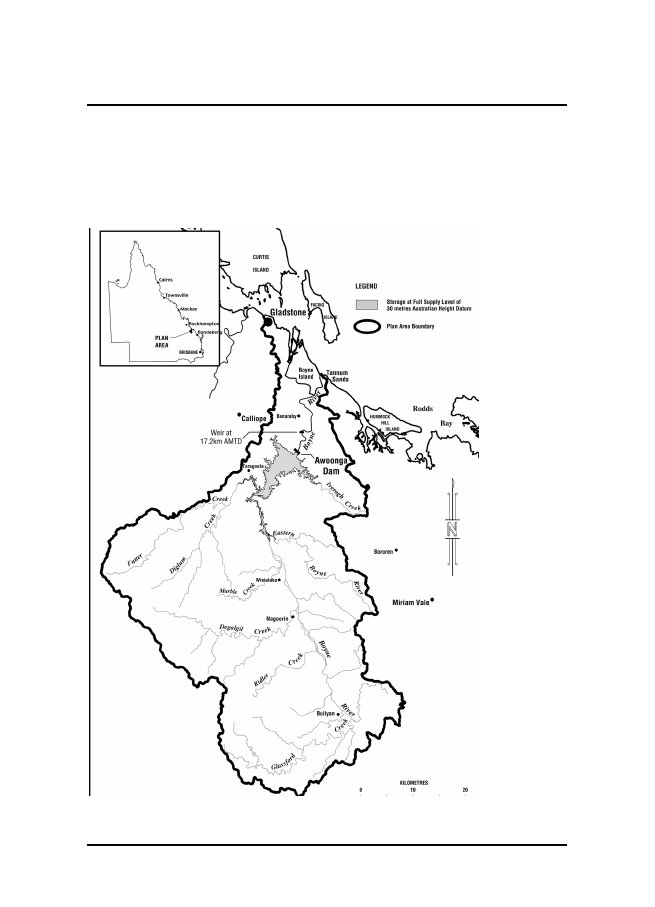
applies to the area within the plan area boundaryshown on the plan area map in schedule
1.Editor’snote—A copy of the plan area map may be
inspected at the department’soffices at the
following places—•41 George Street, Brisbane•212 Quay Street, Rockhampton.5Water to which plan appliesThis
plan applies to water in a watercourse, lake or spring inthe
plan area.Part 3Outcomes for
sustainablemanagement of water6General outcomesWater is to be
managed and allocated—(a)toensureareliableandsecuresupplyofwaterfromAwoonga Dam during the time this plan is in
force; and(b)toensurethesupplyofregulatedwaterintheareadownstream of Awoonga Dam for agriculture
and othersmall scale uses; and(c)to
allow water to be taken upstream of Awoonga Damfull supply
level or from Awoonga Dam for—(i)agriculture and other small scale uses;
andPage 4Current as at 5
January 2001
Water
Resource (Boyne River Basin) Plan 2000Part 3 Outcomes
for sustainable management of water[s 7](ii)urban needs;
and(d)to protect the probability of being
able to obtain waterunder a water allocation.7Ecological outcomesRiver flows are to be managed—(a)tomaintainexistinghabitatsthatsustainnativeplantsand
animals—(i)associatedwithwatercourses,waterholesandriparianzonesupstreamofAwoongaDamfullsupply level;
or(ii)dependant on
pool and associated riparian habitatinthefreshwaterreachdownstreamofAwoongaDam; and(b)toprovidewaterforfinesedimentremovalandlongterm water
quality suitable for—(i)riverineecosystemsupstreamofAwoongaDamfull
supply level; and(ii)ecosystems
downstream of Awoonga Dam; and(c)to
allow movement by marine and estuarine fish over oraround the weir at Boyne River AMTD 17.2km;
and(d)to provide water to stimulate
reproductive processes forestuarine animals downstream of
Awoonga Dam; and(e)toprovidewaterfordeliveryofcatchmentbasednutrientsfromupstreamofAwoongaDamtotheriverine and
estuarine reaches downstream of the dam;and(f)to allow river forming flows upstream
of Awoonga Damfullsupplylevelandintheriverineandestuarinereaches
downstream of the dam; and(g)to allow for an
increase in the frequency and duration ofmarine
conditions in the estuarine reach downstream ofCurrent as at 5
January 2001Page 5
Water
Resource (Boyne River Basin) Plan 2000Part 4
Environmental flow objectives, water allocation security objectives
and performanceindicators[s 8]AwoongaDamleadingtoashifttowardsplantandanimal species that favour or tolerate the
increase.Part 4Environmental
flow objectives,water allocation securityobjectives and performanceindicatorsDivision 1Preliminary8Calculation of objectivesTheenvironmentalflowobjectivesandwaterallocationsecurityobjectivesstatedinthisplanhavebeencalculatedusing the IQQM
computer program.9Calculation of performance
indicators(1)Fortheenvironmentalflowandwaterallocationsecurityobjectives, the performance indicators are
calculated using theIQQMcomputerprogram’ssimulationfortheperiodfrom1
January 1891 to 31 December 1997 (thesimulation
period).(2)If it is not
practicable to use the IQQM computer program tocalculatetheperformanceindicators,theindicatorsmaybecalculated under an assessment method
approved by the chiefexecutive.(3)The
chief executive may approve an assessment method forsubsection(2)onlyifthechiefexecutiveissatisfiedthemethod will accurately assess the impact of
an allocation andmanagement decision or proposal on water
entitlements andnatural ecosystems.Page 6Current as at 5 January 2001
Water
Resource (Boyne River Basin) Plan 2000Part 4
Environmental flow objectives, water allocation security objectives
and performanceindicators[s 10]Division 2Environmental
flow objectives andperformance indicators10Environmental flow objectivesThe
environmental flow objectives for this plan are stated inschedule 2.11Performance indicatorsTheperformanceindicatorsfortheenvironmentalflowobjectives are as follows—(a)average summer flow;(b)mean annual flow;(c)monthly low flows;(d)number of days of flow to inundate riparian
zone;(e)number of river forming flows;(f)number of trigger flows.Division 3Water allocation
security objectiveand performance indicator12Water allocation security
objectiveFor water allocations relating to Awoonga
Dam, the monthlyreliability of supply of water under the
allocations during thesimulation period must be at
least—(a)ifthedam’sfullsupplylevelisnotmorethan30mAHD—99%; or(b)if
the full supply level is more than 30m AHD—100%.Current as at 5 January 2001Page
7
Water
Resource (Boyne River Basin) Plan 2000Part 5 Strategies
for achieving outcomes[s 13]13Performance indicatorTheperformanceindicatorforthewaterallocationsecurityobjectiveisthemonthlyreliabilityofsupplyofwaterfromAwoonga Dam during the simulation
period.Part 5Strategies for
achievingoutcomes14Decisions about allocating waterDecisions about the future allocation of
water in the plan areamust be consistent with—(a)the environmental flow objectives
stated in schedule 2;and(b)the
water allocation security objective stated in section12.15Restriction on
full supply level of Awoonga DamFull supply
level for Awoonga Dam must not be more than45m AHD.16Restriction on volume of water
available from AwoongaDam(1)ThemaximumvolumeofwateravailabletotheGladstoneArea
Water Board from Awoonga Dam is as follows—(a)atfullsupplylevel30mAHD—63000megalitresayear;(b)atfullsupplylevel45m
AHD—113600megalitresayear.Page 8Current as at 5 January 2001
Water
Resource (Boyne River Basin) Plan 2000Part 5 Strategies
for achieving outcomes[s 17](2)Forafullsupplylevelthatisbetweenthelevelsstatedinsubsection (1)(a) and (b), the maximum
volume is calculatedusing the IQQM computer
program.17Releases from Awoonga Dam for the
environment(1)This section applies if the full
supply level of Awoonga Damis more than 30m
AHD.(2)Appropriate infrastructure must be
incorporated into the damto accommodate releases for the
environment downstream ofthe dam.(3)Water released downstream from the dam must
be from theupper oxygenated layers of water in the
dam.(4)Subsections (5) to (7) apply if the
dam’s actual water level isat least 30m
AHD.(5)For each day of a month stated in
schedule 3, column 1, thefollowing volume of water must be
released from the dam forthe benefit of the downstream
environment—(a)the volume stated for the month in
schedule 3, column2; or(b)for
any day on which the stream flow into the dam islessthanthevolumementionedinparagraph(a)—thevolume of the stream flow.(6)Subsection (7) applies whenever the
stream flow into the damisatleast3210
megalitresadayfor4ormoreconsecutivedays (theconsecutive inflow days).(7)For the benefit of the environment
downstream of the dam, anaverageofatleast3210
megalitresofwateradaymustbereleased from the dam—(a)immediately after day 4 of the consecutive
inflow daysends; and(b)foranequalnumberofconsecutivedaysastheconsecutive
inflow days.Current as at 5 January 2001Page
9
Water
Resource (Boyne River Basin) Plan 2000Part 5 Strategies
for achieving outcomes[s 18]18Releases from Awoonga Dam for downstream
users(1)AppropriateinfrastructuremustbeincorporatedintoAwoonga Damtoaccommodatereleasesforlicenseesandpermittees downstream of the dam.(2)Water released downstream from the dam
must be from theupper oxygenated layers of water in the
dam.(3)Sufficientwatermustbereleasedforthelicenseesandpermittees to be able to take the amount of
water allowed tobe taken under their licences or
permits.19Restrictions on taking water from
Boyne Riverdownstream of Awoonga DamThe
chief executive may grant a licence for taking water fromthe
Boyne River downstream of Awoonga Dam (therelevantarea) only if the
volume of water allowed to be taken underthe
licence—(a)is not more than 40 megalitres a year;
and(b)does not result in the total volume of
water allowed to betaken from the relevant area under licences
being morethan—(i)ifthedam’sfullsupplylevelisnotmorethan30m
AHD—400 megalitres a year; or(ii)ifthefullsupplylevelismorethan30m
AHD—800 megalitres a year.20Restriction on
taking water upstream of Awoonga Damfull supply level
or from Awoonga Dam(1)The chief executive may grant a
licence or permit for takingwater upstream
of Awoonga Dam full supply level or fromAwoonga Dam
(therelevant area) only
if—(a)thevolumeofwaterallowedtobetakenunderthelicence or permit is not more than—(i)for stock and domestic purposes—20
megalitres ayear; orPage 10Current as at 5 January 2001
Water
Resource (Boyne River Basin) Plan 2000Part 5 Strategies
for achieving outcomes[s 20](ii)for
town water supply—200 megalitres a year; or(iii)for
other purposes—160 megalitres a year; and(b)thevolumeofwaterallowedtobetakenunderthelicence or permit does not result in the
total volume ofwater allowed to be taken from the relevant
area underlicences or permits being more than—(i)for town water supply—200 megalitres a
year; or(ii)for purposes
other than town water supply, stock,domestic or
temporary purposes—(A)if the dam’s full supply level is not
more than30m AHD—1500 megalitres a year; and(B)ifthedam’sfullsupplylevelismorethan30m
AHD—3000 megalitres a year; and(c)the
chief executive imposes on the licence or permit acondition that water may be taken from a
watercourse,lake or spring in the relevant area only
if—(i)thewaterinthewatercourse,lakeorspringisflowing; and(ii)takingthewaterdoesnotstopthewaterinthewatercourse,lakeorspringflowingimmediatelydownstream of
the point where the water is taken.(2)Subsection (1)(c) does not apply to—(a)apermitforstockordomesticpurposesorfortownwater supply; or(b)a
licence to take from Awoonga Dam.(3)In
subsection (1)(b)(ii)—temporary purposemeans a purpose
for which a permit maybegrantedundertheWaterResourcesAct1989,section56(1)(b).Current as at 5
January 2001Page 11
Water
Resource (Boyne River Basin) Plan 2000Part 5 Strategies
for achieving outcomes[s 21]21Entitlement expressed as an area(1)This section applies if a licence has
an entitlement expressedas an area.(2)To
calculate, for section 20(1)(b), the total volume of waterassumedtobetakenfromtherelevantarea,thevolumeofwater, in megalitres, assumed to be taken
under the licence iscalculated by multiplying the area in
hectares by 4.4.(3)Thechiefexecutivemustamendthelicencetostatetheentitlement in megalitres.22Requirement to consider
criteria(1)Thechiefexecutivemustconsiderthefollowingcriteriaindecidinganapplicationfororaboutalicenceorpermitrelating to the
plan area or in imposing conditions on a licenceor
permit—(a)the purpose for which the water is
intended to be taken;(b)the volume of
water intended to be taken;(c)the
availability of water for the intended purpose;(d)the
potential impact of the proposed taking on—(i)theentitlementsofallusersofwaterintheplanarea; and(ii)theecologicalvalueandfunctionofinstreamenvironmentsandrelatedareasincluding,forexample, riparian zones;(e)the
efficiency and sustainability of the proposed taking;(f)theavailabilityofanalternativewatersupplyfortheintendedpurposeincludingthemoreefficientuseofwater already
available to the licensee or permittee;(g)whether the volume of water intended to be
taken underthelicenceorpermitshouldberestrictedorameterapprovedbythechiefexecutiveusedtomeasurethevolume of water taken;Page 12Current as at 5 January 2001
Water
Resource (Boyne River Basin) Plan 2000Part 6
Implementing plan[s 23](h)whether the taking should be restricted
during particularperiods, including, for example,
when—(i)there is no water flow in the
watercourse; or(ii)the flow is
insufficient for downstream water usersor to sustain
the health of ecosystems; or(iii)water is released for the benefit of the
environmentdownstream of the dam;(i)whether the proposed taking may restrict the
movementof fish or other aquatic species;(j)the extent to which rapid artificial
variations in instreamwater levels may adversely affect the
environment;(k)the impact of water infrastructure on
water quality;(l)theimpactonthenaturalvariabilityanddurationofseasonal streamflow patterns.(2)This section does not limit the
matters the chief executive mayconsider in
deciding an application or imposing conditions.(3)However,anyothermattersconsideredmustbeconsistentwith the
outcomes under part 3.Part 6Implementing
plan23Schedule of proposed arrangements for
implementingplan(1)Aresourceoperationsplanis
tobepreparedfor,butisnotlimited to, the following purposes—(a)toconvertanexistingauthorisationfortheAwoongaDamfullsupplylevel(thepriorityarea)heldbytheGladstone Area Water Board to a water
allocation; or(b)to grant unallocated water to the
Gladstone Area WaterBoard from the priority area;
orCurrent as at 5 January 2001Page
13
Water
Resource (Boyne River Basin) Plan 2000Part 7 Monitoring
and reporting requirements[s 24](c)tostatethedetailsoftheprocedureforreleasesfromAwoonga Dam under sections 17 and 18;
or(d)to implement the monitoring
requirements in part 7.(2)It is proposed
to prepare the resource operations plan within9 months after
the commencement of this plan.(3)The
chief executive, in preparing a resource operations planforthepurposestatedinsubsection(1)(b),mustconsiderarrangementsbetweencurrentwaterusersdownstreamofAwoongaDamtoAMTD 17.2kmandtheGladstoneAreaWater Board about managing the taking of the
water.Part 7Monitoring and
reportingrequirements24Monitoring(1)The
monitoring requirements for the plan area are—(a)water monitoring, in relation to—(i)river flow; and(ii)diversions of water; and(iii)water quality; and(b)natural ecosystems monitoring, in relation
to—(i)the condition of riverine and
estuarine habitats andassociated plants and animals;
and(ii)river forming
flows.(2)The monitoring requirements are to be
achieved by—(a)monitoring programs undertaken by
water infrastructureoperators under a resource operations
plan; and(b)monitoringprogramsadministeredbyrelevantStateagencies.Page 14Current as at 5 January 2001
Water
Resource (Boyne River Basin) Plan 2000Part 7 Monitoring
and reporting requirements[s 25]25Monitoring programs undertaken by the
waterinfrastructure operator of Awoonga
Dam(1)ThewaterinfrastructureoperatorofAwoongaDammustdevelopandundertakemonitoringprograms,satisfactorytothe
chief executive, that include monitoring the following inthe
dam and downstream to the mouth of the Boyne River—(a)water,inrelationtothemattersstatedinsection24(1)(a);(b)natural ecosystems, in relation to the
matters stated insection 24(1)(b).(2)Forsubsection(1)(a),theprogrammustincludemonitoringthe
following—(a)water quantity including—(i)inflows to Awoonga Dam; and(ii)thevolume,frequencyanddurationofseasonalreleasesfromAwoongaDamforeachofthefollowing—(A)consumption;(B)the
environment;(C)anyotherpurposedecidedbythechiefexecutive; and(iii)thewaterlevelsinAwoongaDamandatBoyneRiver AMTD 17.3km;(b)theoperationofmulti–levelofftakeandotheroutletworks relating to Awoonga Dam;(c)water quality including—(i)temperature; and(ii)chemical measurements; and(iii)biological
measurements.(3)Themonitoringprogramsmustassistinenablingthechief executive—Current as at 5
January 2001Page 15
Water
Resource (Boyne River Basin) Plan 2000Part 7 Monitoring
and reporting requirements[s 26](a)to
assess the impact of the dam and the release strategystatedinsection 17(5)to(7)ontheplan’secologicaloutcomes;
and(b)to compare the condition of the
natural ecosystems withtheirconditionatthecommencementofthisplaninrelation to the matters stated in
section 24(1)(b).26Water infrastructure operator to give
report(1)Thewaterinfrastructureoperatormustgivethechiefexecutiveawrittenreportcontainingthefollowinginformation—(a)detailsoftheinformationobtainedbymonitoringthematters mentioned in section 25;(b)details of decisions made by the
operator in managingwaterandwaterinfrastructureincluding,forexample,decisions about
the following—(i)restrictions on the taking or supply
of water;(ii)infrastructure
modifications or installations;(c)information about any non-compliance by the
operatorwith a resource operations plan for the plan
area;(d)details of remedial action taken by
the operator—(i)inrelationtoarequirementunderaresourceoperations plan;
or(ii)in response to a
water quality problem;(e)detailsofany emergencyactiontakenbytheoperatorthat may affect
this plan’s outcomes.(2)A report about a
matter mentioned in subsection (1)(a) mustbe given—(a)for each financial year in which the
operator manageswater under this plan; and(b)within3 monthsaftertheendofthefinancialyeartowhich the report relates.Page
16Current as at 5 January 2001
Water
Resource (Boyne River Basin) Plan 2000Part 8 Minister’s
report and amending plan[s 27](3)A
report about a matter mentioned in subsection (1)(b) to (d)must
be given within 1 month after the matter happens.(4)A report about a matter mentioned in
subsection (1)(e) mustbe given the next business day after
the action is taken.Part 8Minister’s report
and amendingplan27Minister’s report
on plan—Act, s 53The Minister’s report1on
this plan must be prepared—(a)for
each financial year the plan is in force; and(b)within6monthsaftertheendofthefinancialyeartowhich the report relates.28Minor amendment of plan—Act, s
57The following types of amendments may be
made to this planunder section 57(b) of the Act—(a)anamendmenttoextendanenvironmentalflowobjective or water allocation security
objective to otherpartsoftheplanareaiftheamendmentachievesanequivalentorimprovedecologicaloutcomewithoutadverselyaffectingthewaterallocationsecurityobjectives in the plan area or the outcomes
under part 3;(b)anamendmentoradditionofanenvironmentalflowobjectiveiftheamendmentoradditionachievesanequivalentorimprovedecologicaloutcomewithoutadverselyaffectingthewaterallocationsecurityobjectives in the plan area or the outcomes
under part 3;1See section 54 (Matters the reports
must include) of the Act.Current as at 5 January 2001Page
17
Water
Resource (Boyne River Basin) Plan 2000Part 8 Minister’s
report and amending plan[s 28](c)an
amendment or addition of a water allocation securityobjectiveiftheamendmentoradditiondoesnotadverselyaffectexistingwaterallocations,environmentalflowobjectivesortheoutcomesunderpart
3;(d)an amendment or addition of a
monitoring or reportingrequirement under part 7.Page
18Current as at 5 January 2001
Schedule 1Water Resource
(Boyne River Basin) Plan 2000Schedule 1Plan
area mapsection 4Current as at 5
January 2001Page 19
Water
Resource (Boyne River Basin) Plan 2000Schedule 2Schedule 2Environmental
flow objectivessections 10 and 14(a)1Definitions for sch 2In this
schedule—average summer flowmeans the total
volume of flow in themonthsfromDecembertoMarchinthesimulationperioddivided by the number of years in the
simulation period.meanannualflowmeansthetotalvolumeofflowinthesimulationperioddividedbythenumberofyearsinthesimulation period.monthly low
flows, for a named month, means the
percentageoftimeoverthesimulationperiodthatdailyflowforthemonth is at least the daily flow that
occurred 80% of the timefor the same month in the
pre-development flow pattern.number of days
of flow to inundate riparian zonemeans thenumberofdaysinthesimulationperiodthattheflowisatleast 15000 megalitres a day.number of river forming flowsmeans the number of times inthe
simulation period that the flow reaches 50000 megalitres aday.numberoftriggerflowsmeansthenumberoftimesinthesimulation period that the flow
reaches 3210 megalitres a day.2Environmental flow objectives for Boyne
River at AMTD17.2kmThe following
are the environmental flow objectives for theBoyne River at
AMTD 17.2 km—•the average summer flow, expressed as
a percentage ofthe average summer flow for the
pre-development flowpattern, must be at least 61%Page
20Current as at 5 January 2001
Water
Resource (Boyne River Basin) Plan 2000Schedule 2•the mean annual flow, expressed as a
percentage of themean annual flow for the pre-development
flow pattern,must be at least 57%•if
the full supply level of Awoonga Dam is more than30m
AHD,themonthlylowflowsforeachnamedmonth must be between 94% and 102%•the number of days of flow to inundate
riparian zone,expressed as a percentage of the number of
days of flowto inundate riparian zone for the
pre-development flowpattern, must be at least 57%•thenumberofriverformingflows,expressedasapercentage of
the number of river forming flows for thepre-development
flow pattern, must be at least 41%•the
number of trigger flows, expressed as a percentageof
the number of trigger flows for the pre-developmentflow
pattern, must be at least 56%.3Environmental flow objectives for the
combined flowsentering Awoonga DamThe following
are the environmental flow objectives for thecombined flows
entering Awoonga Dam—•the average
summer flow, expressed as a percentage ofthe average
summer flow for the pre-development flowpattern, must be
at least 99%•the mean annual flow, expressed as a
percentage of themean annual flow for the pre-development
flow pattern,must be at least 99%•the
monthly low flows for each named month must bebetween 85% and
100%•the number of days of flow to inundate
riparian zone,expressed as a percentage of the number of
days of flowto inundate riparian zone for the
pre-development flowpattern, must be at least 99%Current as at 5 January 2001Page
21
Water
Resource (Boyne River Basin) Plan 2000Schedule 2•thenumberofriverformingflows,expressedasapercentage of
the number of river forming flows for thepre-development
flow pattern, must be at least 99%•the
number of trigger flows, expressed as a percentageof
the number of trigger flows for the pre-developmentflow
pattern, must be at least 99%.Page 22Current as at 5 January 2001
Schedule 3Column 1MonthJanuaryFebruaryMarchAprilMayJuneJulyAugustSeptemberOctoberNovemberDecemberWater
Resource (Boyne River Basin) Plan 2000Schedule 3Daily
water releases for thedownstream environmentsection 17(5)Column 2Megalitres a day175462523029323024231720Current as at 5
January 2001Page 23
Water
Resource (Boyne River Basin) Plan 2000Schedule 4Schedule 4Dictionarysection 3Page 24AHDmeanstheAustralianheightdatumadoptedbytheNational Mapping
Council of Australia for referencing a levelor height back
to a standard base level.AMTDmeans the
adopted middle thread distance which is thedistanceinkilometres,measuredalongthemiddleofawatercourse, that a specific point in
the watercourse is fromthewatercourse’smouthorjunctionwiththemainwatercourse.IQQM computer
programmeans the department’s IntegratedQuantityandQualityModellingcomputerprogramthatsimulatesdailystreamflows,flowmanagement,storages,releases,instreaminfrastructure,waterdiversions,waterdemands and other hydrologic events in the
plan area.licencemeans—(a)a water licence; or(b)a licence under theWaterResourcesAct1989.megalitremeans 1 million
litres.multi-levelofftake,foradamorweir,meansanoutletstructure in the
dam or weir that is used to take water out ofthe dam or weir
at different levels below the water surface.permitmeans—(a)a
water permit; or(b)a permit under theWaterResourcesAct1989, section
56or 57.pre-developmentflowpatternmeanstheflowpatternthatwouldhaveoccurredduringthesimulationperiodiftherewere no dams or
other instream infrastructure and no waterbeing taken
under licences or permits in the plan area.priority
areasee section 23.Current as at 5
January 2001
Water
Resource (Boyne River Basin) Plan 2000Schedule 4release,forwaterfromadam,meansthewaterpassesdownstreamfromthedam,eitherthroughthedamoutletworks or over
the dam spillway.river forming flowmeans a flow
that structures and maintainsthe river
channel features.simulation periodsee section
9.Current as at 5 January 2001Page
25
Water
Resource (Boyne River Basin) Plan 2000EndnotesEndnotes1Index to endnotesPage2Date to which amendments incorporated
. . . . . . . . . . . . . . . . . . . . . . . . . . . . . . . .
.263Key . . . . . . . . . . . . . . . . .
. . . . . . . . . . . . . . . . . . . . . . . . . . . . . . . . . .
. . . . . . . . . . .264Table of reprints
. . . . . . . . . . . . . . . . . . . . . . . . . . . . . . . . . .
. . . . . . . . . . . . . . . . . .265List
of legislation . . . . . . . . . . . . . . . . . . . . . . . . . .
. . . . . . . . . . . . . . . . . . . . . . . . .272Date to which amendments
incorporatedThis is the reprint date mentioned in the
Reprints Act 1992, section 5(c).However,
noamendments have commenced operation on or
before that day.Future amendments of theWater Resource
(Boyne River Basin) Plan 2000 may be made in accordance with
thisreprint under the Reprints Act 1992, section
49.3KeyKey to
abbreviations in list of legislation and annotationsKeyAIAamdamdtchdefdivexpgazhdginslapnotfdo in comorigpparaprecpresprevExplanation=Acts
Interpretation Act 1954=amended=amendment=chapter=definition=division=expires/expired=gazette=heading=inserted=lapsed=notified=order in council=omitted=original=page=paragraph=preceding=present=previousKey(prev)procprovptpubdR[X]RArelocrenumrep(retro)rvsschsdivSIASIRSLsubunnumExplanation=previously=proclamation=provision=part=published=Reprint No.[X]=Reprints Act 1992=relocated=renumbered=repealed=retrospectively=revised edition=section=schedule=subdivision=Statutory Instruments Act 1992=Statutory Instruments Regulation
2002=subordinate legislation=substituted=unnumberedPage 26Current as at 5 January 2001