Transport Operations (Passenger Transport) Standard 2000
Transport Operations (Passenger Transport) Standard
2000
QueenslandTransportOperations(PassengerTransport)Act1994TransportOperations(PassengerTransport)Standard2000Reprinted as in force on 2 January
2009Reprint No. 2BThis reprint is
prepared bythe Office of the Queensland Parliamentary
CounselWarning—This reprint is not an authorised
copyNOT FURTHER AMENDEDLAST REPRINT
BEFORE REPEALSee 2010 SL No. 224 s 43
Information about this reprintThis
standard is reprinted as at 2 January 2009. The reprint shows the
law as amended byall amendments that commenced on or before
that day (Reprints Act 1992 s 5(c)).The reprint
includes a reference to the law by which each amendment was
made—see listof legislation and list of annotations in
endnotes. Also see list of legislation for anyuncommenced
amendments.This page is specific to this reprint. See
previous reprints for information about earlierchanges made under
the Reprints Act 1992. A table of reprints is included in the
endnotes.Also see endnotes for information
about—•when provisions commenced•editorial changes made in earlier
reprints.SpellingThe spelling of
certain words or phrases may be inconsistent in this reprint or
with otherreprints because of changes made in various
editions of the Macquarie Dictionary (forexample, in the
dictionary, ‘lodgement’ has replaced ‘lodgment’). Variations of
spellingwill be updated in the next authorised
reprint.Dates shown on reprintsReprints dated at
last amendmentAllreprintsproducedonorafter1July2002,authorised (that is, hard copy) and
unauthorised (that is, electronic), are dated as at the lastdate
of amendment. Previously reprints were dated as at the date of
publication. If anauthorised reprint is dated earlier than an
unauthorised version published before 1 July2002,itmeansthelegislationwasnotfurtheramendedandthereprintdateisthecommencement of the last amendment.If the
date of an authorised reprint is the same as the date shown for an
unauthorisedversion previously published, it merely means
that the unauthorised version was publishedbeforetheauthorisedversion.Also,anyrevisededitionofthepreviouslypublishedunauthorised
version will have the same date as that version.Replacement reprint dateIf the date of an
authorised reprint is the same as the dateshown on another
authorised reprint it means that one is the replacement of the
other.
s17Transport
Operations (Passenger Transport) Standard2000s4Transport Operations (Passenger
Transport)Standard 2000[as amended by
all amendments that commenced on or before 2 January 2009]Part
1Preliminary1Short
titleThisstandardmaybecitedastheTransportOperations(Passenger
Transport) Standard 2000.2CommencementThis standard
commences on 1 May 2000.Part 1AInterpretation3DefinitionsThe dictionary in
schedule 4 defines particular words used inthis
standard.4Meaning ofincident(1)Anincidentisaneventinvolvingarelevantvehicleorthedriver of, or a
passenger in, a relevant vehicle and a relevantservice if the
event—(a)disrupts the provision of the relevant
service for morethan 30 minutes after the scheduled or
agreed time forthe provision of the relevant service;
or(b)prevents the provision of the relevant
service.
s58Transport
Operations (Passenger Transport) Standard2000s5(2)An incident
includes any of the following—(a)an
event involving the relevant vehicle in which a personis
injured or killed;(b)the breakdown of, or an accident
involving, the relevantvehicle;(c)a
fire in the relevant vehicle;(d)unsafe road conditions for the relevant
vehicle;(e)aterroristactorterrorism,withinthemeaningofthePolicePowersandResponsibilitiesAct2000,section211,
involving the relevant vehicle or the driver of, or apassenger in, the relevant vehicle;(f)the use, or attempted or threatened
use of, a chemical,explosive or weapon by a person in a way
that involvesthe relevant vehicle or the driver of, or a
passenger in,the relevant vehicle;(g)an
assault or threat to the driver of, or a passenger in, therelevant vehicle;(h)amedicalemergencyinvolvingthedriverof,orapassenger in, the
relevant vehicle.(3)In this section—weaponmeans
a weapon under theWeapons Act 1990.Part
2Drivers5Purpose of pt 2The purpose of
this part is to enhance the level of safety andcustomerserviceprovidedbydriversintheprovisionofpublic passenger services by imposing
obligations—(a)onapplicantsforagrantorrenewalofdriverauthorisation;
and(b)about operating relevant
vehicles.
s69Transport
Operations (Passenger Transport) Standard2000s66Qualifications
for operating relevant vehicles that aremotorbikes(1)Anapplicantfordriverauthorisationfortheoperationofarelevantvehiclethatisamotorbikemustholdaprescribedlicence of the appropriate class.(2)The applicant must also, subject to
subsection (3)—(a)have held continuously for at least 5
years—(i)an open or provisional licence for a
motorbike; or(ii)a corresponding licence to an open or
provisionallicence for a motorbike; or(iii)a foreign driver
licence for a motorbike; or(iv)aseriesofanyofthelicencesmentionedinsubparagraph (i), (ii) or (iii);
or(b)havepassedanapprovedcompetencetestfortheoperationofamotorbike with apillionpassengerandhave
held continuously for at least 3 years—(i)an
open or provisional licence for a motorbike; or(ii)a
corresponding licence to an open or provisionallicence for a
motorbike; or(iii)a foreign driver
licence for a motorbike; or(iv)aseriesofanyofthelicencesmentionedinsubparagraph (i), (ii) or
(iii).(3)Also, for at least 2 years of the
continuous 5 or 3 year periodmentionedinsubsection(2),theapplicantmusthaveheldcontinuously—(a)an
open or provisional licence for a motorbike; or(b)acorrespondinglicencetoanopenorprovisionallicence for a
motorbike; or(c)a series of any of the licences
mentioned in paragraph(a) or (b).(4)Apersonmustnotoperatearelevantvehiclethatisamotorbike unless the person holds a
prescribed licence of theappropriate class.
s
710Transport Operations (Passenger
Transport) Standard2000s77Qualifications for operating relevant
vehicles other thanmotorbikes(1)Anapplicantfordriverauthorisationfortheoperationofarelevantvehicle,otherthanamotorbike,mustholdaprescribed
licence of the appropriate class.(2)The
applicant must also, subject to subsection (3)—(a)have
held continuously for at least 3 years—(i)an
open or provisional licence for a car, truck orbus; or(ii)a corresponding licence to an open or
provisionallicence for a car, truck or bus; or(iii)a foreign driver
licence for a car, truck or bus; or(iv)aseriesofanyofthelicencesmentionedinsubparagraph (i), (ii) or (iii);
or(b)havepassedanapprovedcompetencetestfortheoperationofthetypeofvehiclethepersonintendstodrive under the driver
authorisation.(3)Also,foratleast2yearsofthecontinuous3yearperiodmentionedinsubsection(2)(a)orforatleast2yearsforsubsection(2)(b),theapplicantmusthaveheldcontinuously—(a)an
open or provisional licence for a car, truck or bus; or(b)acorrespondinglicencetoanopenorprovisionallicence for a
car, truck or bus; or(c)a series of any
of the licences mentioned in paragraph(a) or
(b).(4)However,subsection(3)doesnotapplyifthedriverauthorisation
applied for is for a general route service, schoolservice, taxi service, limousine service,
community transportservice or courtesy transport
service.(4A)Subsections(1)to(4)donotapplytoapersonseekingarestricted driver
authorisation.
s
8A11Transport Operations (Passenger
Transport) Standard2000s9(5)Apersonmustnotoperatearelevantvehicle,otherthanamotorbike, unless the person holds a
prescribed licence of theappropriate class.8ALicence requirements for restricted driver
authorisation(1)Apersonisnoteligibletobegrantedarestricteddriverauthorisation by an operator unless the
person—(a)holds a prescribed licence of the
appropriate class; and(b)has held
continuously for at least 3 years—(i)an
open or provisional licence for a car, truck orbus; or(ii)a corresponding licence to an open or
provisionallicence for a car, truck or bus; or(iii)aseriesofanyofthelicencesmentionedinsubparagraph (i) or (ii).(2)A person must not operate a public
passenger vehicle underrestricteddriverauthorisationunlessthepersonholdsaprescribed licence of the appropriate
class.9Particular qualification to drive a
taxi(1)Anapplicantfordriverauthorisationforarelevantvehiclethat
is a taxi must—(a)be able to speak and understand
English; and(b)haveaknowledgeofcommondestinationsandmajorconnecting roads
within the taxi service area where theapplicant intends
to drive the taxi; and(c)either—(i)have successfully completed a training
course fortaxi drivers specified by the chief
executive; or(ii)have attained competency in each of
the followingRoadTransportCompetencyStandardsapprovedbytheformerAustralianNationalTrainingAuthorityestablishedundertherepealed
s
1012Transport Operations (Passenger
Transport) Standard2000s 11AustralianNationalTrainingAuthorityAct1992(Cwlth)—(A)Followoccupationalhealthandsafetyprocedures;(B)Drive
a taxicab;(C)Apply customer service skills;(D)Apply quality procedures;(E)Transport persons with
disabilities.(2)Apersonmustnotoperatearelevantvehiclethatisataxiunlessthepersonhasaknowledgeofcommondestinationsand major
connecting roads within the taxi service area wherethe
person intends to drive the taxi.(3)An
applicant for renewal of driver authorisation for a relevantvehicle that is a taxi must, if required by
the chief executive,have successfully completed a training
course for taxi driversspecified by the chief
executive.(4)This section is in addition to, and
does not limit, section 7.10Alcohol and
drugs(1)Adriverofarelevantvehiclemusthaveabloodalcoholconcentration of
zero while operating the vehicle.(2)A
driver of a relevant vehicle must not be under the influenceof a
drug while operating the vehicle.11Fatigue management(1)A
driver of a relevant vehicle must not operate the vehicle ifthe
driver’s fatigue level may endanger passenger safety.(2)Thedriverdoesnotcontravenesubsection(1)ifthedrivercomplieswithanyrequirementsaboutfatiguemanagementapplying to the driver under—(a)theTransportOperations(RoadUseManagement—FatigueManagement)Regulation2008;or
s
1213Transport Operations (Passenger
Transport) Standard2000s 12(b)analternativecomplianceschemeaboutfatiguemanagement
approved under theTransport Operations(Road Use
Management) Act 1995.12Operational
safety of vehicles(1)A driver of a relevant vehicle must
operate it safely.(2)Without limiting subsection (1) the
driver must ensure—(a)the vehicle is not overloaded;
and(b)ifthevehicleisusedforlongdistancescheduledpassenger services or tourist services, it
does not carrystanding passengers; and(c)if
the vehicle is a bus that carries standing passengers—(i)the bus is specifically designed and
constructed forthe purpose; and(ii)no
passenger stands for more than 20km; and(iii)whencarryingstandingpassengers,thebusdoesnot travel on a
road notified by the chief executive,by gazette
notice, as a road on which the bus mustnot carry
standing passengers.(3)Despite subsection (2)(c), a driver of
a bus fitted with seatbeltsfor every seated passenger must ensure
the bus is used only tocarryseatedpassengers,unlesseachseatofthebusisoccupied.(4)A
driver of a bus mentioned in subsection (3) that carries apermitted standing passenger during the
driver’s shift must, attheendoftheshift,givethefollowinginformationtotheoperator of the bus —(a)the date and time when, and place
where, the passengerboardedthebustobecomeapermittedstandingpassenger; and(b)the
number of passengers, including the passenger, whoboarded the bus when the passenger boarded
it.
s
1314Transport Operations (Passenger
Transport) Standard2000s 14(5)In
this section—permitted standing passengermeans
a passenger the bus ispermitted to carry as a standing
passenger under subsection(3).13Seating(1)A
driver of a relevant vehicle must take reasonable steps toensure that no more than 1 passenger sits in
any adult seat inthe vehicle.(2)Howeverifthevehicleisabus,3primaryschoolorpre-school children may sit in a bench
type bus seat designedfor 2 adults if—(a)either—(i)the
seat is not fitted with any seat belts or approvedrestraints; or(ii)theseatisfittedwitheitheraseatbeltoranapproved restraint for each of the 3
children; and(b)the placement and construction of the
seat allows; and(c)nochildsitsintheseatformorethanatotalof90minutes while any
2 other children sit in the seat.(3)Also,aninfantpassengermayoccupythesameseatasanother passenger if—(a)the
vehicle is a bus; or(b)the vehicle is a taxi and the infant
passenger does so incircumstancesthatdonotcontravenetheQueenslandRoad
Rules.114Customer
service(1)A driver of a relevant vehicle must be
reasonably courteous topassengers and the public.1See the Queensland Road Rules,
sections 266 (Wearing of seatbelts by passengersunder
16 years old) and 267 (Exemptions from wearing
seatbelts).
s
1515Transport Operations (Passenger
Transport) Standard2000s 15(2)A
driver of a vehicle providing a general route service, otherthan
a school service, must provide the service in accordancewith
the advertised schedules of the operator of the vehicle,unlesspreventedfromdoingsobyanunforeseeablecircumstance.Examples of an
unforeseeable circumstance—•an
incident•an accident,whetheror
notinvolvingthevehicle providing thepublic passenger
service•flooding or storm damageExample of a foreseeable circumstance—traffic volume(2A)Adriverofavehicleprovidingarelevantservicethatisaschool service must provide the service in
accordance with thetimetable of the operator of the service,
unless prevented fromdoing so by an unforeseeable
circumstance.(2B)Theschedules,andservicesunderthetimetable,mustberealistically achievable.(3)If an incident happens, a driver of a
relevant vehicle must tellpassengers in the vehicle—(a)thereasonforthedisruptionorpreventionoftheprovision of the relevant service;
and(b)the arrangements being made for the
completion of therelevant service.(4)A
taxi driver must have a knowledge of common destinationsand
major connecting roads within the taxi service area wherethe
driver drives the taxi.15Compliance with
certain transport legislationA driver of a
relevant vehicle must comply with all provisionsoftheTransportOperations(RoadUseManagement)Act19952imposing an obligation, prohibition,
restriction or other2A reference to the Act includes a
reference to the statutory instruments made or inforce
under the Act. See theActs Interpretation Act 1954,
section 7.
s
15A16Transport Operations (Passenger
Transport) Standard2000s 15Brequirement on
the driver in relation to—(a)the driving, use
or operation of the vehicle; or(b)being
in charge of the vehicle; or(c)thevehicle(including,forexample,itsdesign,condition,
equipment, mass, loading or signs).15ACompliance with code of conductIf a
school child is travelling on a relevant vehicle that is abus,thedriverofthebusmustcomplywiththecodeofconduct.15BBus
carrying school students on a no standingpassenger
road(1)This section applies to a bus
that—(a)is descending a road notified under
section 12(2)(c)(iii)or 21(2)(c)(iii) as a road on which a
bus must not carrystandingpassengers(anostandingpassengerroad);and(b)is
carrying school students on a general route service, orschoolservice,onajourneythatis,orispartof,ajourney to or from a school;
and(c)is or was introduced into service by
the operator of theservice after 4 July 2005 for a general
route service, orschoolservice,providedunderaservicecontract,TransLink service contract or prescribed
school servicecontract.(2)If
the bus is—(a)alightbusbuilttocarrymorethan16passengers,whetherseatedorstanding,aswellasthedriverandcrew;
and(b)being used to provide a school
service;the driver of the bus must activate the
exhaust brake fitted tothe bus.
s
1617Transport Operations (Passenger
Transport) Standard2000s 18(3)If
the bus is a heavy bus, the driver of the bus must use thepower-train retarder fitted to the bus under
schedule 1, section29(1)(c).Part 3Operators16DefinitionsIn this
part—incidentmanagementplanmeansaplancomplyingwithsection 31A.incidentreportmeansareportcomplyingwithsection31B(1).17Purpose of pt 3The purpose of
this part is to enhance the level of safety andcustomer service
in the provision of public passenger servicesby imposing
obligations—(a)onapplicantsforagrantorrenewalofoperatoraccreditation;
and(b)on operators of relevant
services.18Training of operators(1)Anapplicantforoperatoraccreditationmustsuccessfullycomplete a
training course specified by the chief executive inthe
matters mentioned in section 14 of the Act.(2)Anapplicantforrenewalofoperatoraccreditationmayberequired to successfully complete a
training course mentionedin subsection (1).(3)However,thechiefexecutivemayacceptanotherqualificationfromtheapplicantascompliancewithsubsection(1)or(2)ifthechiefexecutiveconsidersthe
s
1918Transport Operations (Passenger
Transport) Standard2000s 19qualification
equivalent to, or better than, the training underthe
training course mentioned in subsection (1).(4)In
this section—qualificationmeansexperienceortraining,otherthantraining under a training course
mentioned in subsection (1).19Ensuring drivers are trained in obligations
under the Act(1)An operator of a relevant service must
ensure each driver whoistooperateavehicleprovidingtheserviceisgivenanintroduction to the driver’s obligations
under the Act.(2)However, the operator does not
contravene subsection (1) iftheoperatorissatisfied,bydocumentaryevidence,thatthedriver’sexperience,orexperienceandtraining,provideanadequate level of knowledge of the
obligations.(3)An operator of a relevant service must
ensure each driver whooperatesavehicleprovidingtheserviceisgiventraining,underadocumentedtrainingprogram,inthedriver’sobligations under
the Act.(4)For the program mentioned in
subsection (3), the driver mustbegiventhetrainingwithin2monthsofthedriverfirstoperating the vehicle providing the
service.(5)Anoperatorofarelevantservicemustkeepthefollowingrecords—(a)for
subsection (1), evidence of the introduction;Example for
paragraph (a) of evidence of the introduction—training book showing the date, time and
place the driver wasgiven training on a driver’s obligations
under the Act(b)for subsection (2), a copy of the
documentary evidence;(c)forsubsection(3),evidenceofeachdriver’strainingunder
the documented training program.(6)Theevidenceofadriver’strainingunderthedocumentedtraining program
must be enough to ensure the chief executiveis able to
monitor the driver’s progression through the trainingprogram.
s
2019Transport Operations (Passenger
Transport) Standard2000s 21(7)The
records mentioned in subsection (5) must be kept in sucha way
that the chief executive is able to monitor from them theoperator’s compliance with subsections (1)
to (3).20Ensuring drivers comply with fatigue
managementrequirementsAn operator of a
relevant service must take reasonable steps toensurethateachdriverofavehicleprovidingtheservicecomplies with
section 11.21Ensuring operational safety of
vehicles(1)An operator of a relevant service must
take reasonable steps toensure that a vehicle providing the
service is safely operated.(2)Withoutlimitingsubsection(1),theoperatormusttakereasonable steps
to ensure—(a)the vehicle is not overloaded;
and(b)ifthevehicleisusedforlongdistancescheduledpassenger services or tourist services—it
does not carrystanding passengers; and(c)if
the vehicle is a bus, that carries standing passengers—(i)the bus is specifically designed and
constructed forthe purpose; and(ii)no
passenger stands for more than 20km; and(iii)whencarryingstandingpassengers,thebusdoesnot travel on a
road notified by the chief executive,by gazette
notice, as a road on which the bus mustnot carry
standing passengers.(3)Despitesubsection(2)(c),anoperatorofabusfittedwithseatbeltsforeveryseatedpassengermusttakereasonablesteps to ensure
the bus is used only to carry seated passengers,unless each seat of the bus is
occupied.(4)Anoperatorofabusfittedwithseatbeltsforeveryseatedpassenger must—
s
2220Transport Operations (Passenger
Transport) Standard2000s 23(a)have
a written statement of the training to be given toeachdriverofthebusaboutthedriver’sobligationsunder section 12,
including when the bus may be usedunder that
section to carry standing passengers; and(b)on or
after 1 July 2009, if the operator provides a publicpassengerservicethatroutinelycarriesstandingpassengersundersection12—haveawrittenplantoprevent future occasions on which a
standing passengeris carried on a bus, used to provide the
service, underthat section; and(c)follow the plan; and(d)makeawrittenrecordoftheinformationgiventotheoperator under
section 12(4); and(e)keep the record for at least 5
years.22Compliance with vehicle standards
regulation, s 5Anoperatorofarelevantservicemustensurethateachvehicle providing the service complies
with the requirementsforthevehiclestatedinthevehiclestandardsregulation,section 5.22ACompliance with vehicle standards
regulation, s 22An operator of a relevant service must
ensure that the ownerofeachvehicleprovidingtheservicecomplieswiththerequirementsforthevehiclestatedinthevehiclestandardsregulation,
section 22.23Design and construction of bus
manufactured before 20May 1992Anoperatorofarelevantservicemustensurethatabusmanufactured
before 20 May 1992 used to provide the service
s
2421Transport Operations (Passenger
Transport) Standard2000s 25complieswiththeCodeofPractice‘OmnibusLicensingEvaluation S6’ as
issued at August 1992.324Seating(1)An
operator of a relevant service must take reasonable steps toensure that no more than 1 passenger sits in
any adult seat in avehicle used to provide the service.(2)Howeverifthevehicleisabus,3primaryschoolorpre-school children may sit in a bench
type bus seat designedfor 2 adults if—(a)either—(i)the
seat is not fitted with any seat belts or approvedrestraints; or(ii)theseatisfittedwitheitheraseatbeltoranapproved restraint for each of the 3
children; and(b)the placement and construction of the
seat allows; and(c)nochildsitsintheseatformorethanatotalof90minutes while any
2 other children sit in the seat.(3)Also,aninfantpassengermayoccupythesameseatasanother passenger if—(a)the
vehicle is a bus; or(b)the vehicle is a taxi and the infant
passenger does so incircumstancesthatdonotcontravenetheQueenslandRoad
Rules.425Type and age of
vehicles etc.(1)An operator of a relevant service may
only use a vehicle toprovide the service that is of a type
and age suitable to providethe service.3ThiscodeformspartoftheCodeofPractice—CommercialMotorVehicleModifications and
is available for inspection at the offices of the department
atTransport House, Brunswick Street, Fortitude
Valley, Brisbane.4See the Queensland Road Rules,
sections 266 (Wearing of seatbelts by passengersunder
16 years old) and 267 (Exemptions from wearing
seatbelts).
s
2622Transport Operations (Passenger
Transport) Standard2000s 27(2)Theoperatoristakentocomplywithsubsection(1)ifthevehicle complies
with the requirements for the vehicle, if any,stated in
schedule 1.(3)Also, an operator of a relevant
service must comply with theobligations that
apply in relation to the vehicle under schedule1, sections 8(2),
9(2), 10, 29(4), 30(1), (3) and (7), 31, 32(2),(3) or (4), 33(1)
and 34(2).26Compulsory third party
insuranceAn operator of a relevant service must not
operate, or allowsomeoneelsetooperate,avehicleprovidingtheserviceunless the
insurance requirements under theMotor
AccidentInsurance Act 1994for the vehicle
have been complied with.27Maintenance of
vehicles(1)An operator of a relevant service must
have and comply withadocumentedmaintenanceprogramforeachvehicleproviding the service.(2)The
program must provide—(a)for the servicing
and other maintenance of the vehicle toa standard that
complies with, or exceeds, the servicingandmaintenanceprogramspecifiedbythevehicle’smanufacturer;
and(b)foradailypre-tripinspectionofthevehicle,toastandardappropriatetoanexperienceddriverofthatgeneral type of
vehicle, to identify defects in the vehiclethat may endanger
public safety or substantially reducepassenger
comfort; and(c)a system to ensure—(i)defects in the vehicle that come to
the notice of thedriveroranyoneelseinvolvedinprovidingtheservice are reported to the operator and
recorded;and(ii)thevehicleisnotreturnedtoserviceuntilareporteddefectthatmayendangerpublicsafetyhas
been fixed; and
s
2823Transport Operations (Passenger
Transport) Standard2000s 29(iii)reporteddefectsinthevehiclethatsubstantiallyreducepassengercomfortarefixedwithinareasonable time; and(iv)actiontakentofixdefectsinthevehicleisrecorded.(3)An
operator of a relevantservice must keep a record of
allservicing or other maintenance, including a
record of the dailypre-tripinspection,oneachvehicleusedtoprovidetheservice.(4)Subsection(3)appliestoallmaintenance,whetherornotperformed under
the program.28Customer service(1)Anoperatorofarelevantservicethatisataxiserviceoraserviceprovidingscheduledservicesmusttakereasonablestepstoensuretheoperator’sdriversarecompetentinproviding customer service.(2)Withoutlimitingsubsection(1),anoperatorofarelevantserviceprovidingscheduledservicesmusttakereasonablesteps to ensure
drivers are aware of the timetables and routesfor the
services.29Vehicles to be maintained in clean,
tidy and comfortablecondition etc.(1)This
section applies to an operator of a relevant service that isageneralrouteservice,schoolservice,taxiserviceorlimousine service.(2)The
operator must take reasonable steps to ensure that eachvehicle providing the service—(a)complies with any requirements for the
vehicle stated inschedule 3, part 1; and(b)ismaintainedinaclean,tidyandreasonablycomfortable
condition.(3)The operator is taken to comply with
subsection (2)(b) if thevehicle is maintained in the way
stated in schedule 3, part 2.
s
3024Transport Operations (Passenger
Transport) Standard2000s 3130Access to information about services
provided(1)This section applies to an operator of
a relevant service thatis—(a)a
general route service or school service; or(b)a
taxi service if bookings for the service are not taken bya
service for the administration of taxi services.(2)The operator must provide the public
with a convenient wayofobtaininginformationaboutthegeneralrouteservice,school service or
taxi service.Example—ensuring information about the service is
obtainable by telephone duringappropriate
hours30ATimetable for school service(1)An operator of a relevant service that
is a school service mustensure there is a current timetable
for the service.(2)If the service has 1 or more places
for picking up, or settingdown, passengers (designated
transport points)—(a)eachdesignatedtransportpointmustbestatedinthetimetable; or(b)the
operator must ensure each designated transport pointis
stated in another document conveniently available topassengers of the service.31Obligations in relation to incident
management plan andincident report(1)An
operator of a relevant service must—(a)have
an incident management plan; and(b)comply with the plan; and(c)ensure there is, in each relevant
vehicle, a copy of thepartsoftheplanrelevanttothedriveroftherelevantvehicle.
s
31A25Transport Operations (Passenger
Transport) Standard2000s 31B(2)Anoperatorofarelevantservicemustensureanincidentreport about an
incident is filled in within 24 hours after theincident
happens.(3)The operator must keep each incident
report.31ARequirements of incident management
planAn incident management plan must—(a)be in writing; and(b)set
out procedures to be followed by the operator of arelevantserviceandemployeesoftheoperator,including the
driver of a relevant vehicle, if an incidenthappens;
and(c)state that, if an incident happens, a
driver of a relevantvehicle must tell the operator of the
relevant service andpassengersintherelevantvehicleaboutthemattersmentioned in
section 14(3); and(d)state that, if an incident happens and
the relevant serviceis a school service, the operator of the
relevant servicemust, as soon as reasonably
practicable—(i)telltheschoolaboutthemattersmentionedinsection 14(3); or(ii)if
the school is unattended and the operator of therelevantservicehasreasonableaccesstothecontactdetailsofaparentofastudentwhoisapassengerontheschoolservice—telltheparentabout the matters
mentioned in section 14(3).31BRequirements of
incident report(1)An incident report must—(a)be in writing; and(b)describe the incident by including all of
the following—(i)the date, time and location of the
incident;(ii)the type of incident;
s
31B26Transport Operations (Passenger
Transport) Standard2000s 31B(iii)the
estimated number of persons involved, injuredor killed in the
incident;(iv)ifapersonwasinjuredintheincident—theapparent nature
and extent of the person’s injuries;(v)ifarelevantvehiclewasdamagedintheincident—theapparentnatureandextentofthedamage to the relevant vehicle;(vi)if help was required because of the
incident—thenature of the help;Example of
help—attendance of an ambulance, fire
brigade, police officer ormechanic(vii) if a person
mentioned in the incident managementplanwastoldabouttheincident—theperson’sname,thecapacityinwhichthepersonwastoldabout the incident and the date and
time the personwas told about the incident; and(c)describethecourseofactiontakeninresponsetotheincident, including the course of
action taken to complywiththeproceduresmentionedinsection31A(c)and(d); and(d)outlineanymeasuresthatcouldbetakentopreventasimilar incident from happening in the
future; and(e)state all of the following—(i)theoperator’snameandoperatoraccreditationnumber;(ii)therelevantvehicle’scertificateofinspectionnumber;(iii)thenameanddriverauthorisationnumberoftherelevant
vehicle’s driver;(iv)theregistrationnumberassignedtotherelevantvehicle under
theTransport Operations (Road UseManagement—VehicleRegistration)Regulation1999,
section 23(1)(a).
s
31C27Transport Operations (Passenger
Transport) Standard2000s 31D(2)In
this section—certificate of inspection numbermeans
a unique identifyingnumber for a certificate of inspection
issued under the vehiclestandards regulation.driverauthorisationnumbermeansauniqueidentifyingnumber for a
driver authorisation, other than a restricted driverauthorisation,grantedunderthepassengertransportregulation, part 3.operatoraccreditationnumbermeansauniqueidentifyingnumberforanoperatoraccreditationgrantedunderthepassenger transport regulation, part
2.31CReview of
incident management plan(1)Anoperatorofarelevantservicemustreviewanincidentmanagement plan
at least once each year.(2)The chief
executive may, at any time, direct an operator of arelevantservicetoreviewtheoperator’scurrentincidentmanagement
plan.(3)The operator must comply with a
direction under subsection(2).(4)If,inayear,thechiefexecutivegivesadirectionundersubsection (2), the operator need not
conduct a further reviewof the plan in the year.(5)If an incident report includes
measures mentioned in section31B(1)(d),theoperatormustensureinformationaboutthemeasuresareincludedintheplanwhentheplanisnextreviewed.31DWhen
ss 31 to 31C do not apply to operators of taxiservicesSections31to31Cdonotapplytoanoperatorofataxiservice if a
service for the administration of taxi services takesbookings for the taxi service under a
service contract.
s
3228Transport Operations (Passenger
Transport) Standard2000s 3432Reliability of service(1)Anoperatorofageneralrouteservice,otherthanaschoolservice,mustprovidetheserviceinaccordancewiththeoperator’s advertised schedules,
unless prevented from doingso by an unforeseeable
circumstance.Examples of an unforeseeable
circumstance—•an
incident•an accident,whetheror
notinvolvingthevehicle providing thepublic passenger
service•flooding or storm damageExample of a foreseeable circumstance—traffic volume(2)An
operator of a relevant service that is a school service mustprovidetheserviceinaccordancewiththeoperator’stimetable, unless
prevented from doing so by an unforeseeablecircumstance.(3)Theschedules,andservicesunderthetimetable,mustberealistically achievable.33What must be shown on vehicleAn
operator of a relevant service that is a general route
serviceor school service must ensure that each
vehicle providing theservice—(a)is
readily identifiable as belonging to the service; and(b)displays a conspicuous destination
sign.34Complaints(1)An
operator of a relevant service must—(a)ensure a complaint about the service,
whether or not it isabout conduct by the operator or a driver,
is recorded;and(b)promptly
investigate the complaint; and(c)ensure action, if any, taken in response to
the complaintis recorded.
s
3529Transport Operations (Passenger
Transport) Standard2000s 38(2)This
section does not apply to an operator of a taxi service if aservice for the administration of taxi
services takes bookingsfor the taxi service under a service
contract.35Compliance with code of conductIfaschoolchildistravellingonabusprovidingarelevantservice, the
operator of the service must comply with the codeof
conduct.Part 4Transitional
provisions36Density of bus safety padding(1)Thissectionappliesif,immediatelybeforethecommencement of this section, a bus
was fitted with paddingthe density of which complied with the
repealed guidelines,section 25.1.(2)The
density of the padding is taken to comply with schedule1,
section 17(1).37Warning signs and warning lights
fitted to school busimmediately before 1 October 1999Schedule 1, section 19(1) does not apply to
a relevant vehiclethat is a school bus if—(a)immediately before 1 October 1999, the bus
compliedwiththeTrafficRegulation1962,schedule1,section18B as it was
then in force; and(b)thebuscontinuestocomplywiththatsectionasifitwere still in
force.38Heavy bus service life
extension(1)This section applies if a person has
started to have a heavy busrefurbished for the purpose
of—
s
3930Transport Operations (Passenger
Transport) Standard2000s 39(a)obtaininga5yearlifeextensionofthebusundertherepealed guidelines, section 25.4;
or(b)undergoing an age zero refurbishment
of the bus underthe repealed guidelines, section
25.4.(2)The refurbishment may be finished, and
the service life of thebus may be extended, as if the
repealed guidelines were still inforce.39Bus fitted with seatbelts for every
seated passenger(1)Sections12and21asinforceimmediatelybeforethecommencementcontinuetoapplyinrelationtoajourneystarted but not
finished before the commencement.(2)In
this section—commencementmeans the
commencement of this section.
31Transport Operations (Passenger
Transport) Standard2000Schedule 1Vehicle
requirements andoperator’s obligationssection
25Part 1Preliminary1Purpose of sch 1This schedule
states the following—(a)the requirements,
under section 25(2) of this standard,for a vehicle
used to provide a relevant service;(b)the
obligations, under section 25(3) of this standard, foran
operator of a relevant service.2Meaning ofprescribedvehicleAprescribedvehicleisarelevantvehiclethatisabus,forward-controlpassengervehicleoranoff-roadpassengervehicle.3Meaning of particular classifications of
prescribedvehicles(1)Aprescribedvehicleisanopenclassificationvehicleifitoperates over an
unlimited distance.(2)A prescribed vehicle is aregional classification vehicleif
itoperateswithinaradiusof350kmfromthefirstpassengerpick
up point.(3)Aprescribedvehicleisalocalclassificationvehicleifitoperates—(a)within a radius of 40km from the first
passenger pick uppoint; or(b)if
the journey is entirely within a single or contiguousurban
area—within a radius of more than 40km from thefirst passenger
pick up point.
32Transport Operations (Passenger
Transport) Standard2000Part 2Schedule 1
(continued)Maximum age, design andluggage4Maximum age(1)Aprescribedvehicleusedforprovidingarelevantservicemust
not be older than the maximum age for the vehicle statedin
subsection (2), unless—(a)theservicelifeofvehiclehasbeenextendedunderschedule 2; and(b)the
extension has not ended.(2)For subsection
(1), the maximum age is—(a)for a heavy bus
that is—(i)an open classification vehicle—15
years; or(ii)a regional classification vehicle—25
years; or(iii)a local
classification vehicle—25 years; or(b)for a
light bus that is—(i)an open classification vehicle—10
years; or(ii)a regional classification vehicle—20
years; or(iii)a local
classification vehicle—20 years; or(c)foraforwardcontrolpassengervehicleoroff-roadvehicle that
is—(i)an open classification vehicle—10
years; or(ii)a regional classification vehicle—10
years; or(iii)a local
classification vehicle—10 years.(3)However, a prescribed vehicle that is both a
light bus and aregionalclassificationvehicleorlocalclassificationvehiclemustbelessthan15yearsoldwhenfirstintroducedintoservice by the current operator of the
service.
33Transport Operations (Passenger
Transport) Standard2000Schedule 1 (continued)5Working out age of vehicles(1)For this schedule and schedule
2—(a)theageofavehicleisworkedoutstartingonthefollowing date (starting
date)—(i)ifthedateoffirstregistrationofthevehicleinQueensland or elsewhere is available—that
date;(ii)if that date is not available and a
dated receipt forthe first or only sale of the vehicle is
available—thedate of the receipt;(iii)if
neither of the dates mentioned in subparagraph(i) or (ii) is
available—the date of manufacture ofthe vehicle’s
original body;(iv)if none of the dates mentioned in
subparagraph (i),(ii) or (iii) is available—the date of
manufacture ofthe vehicle’s original chassis; and(b)avehicleisanageinyearsatthebeginningoftheanniversary, for the age, of the
starting date.(2)Subsection (1)(a) applies subject to
schedule 2, section 10(4).6Requirements
about design, generally(1)Subjecttosubsection(2),abusmustcomplywiththefollowingADRsasinforcewhenthebuswasmanufactured—(a)ifitisanopenclassificationvehicle—theADRsapplyingtoanon-routeservicebuswithhigh-backseats;(b)ifitisaregionalclassificationvehicle—theADRsapplying to a non-route service bus with
high-back seatsor low-back seats;(c)if it
is a local classification vehicle—the ADRs applyingto a
route service bus.
34Transport Operations (Passenger
Transport) Standard2000Schedule 1 (continued)(2)If the bus is used in the wilderness,
it must comply with theADRs applying to a non-route service
bus that were in forcewhen the bus was manufactured.(3)The seating of the bus must be—(a)ifitisanopenclassificationvehicle—forwardorrearward facing, coach-style, high-back
seats; or(b)ifitisaregionalclassificationvehicleorlocalclassification
vehicle—forward, rearward or side facingseats.(4)The brakes of the bus must be a dual
circuit system.(5)Ifthebusisaregionalclassificationvehicleandhassidefacingseats,theseatsmustbefittedwithlapseatbeltscomplying with
ADR 4/00 and ADR 5/00.7Requirements
about design if used in the wilderness(1)Thissectionappliestoaprescribedvehicleusedinthewilderness.(2)Thevehiclemustbedesignedsothatitsoccupantsareprotected from overhanging foliage and
inclement weather.(3)The driver and front passenger seating
positions of the vehiclemust have full windscreen
protection.(4)The vehicle must have adequate
roll-over protection for all ofits
occupants.(5)All seats in the vehicle must be
forward facing.8Luggage—open classification vehicle or
regionalclassification vehicle(1)This
section applies if an operator of a relevant service uses anopen
classification vehicle or regional classification vehicle toprovide the service.(2)The
operator must not use the vehicle to carry or haul luggage,unless the luggage is—
35Transport Operations (Passenger
Transport) Standard2000Schedule 1 (continued)(a)in a separate luggage compartment or a
luggage trailer;or(b)a passenger’s
light hand luggage or luggage stowed inan overhead
locker or overhead luggage rack.9Luggage—local classification vehicle(1)This section applies if an operator of
a relevant service uses alocalclassificationvehiclenotfittedwithaluggagecompartment to
provide the service.(2)The operator must not use the vehicle
to carry or haul luggageunless—(a)the
luggage is carried in a trailer; or(b)the
operator—(i)carriestheluggageonlyinapreselectedseatingarea
forward of the passengers; and(ii)securestheluggagewithsuitabletiedownsorcargo
nets.10Luggage in prescribed vehicle that is
a bus not toimpede exitAnoperatorofarelevantservicewhousesaprescribedvehiclethatisabustoprovidetheservicemustnotcarryluggage in an
aisle, or in another section of the bus, where itwill
impede passenger exit through doors or emergency exits.Part
3Bus padding11Purpose of pt 3The purpose of
this part is to ensure padding is fitted to eachhard
surface, in a relevant vehicle that is a bus, that is likely
to
36Transport Operations (Passenger
Transport) Standard2000Schedule 1 (continued)bestruckbytheheadofaseatedpassengerifthebusisinvolved in a frontal
collision.12Application of pt 3This
part applies to each of the following—(a)a bus
that is a regional classification vehicle;(b)abusthatisalocalclassificationvehicleandwasintroducedintoserviceinQueenslandafter31December 1996;(c)a
school bus that—(i)was introduced into service in
Queensland after 31December 1996; or(ii)is a
light bus and was less than 18 years old as at 5July
2005; or(iii)is a heavy bus
and was less than 23 years old as at5 July
2005.Note—See section 5 for
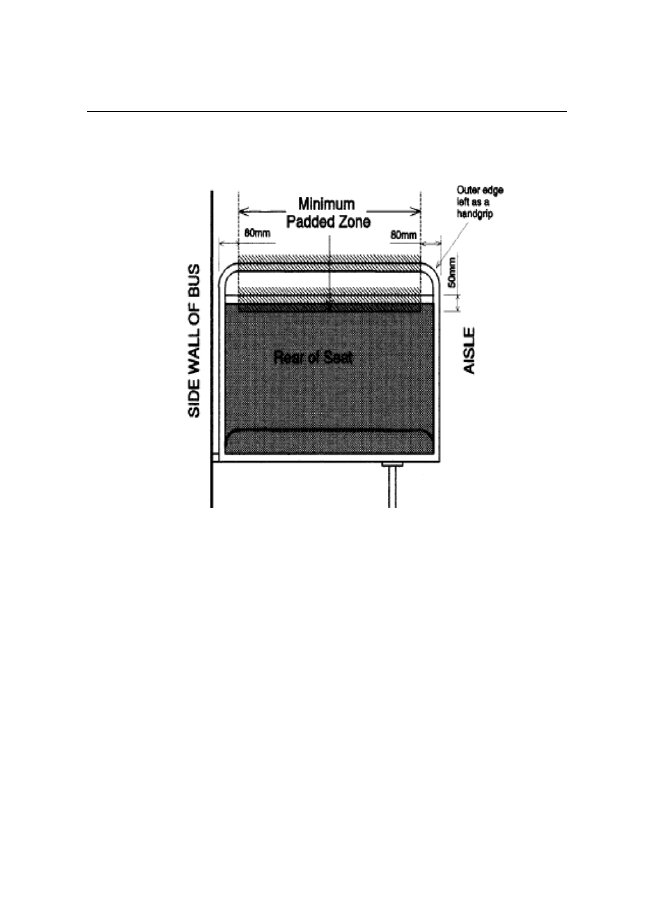
how to work out the age of a relevant vehicle.13Definition for pt 3In this
part—minimumpaddedzonemeanstheminimumpaddedzoneshown in the following
figure—
37Transport Operations (Passenger
Transport) Standard2000Schedule 1 (continued)14Tops of seats(1)If
the top face or the rear face of the seat of the bus is a
hardsurface, padding must be fitted to the
face.Example of when padding need not be fitted
under this subsection—Typically,coach-style,high-backseatsthathavefoam-backedupholstery or
moulded foam coverings do not have hard surfaces and sodo
not require padding to be fitted under this subsection.(2)The padding of the rear face of the
seat must extend at least50mm down the back of the seat from
the top face of the seat.(3)The top face and
the upper 50mm of the rear face of the seatmust be padded at
least across the minimum padded zone towithin—(a)80mm of the outside edge of the seat;
and(b)80mm of the aisle side of the
seat.
38Transport Operations (Passenger
Transport) Standard2000Schedule 1 (continued)15Handrails(1)An
exposed handrail directly in front of a seat of the bus mustbepaddedatleastonthetop,rearandfrontfacesofthehandrail at least
across the minimum padded zone to within—(a)80mm
of the outside edge of the seat; and(b)80mm
of the aisle side of the seat.Note—This allows for the handrail at the
aisle to be retained as a handgrip—seethe figure in
section 13.(2)However, handrails with a bend may be
padded up to the startof the bend if the padding—(a)is not more than 120mm or not less
than 80mm from theoutside edge of the seat; or(b)is not more than 120mm or not less
than 80mm from theaisle side of the seat.16Partitions(1)Partitions directly in front of a seat of
the bus must be paddedso that the top face and the upper
50mm of the rear face of thepartition are
padded at least across the minimum padded zone.(2)If
the aisle side of the partition has a bend, the bend need
notbe padded.17Padding materials and fastening(1)The padding must be—(a)semi-rigidmouldedpolyurethane,self-skinningrigidmoulded polyurethane, closed-cell
polyethylene foam orclosed-cell EVA foam that—(i)is at least 25mm, but not more than
30mm thick;and(ii)hasadensityofatleast270kg/m3,butnotmorethan
300kg/m3; or
39Transport Operations (Passenger
Transport) Standard2000Schedule 1 (continued)(b)a material that is of a thickness and
density that gives atleast the level of protection as is
given under paragraph(a).(2)The
padding must be securely fastened to the seat, handrail orpartition with fastenings that are protected
to ensure they donot cause injury.18Fittings on the back of a seat or
partitionEach fitting, on the back of a seat or
partition of the bus, thatisoutsidetheminimumpaddedzonemustnotbelikelytocauseinjurytoapassengerfromanimpactfromafrontalcollision.Part 4Warning signs and lights to befitted to school bus19School bus to be fitted with warning signs
and warninglights(1)A
relevant vehicle that is a school bus must be fitted with—(a)warning signs complying with sections
20 and 21; and(b)warning lights complying with sections
22 to 24.Note—For the use of,
and prohibition on driving without, the warning lightsand
warning signs see the Queensland Road Rules, sections 222
and222A.(2)The
warning signs may be fitted permanently to the bus or to abacking that allows them to be detached or
folded.20Number and location of warning
signs(1)The bus must have 2 warning
signs—
40Transport Operations (Passenger
Transport) Standard2000Schedule 1 (continued)(a)1 of which is fitted at the front, and
the other of which isfitted at the rear of the bus on the
inside or outside of thebus; and(b)each
of which is visible from outside the bus.(2)However, a warning sign may be fitted on the
inside of the busonly if the sign is as visible as, and is
the same colour as, andis not significantly dimmer than it
would be if it were fitted onthe outside of
the bus at the front or rear of the bus.Example—a warning sign fitted behind a clear
back window(3)Also, the warning sign must not be
fitted where it obscures thedriver’s vision
or hinders the use of an emergency exit.21Content, size, shape and material of warning
signs(1)A warning sign on the front of the bus
must display—(a)the words ‘school bus’ in capital
letters at least 100mmhigh in the vertical plane; or(b)the required image.(2)Awarningsignontherearofthebusmustdisplaytherequired image.(3)A
warning sign displaying the required image must—(a)be rectangular; and(b)either—(i)ifanyofthewarninglightsareonthewarningsign—be at least
550mm wide and 400mm high inthe vertical
plane; or(ii)otherwise—beatleast400mmwideand250mmhigh
in the vertical plane; and(c)have a black
border; and(d)have black graphics; and
41Transport Operations (Passenger
Transport) Standard2000Schedule 1 (continued)(e)be coated, other than over the border
or graphics, withretro-reflective material that—(i)is yellow; and(ii)is of
class 1 or 2 as described in AS 1906; and(iii)complies with AS 1906.(4)Theminimumheightundersubsection(3)(b)ofawarningsign is based on
the sign being mounted vertically.(5)However,awarningsignmaybelowerthantheminimumheight in the vertical plane if—(a)either—(i)ifanyofthewarninglightsareonthewarningsign—thewarninglightisatleast400mmhighmeasured from its top to its bottom;
or(ii)otherwise—thewarninglightisatleast250mmhigh
measured from its top to its bottom; and(b)thewarninglightismountedonasurfacethatisnotmore than 15º
from the vertical.(6)Accordingly,ifthesurfaceofthebusataplacewhereawarning sign may be fitted is more
than 15º from the vertical,a warning sign may be fitted at the
place if—(a)the warning sign complies with
subsection (5)(a); and(b)thewarningsignismountedonaseparatesurfacesothat the sign can stand vertically or
otherwise stand atnot more than 15º from the vertical.(7)Also, a warning sign may be fitted
flush to a surface of thebus,ataplacewhereawarningsignmaybefitted,thatismore than 15º
from the vertical if the sign is made tall enoughto
achieve the minimum vertical height.(8)In
this section—requiredimagemeansanimageof2childreninthesameproportions as
the children in AS 1743,image W6-3, with
theimage of the taller child at least 230mm
high.
42Transport Operations (Passenger
Transport) Standard2000Schedule 1 (continued)22Number and location of warning
lights(1)The bus must have a pair of warning
lights—(a)1 of which is fitted at the front, and
the other of which isfitted at the rear of the bus on the
inside or outside of thebus; and(b)each
of which is visible from outside the bus.(2)However, a warning light may be fitted on
the inside of thebus only if the light from the warning light
is the same colouras,andnotsignificantlydimmerthan,itwouldbeifthewarning light
were fitted on the outside of the front or the rearof
the bus.Example—a
warning light fitted behind a clear windscreen(3)Also,
a warning light must not be fitted where it obscures thedriver’s vision or hinders the use of an
emergency exit.(4)A warning light must be fitted—(a)on the left and right side of, and the
same distance from,the centre of the warning sign that is on
the same end ofthe bus as the warning light; and(b)so the warning lights are at least
300mm apart; and(c)sonopartofthebus,includingparkedoroperatingwindscreen
wipers, obstructs the light displayed by thewarning
light—(i)within an arc, in the horizontal
plane, from 30º totheleftto30ºtotherightofthecentreofthewarning light; or(ii)within an arc, in the vertical plane, from
10º aboveto 10º below the centre of the warning
light; and(d)so the lens of the warning light is
not over 100mm fromthe warning sign that is on the same end of
the bus as thewarning light.
43Transport Operations (Passenger
Transport) Standard2000Schedule 1 (continued)(5)However, a warning light on an end of
the bus may be on thewarning sign that is on the same end
of the bus if the words orimage on the sign are not
obscured.(6)Warning lights on the same end of the
bus must be fitted—(a)at the same height; and(b)as high as practicable; and(c)so no part of the lens of each light
is lower than midwaybetween the highest and lowest points on the
body of thebus at that end of the bus.(7)If the centres of warning lights on
the same end of the bus arelessthan1.8mabovegroundlevel,nopartofthewarninglights, or
warning sign, on that end of the bus may be on theleft
side of the bus.23Lens and light of warning
lightsEach warning light must—(a)havealenswithaneffectivelitlensareaofatleast60cm2;
and(b)emit a yellow light that has been
tested under the testprocedurestatedinADR6/00andfoundtohavealuminous
intensity of at least the amounts mentioned inthefollowingtablewhenmeasuredattheanglesmentioned in the
table; andNote—Indicator lights
complying with ADR 6/00 are unsuitable for useas warning lights
because the luminous intensity levels in thetable are much
brighter than the level required for an indicatorlight
to comply with ADR 6/00.(c)emitaboutthesameamountoflightastheotherwarning light of
the pair; and(d)be aimed so the beam from the light is
focused—(i)parallel to the road; and
44Transport Operations (Passenger
Transport) Standard2000Schedule 1 (continued)(ii)parallel to the longitudinal centre
line of the bus;and(e)be built and
adjusted so it can not dazzle the driver ofanother
vehicle.TableLuminous
intensity of warning light, in candelavertical
axishorizontal axis-30º-20º-10º-5º0º5º10º20º10º5080505º1803203504503503201800º754501
0001 2501 5001
2501 000450-5º40270450570600570450270-10º75757530º754024Operation of
warning lights(1)The bus must—(a)have
a visible or audible signal that tells the driver of thebus
when the warning lights are on; and(b)be
fitted with a switch that allows the driver, from thedriver’s normal driving position to turn on,
or turn off,simultaneously all warning lights fitted to
the bus.(2)When operating—(a)the
warning lights on the same end of the bus must flashalternately; and(b)the
warning lights must emit regular flashes of light at arate
of at least 90, and not over 180, flashes a minute.(3)The warning lights must operate
automatically when a dooron the bus opens and continue to
operate—(a)while a door is open; and
45Transport Operations (Passenger
Transport) Standard2000Schedule 1 (continued)(b)for at least 10 seconds, but not more
than 20 seconds,after all doors of the bus have
closed.Note—For further
requirements about the operation of warning lights, see theQueensland Road Rules, section 222A (Use of
warning lights—pickingup or setting down school
children).25Non-school bus—optional warning signs
or warninglights for school students(1)A relevant vehicle that is a bus,
other than a school bus, maybe fitted
with—(a)schoolstudentwarningsignsifthewarningsignscomply with
sections 20 and 21; or(b)schoolstudentwarninglightsifthewarninglightscomply with sections 22 to 24.(2)In this section—schoolstudentwarningsignmeansasigntowarnpassingmotorists of the
possibility of school students in the area ofthe bus.school student warning lightsmeans
lights to warn passingmotorists of the possibility of school
students in the area ofthe bus.Part 5Buses
carrying schoolstudents on a no standingpassenger road26Application of pt 5(1)This
part applies to a bus that—(a)is travelling on
a no standing passenger road; and
46Transport Operations (Passenger
Transport) Standard2000Schedule 1 (continued)(b)is carrying school students on a
general route service, orschoolservice,onajourneythatis,orispartof,ajourney to or from a school;
and(c)is or was introduced into service by
the operator of theservice after 4 July 2005 for a general
route service, orschoolservice,providedunderaservicecontract,TransLink service contract or prescribed
school servicecontract.(2)However, subsection (1)(c) does not apply
after 31 December2009.27Light
bus built to carry not more than 16 passengersand used to
provide a school service(1)This section
applies if the bus—(a)is a light bus built to carry not more
than 16 passengers,whether seated or standing, not including
the driver andcrew; and(b)is
being used to provide a school service.(2)Each
passenger seat fitted to the bus must comply with ADR68/00.(3)However, if the bus is being used to provide
a school servicefor which there is no prescribed school
service contract, thissection does not apply to the bus
until 1 January 2010.28Light bus built
to carry more than 16 passengers(1)This
section applies if the bus is a light bus built to carry
morethan 16 passengers, whether seated or
standing, not includingthe driver and crew.(2)The bus must—(a)comply with ADR 59/00; and(b)be fitted with an exhaust
brake.(3)Ifthebusisbeingusedtoprovideaschoolservice,eachpassenger seat fitted to the bus must
comply with ADR 68/00.
47Transport Operations (Passenger
Transport) Standard2000Schedule 1 (continued)(4)However, if the bus is being used to
provide a school serviceforwhichthereisnoprescribedschoolservicecontract,subsection (3) does not apply to the bus
until 1 January 2010.(5)The operator of
the service must ensure the driver of the bus istrained in the use of the exhaust
brake.29Heavy bus(1)If
the bus is a heavy bus, it must—(a)be a
single-decked bus; and(b)comply with ADR
59/00; and(c)be fitted with a power-train
retarder.(2)Ifthebusisbeingusedtoprovideaschoolservice,eachpassenger seat fitted to the bus must
comply with ADR 68/00.(3)However, if the
bus is being used to provide a school serviceforwhichthereisnoprescribedschoolservicecontract,subsection(1)(d)doesnotapplytothebusuntil1January2010.(4)The operator of the service must
ensure the driver of the bus istrained in the
use of the power-train retarder.Part 6Structural inspection andrepair of buses30Inspection of heavy buses(1)Anoperatorofarelevantservicethatusesaheavybustoprovidetheservicemust,whenthebusis20yearsoldbutbefore it is 21
years old, have a prescribed inspection entityinspect the body
framework of the bus for signs of weakeningcaused by rust or
incorrect repair.
48Transport Operations (Passenger
Transport) Standard2000Schedule 1 (continued)Note—See section 5 for
how to work out the age of a heavy bus.(2)Subsection(3)appliesifanoperatorofarelevantservicewants
to introduce a heavy bus that is at least 21 years old intoservice in Queensland.(3)BeforeintroducingthebusintoserviceinQueensland,theoperator must have a prescribed inspection
entity inspect thebody framework of the bus for signs of
weakening caused byrust or incorrect repair.(4)Subsection (1) does not apply
if—(a)aprescribedinspectionentityinspectedthebodyframework of the bus—(i)when the bus was 19 years old but
before it was 20years old; and(ii)within the last 50000km travelled by the
bus; and(b)the inspection showed that the body
framework was in asatisfactory structural condition.(5)Subsection (3) does not apply
if—(a)aprescribedinspectionentityhasinspectedthebodyframework of the bus—(i)within1yearimmediatelybeforetheoperatorintroduces the
bus into service in Queensland; and(ii)within the last 50000km travelled by the
bus; and(b)theinspectionshowsthatthebodyframeworkisinasatisfactory structural condition.(6)Subsections (1) to (3) do not apply
if—(a)a5yearservicelifeextension,oranagezerorefurbishment service life extension, has
been obtainedfor the bus under schedule 2; and(b)the extension has not ended.(7)Anoperatorofarelevantservicethatusesaheavybustoprovide the
service must have a prescribed inspection entity
49Transport Operations (Passenger
Transport) Standard2000Schedule 1 (continued)inspect the body framework of the bus for
signs of weakeningcaused by rust if the bus has substantial
rust that may affectthe structural integrity of the bus.31Repairs to bus structuresAn
operator of a relevant service that uses a bus to provide
theservicemustensurethatarepairtotheframe,bowsorsheeting of the bus is performed by a
qualified tradesperson inthe trade to which the repair
relates.32Inspection of structural
repairs(1)Thissectionappliesif,becauseofcorrosionoraccidentdamage, it is
necessary to carry out structural repairs to a busused
to provide a relevant service.(2)The
operator of the service must have the repairs inspected bya
prescribed inspection entity.(3)Theoperatormustarrangewiththeprescribedinspectionentity for the inspection before any
painting of the frame orrefitting of the body panels.(4)Aftertheinspection,theoperatormustobtainawrittenstatement by the
prescribed inspection entity of the names andqualifications of
the persons who performed the repairs.Part 7Maintenance record33Operator to keep maintenance record(1)An operator of a relevant service that
uses a bus to provide theservice must keep a written record of
the maintenance done onthe bus, for at least 5 years after
its last maintenance is done.(2)Therecordmustincludeeachstatementobtainedbytheoperator under
section 32(4) for the bus.
50Transport Operations (Passenger
Transport) Standard2000Schedule 1 (continued)34Operator to obtain endorsement on
maintenance recordby prescribed inspection entity(1)This section applies if a prescribed
inspection entity—(a)underpart6,inspectsabusthatisusedtoprovidearelevant service; and(b)considers the bus is in a satisfactory
condition.(2)Theoperatoroftherelevantservicemustobtainfromtheprescribedinspectionentityanendorsementonthemaintenancerecordkeptundersection33thatthebushasbeen inspected
and is in a satisfactory condition.(3)The
endorsement must be signed and dated by the prescribedinspection entity.
51Transport Operations (Passenger
Transport) Standard2000Schedule 2Heavy bus service
lifeextensionsschedule 1,
section 4Part 15 year service
life extension1How to obtain a 5 year service life
extension(1)Anoperatorofarelevantservicethatusesaheavybustoprovide the
service may obtain a 5 year service life extensionfor
the bus if sections 2 to 9 and part 3 are complied with forthe
bus.(2)Sections 2 to 8, 14(1) and 16 are
taken to have been compliedwith for the bus if the operator shows
the chief executive—(a)acertificatefromaprescribedinspectionentity,inrelation to the 5 year service life
extension being soughtbytheoperator,statingthatonaparticulardaytheprescribed inspection entity inspected
the frame of thebusandfoundittobeinasatisfactorystructuralcondition; and(b)acertificatefromaprescribedinspectionentity,inrelation to the 5 year service life
extension being soughtbytheoperator,statingthatonaparticulardaytheprescribed inspection entity inspected
the bus and it hadno defect that would affect its safe use on
the road.(3)If the operator satisfies the chief
executive that sections 2 to 9andpart3havebeencompliedwithforthebus,thechiefexecutive must,
by written notice given to the operator—(a)grant
the 5 year service life extension; and(b)state
the date the 5 year service life extension is granted.(4)However, the chief executive may only
grant a 5 year servicelife extension for the bus
if—
52Transport Operations (Passenger
Transport) Standard2000Schedule 2 (continued)(a)the bus is—(i)an
open classification vehicle that is at least 13, butnot
more than 15, years old; or(ii)aregionalclassificationvehicleorlocalclassificationvehiclethatisatleast13,butnotmore than 25,
years old; and(b)a 5 year service life extension has
not previously beengranted for the bus under the Act.(5)Ifa5yearservicelifeextensionisgrantedforabus,themaximumageofthebusunderschedule1,section4(2)isextended by 5 years.Examples—1If an open classification vehicle has
a 5 year service life extension,it may continue
to be used as an open classification vehicle until itreaches 20 years and then it may be used as
a regional classificationvehicle or local classification
vehicle until it is 30 years old.2Ifaregionalclassificationvehiclehasa5yearservicelifeextension, it may continue to be used as a
regional classificationvehicle until it is 30 years
old.3If a local classification vehicle has
a 5 year service life extension, itmay continue to
be used as a local classification vehicle until it is30
years old.2ADRsThe bus must
comply with the ADRs that applied to the buswhen it was 5
years old, other than ADRs for the control ofexhaust
emissions.3Body(1)The
body of the bus must be in good structural condition.(2)A full panel removal and body
framework inspection must beperformed
if—
53Transport Operations (Passenger
Transport) Standard2000Schedule 2 (continued)(a)the body of the bus shows signs of
structural damage, orsigns of corrosion of the frame, for
example, rust stains,loose rivets or loose or rusted
panels; or(b)the bus has not been inspected under
schedule 1, section30, and found to be satisfactory, within the
last 5 years.(3)Interior trim material of the bus must
be in good serviceablecondition and not be damaged.(4)If the bus is a regional
classification vehicle, any side facingseats must be
replaced with forward or rearward facing seats.(5)Seats,partitionsandexposedhandrailsofthebusmustbepadded if
required under schedule 1, part 3.(6)Floor
coverings of the bus that are damaged or not non-slipmust
be replaced with suitable non-slip floor coverings.(7)Windows and window sealing must be in
good condition.(8)Paintwork must be in good
condition.4Chassis and suspensionAll
components of the chassis or suspension of the bus mustbe
cleaned, inspected, and crack tested if necessary to ensurethey
are rust free, structurally sound and within safe servicewear
limits.5Steering(1)Power
steering components of the bus must be free of leaks.(2)Crackedoroilaffectedhydraulichosesofpowersteeringcomponents must be replaced.(3)Stub axles and steering arms,
including pitman arms and draglinks—(a)must be crack tested; and(b)must be replaced if they are
defective; and(c)must not be repaired using a heating
or welding process.
54Transport Operations (Passenger
Transport) Standard2000Schedule 2 (continued)6Brakes(1)Thebrakingsystemmustbefullyrefurbished,includingreplacement of flexible air or hydraulic
lines, valve seals anddiaphragms.(2)AllreplacementbrakingsystemcomponentsmustcomplywiththeTransportOperations(RoadUseManagement—VehicleStandardsandSafety)Regulation1999,
schedule 1, section 112(2).(3)The
parking brakes of the bus must be tested to ensure theycomplywithschedule1,section115(8)oftheregulationmentioned in subsection (2).7Electrical components(1)Electrical fittings, lights,
reflectors, lenses and wiring must bein a serviceable
condition.(2)Lightorreflectorlensesmustbefreeofcracks,andhaveserviceable reflective
surfaces.Example—Discoloured or cracked lenses must be
replaced.(3)Electrical wiring and wiring conduit
must be secure, shieldedfromtheeffectsofexcessiveheat,andinaserviceablecondition.(4)The voltage under load, with the
engine running, at each lampmust not be more
than 10% below the nominal voltage of theelectrical system
of the bus.Example—For a
system with a nominal voltage of 12V, the voltage at each
lampmust be at least 10.8V.8Engine and driveline(1)Each
component of the engine or driveline must be inspected,andmayrequiredismantlingifnecessarytoensurethe
55Transport Operations (Passenger
Transport) Standard2000Schedule 2 (continued)component is reliable and mechanically
sound, including thefollowing—(a)adequate engine power output;(b)theengineanddrivelinearefreeofoil,water,air,vacuum and exhaust leaks;(c)the engine and driveline are not
excessively noisy;(d)whenoperatedunderloadtheenginedoesnotemitvisible smoke
continuously for more than 10 seconds;(e)each
component of the transmission or driveline is freeof
oil leaks and excessive wear;(f)the
driveline is free of excessive backlash;(g)rubber mounts and dampers are free of oil
impregnation,cracking and deterioration.(2)Eachaxlehubassemblymustberemoved,dismantled,cleaned and
inspected to ensure it is reliable and mechanicallysound.(3)Each
hub oil seal or gasket must be replaced.(4)Wheel
bearings that are excessively worn must be replaced.9Certificate by prescribed inspection
entityTheoperatormustobtainacertificatefromaprescribedinspection entity
stating that—(a)thebody,chassis,suspension,steeringandbrakecomponents are
structurally sound and serviceable; and(b)the
bus complies with the ADRs that applied to the buswhen
it was 5 years old, other than ADRs for the controlof
exhaust emissions.
56Transport Operations (Passenger
Transport) Standard2000Part 2Schedule 2
(continued)Age zero refurbishment servicelife
extension10How to obtain an age zero
refurbishment service lifeextension(1)Anoperatorofarelevantservicethatusesaheavybustoprovide the service may obtain a
service life extension for thebus(anagezerorefurbishmentservicelifeextension)ifsections 11 to 13
and part 3 are complied with for the bus.(2)Sections 11, 12(1), (3), (4) and (5), 14(1)
and 16 are taken tohave been complied with for the bus if the
operator shows thechief executive—(a)acertificatefromaprescribedinspectionentity,inrelationtotheagezerorefurbishmentservicelifeextension being sought by the
operator, stating that on aparticular day the prescribed
inspection entity inspectedthe frame of the bus and found it to
be in a satisfactorystructural condition; and(b)acertificatefromaprescribedinspectionentity,inrelationtotheagezerorefurbishmentservicelifeextension being sought by the
operator, stating that on aparticular day the prescribed
inspection entity inspectedthe bus and it had no defect that
would affect its safe useon the road.(3)If
the operator satisfies the chief executive that sections 11
to13 and part 3 have been complied with for
the bus, the chiefexecutive must, by written notice given to
the operator—(a)grant the age zero refurbishment
service life extension;and(b)statethedatetheagezerorefurbishmentservicelifeextension is granted.(4)If an age zero refurbishment service
life extension is grantedfor a bus, the age of the bus is to be
worked out starting on theday of the grant.
57Transport Operations (Passenger
Transport) Standard2000Schedule 2 (continued)11ADRsThe bus
must—(a)iftheoperatorintendsthebustobeusedasanopenclassificationvehicleorregionalclassificationvehicle—complywiththeADRsapplyingtoanon-routeservicebusthatareinforcewhentherefurbishment of the bus for the
extension is finished; or(b)iftheoperatorintendsthebustobeusedasalocalclassification
vehicle—comply with the ADRs applyingto a service bus
that are in force when the refurbishmentof the bus for
the extension is finished.12Body, brakes and
mechanical or structural components(1)Anewbody,includingallinteriorandexteriorfittingsandequipment must be fitted to the
bus.(2)The operator must give a prescribed
inspection entity writtenevidence verifying that all mechanical
components, includingthe engine, gearbox, steering,
suspension and axles have beenrebuilt,includingthereplacementofallgaskets,seals,bearings and wearing components.(3)Each structural component of the bus,
for example, the chassisor spring hangers—(a)mustbedismantled,inspectedandcracktestedifnecessary to ensure the component is
structurally sound;and(b)mustthenbereplacedorrefurbishedifnecessarytoensure the component is structurally
sound.(4)The braking system must be fully
rebuilt, including—(a)replacementorrefurbishmentofallwearingcomponents;
and(b)replacement of all flexible air or
hydraulic lines, valveseals, diaphragms and
springs.
58Transport Operations (Passenger
Transport) Standard2000Schedule 2 (continued)(5)Each component of the braking system
must comply with theTransportOperations(RoadUseManagement—VehicleStandardsandSafety)Regulation1999,schedule1,section112(2).13Certificate by
prescribed inspection entityTheoperatormustobtainacertificatefromaprescribedinspection entity
stating that—(a)thebody,chassis,suspension,steeringandbrakecomponentsofthebusarestructurallysound,andserviceable; and(b)the
bus complies with the ADRs required to be compliedwith
under this standard for an age zero refurbishmentservice life extension for the bus.Part
3Further provisions applying to5
year service life extensionsand age zero
refurbishmentservice life extensions14Inspection etc. of critical
components(1)Each mechanical component and each
structural componentthat is critical to the safety of the bus
must be—(a)inspected; and(b)cracktestedifnecessarytoensurethecomponentismechanically or structurally sound.(2)An operator of a bus mentioned in part
1 or 2 must obtain acertificatebyaprescribedinspectionentitythateachmechanical component and each
structural component that iscritical to the
safety of the bus has been—
59Transport Operations (Passenger
Transport) Standard2000Schedule 2 (continued)(a)inspected by the prescribed inspection
entity; and(b)cracktestedifnecessarytoensurethecomponentismechanically or structurally sound.15Previous refurbishment or
replacement(1)A vehicle system or component, of a
bus, that is required to berefurbishedorreplacedunderthisschedulefora5yearservicelifeextensionoranagezeroservicelifeextensionneed not be
refurbished or replaced if it has been refurbishedor
replaced within—(a)1 year immediately before the
extension is obtained; and(b)the last 50000km
travelled by the bus.(2)However,writtenevidenceofthereplacementorrefurbishment must be given to a prescribed
inspection entity.16Rating of particular components of
bus, and evaluation ofbus, under code(1)An
operator of a bus mentioned in part 1 or 2 must—(a)have an approved person perform a
rating of particularcomponentsofthebus,andapprovetherating,undersection S4 or S5 of the code; and(b)have an approved person perform an
evaluation of thebus, and approve the evaluation, under
section S6 of thecode.(2)In
this section—codemeansCodeofPractice—CommercialMotorVehicleModificationsapprovedundertheTransportOperations(RoadUseManagement—VehicleStandardsandSafety)Regulation
1999.
60Transport Operations (Passenger
Transport) Standard2000Schedule 3Maintaining
particular relevantvehicles in a clean, tidy andcomfortable condition andother
vehicle requirementssection 29Part 1Vehicle requirements1Vehicle requirements(1)Thissectionstatestherequirementsthatavehicleusedtoprovide the following relevant service
must comply with forsection 29(2)(a)—(a)a
taxi service;(b)a limousine service;(c)a general route service, or school
service, that uses a busto provide the service.(2)Body panels must not be excessively
dented.(3)Exterior paintwork must not be
excessively scratched, dirty ordiscoloured,soastodetractfromthevehicle’sgeneralappearance.(4)If
the vehicle is a bus, any non-illuminated destination signdisplayed on the bus must be clearly visible
and legible.(5)If the vehicle is a taxi—(a)the fare sticker must be fixed to the
taxi; and(b)the taximeter, if fitted, must be
working; and(c)the fleet number of the taxi must be
clearly displayed inthe interior and on the exterior of the
taxi.
61Transport Operations (Passenger
Transport) Standard2000Part 2Schedule 3
(continued)Way to maintain vehicle2Way
to maintain vehicleSections3to5statethewayavehicleusedtoprovidethefollowingrelevantservicemustbemaintainedforsection29(3)—(a)a taxi service;(b)a
limousine service;(c)a general route service, or school
service, that uses a busto provide the service.3Seating(1)Seat
covers must not be torn or frayed and must be kept clean.(2)Seat springs must not be broken or
sagging.(3)Seatbelt webbing must not be shabby or
dirty.4Interior appearance and
fittings(1)Interior trim panels must not be loose
or missing and must bein good condition.(2)Interiortrimmustnotbesoiledordustysoastocausediscomfort to a passenger or soil
clothing.(3)The interior compartment must be free
of odour.(4)Floor coverings must be clean and
intact.(5)The luggage compartment must be clean
and tidy.(6)If the vehicle is a bus—(a)windowadornments,forexample,curtains,mustbeclean; and(b)the disembark light must work;
and(c)interior safety padding must be in
good condition; and
62Transport Operations (Passenger
Transport) Standard2000Schedule 3 (continued)(d)buzzers or bells for requesting the
bus to stop must be inworking order.(7)If
the vehicle is a taxi—(a)a safety screen,
if fitted, must be clean and intact; and(b)a
cargo barrier, if fitted, must be clean and intact.5WindscreenThe windscreen
must be clean.
63Transport Operations (Passenger
Transport) Standard2000Schedule 4Dictionarysection 3ADRseetheTransportOperations(RoadUseManagement—VehicleStandardsandSafety)Regulation1999,
schedule 4.advisoryspeedsignmeansanofficialtrafficsigninstalledunder theTransport Operations (Road Use Management)
Act1995as a guide to the speed of
vehicles.approvedmeans approved by
the chief executive.approved personmeans a person
accredited as an approvedpersonundertheTransportOperations(RoadUseManagement—AccreditationandOtherProvisions)Regulation
2005.approvedrestraintmeansanapprovedchildrestraintunderthe
Queensland Road Rules.carseetheTransportOperations(RoadUseManagement)Act 1995,
schedule 4.code of conducthas the meaning
given under the passengertransport regulation.corresponding licenceto—(a)an open licence, for a requirement
relating to restricteddriver authorisation—means a document
correspondingto the open licence that is issued under a
law of anotherStateoraforeigncountrythatprovidesforthesamematter as the
provision under which the open licence isissued; or(b)an open licence, other than for a
requirement relating torestricteddriverauthorisation—meansadocumentcorresponding to
the open licence that is issued under alaw of another
State that provides for the same matter asthe provision
under which the open licence is issued; or(c)aprovisionallicence,forarequirementrelatingtorestricteddriverauthorisation—meansadocument
64Transport Operations (Passenger
Transport) Standard2000Schedule 4 (continued)correspondingtotheprovisionallicencethatisissuedunder
a law of another State or a foreign country thatprovidesforthesamematterastheprovisionunderwhich the
provisional licence is issued; or(d)aprovisionallicence,otherthanforarequirementrelatingtorestricteddriverauthorisation—meansadocument corresponding to the provisional
licence thatis issued under a law of another State that
provides forthesamematterastheprovisionunderwhichtheprovisional licence is issued.defined urban areameans—(a)theareaoftheCityofBrisbaneundertheCityofBrisbane Act 1924; or(b)anareaforwhichaservice contractisrequiredundersection42oftheActfortheprovisionofroad-basedgeneral route
services that are not—(i)school services
only; or(ii)servicesonlyforthecarriageofeligibleschoolstudents.eligible school
studentssee the regulation, schedule 11.exhaust brakemeans a device
fitted into the exhaust systemof a vehicle that
when activated creates a back pressure duringbraking, using
the retardant effect of the engine to slow thevehicle and act
as a non-fade brake.foreigndriverlicencemeansalicencetodriveamotorvehicle
corresponding to an open or provisional licence andissued under the law of another country that
provides for thesamematterastheprovisionunderwhichtheopenorprovisional
licence is issued.GVMsee theTransport
Operations (Road Use Management)Act 1995,
schedule 4.heavy bussee the
regulation, schedule 11.held continuously, for a period,
includes being held for theperiod without a break that lasted
more than 7 days.
65Transport Operations (Passenger
Transport) Standard2000Schedule 4 (continued)high-back seat, for a vehicle,
means a seat having a height of1m or more when
measured from the vehicle floor, where thepassenger’s heels
touch, to the top of the seat back, excludingany head
restraint.incidentsee section
4.incident management plan, for part 3, see
section 16.incident report, for part 3, see
section 16.infant passengermeans a passenger
under 1 year old.injuredmeansinjuredinawaythatrequiresimmediatemedical attention or hospitalisation.light bussee the
regulation, schedule 11.local classification vehiclesee
schedule 1, section 3(3).longdistancescheduledpassengerservicemeansaroadbased general
service in which passengers are carried on anestablished
route—(a)for an average distance of at least
40km; or(b)between non-adjoining service contract
areas or routes.low-back seat, for a vehicle,
means a seat having a height ofless than 1m when
measured from the vehicle floor, where thepassenger’s heels
touch, to the top of the seat back, excludingany head
restraint.motorbikeseetheTransportOperations(RoadUseManagement) Act 1995,
schedule 4.non-route service busmeans a bus that
is not designed withspaces for standing passengers.no
standing passenger roadsee section 15B(1).open
classification vehiclesee schedule 1, section 3(1).openlicenceseetheTransportOperations(RoadUseManagement) Act 1995,
schedule 4.overloaded, for a vehicle,
includes—
66Transport Operations (Passenger
Transport) Standard2000Schedule 4 (continued)(a)notcomplyingwithamassrequirementwithinthemeaningoftheTransportOperations(RoadUseManagement—Mass,DimensionsandLoading)Regulation
2005; or(b)carryingmorethanthemaximumnumberofpassengers—(i)for
which the vehicle is designed; or(ii)specifiedorrecommendedbythevehicle’smanufacturer;
or(c)carrying in the standing area of the
vehicle more thanthe full complement of passengers for the
area.passengertransportregulationmeanstheTransportOperations
(Passenger Transport) Regulation 2005.power-train
retardermeans a device, other than the
servicebrake, fitted to a bus that—(a)canbeturnedonandofffromthedriver’snormaldriving position by a switch fitted to the
bus; and(b)when turned on—(i)operates on the power-train of the bus;
and(ii)enables the driver of the bus to keep
the speed ofthe bus, as controlled by the power-train
retarder,orbythepower-trainretarderandminorbrakingusing
the service brake of the bus, at or under therequired speed if
the bus is or were to be loaded toits GVM.Examples of devices that operate on the
power-train of a bus—•drivelineretarders,forexample,hydraulic(hydrodynamic)retarders•electromagnetic retarders, commonly
known as eddy current brakes•engine brakes, commonly known as jake
brakesprescribed inspection entitymeans—(a)an
approved person; or
67Transport Operations (Passenger
Transport) Standard2000Schedule 4 (continued)(b)anauthorisedofficerundertheTransportOperations(RoadUseManagement)Act1995,section20,otherthan a police
officer.prescribed licencemeans—(a)an open licence, or a corresponding
licence to an openlicence; or(b)a
restricted licence.prescribed vehiclesee schedule 1,
section 2.provisional licencesee theTransport Operations (Road UseManagement) Act 1995, schedule
4.regional classification vehiclesee
schedule 1, section 3(2).regulationmeanstheTransportOperations(PassengerTransport)
Regulation 2005.relevant servicemeans a public
passenger service for whichoperator accreditation is
required.relevant vehiclemeans a vehicle
providing a public passengerservice for which
driver authorisation is required.repealed
guidelinesmeans the repealed guidelines—(a)madeundersection62BoftherepealedTransportOperations
(Passenger Transport) Regulation 1994; and(b)asinforceimmediatelybeforethecommencementofsection 36.required
speedmeans—(a)ifthereisanadvisoryspeedsigninstalledontheroad—the speed shown on the sign, from
when the buspasses the sign until the bus reaches the
end of the bend,steepdescentorotherhazardforwhichthesignisinstalled;
or(b)otherwise—the speed limit applying to
the driver underthe Queensland Road Rules, section 20 for
the length ofroad where the driver is
driving.
68Transport Operations (Passenger
Transport) Standard2000Schedule 4 (continued)restrictedlicenceseetheTransportOperations(RoadUseManagement) Act 1995,
schedule 4.routeservicebusmeansabusdesignedwithspacesforstanding passengers.school
busmeans a bus being used to provide a school
serviceoutside or partly outside a defined urban
area, even though thebus may be used for other purposes at
other times.servicebrake,forabus,meansthefoot-operatedbrakenormally used to decelerate the bus.tourist servicemeans a
pre-booked public passenger serviceoperated in
accordance with a publicly available itinerary to—(a)a common scenic or tourist attraction;
or(b)if the service is not wholly within a
service contract areaor route—a major sporting or cultural
event.trucksee theTransport Operations (Road Use
Management)Act 1995, schedule
4.vehicle standards regulationmeans
theTransport Operations(RoadUseManagement—VehicleStandardsandSafety)Regulation
1999.wildernesssee theNature Conservation Act 1992,
schedule.
69Transport Operations (Passenger
Transport) Standard2000Endnotes1Index to endnotesPage2Date to which amendments incorporated
. . . . . . . . . . . . . . . . . . . . . . . . . . . . . . . .
.693Key . . . . . . . . . . . . . . . . .
. . . . . . . . . . . . . . . . . . . . . . . . . . . . . . . . . .
. . . . . . . . . . .694Table of reprints
. . . . . . . . . . . . . . . . . . . . . . . . . . . . . . . . . .
. . . . . . . . . . . . . . . . . .705List
of legislation . . . . . . . . . . . . . . . . . . . . . . . . . .
. . . . . . . . . . . . . . . . . . . . . . . . .706List of annotations . . . . . . . . .
. . . . . . . . . . . . . . . . . . . . . . . . . . . . . . . . . .
. . . . . . .712Date to which amendments
incorporatedThis is the reprint date mentioned in the
Reprints Act 1992, section 5(c). Accordingly, thisreprint includes all amendments that
commenced operation on or before 2 January 2009.Future
amendments of the Transport Operations (Passenger Transport)
Standard 2000 maybe made in accordance with this reprint under
the Reprints Act 1992, section 49.3KeyKey to abbreviations in list of
legislation and annotationsKeyAIAamdamdtchdefdivexpgazhdginslapnotfdnumo in comorigpparaprecpresprevExplanation=Acts
Interpretation Act 1954=amended=amendment=chapter=definition=division=expires/expired=gazette=heading=inserted=lapsed=notified=numbered=order
in council=omitted=original=page=paragraph=preceding=present=previousKey(prev)procprovptpubdR[X]RArelocrenumrep(retro)rvsschsdivSIASIRSLsubunnumExplanation=previously=proclamation=provision=part=published=Reprint No. [X]=Reprints Act 1992=relocated=renumbered=repealed=retrospectively=revised edition=section=schedule=subdivision=Statutory Instruments Act 1992=Statutory Instruments Regulation
2002=subordinate legislation=substituted=unnumbered
70Transport Operations (Passenger
Transport) Standard20004Table of
reprintsReprints are issued for both future and past
effective dates. For the most up-to-date tableof reprints, see
the reprint with the latest effective date.Ifareprintnumberincludesaletterofthealphabet,thereprintwasreleasedinunauthorised, electronic form only.ReprintNo.11A1BAmendments tonone2000
SL No. 1022002 SL No. 49Effective1 May
20002 June 200022 March
2002Reprint date5 May 200021
July 20005 April 2002ReprintNo.1C1D1E22A2BAmendments included2002
SL No. 278—2007 SL No. 66—2008
SL No. 3982008 SL No. 397Effective25
October 200223 March 200327 April
200727 April 200717 December
20082 January 2009Notesprov
exp 22 March 2003R1E withdrawn, see R25List
of legislationTransport Operations (Passenger Transport)
Standard 2000 SL No. 61made by the chief executive on 1 March
2000notfd gaz 7 April 2000 pp 1312–13ss
1–2 commenced on date of notificationremaining
provisions commenced 1 May 2000 (see s 2)exp 1 September
2010 (see SIA s 54)Note—The expiry date may have changed since
this reprint was published. See thelatest reprint of
the SIR for any change.amending legislation—Transport Operations (Passenger Transport)
Amendment Standard (No. 1) 2000 SLNo. 102notfd
gaz 2 June 2000 pp 370–1commenced on date of
notificationTransport Operations (Passenger Transport)
Amendment Standard (No. 1) 2002 SLNo. 49notfd
gaz 22 March 2002 pp 112–13commenced on date of
notificationTransport Operations (Passenger Transport)
Amendment Standard (No. 2) 2002 SLNo. 278notfd
gaz 25 October 2002 pp 690–1commenced on date
of notification
71Transport Operations (Passenger
Transport) Standard2000Transport Operations (Passenger
Transport) Amendment Standard (No. 1) 2007 SLNo. 66notfd
gaz 27 April 2007 pp 1887–90commenced on date
of notificationTransport Operations (Passenger Transport)
Amendment Standard (No. 1) 2008 SLNo. 397notfd
gaz 5 December 2008 pp 1840–3ss 1–2 commenced
on date of notificationremaining provisions commenced 2
January 2009 (see s 2)Transport Operations (Passenger
Transport) Amendment Standard (No. 2) 2008 SLNo. 398notfd
gaz 5 December 2008 pp 1840–3ss 1–2 commenced
on date of notificationremaining provisions commenced 17
December 2008 (see s 2)6List of
annotationsPART 1A—INTERPRETATIONpt hdgins
2007 SL No. 66 s 3Definitionss 3amd
2008 SL No. 398 s 4Meaning of “incident”s 4sub
2007 SL No. 66 s 4PART 2—DRIVERSpt hdgsub
2007 SL No. 66 s 4Qualifications for operating relevant
vehicles that are motorbikess 6amd
2002 SL No. 49 s 3Qualifications for operating relevant
vehicles other than motorbikess 7amd
2000 SL No. 102 s 3; 2002 SL No. 49 s 4; 2008 SL No. 397 s 4Medical fitness for driver
authorisations 8amd 2000 SL No. 102 s 4om
2008 SL No. 398 s 5Licence requirements for restricted driver
authorisations 8Ains 2000 SL No. 102 s 5Medical fitness for restricted driver
authorisations 8Bins 2000 SL No. 102 s 5amd
2007 SL No. 66 s 5om 2008 SL No. 398 s 5Particular
qualification to drive a taxis 9amd
2008 SL No. 398 s 6
72Transport Operations (Passenger
Transport) Standard2000Fatigue managements 11amd
2008 SL No. 398 s 7Operational safety of vehicless
12amd 2008 SL No. 398 s 8Seatings
13amd 2002 SL No. 49 s 5; 2002 SL No. 278 s
3Customer services 14amd
2007 SL No. 66 s 6; 2008 SL No. 398 s 9Compliance with
code of conducts 15Ains 2002 SL No. 49 s 6Bus
carrying school students on a no standing passenger roads
15Bins 2008 SL No. 398 s 10Definitionss
16sub 2007 SL No. 66 s 7Ensuring drivers
are trained in obligations under the Acts 19amd
2002 SL No. 49 s 7Ensuring operational safety of
vehicless 21amd 2008 SL No. 398 s 11Compliance with vehicle standards regulation,
s 5prov hdgsub 2002 SL No.
49 s 8(1)s 22amd 2002 SL No. 49 s 8(2)Compliance with vehicle standards regulation,
s 22s 22Ains 2002 SL No. 49 s 9Seatings 24amd
2002 SL No. 49 s 10; 2002 SL No. 278 s 4Type and age of
vehicles etc.s 25sub 2008 SL No. 398 s 12Maintenance of vehicless 27amd
2002 SL No. 49 s 11Vehicles to be maintained in clean, tidy and
comfortable condition etc.s 29sub 2008 SL No.
398 s 13Access to information about services
provideds 30amd 2008 SL No. 397 s 5Timetable for school services
30Ains 2008 SL No. 398 s 14Obligations in
relation to incident management plan and incident reports
31sub 2007 SL No. 66 s 8Requirements of
incident management plans 31Ains 2007 SL No.
66 s 8
73Transport Operations (Passenger
Transport) Standard2000Requirements of incident reports
31Bins 2007 SL No. 66 s 8Review of incident
management plans 31Cins 2007 SL No. 66 s 8When
ss 31 to 31C do not apply to operators of taxi servicess
31Dins 2007 SL No. 66 s 8Reliability of
services 32amd 2008 SL No. 398 s 15What
must be shown on vehicleprov hdgsub 2008 SL No.
397 s 6(1)s 33amd 2008 SL No. 398 s 16; 2008 SL No.
397 s 6(2)Compliance with code of conducts
35prev s 35 exp 2 May 2000 (see s
35(2))pres s 35 ins 2002 SL No. 49 s 12PART
4—TRANSITIONAL PROVISIONSpt hdgorig pt 4 hdg exp
2 May 2000 (see s 35(2))prev pt 4 hdg ins 2002 SL No. 49 s
12om 2007 SL No. 66 s 9pres pt 4 hdg ins
2008 SL No. 398 s 17Density of bus safety paddings
36prev s 36 ins 2002 SL No. 49 s 12exp
22 March 2003 (see s 36(3))pres s 36 ins 2008 SL No. 398 s
17Warning signs and warning lights fitted to
school bus immediately before 1 October1999s
37ins 2008 SL No. 398 s 17Heavy bus service
life extensions 38ins 2008 SL No. 398 s 17Bus
fitted with seatbelts for every seated passengers
39ins 2008 SL No. 398 s 17SCHEDULE1—VEHICLEREQUIREMENTSOBLIGATIONSsch hdgins
2008 SL No. 398 s 19ANDOPERATOR’SPART
1—PRELIMINARYpt 1 (ss 1–3)ins 2008 SL No.
398 s 19PART 2—MAXIMUM AGE, DESIGN AND LUGGAGEpt 2
(ss 4–10)ins 2008 SL No. 398 s 19PART 3—BUS
PADDINGpt 3 (ss 11–18)ins 2008 SL No.
398 s 19PART 4—WARNING SIGNS AND LIGHTS TO BE FITTED
TO SCHOOL BUSpt 4 (ss 19–25)ins 2008 SL No.
398 s 19
74Transport Operations (Passenger
Transport) Standard2000PART5—BUSESCARRYINGSCHOOLSTUDENTSONANOSTANDINGPASSENGER ROADpt 5 (ss
26–29)ins 2008 SL No. 398 s 19PART 6—STRUCTURAL
INSPECTION AND REPAIR OF BUSESpt 6 (ss
30–32)ins 2008 SL No. 398 s 19PART 7—MAINTENANCE
RECORDpt 7 (ss 33–34)ins 2008 SL No.
398 s 19SCHEDULE 2—HEAVY BUS SERVICE LIFE
EXTENSIONSsch hdgins 2008 SL No.
398 s 19PART 1—5 YEAR SERVICE LIFE EXTENSIONpt 1
(ss 1–9)ins 2008 SL No. 398 s 19PART 2—AGE ZERO
REFURBISHMENT SERVICE LIFE EXTENSIONpt 2 (ss
10–13)ins 2008 SL No. 398 s 19PART 3—FURTHER
PROVISIONS APPLYING TO 5 YEAR SERVICE LIFEEXTENSIONSANDAGEZEROREFURBISHMENTSERVICELIFEEXTENSIONSpt 3 (ss
14–16)ins 2008 SL No. 398 s 19SCHEDULE
3—MAINTAINING PARTICULAR RELEVANT VEHICLES IN ACLEAN,TIDYANDCOMFORTABLECONDITIONANDOTHERVEHICLE
REQUIREMENTSsch hdgins 2008 SL No.
398 s 19PART 1—VEHICLE REQUIREMENTSpt 1
(s 1)ins 2008 SL No. 398 s 19PART 2—WAY TO
MAINTAIN VEHICLEpt 2 (ss 2–5)ins 2008 SL No.
398 s 19SCHEDULE 4—DICTIONARYsch 4(prev
sch) num 2008 SL No. 398 s 18def“ADR”ins 2008 SL No.
398 s 20(1)def“advisory speed sign”ins
2008 SL No. 398 s 20(1)def“approved
person”ins 2008 SL No. 398 s 20(1)def“approved restraint”ins
2002 SL No. 278 s 5def“car”amd 2008 SL No.
398 s 20(2)def“code of conduct”ins 2002 SL No.
49 s 13amd 2007 SL No. 66 s 10(3)def“corresponding licence”sub
2000 SL No. 102 s 6(1)def“defined urban
area”ins 2008 SL No. 398 s 20(1)def“eligible school students”ins
2008 SL No. 398 s 20(1)def“exhaust
brake”ins 2008 SL No. 398 s 20(1)def“foreign driver licence”ins
2002 SL No. 49 s 13def“GVM”ins 2008 SL No.
398 s 20(1)def“heavy bus”ins 2008 SL No.
398 s 20(1)def“high-back seat”ins 2008 SL No.
398 s 20(1)def“incident”ins 2007 SL No.
66 s 10(2)