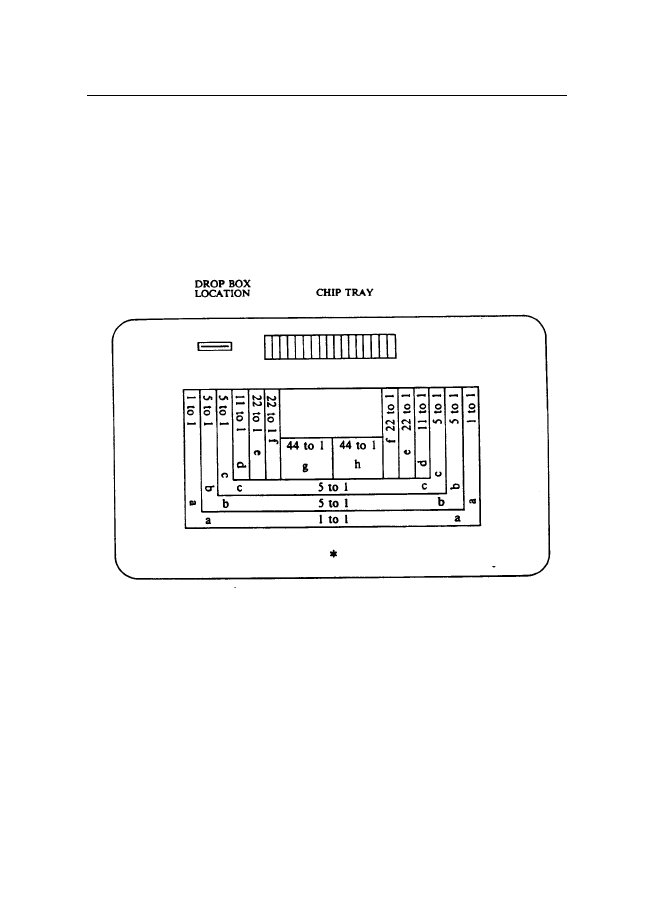
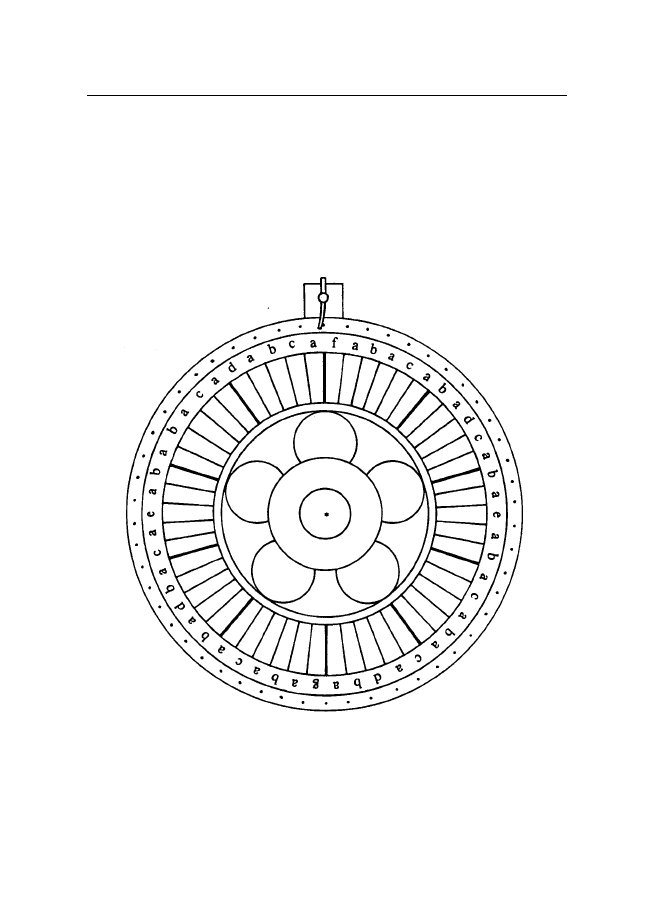
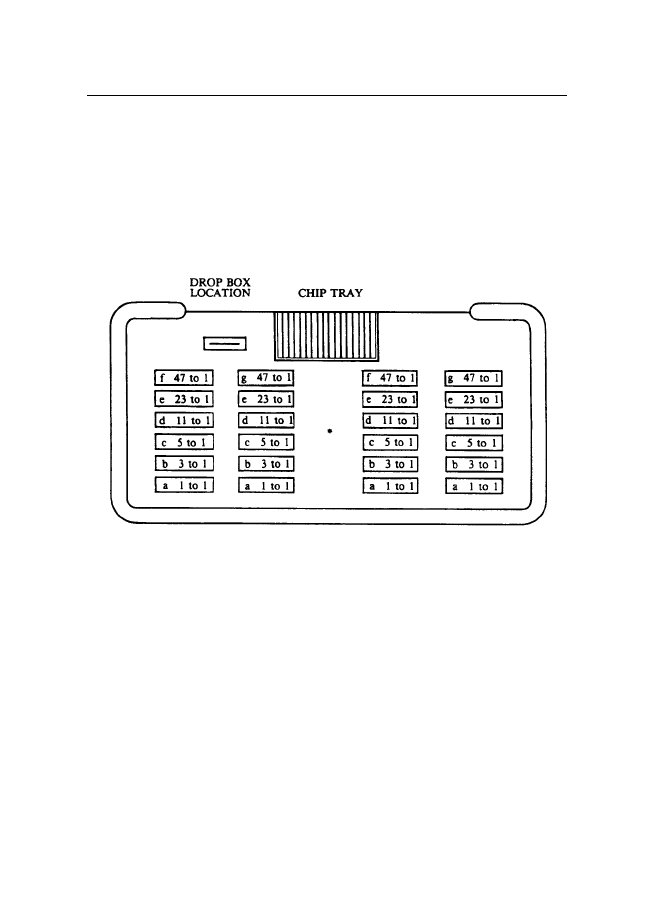
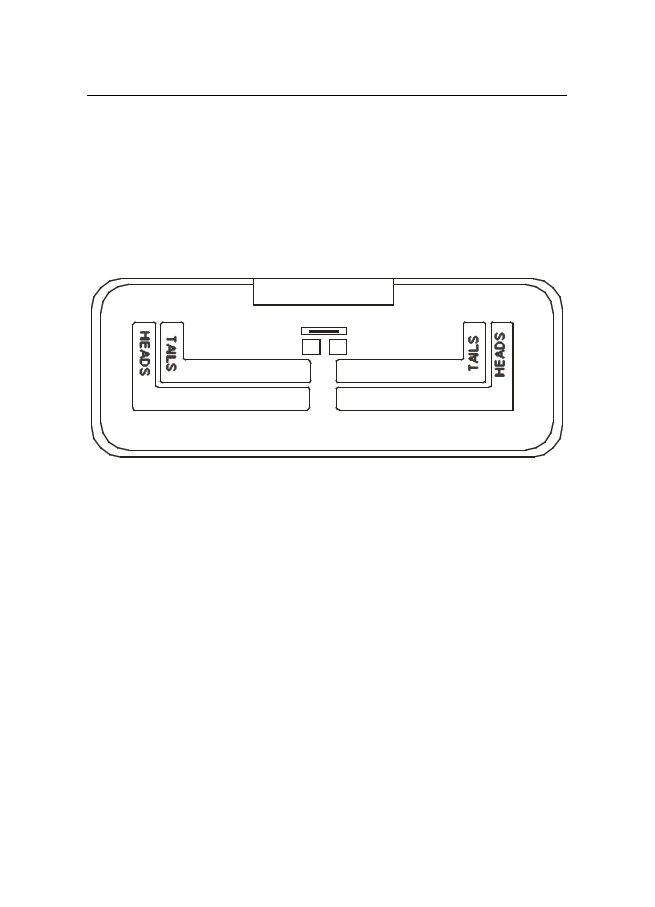
QueenslandCasinoControlAct1982CasinoGamingRule1999Reprinted as in
force on 9 April 2010Reprint No. 4EThis reprint is
prepared bythe Office of the Queensland Parliamentary
CounselWarning—This reprint is not an authorised
copyNOT FURTHER AMENDEDLAST REPRINT
BEFORE REPEALSee 2010 SL No. 198 s 20
Information about this reprintThis
rule is reprinted as at 9 April 2010. The reprint shows the law as
amended by allamendments that commenced on or before that
day (Reprints Act 1992 s 5(c)).The reprint
includes a reference to the law by which each amendment was
made—see listof legislation and list of annotations in
endnotes. Also see list of legislation for anyuncommenced
amendments.This page is specific to this reprint. See
previous reprints for information about earlierchanges made under
the Reprints Act 1992. A table of reprints is included in the
endnotes.Also see endnotes for information
about—•when provisions commenced•editorial changes made in earlier
reprints.SpellingThe spelling of
certain words or phrases may be inconsistent in this reprint or
with otherreprints because of changes made in various
editions of the Macquarie Dictionary (forexample, in the
dictionary, ‘lodgement’ has replaced ‘lodgment’). Variations of
spellingwill be updated in the next authorised
reprint.Dates shown on reprintsReprints dated at
last amendmentAllreprintsproducedonorafter1July2002,authorised (that is, hard copy) and
unauthorised (that is, electronic), are dated as at the lastdate
of amendment. Previously reprints were dated as at the date of
publication. If anauthorised reprint is dated earlier than an
unauthorised version published before 1 July2002,itmeansthelegislationwasnotfurtheramendedandthereprintdateisthecommencement of the last amendment.If the
date of an authorised reprint is the same as the date shown for an
unauthorisedversion previously published, it merely means
that the unauthorised version was publishedbeforetheauthorisedversion.Also,anyrevisededitionofthepreviouslypublishedunauthorised
version will have the same date as that version.Replacement reprint dateIf the date of an
authorised reprint is the same as the dateshown on another
authorised reprint it means that one is the replacement of the
other.
s
121s 4Casino Gaming
Rule 1999Casino Gaming Rule 1999[as amended by
all amendments that commenced on or before 9 April 2010]Part
1Preliminary1Short
titleThis rule may be cited as theCasino Gaming Rule 1999.2CommencementThis rule
commences on 1 July 1999.3Casino
games(1)Thisruleprovidesforconductingandplayinggamesincasinos.(2)Each
schedule states the rules for conducting and playing thegame
described in the schedule.1(3)Subsection (2) has effect subject to section
5.4DefinitionsIn this
rule—card machinemeans an item of
gaming equipment combininga card mixing device and a card
dealing device, approved bythe chief executive under section 62
of the Act for use in thegame stated in the approval, that is
used—(a)for randomly mixing discards into the
stack from whichcards are dealt; and(b)as a
shoe for dealing cards.1Seesections63(Casinogames)and92(Entryto
andexclusionofentryfromcasino—generally) of the Act.
s
422s 4Casino Gaming
Rule 1999dealing shoemeans an item of
gaming equipment, approvedby the chief executive under section
62 of the Act, that is usedfor a game involving playing
cards—(a)intowhichthedealerinsertsthecardsaftershufflingthem by hand;
and(b)from which the cards are dealt, when
appropriate, 1 at atime.discardrackmeansarackrequiredbythisruleforcertaintable games
involving playing cards into which the cards mustbe
placed as part of the game.floor
manager, for a casino, means a person who is
licensedfor games supervision in the casino as a
casino employee orcasino key employee.non-valuechipmeansachip2notofaspecifieddenomination.preshuffled, in relation to
cards, means cards that have beeninspectedandshuffledunderthisruleandtheapprovedcontrol system
for a casino, before the cards are first placed ona
table for play at the casino.shufflemeans
randomly mix cards.tablemeans—(a)ifmentionedinaschedule—atableforplayingthegame
mentioned in the schedule; or(b)otherwise—a table for gaming.table gamemeans a game
played at a table.tournamentmeansatournamentbasedontheplayingofagame provided for
in this rule.value chipmeans a chip of a
specified denomination.void, for a wager,
means the wager neither wins nor loses butis a stand
off.2Act, schedule (Dictionary)—chipsmeans any tokens
used or capable of being used in a casino in the conduct ofgaming in the place of money and approved
for the purpose by the chief executive.
s
523s 6Casino Gaming
Rule 1999washingmeansputtingcardsfacedownonthetableandmoving them around so the cards are randomly
mixed.Part 2Casino
tournaments5Conducting tournaments(1)The rules for conducting and playing a
game in a tournamentaretherulesforthegameunderthisruleasvariedbytheMinisterinawrittennoticegiventothecasinooperatorproposing to
conduct the tournament.(2)However,theprovisionsofthisruleaboutconductingandplaying a game may be varied only to the
extent reasonablynecessary to conduct the tournament.(3)The chief executive must approve
conditions for conductingthe tournament, including, for
example—(a)the entry form to be used; and(b)the entry fee to be paid.(4)The casino operator must
ensure—(a)a game in the tournament is conducted
and played underthe rules applying to the game; and(b)theconditionsforconductingthetournamentarecomplied with.6Entry
fees for tournament(1)Allentryfeesreceivedbythecasinooperatormustbeincludedinaprizepoolfordistributiontothewinningplayers.(2)Anentryfeeorpartofafeemustnotberefundedunlesspermitted under the conditions for
conducting the tournament.
s
6A24Casino Gaming Rule 1999s8Part 3Miscellaneous6ANames
of table games and wagersAcasinooperatormay,withthechiefexecutive’sapproval,use
any name the casino operator considers appropriate for atable
game or a wager under the rules of a table game.7Use of calculators and other devices
prohibited(1)A person must not, either alone or
with another person, use orhave in the person’s possession or
control at or near a table orlocation for the
playing of a game a device that is capable, foragameorapartofagame,ofrecording,projectingoranalysinganoutcomeorthechangingprobabilitiesortheplaying strategies to be used.(2)If a floor manager or casino key
employee is satisfied a playerhas contravened
subsection (1), the floor manager or casinokey employee
may—(a)declare any wager made by the person
to be void; and(b)exclude the person from taking part in
the game.(3)Subsection(1)doesnotapplytoapersonwhousesorhaspossessionorcontrolofadeviceunderawrittenapprovalgranted by the chief executive.(4)In this section—deviceincludesacalculator,computerandotherelectronic,electrical or
mechanical apparatus.8Permissible
wagers(1)Ifawagerforanamountthat isnotwithinthepermissibleminimum and
maximum wagers for a game is inadvertentlymade and accepted
by a casino operator or a casino operator’semployee or
agent, the wager—(a)if it is less than the permissible
minimum—is valid; and(b)ifitismorethanthepermissiblemaximum—isvoidonly to the extent of the amount above
the permissiblemaximum.
s
925s 11Casino Gaming
Rule 1999(2)Thecasinooperatormayrequirewagerstobemadeinincrementsofaspecifiedamountthatisnotmorethanthepermissible minimum wager for the
table.(3)The amount of the increment must be
displayed at the table onthesamesignonwhichtheminimumpermissiblewagerisdisplayed.(4)The
letters and numbers on the sign showing the permissibleminimum and maximum wagers for a table must
be at least8mm high.9Use
of cash in games(1)A casino operator may—(a)permit a player to place a wager using
prescribed coins;and(b)pay a winning
wager using prescribed coins.(2)A
reference in this rule to chips may, if the context permits,
beread as including a reference to prescribed
coins.(3)In this section—prescribedcoinsmeansAustraliancoinsof50cdenomination.10Tables operated for teaching purposesA
casino operator may operate the number and type of tablesapproved by the chief executive at
which—(a)the minimum wager permitted is $2 and
the maximumwager permitted is $10; and(b)casino patrons are instructed in the
rules, procedures andbasic playing strategies of casino
games.11Players to be silentIf a
floor manager considers silence is necessary during theconduct of a game, the floor manager may
direct all players tobe silent.
s
1226s 12Casino Gaming
Rule 199912Effect of contravention of
rules(1)This section applies if a floor
manager is satisfied a player—(a)has
contravened a provision of this rule in relation to agame;
or(b)does not comply with a direction given
under section 11.(2)The floor manager or another casino
employee of the level offloormanagerorhighermaydoany1ormoreofthefollowing—(a)declare the player’s wager void;(b)exclude the player from the
game;(c)exclude the player from playing the
game at the sametable as another player.
27Casino Gaming Rule 1999Schedule 1Baccaratsection 3(2)1Conducting and playing baccaratThis
schedule states the rules for conducting and playing thecasino game known as baccarat.2Definitions for sch 1In
this schedule—draw, for the banker’s or player’s hand,
means take a thirdcard.stay, for
the banker’s or player’s hand, means not take a thirdcard.3Table
and layout(1)Baccarat is played on a table having
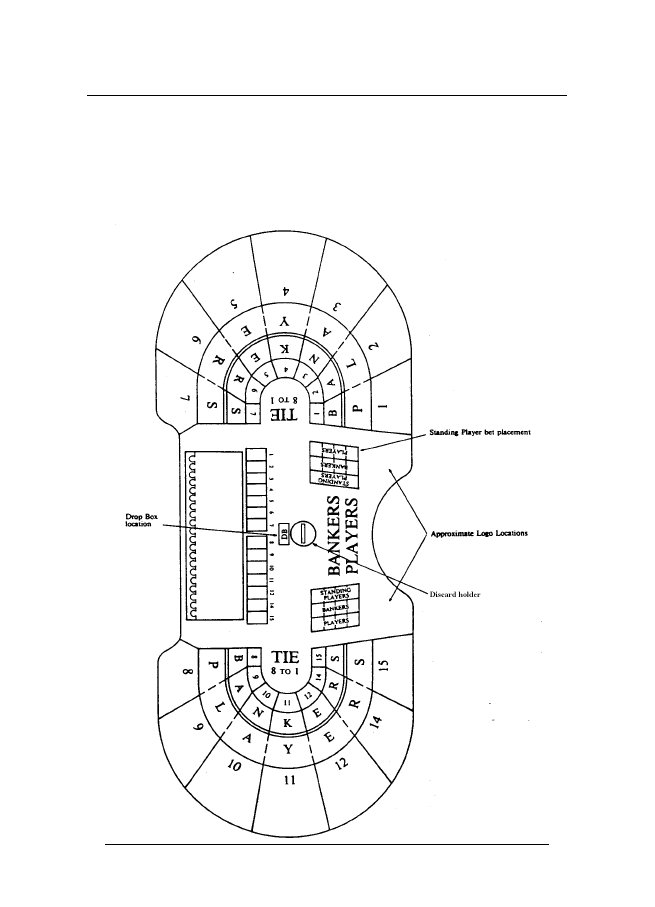
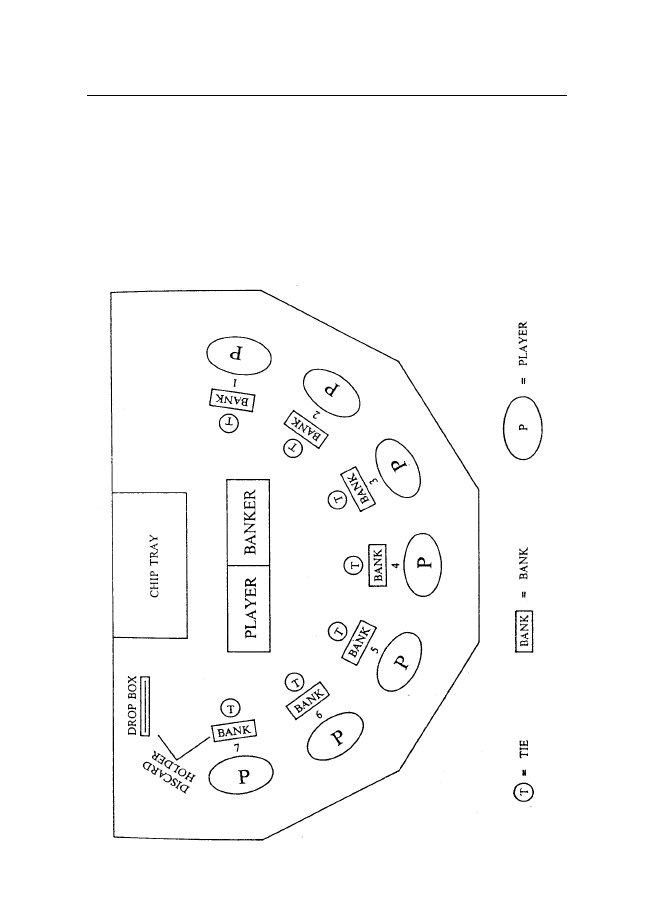
numbered places for 10to 14 seated players.(2)The layout cloth covering the table
must have imprinted on itthenameof,orlogofor,thecasinoandmustbemarkedsimilarly to the
way shown in diagram 1.1.4Drop box and
discard holderThe baccarat table must have a drop box and
a discard holderattached to it in approximately the position
shown in diagram1.1.5Standing
players(1)Ifallnumberedplacesatthetableareoccupiedbyseatedplayers, players
who are standing may also participate in thegame.
28Casino Gaming Rule 1999Schedule 1—Baccarat (continued)(2)Standing players—(a)may
place a wager in the part of the layout identified forstanding player wagers; and(b)must not participate in the cut of the
cards or touch orhandle the cards used in the game;
and(c)may not be appointed banker;
and(d)forallwinningwagersonthebanker’shand,immediatelythewinningsbecomepayable—mustpayorhavedeductedfromthewinningsthecommissioncalculated under
section 12.6Number of decks and way cards are
dealt(1)Baccaratisplayedwith8decksofcardswithbacksofthesame colour and design and 2
additional cutting cards.(2)All cards must be
dealt from a dealing shoe designed for thepurpose.7Value of cards and point count of
hands(1)The value of the cards in each deck is
as follows—(a)a card from 2 to 9 has its face
value;(b)a 10, jack, queen or king has a value
of 0;(c)an ace has a value of 1.(2)Thepoint
countof a hand is a single digit number from 0 to
9inclusive and is decided by adding together
the value of thecards in the hand.(3)If
the total of the cards in a hand is a 2-digit number, the
leftdigit of the number must be discarded having
no value and theright digit is the point count of the
hand.8Permissible wagers and resultsThe
following wagers are the permissible wagers by a playerat a
game of baccarat—
29Casino Gaming Rule 1999Schedule 1—Baccarat (continued)(a)a wager on the banker’s hand—(i)wins if the banker’s hand has a point
count higherthan the player’s hand; and(ii)loses if the banker’s hand has a point
count lowerthan the player’s hand; and(iii)is void if the
point counts of the banker’s hand andthe player’s hand
are equal;(b)a wager on the player’s hand—(i)wins if the player’s hand has a point
count higherthan the banker’s hand; and(ii)loses if the player’s hand has a point
count lowerthan the banker’s hand; and(iii)is void if the
point counts of the banker’s hand andthe player’s hand
are equal;(c)a tie bet wins if the point counts of
the banker’s handandtheplayer’shandareequalandlosesifthepointcounts are not
equal.9How wagers may be made(1)A wager at baccarat is made by placing
gaming chips on theappropriate wager area of the baccarat
layout.(2)A wager can not be made orally.10When wagers can not be placed, changed
or withdrawnA wager can not be placed, changed or
withdrawn after thefirst card of a round has been removed from
the shoe.11Minimum and maximum wagers(1)If the minimum wager permitted for a
table is not more than$10, the maximum wager permitted for
the table must be atleast $500.
30Casino Gaming Rule 1999Schedule 1—Baccarat (continued)(2)A tie bet must not be more than
one-eighth of the maximumwager permitted for the table.11AFree hand(1)A
casino operator may direct the banker to deal a round ofplay,forwhichtheplayersmustnotmakeawager(afreehand),
if—(a)a player at the table asks for a free
hand; and(b)all of the other players agree to play
a free hand.(2)A free hand must be played under
sections 21 to 27, 28(1) and(2), and
30.(3)No more than 3 free hands may be
played consecutively.12Payout odds and
commission(1)Awinningwagermadeoneithertheplayer’shandorthebanker’s hand is
paid at odds of 1 to 1.(2)However, for a
winning wager made on the banker’s hand, a5% charge
(acommission) is payable to
the casino operatoron the amount won.(3)The
commission may be rounded up to 50c or the next highestmultipleof50cifthecommissionisnotexactly50coramultiple of
50c.(4)The commission is collected from a
player when the winningpayout is made.(5)Collectionfromseatedplayersmaybedeferredbutalloutstanding
commission must be collected before reshufflingthe cards in the
shoe.(6)For any commission not collected when
the winning payout ismade,thedealermustplaceamarkerbuttonshowingtheamount of commission owed in a rectangular
space imprintedwith the number of the player owing the
commission, on thepart of the layout in front of the
dealer.(7)A winning tie bet is paid at odds of 8
to 1.
31Casino Gaming Rule 1999Schedule 1—Baccarat (continued)13No commission baccarat(1)A casino operator may, at any time,
offer a variation of thegame of baccarat known as ‘no
commission baccarat’.(2)In no commission
baccarat, a winning wager on the banker’shand is
paid—(a)for a banker’s hand with a point count
of 6—at odds of 1to 2; and(b)for
any other banker’s hand—at odds of 1 to 1.14Procedures for inspecting and shuffling
cards(1)Cards must be inspected and
shuffled—(a)under the provisions of this schedule;
and(b)under the approved control system for
the casino.(2)Beforebeingusedinplay,thecardsmustbeinspectedtocheck
for marks and imperfections and that each deck of cardscontains the correct cards.(3)If a player asks to inspect the cards
when the cards are firstplaced on the table for play, the
dealer must spread the cardsface up on the
table to enable a person inspecting them to seeif each deck of
cards is complete.17Cutting the cards(1)After
the cards have been shuffled, the dealer calling the gamemust
offer the stack of cards, with backs facing away from thedealer, to the players to be cut.(2)Thedealermuststartwiththeplayerseatedinthehighestnumber position at the table and, working
clockwise aroundthetable,mustofferthestacktoeachplayeruntilaplayeraccepts the
cut.(3)The player who accepts the cut may ask
another player to cutthe cards.
32Casino Gaming Rule 1999Schedule 1—Baccarat (continued)(4)Ifnoplayeracceptsthecut,thedealer,oranothercasinoemployeeorcasinokeyemployeeapprovedundertheapproved control system for the casino, must
cut the cards.(5)The cards must be cut by placing the
cutting card in the stackat least 10 cards in from either
end.(6)Afterthecuttingcardhasbeeninsertedintothestack,thedealercallingthegamemusttakeallcardsinfrontofthecutting card and place them at the
back of the stack.(7)The dealer must then insert 1 cutting
card in a position at least14 cards in from the back of the stack
and the second cuttingcard at the end of the stack.(8)The stack of cards must then be placed
in the dealing shoe forthe start of play.(9)Beforestartingplay,thedealermustremovethefirstcardfrom
the shoe and place it, and an additional number of cardsequal
to the face value of the first card drawn, in the discardholder after the faces of all cards drawn
have been shown tothe players.(10)In
the procedure mentioned in subsection (9), 10, jack, queenand
king cards have a face value of 10 and an ace card a facevalue
of 1.18Selecting the banker(1)This section applies subject to
section 20.(2)The dealer calling the game must, at
the start of play, offer thedealing shoe to
the player in seat number 1 at the table.(3)If
the player rejects the dealing shoe, or there is no-one in
seatnumber 1, the dealer must offer the shoe to
each of the otherseated players in turn, going anticlockwise
around the table,until the shoe is accepted by a player or
has been rejected byall of the players.(4)If a
player accepts the dealing shoe, the player is the bankerand
must deal the cards under this rule and the instructions ofthe
dealer.
33Casino Gaming Rule 1999Schedule 1—Baccarat (continued)(5)If no player accepts the dealing shoe,
the dealer is the bankerfor the round of play and must deal
the cards.(6)Ifaplayerstopsbeingthebanker(theformerbanker),thedealer must,
before the start of the next round of play, offer thedealing shoe to the player seated nearest
the former banker,going anticlockwise around the table.(7)Iftheplayertowhomthedealingshoeisofferedundersubsection (6)
rejects the shoe, the dealer must offer the shoeto
each of the other seated players in turn, going
anticlockwisearound the table, until the shoe is accepted
by a player or hasbeen rejected by all of the players.(8)Ifaplayertowhomthedealingshoeisofferedundersubsection (6) or
(7) accepts the shoe, the player is the bankerand must deal the
cards under this rule and the instructions ofthe
dealer.(9)If no player accepts the dealing shoe,
the dealer is the bankerfor the round of play and must deal
the cards.19Banker must make minimum wagers(1)A player wishing to continue as banker
must wager at least thepermissibleminimumwageroneitherthebanker’shandorthe player’s hand.(2)Iftheplayerdeclinestowager,theplayerstopsbeingthebanker and must relinquish the shoe.(3)A player who is the banker may place
wagers on either thebanker’s hand or the player’s hand and may
switch betweenthe hands on successive deals.20Dealer may be the banker(1)A casino key employee of a level
higher than a floor managermay direct the dealer calling the game
to be the banker duringa game of baccarat.
34Casino Gaming Rule 1999Schedule 1—Baccarat (continued)(2)While a direction given under
subsection (1) is in force—(a)the dealer
calling the game must be the banker and isresponsible for
dealing the cards in accordance with thisrule; and(b)a player must not touch or handle the
cards other than tocut the cards or if permitted by a dealer;
and(c)this section applies despite any other
provision of thisrule.21Dealing of first 2 cards to each hand(1)Theremustbe2handsdealtinthegameofbaccarat1ofwhichmustbedesignatedtheplayer’shandandtheotherdesignated the banker’s hand.(2)At the start of each round of
play—(a)thedealercallingthegamemustannounce‘nomorebets’; and(b)the dealer must announce ‘cards’;
and(c)the banker must then start dealing the
cards.(3)The banker must deal 4 cards from the
shoe, all face up or allface down.(4)The
first and third cards dealt are the first and second cards
ofthe player’s hand.(5)Thesecondandfourthcardsdealtarethefirstandsecondcards of the
banker’s hand.(6)Afterthecardsaredealttoeachhand,thecardsmustbeplaced face up in front of the dealer,
if the cards were dealtface down.22Announcement of point count of each hand
after first 4cards(1)After
the first 4 cards have been dealt, the dealer calling thegame
announces the point count of the player’s hand and thenthe
banker’s hand.
35Casino Gaming Rule 1999Schedule 1—Baccarat (continued)(2)Following the announcement of the
point counts of each hand,thebankerdealsathirdcardtoeachhandasrequiredbysections 25 to 27.23Dealing of additional cardsIf
both the player’s hand and the banker’s hand require a thirdcard
to be dealt to them—(a)the player’s hand is to be dealt to
first; and(b)only 1 additional card may be dealt to
either hand.24Appearance of cutting card during
play(1)Whenthecuttingcardappearsduringplay,itmustberemoved, and the
round of play completed.(2)When the round of
play is completed, the dealer must tell theplayersthelastroundisabouttobeplayed,andafurtherround is then
played.(3)When the further round is completed,
no more cards may bedealt until the cards are shuffled or new
cards are brought intoplay.(4)However, if the cutting card is the first
card out of the shoe atthe start of a round, the dealer must
tell the players the lastroundisabouttobeplayed,andonlythatroundmaybeplayed before the
cards are shuffled or new cards are broughtinto play.25No additional cards may be drawn in
certaincircumstancesIf the point
count of either the player’s hand or the banker’shand
after the first 2 cards are dealt to each is an 8 or 9 (anatural), no more cards
may be dealt to either hand.
36Casino Gaming Rule 1999Schedule 1—Baccarat (continued)26When player’s hand must draw or
stay(1)If the point count of the banker’s
hand on the first 2 cards is 0to 7 and the
point count of theplayer’shandis0to5,theplayer’s hand
must draw.(2)If the point count of the banker’s
hand on the first 2 cards is 0or 7 and the
point count of the player’s hand is 6 or 7, theplayer’s hand
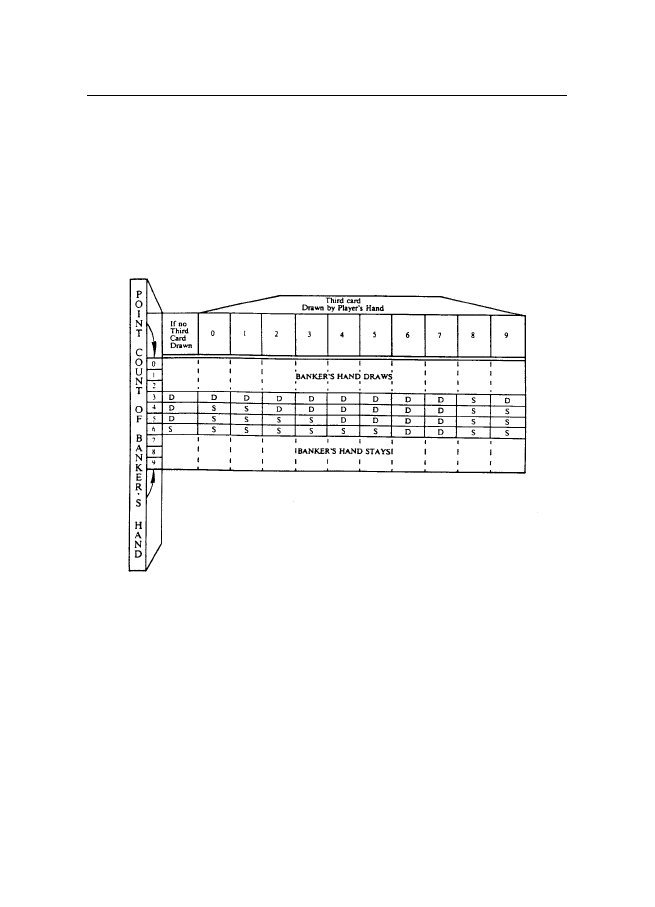
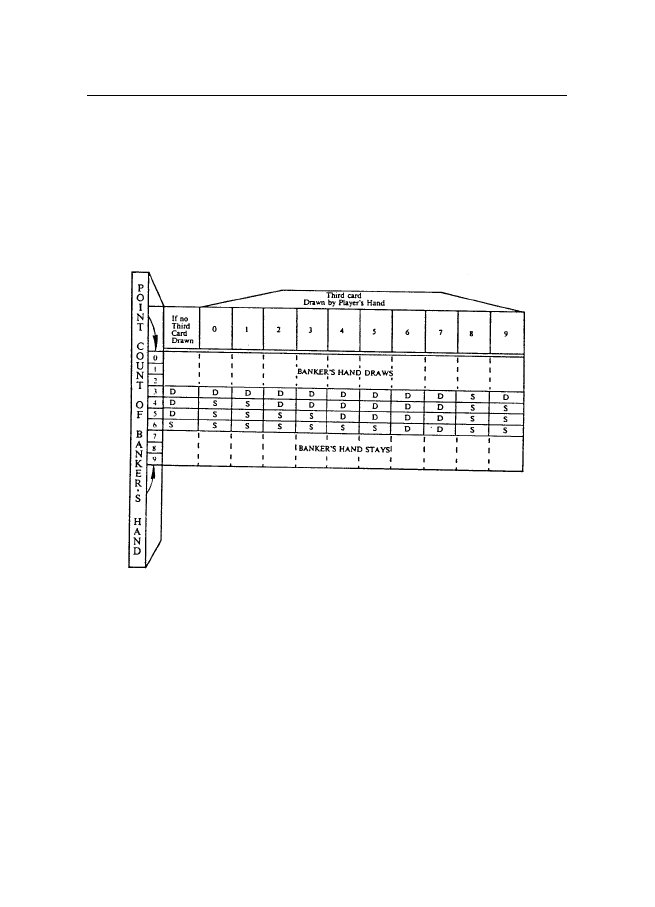
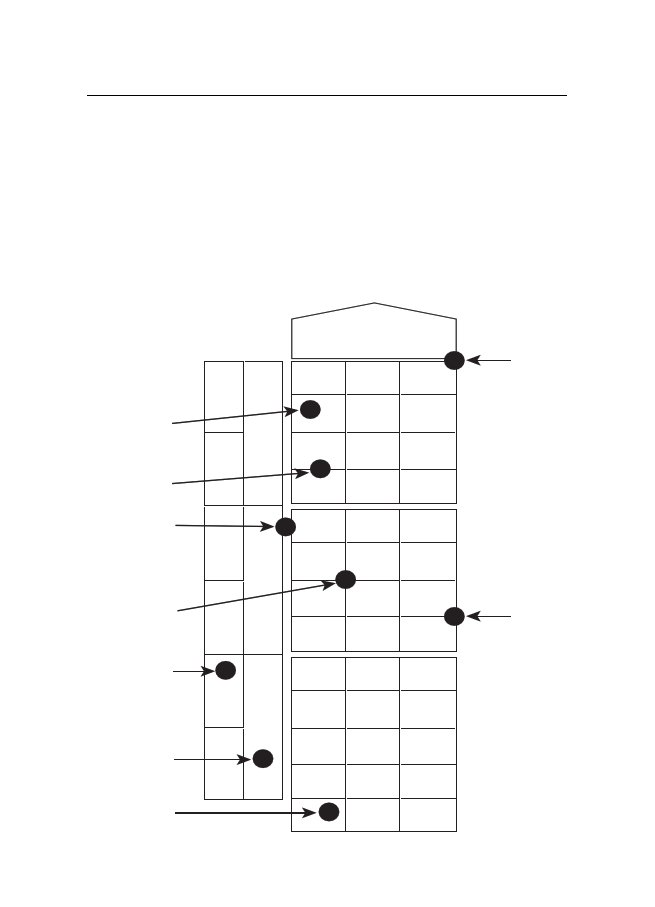
must stay.27Additional cards for banker’s hand in
certaincircumstances(1)The
banker’s hand must draw or stay as required by diagram1.2.(2)The first
vertical column in the diagram labelled ‘point countofbanker’shand’referstothepointcountofthebanker’shand
after the first 2 cards have been dealt to it.(3)The
first horizontal column at the top of the diagram labelled‘third card drawn by player’s hand’ refers
to the value of thethird card drawn by the player’s hand not
the point count ofthe player’s hand.(4)The
letter ‘D’ used in the diagram means the banker’s handmust
draw and the letter ‘S’ used in the diagram means thebanker’s hand must stay.(5)Tousethediagram,apersonfindsthepointcountofthebanker’shandinthefirstverticalcolumnandtracesithorizontallyacrossthediagramuntilitintersectsthethirdcard drawn by the
player’s hand.(6)The box at which the intersection
takes place shows whetherthe banker’s hand must draw or
stay.28Deciding the results of the round and
dealing withwagers(1)Aftereachhandhasreceivedallthecardsitisentitledtounder this rule, the dealer announces
the final point count ofeach hand indicating which hand has
won the round.
37Casino Gaming Rule 1999Schedule 1—Baccarat (continued)(2)If the 2 hands have equal point
counts, the dealer announces‘tie
hand’.(3)Aftertheresultoftheroundisannounced,thedealerordealersresponsibleforthewagersonthetablecollectalllosingwagers,payallwinningwagersandeithercollectormark up any commission owed.29Continuing as banker or selecting a
new banker(1)After a round of play, the banker may
elect to pass the shoe orremain as banker.(2)However—(a)thebankermustpasstheshoewheneverthebanker’shand loses;
and(b)the dealer or a floor manager may
order the banker topasstheshoeifthebankerunreasonablydelaysthegame,repeatedlymakesinvaliddealsorviolatestherules
of the game.(3)When a voluntary or compulsory
relinquishment of the shoeoccurs, the dealer calling the game
must offer the shoe to theplayer immediately to the right of the
previous banker.(4)If the player does not accept the shoe
or there is no player inthatposition,thedealermustoffertheshoetoeachoftheother seated
players in turn anticlockwise around the table.(5)The
first person to accept the shoe becomes the new banker.30Irregularities(1)A
third card dealt to the player’s hand when no third card isauthorised by this rule becomes the third
card of the banker’shand if, under section 27, the banker’s hand
must draw.(2)If the banker’s hand is required to
stay, the card dealt in errorbecomes the first
card of the next round of play unless it hasbeen
disclosed.(3)A card drawn in error from the shoe if
not disclosed is used asthe first card of the next round of
play.
38Casino Gaming Rule 1999Schedule 1—Baccarat (continued)(4)A card that would have been the first
card of the next round ofplay becomes the first card of a dummy
round if the card—(a)has been disclosed; or(b)is found face up in the shoe.(5)A dummy round—(a)can
only arise under subsection (4); and(b)must
be played in accordance with sections 21 to 27.(6)A
player must not make a wager on a dummy round.(7)If,
after the start of a round of play, a card is found face up
inthe shoe, the card—(a)is
taken to be a live card; and(b)must
be played as if it were found face down.(8)Iftherearenotenoughcardsremainingintheshoetocomplete a round of play—(a)the round has no effect; and(b)a new round must start.
41Casino Gaming Rule 1999Schedule 2Blackjacksection 3(2)Part 1Preliminary1Conducting and playing blackjackThis
schedule states the rules for conducting and playing thecasino game known as blackjack.2Definitions for sch 2In
this schedule—blackjackmeans an ace and
any card having a point value of10 dealt as the
first 2 cards to a player or a dealer.blackjack
wagersee section 7(1).dealermeans
the person responsible for dealing the cards at ablackjack table.double
downsee section 26.hard
totalmeans the point total of a hand containing
no acesor containing aces that are each counted as
1 in value.insurance wagermeans a wager
under section 25.madness 21 wagersee section
44B.perfect pairs wagersee section
44I.soft totalmeans the point
total of a hand containing an ace ifthe ace is
counted as 11 in value.split, for cards or a
hand of cards, means to split the cards orhand of cards
under section 27.3Table and layout(1)Blackjack is played at a table having a
place for the dealer on1 side and places for the players on
the opposite side.
42Casino Gaming Rule 1999Schedule 2—Blackjack (continued)(2)The layout cloth for the blackjack
table must have printed onit the name of, or logo for, the
casino and—(a)rectangular,circularorovalareastoshowboxesforwagers; or(b)if
the chief executive has approved a change to the boxesfor
bonus blackjack wagers, madness 21 wagers, perfectpairswagersorsupersevenswagers—theboxesasapproved.(3)The
following words must be printed on the layout cloth—•blackjack pays 3 to 2•dealer must stand on 17 and must draw
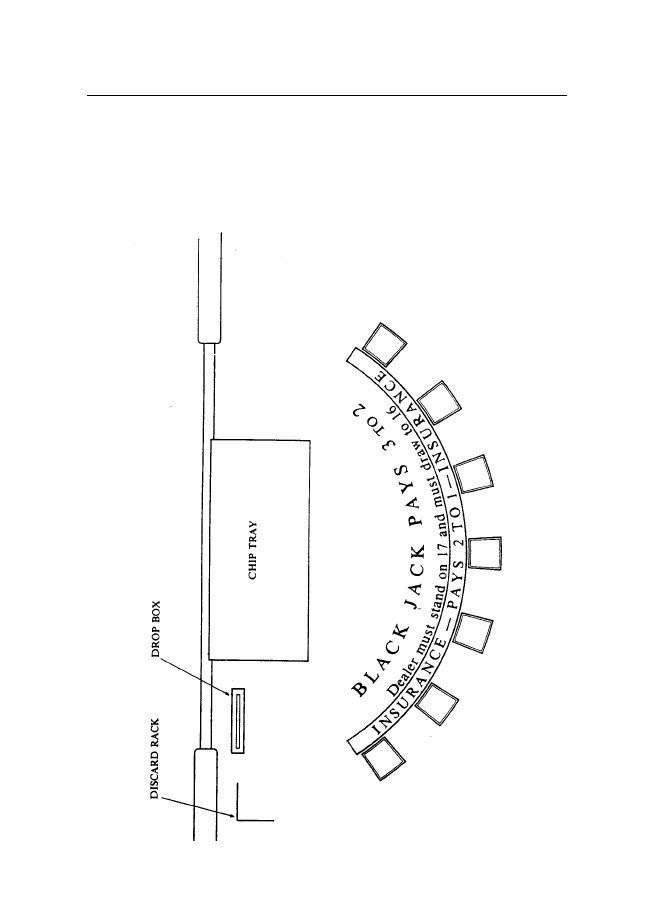
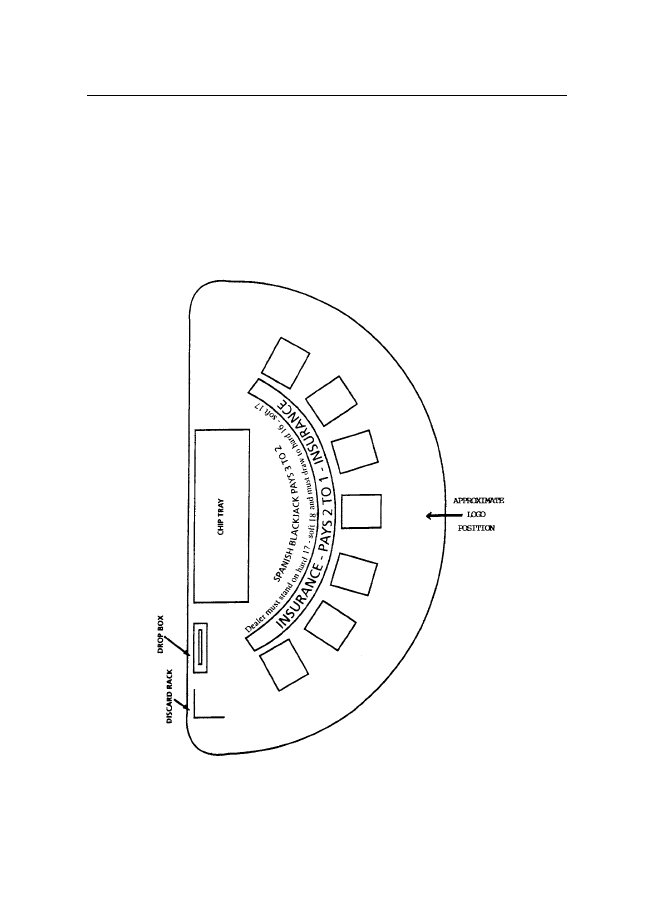
to 16•insurance pays 2 to 1.4Drop box and discard rackEach
blackjack table must have a drop box and a discard rackattached to it at approximately the
positions shown in diagram2.1.Part 2General rules5Number of decksBlackjack is
played with 5 to 8 decks of cards with backs ofthe same colour
and design and 2 additional cutting cards.6Value
of cards(1)The value of the cards contained in
each deck is as follows—(a)a card from 2 to
10 has its face value;(b)a jack, queen or
king has a value of 10;
43Casino Gaming Rule 1999Schedule 2—Blackjack (continued)(c)unlesssubsection(2)orsection26(4)3applies,anacehas a value of 11.(2)If a
value of 11 for an ace would give a player or the dealer apoint
total of more than 21, the ace has a value of 1.7Winning and losing wagers(1)Beforethefirstcardisdealtforeachroundofplay,eachplayer at a game of blackjack must make a
wager (ablackjackwager)
against the dealer.(2)The wager—(a)wins
if the player’s point total is not more than 21 andthe
dealer’s point total is more than 21; or(b)wins
if the player’s point total is more than the dealer’spoint
total but neither is more than 21; or(c)wins
if the player has a blackjack and the dealer doesnot
have a blackjack; or(d)loses if the dealer has a blackjack
and the player doesnot have a blackjack; or(e)is
void if the player’s and the dealer’s point totals are thesame
or the player and the dealer both have a blackjack;or(f)loses if the
player’s point total is more than 21; or(g)loses
if the dealer’s point total is more than the player’spoint
total but neither is more than 21.(3)If
the player has split cards and the dealer has a blackjack—(a)the player’s blackjack wager loses;
and(b)the additional wager made by splitting
the cards is void.3Section 26—(4)An
ace in the first 2 cards of a double down has a value of 1, not
11.
44Casino Gaming Rule 1999Schedule 2—Blackjack (continued)8How wagers may be made(1)Awageratblackjackismadebyplacingchipsintheappropriate area of the layout.(2)A wager can not be made orally.9Payout odds for winning wagers(1)Winning wagers, other than for a
blackjack, are paid at oddsof 1 to 1.(2)A
blackjack is paid at odds of 3 to 2.10Time
for wagering(1)After the first card of a round of
play has been removed fromtheshoe,aplayermustnothandle,removeoraltertheblackjack wager on a hand until a decision
about the wagerhas been made and has taken effect.(2)After a wager on the insurance line, a
wager to double downor a wager to split cards has been made and
confirmed by thedealer, a player must not handle, remove or
alter any wageruntil a decision about the wager has been
made and has takeneffect.11Entry
to or exclusion from game after first round(1)A
casino operator may refuse to allow a person who has notmade
a blackjack wager on the first round of play to enter alater
round, until the cards are reshuffled.(2)A
casino operator who allows a person to enter a game afterthefirstroundofcardsisdealtfromthedealingshoemayallow the person to wager only the
minimum wager for thetable, until the cards are reshuffled
and a new shoe is started.(3)Acasinooperatormayrefusetoallowaperson,whohasplaced a blackjack wager on a round of
play and declined toplace a blackjack wager on a later round, to
place a furtherblackjack wager until the shoe is completed
and a new shoe isstarted.
45Casino Gaming Rule 1999Schedule 2—Blackjack (continued)12Minimum and maximum wagers for
tables(1)If the minimum wager permitted for a
table is not more than$5,themaximumwagerpermittedforthetablemustbeatleast
$100.(2)Despite subsection (1), a casino key
employee responsible formanaging table games may direct
that—(a)a player may wager on only 1 box;
and(b)the player may wager only the minimum
wager for thetable.(3)Theemployeemaygivethedirectiononlyiftheemployeereasonably
believes the player is playing the game in a waythat
affects, or could potentially affect, the randomness of theoutcome of the game as intended by this
rule.(4)The casino employee must immediately
report the direction toan inspector.13Procedures for inspecting and shuffling
cards(1)Cards must be inspected and
shuffled—(a)under the provisions of this schedule;
and(b)under the approved control system for
the casino.(2)Beforebeingusedinplay,thecardsmustbeinspectedtocheck
for marks and imperfections and that each deck of cardscontains the correct cards.(3)If a player asks to inspect the cards
when the cards are firstplaced on the table for play, the
dealer must spread the cardsface up on the
table to enable a person inspecting them to seeif each deck of
cards is complete.(4)The cards must be shuffled—(a)before being brought into play;
and(b)afterthecuttingcardisreachedinthedealingshoe,unless—(i)the
cards are taken out of play; or
46Casino Gaming Rule 1999Schedule 2—Blackjack (continued)(ii)the table is to close at the end of
the last round ofplay; and(c)after
a round of play if directed by a casino employeehigher than a floor manager.(5)The dealer must reshuffle cards that
have been preshuffled if aplayerasksthedealertoreshufflethe cardsbeforethe firstcard
is removed from the dealing shoe.15Cutting of cards by player and dealer(1)After the cards have been shuffled,
the cards must be cut.(2)Two cutting cards
must be used.(3)The dealermustofferthe stackofcards,withbacksfacingaway
from the dealer, to the players to be cut.(4)Theplayerspecifiedinsection16mustcutthecardsbyplacing1ofthecuttingcardsinthestackatleast10cardsfrom either
end.(5)However,theplayermentionedinsubsection(4)mayaskanother player to
cut the cards.(6)The stack of cards must be cut only
once by the player.(7)After the cutting card has been
inserted into the stack by theplayer, the
dealer must take the cutting card and all cards infrontofthecuttingcardandplacethemtothebackofthestack.(8)Thedealermustinserttheothercuttingcardinapositionapproximately 1
deck or more in from the back of the stack orat the discretion
of a pit boss or assistant pit boss insert thecutting card in a
position between approximately 1 deck andapproximately
two-thirds of the way in from the back of thestack.(9)The stack of cards must then be
inserted in the dealing shoefor start of
play.
47Casino Gaming Rule 1999Schedule 2—Blackjack (continued)16Selecting player to cut cards(1)The player to cut the cards must
be—(a)the first player to the table
immediately before the startof play;
or(b)theplayeronwhoseboxthecuttingcardappearedduring the last
round of play; or(c)if the cutting card appeared on the
dealer’s hand duringthe last round of play—the player at the
farthest point tothe right of the dealer; or(d)ifthereshuffleofthecardswasundersection13(4)(c)—the player at the farthest point to
the right ofthe dealer.(2)Iftheplayerspecifiedinsubsection(1)refusestocut,thecards must be
offered to each other player moving clockwisearound the table
until a player accepts the cut.(3)A
player specified in subsection (1) or a player who acceptsthe
cut under subsection (2) may ask another player to cut thecards.(4)If no
player accepts the cut, the pit boss, assistant pit boss,floor
manager or the dealer must cut the cards.17Replacing the cardsApitboss,assistantpitbossorfloormanagermay,afteraround
of play, direct that the cards be replaced.18Using
a dealing shoe(1)All cards used in the game of
blackjack must be dealt from adealing shoe
designed for the purpose and located on the tableto
the left of the dealer.(2)Thedealermustremovecardsfromtheshoewiththelefthand,
and then with the right hand place them, face up, on theappropriate area of the layout.
48Casino Gaming Rule 1999Schedule 2—Blackjack (continued)19Dealing the cards(1)At
the start of each round of play, the dealer must, starting
onthedealer’sleftandcontinuingaroundthetable,dealthecards in the following order—(a)onecardfaceuptoeachboxonthelayoutwhichcontains a blackjack wager;(b)one card face up to the dealer;(c)asecondcardfaceuptoeachboxwhichcontainsablackjack wager.(2)After
2 cards have been dealt to each player and 1 card to thedealer,thedealer,startingfromthedealer’sleft,mustannounceeachplayer’spointtotalandeachplayermustindicatewhethertheplayerwishestodoubledown,splitcards, stand, or
draw.(3)For subsection (2)—(a)aplayermustindicatewhethertheplayerwishestodoubledownorsplitcardsbyplacinganadditionalwager; and(b)aplayermustindicatewhethertheplayerwishestostand or draw by a hand signal.(4)As each player indicates his or her
decision, the dealer mustdeal face up the additional cards
required and must announcethe point total of the player after
each additional card is dealt.(5)After
all additional cards have been dealt, the dealer must deala
second card face up to the dealer.(6)Any
additional cards dealt to the hand of the dealer must bedealtfaceupafterwhichthedealermustannouncethedealer’s point total.20Collecting and discarding cards after
play(1)At the completion of a round of play,
all cards still remainingon the layout must be picked up by the
dealer in order so thatthe cards can be easily arranged to
indicate each player’s handif there is a question or
dispute.
49Casino Gaming Rule 1999Schedule 2—Blackjack (continued)(2)The dealer must pick up the cards
starting with the player tothedealer’sfarrightandmovinganticlockwisearoundthetable.(3)After
all the players’ cards have been collected and discardedthe
dealer must pick up the dealer’s cards and place them facedown
on top of the players’ cards in the discard rack.21Procedure when cutting card is
reachedWhen the cutting card is reached in a round
of play, the dealermustcontinuedealingthecardsuntiltheroundofplayiscompleted and
then reshuffle the cards.22Players not to
handle cardsAplayerorspectatormustnothandle,removeoralteranycards
used in a game of blackjack.23Player responsible for own point
totalEach player at the table is responsible for
correctly computingthe point total of the player’s hand and may
not rely on thepoint total announced by the dealer.24Play if player has blackjack(1)If the first face up card dealt to the
dealer is 2, 3, 4, 5, 6, 7, 8or 9 and a player
has blackjack, the dealer must announce andpaytheblackjackatoddsof3to2andmustremovetheplayer’s cards before any player receives a
third card.(2)Ifthefirstfaceupcarddealttothedealerisanace,king,queen, jack or 10
and a player has a blackjack, the dealer mustannouncetheblackjackbutmaymakenopaymentnorremove any cards until all other cards are
dealt to the playersand the dealer receives a second
card.(3)If the dealer’s second card does not
give the dealer blackjack,the dealer must complete his or her
hand and any player withblackjack must be paid at the odds of
3 to 2.
50Casino Gaming Rule 1999Schedule 2—Blackjack (continued)(4)Despiteanyotherprovisionofthisrule,whenaplayerhasblackjack and the dealer’s first card
is an ace, the dealer mustpay the player immediately at odds of
1 to 1 in full settlementof the player’s wager if requested by
the player.Part 3Different types
of wagers, extraplayers and other matters25Insurance wagers(1)If
the first card dealt to the dealer is an ace, each player
maymake an insurance wager which wins if the
dealer’s secondcardisaking,queen,jackor10andlosesifthedealer’ssecond card is an
ace, 2, 3, 4, 5, 6, 7, 8 or 9.(2)Ifsubsection(1)applies,thedealermustcallforinsurancewagers by calling ‘insurance’.(3)A player may make an insurance wager,
immediately after thesecond card is dealt to the player and
before any additionalcard is dealt, by placing on the
insurance line an amount notmore than half
the amount staked on the player’s blackjackwager.(4)However,theinsurancewagermaybemorethanhalftheamountstakedontheplayer’sblackjackwagerby25ctoensure an even dollar payout, if the
insurance wager wins.(5)All winning
insurance wagers are paid at odds of 2 to 1.(6)All
losing insurance wagers must be collected by the dealerimmediately after the dealer draws a second
face up card forthe dealer’s hand and before the dealer
draws any additionalcards.26Doubling down(1)If
the point count of the first 2 cards dealt to a player or
thefirst 2 cards of a hand made by splitting
cards totals 9, 10 or
51Casino Gaming Rule 1999Schedule 2—Blackjack (continued)11,
the player may elect to make an additional wager of notmorethantheamountoftheplayer’sblackjackwager(todouble down) on the first 2
cards dealt to the player or the first2 cards of a hand
made by splitting cards.(2)However, only 1
additional card may be dealt to the hand onwhich the player
has elected to double down.(3)The additional
card must be dealt face up and placed sidewayson the
layout.(4)An ace in the first 2 cards of a
double down has a value of 1,not 11.(5)If the dealer obtains blackjack after
a player doubles down,thedealermaycollectonlytheamountoftheplayer’sblackjackwagerandnottheadditionalamountwageredindoubling down.27Splitting cards(1)If
the first 2 cards dealt to a player are identical in value,
theplayer may elect to split the hand, making
each card the firstcard of a separate hand.Example—If a player’s hand consists of a queen
and a 10, the 2 cards may be split,making the queen
the first card of 1 hand and the 10 the first card of aseparate hand.(2)However,theplayermustwageroneachhandtheamountwagered on the
original hand before it was split.(3)When
a player splits cards, the dealer must deal a second cardtothefirstofthehandsformedandmustcompletetheplayer’s decisions about the hand before
proceeding to dealcards to the second hand.(4)After a second card is dealt to a
split card, the dealer mustannouncethepointtotalofthehandandtheplayermustindicate to the dealer whether the
player wishes to stand, drawor double down
but—(a)a player may not split cards again;
and
52Casino Gaming Rule 1999Schedule 2—Blackjack (continued)(b)aplayersplittingacesmayhaveonly1carddealttoeach ace and may not elect to receive
additional cards;and(c)a player
splitting aces or 10 point value cards can notachieve a
blackjack.(5)If the dealer obtains a blackjack
after a player splits cards, thedealer may
collect only the amount of the player’s blackjackwager
and may not collect the additional amount wagered insplitting cards.28Additional cards for players(1)Aplayermayelecttodrawadditionalcardsiftheplayer’spoint
total is less than 21.(2)However—(a)aplayerelectingtodoubledownmaydrawonly1additional card; and(b)aplayersplittingacesmayhaveonly1carddealttoeach ace and may not elect to receive
additional cards.(3)A dealer may direct a player to draw
an additional card if theplayer’s point total is not more than
11, other than if—(a)the total includes an ace that has
been given a value of 1;or(b)section 26 or 27 applies.29Additional cards for dealer(1)A dealer must draw additional cards to
the dealer’s hand untilthe dealer has a hard or soft total of
17 to 21 after which thedealer must not draw any further cards
to the dealer’s hand.(2)A dealer must not
draw additional cards to the dealer’s hand,regardless of the
point total, if decisions have been made onallplayers’handsandtheadditionalcardswouldhavenoeffect on the
outcome of the round of play.
53Casino Gaming Rule 1999Schedule 2—Blackjack (continued)30One player for each boxSubject to section 31 and part 5B—(a)only 1 player may play on a box at a
blackjack table;and(b)the dealer must
not allow a player to place a wager onanother player’s
hand.31More than 1 player for a box(1)Acasinooperatormaypermitupto3playerstoplaceablackjack wager on 1 box at a blackjack
table.(2)The casino operator may direct that
either—(a)thetotalofallplayers’wagerson1boxmustnotbemore than the
table maximum; or(b)the separate wagers for each player
must not be morethan the table maximum.32Relationship between players placing
blackjack wagerson the same box(1)This
section applies—(a)if more than 1 player places a
blackjack wager on a box;and(b)to
each player who places a blackjack wager on the box.(2)The dealer must decide the player who
controls the box.(3)The dealer must ensure the wager of
the player who controlsthe box is in the part of the box
closest to the dealer’s side ofthe table.(4)Only the player controlling the box
may make decisions aboutthecardstobedealttotheboxandallotherplayersmustplace
their wagers immediately behind and in a straight linewith
the wager of the player controlling the box.(5)All
players may make an insurance wager.
54Casino Gaming Rule 1999Schedule 2—Blackjack (continued)(6)Iftheplayercontrollingtheboxdoublesdown,theotherplayers may also
double down but—(a)are not required to do so; and(b)only 1 additional card may be dealt to
the hand involvedin the double down.(7)If
the player controlling the box splits cards, the other
playersmust either make an additional wager to
cover each split cardor specify to which of the split cards
they wish their blackjackwager to apply.33Circumstances when a player may wager on
more than 1box(1)Aplayermaybepermittedbyacasinooperatortoplaceablackjack wager on more than 1 box at a
blackjack table withthe understanding that, when there are not
enough seats in thecasino to accommodate patron demand, a
player wagering onmore than 1 box must give up a box or boxes
to accommodateother players.(2)If a
player is permitted to place a blackjack wager on morethan1boxatatable,theplayermustmakeatleasttheminimum wager on each hand
played.Part 4Super sevens
wagers34Additional super sevens wagerA
player may choose to place an additional wager if the boxesforwagersontheblackjacktablelayoutprovideforsupersevens wagers
(asuper sevens wager).
55Casino Gaming Rule 1999Schedule 2—Blackjack (continued)35Placing a super sevens wager(1)For a round of play, a player may
place a super sevens wageron any box on which the player has
placed a blackjack wager.(2)The wager must be
placed before any cards are dealt in theround of
play.36Winning and losing super sevens wagers
and payoutodds(1)A super sevens
wager wins if—(a)thefirst,secondandthirdcardsdealttotheplayerplacing the wager
are all sevens; or(b)the first and second cards dealt to
the player placing thewager are both sevens, but the wager
does not win underparagraph (a); or(c)the
first card dealt to the player placing the wager is aseven, but the wager does not win under
paragraph (a) or(b).(2)Winning super
sevens wagers have the following payouts—(a)for 3
sevens (see subsection (1)(a))—(i)if
the 3 sevens are all the same suit—5000 to 1; or(ii)if the 3 sevens are not all the same
suit—500 to 1;(b)for 2 sevens (see subsection
(1)(b))—(i)if the 2 sevens are both the same
suit—100 to 1; or(ii)if the 2 sevens are not both the same
suit—50 to 1;(c)for 1 seven (see subsection (1)(c))—3
to 1.(3)A super sevens wager loses if the
first card dealt to the playerplacing the wager
is not a seven.37How super sevens wagers are dealt
with(1)After each player has been dealt the
player’s first 2 cards, thedealer takes away all losing super
sevens wagers.
56Casino Gaming Rule 1999Schedule 2—Blackjack (continued)(2)The dealer then makes payouts to each
player whose first cardis a seven but whose second card is
not seven.(3)The dealer then goes on to deal with
each player in the usualway for blackjack.(4)Ifaplayerwith2sevensdeclinesathirdcard,thedealerimmediately makes
a payout for the player’s winning supersevens
wager.(5)If a player with 2 sevens takes a
third card and it is a seven,thedealerimmediatelymakesapayoutfortheplayer’swinning super
sevens wager.(6)Ifaplayerwith2sevenstakesathirdcardanditisnotaseven,buttheplayerdoesnotbust,thedealerimmediatelymakes a payout
for the player’s winning super sevens wager.(7)Ifaplayerwith2sevenstakesathirdcardandbusts,thedealer takes away the player’s blackjack
wager, then makes apayout for the player’s winning super sevens
wager, and lastlytakes away the player’s cards.38Splitting sevens(1)If a
player who makes a super sevens wager splits 2 sevens,the
player’s super sevens result is decided from the 2 sevensthatweresplitandthenextcarddealttotheplayerasthesecond card to the first of the split
sevens.(2)Thedealermakesapayoutforthesupersevenswagerimmediately the
result is decided.39Two or more players on a box(1)If 2 or more players place a blackjack
wager on a box and theplayer controlling the box is
permitted to make super sevenswagers,theotherplayerorplayersmayalsomakesupersevens wagers, but the right of the player
controlling the boxto make decisions about the cards to be
dealt is not affected.(2)If the player
controlling the box splits a pair of sevens, thecardsthatdecidethesupersevensresultfortheplayercontrollingtheboxalsodecidethesupersevensresultfor
57Casino Gaming Rule 1999Schedule 2—Blackjack (continued)another player placing a blackjack wager on
the box, whetheror not the other player chooses to make an
additional wager tocover each split card.Part 5Bonus
blackjack40Additional bonus blackjack
wager(1)Aplayermayplaceanadditional$1wager(abonusblackjack
wager) if—(a)theboxesforwagersontheblackjacktablelayoutprovide for bonus
blackjack; and(b)asignatthetableshowstheamountsofthebonusblackjack payouts
for the table.(2)Bonus blackjack may be played only if
either 6 or 8 decks ofcards are used for the game of
blackjack.41Placing a bonus blackjack wager(1)Onlytheplayercontrollingaboxmaymakeabonusblackjack
wager.(2)Thewagermustbeplacedbeforeanycardsinaroundareremoved from the shoe.(3)The
wager is made by placing chips in the appropriate area ofthe
layout.42Winning bonus blackjack wagers and
payouts(1)A bonus blackjack wager wins
if—(a)4 cards are dealt to the player
placing the wager, and 3of the 4 cards are fives and the other
card is a six; or(b)3 cards are dealt to the player
placing the wager and theyare all sevens; or
58Casino Gaming Rule 1999Schedule 2—Blackjack (continued)(c)3 cards are dealt to the player
placing the wager and 1card is a six, 1 card is a seven, and
1 card is an eight; or(d)a nominated
blackjack is dealt to the player placing thewager.(2)Winning bonus blackjack wagers have
the following payoutamounts—(a)for 3
fives and a six (see subsection (1)(a))—(i)if
the 4 cards are all the same suit—$25000; or(ii)if
the 4 cards are not all the same suit—$1500;(b)for 3
sevens (see subsection (1)(b))—(i)if
the 3 cards are all the same suit—$5000; or(ii)if
the 3 cards are not all the same suit—$500;(c)for a
six, a seven and an eight (see subsection (1)(c))—(i)if the 3 cards are all the same
suit—(A)if 8 decks of cards are in use for the
game ofblackjack—$750; or(B)if 6
decks of cards are in use for the game ofblackjack—$800;
or(ii)if the 3 cards are not all the same
suit—$50;(d)foranominatedblackjack(seesubsection(1)(d))—$175.(3)In
this section—nominated blackjackmeans a blackjack
consisting of an aceof a suit nominated for the round of play on
a sign on the tableand another card, also nominated on the
sign, of the same suitas the ace.43Dealing with bonus blackjack wagers(1)This section applies to a player who
makes a bonus blackjackwager in addition to the player’s
blackjack wager.
59Casino Gaming Rule 1999Schedule 2—Blackjack (continued)(2)If the dealer settles a winning
blackjack wager for the playerand the player
has blackjack, the dealer must—(a)if
the player’s bonus blackjack wager is not a winningbonus
blackjack wager—take away the bonus blackjackwager; or(b)ifthebonusblackjackwagerisawinningbonusblackjackwager—alsosettlethewinningbonusblackjack wager.(3)If
the player’s bonus blackjack wager can not be a winningbonus
blackjack wager, the dealer must take away the wageras
soon as it is evident no more cards are to be dealt to theplayer.(4)Iftheplayer’sbonusblackjackwagerisawinningbonusblackjack wager, but subsection (2) does not
apply, the dealermust leave the wager in place.(5)If the player’s bonus blackjackwager
is left in place undersubsection(4),thedealermustsettleitafterallplayers’blackjack wagers
have been settled.44Splitting cardsIf a player who
makes a bonus blackjack wager splits 2 cards,the player’s
bonus blackjack result is decided from the handdealt to the
first of the split cards.Part 5AMadness 21
wagers44ADefinitions for pt 5AIn
this part—controllingplayer,forabox,meanstheplayerwhomthedealer decides, under section 32,
controls the box.
60Casino Gaming Rule 1999Schedule 2—Blackjack (continued)electronicprizemetermeansameterfordisplayingtheamount of the prize for each $1 wager that
is a madness 21wager.44BAdditional madness 21 wagerA
player may choose to place an additional wager (amadness21 wager)
if—(a)theboxesforwagersontheblackjacktablelayoutprovide for
madness 21 wagers; and(b)the table is
fitted with the following equipment approvedby the chief
executive—(i)a jackpot button;(ii)a
random number generator;(iii)an electronic
prize meter.44CPlacing a madness 21 wager(1)A player may place a madness 21 wager
on any box on whichthe player has placed a blackjack
wager.(2)The madness 21 wager must be placed
before any cards in theround of play are dealt.(3)The madness 21 wager must be at least
the minimum amount,andnotmorethanthemaximumamount,displayedonthesign at the table
about madness 21 wagers.4(4)Subsection (1) does not apply if the madness
21 equipment forthe table has malfunctioned or is not
operating.44DWinning and losing madness 21 wagers
and payouts(1)A madness 21 wager on a box wins if
the controlling playerfor the box has a blackjack, even if
the dealer has a blackjack.4Under section
64(1)(d)of the Act, a casino operator must
display at each gamingtable or location for the playing of a
game a sign showing the permissible minimumand maximum
wagers for the game played at the table or location.
61Casino Gaming Rule 1999Schedule 2—Blackjack (continued)(2)A madness 21 wager on a box loses if
the controlling playerfor the box does not have a
blackjack.(3)Subjecttosubsection(4),afterthejackpotbuttonhasbeenpressed by a
person eligible to press it under section 44E, eachwinning madness 21 wager on a box must be
paid, for each $1wager that is a madness 21 wager, the amount
displayed onthe electronic prize meter for madness 21
wagers at the table.(4)If, during the round of play, the
equipment for madness 21malfunctionsandcannotbeusedtodecidetheamountpayableforawinningmadness21wager,thewinningmadness 21 wager
for the round must be paid an amount equalto 25 times the
amount of the madness 21 wager.44EDeciding who is eligible to press jackpot
button(1)The person who may press the jackpot
button for a winningmadness 21 wager on a box is decided under
this section.(2)Thecontrollingplayerfortheboxmaypressthejackpotbutton if the
controlling player placed a winning madness 21wager on the
box.(3)The second player for the box may
press the jackpot buttonif—(a)thecontrollingplayerfortheboxhasnotplacedamadness 21 wager, is not present or
refuses to press thejackpot button; and(b)thesecondplayerhasplacedawinningmadness21wager on the box.(4)The
third player for the box may press the jackpot button if—(a)no-onemaypressthejackpotbuttonundersubsection(2)or(3)orthepersonswhomaypressthejackpotbutton under
either of the subsections are not present orrefuse to press
the jackpot button; and(b)the third player
has placed a winning madness 21 wageron the
box.
62Casino Gaming Rule 1999Schedule 2—Blackjack (continued)(5)The floor manager may press the
jackpot button if all personswho may press the
button under subsection (2), (3) or (4) arenot present or
refuse to press the jackpot button.(6)In
this section—second player, for a box,
means the player for a box whoseblackjack wager
is directly behind the blackjack wager of thecontrolling
player for the box.thirdplayer,forabox,meanstheplayerforaboxwhoseblackjack wager is directly behind the
blackjack wager of thesecond player for the box.44EAPressing the jackpot button(1)A player may use only reasonable force
to press the jackpotbutton.(2)Ifacasinokeyemployeeresponsibleformanagingtablegamesissatisfiedaplayerusedmoreforcethanwasreasonabletopressthejackpotbutton,thecasinokeyemployee may direct that the player be
excluded from placingmadness 21 wagers at the
casino.44FHow madness 21 wagers are dealt
with(1)This section applies despite section
24.(2)After controlling players have been
dealt their first 2 cards,the dealer must take away all losing
madness 21 wagers.(3)If a player has blackjack and the
dealer’s first card is a 2, 3, 4,5, 6, 7, 8 or 9,
the dealer must—(a)pay the player’s blackjack wager, push
the controllingplayer’s cards together and leave them on
the layout onthe dealer’s side of the box; and(b)dealwitheachotherplayerintheusualwayforthegame
of blackjack.(4)If a player has blackjack and the
dealer’s first card is an ace,king, queen, jack
or 10, the dealer must deal with each playerin the usual way
for a game of blackjack.
63Casino Gaming Rule 1999Schedule 2—Blackjack (continued)(5)After the dealer has made payouts for
the round of play butbefore removing the cards from the
layout, the dealer must,foreachboxwithawinningmadness21wager,offerthejackpotbuttontothepersonswhomaypressthejackpotbuttonfortheboxundersection44E,startingfromthedealer’sright,untiloneofthepersonspressesthejackpotbutton.(6)After an amount is displayed on the
electronic prize meter fora box with a winning madness 21 wager,
the dealer must pay,foreach$1wagerthatisamadness21wager,theamountdisplayed on the
electronic prize meter for madness 21 wagersatthetable,beforemovingtothenextboxwithawinningmadness 21 wager.(7)Afterallwinningmadness21wagershavebeenpaid,thedealer must collect the players’ cards and
place them in thediscard rack.(8)To
remove doubt, it is declared that—(a)the
jackpot button mayonly be pressed once for eachbox
with a winning madness 21 wager; and(b)each
player with a winning madness 21 wager on a boxis to be paid
under subsection (6) or section 44D(4).44GSchedule of prizesFor each casino
for which approval has been given for gamingequipment that
provides for madness 21 wagers as part of thegameofblackjack,thechiefexecutivemustapproveascheduleofprizesforeach$1wagerthatisamadness21wager
as part of the game at the casino.Part 5BPerfect pairs wagers44HDefinitions for pt 5BIn this
part—
64Casino Gaming Rule 1999Schedule 2—Blackjack (continued)coloured pairmeans a pair
comprised of—(a)2 red cards of different suits;
or(b)2 black cards of different
suits.face value, of a card,
means—(a)the number of the card, namely 2, 3,
4, 5, 6, 7, 8, 9 or 10;or(b)the
type of card, namely jack, queen, king or ace.mixed
pairmeans a pair comprised of 1 red card and 1
blackcard.pairmeans
2 cards with the same face value.perfect
pairmeans a pair comprised of cards of the same
suit.44IPerfect pairs wagerA
player may choose to place a wager (aperfect pairs
wager)for a round of play if the boxes for
wagers on the blackjacktable layout provide for perfect pairs
wagers.44JPlacing a perfect pairs wager(1)If a player places a blackjack wager
on a box, a perfect pairswager on the player’s hand may also be
placed on the box.(2)However,theplayerplacingtheblackjackwagermustbegivenanopportunitytoplaceaperfectpairswagerontheplayer’s hand before any other person
is allowed to place aperfect pairs wager on the player’s
hand.(3)Aperfectpairswagerforaroundofplaymustbeplacedbefore any cards
are dealt in the round of play.(4)A
perfect pairs wager must be at least the minimum amount,andnotmorethanthemaximumamount,displayedonthesign at the table
about perfect pairs wagers.55Under section 64(1)(d) of the Act, a
casino operator must display at each gamingtable or location
for the playing of a game a sign showing the permissible
minimumand maximum wagers for the game played at
the table or location.
65Casino Gaming Rule 1999Schedule 2—Blackjack (continued)44KWinning and losing perfect pairs
wagers and payouts(1)A perfect pairs wager wins if the
first 2 cards dealt to the handon which the
wager was placed are a pair.(2)Winning perfect pairs wagers must be paid as
follows—(a)if the chief executive has approved
the application of theNo. 1 schedule of prizes for perfect
pairs wagers as partof the game of blackjack at the
casino—(i)for a mixed pair—5 to 1; and(ii)for a coloured pair—10 to 1;
and(iii)for a perfect
pair—30 to 1;(b)if the chief executive has approved
the application of theNo. 2 schedule of prizes for perfect
pairs wagers as partof the game of blackjack at the
casino—(i)for a mixed pair—6 to 1; and(ii)for a coloured pair—12 to 1;
and(iii)for a perfect
pair—25 to 1.(3)A perfect pairs wager loses if the
first 2 cards dealt to the handon which the
wager was placed do not comprise a pair.44LSchedule of prizesFor each casino
for which approval has been given for gamingequipment that
provides for perfect pairs wagers as part of thegameofblackjack,thechiefexecutivemustapprovetheapplication of the No. 1 schedule of prizes
or No. 2 scheduleof prizes for perfect pairs wagers as part
of the game at thecasino.44MHow
perfect pairs wager dealt with(1)After
each player has been dealt the player’s first 2 cards, thedealer must—(a)take
away all losing perfect pairs wagers; and
66Casino Gaming Rule 1999Schedule 2—Blackjack (continued)(b)make a payout to each player who has
placed a winningperfect pairs wager.(2)The
dealer then goes on to deal with each player in the usualway
for blackjack.Part 6Irregularities45Exposed card in rackA card found face
up in the shoe must be removed from playand placed in the
discard rack.46Card drawn in error to be used in
play(1)A card drawn in error without its face
being exposed must beused as though it were the next card
from the shoe.(2)After the first 2 cards have been
dealt to each player and acardisdrawninerrorandexposedtotheplayers,thecardmust be dealt to a player or the
dealer as though it were thenext card from
the shoe.Examples of a card drawn in error and
exposed to players—1A dealer gives a
card to a player who has not indicated for a card.2Adealeraccidentallyexposesacardwhendrawingitfromadealing
shoe.(3)Aplayerrefusingtoacceptthecardmustnothaveanyadditional cards
dealt to that hand during the round.(4)Ifthecardisrefusedbytheplayers,itmustbecomethedealer’s second card.47Card
drawn in error not to be used(1)Subsection (2) applies if the dealer—(a)has 17 or more points;
and
67Casino Gaming Rule 1999Schedule 2—Blackjack (continued)(b)accidentally deals another card to the
dealer’s hand; and(c)exposes the face of the card to the
players.(2)The card must be removed from play and
placed in the discardrack.48Not
enough cards in shoe to complete round of playIftherearenotenoughcardsremainingintheshoetocomplete a round of play, the dealer must
shuffle and cut thecards in the discard rack and complete the
round of play.49Incorrect placement of card(1)If, during the original dealing of
cards in a round of play, anyofthecardsareincorrectlyplaced,andtheincorrectplacement is noticed before the dealer acts
on any hand, thecards must be placed in the order they would
have been in ifthe incorrect placement had not
happened.(2)For subsection (1), a dealer is taken
to have acted on a handif—(a)the
dealer has received a hand signal from the player forthe
first box in play at the table; or(b)theplayerforthefirstboxinplayatthetablehasdecidedtodoubledownandathirdcardhasbeendelivered to the hand; or(c)theplayerforthefirstboxinplayatthetablehasdecidedtosplitthehandandasecondcardhasbeendelivered to the
first of the hands formed; or(d)a
player’s wager has been settled.50Dealer with too many cards(1)If, contrary to section 19(1)(b), the
dealer has inadvertentlydealt 2 or more cards to the dealer’s
hand, and the dealer hasstarted acting on a player’s hand, the
dealer must—
68Casino Gaming Rule 1999Schedule 2—Blackjack (continued)(a)inform the players that the cards held
by the dealer aretakentohavethepointtotalusuallycountedafterthedealer’s cards have been dealt, but
not a blackjack; and(b)give each player the choice of
withdrawing the player’sblackjack wager; and(c)finishactingonallplayers’handsthathavenotbeenwithdrawn.(2)The
dealer must finish hitting the dealer’s hand if there is atleast
1 player—(a)who did not withdraw the player’s
blackjack wager; and(b)whose point total is not more than
21.51No cards or only 1 card dealt to a
player’s hand(1)Ifnocardsaredealttoaplayer’shand(playerA),andthedealer has started acting on another
player’s hand, player A’shand is dead and player A must retract
his or her blackjackwager.(2)If
only 1 card is dealt to a player’s hand (player B) and
thedealer has started acting on another
player’s hand, player Bmay—(a)retract player B’s blackjack wager;
or(b)receive a second card when the dealer
starts acting onplayer B’s hand.52No
second card to last player if dealer has no secondcard(1)Thissectionappliestotheplayerimmediatelybeforethedealer if—(a)the
dealer has not dealt a second card to the player; and(b)all other players have been dealt a
second card and hitwith the additional cards each has
requested; and(c)the dealer has not dealt the dealer’s
hand a second card.
69Casino Gaming Rule 1999Schedule 2—Blackjack (continued)(2)The player may choose—(a)to retract the player’s blackjack
wager; or(b)to be dealt a second card and
additional cards before thedealer deals a second card to the
dealer’s hand.53Additional cards not offered or dealt
to a player(1)This section applies to a player
if—(a)the dealer does not—(i)offer additional cards to the player;
or(ii)deal additional cards to the player
and the playerhas indicated for additional cards;
and(b)theplayerisnottheplayerimmediatelybeforethedealer.(2)The
player may retract his or her blackjack wager or play outhisorherhandafterallotherplayershavecompletedtheirhands
and before any other card is dealt.54No
second card or additional cards to last player if dealerhas
second card and more(1)Thissectionappliestotheplayerimmediatelybeforethedealer if—(a)the
dealer has not dealt a second card to the player, oroffered to hit the player with additional
cards; and(b)the dealer has dealt himself or
herself a second card andhit the dealer’s hand with an
additional card.(2)The dealer must separate out the
dealer’s second card and anyadditional cards
in the order in which they were dealt.(3)Before taking any other cards from the shoe,
the dealer mustuse the second card and any additional cards
that have beenseparated out in the order the cards were
originally taken fromthe shoe.
70Casino Gaming Rule 1999Schedule 2—Blackjack (continued)(4)Thedealermustdealtheplayerimmediatelybeforethedealer—(a)if
the player was not dealt a second card—a second card;and(b)iftheplayerindicatesheorshewantstobehitwithadditional cards—as many additional cards as
the playerindicates.(5)The
dealer must deal a second card to the dealer’s hand andmay
hit the dealer’s hand in the usual way.55Dealer with no first card(1)Ifadealerisactingonaplayer’shandanddiscoversthedealer has missed dealing a first card to
the dealer’s hand, thedealer must—(a)give
each player the choice of withdrawing the player’sblackjack wager; and(b)finishactingonallplayers’handsthathavenotbeenwithdrawn.(2)The
dealer must take 2 cards and, if necessary, finish hittingthe
dealer’s hand, if there is at least 1 player—(a)who
did not withdraw the player’s blackjack wager; and(b)whose point total is not more than
21.(3)The dealer need not deal to the
dealer’s hand if either of thefollowing applies
to each of the players—(a)the player
withdrew the player’s blackjack wager;(b)the
player obtained a point total of more than 21.56Extra
hand dealtIfthedealerhasstartedactingonaplayer’shand,anextrahand dealt in
error is void.
71Casino Gaming Rule 1999Schedule 2—Blackjack (continued)57Player not acting on hand after
wageringIf a player who has made a blackjack wager
does not act onthe player’s hand within a reasonable time,
or refuses to act oris not present, a pit boss, assistant pit
boss or floor managermay direct that—(a)the
first 2 cards must be dealt to the player’s hand; and(b)further cards must be dealt to the
player’s hand, if thehardtotalofthehandisnotmorethan11orthesofttotal of the hand
is not more than 16.Part 7Use of card
machine58Card machine(1)A
card machine may be used for blackjack.(2)However,acardmachinemustnotbeusedforagameofblackjackifsupersevens,bonusblackjack,madness21orperfectpairsisofferedwiththegame,unlesstheapprovedcontrol system
for the casino states that a card machine maybeusedforagameofblackjackwithwhichsupersevens,bonus blackjack,
madness 21 or perfect pairs is offered.(3)Ifacardmachineisused,theoperationofparts1to5ischangedtotheextentnecessaryforthefollowingtohaveeffect—(a)thenumberofdecksusedmustbenotlessthantheminimum, and not more than the maximum
(which inturnmustbenotmorethan8),numberofdecksapprovedbythechiefexecutiveforuseinthecardmachine;(b)when
play is started, or if the cards in the card machinearereplacedundersection17,thecardsmustbeinspectedandshuffledandthenplacedinthecardmachine;
72Casino Gaming Rule 1999Schedule 2—Blackjack (continued)(c)the cards do not need to be cut before
being placed inthe card machine;(d)a
cutting card may be used to conceal the bottom card ofthecardsplacedintothemachine,butitmustberemovedfromthemachinebeforecardsforthefirstround of play are
dealt;(e)cutting cards are not used for the
game, other than in theway mentioned in paragraph (d);(f)for dealing the cards, the card
machine takes the place ofthe dealing shoe;(g)cardsthathavebeenplacedinthediscardrackareplacedinthecardmachinetobemixedwiththeremaining cards in the machine.(4)Section 11 does not apply if a card
machine is used.59Card machine malfunction(1)This section applies if a card machine
malfunctions during around of play.(2)Acasinoemployeeofthelevelofpitbossorhighermustensurethatthecardmachineisrepairedorreplacedinaccordance with the casino’s approved
control system.(3)Ifthecasinoemployeeconsidersthatthemalfunctionhasdisadvantagedaplayer,eachplayermustbegiventheopportunity to have the player’s wagers for
the round of playreturned to the player before the round of
play is continued.
74Casino Gaming Rule 1999Schedule 3Caribbean stud
pokersection 3(2)Part 1Preliminary1Conducting and playing caribbean stud
pokerThis schedule states the rules for
conducting and playing thecasino game known as caribbean stud
poker.2Definitions for sch 3In
this schedule—1 pairsee section
6.2 pairssee section
6.3 of a kindsee section
6.4 of a kindsee section
6.ante wagermeans a wager
made by a person to enable theperson to take
part in a round of the game as a player.betwagermeansawagermadebyaplayerafterthecardshave been dealt
and the player has had an opportunity to lookat the player’s
hand.closes a player’s handsee section
3.continuingplayermeansaplayerwhohasmadeanantewager and has not folded.dead
man’s handmeans a hand with a pair of aces, a pair
ofeights and 1 odd card.dealer’s
upcardsee section 16.face
value, of a card, means—(a)the
number of the card, namely, 2, 3, 4, 5, 6, 7, 8, 9 or10;
or(b)the type of card, namely, jack, queen,
king or ace.
75Casino Gaming Rule 1999Schedule 3—Caribbean stud poker
(continued)flushsee section
6.foldmeans to stop taking part in a round
of the game.full housesee section
6.gamemeans caribbean stud poker.jackpotprize,forthegameatacasino,meansanamountworked out or
stated for the game under the approved controlsystem for the
casino.jackpot wagermeans a wager
made by a player by placing thewagerintheareaforjackpotwagersonthetable,ortheappropriate slot,
before the cards for a round are dealt.maximumpayment,forabetwageratatable,meansthemaximumamountstatedbythecasinooperatorinthesignmentioned in section 10(1)(b) for the table
as the maximumpayment for a winning bet wager.odd
card, in relation to another card or cards,
means a cardwith a different face value to the other
card or cards.odd card handsee section
6.pokerranking,ofahand,meanstherankingofthehandworked out under
section 7.qualifies, for a dealer’s
hand, see section 4.round, of the game,
includes the wagering, dealing of cards,playing the game
with the cards as dealt, deciding the winninghands, collecting
losing wagers and paying for winning hands.royal
flushsee section 6.straightsee
section 6.straight flushsee section
6.wagermeans an ante
wager, bet wager or jackpot wager.winning jackpot
handsee section 5.3Meaning ofclosesaplayer’shandA
dealercloses a player’s handby—
76Casino Gaming Rule 1999Schedule 3—Caribbean stud poker
(continued)(a)collectingtheplayer’santewager,jackpotwagerandcards; and(b)individuallyspreadingoutthecollectedcards,facedown,
and counting them; and(c)placing the cards
in the table’s discard rack.4Meaning ofqualifiesfor a
dealer’s handA dealer’s handqualifiesif it
is—(a)anoddcardhandandthecombinationof5cardsincludes an ace
and a king; or(b)a poker hand ranking higher than an
odd card hand.5Meaning ofwinningjackpothand(1)Each of the following is awinning jackpot hand—•flush•full
house•4 of a kind•straight flush•royal
flush.(2)Also, if a dead man’s hand is a
winning jackpot hand under acasino’s approved
control system, awinning jackpot handforthe
casino includes a dead man’s hand.
77Casino Gaming Rule 1999Schedule 3—Caribbean stud poker
(continued)6Meaning of various poker handsThe
following poker hands have the meaning given oppositethe
hand—Poker handCardsodd
card hand1 pair2 pairs3 of
a kindstraightflushfull
house4 of a kindstraight
flushroyal flushany combination
of 5 cards, otherthananotherpokerhandmentioned in this section2cardswiththesamefacevalueand 3 odd
cards2 cards with the same face value,another 2 cards with the same facevalue
(other than the face value ofthe first 2
cards) and 1 odd card3cardswiththesamefacevalueand 2 odd
cards5 cards of more than 1 suit runningconsecutively in face value5cardsofthesamesuitbutnotrunningconsecutivelyinfacevalue3cardswiththesamefacevalueand another 2
cards with same facevalue (other than the face value ofthe
first 3 cards)4cardswiththesamefacevalueand 1 odd
card5cardsofthesamesuitrunningconsecutivelyinfacevalue,otherthan
a royal flush10, jack, queen, king and ace of thesame
suit.
78Casino Gaming Rule 1999Schedule 3—Caribbean stud poker
(continued)7Ranking of poker hands and
cards(1)Therankingofpokerhands,fromlowesttohighest,isasfollows—•odd
card hand•1 pair•2
pairs•3 of a kind•straight•flush•full
house•4 of a kind•straight flush•royal
flush.(2)All suits of cards are of equal
value.(3)Handsrankingthesame,butwithcardsofdifferentfacevalues, rank according to the cards’ face
values.(4)The ranking of cards, from lowest to
highest, is 2, 3, 4, 5, 6, 7,8, 9, 10, jack,
queen, king and ace.(5)If a player has an ace, 2, 3, 4 and 5,
the ace may rank as 1.(6)If the dealer’s
hand and a player’s hand have the same pokerranking and face
values, it is a stand off.Examples of application of
section—1A 9, 10, jack, queen, king straight
beats a 7, 8, 9, 10, jack straight.2If
there are 2 hands, each containing 2 pairs, the hand holding
thehighest pair in face values is ranked the
higher. If each hand has anequally ranked pair, the face values
of the second pairs decide theoutcome. If each
hand has 2 equally ranked pairs, the face value ofthe
fifth card of each hand decides the outcome. If each of the
fifthcards is equally ranked, it is a stand
off.
79Casino Gaming Rule 1999Schedule 3—Caribbean stud poker
(continued)Part 2Table, layout and
equipment8Table and layout(1)Caribbeanstudpokerisplayedatatablewithplacesforplayers on 1 side and a place for the dealer
on the oppositeside.(2)The
layout cloth for the table must have printed on it—(a)the name of, or logo for, the casino;
and(b)the words ‘dealer only plays with ace
& king or higher’;and(c)rectangular, circular or oval areas for
wagers.(3)The areas for wagers must be
marked—(a)for ante wagers—by the word ‘ante’;
and(b)for bet wagers—by the word ‘bet’;
and(c)forjackpotwagers(ifthetableisnotequippedwithslotsforthewagers)—bytheword‘jackpot’or,ifanother description is stated under
the approved controlsystem for the casino, the other
description.(4)Thelayoutforthetableisthelayoutindiagram3.1orasimilar layout
approved by the chief executive.69Special jackpot equipment(1)Acasinooperatormaylink2ormoretablestogetherelectronically to form a progressive jackpot
link arrangement,if the chief executive has approved the
arrangement.(2)The tables must have—(a)a slot for a jackpot wager by each
player; and(b)a light for each slot that lights up
if a chip is placed inthe slot by a player and is accepted;
and6See section 62 (Gaming equipment and
chips) of the Act.
80Casino Gaming Rule 1999Schedule 3—Caribbean stud poker
(continued)(c)ameterorsignthatshowstheamountofthejackpotprize for the
table.(3)Thearrangementmustincludeaprogressivejackpotmeterthat shows the
amount of the jackpot prize for all tables underthe
arrangement.10Other equipment(1)A
table for the game must also be equipped with—(a)a
dealing shoe or mechanical shuffling device; and(b)a sign stating the maximum payment for
the table; and(c)adropboxanddiscardrackatapproximatelythelocation shown in diagram 3.1.(2)Acasinooperatormaycomplywithsubsection(1)(b)foratable by stating
the maximum payment on the sign requiredunder section
64(1)(d) of the Act.Part 3Preparing for the
game at atable11Cards(1)Caribbeanstudpokerisplayedwith1deckofcardswithbacks
of the same colour and design and 1 cutting card.(2)However,ifamechanicalshufflingdeviceisinuseatatable—(a)thedevicemaybeloadedwith1deckofcardswhileanother deck is used in play; and(b)thebacksofthe2decksofcardsmusthavedifferentcolours;
and(c)the discard rack must only contain the
cards from 1 deckat a time.
81Casino Gaming Rule 1999Schedule 3—Caribbean stud poker
(continued)12Procedures for inspecting, shuffling
and cutting cards(1)Cards must be inspected and
shuffled—(a)under the provisions of this part;
and(b)under the approved control system for
the casino.(2)Beforebeingusedinplay,thecardsmustbeinspectedtocheck
for marks and imperfections and that each deck of cardscontains the correct cards.(3)If a player asks to inspect the cards
when the cards are firstplaced on the table for play, the
dealer must spread the cardsface up on the
table to enable a person inspecting them to seeif each deck of
cards is complete.(4)The cards must be shuffled—(a)before being used in play; and(b)at the end of each round of
play.(5)Ifthecardshavebeenshuffledmanuallybythedealer,thedealer must cut the cards and place
them with the cutting cardinto a dealing shoe.Part
4Placing wagers and playing thegame14Placing ante and
jackpot wagers(1)Before a round of the game starts,
each player must—(a)make an ante wager; and(b)be given an opportunity to make a
jackpot wager.(2)Subsection (1)(b) does not apply if
the equipment for makinga jackpot wager malfunctions or is not
operating.
82Casino Gaming Rule 1999Schedule 3—Caribbean stud poker
(continued)15How wagers are made(1)All wagers must be made by placing
chips in the appropriateareas for wagers on the table.(2)However,ifthetableisequippedwithslotsforjackpotwagers, a jackpot
wager must be made by placing a chip ofthe correct
denomination in the appropriate slot.(3)Ifaplayerplacesachipinaslotforajackpotwager,theplayer must check if the appropriate
light is lit after the wagerhas been placed
in the slot and, if it is not lit, must tell thedealer immediately.(4)A
player must not wager on more than 1 hand in a round.(5)Only 1 wager may be accepted on each
area for wagers.(6)Afterthefirstcardofaroundhasbeenremovedfromtheshoe, a person
must not change, take away or touch a wageruntiladecisionaboutthewagerismade,andthewagerisdealt
with, by the dealer.16Dealing the cards(1)After
all ante wagers and jackpot wagers for a round of playhavebeenmade,thedealermustdealthecardsbystartingfromthedealer’sleftandcontinuingclockwisearoundthetable.(2)The
cards must be dealt in 1 of the following ways provided inthe
approved control system for the casino—(a)by
placing in turn—(i)onecardtoeachareacontaininganantewager;and(ii)one card to the dealer; and(iii)a second, third,
fourth and fifth card, in sequence,to each area
containing an ante wager; and(iv)a
second, third, fourth and fifth card to the dealer;(b)by placing in turn—
83Casino Gaming Rule 1999Schedule 3—Caribbean stud poker
(continued)(i)5 cards at a time to each area
containing an antewager; and(ii)5
cards at a time to the dealer.(3)All
cards must be dealt face down, other than 1 of the dealer’scards
(thedealer’s upcard).17Players may look at cards and fold or
place a bet wager(1)After the cards for a round have been
dealt, the players maylook at their cards.(2)If a player decides to fold, the
player must place the cards facedown on the
table.(3)If a player decides to continue to
play in the round, the playermust place a bet
wager in the appropriate area and place thecards face down
on the table.(4)A player’s bet wager must be twice the
amount of the player’sante wager.(5)If a
player folds, the dealer must close the player’s hand.(6)A player’s cards must be in full view
of the dealer during around of play.18Declaration by dealerAfter all
continuing players have made bet wagers and placedtheir
cards face down on the table, the dealer must turn all thedealer’s remaining cards face up and
declare—(a)whether or not the dealer’s hand
qualifies; and(b)if the dealer’s hand qualifies—the
highest poker rankingof the dealer’s hand.19If dealer’s hand does not
qualify(1)This section applies if the dealer’s
hand does not qualify.(2)Afterdeclaringthatthedealer’shanddoesnotqualify,thedealer must—
84Casino Gaming Rule 1999Schedule 3—Caribbean stud poker
(continued)(a)pay the ante wagers of the continuing
players at the oddsof 1 to 1; and(b)count
and collect the cards of the continuing players andplace
them in the discard rack.(3)The bet wagers
are void.(4)However,ifaplayerhasmadeajackpotwagerandhasawinning jackpot
hand, the dealer must not collect the player’scards until the
dealer has dealt with it under sections 23 to 25.20If dealer’s hand qualifies(1)This section applies if the dealer’s
hand qualifies.(2)Afterdeclaringthatthedealer’shandqualifies,thedealer,startingonthedealer’srightandcontinuinganticlockwisearound the table,
must—(a)turn the cards of each continuing
player face up; and(b)decide the highest poker ranking of
the player’s hand.20APlayers must not exchange cards or
communicateA player must not—(a)exchange cards; or(b)exchange or communicate, or cause to be
exchanged orcommunicated, information about the player’s
hand; or(c)speak in a language other than English
if directed by adealer or floor manager; or(d)touch another player’s
cards.
85Casino Gaming Rule 1999Schedule 3—Caribbean stud poker
(continued)Part 5Deciding the
outcome ofwagers and paying winningwagers21Player’s hand—when it wins, loses or is a
stand off(1)A player’s hand wins if the poker
ranking of the player’s handis higher than
the poker ranking of the dealer’s hand.(2)If a
player’s hand wins, the dealer must—(a)pay
the ante wager at the odds of 1 to 1; and(b)paythebetwagerattheoddsmentionedinsection22(1); and(c)collect the player’s cards and place
them in the discardrack.(3)A
player’s hand loses if the poker ranking of the player’s
handis lower than the poker ranking of the
dealer’s hand.(4)If a player’s hand loses, the dealer
must—(a)collect both the ante and bet wagers
for the hand; and(b)collect the player’s cards and place
them in the discardrack.(5)Aplayer’shandisastandoffifthepokerrankingoftheplayer’shandisequaltothepokerrankingofthedealer’shand.(6)Ifaplayer’shandisastandoff,thedealermustclosetheplayer’s hand.(7)However,ifaplayerhasmadeajackpotwagerandhasawinning jackpot
hand, the dealer must not close the player’shand until the
dealer has dealt with it under sections 23 to 25.
86Casino Gaming Rule 1999Schedule 3—Caribbean stud poker
(continued)22Payment odds for bet wagers(1)The payment odds for winning bet
wagers are as follows—Winning handPayment
oddsodd card hand or 1 pair2 pairs3 of
a kindstraightflushfull
house4 of a kindstraight
flushroyal flush1 to 12 to
13 to 14 to 15 to
17 to 120 to 150 to
1250 to 1.(2)However,thetotalpaymentforabetwageratatableislimited to the maximum payment for the
table.23Winning jackpot hands(1)A player who has made a jackpot wager
and has a winningjackpot hand wins the payment mentioned in
section 24 forthe hand.(2)Subsection(1)applieswhetherornotthedealer’shandqualifies.(3)Payments for winning jackpot hands are made
after all anteand bet wagers have been collected or
paid.(4)Apaymentforawinningjackpothandisinadditiontoapayment for a
winning ante wager or bet wager.(5)Beforeapaymentmentionedinsection24ismadeforawinning jackpot hand that is a
straight flush or royal flush, thedealer
must—(a)notify the floor manager;
and
87Casino Gaming Rule 1999Schedule 3—Caribbean stud poker
(continued)(b)count the cards in the deck in use at
the table.(6)If the dealer finds the deck does not
contain 52 cards—(a)a casino key employee responsible for
managing tablegames must immediately notify an inspector;
and(b)the round of play is void; and(c)all wagers placed for the round must
be returned to theplayers.24Payments for winning jackpot hands(1)The following amounts must be paid for
each winning jackpothand—HandPaymentdead man’s hand
(if section 5(2)applies to the casino)flushfull
house4 of a kindstraight
flushroyal flush$50$100$150$500the
greater of $1000 or10% of the jackpot prizethe greater of
$10000 or100% of the jackpotprize.(2)This section is subject to section
25.25More than 1 straight flush or royal
flush as winningjackpot hands in a round(1)This
section applies to a player in a round of a game who hasmade
a jackpot wager for the round and has a straight flush orroyal
flush.(2)The player shares the jackpot prize in
the way stated under theapproved control system for the casino
if—
88Casino Gaming Rule 1999Schedule 3—Caribbean stud poker
(continued)(a)another player has made a jackpot
wager for the roundand has a straight flush or royal flush;
and(b)the approved control system for the
casino states a wayplayersshareinthejackpotprize,otherthanthewaymentioned in section 24(1).(3)However, subsection (2) applies only
if, when the round wasplayed,asignwasontherelevanttablestatingthewayinwhich the jackpot
prize is to be shared if 2 or more playershave winning
jackpot hands that are a straight flush or royalflush.Part 6Irregularities27Coin-in button pressed before jackpot wagers
acceptedIf a dealer presses the coin-in button on
the console shown indiagram3.1beforeallowingallplayerstheopportunitytoplace
a jackpot wager—(a)marker buttons must be used to
indicate the players whohave placed a jackpot wager;
and(b)thedealermustpressthegameoverbuttonontheconsole;
and(c)the players who have not been given
the opportunity toplaceajackpotwagermaydosobeforethedealerpresses the
coin-in button again.28Bet wager under
or over twice the ante wagerIf, while acting
on the hands, the dealer becomes aware that abet wager
is—(a)morethantwicetheamountoftheantewager—thedealermustgivetheexcessamounttotheplayerandtake
or pay the wager accordingly; or
89Casino Gaming Rule 1999Schedule 3—Caribbean stud poker
(continued)(b)less than twice the amount of the ante
wager—the dealermust take or pay according to the amount
wagered andtell the player that for subsequent rounds
the player’s betwagermustbetwicetheamountoftheplayer’santewager.29Cards
dealt when no ante wagerIf a card or cards are dealt to a
player who has not placed anante
wager—(a)the player’s hand is void; and(b)any jackpot wager placed by the player
for the round ofplay must be returned to the player;
and(c)allplayersatthetablemustbegiventheoptionofretracting their wagers.30Player wagering on more than 1 betting
areaIfaplayerhasbeendealtmorethan1handinaroundofplay—(a)the
player’s hand, for the round, is the first hand dealt tothe
player; and(b)other hands dealt to the player are
void; and(c)allplayersatthetablemustbegiventheoptionofretracting their wagers.31Incorrect number of cards(1)Ifanincorrectnumberofcardsaredealttoaplayerorthedealer’shandandnoneoftheplayershavelookedattheplayers’ cards—(a)the
round of play is void; and(b)the dealer must
immediately tell a casino employee ofthe level of
floor manager or higher; and(c)the
employee must direct the dealer to count the cards toverify there are 52; and
90Casino Gaming Rule 1999Schedule 3—Caribbean stud poker
(continued)(d)if the dealer finds the deck does not
contain 52 cards—acasino employee of the level of pit boss or
higher mustimmediately tell an inspector.(2)Ifanincorrectnumberofcardsaredealttoaplayerorthedealer’shandandanyplayerhaslookedattheplayer’scards—(a)the dealer must immediately tell a
casino employee ofthe level of floor manager or higher;
and(b)the employee must direct the dealer to
count the cards toverify there are 52.(3)If
the dealer finds the deck does not contain 52 cards—(a)a casino employee of the level of pit
boss or higher mustimmediately tell an inspector; and(b)the round of play is void; and(c)all wagers placed for the round must
be returned to theplayers.(4)If
the dealer finds the deck contains 52 cards and the dealer’shand
has an incorrect number of cards—(a)thedealermustdeclarethedealer’shanddoesnotqualify;
and(b)the ante wager for other players who
have folded mustbe reinstated; and(c)all
ante wagers must be paid even money; and(d)all
bet wagers are void; and(e)jackpot wagers
must be returned to the players; and(f)winning jackpot wagers must be paid to the
players inthe usual way.(5)If
the dealer finds the deck contains 52 cards and the player’shand
has an incorrect number of cards—(a)the
player’s hand is void; and(b)all wagers placed
for the hand must be returned to theplayer;
and
91Casino Gaming Rule 1999Schedule 3—Caribbean stud poker
(continued)(c)allplayersatthetablemustbegiventheoptionofretracting their wagers.(6)Ifthedealerfindsthedeckcontains52cardsandboththeplayer’s and the
dealer’s hands have an incorrect number ofcards—(a)the player’s hand is void; and(b)all wagers placed for the hand must be
returned to theplayer; and(c)thedealermustdeclarethedealer’shanddoesnotqualify;
and(d)the ante wager for other players who
have folded mustbe reinstated; and(e)allantewagersforotherplayersmustbepaidevenmoney; and(f)all
bet wagers for other players are void; and(g)jackpot wagers for other players must be
returned to theplayers; and(h)winning jackpot wagers for other players
must be paidto the players in the usual way.32Effect of cards being exposed during a
deal(1)If 3 or more cards are exposed during
a deal, the round of playis void.(2)However, if 3 cards are exposed during a
deal and 1 or moreof the exposed cards are dealt to the
dealer—(a)the first exposed card dealt to the
dealer must be used asthe dealer’s upcard; and(b)otherexposedcards(whetherdealttothedealeroraplayer) must be turned face down;
and(c)play continues in the usual
way.(3)If 2 cards are exposed during a deal
and both of the cards aredealt to the dealer—
92Casino Gaming Rule 1999Schedule 3—Caribbean stud poker
(continued)(a)the first exposed card dealt to the
dealer must be used asthe dealer’s upcard; and(b)other exposed cards must be turned
face down; and(c)play continues in the usual
way.(4)If 2 cards are exposed during a deal
and both of the cards aredealt to players—(a)the
exposed card or cards must be turned face down; and(b)play continues in the usual
way.(5)If 2 cards are exposed during a deal
and 1 of the cards is dealtto the dealer and the other to a
player—(a)the card dealt to the dealer must be
used as the dealer’supcard; and(b)the
card dealt to the player must be turned face down;and(c)play continues in
the usual way.(6)If 1 card is exposed during a deal and
the card is dealt to thedealer—(a)the
card must be used as the dealer’s upcard; and(b)play
continues in the usual way.(7)If 1 card is
exposed during a deal and the card is dealt to aplayer—(a)the
card must be turned face down; and(b)play
continues in the usual way.33Card placed in
incorrect positionIf a card has been placed in an incorrect
position on the layoutand no further cards have been dealt
for the round of play—(a)thecardmustbemovedtoitscorrectpositiononthelayout;
and(b)the round of play continues in the
usual way.
93Casino Gaming Rule 1999Schedule 3—Caribbean stud poker
(continued)Diagram 3.1—Caribbean stud poker table
layoutsection 8(4)
94Casino Gaming Rule 1999Schedule 4Crapssection 3(2)1Conducting and playing crapsThis
schedule states the rules for conducting and playing thecasino game known as craps.2Definitions for sch 4In
this schedule—7outmeansatotalof7thrownbytheshooteraftertheshooter’s establishment of a come out
point.come out pointmeans a total of
4, 5, 6, 8, 9 or 10 thrown bythe shooter on
the come out roll.come out rollmeans the first
roll of the dice at the opening ofa game or after a
decision about a win bet and don’t win bethas been
made.come pointmeans a total of
4, 5, 6, 8, 9 or 10 thrown by theshooter on the
next roll after placement of a come bet or don’tcome
bet.rollmeans the throw of the dice by the
shooter.shootermeans the player
who throws the dice.totalmeansthesumofthenumbersshownonthehighoruppermost sides of the 2 dice on a
roll.3Table and layout(1)Craps
is played on an oblong table with rounded corners andhigh
walled sides.(2)The cloth of the table must have the
name of, or logo for, thecasinoimprintedonitandmustbemarkedasshownindiagram 4.1.
95Casino Gaming Rule 1999Schedule 4—Craps (continued)4Permissible wagers and results(1)The wagers defined in this section are
the permissible wagersby a player at the game of
craps.(2)In this schedule—1 roll
wagermeans a wager that is decided by the next
throwof the die.4 the
hardwaymeans a wager made at any time that—(a)wins if a total of 4 is thrown with 2
appearing on eachdie before 4 is thrown in any other way and
before a 7 isthrown; and(b)isvoidonacomeoutrollunlesscalled‘on’bytheplayer and confirmed by the dealer through
placementof an on marker button on top of the
player’s wager.6 the hardwaymeans a wager
made at any time that—(a)wins if a total
of 6 is thrown with 3 appearing on eachdie before 6 is
thrown in any other way and before a 7 isthrown;
and(b)isvoidonacomeoutrollunlesscalled‘on’bytheplayer and
confirmed by the dealer through placementof an on marker
button on top of the player’s wager.8 the
hardwaymeans a wager made at any time that—(a)wins if a total of 8 is thrown with 4
appearing on eachdie before 8 is thrown in any other way and
before a 7 isthrown; and(b)isvoidonacomeoutrollunlesscalled‘on’bytheplayer and confirmed by the dealer through
placementof an on marker button on top of the
player’s wager.10 the hardwaymeans a wager
made at any time that—(a)wins if a total
of 10 is thrown with 5 appearing on eachdie before 10 is
thrown in any other way and before a 7is thrown;
and
96Casino Gaming Rule 1999Schedule 4—Craps (continued)(b)isvoidonacomeoutrollunlesscalled‘on’bytheplayer and
confirmed by the dealer through placementof an on marker
button on top of the player’s wager.11 in 1
rollmeans a 1 roll wager made at any time
that—(a)wins if a total of 11 is thrown on the
roll immediatelyfollowing placement of the wager; and(b)loses if another total is
thrown.any 7means a 1 roll
wager made at any time that—(a)winsifatotalof7isthrownontherollimmediatelyfollowing
placement of the wager; and(b)loses if another
total is thrown.any crapsmeans a 1 roll
wager made at any time that—(a)winsifatotalof2,3or12isthrownontherollimmediately following placement of the
wager; and(b)loses if another total is
thrown.big 6means a wager
made at any time that—(a)wins if a total
of 6 is thrown before a 7; and(b)loses
if a 7 is thrown before a 6.big 8means
a wager made at any time that—(a)wins
if a total of 8 is thrown before a 7; and(b)loses
if a 7 is thrown before an 8.come betmeans
a wager made at any time after the come outroll that—(a)wins if, on the roll immediately
following placement ofthe wager—(i)a
total of 7 or 11 is thrown; or(ii)a
total of 4, 5, 6, 8, 9 or 10 is thrown and that totalis
again thrown before a 7 is thrown; and(b)loses
if, on the roll immediately following placement ofthe
wager—
97Casino Gaming Rule 1999Schedule 4—Craps (continued)(i)a total of 2, 3 or 12 is thrown;
or(ii)a total of 4, 5, 6, 8, 9 or 10 is
thrown and a 7 isthrown before that total is again
thrown.craps 2means a 1 roll
wager made at any time that—(a)winsifatotalof2isthrownontherollimmediatelyfollowing
placement of the wager; and(b)loses if another
total is thrown.craps 3means a 1 roll
wager made at any time that—(a)winsifatotalof3isthrownontherollimmediatelyfollowing
placement of the wager; and(b)loses if another
total is thrown.craps 12means a 1 roll
wager made at any time that—(a)wins
if a total of 12 is thrown on the roll immediatelyfollowing placement of the wager; and(b)loses if another total is
thrown.don’tcomebetmeansawagermadeatanytimeafterthecome
out roll that—(a)wins if, on the roll immediately
following placement ofthe wager—(i)a
total of 3 or 12 is thrown; or(ii)a
total of 4, 5, 6, 8, 9 or 10 is thrown and a 7 isthrown before that total is again thrown;
and(b)loses if, on the roll immediately
following placement ofthe wager—(i)a
total of 7 or 11 is thrown; or(ii)a
total of 4, 5, 6, 8, 9 or 10 is thrown and that totalis
again thrown before a 7 is thrown; and(c)is
void if, on the roll immediately following placementof
the wager, a total of 2 is thrown.don’twinbetmeansawagermadeimmediatelybeforethecome out roll that—
98Casino Gaming Rule 1999Schedule 4—Craps (continued)(a)wins if, on the come out roll—(i)a total of 3 or 12 is thrown;
or(ii)a total of 4, 5, 6, 8, 9 or 10 is
thrown and a 7 isthrown before that total is again thrown;
and(b)loses if, on the come out roll—(i)a total of 7 or 11 is thrown;
or(ii)a total of 4, 5, 6, 8, 9 or 10 is
thrown and that totalis again thrown before a 7 is thrown;
and(c)is void if, on the come out roll, a
total of 2 is thrown.field betmeans a 1 roll
wager made at any time that—(a)wins
if a total of 2, 3, 4, 9, 10, 11 or 12 is thrown on theroll
immediately following placement of the wager; and(b)loses if a total of 5, 6, 7 or 8 is
thrown.horn betmeans a 1 roll
wager made at any time that—(a)winsifatotalof2,3,11or12isthrownontherollimmediately
following placement of the wager; and(b)loses
if another total is thrown.horn high
betmeans a 1 roll wager made at any
time—(a)in units of 5 with 4 units wagered as
a horn bet and anadditional unit wagered on a total of 2, 3,
11 or 12; and(b)that—(i)wins
if a total of 2, 3, 11 or 12 is thrown on the rollimmediatelyfollowingplacementofthewager;and(ii)loses if another total is
thrown.place betmeans a wager
made at any time on 4, 5, 6, 8, 9 or10 that—(a)wins if the number on which the wager
was placed isthrown before a 7; and(b)loses
if a 7 is thrown before the number; and
99Casino Gaming Rule 1999Schedule 4—Craps (continued)(c)isvoidonacomeoutrollunlesscalled‘on’bytheplayer and
confirmed by the dealer through placementof an on marker
button on top of the player’s wager.win betmeans
a wager made immediately before the come outroll,
that—(a)wins if, on the come out roll—(i)a total of 7 or 11 is thrown;
or(ii)a total of 4, 5, 6, 8, 9 or 10 is
thrown and that totalis again thrown before a 7 is thrown;
and(b)loses if, on the come out roll—(i)a total of 2, 3 or 12 is thrown;
or(ii)a total of 4, 5, 6, 8, 9 or 10 is
thrown and a 7 isthrown before that total is again
thrown.5Time and way for wagering(1)A wager must be made before the dice
are thrown.(2)However, a wager may be made between
when the dice leavethe shooter’s hand and the dice come to rest
if the wager isconfirmed orally by the dealer and a
boxperson.(3)A wager at craps is made by placing
chips on the appropriatearea of the layout.(4)However,awagermadeorallyandaccompaniedbycashplaced on the layout may be accepted
if—(a)thewagerisconfirmedorallybythedealerandaboxperson;
and(b)thecashis,assoonaspracticable,replacedbychipsplaced on the
appropriate area of the layout.(5)Acashwagermaybeacceptedonlyifthereisnotenoughtime
to convert the cash into gaming chips (that is, when thedice
are in the air).(6)If a cash wager wins, the cash must be
immediately convertedinto gaming chips before the winning
wager is paid.
100Casino Gaming Rule 1999Schedule 4—Craps (continued)6Removal or reduction of wager(1)A wager may be removed or reduced at
any time before a rollthat decides the outcome of the
wager.(2)However, a win bet and a come bet must
not be removed orreduced after a come out point or come point
is established forthe bet.(3)Adon’tcomebetoradon’twinbetmayberemovedorreduced at any time but may not be replaced
or increased afterthe removal or reduction.7Circumstances when place bets inactive
or active(1)Allbuyandplacebetstowin,comeodds,andhardwaywagers are
inactive on a come out roll unless called ‘on’ bythe
player and confirmed by the dealer or boxperson throughplacementofanonmarkerbuttonontopofeachplayer’swager.(2)However, 1 wager marked with an on
marker button indicatesthat all similar wagers for that
player are ‘on’ unless otherwisespecified by the
players.(3)All other wagers are taken to be
‘on’.8Minimum and maximum wagers(1)If the minimum wager permitted for a
table is not more than$5,themaximumwagerpermittedforthetablemustbeatleast
$200.(2)The maximum wager on win, don’t win,
come, or don’t comemustnotbeanamountthatstopsaplayerfromtakingtheodds
or laying the odds in accordance with this schedule.9Player responsible if wagering or
giving instructions(1)Aplayerisresponsibleforthecorrectpositioningoftheplayer’s wagers on the craps layout
regardless of whether theplayer is assisted by the dealer or
stickperson.
101Casino Gaming Rule 1999Schedule 4—Craps (continued)(2)The player must ensure the
instructions the player gives to thedealerorstickpersonabouttheplacementoftheplayer’swagers are
correctly carried out.10Payout odds for
winning wagers(1)Winningwagersatthegameofcrapsmustbepaidatthefollowing odds—WagerPayout oddswin betdon’t
win betcome betdon’t come
betplace bet 4 to winplace bet 5 to
winplace bet 6 to winplace bet 8 to
winplace bet 9 to winplace bet 10 to
winbig 6big 84 the
hardway6 the hardway8 the
hardway10 the hardwayfield bet1 to
11 to 11 to 11 to
19 to 57 to 57 to
67 to 67 to 59 to
51 to 11 to 17.5
to 19.5 to 19.5 to 17.5
to 11 to 1 on 3, 4, 9, 10, 112 to
1 on 22 to 1 on 12
102Casino Gaming Rule 1999Schedule 4—Craps (continued)WagerPayout
oddsany 74 to 1any
crapscraps 27.5 to 133 to
1craps 316 to 1craps
1211 in 1 roll33 to 116 to
1.(2)Ahornbetorhornhighbetmustbepaidasifitwere4separate wagers on 2, 3, 11 and
12.11True odds for buy bets(1)Inadditiontothepayoutoddsmentionedinsection10forplace bets to win on 4, 5, 6, 8, 9 and
10, a player is entitled toreceive true odds on the bets in
return for the player paying tothe casino
operator, when the player makes the bet, not morethan
5% of the amount the player wagers on the bet.(2)Winning wagers are paid at the following
odds—WagerPayout
odds4 to win5 to win6 to
win8 to win9 to win10 to
win2 to 13 to 26 to
56 to 53 to 22 to
1.12True odds for lay bets(1)Aplayermaywageron4,5,6,8,9or10toloseandisentitled to
receive true odds on the wagers in return for theplayer paying to the casino operator, when
the player makes
103Casino Gaming Rule 1999Schedule 4—Craps (continued)the
wager, not more than 5% of the amount the player couldwin
on the wager.(2)Winning wagers are paid at the
following odds—WagerPayout
odds4 to lose5 to lose6 to
lose8 to lose9 to lose10 to
lose1 to 22 to 35 to
65 to 62 to 31 to
2.13Percentages, fees and other
matters(1)A percentage, fee or vigorish paid by
a player under section11or12mustbereturnedtotheplayerifthewagerisremoved before a roll that decides the
outcome of the wager.(2)No percentage,
fee or vigorish (other than a percentage, fee orvigorish mentioned in section 11 or 12) may
be charged to aplayer making a wager in the game of
craps.14Supplemental wagers after come out
roll for win bets(1)If a player makes a win bet and a
total of 4, 5, 6, 8, 9 or 10 isthrownonthecomeoutroll,theplayermaymakeanadditional wager
in support of the win bet.(2)Theadditionalwagercannotbemoretheamountoftheoriginal win
bet.(3)However, the additional wager may
be—(a)anamountofmorethantheoriginalwinbetforthepurpose of effecting a payable unit;
or(b)ifthecasinooperatoragrees—anamountofnotmorethan
twice the amount of the original win bet.
104Casino Gaming Rule 1999Schedule 4—Craps (continued)(4)Iftheamountofwinningsforawagermentionedinsubsection(3)(a)or(b)wouldincludepartofadollar,theamount of the winnings may be rounded
up to the next wholedollar.(5)If,
in the circumstances, the win bet wins, the original amountof
the win bet is paid at odds of 1 to 1 and the supplementalamount is paid at odds of 2 to 1 if the come
out point was 4 or10, 3 to 2 if the come out point was 5 or 9,
or 6 to 5 if thecome out point was 6 or 8.15Supplemental wagers after come out
roll for don’t winbets(1)Whenever a player
makes a don’t win bet and a total of 4, 5, 6,8, 9 or 10 is
thrown on the come out roll, the player may makean
additional wager in support of the don’t win bet.(2)Theadditionalwagercannotbemorethananamountcalculatedtoprovidewinningsequaltotheamountoftheoriginal don’t win bet.(3)However, the additional wager may
be—(a)an amount calculated to provide
winnings of more thanthe original don’t win bet for the
purpose of effecting apayable unit; or(b)if
the casino operator agrees—an amount calculated toprovide winnings of not more than twice the
amount ofthe original don’t win bet.(4)If the amount of winnings mentioned in
subsection (3)(a) or(b) would include part of a dollar, the
amount may be roundedup to the next whole dollar.(5)If, in the circumstances, the don’t
win bet wins, the originalamount of the don’t win bet is paid at
odds of 1 to 1 and thesupplemental amount is paid at odds of
1 to 2 if the come outpoint was 4 or 10, 2 to 3 if the come
out point was 5 or 9, or 5to 6 if the come out point was 6 or
8.
105Casino Gaming Rule 1999Schedule 4—Craps (continued)16Supplemental wagers after come out
roll for come bets(1)Whenever a player makes a come bet and
a total of 4, 5, 6, 8, 9or 10 is thrown on the roll
immediately following placementof the bet, the
player may make an additional wager in supportof the come
bet.(2)The additional wager can not be more
than the amount of theoriginal come bet.(3)However, the additional wager may be—(a)an amount of more than the original
come bet for thepurpose of effecting a payable unit;
or(b)ifthecasinooperatoragrees—anamountofnotmorethan
twice the amount of the original come bet.(4)Iftheamountofwinningsforawagermentionedinsubsection(3)(a)or(b)wouldincludepartofadollar,theamount of the winnings may be rounded
up to the next wholedollar.(5)If
the come bet wins, the original amount of the come bet ispaid
at odds of 1 to 1 and the supplemental amount is paid atodds
of 2 to 1 if the come point was 4 or 10, 3 to 2 if the comepoint
was 5 or 9, or 6 to 5 if the come point was 6 or 8.(6)All additional wagers in support of
the come bet are inactiveonacomeoutrollunlesscalled‘on’bytheplayerandconfirmed by the dealer through placement of
an on markerbutton on top of each player’s wager.(7)All other wagers are taken to be
‘on’.17Supplemental wagers after come out
roll for don’t comebets(1)Whenever a player
makes a don’t come bet and a total of 4, 5,6,8,9or10isthrownontherollimmediatelyfollowingplacementofthebet,theplayermaymakeanadditionalwager
in support of the don’t come bet.(2)Theadditionalwagercannotbemorethananamountcalculatedtoprovidewinningsequaltotheamountoftheoriginal don’t come bet.
106Casino Gaming Rule 1999Schedule 4—Craps (continued)(3)However, the additional wager may
be—(a)an amount calculated to provide
winnings of more thanthe original don’t come bet for the
purpose of effecting apayable unit; or(b)if
the casino operator agrees—an amount calculated toprovide winnings of not more than twice the
amount ofthe original don’t come bet.(4)If the amount of winnings mentioned in
subsection (3)(a) or(b) would include part of a dollar, the
amount may be roundedup to the next whole dollar.(5)If the don’t come bet wins, the
original amount of the don’tcomebetispaidatoddsof1to1andthesupplementalamount is paid at
odds of 1 to 2 if the come point was 4 or 10,2 to 3 if the
come point was 5 or 9, or 5 to 6 if the come pointwas 6
or 8.18Control of dice(1)A set
of 5 dice must be present at the craps table at the start ofplay.(2)The
stickperson at the table must keep all dice, other than thedice
in active play, in a dice cup at the table.19Selecting the shooter and matters about
inactive dice(1)At the start of play, the stickperson
offers the set of dice to theplayer
immediately to the left of the boxperson at the table.(2)If the player rejects the dice, the
stickperson offers the dice toeach of the other
players in turn clockwise around the tableuntil 1 of the
players accepts the dice.(3)The first player
to accept the dice becomes the shooter whoselects and keeps
2 of the dice offered.(4)The remaining
dice of the set must be returned to the dice cupwhich
must be placed immediately in front of the
stickperson.
107Casino Gaming Rule 1999Schedule 4—Craps (continued)20Procedure if die goes off table(1)If a die or dice go off the table, the
following procedures mustbe followed—(a)an
immediate effort must be made to retrieve the die ordice;(b)theremainingdicemustbeofferedtotheshootertoselect new dice;(c)ifthemissingdieordicearefound,theymustbechecked by the
boxperson then—(i)if requested by the player—returned to
the player;or(ii)if not requested
by the player—placed back in thedice cup;(d)if 2 dice are lost—a new set of dice
must be promptlyplacedatthetableandtheremainingdiceofthesetpreviously in use must be removed from the
table.(2)Despite subsection (1)(b), the shooter
may ask for the originaldice to be returned.(3)Despitesubsection(1)(d),theshooterwhen2dicearelostmay, to avoid delay in a game,
continue with the remainingdice of the original set until the win
bet is lost by the shooterrollinga7outoruntiltheshooter’swagerwinsandtheshooter declines further rolls of the
dice.21Wagering and dice throwing by
shooter(1)After selection of the dice, the
shooter must make a win ordon’t win bet, and throw the 2
selected dice so that they—(a)leave the
shooter’s hand simultaneously; and(b)strike the end of the table farthest from
the shooter.(2)Following the come out roll, a player
must continue to wageronthewinordon’twinlineoneachrolltobeeligibletocontinue as the shooter.(3)The
shooter must use only 1 hand to handle or throw the
dice.
108Casino Gaming Rule 1999Schedule 4—Craps (continued)22Invalid roll of the dice(1)A roll of the dice is invalid
if—(a)either or both of the dice go off the
table; or(b)one die comes to rest on top of the
other; or(c)eitherorbothofthedicecometorestonthechipsconstituting the
craps bank of chips located in front ofthe boxperson;
or(d)either or both of the dice come to
rest in the dice cup infront of the stickperson or on 1 of
the rails surroundingthe table; or(e)more
than 1 side of a die is resting on a stack of chips orother
object.(2)A boxperson or stickperson may
invalidate a roll of the diceby calling ‘no
roll’ if—(a)the dice do not leave the shooter’s
hand simultaneously;or(b)eitherorbothofthedice donotstrike theendofthetable farthest
from the shooter; or(c)foranyotherreason,theboxpersonorstickpersonconsiders the
throw to be improper.(3)The call of ‘no
roll’ by the boxperson orstickpersonundersubsection (2) must be made, whenever
possible, before bothdice come to rest.(4)A
throw of the dice which causes the dice to come into contactwithchipsonthetable,otherthanthecrapsbankofchipslocated in front of the boxperson is not a
cause for a call of ‘noroll’.23Declaration may be overruled(1)Theboxpersonmayoverrulethestickpersonif,intheboxperson’s
judgment, the stickperson has made an error incalling the throw
of the dice.
109Casino Gaming Rule 1999Schedule 4—Craps (continued)(2)The floor manager may overrule the
stickperson or boxpersonif,inthefloormanager’sjudgment,thestickpersonorboxperson has made an error in calling the
throw of the dice.(3)An assistant pit boss or a more senior
casino employee mayoverrule the stickperson, boxperson or floor
manager if, in hisor her judgment, the stickperson, boxperson
or floor managerhas made an error in calling the throw of
the dice.24Calling the results of throw and
dealing with wagers(1)Whenthedicecometorestfromavalidthrow,thestickperson must call out the sum of
the numbers on the highor uppermost sides of the 2
dice.(2)Only 1 face on each die may be
considered uppermost.(3)If either or both
of the dice do not land flat on the table, theside directly
opposite the side that is resting on the chips orother
object is taken to be uppermost.(4)After
calling the throw, the stickperson must collect the diceandbringthemtothecentreofthetablebetweenthestickperson and the boxperson.(5)All wagers decided by that throw must
then be collected orpaid,afterwhichthestickpersonmustpassthedicetotheshooter for the
next throw.(6)When collecting the dice and passing
them to the shooter, thestickperson must use a stick
designated for the purpose.25Continuing
shooter or selecting new shooter(1)The
shooter may, after a roll, either pass the dice or remain
theshooter.(2)However—(a)if
the shooter throws a loser seven, the shooter must passthe
dice; or(b)if the shooter unreasonably delays the
game, repeatedlymakes invalid rolls or contravenes the rules
of the game,the boxperson may order the shooter to pass
the dice.
110Casino Gaming Rule 1999Schedule 4—Craps (continued)(3)If the shooter, either voluntarily or
compulsorily, relinquishesthe dice, the stickperson must offer
the complete set of dicecurrently in play to the player
immediately to the left of theprevious shooter
and, if the player does not accept, to each ofthe other players
in turn clockwise around the table.(4)The
first player to accept the dice becomes the new shooterwho
selects and keeps 2 of the dice offered.(5)The
remaining dice of the set must be returned to the dice cupwhich
must be placed immediately in front of the
stickperson.
112Casino Gaming Rule 1999Schedule 5Manila
pokersection 3(2)Part 1Preliminary1Conducting and playing manila pokerThis
schedule states the rules for conducting and playing thecasino game known as manila poker.2Definitions for sch 5In
this schedule—1 pairsee section
8.2 pairssee section
8.3 of a kindsee section
8.4 of a kindsee section
8.act, in a round of betting, means to
check, fold, call, call andraise, or raise.active
player, for a round of play, means a player who
has notfolded or tapped out.betmeans
an amount put out for a blind bet, an opening bet, acall
or a raise.blind betsee section
20.buckmeansthemarkerusedtoshowtheplayerwhoistoplace the blind
bet and be dealt the first cards in a round ofplay.buckposition,foraroundofplay,meansthepositionoccupied by a
player who has the buck for the round of play.callsee
section 3.checksee section
30.closest playersee section
10.
113Casino Gaming Rule 1999Schedule 5—Manila poker (continued)commissionmeans the amount
the dealer deducts from a potfor payment to
the casino.communal cardssee section
20.designated player, for a round of
play, means—(a)the player in the buck position for
the round of play; or(b)if the player in
the buck position is no longer an activeplayer for the
round of play—the next player after theplayer in the
buck position who is still an active playerfor the round of
play.face value, of a card,
means—(a)the number of the card, namely, 7, 8,
9 or 10; or(b)the type of card, namely, jack, queen,
king or ace.flushsee section
8.fold, for a player in a round of play,
means to indicate to thedealer that the player wishes to stop
taking part in the round ofplay.full
housesee section 8.gamemeans
the game made up of successive rounds of playof manila
poker.handsee section 4.hole cardsee
section 20.inactive player, for a round of
play, means a player who hastapped out or
folded.minimumtablestake,foragameatatable,meanstheminimum stake to enter the game at the
table.misdealsee section
33.next playersee section
10.odd card, in relation to
another card or cards, means a cardwith a different
face value to the other card or cards.odd card
handsee section 8.
114Casino Gaming Rule 1999Schedule 5—Manila poker (continued)opening bet, for a round of
betting, means the bet with whicha player opens
the betting for the round.playermeans a player in
a game of manila poker.poker handsee section
8.poker rankingsee section
9.potmeans an accumulation of bets during a
round of play.raisesee section
5.reduceddeckmeansadeckof32identicallybackedcardscontaining an
ace, king, queen, jack, 10, 9, 8 and 7 in each ofspades, hearts, diamonds and clubs.round of bettingmeans the betting
that happens in a round ofplay after each communal card is
dealt.round of playordinarily
includes dealing the cards, betting atthe successive
rounds of betting, deciding the winning hand,deducting the
commission and the winner collecting the pot.royal
flushsee section 8.showdownsee
section 7.straightsee section
8.straight flushsee section
8.tablestake,ofaplayer,meanstheamount(inchips)theplayer has on the table, before a round of
play of the gamestarts, for betting in the round of
play.tap outsee section
27.3Meaning ofcallandcalled(1)Aplayer(playerA)callsinaroundofbettingifplayerAmakes
the bet needed to make the total bets by player A fortheroundofbettingequaltothetotalbetsbytheplayer(player B) who has bet the
highest total amount in the roundof
betting.(2)Under subsection (1), player B is the
player who is called.
115Casino Gaming Rule 1999Schedule 5—Manila poker (continued)(3)In the first round of betting for a
round of play after the firstcommunal card is
dealt, the first player entitled to call (or tocall and raise or
to fold) calls if the player makes a bet equal tothe
blind bet made by the designated player before the holecards
were dealt for the round of play.4Meaning of player’shandAplayer’shandisthebestpokerhandavailablefromacombination of—(a)the
player’s hole cards; and(b)3 of the 5
communal cards.5Meaning ofraise(1)A playerraisesin a
round of betting if the player calls andthen bets an
additional amount (araise).(2)Additionally, if a player (player A) makes a blind
bet and atleast 1 other player calls the bet but no
player raises, player Araises if player A then bets an
additional amount.6Meaning ofroundofbetting(1)Aroundofbettingisthebettingthathappensaftereachcommunal card is dealt.(2)Thefirstroundof bettinghappensafterthefirstcommunalcardisdealt,thesecondroundofbettinghappensafterthesecond communal card is dealt, and so on
until the final roundofbettingwhichhappensafterthefifthcommunalcardisdealt.7Meaning ofshowdownAshowdownhappens when, for
deciding the winning hand orhands, 1 or more
players show their hole cards after the finalround of
betting.
116Casino Gaming Rule 1999Schedule 5—Manila poker (continued)8Meaning of various poker handsThe
following poker hands have the meaning given oppositethe
hand—Poker handCardsodd
card handany combination of 5 cards, other than
anotherpoker hand mentioned in this section1
pair2cardswiththesamefacevalueand3oddcards2
pairs2cardswiththesamefacevalue,another2cards with the same face value (other
than theface value of the first 2 cards) and 1 odd
card3 of a kind3cardswiththesamefacevalueand2oddcardsstraight5cardsofmorethan1suitrunningconsecutively in
face valuefull house3 cards with the
same face value and another 2cards with same
face valueflush5cardsofthesamesuitbutnotrunningconsecutively in face value4 of
a kind4cardswiththesamefacevalueand1oddcardstraight flush5 cards of the
same suit running consecutivelyin face value,
other than a royal flushroyal flush10, jack, queen,
king and ace of the same suit.9Ranking of poker hands and cards(1)The ranking of poker hands (poker ranking), from lowest
tohighest, is as follows—•odd
card hand•1 pair•2
pairs
117Casino Gaming Rule 1999Schedule 5—Manila poker (continued)•3 of a kind•straight•full
house•flush•4 of
a kind•straight flush•royal
flush.(2)All suits of cards are equal.(3)Handsrankingthesame,butwithcardsofdifferentfacevalues, rank according to the cards’ face
values.(4)The ranking of cards, from lowest to
highest, is 7, 8, 9, 10,jack, queen, king and ace.(5)However, if a player has an ace, 7, 8,
9 and 10, the ace ranksas the lowest card of a straight
having a 10 as its highest cardif,beforetheroundsofplayforthegamestart,thedealerannounces the ace
to be both high and low for the game.(6)If 2
or more players’ hands have identical poker ranking andface
values, the hands are of equal value.Examples of
application of section—1A 9,
10, jack, queen, king straight beats a 7, 8, 9, 10, jack
straight.2If there are 2 hands, each containing
2 pairs, the hand holding thehighest pair in
face values is ranked the higher. If each hand has anequally ranked pair, the face values of the
second pairs decide theoutcome. If each hand has 2 equally
ranked pairs, the face value ofthe fifth card of
each hand decides the outcome. If each of the fifthcards
is equally ranked, the 2 hands are of equal value.10Clockwise direction to be used(1)Thenext
playerto another player (theother
player), meansthe player seated
next to, or the player positioned after, theother player,
going around the table in a clockwise direction.
118Casino Gaming Rule 1999Schedule 5—Manila poker (continued)(2)Theclosest
playerto another player (theother
player) meansthe player seated
closest to the other player, going around thetable in a
clockwise direction.(3)If, in a round of play, the dealer has
to deal with players inturn, or the players have to act in
turn, the dealer must dealwiththeplayers,ortheplayersmustact,goingaroundthetable in a clockwise direction.Part
2Table, layout and equipment11Table and layout(1)Manila poker is played at a table with
places for not more than13 players and 1 dealer.(2)The layout for the table is the layout
approved by the chiefexecutive,7but
the layout must include—(a)a circle for
discards; and(b)the name of, or logo for, the
casino.12Equipment and informationA
table for the game must be equipped with the following—(a)a buck;(b)a
cutting card;(c)a dealing shoe;(d)a
drop box.7See section 62 (Gaming equipment and
chips) of the Act.
119Casino Gaming Rule 1999Part
3Schedule 5—Manila poker (continued)Preparation for the game at atable13CardsManila poker is
played with a reduced deck.14Sorting,
inspecting and shuffling cards(1)After
receiving a complete deck of 52 cards at the table, thedealerandafloormanagermustsortandinspectthecardsindependently.(2)After
the cards have been sorted and inspected and the cardsnot
forming part of a reduced deck have been removed, thedealer must spread the remaining cards face
up on the table tomake it easy for a person inspecting them to
see if the cardsform a reduced deck.(3)After
a player has been given an opportunity to look at thecards,thecardsmustbeturnedfacedownonthetable,washed, stacked
and shuffled by hand.(4)The dealer must
receive a complete deck of cards at the table,and act under
subsections (1) to (3)—(a)before the rounds
of play for a game start; and(b)if,afteraroundofplay,thedealer,pitbossorfloormanagerconsidersatleast1ofthecardsinthedeckused
for the last round of play is unfit for further use.(5)A floor manager may, after a round of
play, ask the dealer tocheck that the 32 cards required for
the reduced deck are allpresent.15Seating positions(1)If,
before the rounds of play start, 2 or more persons wish tositataparticularpositionatthetable,theseatingpositionmust
be decided by a draw of the cards.
120Casino Gaming Rule 1999Schedule 5—Manila poker (continued)(2)However,ifaseatbecomesvacantduringtheroundsofplay—(a)theorderofpriorityforfillingtheseatisthefollowing—(i)playerswhohavebeentakingpartinthegamesince the rounds of play started at
the table are firstin priority;(ii)other
players are second in priority;(iii)persons who wish to become players are third
inpriority; and(b)if
there are 2 or more persons having the same priority tofillthevacantseat,andthereisno-onewithahigherpriority, the
seating position must be decided by a drawof the
cards.16Shuffling cards before each round of
play(1)The dealer must shuffle the cards by
hand immediately beforethe start of a round of play.(2)Afterthedealerhasshuffledthecards,thedealermust,inorder—(a)cut
the cards once at least 2 cards from either end of thedeck;
and(b)place the cards that, before the cut,
formed the top of thedeck squarely on top of the cutting
card; and(c)place the cards that, before the cut,
formed the bottom ofthedecksquarelyontopoftheothercardsandthecutting card;
and(d)place the deck and cutting card in a
dealing shoe.17The buck(1)Theplayertotheimmediateleftofthedealerreceivesthebuck
for the first round of play.
121Casino Gaming Rule 1999Schedule 5—Manila poker (continued)(2)At the start of each round of play
after the first round of play,the buck is
passed to the next player after the player who hadthe
buck for the previous round of play.(3)A
player may not decline to receive the buck when it is theplayer’s turn to receive it.18Ace high and low or high onlyBefore the rounds of play for a game start,
the dealer mustannounce whether the ace is both high and
low or high only.19Minimum table stake(1)Before a person becomes a player in
the first round of play fora game, or in a later round of play
for the game if the personwas not a player for the immediately
preceding round of play,the person must place on the table, in
full view of the dealerand all players or intending players
for the next round of play,the player’s table stake in the form
of chips, or in the form ofcash to be immediately converted into
chips.(2)The table stake must be at least the
minimum table stake.(3)Subsection (2) does not apply if a
player—(a)leaves the table for a legitimate
reason with the approvalof a casino employee of the level of
floor manager orhigher; and(b)rejoins the game in accordance with the
approval.(4)A player must not add to or reduce
(other than by taking partin a round of betting) the player’s
table stake during a roundof play.20Play
sequence(1)Thissectionstatesthesequenceforaroundofplaythatincludes all
steps.(2)The designated player makes a bet
(theblind bet), equal to
theminimum permissible table
wager.
122Casino Gaming Rule 1999Schedule 5—Manila poker (continued)(3)Thedealerdeals2cards(holecards),facedown,tothedesignated
player, and then deals 2 cards (alsohole
cards),facedown,toeachotherplayerinturn,makingsureeachplayer is dealt
both hole cards before the next player is dealtcards.(4)Thedealerthendealsnotmorethan5cards(communalcards)
face up in the middle of the table.(5)There
is a round of betting after each communal card is dealt.(6)Finally, a showdown decides who wins
the amounts bet.Part 4Playing the
game21How to wager(1)A
player wagers in a round of play by placing gaming chips inthe
appropriate area of the table layout.(2)A
wager can not be made orally.22Placing the blind bet and dealing the first
cards(1)Before a round of play can start, the
designated player mustmake the blind bet.(2)When the blind bet has been made, the
dealer deals the holecards and the first communal
card.23Sequence for first round of
betting(1)After the first communal card is
dealt, each player (other thanthe designated
player) in turn, starting with the player next tothe
designated player—(a)calls; or(b)calls
and raises; or(c)folds.
123Casino Gaming Rule 1999Schedule 5—Manila poker (continued)(2)Whenalltheplayersotherthanthedesignatedplayerhavecalled, called and raised, or folded—(a)if all the other players have
folded—the round of play iscompleted,andtheblindbetisreturnedtothedesignated player; or(b)ifnoneoftheplayershasraisedbutatleast1hascalled—the designated player—(i)raises; or(ii)declines to raise; or(c)if1ormoreoftheotherplayershaveraised,thedesignated player—(i)calls; or(ii)calls
and raises; or(iii)folds.(3)After the designated player has acted
under subsection (2)(b)or (c), each player (including the
designated player) in turn,starting with the player next to the
designated player, and untilthe first round
of betting finishes—(a)calls; or(b)calls
and raises; or(c)folds.(4)The
first round of betting finishes when—(a)a
player raises and no player calls; or(b)2ormoreplayershaveeachcontributedanequalamount to the
pot, and both of the following apply—(i)no
other player has contributed a greater amount tothe
pot;(ii)no player raises.(5)If
subsection (4)(a) applies—(a)the
dealer—(i)announces that the pot has been won;
and
124Casino Gaming Rule 1999Schedule 5—Manila poker (continued)(ii)returns the uncalled raise to the
player so that theuncalled raise does not form part of the
pot; and(iii)calculatestheamountofthecasinooperator’scommission; and(iv)announces the amount of the pot and the
amount ofthe commission; and(v)deducts the commission from the pot;
and(vi)passes the pot, with the commission
deducted, tothe player who raised; and(b)the round of play, as well as the
first round of betting, iscompleted.(6)Ifsubsection(4)(b)applies,thedealerdealsthesecondcommunal
card.24Sequence for second, third, fourth and
final rounds ofbetting(1)Thissectionexplainsthebettingsequenceforeachofthesecond, third, fourth and final rounds
of betting.(2)For the second, third and fourth
rounds of betting, the openingbet must be equal
to, or twice, the blind bet.(3)For
the final round of betting, the opening bet be must equalto,
or twice, 3 times or 4 times, the blind bet.(4)After
the communal card needed to start the round of bettinghas
been dealt, the designated player—(a)opens
the betting by placing a bet in the pot; or(b)checks; or(c)folds.(5)If
the designated player does not make an opening bet, eachplayer in turn, starting with the player
next to the designatedplayer—(a)opens
the betting by placing a bet in the pot; or(b)checks; or
125Casino Gaming Rule 1999Schedule 5—Manila poker (continued)(c)folds.(6)Ifeachactiveplayerchecksinthesecond,thirdorfourthroundofbetting,theroundofbettingfinishesandthenextcommunal card is dealt.(7)Ifnoplayermakesanopeningbetinthefinalroundofbetting—(a)the
dealer—(i)announces that the pot has been won;
and(ii)calculatestheamountofthecasinooperator’scommission; and(iii)announces the amount of the pot and the
amount ofthe commission; and(iv)deducts the commission from the pot;
and(v)passes the pot, with the commission
deducted, tothe player with the highest ranking poker
hand; and(b)theroundofplay,aswellastheroundofbetting,iscompleted.(8)Afteranopeningbethasbeenmade,eachactiveplayerinturn, starting with the player next to
the player who made theopening bet, and until the round of
betting finishes—(a)calls; or(b)calls
and raises; or(c)folds.(9)If a
player makes an opening bet but no player calls—(a)the dealer—(i)announces that the pot has been won;
and(ii)returnstheuncalledopeningbettotheplayersothat
the uncalled opening bet does not form part ofthe pot;
and(iii)calculatestheamountofthecasinooperator’scommission; and
126Casino Gaming Rule 1999Schedule 5—Manila poker (continued)(iv)announces the amount of the pot and
the amount ofthe commission; and(v)deducts the commission from the pot;
and(vi)passes the pot, with the commission
deducted, tothe player who made the uncalled opening
bet; and(b)theroundofplay,aswellastheroundofbetting,iscompleted.(10)If a
player calls and raises and no player calls—(a)the
dealer—(i)announces that the pot has been won;
and(ii)returns the uncalled raise to the
player so that theuncalled raise does not form part of the
pot; and(iii)calculatestheamountofthecasinooperator’scommission; and(iv)announces the amount of the pot and the
amount ofthe commission; and(v)deducts the commission from the pot;
and(vi)passes the pot, with the commission
deducted, tothe player who raised; and(b)theroundofplay,aswellastheroundofbetting,iscompleted.(11)The
round of betting, but not the round of play, finishes if 2
ormore players have each contributed an equal
amount to thepot, and both of the following apply—(a)no other player has contributed a
greater amount to thepot;(b)no
player raises.(12)If subsection (11) applies, and not
all of the communal cardshave been dealt, the dealer deals the
next communal card.25Showdown(1)This
section applies if—
127Casino Gaming Rule 1999Schedule 5—Manila poker (continued)(a)the final round of betting is
finished; but(b)no player has won the pot.(2)The last player to be called in the
final round of betting (thecalled
player) shows the called player’s hole
cards.(3)However, if all active players checked
in the final round ofbetting,thedesignatedplayerforthefinalroundofbetting(thedesignatedplayer)showsthedesignatedplayer’sholecards.(4)If
another active player (theother player) has a hand
equal invalue to or of greater value than the called
player’s hand (ifsubsection(2)applies)orthedesignatedplayer’shand(ifsubsection(3)applies),theotherplayershowstheotherplayer’s hole
cards.(5)The dealer—(a)announces the winning hand or winning hands;
and(b)calculatestheamountofthecasinooperator’scommission; and(c)announces the amount of the pot and the
amount of thecommission; and(d)deducts the commission from the pot;
and(e)passesthepot,withthecommissiondeducted,tothewinning player or
players.(6)For subsection (5)(e), if there are 2
or more winning players,the pot is divided equally, in units
of $1.(7)Ifthereisanamountleftoverafterthedivisionundersubsection (6), the amount is given to the
player who(a)shared in the pot; and(b)isseatedclosesttothedesignatedplayerinthefinalround
of betting.(8)Thepotmustnotbedividedonthebasisofanagreementbetween 2 or more
players, and each round of play must beplayed to its
conclusion.
128Casino Gaming Rule 1999Schedule 5—Manila poker (continued)26Raises(1)Not
more than 3 players (not including a player who bets lessthan
the amount needed for a raise and taps out) may raise in around
of betting.(2)If a player makes a raise in the
first, second, third or fourthroundofbetting,theraisemustbeequaltoortwicetheamount of the blind bet.(3)If a
player makes a raise in the final round of betting, the
raisemust be equal to, or twice, 3 times or 4
times the amount ofthe blind bet.(4)A
raise made in a round of betting must not be less than anyprevious raise made in the round.(5)Despite subsections (2) to (4), if
only 2 players are contestingapot,eachplayermayraiseuntiltheplayerhasusedtheplayer’s table
stake.27Tapping out(1)A
playertaps outin a round of
betting if the player—(a)wishes to stay in
the round of play, but—(i)has some table
stake remaining, but not enough tocall; or(ii)has only enough table stake remaining
to call; or(iii)after calling,
has some table stake remaining, butnot enough to
raise; or(iv)has only enough table stake remaining
to call andraise; and(b)bets
the remaining amount of the player’s table stake byputting all the chips remaining in the
player’s table stakeinto the pot.(2)If a
player taps out, the player stays in the round of play untiltheshowdown,buttakesnofurtherpartintheroundofbettinginwhichtheplayertapsout,andtakesnopartinalater round of betting for the round
of play.
129Casino Gaming Rule 1999Schedule 5—Manila poker (continued)(3)Amounts bet by players that are more
than the player who hastapped out has bet are placed in a
separate pot.(4)A player who taps out is eligible to
win a pot only if it wasformed before the player tapped
out.(5)Subsection (6) applies to a round of
betting if, in the round ofbetting—(a)a
player (player A) raises when
tapping out; and(b)the amount player A bets is less than
the amount neededfor a raise; and(c)allotheractiveplayers(theotherplayers)havetheopportunity to act for the round of betting
before playerA acts.(6)For
the remainder of the round of betting after player A raisesand
taps out, the other players may only call.(7)If a
player (player B) taps out and
another player (player C)makes
an uncalled opening bet or an uncalled raise for a roundofbetting,entitlementtothepotformedbeforeplayerBtapped out is decided on a comparison
of player B’s hand andplayer C’s hand.(8)If,whenplayerB’shandandplayerC’shandaretobecomparedundersubsection(7),all5communalcardshavenot
been dealt, the remaining communal cards must be dealtbefore the comparison is made.(9)The size of the pot is announced, and
commission is deductedfrom it, before it is handed
over.Example of operation of section—Player A taps out in the third round
of betting. The final round of bettingfinishes and
there is a showdown. Players B and C are the only stillactive players at the showdown, all other
players (other than player Awho tapped out)
have folded. Player A’s hand is greater in value thanplayer B’s hand, which in turn is greater in
value than player C’s hand.Player A wins the pot formed before
player A tapped out. Player B winsthe separate pot
formed after player A tapped out.
130Casino Gaming Rule 1999Schedule 5—Manila poker (continued)28Commission(1)The
commission to be deducted from a pot is as follows—(a)for a pot of not more than
$19—nil;(b)for a pot of more than $19—5% of the
highest amountof the pot that is wholly divisible by
20.(2)However, for deducting commission from
a pot that is morethan 100 times the minimum permissible wager
for the game,thepotistakentobe100timestheminimumpermissiblewager.(3)The casino operator may deduct less
commission from a potfor a game if the players are told,
before the rounds of playstart, about the way the commission is
to be calculated.(4)For calculating commission, if—(a)a player wins more than 1 pot in a
round of play, theamount of the pot is taken to be the total
of all pots won;and(b)a player raises
but is not called, the raise is taken not tobe part of a pot;
and(c)2 or more players, holding hands of
equal value, share apotforaroundofplayandnootherplayerhascontributed to the pot, no commission
is deducted fromthe pot.29Table
stake(1)Before the dealer starts to deal the
hole cards for a round ofplay (thenew round), a
player who wishes to stay in the gamebutwhohasnotablestakeremaining,orwhoseremainingtablestakeislessthantheminimumtablestake,mustbegiven the opportunity to increase the
player’s table stake to atleast the minimum table stake for the
game.(2)Iftheplayerhasnotablestakeremaining,anddoesnotincrease it under
subsection (1) to at least the minimum tablestake, the player
must leave the game before the new roundstarts.
131Casino Gaming Rule 1999Schedule 5—Manila poker (continued)(3)A player can not, in a round of play,
bet for another player, orgive or loan chips to another
player.30Checking(1)A
playerchecksin a round of
betting if the player declines tomake a bet but
does not fold.(2)A player may check only in the second,
third, fourth or finalrounds of betting.(3)When
a player checks, the player is taken to indicate that theplayer wishes to continue as an active
player in the round ofplay, but does not wish to make an
opening bet.(4)The first player who may check in a
round of betting is theplayer who is entitled to make the
opening bet for the round ofbetting.(5)If a player checks, the next active
player may also check.(6)However,aplayermaynotcheckifaplayerhasmadeanopening bet for
the round of betting.31How to
fold(1)A playerfoldsin a
round of play if, in a round of betting—(a)the
player places the player’s hole cards face down onthe
table; and(b)the player clearly indicates to the
dealer that the playerwishes to stop taking part in the
round of play; and(c)the cards are collected by the dealer
and placed in thecircled area of the table layout.(2)Subsection (1) is the correct way
under this rule for a player tofold in manila
poker.(3)However, a player is taken to have
folded, even though theplayer has not complied with this
rule, if the player—(a)putstheplayer’sholecardsinthecircledareaofthetable layout;
or
132Casino Gaming Rule 1999Schedule 5—Manila poker (continued)(b)in some other way clearly indicates to
the dealer that theplayer wishes to stop taking part in the
round of play.Part 5Irregularities32Collusion(1)A
player is required to play only in the player’s interest,
andmustnothelp,ortrytohelp,anotherplayerinawaythatcould
adversely affect a third player.(2)Only
1 player is allowed to play a hand, and the player mustmake
all decisions affecting the hand without help or advicefrom
another person.(3)In a round of play, a player must make
sure no other personfinds out what the player’s hole cards
are.(4)Subsection (3) applies even if the
player becomes an inactiveplayer in the round of play.(5)Despite subsections (3) and (4), if
information about the holecards of a player who has become an
inactive player is gained,throughinadvertenceorotherwise,byanactiveplayer,theactive player must make sure the
information is given to allother active players.(6)If information about the hole cards of
a player who has made abet and has not been called is gained
by another player, theother player must make sure the
information is given to allother players.(7)A
player may not look at the cards of a player who has folded,or at
any undealt cards, in or after a round of play.33Misdeals(1)Amisdealhappens for a
round of play only if—(a)a card is exposed
when the cards are cut; or
133Casino Gaming Rule 1999Schedule 5—Manila poker (continued)(b)the cards are not cut before the first
card is dealt for theround of play; or(c)the
dealer exposes a hole card during the deal; or(d)thecardintendedtobethesecondcommunalcardisfound face up in
the deck; or(e)the dealer—(i)deals
a hole card out of turn; or(ii)deals no hole
cards to a player; or(iii)does not deal a
second hole card to a player; or(iv)deals
too many hole cards to a player; or(v)deals
a hole card to a position where there is not aplayer for the
round of play.(2)Only the dealer may declare a
misdeal.(3)Thedealermustdeclareamisdealifthedealerbecomesaware, before the first round of betting for
the round of playstarts, that the misdeal has
happened.(4)However, the dealer must not declare a
misdeal, and the roundof play may be continued, if an event
mentioned in subsection(1)(e) happens, but—(a)no player who has received a card the
player should nothave received has looked at the card;
and(b)the dealer reconstructs the deal and
gives the players thecards they should have
received.(5)The dealer must reconstruct the deal
under subsection (4)(b)unless it is not practicable to
reconstruct it.(6)If an event mentioned in subsection
(1)(e)(v) happens, but amisdeal can not be declared, the
dealer, on becoming awarethe event has happened, must place
each card that should nothave been dealt to the position into
the circled area of the tablelayout.(7)If the dealer declares a misdeal for a
round of play, the roundofplayistakennottohavestarted,andthecardsmustbeshuffled and cut
for a fresh round of play.
134Casino Gaming Rule 1999Schedule 5—Manila poker (continued)34Betting out of turn(1)As soon as it is discovered in a round
of betting that a player(theout of turn
player) has acted out of turn in the round
ofbetting, each player (amissed
player) who should have hadthe opportunity
to act in the round of betting before the out ofturn
player acted must be given the opportunity to act in theround
of betting.(2)If, when acting out of turn, the out
of turn player made a bet(theout of turn
bet), the out of turn bet stands if each
missedplayer—(a)folds; or(b)checks; or(c)makes
a bet of not more than the out of turn bet.(3)However, the out of turn player may fold,
call or, if the roundof betting is limited to 3 raises and
there has not already been3raisesintheroundofbetting,callandraise,ifamissedplayer makes a
bet of more than the out of turn bet.(4)If
the out of turn player folds under subsection (3), the out
ofturn bet must be returned to the out of turn
player.(5)Despite subsection (2), if the out of
turn bet is more than thebetting limit, the difference between
the out of turn bet andthe betting limit is returned to the
out of turn player.35Premature exposure of communal
cards(1)If it becomes evident to the dealer,
after a round of betting(thecurrent round of
betting) has started, but before it hasfinished, that the dealer has exposed the
card intended to bethe communal card to be exposed after the
current round ofbetting is finished, the current round of
betting continues, buta player may call or fold, but may not
raise.(2)If the third, fourth or fifth communal
card is exposed before,respectively, the second, third or
fourth round of betting hasstarted,thecardislaidoutwiththepreviouslyexposedcommunal cards and when the round of betting
starts, betting
135Casino Gaming Rule 1999Schedule 5—Manila poker (continued)is
restricted to the table minimum, and a player may call orfold,
but may not raise.36Holding the wrong number of hole
cards(1)The dealer must declare a player’s
hand dead for a round ofplay if—(a)thedealerbecomesawaretheplayerholdstoo
fewortoo many hole cards; and(b)a misdeal is not declared for the
round of play.(2)If a player’s hand is declared dead,
the player is taken to havefolded, and all bets made by the
player on the hand before thehand is declared
dead stay in the pot.(3)If a player’s
hand is, or 2 or more players’ hands are, declareddeadatashowdownandthereisonly1activeplayerremaining to
complete the showdown, the active player winsthe pot.(4)If a player’s hand is, or 2 or more
players’ hands are, declareddead at a
showdown and there is no active player remaining tocomplete the showdown, the pot is won by the
player who lastfolded(otherthanaplayerwhoistakentohavefoldedbecause the player’s hand was declared
dead).37Players must not exchange cards or
communicateA player must not—(a)exchange cards; or(b)exchange or communicate, or cause to be
exchanged orcommunicated, information about the player’s
hand; or(c)speak in a language other than English
if directed by adealer or floor manager.
136Casino Gaming Rule 1999Schedule 6Mini-baccaratsection
3(2)Part 1Preliminary1Conducting and playing mini-baccaratThis
schedule states the rules for conducting and playing thecasino game known as mini-baccarat.2Definitions for sch 6In
this schedule—banker’s handsee section
17(1).dragon bonus wagersee section
29.draw, for the banker’s or player’s hand,
means take a thirdcard.mini-baccarat
wagersee section 7(1).naturalsee
section 20.perfect pairs wagersee section
25.player’s handsee section
17(1).standoffmeans the
banker’s hand and the player’s hand areeach a natural
and have the same point count.stay, for
the banker’s or player’s hand, means not take a thirdcard.3Table
and layout(1)Mini-baccarat is played at a table
having numbered places forup to 9 players.(2)The
table layout must be substantially as shown in diagram6.1
and must include—(a)the name of, or logo for, the casino;
and
137Casino Gaming Rule 1999Schedule 6—Mini-baccarat (continued)(b)3 betting areas for each player;
and(c)ifthechiefexecutivehasapprovedachangetothebetting areas for perfect pairs
wagers—the betting areasas approved; and(d)ifthechiefexecutivehasapprovedachangetothebettingareasfordragonbonuswagers—thebettingareas
for dragon bonus wagers as approved.(3)The
table must have a drop box and a discard holder attachedto it
in approximately the positions shown in diagram 6.1.Part
2General rules4Standing players(1)Apersonwhoisstandingmayparticipateinagameofmini-baccarat even though all numbered
places at the table arenot occupied by seated players.(2)Standing players—(a)may
place a wager on any seated player’s betting areas;and(b)must not
participate in the cut of the cards or touch orhandle the cards
used in the game.4AMaximum of 3 players for a numbered
place at a tableNot more than 3 players may wager at a
numbered place at atable.5Number of decks and way cards are
dealt(1)Mini-baccarat is played with 6 or 8
decks of cards with backsof the same colour and design and 2
additional cutting cards.(2)All cards must be
dealt from a dealing shoe designed for thepurpose.
138Casino Gaming Rule 1999Schedule 6—Mini-baccarat (continued)6Value of cards and point value of
hand(1)The value of the cards in each deck is
as follows—(a)a card from 2 to 9 has its face
value;(b)a 10, jack, queen or king has a value
of 0;(c)an ace has a value of 1.(2)Thepoint
countof a hand is a single digit number from 0 to
9and is decided by adding together the values
of the cards inthe hand.(3)If
the total value of the cards in a hand is a two-digit
number,the left digit of the number is discarded
and the right digit isthe point count of the hand.7Mini-baccarat wagers and
results(1)For amini-baccarat
wager, a player wagers on the banker’shand,
the player’s hand or a tie bet.(2)A
wager on the banker’s hand—(a)wins if the
banker’s hand has a point count higher thanthe player’s
hand; and(b)loses if the banker’s hand has a point
count lower thanthe player’s hand; and(c)is
void if the point counts of the banker’s hand and theplayer’s hand are equal.(3)A
wager on the player’s hand—(a)wins if the
player’s hand has a point count higher thanthe banker’s
hand; and(b)loses if the player’s hand has a point
count lower thanthe banker’s hand; and(c)is
void if the point counts of the banker’s hand and theplayer’s hand are equal.(4)A tie
bet wins if the point counts of the banker’s hand and theplayer’s hand are equal and loses if the
point counts are notequal.
139Casino Gaming Rule 1999Schedule 6—Mini-baccarat (continued)8How wagers are made(1)A wager at mini-baccarat is made by
placing gaming chips onthe appropriate betting area of the
mini-baccarat layout.(2)A wager can not
be made orally.9When a wager can not be placed,
changed or withdrawnA wager can not be placed, changed or
withdrawn after thefirst card for a round has been removed from
the shoe.10Minimum and maximum wagers(1)If the minimum wager permitted for a
table is not more than$5,themaximumwagerpermittedforthetablemustbeatleast
$200.(2)A tie bet must not be more than
one-eighth of the maximumwager permitted for the table.10AFree hand(1)A
casino operator may direct the banker to deal a round ofplay,forwhichtheplayersmustnotmakeawager(afreehand),
if—(a)a player at the table asks for a free
hand; and(b)all of the other players agree to play
a free hand.(2)A free hand must be played under
sections 17 to 22, 23(1) and(2), and
33.11Payout odds for winning mini-baccarat
wagers(1)A winning mini-baccarat wager made on
the player’s hand ispaid at odds of 1 to 1.(2)A
winning mini-baccarat wager made on the banker’s hand ispaid
at odds of 19 to 20.(3)Despitesubsection(2),thepayoutforawinningmini-baccaratwagermadeonthebanker’shandmaybe
140Casino Gaming Rule 1999Schedule 6—Mini-baccarat (continued)rounded down to the nearest sum consisting
of a multiple of50c.(4)A winning tie bet
is paid at odds of 8 to 1.12No commission
mini-baccarat(1)A casino operator may, at any time,
offer a variation of thegameofmini-baccaratknownas‘nocommissionmini-baccarat’.(2)Innocommissionmini-baccarat,awinningwageronthebanker’s hand is
paid—(a)for a banker’s hand with a point count
of 6—at odds of 1to 2; and(b)for
any other banker’s hand—at odds of 1 to 1.Part 3Playing the game13Procedures for inspecting and shuffling
cards(1)Cards must be inspected and
shuffled—(a)under the provisions of this schedule;
and(b)under the approved control system for
the casino.(2)Beforebeingusedinplaythecardsmustbeinspectedtocheck
for marks and imperfections and that each deck of cardscontains the correct cards.(3)If a player asks to inspect the cards
when the cards are firstplaced on the table for play, the
dealer must spread the cardsface up on the
table to enable a person inspecting them to seeif each deck of
cards is complete.(4)The cards must be shuffled—(a)before being brought into play;
and
141Casino Gaming Rule 1999Schedule 6—Mini-baccarat (continued)(b)afterthecuttingcardisreachedinthedealingshoe,unless—(i)the
cards are taken out of play; or(ii)the
table is to close at the end of the last round ofplay;
and(c)after a round of play if directed by a
casino employeehigher than a floor manager.(5)The dealer must reshuffle cards that
have been preshuffled if aplayerasksthedealertoreshufflethe cardsbeforethe firstcard
is removed from the dealing shoe.16Cutting the cards(1)After
the cards have been shuffled, the dealer must offer thestack
of cards, with backs facing away from the dealer, to theseated players to be cut.(2)Thedealerstartswiththeplayerseatedatthelowestnumbered place at the table and working
clockwise around thetable, offers the stack to each player until
a player accepts thecut.(3)The player who
accepts the cut may ask another player to cutthe cards.(4)If no player accepts the cut, the pit
boss, assistant pit boss,floor manager or dealer cuts the
cards.(5)The cards must be cut by placing the
cutting card in the stackat least 10 cards in from either
end.(6)Afterthecuttingcardhasbeeninsertedintothestack,thedealer takes all cards in front of the
cutting card and placesthem to the back of the stack.(7)Thedealertheninsertsthesecondcuttingcardatleast14cardsinfromthebackofthestackandleavesthesecondcutting card at
the end of the stack.(8)The stack of
cards is then inserted into the dealing shoe forstart
of play.
142Casino Gaming Rule 1999Schedule 6—Mini-baccarat (continued)(9)Beforestartingplay,thedealermustremovethefirstcardfrom
the shoe face down and place it in the discard holder.(10)However, if a player asks, the dealer
must show the face of thecard to the players.(11)Ifaplayerasksandallotherplayersatthetableagree,acasinoemployeeofthelevelofassistantpitbossorhighermay
direct the dealer to remove an additional number of cardsequal
to the face value of the first card drawn and to placethem
in the discard holder after the faces of all cards drawnhave
been shown to the players.(12)For subsection
(11)—(a)a 10, jack, queen or king card has a
face value of 10; and(b)an ace card has a
face value of 1.16ABanker(1)The
dealer is the banker unless a player is the banker underthis
rule.(2)If a casino key employee of a level
higher than floor managerdirects the dealer to offer the
dealing shoe to a player seated atthe table, the
dealer must, before the start of play, offer theshoe
to the player in seat number 1 at the table.(3)If
the player rejects the dealing shoe or if there is no-one inseat
number 1, the dealer must offer the shoe to each of theother
seated players in turn, going clockwise around the tableuntil
the shoe is accepted by a player or has been rejected byall
of the players.(4)If a player accepts the dealing shoe,
the player is the bankerand must deal the cards under this
rule and the instructions ofthe
dealer.(5)If no player accepts the dealing shoe,
the dealer must deal thecards.16BBanker must make minimum wagers(1)This section applies to a player who
is the banker.
143Casino Gaming Rule 1999Schedule 6—Mini-baccarat (continued)(2)Theplayermustwageratleastthepermissibleminimumwager
on either the banker’s hand or the player’s hand for around
of play.(3)If the player does not wish to make a
mini-baccarat wager fora round of play, the player stops
being the banker and mustsurrender the dealing shoe.17Dealing first 2 cards to each
hand(1)There are 2 hands (theplayer’s handand thebanker’s hand)dealt
in mini-baccarat.(2)At the start of each round of play,
the dealer announces ‘nomore bets’ before the cards are
dealt.(3)The banker must deal 4 cards from the
shoe.(4)The first and third cards dealt are
the first and second cards ofthe player’s hand
and are placed on the player box.(5)Thesecondandfourthcardsdealtarethefirstandsecondcards of the
banker’s hand and are placed on the banker box.(6)All
cards must be dealt either face up or face down.(7)After all the cards are dealt to each
hand, the cards must beplaced face up in front of the dealer,
if the cards were dealtface down.18Announcing point count of each hand after
first 4 cardsand dealing additional cards(1)After the first 4 cards have been
dealt, the dealer announcesthepointcountoftheplayer’shandandthenthebanker’shand.(2)Following the announcement of the
point counts of each hand,a third card, if required, is dealt to
each hand under sections20 to 22.(3)Only
1 additional card may be dealt to either hand.
144Casino Gaming Rule 1999Schedule 6—Mini-baccarat (continued)19Appearance of cutting card during
play(1)Whenthecuttingcardappearsduringplay,itmustberemoved and the
round of play completed.(2)When the round is
completed, the dealer must tell the playersa last round is
about to be played.(3)When the further round is completed,
no more cards may bedealt until the cards are shuffled or new
cards are brought intoplay.(4)However, if the cutting card is the first
card out of the shoe atthe start of a round of cards, the
dealer must tell the players alast round is
about to be played, and only that round may beplayed before the
cards are shuffled or new cards are broughtinto play.20No additional cards may be drawn in
certaincircumstancesIf the point
count of either the player’s hand or the banker’shand
after the first 2 cards are dealt to each is an 8 or 9 (anatural), no more cards
may be dealt to either hand.21When
player’s hand must draw or stay(1)If
the point count of the banker’s hand on the first 2 cards is
0to 7 and the point count of theplayer’shandis0to5,theplayer’s hand
must draw.(2)If the point count of the banker’s
hand on the first 2 cards is 0to 7 and the
point count of the player’s hand is 6 or 7, theplayer’s hand
must stay.22Additional card for banker’s hand in
certaincircumstances(1)The
banker’s hand must draw or stay as required by diagram6.2.
145Casino Gaming Rule 1999Schedule 6—Mini-baccarat (continued)(2)The first vertical column in the
diagram labelled ‘point countofbanker’shand’referstothepointcountofthebanker’shand
after the first 2 cards have been dealt to it.(3)The
first horizontal column at the top of the diagram labelled‘third card drawn by player’s hand’ refers
to the value of thethird card drawn by the player’s hand as
distinguished fromthe point count of the player’s hand.(4)The letter ‘D’ used in the diagram
means the banker’s handdrawsandtheletter‘S’usedinthediagrammeansthebanker’s hand stays.(5)Tousethediagram,apersonfindsthepointcountofthebanker’shandinthefirstverticalcolumnandtracesithorizontallyacrossthediagramuntilitintersectsthethirdcard drawn by the
player’s hand.(6)The box at which the intersection
takes place shows whetherthe banker’s hand draws or
stays.23Deciding the round and dealing with
wagers(1)Aftereachhandhasreceivedallthecardsitisentitledtounder this rule, the dealer announces
the final point count ofeach hand indicating which hand has
won the round.(2)If the 2 hands have equal point
counts, the dealer announces‘tie
hand’.(3)If a dragon bonus wager has been made
and there is a standoffthe dealer announces
‘standoff’.(4)After the result of the round is
announced, the dealer—(a)collectsalllosingmini-baccaratwagersanddragonbonus wagers;
and(b)paysallwinningmini-baccaratwagersanddragonbonus
wagers.
146Casino Gaming Rule 1999Part
4Schedule 6—Mini-baccarat (continued)Perfect pairs wagers24Definitions for pt 4In this
part—coloured pairmeans a pair
comprised of—(a)2 red cards of different suits;
or(b)2 black cards of different
suits.face value, of a card,
means—(a)the number of the card, namely 2, 3,
4, 5, 6, 7, 8, 9 or 10;or(b)the
type of card, namely jack, queen, king or ace.mixed
pairmeans a pair comprised of 1 red card and 1
blackcard.pairmeans
2 cards with the same face value.perfect
pairmeans a pair comprised of cards of the same
suit.25Perfect pairs wagerFor
aperfect pairs wager, a player wagers
that—(a)if the wager is placed on the betting
area for the banker’shand, the first 2 cards dealt to the
banker’s hand will bea pair; or(b)if
the wager is placed on the betting area for the player’shand,
the first 2 cards dealt to the player’s hand will be apair.26Placing a perfect pairs wager(1)A player may place a perfect pairs
wager if—(a)the betting areas for wagers on the
table layout providefor perfect pairs wagers; and(b)the player has placed a mini-baccarat
wager.
147Casino Gaming Rule 1999Schedule 6—Mini-baccarat (continued)(2)A perfect pairs wager must be at least
the minimum amount,andnotmorethanthemaximumamount,displayedonthesign at the table
about perfect pairs wagers.27Winning and
losing perfect pairs wagers and payouts(1)A
perfect pairs wager on the banker’s hand wins if the first 2cards
dealt to the banker’s hand are a pair.(2)A
perfect pairs wager on the player’s hand wins if the first 2cards
dealt to the player’s hand are a pair.(3)Winning perfect pairs wagers in a game of
mini-baccarat mustbe paid as follows—(a)if
the game is played with 6 decks—(i)for a
mixed pair—5 to 1; and(ii)for a coloured
pair—10 to 1; and(iii)for a perfect
pair—30 to 1;(b)if the game is played with 8
decks—(i)for a mixed pair—6 to 1; and(ii)for a coloured pair—12 to 1;
and(iii)for a perfect
pair—25 to 1.(4)A perfect pairs wager on the banker’s
hand loses if the first 2cards dealt to the banker’s hand are
not a pair.(5)A perfect pairs wager on the player’s
hand loses if the first 2cards dealt to the player’s hand are
not a pair.28How a perfect pairs wager is dealt
with(1)After 2 cards are dealt to the
player’s hand and 2 cards aredealt to the
banker’s hand, the dealer must—(a)take
away all losing perfect pairs wagers; and(b)pay
all winning perfect pairs wagers.(2)The
dealer must then continue to deal the game in the usualway
for mini-baccarat.
148Casino Gaming Rule 1999Schedule 6—Mini-baccarat (continued)Part
4ADragon bonus wager29Dragon bonus wagersFor adragon bonus wager, a player wagers
that—(a)if the wager is placed on the betting
area for the banker’shand, either of the following will
happen—(i)the banker’s hand will be a natural
and win;(ii)thebanker’shandwillnotbeanaturalandwinwith a point
count 4 or more points greater than theplayer’s hand
point count; or(b)if the wager is placed on the betting
area for the player’shand, either of the following will
happen—(i)the player’s hand will be a natural
and win;(ii)the player’s hand will not be a
natural and win withapointcount4ormorepointsgreaterthanthebanker’s hand
point count.30Placing a dragon bonus wager(1)A player may place a dragon bonus
wager if the betting areasforwagersonthetablelayoutprovidefordragonbonuswagers.(2)Also,
a player may place a dragon bonus wager in any player’sbetting area at the table.(3)A dragon bonus wager must be at least
the minimum amount,andnotmorethanthemaximumamount,displayedonthesign at the table
about dragon bonus wagers.(4)Amaximumof3dragonbonuswagersmaybeallowedateachdragonbonuswagerbettingareaonthetableandpreference for placing a dragon bonus wager
is given to theplayers who have also placed a mini-baccarat
wager.
149Casino Gaming Rule 1999Schedule 6—Mini-baccarat (continued)31Winning and losing dragon bonus
wagers(1)A dragon bonus wager on the banker’s
hand—(a)wins if the banker’s hand has a point
count higher thanthe player’s hand and—(i)is a
natural; or(ii)isnotanaturalandhas4ormorepointshigherthan
the point count of the player’s hand; and(b)loses
if the banker’s hand—(i)has a point count
lower than the player’s hand; or(ii)is
not a natural and has a point count less than 4points higher
than the player’s hand; and(c)is void if there
is a stand off.(2)A dragon bonus wager on the player’s
hand—(a)wins if the player’s hand has a point
count higher thanthe banker’s hand and—(i)is a
natural; or(ii)isnotanaturalandhas4ormorepointshigherthan
the point count of the banker’s hand; and(b)loses
if the player’s hand—(i)has a point count
lower than the banker’s hand; or(ii)is
not a natural and has a point count less than 4points higher
than the banker’s hand; and(c)is void if there
is a stand off.(3)A dragon bonus wager that is void
under subsection (1)(c) or(2)(c) is returned to the player who
made the wager.32PayoutsA winning dragon
bonus wager ina game of mini-baccaratmust be paid as
follows—(a)for a winning hand that is a natural—1
to 1;
150Casino Gaming Rule 1999Schedule 6—Mini-baccarat (continued)(b)for a winning hand that is not a
natural and wins by—(i)9 points—30 to 1; or(ii)8 points—10 to 1; or(iii)7 points—6 to 1;
or(iv)6 points—4 to 1; or(v)5 points—2 to 1; or(vi)4 points—1 to 1.Part 5Irregularities33Irregularities(1)A
third card dealt to the player’s hand when no third card isauthorised by this rule becomes the third
card of the banker’shand if, under section 22, the banker’s hand
must draw.(2)If the banker’s hand is required to
stay, the card dealt in errorbecomesthefirstcardofthenexthandunlessithasbeendisclosed.(3)A card that would have been the first
card of the next handbecomes the first card of a dummy
round if the card—(a)has been disclosed; or(b)is found face up in the shoe.(4)A dummy round—(a)can
only arise under subsection (3); and(b)must
be played in accordance with sections 17 to 22.(5)A
player must not make a wager on a dummy round.(6)If,
after the start of a hand, a card is found face up in the
shoe,the card—(a)is
taken to be a live card; and
151Casino Gaming Rule 1999Schedule 6—Mini-baccarat (continued)(b)must be played as if it were found
face down.(7)Iftherearenotenoughcardsremainingintheshoetocomplete a round of play—(a)the round has no effect; and(b)a new round must start.
154Casino Gaming Rule 1999Schedule 7Mini-dicesection 3(2)1Conducting and playing mini-diceThis
schedule states the rules for conducting and playing thecasino game known as mini-dice.2Table layout, dice number and 3
identical dice(1)Mini-dice is played at a table having
places for players on 1side and a place for the dealer on the
opposite side.(2)Alayoutclothcoveringthemini-dicetablemusthaveimprinted on it
the name of, or logo for, the casino and boxesfor
wagers.(3)The boxes must be marked as shown in
diagram 7.1.(4)The mini-dice table must have attached
to it—(a)a drop box; and(b)a
dice tumbler containing 3 identical dice.(5)The 3
dice must remain in the dice tumbler under seal.3Inspecting dice tumbler and seal
before opening table forgamingBefore opening a
mini-dice table for gaming, a floor managermust—(a)inspectthedicetumblerandensureitisfunctioningcorrectly by
spinning the dice; and(b)ensure the 3 dice
in the dice tumbler are properly underseal and the seal
has not been interfered with.4Permissible wagers and results(1)The wagers defined in this section are
the permissible wagersby a player at the game of
mini-dice.
155Casino Gaming Rule 1999Schedule 7—Mini-dice (continued)(2)In this schedule—fieldmeans
a wager that wins if a total of 5, 6, 7, 8, 13, 14, 15or 16
appears in any combination of the 3 dice and loses if anyother
total appears.individual die face values, 1,
2, 3, 4, 5 or 6, means a wager on1 of the numbers
that wins if the number appears on 1 or moreof the dice and
loses if the number does not appear.total’smeans
the total of the uppermost sides of the 3 dice inany
spin of the dice tumbler.(3)Thewinorlossofawagerisdecidedbythenumbersappearing on the
uppermost sides of the dice.(4)Only
1 face of each die is taken to be uppermost.5How
wagers may be made(1)A wager at mini-dice is made by
placing gaming chips in theappropriate wager area of the
mini-dice layout.(2)A wager can not be made orally.6Player responsible when wagering or
giving instructions(1)Each player is responsible for the
correct positioning of theplayer’swagersonthelayoutwhetherornottheplayerishelped by the dealer.(2)Each player must ensure instructions
the player gives to thedealer about placement of the player’s
wagers are carried outcorrectly.7Time
for wagering(1)Ifthedicetumblerisnotcovered,thedealermustcall‘nomore bets’ before
activating the dice tumbler.(2)If
the dice tumbler is covered, the dealer must call ‘no morebets’
before the dealer removes the cover to reveal the result.(3)A wager must not be placed, changed or
withdrawn after thedealer has called ‘no more
bets’.
156Casino Gaming Rule 1999Schedule 7—Mini-dice (continued)8How wagers are dealt withEachwagermustbesettledstrictlyinaccordancewithitsposition on the layout when the result
is decided or revealed.9Change to
application of ss 6 and 8 if unfair(1)This
section applies if—(a)either of the following
happens—(i)a player’s chip is moved from its
original positionby another person to another position on the
tablelayout and the chip and its original
position can beidentified by the casino operator;(ii)a dealer does not place a chip for a
player’s wageras instructed by the player, or incorrectly
places thechip, and the instructions can be confirmed
by thedealer; and(b)thecasinooperatorissatisfiedtheapplicationofsections 6 and 8 would be unfair to the
player.(2)Despite sections 6 and 8, the casino
operator may settle theplayer’s wager as if the chip were in
the original or correctposition.10Use
of non-value chips(1)Thedealermustnotissueplayerswithidenticallycolourednon-value chips unless all the players who
are issued with thechips agree to the issue.(2)A non-value chip may be used only at
the table at which it wasissued.(3)Thedealermayacceptanon-valuechipinexchangeforavalue chip only if—(a)the non-value chip was issued at the
dealer’s table; or(b)the non-value chip was issued at a
table that is closedwhenaplayerasksforthenon-valuechiptoberedeemed.
157Casino Gaming Rule 1999Schedule 7—Mini-dice (continued)11Payout odds for winning wagersWinningwagersatthegameofmini-dicearepaidatthefollowing odds—WagerPayout odds(a)field(b)individual dieface
values1, 2, 3, 4, 5 or 61 to 1if
numberappearson 1 die1 to
1if numberif numberappears on 2appearsdiceon 3 dice2 to 112 to
1.12Use of dice tumblerThe
dice tumbler must be activated so that—(a)the
bottom of the dice tumbler is brought to the top atleast
3 times; or(b)the dice are spun within the dice
tumbler at least 3 times.13Announcing the
result(1)If, when the 3 dice have come to rest
in the bottom section ofthe dice tumbler, the dice are all
lying flat,8the dealer mustannounce—(a)the result by calling the numbers on
the uppermost faceofeachdieinorderfromthesmallestnumbertothehighest;
and(b)the total of the numbers on the 3
uppermost faces of thedice.Example—2, 3, 6; total 11(2)Doubles and triples and the total must be
called in a similarway.8Section 15
explains what happens if 1 or more of the dice are not lying
flat.
158Casino Gaming Rule 1999Schedule 7—Mini-dice (continued)Example—double 3, 4; total 10triple 5; total
1514No unauthorised interference with
gaming equipmentAperson,otherthanacasinoemployeeoracasinokeyemployee who is responsible for the
operation of the game,mustnotactivatethedicetumblerorinterferewiththeoperation of the dice tumbler.15Irregularities(1)After
the dice have been spun as required by section 12, if anyof
the 3 dice are not lying flat in the bottom section of thetumbler,thedealermustannounce‘nospin’inaclearlyaudible
voice.(2)Ifthedicetumblerafterbeingactivateddoesnotoperatecorrectly,thedealermustannounce‘nospin’inaclearlyaudible
voice.
160Casino Gaming Rule 1999Schedule 8Pai gowsection 3(2)Part 1Preliminary1Conducting and playing pai gowThis
schedule states the rules for conducting and playing thecasino game known as pai gow.2Definitions for sch 8In
this schedule—chong ranking 3see section
3.chungsee section
9.co-bankermeans a player
banking in equal partnership withthe house.exceptionssee section
35.first playerfor a box, see
section 15.gamemeans the game of pai gow described in
this schedule.handmeans a 2 tile setting.high
hand, for a player or banker, means—(a)the player or banker’s hand that has a
ranking or pointcounthigherthantherankingorpointcountoftheplayer or
banker’s other hand; or(b)if the player or
banker has 2 hands of equal ranking orpointcount—thehandcontainingthehighestindividually
ranked tile.housemeans the casino
operator.house waymeans the way the
dealer sets the house’s tiles.la jasee
section 22.low hand, for a player or
banker, means—
161Casino Gaming Rule 1999Schedule 8—Pai gow (continued)(a)the player or banker’s hand that has a
ranking or pointcount lower than the ranking or point count
of the playeror banker’s other hand; or(b)if the player or banker has 2 hands of
equal ranking orpoint count—the hand that does not contain
the highestindividually ranked tile.off
markersee section 12.player/bankermeans a player
who has taken over the bankand who is covering the declared
wagers of all other players.priority set
markersee section 14.round of
play, for a game, includes the following—(a)shuffling and stacking the
tiles;(b)placing wagers;(c)dealing the tiles;(d)setting the players’ tiles;(e)setting the bank’s tiles;(f)deciding and paying the winning
wagers, deciding andcollectingthelosingwagers,decidingstandoffsanddeducting
commission.shufflemeans to turn the
tiles face down on the table and mixthoroughly by
hand.standoffmeans a
wager—(a)in which a player and the banker have
the same pointcount; and(b)that
neither wins nor loses.tilesmeansthedominoswithpaigowmarkingsusedforplaying pai
gow.tumblermeans a
non-transparent cover in the shape of a cup,used to contain
and shake the 3 dice used in pai gow.
162Casino Gaming Rule 1999Schedule 8—Pai gow (continued)3Meaning ofchongranking3(1)Chong ranking 3is made up of 2
tiles with a total point countof 3.(2)The higher ranking tile of the 2 tiles
must have a ranking ofhigh 6 (chong).4How
to achieve chong ranking 3 or better(1)To
achieve chong ranking 3 or better, a low hand must have apoint
count of 3 or higher.(2)However, if the
point count is 3, the hand must include a tilewith a ranking of
high 6 (chong) or higher (that is, 12, 2, high8 or high
4).Part 2Table, layout,
tiles and tileranking5Table
and layout(1)Pai gow is played at a table having
places for the players on 1side and a place for the dealer on the
opposite side.(2)The layout for the table—(a)is the layout in diagram 8.1 or a
similar layout approvedby the chief executive; and(b)must include the following—(i)the name of, or logo for, the
casino;(ii)not more than 8 numbered circular
areas to indicateboxes for wagers;(iii)2
circular areas in front of the dealer for placingwinning and losing wagers;(iv)a drop box.
163Casino Gaming Rule 1999Schedule 8—Pai gow (continued)6TilesPai gow is played
with 32 tiles with—(a)faces bearing the markings shown in
diagram 8.2; and(b)backs of the same colour and
design.7Tile ranking(1)Therankingofpairsfromhighesttolowestisshownindiagram 8.2, and is as follows—•gee jun or 3/6•teen
or 12•day or 2•yun
or high 8•gor or high 4•mooy
or high 10•chong or high 6•bon
or low 4•foo or 11•ping
or low 10•tit or high 7•look
or low 6•chop gow or 9•chop
bot or low 8•chop chit or low 7•chop
ng or 5.(2)Therankingofwongs,gongsandhigh9sfromhighesttolowest is as follows—•teen
wong (a 12 (teen) tile with any 9 tile)•day
wong (a 2 (day) tile with any 9 tile)•teen
gong (a 12 (teen) tile with any 8 tile)
164Casino Gaming Rule 1999Schedule 8—Pai gow (continued)•day gong (a 2 (day) tile with any 8
tile)•teen high 9 (a 12 (teen) tile with any
7 tile)•day high 9 (a 2 (day) tile with any 7
tile).(3)Examples of wongs, gongs and high 9s
are shown in diagram8.3.(4)Therankingofindividualtilesfromhighesttolowestisshown
in diagram 8.4, and is as follows—•12•2•high 8•high
4•high 10•high
6•low 4•11•low 10•high 7•low
6•9•low
8•low 7•5•3/6.8Tile point counts(1)The
point count of a hand, if no ranking hand is to be played,is
decided by adding together the point counts of the 2 tilesforming the hand.
165Casino Gaming Rule 1999Schedule 8—Pai gow (continued)(2)If the total of the tiles in a hand is
a 2 digit number, the leftdigit of the number is discarded as
having no value, and theright digit (from 0 to 9) becomes the
point count of the hand.Part 3Other equipment
and its use9Chung(1)Amarker(achung)isusedtoindicatethebanker,ortheco-banker, in a round of play.(2)If a player and the house are
co-bankers, a chung or a co-bankmarker is used to
indicate the co-bankers.10Tumbler, dice and
cover(1)Three identical dice are used to
decide which box receives thefirst set of
tiles.(2)A tumbler is used to shake the
dice.11Use of dice(1)After
the tiles are cut, the dice are shaken to ensure all dicetumble.(2)The
total of the 3 dice decides which box receives the first setof
tiles.(3)The dealer—(a)countsinananticlockwisedirection,startingwiththebox identified by the chung as 1, 9 or
17; and(b)counts by box until the dealer reaches
the box with thesame number as the total of the dice;
and(c)delivers the first set of tiles to the
box.
166Casino Gaming Rule 1999Schedule 8—Pai gow (continued)12Off marker(1)A
casino operator may take a box out of play by placing anoffmarkeron the box before
a round of play.(2)If an off marker is placed on a box, a
player is not permitted towager on the box.Part 4Wagers13Placing wagers(1)After
the dealer starts pushing the tiles out to the first player,
aplayer must not handle, remove or change a
wager, or place anadditional wager, until the wager has been
decided and dealtwith.(2)A
wager at pai gow is made by placing gaming chips in theappropriate wager area of the pai gow
layout.14Minimum and maximum wagers(1)Inacceptingawager,aplayer/bankermustconsidertheplayer/banker’sabilitytomeetthemaximumliabilitythatmight arise to the player/banker from
other players’ wagers.(2)If the house is
co-banker—(a)themaximumhouseliability,forthetable,mustbedisplayed at or
near the table; and(b)wagers must be placed in a way that
ensures—(i)the house’s maximum liability is not
more than theamount displayed; and(ii)the
co-banker’s maximum liability is not more thanthe amount the
co-banker is able to meet.
167Casino Gaming Rule 1999Schedule 8—Pai gow (continued)(3)If,underanarrangementundersection64AoftheAct,aplayer wagers more than the
permissible maximum wager forthe table, the
player is the only player allowed to wager on thebox
the player is using.(4)Ifthetotalofallwagersonaboxisatleasthalfthepermissible maximum wager for the
table—(a)a marker (apriority set
marker) must be placed at thebox before the
tiles are dealt for the round of play; and(b)the
tiles for the box must be set before players at otherboxes
look at or start setting their tiles.(5)However, it is not necessary to place a
priority set marker at abox if—(a)there
is only 1 box in play at the game; or(b)all
boxes in play have total wagers of at least half thepermissible maximum wager for the
table.15Number of players for a box(1)Not more than 3 players may wager on
each box.(2)Ifmorethan1playerwagersonabox,thedecisionaboutsetting the tiles is called by—(a)the player who has wagered on the box
for the longesttime (thefirst
player); or(b)at
the discretion of the first player—another player witha
wager on the box; or(c)if the first player is not present—the
player whose wageris closest to the dealer.16Number of hands for a player(1)A player may set the tiles for only 1
box in a round of play.(2)However, a player
may wager on 2 boxes and set the tiles forboth boxes
against the house if—
168Casino Gaming Rule 1999Schedule 8—Pai gow (continued)(a)the player is the only player wagering
on that round ofplay; and(b)the
total wagered on 1 box is at least twice the amountwagered on the other box; and(c)the player first sets the tiles for
the box with the higherwager before looking at the tiles for
the other box; and(d)the player does not change the setting
of the tiles for thebox with the higher wager after they have
been set.Part 5The bank17Use of the chung(1)If a
player is banker for a round of play, a chung is placed infront
of the player’s box to show that the player is banker.(2)If the house is banker for a round of
play, a chung is placed infront of the area designated for the
game as box 1 to show thatthe house is banker.(3)If a player and the house are
co-bankers, a chung or a co-bankmarkerisplacedtoshowthattheplayerandthehouseareco-bankers.18Appointment as banker(1)Thehouseisbankerexclusivelyunlessaplayerisaplayer/banker or co-banker.(2)Foraplayertobeaplayer/bankerorco-banker,theplayermust have played
the previous round of play on the box onwhich the player
intends to take the bank.(3)However,ifaplayerisplayer/bankerorco-bankerfortheround of play immediately after a
round of play for which thehousewasbanker,theplayermaybeplayer/bankerorco-banker on the box designated as box
1.
169Casino Gaming Rule 1999Schedule 8—Pai gow (continued)(4)For a player to be player/banker, the
player must be able tocover all other players’
wagers.(5)Aplayerqualifiedtobeplayer/bankermaychoosetobeco-banker.(6)Twoormoreplayersmaycombinetheirchipstobecomeplayer/banker.(7)If
subsection (6) applies, the players who are player/banker—(a)must choose a player or players to
handle the tiles; and(b)must not wager on
another hand for the round of playfor which they
are player/banker.(8)The house, through the dealer, is
banker for the first round ofplay
after—(a)the start of play for the game;
or(b)the game is restarted after a break in
play.(9)After the first round of play
mentioned in subsection (8), thebank is offered
around the table to the first player at each box,starting with the first player at the box
designated as box 2,andmovingaroundthetablefromboxtoboxinananticlockwise
direction.(10)A player (player A) may
be player/banker or co-banker for notmore than 2
consecutive rounds of play.(11)AfterplayerAhasbeenplayer/bankerorco-bankerfor2consecutive rounds of play, the bank
is again offered aroundthe table in an anticlockwise
direction, starting with the playernext to player
A.(12)If the bank is offered under
subsection (11) but no player, oronly player A,
wishes to be player/banker or co-banker, thehouse must take
over the bank for at least 1 round of play.(13)Ifthehouseisbankerforaroundofplay,thetilesforthebank’s hand are delivered to box 1 and
another player mustnot wager on box 1 for the round of
play.
170Casino Gaming Rule 1999Part
6Schedule 8—Pai gow (continued)Payout odds and commission19Winning wagers and commission(1)Awinningwageronaplayer’shandispaidattheoddsofevenmoney,but5%isdeductedfromthepayoutforcommission.(2)However, the commission may be rounded up to
the nearestmultiple of 50c.(3)Aplayerwhoisplayer/bankerorco-bankerforaroundofplay
is charged 5% commission on any profits made after allplayers’losingwagershavebeencollectedandallplayers’winning wagers
have been paid.(4)However,thecommissionmayberoundeddowntothenearest multiple
of 50c.Example for subsection (4)—If
the amount on which a co-banker is to pay commission is $97.50,
thecommission is paid on $90.Part
7Opening of table for gaming20Sorting, inspecting and shuffling the
tiles(1)Afterreceivingthe32tilesatthetable,thedealerandthefloor manager must inspect the tiles
independently.(2)After the tiles have been inspected,
the dealer must arrangethetilesfaceuponthetableinrankingpairsforvisualinspection by the
first player or players to arrive at the table.(3)Aplayermustbegivenanopportunitytolookatthetilesbefore the tiles
are shuffled and stacked in preparation for thefirst round of
play.
171Casino Gaming Rule 1999Part
8Schedule 8—Pai gow (continued)Shuffling and cutting the tiles21Shuffling and stacking for each round
of play(1)The dealer must shuffle the tiles face
down on the table by athoroughwashingmotionandstackthetilesatthestartofeach
round of play.(2)The dealer must stack the tiles into 8
groups of 4.22La ja(1)After
the tiles have been stacked, the dealer may perform anadditional form of shuffle known as a ‘la
ja’, but only if askedby—(a)a
player/banker; or(b)if the house is banker—a player;
or(c)if a player is co-banker—the
player.(2)The dealer must perform a la ja in a
way approved by the chiefexecutive.23Cutting the tiles(1)Tiles
must be cut in a way approved by the chief executive.(2)The approved cuts must be displayed on
a sign on or near thetable.(3)If
the house is banker, the tiles must be cut in an approvedway.(4)Ifaplayerisplayer/bankerorco-banker,theplayermaychoose the approved cut to be used.(5)A player must not touch a tile during
the shuffle or cut of thetiles for a round of play.(6)The casino operator may allow
additional cuts to be used if aninspector is told
in advance of the cut or cuts to be used.
172Casino Gaming Rule 1999Schedule 8—Pai gow (continued)24Replacing the tiles(1)If a casino employee of the level of
floor manager or higherdecides a tile is unfit for further
use, the tile or all the tilesmust be replaced
after a round of play.(2)If it is decided
to replace all the tiles rather than a tile, the newtiles
must be checked, shuffled and cut in the way stated insections 20 and 21.(3)The
casino operator may, at the completion of a round of playbut
before dealing the tiles for the next round of play, checkthetiles,arrangetheminrankorderand,ifappropriate,remove tiles from
the table and replace them with new tiles.Part 9Dealing the tiles25Dealing the tiles(1)After
the dealer decides which box is to receive the first tiles,a
group of 4 tiles is dealt to each box in turn, going around
thetable in an anticlockwise direction.(2)However, if a box does not contain a
wager, it is not necessaryfor the dealer to deliver the tiles
for that box directly to thebox.26Controlling the tiles(1)When a player sets the player’s tiles,
the player must keep thefaces of the tiles concealed from all
other players.(2)A player must keep all tiles under the
player’s control—(a)in the playing area; and(b)in view of the dealer and the floor
manager.(3)Only the player who is to set the
tiles for a box may handle thetiles.
173Casino Gaming Rule 1999Schedule 8—Pai gow (continued)(4)However, if 2 players are
player/banker, both may handle thetiles.(5)If more than 2 players are
player/banker, only 2 of the playersmay handle the
tiles.Part 10Setting the
hands27HandsEach player and
the banker must form a low hand and a highhand from the
group of 4 tiles dealt to the player or banker.28Setting the hands(1)A
player to whom tiles are dealt must set the player’s tiles
intoa low hand and a high hand.(2)Eachplayermustworkoutthepointcountoftheplayer’shand.(3)After
a player’s tiles have been set into a low hand and a highhand,thetilesmustbeplacedfacedownonthetableas2separate hands.(4)The 2
tiles forming a hand must be set and positioned with 1tile
on top of the other.(5)The setting of a player’s hand must
not be changed once thebanker turns and starts setting the
bank’s tiles.(6)Thehandsofalltheplayersmustbesetbeforeanyoftheplayers’ tiles are exposed to other players
or the banker.(7)However, the tiles of a player who has
asked for a house wayset may be set after the bank’s tiles
are set if—(a)ahousewaymarkerisplacedneartheplayer’stilesbefore the banker’s tiles are exposed;
and(b)acomputerorhousewaydocumentisavailableatornear the table to confirm the setting
is correct.
174Casino Gaming Rule 1999Schedule 8—Pai gow (continued)(8)After all players (other than a player
who is a player/banker ora co-banker) have set their tiles, the
banker—(a)exposes the bank’s tiles; and(b)sets the bank’s hands.(9)The dealer or a player may view
unplayed tiles only if—(a)the settlement of
all wagers is completed; and(b)the
casino operator allows it.29Particular
settings(1)A player or player/banker may ask the
dealer to set the tiles ofthe player or player/banker in the
house way.(2)After the tiles are exposed, the
dealer must show—(a)the low hand by placing the low hand
tiles horizontallyto the dealer; and(b)the
high hand by placing the high hand tiles vertically tothe
dealer.(3)When the house is banker or co-banker,
the dealer must setthe bank’s tiles the house way.Part
11Setting hands the house way30Setting hands the house way(1)The provisions of this part apply for
setting hands the houseway.(2)Subject to section 35, the provisions apply
in priority order.(3)If hands are set in the house way and
higher play is possible,the hands must be set for the higher
play.
175Casino Gaming Rule 1999Schedule 8—Pai gow (continued)31Play the pairs(1)Only
the following pairs may be split—(a)12s
(teens);(b)2s (days);(c)7s,
8s and 9s.(2)However, the pairs may not be split if
higher play is possible.(3)The pairs are
split in the following ways—(a)split
teens and days—(i)to make 6 and 8 or better; or(ii)with a 9 tile and 11 tile;(b)split 9s to make 9 and 9 or
better;(c)split 8s to make 8 and 8, or 7 and 9
or better;(d)split 7s to make 7 and day 9 or
better.32Wongs, gongs and high 9sIf no
pair play is possible, tiles are set by—(a)playing a high 9, gong or wong in that order
if chongranking 3 or better is achieved on the low
hand; or(b)playing a wong, gong or high 9 in that
order if chongranking 3 or better is not achieved on the
low hand.33Maximise point countIf no
pair play or wong, gong or high 9 play is possible, tilesare
set way by—(a)maximising the point count of the low
hand if the lowhand achieves chong ranking 3 or better;
and(b)if it is not possible to set the low
hand at chong ranking3orbetter—maximisingthepointcountofthehighhand
if a high hand of 7 or better can be achieved; and
176Casino Gaming Rule 1999Schedule 8—Pai gow (continued)(c)ifahighhandof7orbettercannotbeachieved—maximising the point count of the
low hand.34High ranking tiles(1)High
ranking tiles are played in the following way only if theplaying does not alter the point count of
the hands—(a)the high ranking tile is played on the
low hand when thehigh hand is 7 or less;(b)the
high ranking tile is played on the high hand when thehigh
hand is 8 or more.(2)However, if there is a choice, the 2
highest ranking tiles arenot played on the same hand.35Exceptions(1)This
section states exceptions for setting tiles under this part.(2)With a 7, high 8, high 10 and 11, play
7 and 9.(3)With a 3/6, 5, 6 and a 2 or 12, play 7
and 9 instead of 8 and 8.(4)With a 3/6, 4, 5
and any tile not making a pair, play the 9.Part 12Payment and collection ofwagers36Deciding on hands(1)A
player’s wager wins if—(a)the player’s low
hand tiles are higher ranking than thebank’s low hand
tiles; and(b)the player’s high hand tiles are
higher ranking than thebank’s high hand tiles.
177Casino Gaming Rule 1999Schedule 8—Pai gow (continued)(2)A player’s wager loses if—(a)theplayer’slowhandtilesarelowerrankingthanthebank’s low hand
tiles; and(b)the player’s high hand tiles are lower
ranking than thebank’s high hand tiles.(3)A
stand off happens between a player and the bank if—(a)the player’s low hand tiles are higher
ranking than thebank’s low hand tiles, but the player’s high
hand tiles arelower ranking than the bank’s high hand
tiles; or(b)the player’s high hand tiles are
higher ranking than thebank’s high hand tiles, but the
player’s low hand tiles arelower ranking than the bank’s low hand
tiles.(4)If a player and the banker have the
same high hand total or thesame low hand total, the highest
ranking tile from each handis considered for deciding the winning
hand.(5)If the bank and a player have high
hands of the same valueandthebank’shighestrankinghighhandtileisofequalrankingtotheplayer’shighestrankinghighhandtile,thebank’s high hand is taken to be higher
than the player’s highhand.(6)If
the bank and a player have low hands of the same value andthe
bank’s highest ranking low hand tile is of equal ranking totheplayer’shighestrankinglowhandtile,thebank’slowhand
is taken to be higher than the player’s low hand.(7)Despite subsection (6), if both the
bank and a player have lowhands that total 0, the bank’s low
hand wins regardless of whoholds the highest ranking tile.37Wagers and commissionAfter
the result of a round of play is decided, the dealer mustcollect all losing wagers, pay all winning
wagers and collectany commission owed.
178Casino Gaming Rule 1999Part
13Schedule 8—Pai gow (continued)Irregularities38DiceIf, after the dice have been shaken 1
or more of the 3 dice arenot lying flat on the base of the dice
cup—(a)the shake of the dice is taken to have
been ineffective;and(b)the dice cup must
be shaken again.39Dealing irregularities(1)Ifthedealerdistributestilesincorrectly,andtheincorrectdistributionisnoticedbeforeanyplayerhashandledtheplayer’s tiles, the dealer must
re-distribute the tiles correctly.(2)However, if the dealer is unsure of the
correct distribution oris unable to re-distribute the tiles
correctly, the tiles must beshuffled, stacked
and dealt again.(3)If the incorrect distribution is not
noticed before the tiles arehandled,theroundofplaymustbecompletedasifthedistribution were
correct.40Exposed tiles(1)If
the dealer exposes a tile while shuffling or stacking the
tiles(includingwhileperformingalajaorsettingthecut),thedealer must shuffle the tiles again.(2)Ifthedealerexposes1ofaplayer’stiles(includingaplayer/banker’s tiles), the tiles must be
played.(3)If the dealer exposes 2 or more of a
player’s tiles (other than aplayer/banker’s
tiles), and the player has not looked at any tilethe
dealer did not expose, the player may choose to—(a)have the player’s tiles removed from
play and retrievethe player’s wager; or(b)play
the tiles as dealt.
179Casino Gaming Rule 1999Schedule 8—Pai gow (continued)(4)If the dealer exposes 2 or more of a
player/banker’s tiles andthe player/banker has not looked at
any tile the dealer did notexpose, the player/banker may choose
to—(a)require the tiles to be shuffled,
stacked and dealt again;or(b)play
the tiles as dealt.(5)If a player/banker exposes the
player/banker’s own tiles, thetiles must be
played.(6)Iftilesinthehouse’sorco-banker’shandareexposed,thetiles
must be played.41Incorrect setting of tiles(1)If tiles should be set in the house
way but are not, the tilesmust be rearranged so that they are
set in the house way.(2)If a wager has
been decided before the tiles are re-arranged,thewagermustbedecidedagainafterthetilesarere-arranged.42Abandoned round of playIf a round of
play (including the dealing for the round) is notcompletedbecausethetilesmustbereshuffled,theplayersmay retrieve the
wagers they have made for the round of play.43Failure to wagerIf a player fails
to make a wager for 3 consecutive rounds ofplay, the dealer
may require the player to vacate the player’sseat at the table
before a new round of play starts.
184Casino Gaming Rule 1999Schedule 9Roulettesection 3(2)Part 1Preliminary1Conducting and playing rouletteThis
schedule states the rules for conducting and playing thecasino game known as roulette.1ADefinitions for sch 9In
this schedule—display, for a roulette
terminal, means electronically display.roulette
terminalmeans a touch screen for playing
roulette.Part 2Equipment for
roulette2Roulette wheel and ball(1)A roulette wheel must be not less than
0.75m in diameter andhave 37 equally spaced compartments
around the wheel.(2)One of the compartments on a roulette
wheel must be markedwith ‘0’ and coloured green and the other
compartments mustbemarkedwithanumberfrom1to36,with18ofthecompartments coloured red and 18
coloured black.(3)Thenumbersandcoloursonaroulettewheelmustbearranged around
the wheel in the way approved by the chiefexecutive.(4)However,itisnotnecessarytoobtainthechiefexecutive’sapproval under
subsection (3) for the arrangement of numbersand colours shown
in diagram 9.1.
185Casino Gaming Rule 1999Schedule 9—Roulette (continued)(5)Each ball used in gaming at roulette
must be made completelyof a non-metallic substance and must
be not less than 17mmnor more than 23mm in diameter.2AARoulette table and layout(1)A roulettetablemusthavearoulettewheelat1endofthetable and a
roulette layout imprinted on the opposite end ofthe
table on a layout cloth.(2)The layout cloth
of each roulette table must have the name of,orlogofor,thecasinoimprintedonitandmustbemarkedsimilarly to the way shown in diagram
9.2.2ARoulette terminal(1)A
roulette terminal must display a roulette layout similar tothe
layout shown in diagram 9.2.(2)Arouletteterminalalsomustdisplaythefollowinginformation—(a)the
minimum and maximum permissible wagers;(b)when
a player may place bets;(c)the total number
of credits available to the player;(d)the
number of credits bet by the player for the currentround
of play;(e)the winning number for the previous
round of play;(f)the number of credits won by the
player for the previousround of play.(3)For
each roulette wheel for which roulette terminals are used,thechiefexecutivemustapprovethemaximumnumberofroulette terminals for the
wheel.
186Casino Gaming Rule 1999Part
3Schedule 9—Roulette (continued)General rules2BPlaying rouletteAplayerplaysrouletteusingaroulettetableorrouletteterminal.3Rotating the wheel and ball and
controlling wagering(1)The roulette ball must be spun by the
dealer in the oppositedirectiontotherotationofthewheelandmustcompleteatleast
4 revolutions around the track of the wheel to be a validspin.(2)While
the ball is still rotating around the wheel—(a)the
dealer must call ‘no more bets’; and(b)if a
player is using a roulette terminal—the words ‘nomorebets’mustbedisplayedontheterminalandtheterminalmustnotacceptawagerorachangeorwithdrawal of a wager.4Announcing the winning number, placing the
crown anddealing with wagers(1)Aftertheballcomestorestinacompartmentaroundthewheel,thedealermustannouncethenumberofthecompartment and must place a point
marker to be known as acrownon that number on
the roulette layout.(2)After placing the crown on the layout,
the dealer must collectall losing wagers and then pay all
winning wagers.(3)If a player is using a roulette
terminal—(a)the winning number must be displayed
on the terminalafter the ball comes to rest; and(b)the layout displayed on the terminal
must be cleared ofwagers; and(c)if
the player has made a winning wager—
187Casino Gaming Rule 1999Schedule 9—Roulette (continued)(i)thewagerandtheplayer’swinningsmustbedisplayed on the terminal; and(ii)the wager and the player’s winnings
must be addedto the player’s credits and the total of the
creditsmust be displayed on the terminal.5No unauthorised interference with
gaming equipmentDuring play a person, other than a casino
key employee or acasino employee involved in the conduct of
the game, mustnot interfere with the following—(a)the wheel;(b)the
ball;(c)the rotation of the wheel or
ball;(d)the operation of a roulette
terminal;(e)any other gaming equipment used for
the game.6Permissible wagers and results(1)The wagers defined in this section are
the permissible wagersby a player at the game of
roulette.(2)In this schedule—1 number or
straight upmeans a wager that wins if a singlenumber from 0 to 36 is wagered and spun and
loses if anothernumber is spun.2 numbers or
splitmeans a wager that wins if either of the
2numbers wagered is spun and loses if another
number is spun.3 numbers or streetmeans a wager
that—(a)wins if—(i)one
of the 3 numbers in the row wagered is spun;or(ii)0 and 1 and 2 are wagered and 1 of
them is spun; or
188Casino Gaming Rule 1999Schedule 9—Roulette (continued)(iii)0 and 2 and 3 are
wagered and 1 of them is spun;and(b)loses if another number is
spun.4 numbers or cornermeans a wager
that wins if 1 of the 4numbers wagered is spun and loses if
another number is spun.6 numbers or 6-linemeans
a wager that wins if 1 of the 6numbers in the 2
rows wagered is spun and loses if anothernumber is
spun.blackmeans a wager
thatwins ifthecolourofthenumberwagered and spun
is black and loses if another colour is spun.columnmeans
a wager that wins if 1 of the 12 numbers in thecolumn wagered is
spun and loses if another number is spun.dozenmeans
a wager that wins if 1 of the 12 numbers in the12wagered(1–12,13–24,or25–36)isspunandlosesifanother number is spun.evenmeans a wager that wins if the number
wagered and spunisanevennumberandlosesifthenumberspunisanoddnumber or 0.high—(19–36)meansawagerthatwinsif1ofthe18numbers wagered is spun and loses if another
number is spun.low—(1–18)means a wager
that wins if 1 of the 18 numberswagered is spun
and loses if another number is spun.oddmeans
a wager that wins if the number wagered and spunisanoddnumberandlosesifthenumberspunisanevennumber or 0.redmeansawagerthatwinsifthecolourofthenumberwagered and spun
is red and loses if another colour is spun.7How
wagers are made and changed—roulette table(1)Aplayermakesawagerbyplacinggamingchipsintheappropriate wager position on the
roulette layout or by havingsomeoneelseplacethegamingchipsintheappropriateposition on the
player’s behalf.
189Casino Gaming Rule 1999Schedule 9—Roulette (continued)(2)A wager may be made orally, but it has
no effect as a wageruntil the chips have been placed under
subsection (1).(3)Diagram9.3showsthecorrectplacementofwagersontheroulette layout.(4)Nowagersmaybeplaced,changedorwithdrawnafterthedealer has called ‘no more
bets’.(5)A winning wager may be withdrawn
before the next spin.(6)Thissectiondoesnotapplytoaplayerusingarouletteterminal.7AHow wagers are made and
changed—roulette terminal(1)This section
applies to a player using a roulette terminal.(2)The
player makes a wager by touching the part of a rouletteterminal’s touch screen designated for
making wagers.(3)Diagram9.4showsthecorrectplacementofwagersonthelayout for a roulette terminal.(4)The player may make, change or
withdraw a wager until thewords ‘no more bets’ are displayed on
the terminal.8Use of non-value chips(1)The dealer must give a non-value chip
a value before issuingthe chip to a player at the
table.(2)Anon-valuechiphasthevaluegivenbythedealerundersubsection
(1).(3)The dealer must not issue the same
coloured non-value chipsto more than 1 player unless all the
players issued with thechips agree to the issue.(4)A non-value chip may be used only at
the table at which it wasissued.(5)Thedealermayacceptanon-valuechipinexchangeforavalue chip only if—(a)the non-value chip was issued at the
dealer’s table; or
190Casino Gaming Rule 1999Schedule 9—Roulette (continued)(b)the non-value chip was issued at a
table that is closedwhentheplayerasksforthenon-valuechiptoberedeemed.9Player responsible for placing
wagers(1)Eachplayerisresponsibleforcorrectlypositioningtheplayer’s wager or wagers on the layout
regardless of whetherthe player is helped by the
dealer.(2)Each player must ensure instructions
the player gives to thedealeraboutplacingtheplayer’swagerorwagersarecorrectly carried out.10Wagers dealt with when ball falls to
restEachwagermustbesettledstrictlyinaccordancewithitspositiononthelayoutwhentheballfallstorestinacompartment of the wheel.11Change to application of ss 9 and 10
if unfair(1)This section applies if—(a)either of the following
happens—(i)a player’s chip is moved from its
original positionby another person to another position on the
tablelayout and the chip and its original
position can beidentified by the casino operator;(ii)adealerdoesnotplaceaplayer’swagerasinstructed by the player, or
incorrectly places thewager, and the instructions can be
confirmed by thedealer; and(b)thecasinooperatorissatisfiedtheapplicationofsections 9 and 10 would be unfair to the
player.(2)Despite sections 9 and 10, the casino
operator may settle theplayer’s wager as if the chip were in
the original or correctposition.
191Casino Gaming Rule 1999Schedule 9—Roulette (continued)12Minimum and maximum wagers(1)Theamountoftheminimumwagerforagameofroulettemustbethesameforeachplayer,whenaplayerplaysthegame
at a roulette table.(2)Theamountoftheminimumwagerforagameofroulettewhen a player
plays the game at a roulette terminal may bedifferent between
each roulette terminal.(3)Iftheminimumwagerforatypeofwagermentionedincolumn1isnotmorethantheamountincolumn2forthewager—(a)for a player playing at a roulette
table—the maximumwager must be at least the amount in column
3 for thewager; and(b)foraplayerplayingatarouletteterminal—themaximum wager
must be at least the amount in column4 for the
wager.Column 1Column 2Column 3Column 4Type
of wagerMinimumwagerMaximumwager(roulettetable)Maximumwager(rouletteterminal)1
number or straight up2 numbers or split3 numbers or
street4 numbers or corner6 numbers or
6-linecolumndozenlow—(1–18)high—(19–36)even$5$5$5$5$5$25$25$25$25$25$20$40$60$80$120$250$250$500$500$500$10$20$30$40$60$50$50$100$100$100
192Casino Gaming Rule 1999Column
1Type of wageroddredblackSchedule
9—Roulette (continued)Column 2Minimumwager$25$25$25Column 3Maximumwager(roulettetable)$500$500$500Column 4Maximumwager(rouletteterminal)$100$100$10013Use
of value chipsThe casino operator may permit, limit or
prohibit the use ofvalue chips by a player at the roulette
table.14Payout odds for winning wagers(1)Winningwagersatthegameofroulettearepaidatthefollowing odds—WagerPayout odds1 number or
straight up2 numbers or split3 numbers or
street4 numbers or corner6 numbers or
6-linecolumndozenlow—(1–18)high—(19–36)evenodd35 to 117 to 111 to
18 to 15 to 12 to
12 to 11 to 11 to
11 to 11 to
1
193Casino Gaming Rule 1999Schedule 9—Roulette (continued)WagerPayout
oddsred1 to 1black1 to
1.(2)When the ball comes to rest in the
compartment of the wheelmarked‘zero’or‘0’,allwagersloseotherthanthewagersmade straight up
on the zero or 0 or made in any combinationof the zero or 0
and the numbers 1, 2 and 3.(3)Winning wagers
made straight up on the zero or 0 or made inany combination
of the zero or 0 and the numbers 1, 2 and 3,are paid the same
odds as would apply to the same type ofwager involving
any other numbered square on the layout.14ARoulette terminal payments(1)This section applies when a player
collects the player’s creditsfrom a roulette
terminal.(2)The roulette terminal may dispense a
voucher for the value ofcredits due to the player.(3)If the roulette terminal does not
dispense a voucher, the dealermust
either—(a)give the player a voucher for the
value of credits due tothe player; or(b)pay
the player in chips to the value of credits due to theplayer.(4)The
player may redeem a voucher mentioned in subsection (2)or
(3)(a) with the casino operator for an amount equivalent tothe
value of the credits stated in the voucher.
194Casino Gaming Rule 1999Part
4Schedule 9—Roulette (continued)Irregularities15Irregularities and announcing no spin(1)Iftheballisspuninthesamedirectionasthewheel,thedealer,anothercasinoemployee,oracasinokeyemployeemustimmediatelyannounce‘nospin’andthedealermustattempt to remove the ball from the wheel
before it comes torest in 1 of the compartments.(2)Ifthedealeranticipatesthattheballwillnotcomplete4revolutions around the track of the wheel,
the dealer, anothercasino employee, or a casino key employee
must immediatelyannounce ‘no spin’ and the dealer must
attempt to remove theballfromthewheelbeforeitcomestorestin1ofthecompartments.(3)If a
foreign object enters the wheel before the ball comes torest,oriftheballisundulyhungupinanairpocket,thedealer,anothercasinoemployee,oracasinokeyemployeemustimmediatelyannounce‘nospin’andthedealermustattempt to remove the ball from the wheel
before it comes torest in 1 of the compartments.(4)If the ball is propelled or falls out
of the wheel head during aspin,thedealer,anothercasinoemployee,oracasinokeyemployee must announce ‘no
spin’.(5)Afterthedealer,anothercasinoemployee,oracasinokeyemployeehasannounced‘nospin’,itisaninvalidspinwhether or not the ball comes to rest
in 1 of the compartmentsbefore the dealer’s attempt to remove
the ball from the wheel.(6)If ‘no spin’ is
announced under this section and a player isusing a roulette
terminal, the words ‘no spin’ or other wordsindicating‘nospin’hasbeenannounced,mustimmediatelybe displayed on
the terminal.16Irregularities—roulette
terminal(1)Thissectionappliestoarouletteterminalif,aftertheballcomes to rest in a
compartment—
195Casino Gaming Rule 1999Schedule 9—Roulette (continued)(a)thewinningnumberisnotdisplayedontherouletteterminal;
or(b)anumberisincorrectlydisplayedontherouletteterminal as the winning number.(2)A floor manager or a casino key
employee must ensure thecorrect winning number is displayed on
the roulette terminal.
197Casino Gaming Rule 1999Schedule 9—Roulette (continued)Diagram 9.2—Layout for roulette table and
roulette terminalsections 2AA(2) and 2A(1)*Approximate casino name or logo
location
198Casino Gaming Rule 1999Schedule 9—Roulette (continued)Diagram 9.3—Illustration of manner of
placement of wagers at aroulette tablesection
7(3)
199Casino Gaming Rule 1999Schedule 9—Roulette (continued)Diagram 9.4—Illustration of manner of
placement of wagers at aroulette terminalsection
7A(3)Straight UpSplitStreetCornerEven
ChanceDozenColumnOdd19-36RedBlackEven1-183rd122nd121st1201234567891011121314151617181920212223242526272829303132333435362 to 12 to 12 to
1First Four(0,1,2,3)Six
Line
200Casino Gaming Rule 1999Schedule 10Sic-bosection 3(2)1Conducting and playing sic-boThis
schedule states the rules for conducting and playing thecasino game known as sic-bo.2Table layout, dice tumbler and 3
identical dice(1)Sic-bo is played at a table having
places for players on 1 sideand a place for
the dealer on the opposite side.(2)The
name of, or logo for, the casino must be included in thetable
layout in the way shown in diagram 10.1.(3)Thesic-botablemusthaveadicetumblercontaining3identical dice and an entry
terminal.(4)The dice tumbler and the entry
terminal must be attached tothe table.(5)Each sic-bo table must have a drop box
attached to it.(6)The table layout must include the
wagers and their respectivepayout odds.(7)The 3
dice must remain in the dice tumbler under seal.3Electronic equipment and entry
terminal for results(1)Electronic equipment must be located
directly below the glasstop of the table.(2)The
equipment must be programmed to illuminate all winningareasofthelayoutwhen3numberscorrespondingtoadeclared result of the game are
entered into it.(3)Anentryterminalattachedtothetopofthetablemustbelinked to the
electronic equipment.(4)The entry
terminal must have—(a)adisplaywhichgivesvisualverificationofthe3numbers entered
into the electronic equipment; and
201Casino Gaming Rule 1999Schedule 10—Sic-bo (continued)(b)either—(i)a
touch screen console; or(ii)6buttons,numberedfrom1to6,andanentrybutton.4Uppermost sides of dice used to decide
resultsThewinorlossofawagerisdecidedbythenumbersappearing on the
high or uppermost sides of the dice.5Permissible wagers(1)The
permissible wagers by a player in a game of sic-bo aredefined in subsection (2).(2)In this schedule—3 dice
totals, 4, 5, 6, 7, 8, 9, 10, 11, 12, 13, 14, 15,
16 or 17,means a wager on any 1 of these totals which
wins if the totalappears in any combination of the 3 dice and
loses if any othertotal appears.any
triplemeans a wager which wins if triple 6, 5, 4,
3, 2 or 1appears and loses if any other combination
appears.bigmeans a wager which wins if a total of
11, 12, 13, 14, 15,16 or 17 appears in any combination of the 3
dice, other than atriple 4 or triple 5, and loses if any other
total appears or if thetotals of 12 or 15 are decided because
of the combination ofthe dice showing triple 4 or triple 5
respectively.dicecombinationsmeansawageron1ofthefollowingcombinationswhichwinsifthecombinationappearsandloses if any other combination
appears—•1 and 2, 3, 4, 5 or 6•2 and 3, 4, 5 or 6•3 and
4, 5 or 6•4 and 5 or 6•5 and
6.
202Casino Gaming Rule 1999Schedule 10—Sic-bo (continued)double, 6, 5, 4, 3, 2
or 1, means a wager on 1 of these doubleswhich wins if the
double appears and loses if the double doesnot
appear.individual die face values, 1,
2, 3, 4, 5 or 6, means a wager on1 of these
numbers which wins if the number appears on 1 ormore
of the dice and loses if the number does not appear.smallmeans a wager
which wins if a total of 4, 5, 6, 7, 8, 9 or10 appears in any
combination of the 3 dice other than a triple2 or triple 3 and
loses if any other total appears or if the totalsof 6
or 9 are decided because of the combination of the diceshowing triple 2 or triple 3
respectively.totalmeans the total
of the high or uppermost sides of the 3dice in a spin of
the dice in the dice tumbler.triple, 6,
5, 4, 3, 2 or 1, means a wager on 1 of these tripleswhichwinsifthetripleappearsandlosesifanyothercombination
appears.6Gaming chips to be used for
wagering(1)Awageratsic-boismadebyplacinggamingchipsintheappropriate wager
area of the sic-bo layout.(2)A wager can not
be made orally.7Player responsible for placing
wagers(1)Eachplayerisresponsibleforcorrectlypositioningtheplayer’s wager or wagers on the layout
regardless of whetherthe player is helped by the
dealer.(2)Each player must ensure instructions
the player gives to thedealeraboutplacingtheplayer’swagerorwagersarecorrectly carried out.8Time
for wagering(1)Ifthedicetumblerisnotcovered,thedealermustcall‘nomore bets’ before
activating the dice tumbler.
203Casino Gaming Rule 1999Schedule 10—Sic-bo (continued)(2)If the dice tumbler is covered, the
dealer must call ‘no morebets’ before the dealer removes the
cover to reveal the result.(3)A wager must not
be placed, changed or withdrawn after thedealer has called
‘no more bets’.9How wagers are dealt withEachwagermustbesettledstrictlyinaccordancewithitsposition on the layout when the result
is decided or revealed.10Change to
application of ss 7 and 9 if unfair(1)This
section applies if—(a)either of the following
happens—(i)a player’s chip is moved from its
original positionby another person to another position on the
tablelayout and the chip and its original
position can beidentified by the casino operator;(ii)adealerdoesnotplaceaplayer’swagerasinstructed by the player, or
incorrectly places thewager, and the instructions can be
confirmed by thedealer; and(b)thecasinooperatorissatisfiedtheapplicationofsections 7 and 9 would be unfair to the
player.(2)Despite sections 7 and 9, the casino
operator may settle theplayer’s wager as if the chip were in
the original or correctposition.11Use
of non-value chips(1)The dealer must give a non-value chip
a value before issuingthe chip to a player at the
table.(2)Anon-valuechiphasthevaluegivenbythedealerundersubsection
(1).
204Casino Gaming Rule 1999Schedule 10—Sic-bo (continued)(3)Thedealermustnotissueplayerswithidenticallycolourednon-value chips unless all the players who
are issued with thechips agree to the issue.(4)A non-value chip may be used only at
the table at which it wasissued.(5)Thedealermayacceptanon-valuechipinexchangeforavalue chip only if—(a)the non-value chip was issued at the
dealer’s table; or(b)the non-value chip was issued at a
table that is closedwhenaplayerasksforthenon-valuechiptoberedeemed.12Payout odds for winning wagersWinningwagersatthegameofsic-boarepaidatthefollowing odds—WagerPayout odds(a)small(b)big(c)triples—triple 6, 5, 4, 3, 2 or 1(d)doubles—double 6, 5, 4,
3, 2 or 1(e)any triple(f)3
dice totals—total 4 or 17total 5 or
16total 6 or 15total 7 or
14total 8 or 13total 9 or
12total 10 or 11(g)dice
combinations—1 to 11 to 1180
to 111 to 131 to 162 to
131 to 118 to 112 to
18 to 17 to 16 to
1
205Casino Gaming Rule 1999Schedule 10—Sic-bo (continued)WagerPayout
odds1 and 2, 3, 4, 5 or 62 and 3, 4, 5 or
63 and 4, 5 or 64 and 5 or
65 and 66 to 16 to
16 to 16 to 16 to
1(h)individual dieface
values1, 2, 3, 4, 5 or 6if numberappears on1 die1 to
1if numberif numberappearsappears onon 2
dice3 dice2 to 112 to
1.13Use of dice tumblerThe
dice tumbler must be activated so that—(a)the
bottom of the dice tumbler is brought to the top atleast
3 times; or(b)the dice are spun within the dice
tumbler at least 3 times.14Announcing result
of spin(1)Subsection (2) applies—(a)if a covered dice tumbler is
used—after the dice tumblerhas been activated, the 3 dice have
come to rest in thebottomsectionofthedicetumbler,andthedicetumbler’s cover
has been taken off; or(b)if a dice tumbler
other than a covered dice tumbler isused—after the
dice tumbler has been activated and the3 dice have come
to rest in the bottom section of the dicetumbler.(2)If all the dice are lying flat,9the dealer must announce—9Section 17 explains what happens if 1
or more of the dice are not lying flat.
206Casino Gaming Rule 1999Schedule 10—Sic-bo (continued)(a)the result by calling the numbers on
the uppermost faceofeachdieinorderfromthesmallestnumbertothehighest;
and(b)the total of the numbers on the 3
uppermost faces of thedice.(3)Doubles and triples and the total must be
called in a similarway.Example—double 3, 4; total 10triple 5; total 1515Entering results into the electronic
equipment(1)Aswellasannouncingtheresult,thedealermustentertheresult into the electronic equipment.(2)When the result is entered, all
winning areas are illuminated.(3)A
result is valid even if a winning area does not illuminate.(4)If an incorrect result is entered, the
incorrect result must beclearedandthecorrectresultmustbeenteredintotheelectronic
equipment.16No unauthorised operation of dice
tumbler or entryterminalAperson,otherthanacasinoemployeeoracasinokeyemployee who is responsible for the
operation of the game,mustnotactivatethedicetumbleroroperatetheentryterminal.17Irregularities(1)If
any of the 3 dice are not lying flat in the bottom section
ofthetumblerafterthedicehavebeenspun,thedealermustannounce ‘no spin’ in a clearly audible
voice.
208Casino Gaming Rule 1999Schedule 10—Sic-bo (continued)Diagram 10.1—Sic-bo table layoutsection 2(2)(Wagers and
payout odds available to players are marked (a) to (h) on
thisdiagram and correspond with the wagers
described in section 5 and payoutodds specified in
section 12.)
209Casino Gaming Rule 1999Schedule 11Spanish
blackjacksection 3(2)Part 1Preliminary1Conducting and playing spanish
blackjackThis schedule states the rules for
conducting and playing thecasino game known as spanish
blackjack.2Definitions for sch 11In
this schedule—5 card 21means 5 cards
with a point total of 21.6 card 21means 6 cards
with a point total of 21.7 (or more) card 21means
7 (or more) cards with a point totalof 21.blackjackmeans an ace and
any card having a point value of10 dealt as the
first 2 cards to a player or a dealer.dealermeans
the person responsible for dealing the cards at aspanish blackjack table.double
downsee section 27.hard
totalmeans the point total of a hand containing
no acesor containing aces that are each counted as
1 in value.insurance wagersee section
26.perfect pairs wagersee section
34B.soft totalmeans the point
total of a hand containing an ace ifthe ace is
counted as 11 in value.spanish blackjack wagersee
section 7(1).split, for cards or a
hand of cards, see section 28.
210Casino Gaming Rule 1999Schedule 11—Spanish blackjack
(continued)Part 2Table, layout and
equipment3Table and layout(1)Spanish blackjack is played at a table
having a place for thedealeron1sideandplacesfortheplayersontheoppositeside.(2)Thelayoutclothforthespanishblackjacktablemusthaveprinted on it—(a)the
name of, or logo for, the casino; and(b)rectangular, circular or oval areas to
indicate boxes forwagers; and(c)if
the chief executive has approved a change to the boxesfor
perfect pairs wagers—the boxes as approved; and(d)the
following words—(i)spanish blackjack pays 3 to 2;(ii)dealer must stand on hard 17 or soft
18 and mustdraw to hard 16 or soft 17;(iii)insurance pays 2
to 1.(3)Thelayoutforthetableisthelayoutindiagram11.1orasimilar layout
approved by the chief executive.4Drop
box and discard rackEachspanishblackjacktablemusthaveadropboxandadiscardrackattachedtoitatapproximatelythepositionsshown in diagram
11.1.
211Casino Gaming Rule 1999Schedule 11—Spanish blackjack
(continued)Part 3General rules of
spanishblackjack5Number of decksSpanish blackjack
is played with—(a)5 to 8 decks of cards with—(i)backs of the same colour and design;
and(ii)the10ofhearts,diamonds,clubsandspadesremoved from the
packs; and(b)2 cutting cards.6Value
of cardsThe value of the cards contained in each
deck is as follows—(a)a card from 2 to 9 has its face
value;(b)a jack, queen or king has a value of
10;(c)an ace has a value of 11
unless—(i)if a value of 11 for the ace would
give a player orthe dealer a point total of more than 21—the
acehas a value of 1; or(ii)section 27(4)10applies.7Winning and losing wagers(1)Beforethefirstcardisdealtforeachroundofplay,eachplayer at a game of spanish blackjack must
make a wager (aspanish blackjack wager) against the
dealer.(2)The wager—10Section 27—(4)If a
player elects to double down, any aces dealt to the player’s hand
before thedouble down have a value of 1, not
11.
212Casino Gaming Rule 1999Schedule 11—Spanish blackjack
(continued)(a)wins if the player’s point total is
not more than 21 andthe dealer’s point total is more than 21;
or(b)wins if the player’s point total is
more than the dealer’spoint total but neither is more than
21; or(c)wins if the player has a blackjack;
or(d)wins if the player’s point total is
21; or(e)is void if the player’s and the
dealer’s point totals are thesame unless
paragraph (c) or (d) applies; or(f)loses
if the player’s point total is more than 21; or(g)loses
if the dealer’s point total is more than the player’spoint
total but neither is more than 21.8How
wagers may be made(1)A wager at spanish blackjack is made
by placing chips in theappropriate area of the layout.(2)A wager can not be made orally.9Payout odds for winning wagers(1)Winningwagerswiththefollowingresultsarepaidattheodds
stated—ResultsPayout
oddsblackjack5 card 216, 7,
8 mixed suits7, 7, 7 mixed suits6 card 216, 7,
8 same suit (other than spades)7, 7, 7 same suit
(other than spades)7 or more card 213 to 23 to
23 to 23 to 22 to
12 to 12 to 13 to
1
213Casino Gaming Rule 1999Schedule 11—Spanish blackjack
(continued)ResultsPayout
odds6, 7, 8 all spades3 to 17, 7,
7 all spades3 to 1(2)All
other winning wagers are paid at odds of 1 to 1.(3)The following super bonus payouts are
made if a player hasthree 7s of the same suit and the dealer’s
first card is a 7 ofany suit—(a)if
the player’s spanish blackjack wager is not more than$24—$1000;(b)iftheplayer’sspanishblackjackwagerisatleast$25—$5000;(c)allotherplayerswhohavemadespanishblackjackwagers in the
round of play—$50.10Time for wagering(1)After
the first card of a round of play has been removed fromthe
shoe, a player must not handle, remove or alter the spanishblackjack wager on the hand until a decision
about the wagerhas been made and has taken effect.(2)After a wager on the insurance line, a
wager to double downor a wager to split cards has been made and
confirmed by thedealer, a player must not handle, remove or
alter any wageruntil a decision about the wager has been
made and has takeneffect.11Entry
to or exclusion from game after first round(1)A
casino operator may refuse to allow a person who has notmade
a spanish blackjack wager on the first round of play toenter
a later round, until the cards are reshuffled.(2)A
casino operator who allows a person to enter a game afterthefirstroundofcardsisdealtfromthedealingshoemayallow the person to wager only the
minimum wager for thetable, until the cards are reshuffled
and a new shoe is started.
214Casino Gaming Rule 1999Schedule 11—Spanish blackjack
(continued)(3)Acasinooperatormayrefusetoallowaperson,whohasplacedaspanishblackjackwageronaroundofplayanddeclined to place
a spanish blackjack wager on a later round,toplaceafurtherspanishblackjackwageruntiltheshoeiscompleted and a
new shoe is started.12Minimum and maximum wagers for
tables(1)If the minimum wager permitted for a
table is not more than$5,themaximumwagerpermittedforthetablemustbeatleast
$100.(2)Despite subsection (1), a casino key
employee responsible formanaging table games may direct
that—(a)a player may wager on only 1 box;
and(b)the player may wager only the minimum
wager for thetable.(3)Theemployeemaygivethedirectiononlyiftheemployeereasonably
believes the player is playing the game in a waythat
affects, or could potentially affect, the randomness of theoutcome of the game as intended by this
rule.(4)The casino employee must immediately
report the direction toan inspector.13Procedures for inspecting and shuffling
cards(1)Cards must be inspected and
shuffled—(a)under the provisions of this schedule;
and(b)under the approved control system for
the casino.(2)Beforebeingusedinplay,thecardsmustbeinspectedtocheck
for marks and imperfections and that each deck of cardscontains the correct cards.(3)If a player asks to inspect the cards
when the cards are firstplaced on the table for play, the
dealer must spread the cardsface up on the
table to enable a person inspecting them to seeif each deck of
cards is complete.
215Casino Gaming Rule 1999Schedule 11—Spanish blackjack
(continued)(4)The cards must be shuffled—(a)before being brought into play;
and(b)afterthecuttingcardisreachedinthedealingshoe,unless—(i)the
cards are taken out of play; or(ii)the
table is to close at the end of the last round ofplay;
and(c)after a round of play if directed by a
casino employeehigher than a floor manager.(5)The dealer must reshuffle cards that
have been preshuffled if aplayerasksthedealertoreshufflethe cardsbeforethe firstcard
is removed from the dealing shoe.15Cutting of cards by player and dealer(1)After the cards have been shuffled,
the cards must be cut.(2)Two cutting cards
must be used.(3)The dealermustofferthe stackofcards,withbacksfacingaway
from the dealer, to the players to be cut.(4)Theplayerspecifiedinsection16mustcutthecardsbyplacing1ofthecuttingcardsinthestackatleast10cardsfrom either
end.(5)The stack of cards must be cut only
once by the player.(6)After the cutting card has been
inserted into the stack by theplayer, the
dealer must take the cutting card and all cards infrontofthecuttingcardandplacethemtothebackofthestack.(7)Thedealermustinserttheothercuttingcardinapositionapproximately 1
deck or more in from the back of the stack orat the discretion
of a pit boss or assistant pit boss insert thecutting card in a
position between approximately 1 deck andapproximately
two-thirds of the way in from the back of thestack.
216Casino Gaming Rule 1999Schedule 11—Spanish blackjack
(continued)(8)The stack of cards must then be
inserted in the dealing shoefor the start of
play.16Selecting player to cut cards(1)The player to cut the cards must
be—(a)the first player to the table
immediately before the startof play;
or(b)theplayeronwhoseboxthecuttingcardappearedduring the last
round of play; or(c)if the cutting card appeared on the
dealer’s hand duringthe last round of play—the player at the
farthest point tothe right of the dealer; or(d)ifthereshuffleofthecardswasundersection13(4)(c)—the player at the farthest point to
the right ofthe dealer.(2)Iftheplayerspecifiedinsubsection(1)refusestocut,thecards must be
offered to each other player moving clockwisearound the table
until a player accepts the cut.(3)If no
player accepts the cut, the pit boss, assistant pit boss,floor
manager or the dealer must cut the cards.17Replacing the cardsA casino key
employee responsible for managing table gamesmay, after a
round of play, direct that the cards be replaced.18Using a dealing shoe(1)All cards used in the game of spanish
blackjack must be dealtfrom a dealing shoe designed for the
purpose and located onthe table to the left of the
dealer.(2)Thedealermustremovecardsfromtheshoewiththelefthand,
and then with the right hand place them, face up, on theappropriate area of the layout.
217Casino Gaming Rule 1999Schedule 11—Spanish blackjack
(continued)19Dealing the cards(1)At
the start of each round of play, the dealer must, starting
onthedealer’sleftandcontinuingaroundthetable,dealthecards in the following order—(a)onecardfaceuptoeachboxonthelayoutwhichcontains a spanish blackjack wager;(b)one card face up to the dealer;(c)asecondcardfaceuptoeachboxwhichcontainsaspanish blackjack wager.(2)After 2 cards have been dealt to each
player and 1 card to thedealer,thedealer,startingfromthedealer’sleft,mustannounceeachplayer’spointtotalandeachplayermustindicatewhethertheplayerwishestodoubledown,splitcards, stand, or
draw.11(3)For subsection
(2)—(a)aplayermustindicatewhethertheplayerwishestodoubledownorsplitcardsbyplacinganadditionalwager; and(b)aplayermustindicatewhethertheplayerwishestostand or draw by a hand signal.(4)As each player indicates his or her
decision, the dealer mustdeal face up the additional cards
required and must announcethe point total of the player’s hand
after each additional card isdealt.(5)After all additional cards have been
dealt, the dealer must deala second card face up to the dealer’s
hand.(6)Any additional cards dealt to the hand
of the dealer must bedealtfaceupafterwhichthedealermustannouncethedealer’s point total.11See
also sections 25 (Surrender)and 26 (Insurance
wagers).
218Casino Gaming Rule 1999Schedule 11—Spanish blackjack
(continued)20Collecting and discarding cards after
play(1)At the completion of a round of play,
all cards still remainingon the layout must be picked up by the
dealer in order so thatthe cards can be easily arranged to
indicate each player’s handif there is a question or
dispute.(2)The dealer must pick up the cards
starting with the player tothedealer’sfarrightandmovinganticlockwisearoundthetable.(3)After
all the players’ cards have been collected and discardedthe
dealer must pick up the dealer’s cards and place them facedown
on top of the players’ cards in the discard rack.21Procedure when cutting card is
reached(1)When the cutting card is reached in a
round of play, the dealermustcontinuedealingthecardsuntiltheroundofplayiscompleted.(2)Whenthecuttingcardisdrawnasthefirstcardofanewround
of play, the cards must be immediately reshuffled.(3)Subsection (4) applies if, before a
new round of play starts,andbeforethecuttingcardhasbeendealt,acasinokeyemployee responsible for managing table
games directs thatonly 3 more rounds be played before the
table is closed.(4)Despite subsections (1) and (2), if
the cutting card is dealt in 1ofthe3roundsofplaymentionedinsubsection(3),the3rounds may be
completed without a card reshuffle.22Players not to handle cardsAplayerorspectatormustnothandle,removeoralteranycards
used in a game of spanish blackjack.23Player responsible for own point
totalEach player at the table is responsible for
correctly workingout the point total of the player’s hand and
may not rely on thepoint total announced by the
dealer.
219Casino Gaming Rule 1999Schedule 11—Spanish blackjack
(continued)24Play if player has blackjack or a
point total of 21If a player has blackjack or a point total
of 21, the dealer mustannounceandpaythehandandmustremovetheplayer’scards before any
further cards are dealt.Part 4Different types
of wagers, extraplayers and other matters25Surrender(1)If 2
cards have been dealt to each player and the dealer’s firstcard
is a jack, queen, king or ace, the dealer must offer eachplayer who has a point count of less than 21
the opportunity tosurrender half the player’s spanish
blackjack wager.(2)Ifaplayerindicatestothedealerthattheplayerwishestosurrender, the dealer must place a marker
button on top of theplayer’s wager and not deal any further
cards to the player’shand.(3)If
the dealer obtains blackjack, the surrender is void and theplayer loses the whole wager.(4)Ifthedealerdoesnotobtainblackjack,thedealermustcomplete the hand and take half the
surrendered wager.26Insurance wagers(1)If
the first card dealt to the dealer is an ace, the dealer
mustcall for insurance wagers by calling
‘insurance’.(2)Each player may make an insurance
wager which wins if thedealer’s second card is a king, queen
or jack and loses if thedealer’s second card is an ace, 2, 3,
4, 5, 6, 7, 8 or 9.(3)Immediately after the second card is
dealt to each player andbeforeanyadditionalcardsaredealttotheplayers,aninsurancewagermaybemadebyplacingontheinsurance
220Casino Gaming Rule 1999Schedule 11—Spanish blackjack
(continued)line an amount not more than half the amount
staked on theplayer’s spanish blackjack wager.(4)However,toensureanevendollarpayoutiftheinsurancewager
wins, the insurance wager may be up to 25c more thanhalftheamountstakedontheplayer’sspanishblackjackwager.(5)All winning insurance wagers are paid
at odds of 2 to 1.(6)All losing insurance wagers must be
collected by the dealerimmediately after the dealer draws a
second face up card forthe dealer’s hand and before the
dealer draws any additionalcards.27Doubling down(1)Aplayer,otherthanaplayerwhohasblackjackorapointtotal
of 21, may elect to make an additional wager of not morethan
the amount of the player’s spanish blackjack wager (todouble down) on the first 2
or more cards dealt to the playeror the first 2 or
more cards of a hand made by splitting cards.(2)However, only 1 additional card may be dealt
to the hand onwhich the player has elected to double
down.(3)The additional card must be dealt face
up and placed sidewayson the layout.(4)Ifaplayerelectstodoubledown,anyacesdealttotheplayer’s hand
before the double down have a value of 1, not11.(5)If the dealer obtains blackjack after
a player doubles down,the dealer may collect only the amount
of the player’s spanishblackjackwagerandnottheadditionalamountwageredindoubling down.(6)Despite section 9, a winning double down
wager may be paidonly at odds of 1 to 1 for both the spanish
blackjack wager andthe double down wager.(7)Aplayerwhohasdoubleddownforfeitstheamountofthespanish blackjack wager
if—
221Casino Gaming Rule 1999Schedule 11—Spanish blackjack
(continued)(a)thepointcountofthehandonwhichtheplayerhasdoubled down is not more than 21; and(b)the player elects to withdraw the
doubled portion of thewager.(8)Ifaplayerelectstowithdrawthedoubledportionofthewager,thedealermust,beforetheplayerwithdrawsthedoubled portion of the wager and
before any further cards aredealt—(a)remove the amount of the spanish
blackjack wager; and(b)if all the players for the box have
elected to withdrawthedoubledportionoftheirwagers—removetheplayers’ cards.28Splitting cards(1)If
the first 2 cards dealt to a player are identical in value,
theplayer may elect to split the hand, making
each card the firstcard of a separate hand.Example—If a player’s hand consists of a queen
and a jack, the 2 cards may besplit, making the
queen the first card of 1 hand and the jack the first cardof a
separate hand.(2)However,theplayermustwageroneachhandtheamountwagered on the
original hand before it was split.(3)When
a player splits cards, the dealer must deal a second cardtothefirstofthehandsformedandmustcompletetheplayer’s decisions about the hand before
proceeding to dealcards to the second hand.(4)After a second card is dealt to a
split card, the dealer mustannouncethepointtotalofthehandandtheplayermustindicate to the dealer whether the
player wishes to stand, drawor double down
but—(a)a player may not split cards again;
and(b)aplayersplittingacesmayhaveonly1carddealttoeach ace and may not elect to receive
additional cards;and
222Casino Gaming Rule 1999Schedule 11—Spanish blackjack
(continued)(c)a player splitting aces or 10 point
value cards can notachieve a blackjack.(5)If
the dealer obtains a blackjack after a player splits cards,
thedealermaycollectonlytheamountoftheplayer’soriginalwager
and may not collect the additional amount wagered insplitting cards.(6)If
the first 2 cards dealt to a player are 7s of the same suit,
asuper bonus is not payable on either of the
hands formed afterthe split.(7)In
this section—player’s original wagermeans—(a)thespanishblackjackwageronthefirstofthehandsformed by splitting cards; or(b)if the player has a point total of 21
on the first of thehands formed by splitting cards—the wager on
the otherhand; or(c)if
the player doubles down and forfeits on the first of thehands
formed by splitting cards—the wager on the otherhand
if the point total on the other hand is not more than20.29Additional cards
for players(1)Aplayermayelecttodrawadditionalcardsiftheplayer’spoint
total is less than 21.(2)However, a player
may draw only 1 additional card if—(a)the
player has doubled down; or(b)the player’s hand
was formed by splitting aces.(3)A
player may elect to stand on any 2 or more cards.30Additional cards for dealer(1)A dealer must draw additional cards to
the dealer’s hand untilthe dealer has a hard total of 17 to
21 or a soft total of 18 to
223Casino Gaming Rule 1999Schedule 11—Spanish blackjack
(continued)21, after which the dealer must not draw any
further cards tothe dealer’s hand.(2)A
dealer must not draw additional cards to the dealer’s hand,regardless of the point total, if decisions
have been made onallplayers’handsandtheadditionalcardswouldhavenoeffect on the
outcome of the round of play.31One
player for each boxSubject to section 32 and part 4A—(a)only 1 player may play on a box at a
spanish blackjacktable; and(b)the
dealer must not allow a player to place a wager onanother player’s hand.32More
than 1 player for a box(1)Acasinooperatormaypermitupto3playerstoplaceaspanish blackjack wager on 1 box at a
spanish blackjack table.(2)The casino
operator may direct that either—(a)thetotalofallplayers’wagerson1boxmustnotbemore
than the table maximum; or(b)the separate
wagers for each player must not be morethan the table
maximum.33Relationship between players placing
spanish blackjackwagers on the same box(1)This
section applies—(a)if more than 1 player places a spanish
blackjack wageron a box; and(b)to
each player who places a spanish blackjack wager onthe
box.(2)The dealer must decide the player who
controls the box.
224Casino Gaming Rule 1999Schedule 11—Spanish blackjack
(continued)(3)The dealer must ensure the wager of
the player who controlsthe box is in the part of the box
closest to the dealer’s side ofthe table.(4)Only the player controlling the box
may make decisions aboutthecardstobedealttotheboxandallotherplayersmustplace
their wagers immediately behind and in a straight linewith
the wager of the player controlling the box.(5)Despite section 25(1), if the player
controlling the box doesnotsurrender,otherplayerswageringontheboxcannotsurrender.(6)If
the player controlling the box surrenders, the dealer mustnot
deal any further cards to the box.(7)All
players may make an insurance wager.(8)Iftheplayercontrollingtheboxdoublesdown,theotherplayers may also
double down but—(a)are not required to do so; and(b)only 1 additional card may be dealt to
the hand involvedin the double down.(9)If
the player controlling the box splits cards, the other
playersmust either make an additional wager to
cover each split cardor specify to which of the split cards
they wish their spanishblackjack wager to apply.34When a player may wager on more than 1
box(1)Acasinooperatormaypermitaplayertoplaceaspanishblackjack wager
on more than 1 box at a spanish blackjacktable with the
understanding that, when there are not enoughbettingpositionsinthecasinotoaccommodatepatrondemand, a player wagering on more than 1 box
must give up abox or boxes to accommodate other
players.(2)If a player is permitted to place a
spanish blackjack wager onmore than 1 box at a table, the player
must make at least theminimum wager on each hand
played.
225Casino Gaming Rule 1999Schedule 11—Spanish blackjack
(continued)Part 4APerfect pairs
wagers34ADefinitions for pt 4AIn
this part—coloured pairmeans a pair
comprised of—(a)2 red cards of different suits;
or(b)2 black cards of different
suits.face value, of a card,
means—(a)the number of the card, namely 2, 3,
4, 5, 6, 7, 8 or 9; or(b)the type of card,
namely jack, queen, king or ace.mixed
pairmeans a pair comprised of 1 red card and 1
blackcard.pairmeans
2 cards with the same face value.perfect
pairmeans a pair comprised of cards of the same
suit.34BPerfect pairs wagerA
player may choose to place a wager (aperfect pairs
wager)foraroundofplayiftheboxesforwagersonthespanishblackjack table
layout provide for perfect pairs wagers.34CPlacing a perfect pairs wager(1)Ifaplayerplacesaspanishblackjackwageronabox,aperfect pairs wager on the player’s hand may
also be placedon the box.(2)However, the player placing the spanish
blackjack wager mustbe given an opportunity to place a perfect
pairs wager on theplayer’s hand before any other person is
allowed to place aperfect pairs wager on the player’s
hand.(3)Aperfectpairswagerforaroundofplaymustbeplacedbefore any cards
are dealt in the round of play.
226Casino Gaming Rule 1999Schedule 11—Spanish blackjack
(continued)(4)A perfect pairs wager must be at least
the minimum amount,andnotmorethanthemaximumamount,displayedonthesign at the table
about perfect pairs wagers.1234DWinning and losing perfect pairs
wagers and payouts(1)A perfect pairs wager wins if the
first 2 cards dealt to the handon which the
wager was placed are a pair.(2)Winning perfect pairs wagers must be paid as
follows—(a)if the chief executive has approved
the application of theNo. 1 schedule of prizes for perfect
pairs wagers as partof the game of spanish blackjack at the
casino—(i)for a mixed pair—5 to 1; and(ii)for a coloured pair—10 to 1;
and(iii)for a perfect
pair—25 to 1;(b)if the chief executive has approved
the application of theNo. 2 schedule of prizes for perfect
pairs wagers as partof the game of spanish blackjack at the
casino—(i)for a mixed pair—6 to 1; and(ii)for a coloured pair—12 to 1;
and(iii)for a perfect
pair—20 to 1.(3)A perfect pairs wager loses if the
first 2 cards dealt to the handon which the
wager was placed do not comprise a pair.34ESchedule of prizesFor each casino
for which approval has been given for gamingequipment that
provides for perfect pairs wagers as part of thegame
of spanish blackjack, the chief executive must approvetheapplicationoftheNo.1scheduleofprizesorNo.212Under
section 64(1)(d) of the Act, a casino operator must display at each
gamingtable or location for the playing of a game
a sign showing the permissible minimumand maximum
wagers for the game played at the table or location.
227Casino Gaming Rule 1999Schedule 11—Spanish blackjack
(continued)schedule of prizes for perfect pairs wagers
as part of the gameat the casino.34FHow
perfect pairs wager dealt with(1)After
each player has been dealt the player’s first 2 cards, thedealer must—(a)take
away all losing perfect pairs wagers; and(b)make
a payout to each player who has placed a winningperfect pairs wager.(2)The
dealer then goes on to deal with each player in the usualway
for spanish blackjack.Part 4BMadness 21
wagers34GDefinitions for pt 4BIn
this part—controllingplayer,forabox,meanstheplayerwhomthedealer decides, under section 33,
controls the box.electronicprizemetermeansameterfordisplayingtheamount of the prize for each $1 wager that
is a madness 21wager.madness 21
wagersee section 34H.34HAdditional madness 21 wagerA
player may choose to place an additional wager (amadness21 wager)
if—(a)theboxesforwagersonthespanishblackjacktablelayout provide
for madness 21 wagers; and(b)the table is
fitted with the following equipment approvedby the chief
executive—
228Casino Gaming Rule 1999Schedule 11—Spanish blackjack
(continued)(i)a jackpot button;(ii)a
random number generator;(iii)an electronic
prize meter.34IPlacing a madness 21 wager(1)A player may place a madness 21 wager
on any box on whichthe player has placed a spanish blackjack
wager.(2)The madness 21 wager must be placed
before any cards in theround of play are dealt.(3)The madness 21 wager must be at least
the minimum amount,andnotmorethanthemaximumamount,displayedonthesign at the table
about madness 21 wagers.13(4)Subsection (1) does not apply if the madness
21 equipment forthe table has malfunctioned or is not
operating.34JWinning and losing madness 21 wagers
and payouts(1)A madness 21 wager on a box wins if
the controlling playerfor the box has a blackjack, even if
the dealer has a blackjack.(2)A madness 21
wager on a box loses if the controlling playerfor the box does
not have a blackjack.(3)Subjecttosubsection(4),afterthejackpotbuttonhasbeenpressedbyapersoneligibletopressitundersection34K,each winning madness 21 wager on a box
must be paid, foreach$1wagerthatisamadness21wager,theamountdisplayed on the
electronic prize meter for madness 21 wagersat the
table.(4)If, during the round of play, the
equipment for madness 21malfunctionsandcannotbeusedtodecidetheamountpayableforawinningmadness21wager,thewinning13Under
section 64(1)(d) of the Act, a casino operator must display at each
gamingtable or location for the playing of a game
a sign showing the permissible minimumand maximum
wagers for the game played at the table or location.
229Casino Gaming Rule 1999Schedule 11—Spanish blackjack
(continued)madness 21 wager for the round must be paid
an amount equalto 25 times the amount of the madness 21
wager.34KDeciding who is eligible to press
jackpot button(1)The person who may press the jackpot
button for a winningmadness 21 wager on a box is decided under
this section.(2)Thecontrollingplayerfortheboxmaypressthejackpotbutton if the
controlling player placed a winning madness 21wager on the
box.(3)The second player for the box may
press the jackpot buttonif—(a)thecontrollingplayerfortheboxhasnotplacedamadness 21 wager, is not present or
refuses to press thejackpot button; and(b)thesecondplayerhasplacedawinningmadness21wager on the box.(4)The
third player for the box may press the jackpot button if—(a)no-onemaypressthejackpotbuttonundersubsection(2)or(3)orthepersonswhomaypressthejackpotbutton under
either of the subsections are not present orrefuse to press
the jackpot button; and(b)the third player
has placed a winning madness 21 wageron the
box.(5)The floor manager may press the
jackpot button if all personswho may press the
button under subsection (2), (3) or (4) arenot present or
refuse to press the jackpot button.(6)In
this section—second player, for a box,
means the player for a box whosespanishblackjackwagerisdirectlybehindthespanishblackjack wager
of the controlling player for the box.thirdplayer,forabox,meanstheplayerforaboxwhosespanishblackjackwagerisdirectlybehindthespanishblackjack wager
of the second player for the box.
230Casino Gaming Rule 1999Schedule 11—Spanish blackjack
(continued)34LPressing the jackpot button(1)A player may use only reasonable force
to press the jackpotbutton.(2)Ifacasinokeyemployeeresponsibleformanagingtablegamesissatisfiedaplayerusedmoreforcethanwasreasonabletopressthejackpotbutton,thecasinokeyemployee may direct that the player be
excluded from placingmadness 21 wagers at the
casino.34MHow madness 21 wagers are dealt
with(1)This section applies despite section
24.(2)After controlling players have been
dealt their first 2 cards,the dealer must take away all losing
madness 21 wagers.(3)If a player has blackjack and the
dealer’s first card is a 2, 3, 4,5, 6, 7, 8 or 9,
the dealer must—(a)paytheplayer’sspanishblackjackwager,pushthecontrolling
player’s cards together and leave them on thelayout on the
dealer’s side of the box; and(b)dealwitheachotherplayerintheusualwayforthegame
of spanish blackjack.(4)If a player has
blackjack and the dealer’s first card is an ace,king,
queen or jack, the dealer must deal with each player inthe
usual way for a game of spanish blackjack.(5)After
the dealer has made payouts for the round of play butbefore removing the cards from the layout,
the dealer must,foreachboxwithawinningmadness21wager,offerthejackpotbuttontothepersonswhomaypressthejackpotbuttonfortheboxundersection34K,startingfromthedealer’sright,until1ofthepersonspressesthejackpotbutton.(6)After an amount is displayed on the
electronic prize meter fora box with a winning madness 21 wager,
the dealer must pay,foreach$1wagerthatisamadness21wager,theamountdisplayed on the
electronic prize meter for madness 21 wagers
231Casino Gaming Rule 1999Schedule 11—Spanish blackjack
(continued)atthetable,beforemovingtothenextboxwithawinningmadness 21
wager.(7)Afterallwinningmadness21wagershavebeenpaid,thedealer must collect the players’ cards and
place them in thediscard rack.(8)To
remove doubt, it is declared that—(a)the
jackpot button mayonly be pressed once for eachbox
with a winning madness 21 wager; and(b)each
player with a winning madness 21 wager on a boxis to be paid
under subsection (6) or section 34J(4).34NSchedule of prizesFor each casino
for which approval has been given for gamingequipment that
provides for madness 21 wagers as part of thegame of spanish
blackjack, the chief executive must approve ascheduleofprizesforeach$1wagerthatisamadness21wager
as part of the game at the casino.Part 5Irregularities35Exposed card in rackA card found face
up in the shoe must be removed from playand placed in the
discard rack.36Card drawn in error to be used in
play(1)A card drawn in error without its face
being exposed must beused as though it were the next card
from the shoe.(2)After the first 2 cards have been
dealt to each player and acardisdrawninerrorandexposedtotheplayers,thecardmust be dealt to a player or the
dealer as though it were thenext card from
the shoe.
232Casino Gaming Rule 1999Schedule 11—Spanish blackjack
(continued)Examples of a card drawn in error and
exposed to players—1A dealer gives a
card to a player who has not indicated for a card.2Adealeraccidentallyexposesacardwhendrawingitfromadealing
shoe.(3)Aplayerrefusingtoacceptthecardmustnothaveanyadditional cards
dealt to the player’s hand during the round.(4)Ifthecardisrefusedbytheplayers,itmustbecomethedealer’s second card.37Card
drawn in error not to be used(1)This
section applies if the dealer—(a)has a
hard total of 17 or more points or a soft total of 18or
more points; and(b)accidentally deals another card to the
dealer’s hand; and(c)exposes the face of the card to the
players.(2)The card must be removed from play and
placed in the discardrack.38Not
enough cards in shoe to complete round of playIftherearenotenoughcardsremainingintheshoetocomplete a round of play, the dealer must
shuffle and cut thecards in the discard rack and complete the
round of play.39Incorrect placement of card(1)If, during the original dealing of
cards in a round of play, anyofthecardsareincorrectlyplaced,andtheincorrectplacement is noticed before the dealer acts
on any hand, thecards must be placed in the order they would
have been in ifthe incorrect placement had not
happened.(2)For subsection (1), a dealer is taken
to have acted on a handif—(a)the
dealer has received a hand signal from the player forthe
first box in play at the table; or
233Casino Gaming Rule 1999Schedule 11—Spanish blackjack
(continued)(b)theplayerforthefirstboxinplayatthetablehasdecidedtodoubledownandathirdcardhasbeendelivered to the hand; or(c)theplayerforthefirstboxinplayatthetablehasdecidedtosplitthehandandasecondcardhasbeendelivered to the
first of the hands formed; or(d)a
player’s wager has been settled.40Dealer with too may cards(1)If, contrary to section 19(1)(b), the
dealer has inadvertentlydealt 2 or more cards to the dealer’s
hand, and the dealer hasstarted acting on a player’s hand, the
dealer must—(a)inform the players the cards held by
the dealer are takento have the point total usually counted
after the dealer’scards have been dealt, but not a blackjack;
and(b)give each player the choice of
withdrawing the player’sspanish blackjack wager; and(c)finishactingonallplayers’handsthathavenotbeenwithdrawn.(2)The
dealer must finish hitting the dealer’s hand if there is atleast
1 player—(a)whodidnotwithdrawtheplayer’sspanishblackjackwager; and(b)whose point total is not more than
20.41No cards or only 1 card dealt to a
player’s hand(1)Ifnocardsaredealttoaplayer’shand(playerA),andthedealer has started acting on another
player’s hand, player A’shandisdeadandplayerAmustretractplayerA’sspanishblackjack
wager.(2)If only 1 card is dealt to a player’s
hand (player B) and thedealer has started acting on another
player’s hand, player Bmay—
234Casino Gaming Rule 1999Schedule 11—Spanish blackjack
(continued)(a)retract player B’s spanish blackjack
wager; or(b)receive a second card when the dealer
starts acting onplayer B’s hand.42No
second card to last player if dealer has no secondcard(1)Thissectionappliestotheplayerimmediatelybeforethedealer if—(a)the
dealer has not dealt a second card to the player; and(b)all other players have been dealt a
second card and hitwith the additional cards each has
requested; and(c)the dealer has not dealt the dealer’s
hand a second card.(2)The player may choose—(a)to retract the player’s spanish
blackjack wager; or(b)to be dealt a second card and
additional cards before thedealer deals a second card to the
dealer’s hand.43Additional cards not offered or dealt
to a player(1)This section applies to a player
if—(a)the dealer does not—(i)offer additional cards to the player;
or(ii)deal additional cards to the player
and the playerhas indicated for additional cards;
and(b)theplayerisnottheplayerimmediatelybeforethedealer.(2)The
player may retract his or her spanish blackjack wager orplay
out his or her hand after all other players have completedtheir
hands and before any other card is dealt.
235Casino Gaming Rule 1999Schedule 11—Spanish blackjack
(continued)44No second card or additional cards to
last player if dealerhas second card and more(1)Thissectionappliestotheplayerimmediatelybeforethedealer if—(a)the
dealer has not dealt a second card to the player, oroffered to hit the player with additional
cards; and(b)the dealer has dealt the dealer’s hand
a second card andhit the dealer’s hand with an additional
card.(2)The dealer must separate out the
dealer’s second card and anyadditional cards
in the order in which they were dealt.(3)Before taking any other cards from the shoe,
the dealer mustuse the second card and any additional cards
that have beenseparated out in the order the cards were
originally taken fromthe shoe.(4)The
dealer must deal the player immediately before the dealer(player A)—(a)if player A was not dealt a second
card—a second card;and(b)ifplayerAindicatesplayerAwantstobehitwithadditional cards—as many additional cards as
player Aindicates.(5)The
dealer must deal a second card to the dealer’s hand andmay
hit the dealer’s hand in the usual way.45Dealer with no first card(1)Ifadealerisactingonaplayer’shandanddiscoversthedealer has missed dealing a first card to
the dealer’s hand, thedealer must—(a)give
each player the choice of withdrawing the player’sspanish blackjack wager; and(b)finishactingonallplayers’handsthathavenotbeenwithdrawn.
236Casino Gaming Rule 1999Schedule 11—Spanish blackjack
(continued)(2)The dealer must take 2 cards and, if
necessary, finish hittingthe dealer’s hand, if there is at
least 1 player—(a)whodidnotwithdrawtheplayer’sspanishblackjackwager; and(b)whose point total is not more than
20.(3)However, the dealer can not obtain
blackjack from the 2 cardsdealt to the dealer’s hand under
subsection (2), even if the 2cards are an ace
and a card with a point value of 10.46Extra
hand dealtIfthedealerhasstartedactingonaplayer’shand,anextrahand dealt in
error is void.47Player not acting on hand after
wageringIf a player who has made a spanish blackjack
wager does notact on the player’s hand within a reasonable
time, or refuses toactorisnotpresent,apitboss,assistantpitbossorfloormanager may
direct—(a)the first 2 cards must be dealt to the
player’s hand; and(b)further cards must be dealt to the
player’s hand, until thehard total of the hand is more than 11
or the soft total ofthe hand is more than 16.Part
6Use of card machine48Card
machine(1)A card machine may be used for spanish
blackjack.(1A)However,acardmachinemustnotbeusedforagameofspanishblackjackifperfectpairsisofferedwiththegame,unless the
approved control system for the casino states that a
237Casino Gaming Rule 1999Schedule 11—Spanish blackjack
(continued)card machine may be used for a game of
spanish blackjackwith which perfect pairs is offered.(2)Ifacardmachineisused,theoperationofparts1to5ischangedtotheextentnecessaryforthefollowingtohaveeffect—(a)thenumberofdecksusedmustbenotlessthantheminimum and not more than the maximum number
ofdecks (which in turn must be not more than
8) approvedby the chief executive for use in the card
machine;(b)when play is started, or if the cards
in the card machinearereplacedundersection17,thecardsmustbeinspectedandshuffledandthenplacedinthecardmachine;(c)the cards do not need to be cut before
being placed inthe card machine;(d)a
cutting card may be used to conceal the bottom card ofthecardsplacedintothemachine,butitmustberemovedfromthemachinebeforecardsforthefirstround of play are
dealt;(e)cutting cards are not used for the
game, other than in theway mentioned in paragraph (d);(f)for dealing the cards, the card
machine takes the place ofthe dealing shoe;(g)cardsthathavebeenplacedinthediscardrackareplacedinthecardmachinetobemixedwiththeremaining cards in the machine.(3)Section 11 does not apply if a card
machine is used.49Card machine malfunction(1)This section applies if a card machine
malfunctions during around of play.(2)Acasinoemployeeofthelevelofpitbossorhighermustensurethatthecardmachineisrepairedorreplacedinaccordance with the casino’s approved
control system.
238Casino Gaming Rule 1999Schedule 11—Spanish blackjack
(continued)(3)Ifthecasinoemployeeconsidersthatthemalfunctionhasdisadvantagedaplayer,eachplayermustbegiventheopportunity to have the player’s wagers for
the round of playreturned to the player before the round of
play is continued.
240Casino Gaming Rule 1999Schedule 12Wheel of
fortunesection 3(2)Part 1Preliminary1Conducting and playing wheel of
fortuneThis schedule states the rules for
conducting and playing thecasino game known as wheel of
fortune.Part 2Rules for wheel
with 50 spaces2Wheel and layout(1)Wheel
of fortune is played with a circular wheel which is atleast
1.5m in diameter.(2)The rim of the wheel is divided into
the following 50 equallyspaced sections—(a)24
sections showing 1 symbol;(b)8 sections
showing a second symbol;(c)8 sections
showing a third symbol;(d)4 sections
showing a fourth symbol;(e)2 sections
showing a fifth symbol;(f)2 sections
showing a sixth symbol;(g)1 section showing
a seventh symbol;(h)1 section showing an eighth
symbol.(3)Thesectionsarearrangedaroundtherimofthewheelasshown
in diagram 12.1.(4)Each wheel of fortune table layout
cloth must have the nameof, or logo for, the casino, the 8
symbols and the odds that
241Casino Gaming Rule 1999Schedule 12—Wheel of fortune
(continued)applytoeachsymbolimprintedonitinthewayshownindiagram 12.2 or approved by the chief
executive.(5)Each symbol must be imprinted in a
clearly defined area ofthelayoutcloth,whichisusedbytheplayersinplacingwagers at this
game.3Spinning the wheel(1)The
direction of each spin of the wheel may be alternated.(2)The wheel must be spun by the dealer
grasping the rim of thewheel or the spinning knobs and not
the spokes or pegs.(3)To be a valid spin, at least 4
revolutions of the wheel must becompleted after
the dealer has called ‘no more bets’.4Announcing the winning symbol and dealing
with wagersAfter the indicator comes to rest in a
slot—(a)thedealermustannouncethewinningsymboloftheslot; and(b)the dealer must collect all losing
wagers and then pay allwinning wagers.5No
unauthorised interference with gaming equipmentDuring play a
person, other than a casino key employee or acasinoemployeewhoisresponsiblefortheoperationandintegrity of the game, must not interfere
with the wheel or itsrotation.6Permissible wagers and resultsApermissiblewagerbyaplayeratthegameofwheeloffortune is a wager on a symbol that wins if
the symbol is spunand loses if any other symbol is
spun.
242Casino Gaming Rule 1999Schedule 12—Wheel of fortune
(continued)7How wagers may be made or
withdrawn(1)All wagers at wheel of fortune are
made by placing gamingchips on the appropriate area of the
layout.(2)A wager can not be made orally.(3)A wager must not be placed, changed or
withdrawn after therevolutions of the wheel necessary to
constitute a valid spinhave commenced.(4)A
winning wager may be withdrawn before the next spin.8Player responsible when
wagering(1)Eachplayerisresponsibleforcorrectlypositioningtheplayer’s wager or wagers on the layout
regardless of whetherthe player is helped by the
dealer.(2)Each player must ensure instructions
the player gives to thedealeraboutplacingtheplayer’swagerorwagersarecorrectly carried out.9Wagers dealt with when indicator rests in
slotEachwagermustbesettledstrictlyinaccordancewithitsposition on the layout when the
indicator falls to rest in a slotof the
wheel.10Change to application of ss 8 and 9 if
unfair(1)This section applies if—(a)either of the following
happens—(i)a player’s chip is moved from its
original positionby another person to another position on the
tablelayout and the chip and its original
position can beidentified by the casino operator;(ii)adealerdoesnotplaceaplayer’swagerasinstructed by the player, or
incorrectly places thewager, and the instructions can be
confirmed by thedealer; and
243Casino Gaming Rule 1999Schedule 12—Wheel of fortune
(continued)(b)thecasinooperatorissatisfiedtheapplicationofsections 8 and 9 would be unfair to the
player.(2)Despite sections 8 and 9, the casino
operator may settle theplayer’s wager as if the chip were in
the original or correctposition.11Minimum and maximum wagersIf
the minimum wager permitted for a table is not more than$5,themaximumwagerpermittedforthetablemustbeatleast—(a)if
the payout odds are 1 to 1—$400; or(b)if
the payout odds are 5 to 1—$80; or(c)if
the payout odds are 11 to 1—$40; or(d)if
the payout odds are 22 to 1—$20; or(e)if
the payout odds are 44 to 1—$10.12Payout odds for winning wagers(1)Winning wagers at wheel of fortune are
paid at the odds listedbelow—WagerPayout oddssymbol asymbol bsymbol csymbol dsymbol esymbol fsymbol gsymbol h1 to 15 to
15 to 111 to 122 to
122 to 144 to 144 to
1.
244Casino Gaming Rule 1999Schedule 12—Wheel of fortune
(continued)(2)If the indicator comes to rest between
2 symbols (that is, stopsonapeg),thesymbolthatlastpassedtheindicatoristhewinning symbol.(3)Each
wheel of fortune table must have the following noticeposted in full view of the public—‘Iftheindicatorstopsonapeg,theprevioussymbolisthewinner and not
the oncoming symbol.’13Irregularities(1)Ifamechanicalmalfunctionofthewheeloccursthedealermustannounce‘nospin’andthespinisaninvalidspinwhether or not the indicator comes to rest
in 1 of the slots onthe wheel.(2)If
the dealer calls ‘no spin’ all wagers are void on the spin.Part
3Changed rules for wheel with52
spaces14Wheel and layout(1)Ifthechiefexecutiveapproves,analternativewheeloffortunemaybeplayedwithacircularwheelnotlessthan1.5m
in diameter.(2)The rim of the wheel must be divided
into 52 equally spacedsections as follows—(a)24 sections showing 1 symbol;(b)12 sections showing a second
symbol;(c)8 sections showing a third
symbol;(d)4 sections showing a fourth
symbol;(e)2 sections showing a fifth
symbol;
245Casino Gaming Rule 1999Schedule 12—Wheel of fortune
(continued)(f)1 section showing a sixth
symbol;(g)1 section showing a seventh
symbol.(3)The sections must be arranged around
the rim of the wheel asshown in diagram 12.3.(4)Each alternative wheel of fortune
table layout cloth must havethe name of, or
logo for, the casino, the 7 symbols and theoddsthatapplytoeachsymbolimprintedonitinthewayshown in diagram
12.4 or approved by the chief executive.(5)Section 2(5) applies to the alternative
wheel of fortune.15Spinning the wheelSections 3 to 5
apply to the alternative wheel of fortune.16Permissible wagers and resultsSections 6 to 10 apply to the alternative
wheel of fortune.17Minimum and maximum wagers(1)If the minimum wager permitted for a
table is not more than$5,themaximumwagerpermittedforthetablemustbeatleast—(a)if the payout odds are 1 to 1—$200;
or(b)if the payout odds are 3 to 1—$80;
or(c)if the payout odds are 5 to 1—$40;
or(d)if the payout odds are 11 to
1—$20.(2)Also, if the minimum wager permitted
for a table is not morethan $2, the maximum wager permitted
for the table must beat least—(a)if
the payout odds are 23 to 1—$10; or(b)if
the payout odds are 47 to 1—$5.
246Casino Gaming Rule 1999Schedule 12—Wheel of fortune
(continued)18Payout odds for winning wagers(1)Winning wagers at the alternative
wheel of fortune are paid atthe following
odds—WagerPayout
oddssymbol asymbol bsymbol csymbol dsymbol esymbol fsymbol g1 to 13 to
15 to 111 to 123 to
147 to 147 to 1.(2)Section12(2)and(3)appliestothealternativewheeloffortune.19IrregularitiesSection 13
applies to the alternative wheel of fortune.
247Casino Gaming Rule 1999Schedule 12—Wheel of fortune
(continued)Diagram 12.1—Arrangement of wheel of
fortunesection 2(3)
248Casino Gaming Rule 1999Schedule 12—Wheel of fortune
(continued)Diagram 12.2—Wheel of fortune table
layoutsection 2(4)*Approximate
location for casino name or logo
249Casino Gaming Rule 1999Schedule 12—Wheel of fortune
(continued)Diagram 12.3—Arrangement of alternative wheel
of fortunesection 14(3)*Approximate
location for casino name or logo
250Casino Gaming Rule 1999Schedule 12—Wheel of fortune
(continued)Diagram 12.4—Alternative wheel of fortune
table layoutsection 14(4)*Approximate
location for casino name or logo
251Casino Gaming Rule 1999Schedule 13Two-up
dicesection 3(2)Part 1Preliminary1Conducting and playing two-up diceThis
schedule states the rules for conducting and playing thecasino game known as two-up dice.2Definitions for sch 13In
this schedule—headsmeans 2 dice
lying on the table with ‘H’ showing on thetop side of each
die.invalid spinmeans a spin
declared invalid by the dealer undersection
20.oddsmeans 2 dice lying on the table with
‘H’ showing on thetop side of 1 die and ‘T’ showing on the top
side of the otherdie.player’s
wagersee section 11(1).spin, in
relation to dice, means to throw the dice.spinnermeans
the player or dealer who spins the dice.spinner’s
wagersee section 6(1).tailsmeans
2 dice lying on the table with ‘T’ showing on thetop
side of each die.valid spinmeans a spin that
is not an invalid spin.
252Casino Gaming Rule 1999Part
2Schedule 13—Two-up dice (continued)Table, layout and equipment3Table and layout(1)Two-updiceisplayedonanoblongtablewithroundedcorners and high
walled sides having places for players andplaces for the
dealers.(2)Thelayoutclothcoveringthetwo-updicetablemustbesubstantially as shown in diagram 13.1
and must include—(a)the name of, or logo for, the casino;
and(b)areasforplacingthespinner’swagerandplayers’wagers.(3)The two-up dice table must have a drop
box attached to it.4Dice to be used in the game(1)Each die used in the game must
have—(a)6 equal sides; and(b)3 of
the sides marked ‘H’ and 3 sides marked ‘T’; and(c)thesidesarrangedsothateachsidemarked‘H’isopposite a side marked ‘T’.(2)A set of 5 dice must be at the table
at the start of play.(3)However, only 2
dice may be spun for playing the game.(4)The
dealer must keep the dice, other than the dice in play, in adice
cup at the table.(5)A player may not ask for new dice for
a game.
253Casino Gaming Rule 1999Part
3Schedule 13—Two-up dice (continued)The
spinner5Selecting the spinner and the dice for
spinning(1)Thissectionstatestheproceduresforofferingthedicetoplayers to act as
spinner.(2)At the start of the first game after
the table is opened for play,the dealer must
offer the 5 dice at the table to the first playeron
the dealer’s left hand side.(3)Atthestartofasubsequentgame,ifaspinnermustbeselected, the dealer must offer the 5
dice at the table to thenext player at the table, going in a
clockwise direction, fromthe place at the table occupied by the
spinner for the previousgame.(4)Iftheplayerofferedthediceundersubsection(2)or(3)declines to spin the dice, the dealer must
offer the dice to eachof the other players in turn, going
clockwise around the table,until a player accepts the dice or all
players have declined tospin the dice.(5)If a
player accepts the dice, the player is the spinner.(6)If all of the players decline to spin
the dice, the dealer is thespinner.(7)The
spinner must select 2 dice from the 5 dice offered, to usein
play.(8)Ifthedealeristhespinnerundersubsection(6),thedealermust spin the
dice until the dealer spins heads or tails once, orodds
5 times consecutively, after which the dealer may stopbeing
the spinner or continue as the spinner.6Spinner’s wager(1)Thespinnermustplaceawager(thespinner’swager)oneither heads or
tails.(2)However,adealeractingasthespinnermustnotplaceawager.
254Casino Gaming Rule 1999Schedule 13—Two-up dice (continued)(3)The spinner’s wager may only be placed
by placing chips onthe area of the layout for the spinner’s
wager.(4)Thespinner’swagermustremainunchangedonthelayoutuntil
the result of the wager has been decided.7Spinning the dice(1)The
spinner must spin the dice after the dealer calls ‘no morebets’.(2)The
spinner must use only 1 hand to handle or spin the dice.(3)The spinner must spin the dice, so
that they—(a)leave the spinner’s hand
simultaneously; and(b)strike the end of the table farthest
from the spinner.8Results of the spinner’s wager(1)A spinner’s wager on heads—(a)wins if the spinner spins heads 3
times, without spinningtails, and without spinning odds 5
times consecutively;and(b)loses if the
spinner spins tails; and(c)loses if the
spinner spins odds 5 times consecutively.(2)A
spinner’s wager on tails—(a)wins if the
spinner spins tails 3 times, without spinningheads, and
without spinning odds 5 times consecutively;and(b)loses if the spinner spins heads;
and(c)loses if the spinner spins odds 5
times consecutively.9Payout odds for a spinner’s
wagerA winning spinner’s wager is paid at odds of
7.5 to 1.
255Casino Gaming Rule 1999Schedule 13—Two-up dice (continued)10Changing the spinner(1)If the spinner’s wager wins, the
spinner may stop being thespinner or continue as the
spinner.(2)If the spinner’s wager loses, the
spinner must stop being thespinner.(3)If
the spinner stops being the spinner under subsection (1) or(2),
a spinner must be selected for the next game.(4)If
the spinner stops spinning the dice before the result of thespinner’s wager is decided—(a)the dealer must take over as spinner
and spin the diceuntil the result of the spinner’s wager is
decided; and(b)a spinner must be selected for the
next game.Part 4Players11Player’s wager(1)A
player, including a player who is the spinner, may place awager(aplayer’swager)onheadsortailsandmayplaceseparate player’s
wagers on heads and tails.(2)A player’s wager
may only be placed by placing chips on thearea of the
layout for players’ wagers.(3)A player’s wager
must remain unchanged on the layout untilthe result of the
wager has been decided.12Results of a
player’s wager(1)A player’s wager on heads—(a)wins, if the spinner spins heads;
and(b)loses, if the spinner spins—(i)tails; or
256Casino Gaming Rule 1999Schedule 13—Two-up dice (continued)(ii)odds 5 times consecutively.(2)A player’s wager on tails—(a)wins, if the spinner spins tails;
and(b)loses, if the spinner spins—(i)heads; or(ii)odds
5 times consecutively.13Payout odds for a
player’s wagerA winning player’s wager is paid at odds of
1 to 1.Part 5Other matters
about wagers14Minimum and maximum wagersIftheminimumwagerpermittedatatableforagameoftwo-updiceisnotmorethan$5,themaximumwagerpermitted for the table must be at least
$100.15Player responsible for placing
wagers(1)Each player is responsible for the
correct positioning of his orher wagers on the
layout, whether or not the player is helpedby the
dealer.(2)Each player must ensure that the
instructions the player givesto the dealer
about positioning chips for his or her wagers arecarried out correctly.16Wagers to remain after dealer calls ‘no more
bets’Nowagermaybeplaced,changedorwithdrawnafterthedealer has called ‘no more
bets’.
257Casino Gaming Rule 1999Schedule 13—Two-up dice (continued)17How wagers are dealt withEachwagermustbesettledstrictlyinaccordancewithitsposition on the layout when the result
of the wager is decided.18Change to
application of ss 15 and 17 if unfair(1)This
section applies if—(a)any of the following happen—(i)a player’s chip is moved from its
original positionby another person to another position on the
tablelayout and the chip and its original
position can beidentified by the casino operator;(ii)adealerdoesnotplaceachipforawagerasinstructedbyaplayer,orincorrectlyplacesthechip, and the instructions can be
confirmed by thedealer;(iii)aplayer’schipisstruckbyadieduringaspincausing the chip
to move from its original positionto another
position on the table layout, and the chipanditsoriginalpositioncanbeidentifiedbythecasino operator;
and(b)thecasinooperatorissatisfiedtheapplicationofsections 15 and 17 would be unfair to the
player.(2)Despite sections 15 and 17, the casino
operator may settle thewager made by the player as if the
chip were in the original orcorrect
position.19Results of spins to be
displayed(1)The result of each spin must be
shown—(a)if the spin is heads—by switching on 1
light in a set of 3lights that are all the same colour;
or(b)if the spin is tails—by switching on 1
light in a set of 3lights that are all a second colour;
or
258Casino Gaming Rule 1999Schedule 13—Two-up dice (continued)(c)if the spin is odds—by switching on 1
light in a set of 5lights that are all a third colour.(2)If a light fails, a card showing the
result of the spin must beshown instead of the light.Part
6Irregularities20Invalid spins(1)The
dealer—(a)must declare a spin invalid if—(i)the spinner uses both hands to handle
or spin thedice; or(ii)thedicedonotleavethespinner’shandsimultaneously; or(iii)the
dice do not strike the end of the table farthestfrom
the spinner; or(iv)either or both of the dice come to
rest in the table’schip tray; or(v)1 die
comes to rest on top of the other die; or(vi)either or both of the dice come to rest in
the dicecup or on the rail of the table; or(vii)
adiedoesnotcometorestevenlyonthetable,including, for
example, because the die comes torest entirely or
partially on a chip or other object,or a corner of
the die comes to rest against the tablewall; or(viii) either or both of the dice go off the
table; and(b)maydeclareaspininvalidifthedealerotherwiseconsiders the
spin is invalid.
259Casino Gaming Rule 1999Schedule 13—Two-up dice (continued)(2)Subject to subsection (1)(a)(iv) and
(vii), the dealer must notdeclareaspininvalidonlybecauseadiecontactsachipduring the spin.(3)Thedealerdeclaresaspininvalidbycalling‘nospin’or‘barred’—(a)if
possible, before the dice come to rest; or(b)otherwise,assoonaspossibleafterthedicecometorest.(4)If
the dealer declares a spin invalid, a casino key employeeresponsible for managing table games may
overrule the dealerif the casino key employee considers the
dealer has made anerror in declaring the spin invalid.21Dealer may take over as spinner if
there are consecutiveor numerous invalid spins(1)A spinner must stop being the spinner
if—(a)the spinner spins 3 consecutive
invalid spins; or(b)thedealerconsidersthespinnerhasspunanunreasonably high
proportion of invalid to valid spins.(2)If a
spinner stops being the spinner under subsection (1)—(a)thedealermustspinthediceuntiltheresultofthespinner’s wager is decided; and(b)a spinner must be selected for the
next game.(3)Despite subsection (2)(b), if a
spinner stops being the spinnerbecausethespinner’sfirst3spinsareinvalidspins,thespinner may, if he or she wishes,
continue as the spinner afterthe result of the
spinner’s wager is decided.22Procedure if a
die goes off the table(1)If a die or dice
go off the table, the following procedures mustbe
followed—(a)an immediate effort must be made to
retrieve the die ordice;
260Casino Gaming Rule 1999Schedule 13—Two-up dice (continued)(b)theremainingdicemustbeofferedtothespinnertoselect new dice;(c)ifthemissingdieordicearefound,theymustbechecked by the
dealer, then—(i)ifrequestedbythespinner—returnedtothespinner; or(ii)if
not requested by the spinner—placed back in thedice cup;(d)if 2 dice are lost—a new set of dice
must be promptlyplacedatthetableandtheremainingdiceofthesetpreviously in use must be removed from the
table.(2)Despite subsection (1)(b), the spinner
may ask for the originaldice to be returned.(3)Despitesubsection(1)(d),toavoiddelayinagame,thespinner may continue to use the
remaining dice of the originalset until—(a)the spinner’s wager loses; or(b)the spinner’s wager wins and the
spinner decides to stopbeing the spinner.
261Casino Gaming Rule 1999Schedule 13—Two-up dice (continued)Diagram 13.1—Two-up dice table and
layoutsection 3(2)DealerpositionTAILSHEADSChip TrayDealerpositionDrop
BoxHTSpinner’s Bet
AreaTAILSHEADS*Logo (actual location may
vary)
262Casino Gaming Rule 1999Schedule 14Texas hold’em
pokersection 3(2)Part 1Preliminary1Conducting and playing texas hold’em
pokerThis schedule states the rules for
conducting and playing thecasino game known as texas hold’em
poker.2Definitions for sch 14In
this schedule—absentplayermeansaplayerwhoisabsentwithapprovalunder section
21A(2)(a).act, in a round of betting, means to
fold, call, call and raise, orcheck.active player, for a round of
play, means a player who has notfolded or gone
all-in but does not include an absent player.all-inorgoing all-insee section
29(1).betmeans an amount put out for a blind
bet, an opening bet, acall or a call and raise.blind betmeans a first
blind bet or second blind bet.buck, for
a round of play, means the marker used to show thelast
player to receive the hole cards in the round of play.burn
cardmeans the card dealt immediately before the
flop,turn card or river card.callsorcalledsee section
3.checkssee section
4(1).commissionmeans the amount
the dealer deducts from a potfor payment to
the casino operator under section 30.community
card, without indicating a particular
communitycard, means a card from the flop, or the
turn card or river card.
263Casino Gaming Rule 1999Schedule 14—Texas hold’em poker
(continued)designated player, for a round of
play, means the player whohas the buck for the round of
play.face value, of a card,
means—(a)the number of the card, namely, 2, 3,
4, 5, 6, 7, 8, 9 or10; or(b)the
type of card, namely, jack, queen, king or ace.first active
player, for a round of play, means the first
playerwho is an active player, going in a
clockwise direction fromthe designated player for the round of
play.first blind betsee section
23(1).firstroundofbettingmeansthebettingthathappensinaround of play immediately after each
player has been dealt thehole cards for the round of
play.flop, or the first 3 community cards,
means the 3 cards that aredealtfacedownandsimultaneouslyexposedafterthefirstround of
betting.foldsee section 5.gamemeans
a table game made up of successive rounds ofplay of texas
hold’em poker.hand,ofaplayer,meansthepokerhandwiththehighestpoker
ranking that is made up of—(a)the player’s hole
cards and 3 community cards; or(b)1 of
the player’s hole cards and 4 community cards; or(c)all 5 community cards.hole
cardssee section 21(4).inactive
player, for a round of play, means a player who
hasgone all-in or folded.minimumtablestake,foragameatatable,meanstheminimum stake required to enter the
game at the table.misdealsee section
32(1).new playersee section
21A(1).
264Casino Gaming Rule 1999Schedule 14—Texas hold’em poker
(continued)next to, a player, see
section 6.odd card, in relation to
another card or cards, means a cardthat has a
different face value to the other card or cards.opening bet, for a round of
betting, means the bet, other than ablind bet, with
which a player opens the betting for the round.participation
feesee section 20(1).playermeans
a player in a game of texas hold’em poker.poker
handssee section 7.poker
rankingsee section 8.potmeans
an accumulation of bets during a round of play.raiseorraisessee section
9.returning playersee section
21A(2).river card, or the fifth
community card, means the card that isdealt face down
and exposed after the third round of betting.round of
betting, for a round of play, means the first,
second,third, or final round of betting for the
round of play.roundofplayincludesthestepsinthesequenceofplaydescribed in section 21 from paying
the participation fee, ifany, to paying the pot to the
winner.second blind betsee section
23(2).showdownmeans the
procedure under section 27 for decidingthe winning hand
or hands in which 1 or more players showtheir
hands.tablestake,ofaplayer,meanstheamount(inchips)theplayerhasonthetable,beforearoundofplaystarts,forbetting in the round of play.turn
card, or the fourth community card, means the
card thatisdealtfacedownandexposedafterthesecondroundofbetting.
265Casino Gaming Rule 1999Schedule 14—Texas hold’em poker
(continued)3Meaning ofcallsandcalled(1)A
player (player A)callsanother player
(player B) in a
roundof play if player A makes the bet needed to
make the total betsby player A in the round of play equal to
the total bets madeby player B in the round of play.(2)Under subsection (1), player B is the
player who iscalled.4Meaning ofcheck(1)A playerchecksin a
round of betting if the player declines tomake an opening
bet but does not fold.(2)A player may
check only in the second, third, or final round ofbetting.(3)However,aneworreturningplayermaycheckinthefirstround of
betting.(4)The first player who may check in a
round of betting is thefirst active player.(5)If the first active player folds or
checks, each active player inturn may also
check until either—(a)a player makes an opening bet for the
round of betting;or(b)the round of
betting ends.5Meaning offold(1)A playerfoldsin a
round of play if, in a round of betting, theplayer—(a)places the player’shole
cardsfacedownonthetable;and(b)clearly indicates to the dealer that
the player wishes tostop taking part in the round of
play.(2)If a player folds, the dealer must
collect the player’s cards andplace them in the
circled area for discards of the table layout.
266Casino Gaming Rule 1999Schedule 14—Texas hold’em poker
(continued)(3)Forsubsection(1)(b),aplayeristakentohavefoldedinaround of play if the player puts the
player’s cards in the circledarea for discards
of the table layout.6Meaning of beingnexttoa playerA player (player A) isnext
toanother player (player B)
if,going around the table in a clockwise
direction from player B,player A is the nearest player
positioned after player B.7Meaning ofpokerhands(1)Thepoker
handsfor texas hold’em poker are stated in
column1 of the table.(2)Each
poker hand is made up of the cards mentioned oppositethe
poker hand in column 2 of the table.Column 1Column 2Poker handCardsodd card
hand1 pair2 pairs3 of
a kindstraightflushfull
houseanycombinationof5cards,otherthananother poker hand mentioned in this
section2 cards with the same face value and 3
oddcards2 cards with the
same face value, another 2cardswiththesamefacevalue(otherthanthe face value of the first 2 cards)
and 1 oddcard3 cards with the same face value and 2
oddcards5cardsofmorethan1suitrunningconsecutively in
face value5cardsofthesamesuitbutnotrunningconsecutively in face value3
cards with the same face value and another2 cards with the
same face value
267Casino Gaming Rule 1999Schedule 14—Texas hold’em poker
(continued)Column 1Poker hand4 of
a kindstraight flushroyal
flushColumn 2Cards4
cards with the same face value and 1 oddcard5cardsofthesamesuitrunningconsecutivelyinfacevalue,otherthanaroyal
flush10,jack,queen,kingandaceofthesamesuit.8Ranking of poker hands and cards(1)The ranking of poker hands (poker ranking) from lowest
tohighest, is as follows—•odd
card hand•1 pair•2
pairs•3 of a kind•straight•flush•full
house•4 of a kind•straight flush•royal
flush.(2)All suits of cards are equal.(3)Handsrankingthesame,butwithcardsofdifferentfacevalues, rank according to the cards’ face
values.(4)The ranking of cards, from lowest to
highest, is 2, 3, 4, 5, 6, 7,8, 9, 10, jack,
queen, king and ace.(5)An ace may rank in a straight as
high.
268Casino Gaming Rule 1999Schedule 14—Texas hold’em poker
(continued)Example for subsection (5)—a straight consisting of 10, jack,
queen, king and ace(6)An ace may also rank in a straight as
low.Example for subsection (6)—a straight consisting of ace, 2, 3, 4
and 5(7)If 2 or more players’ hands have
identical poker ranking andface values, the hands are of equal
ranking.Examples of application of this
section—1A 9, 10, jack,
queen, king straight beats a 7, 8, 9, 10, jack straight.2If there are 2 hands, each containing
2 pairs, the hand holding thehighest pair in
face values is ranked the higher. If each hand has anequally ranked pair, the face values of the
second pairs decide theoutcome. If each hand has 2 equally
ranked pairs, the face value ofthe fifth card of
each hand decides the outcome. If each of the fifthcards
is equally ranked, the 2 hands are of equal value.9Meaning ofraiseandraises(1)Aplayerraisesinaroundofbettingiftheplayercallsormakes an opening bet and then bets an
additional amount (araise).(2)Thecasinooperatormaydecidethemaximumnumberofraises allowed in each round of
betting.10Clockwise direction to be usedIf,
in a round of play, the dealer has to deal with players inturn,
or the players have to act in turn, the dealer must dealwiththeplayers,ortheplayersmustact,goingaroundthetable
in a clockwise direction.
269Casino Gaming Rule 1999Schedule 14—Texas hold’em poker
(continued)Part 2Table, layout and
equipment11Table and layout(1)Texas
hold’em poker is played at a table with places for notmore
than 10 players and 1 dealer.(2)Thelayoutforthetableisthelayoutindiagram14.1orasimilarlayoutapprovedbythechiefexecutive,butmustinclude—(a)a
circle for discards; and(b)the name of, or
logo for, the casino.12Equipment(1)A table for texas hold’em poker must
be equipped with thefollowing—(a)a
buck;(b)a cutting card;(c)a
dealing shoe;(d)a drop box;(e)a
sign stating the following—(i)the minimum table
stake;(ii)betting limits and structure;(iii)that there are 2
blind bets;(iv)therateofcommissionortheamountoftheparticipation fee.(2)Atablemayalsobeequippedwithamechanicalshufflingdeviceapprovedbythechiefexecutiveforuseintexashold’em
poker.
270Casino Gaming Rule 1999Schedule 14—Texas hold’em poker
(continued)Part 3Preparing for the
game13Complete deck to be usedTexas
hold’em poker must be played with a complete deck of52
cards.14Sorting and inspecting the
cards(1)The dealer and the floor manager must
independently sort andinspect the cards at the table—(a)before the first round of play for a
game starts; and(b)if,afteraroundofplay,thedealer,pitbossorfloormanagerconsidersatleast1ofthecardsinthedeckused
for the last round of play is unfit for further use;and(c)if the cards are
otherwise not to be used for the game.(2)A
floor manager may, after a round of play, ask the dealer tocheck
that the deck being used for the game is complete.15Inspecting and shuffling a new
deck(1)This section applies if a deck is to
be used for a round of playand has not been used in the preceding
round of play.(2)Afterthecardshavebeensortedandinspected,thedealermust spread the
cards face up on the table to make it easy for aplayerinspectingthemtoseeifthecardsformacompletedeck.(3)After
a player has been given an opportunityto look at
thecards, the dealer must turn the cards face
down on the tableand wash, stack and shuffle them by
hand.16Seating positions(1)If,beforeagamestarts,2ormorepersonswishtositataparticular
position at the table, the seating position must bedecided by a draw of the cards.
271Casino Gaming Rule 1999Schedule 14—Texas hold’em poker
(continued)(2)If a seat at a table becomes vacant
during a game, the order ofpriority for filling the seat is as
follows—(a)players who have been taking part in
the game since itstarted are first in priority;(b)other players are second in
priority;(c)personswhowishtobecomeplayersarethirdinpriority.(3)If 2
or more persons have the same priority to fill a vacant seatundersubsection(2),andno-onehasahigherpriority,theseating position must be decided by a draw
of the cards.(4)For a draw of the cards under
subsection (1) or (3), the playerwho has the card
with the highest ranking wins the draw.17Shuffling cards before each round of
play(1)The cards must be shuffled immediately
before the start of around of play.(2)Ifamechanicalshufflingdeviceisbeingused,itmaybeloaded only with 1 deck of cards.(3)After the cards have been shuffled,
the dealer must—(a)cut the cards once at least 2 cards
from either end of thedeck; and(b)place
the cards that, before the cut, formed the top of thedeck
squarely on top of the cutting card; and(c)place
the cards that, before the cut, formed the bottom ofthedecksquarelyontopoftheothercardsandthecutting card;
and(d)place the deck and cutting card in a
dealing shoe.18The buck(1)The
player to the immediate right of the dealer receives thebuck
for the first round of play.
272Casino Gaming Rule 1999Schedule 14—Texas hold’em poker
(continued)(2)At the end of each round of play after
the first round of play,the buck is passed to the player next
to the player who had thebuck for the preceding round of
play.(3)Ifitisanabsentplayer’sturntoreceive thebuck,thenextactive player
receives the buck instead.(4)A player must
accept the buck when it is the player’s turn toreceive
it.19Minimum table stake(1)Subsections (2) and (3) apply if a
person is about to become aplayer in—(a)the
first round of play for a game; or(b)a
later round of play for a game, if the person was not aplayer in the preceding round of
play.(2)The person must place the person’s
table stake on the table, infull view of the
dealer and all players.(3)The table stake
must be—(a)at least the minimum table stake;
and(b)intheformofchips,orifitisplacedonthetableincash,
immediately converted into chips.(4)A
player must not add to or reduce the player’stable
stakeduring a round of play, other than by taking
part in a round ofbetting.(5)A
returning player may continue to play with the table stakethe
player had when the player left the table, even if the tablestake
is less than the minimum table stake.20Participation fee(1)Acasinooperatormaychargeeachplayerafee(aparticipation
fee) for taking part in a round of play.(2)If a participation fee is payable, the
player must pay the feebefore the round of play
starts.
273Casino Gaming Rule 1999Schedule 14—Texas hold’em poker
(continued)(3)However, the casino operator must not
charge a participationfee for a round of play if commission
is to be deducted fromany pots for the round of play.21Play sequence(1)Thissectionstatesthestepsthatmayoccurforaroundofplay.(2)Ifaparticipationfeeischarged,theplayerspaytheparticipation fee for the round of
play.(3)There is blind betting before any
cards are dealt.(4)After the blind betting is completed,
the dealer deals 2 cards(thehole
cards) face down to each player.(5)There is a first round of betting
after each player has receivedthe player’s hole
cards.(6)The dealer deals a burn card face down
before dealing the flopface down.(7)Thedealerexposestheflopandthereisasecondroundofbetting.(8)The
dealer deals a burn card face down before dealing the turncard
face down.(9)The dealer exposes the turn card and
there is a third round ofbetting.(10)Thedealerdealsaburncardfacedownbeforedealingtheriver
card face down.(11)Thedealerexposestherivercardandthereisafourthandfinal
round of betting.(12)Finally, if a player has not already
won the round of play,ashowdown decides who wins the round of
play.(13)The pot is paid to the winner or
winners of the round of play.21ANew
and returning players(1)A person is
anew playerif—
274Casino Gaming Rule 1999Schedule 14—Texas hold’em poker
(continued)(a)he or she is about to become a player
in a round of playfor a game and they were not a player in the
precedinground of play; and(b)he or
she were not directed by a floor manager to movefrom
a table to another table.(2)A player
(thereturning player) may return to a
game if—(a)heorsheleftthegamewiththeapprovalofacasinoemployee of the
level of floor manager or higher; and(b)heorsherejoinsthegameinaccordancewiththeapproval.(3)However,aneworreturningplayermayonlyjoinagameduring a round of play before the hole
cards are dealt.Part 4Playing the
game22How to wager(1)A
player wagers in a round of play by placing gaming chips inthe
appropriate area of the table.(2)A
wager must not be made orally.23Placing the blind bets and dealing the hole
cards(1)Atthestartofaroundofplay,theplayernexttothedesignated player
for the round of play must make a blind bet(thefirstblindbet)equaltohalftheminimumpermissiblewager for the
table.(2)Theplayernexttotheplayerwhomadethefirstblindbetmust
also make a blind bet (thesecond blind bet) equal to
theminimum permissible wager for the
table.(3)Ifitisanabsentplayer’sturntomakeablindbetundersubsection(1)or(2)thenextactiveplayermustmaketheblind
bet.
275Casino Gaming Rule 1999Schedule 14—Texas hold’em poker
(continued)(4)After the second blind bet has been
made and all wagers undersection 23A have been made, the dealer
must deal the holecards to each player.(5)To
deal the hole cards, the dealer must deal 1 card face downtoeachplayerstartingwiththeplayerwhomadethefirstblind
bet until each player has 2 cards.23AWagers for new and returning players(1)A new player in a round of play must
make a wager equal tothe value of the second blind
bet.(2)If a returning player was absent
during their turn to make ablind bet, they must make a wager
equal to the combined totalvalue of all missed blind bets that
the returning player wouldotherwise have been required to
make.(3)The wager mentioned in subsection (1)
and (2) must be madebefore the hole cards are dealt.24Sequence for the first round of
betting(1)Thissectionexplainsthesequenceforthefirstroundofbetting.(2)Aftereachplayerhasbeendealttheholecards,theplayer(playerB)whoisnexttotheplayerwhomadethesecondblind
bet may—(a)make an opening bet for the round of
betting; or(b)make an opening bet and raise;
or(c)fold.(3)If
player B folds under subsection (2)(c), each player in turnmay,
if an opening bet has not already been made—(a)make
an opening bet or an opening bet and raise; or(b)fold.(4)However,aneworreturningplayermayalsocheckifnoopening bet has been
made.
276Casino Gaming Rule 1999Schedule 14—Texas hold’em poker
(continued)(5)An opening bet and a raise made with
an opening bet musteach be equal to the amount of the second
blind bet.(6)If a player (theopening
player) makes an opening bet, eachactiveplayerinturn,startingwiththeplayernexttotheopening player, may—(a)call;
or(b)call and raise; or(c)fold;
or(d)go all-in.(7)If a
player makes an opening bet and no other player raises,the
player who made the first blind bet must make a wagerequal
to the amount of the first blind bet to remain an activeplayer.(8)The
first round of betting and the round of play ends if any ofthe
following happens—(a)no player makes an opening bet;(b)a player makes an uncalled opening
bet;(c)a player makes an uncalled
raise.(9)If no player makes an opening
bet—(a)the player who made the second blind
bet is the winnerof the round of play; and(b)the dealer must announce that the pot
has been won andpay out the pot under section 26.(10)If a player makes an uncalled opening
bet or uncalled raise—(a)the player is the
winner of the round of play; and(b)the
dealer must announce that the pot has been won andpay
out the pot under section 26.(11)The
first round of betting ends and the round of play continuesif—(a)2 or more players
(thecontributing players) have
eachcontributed an equal amount to the pot;
and
277Casino Gaming Rule 1999Schedule 14—Texas hold’em poker
(continued)(b)no other player has contributed a
greater amount to thepot than each of the contributing
players; and(c)no player raises.25Sequence for the second, third and final
rounds ofbetting(1)This
section explains the sequence for the second, third andfinal
rounds of betting.(2)After the dealer has exposed the
appropriate community cardor cards for the round of betting, the
first active player may—(a)make an opening
bet for the round of betting; or(b)check; or(c)fold.(3)If
the first active player checks or folds under subsection
(2),each player in turn may, if an opening bet
has not already beenmade—(a)make
an opening bet; or(b)check; or(c)fold.(4)Anopeningbetmustnotbelessthantheminimumpermissible wager
for the table nor more than the maximumpermissible wager
for the table.(5)If a player (theopening
player) makes an opening bet, eachactiveplayerinturn,startingwiththeplayernexttotheopening player, may—(a)call;
or(b)call and raise; or(c)fold;
or(d)go all-in.(6)The
round of betting and the round of play ends if either of thefollowing happens—
278Casino Gaming Rule 1999Schedule 14—Texas hold’em poker
(continued)(a)a player makes an uncalled opening
bet;(b)a player makes an uncalled
raise.(7)If a player makes an uncalled opening
bet or uncalled raise—(a)the player is the
winner of the round of play; and(b)the
dealer must announce that the pot has been won andpay
out the pot under section 26.(8)The
round of betting ends and the round of play continues if—(a)2 or more players (thecontributing players) have
eachcontributed an equal amount to the pot;
and(b)no other player has contributed a
greater amount to thepot than each of the contributing
players; and(c)no player raises.(9)However, if the final round of betting ends
under subsection(8), a showdown happens for the round of
play.(10)In this section—appropriate
community card or cards, for a round of betting,means—(a)for
the second round of betting—the flop; or(b)for
the third round of betting—the turn card; or(c)for
the final round of betting—the river card.26Payment of pot and commission at end of
round ofbetting(1)This
section applies if a round of play ends when a round ofbetting ends.(2)However, this section does not apply if a
showdown happensfor the round of play.(3)Ifcommissionistobedeductedfortheroundofplay,thedealer must—
279Casino Gaming Rule 1999Schedule 14—Texas hold’em poker
(continued)(a)if the winning player has made an
uncalled opening betor an uncalled raise—return the uncalled
opening bet orraise to the winning player; and(b)calculate and announce the amount of
the pot; and(c)calculate and announce the amount of
the commission;and(d)deduct the
commission from the pot; and(e)announcetheamountofthepot,lessthecommissiondeducted;
and(f)passthepot,lessthecommissiondeducted,tothewinning
player.(4)If a participation fee has been
charged for the round of play,the dealer must
pass the entire pot to the winning player.(5)Subsections (3) and (4) apply subject to
section 29.27Showdown(1)This
section explains the sequence for a showdown in a roundof
play.(2)Ifnoplayermadeanopeningbetforthefinalroundofbetting—(a)the
designated player for the round of play (theshowingplayer) must show the
player’s hand; or(b)if the designated player is not an
active player, the firstactive player (also theshowing player) must show
theplayer’s hand.(3)If
the final round of betting has ended and subsection (2) doesnotapply,thelastplayertobecalledinthefinalroundofbetting(alsotheshowingplayer)mustshowtheplayer’shand.(4)If another active player (aresponding player) or an
eligibleall-in player for the showdown (also
aresponding player) hasa
hand that is equal in poker ranking to, or higher in pokerrankingthan,theshowingplayer’shand,therespondingplayer must show
the responding player’s hand.
280Casino Gaming Rule 1999Schedule 14—Texas hold’em poker
(continued)(5)When the showing player and each
responding player, if any,have shown their hands, the round of
play and the final roundof betting ends.(6)If
only 1 hand has the highest poker ranking, the hand is thewinning hand.(7)If 2
or more hands each have the highest poker ranking, thehands
are the winning hands.(8)After the winning
hand or hands have been worked out, thedealer must
announce the winning hand or hands.(9)Ifcommissionistobedeductedfortheroundofplay,thedealer must—(a)calculate and announce the amount of the
pot; and(b)calculate and announce the amount of
the commission;and(c)deduct the
commission from the pot; and(d)announcetheamountofthepot,lessthecommissiondeducted;
and(e)either—(i)pass
the pot, less the commission deducted, to theplayer with the
winning hand; or(ii)if more than 1 player has a winning
hand, dividethe pot equally, in units of $1, among the
playerswith the winning hands.(10)If a
participation fee has been charged, the dealer must—(a)pass the entire pot to the player with
the winning hand;or(b)if more than 1
player has a winning hand, divide the potequally,inunitsof$1,amongtheplayerswiththewinning hands.(11)If
there is an amount left over after a division under
subsection(9)(e)(ii) or (10)(b), the amount is given
to the player with awinninghandwhoisnexttothedesignatedplayerfortheround of play.
281Casino Gaming Rule 1999Schedule 14—Texas hold’em poker
(continued)(12)Thepotmustnotbedividedonthebasisofanagreementamong
players.(13)This section applies subject to
section 29.(14)In this section—eligibleall-inplayer,forashowdowninaroundofplay,means a player
who—(a)has gone all-in during the round of
play; and(b)is eligible to win the pot.28Betting structure and raises(1)Subject to subsection (11), full pot
betting, half pot betting, nolimit betting,
straddle betting or structured betting applies tobetting at a table.(2)A
player may make a raise that is—(a)not
less than the minimum raise under subsection (4) fora
round of betting and not more than the maximum raiseunder
the betting structure that applies to the round; or(b)if structured betting applies at the
table—in the amountprovided for under subsection (9).(3)Despitesubsection(2)(a),iftheminimumraiseundersubsection (4)
for a round of betting would be more than themaximum raise
under the betting structure that applies to theround, the raise
must be equal to the maximum raise.(4)For a
round of betting, a player (player A)
must not make araise less than—(a)if an
opening bet is made by the last player to bet beforeplayer A—the amount of the opening bet;
or(b)ifthelastplayertobetbeforeplayerAmakesacallwithout raising—the amount of the
call; or(c)ifthelastplayertobetbeforeplayerAcallsandraises—the amount of player A’s
call.
282Casino Gaming Rule 1999Schedule 14—Texas hold’em poker
(continued)(5)Iffull pot
bettingapplies for the round of betting, a
player’sraise must not be more than the total amount
of the pot as it isimmediately before the player raises.Example of full pot betting—If the pot has $200 in it and a
player’s call brings it to $250, the playermay raise up to
$250.(6)Ifhalf pot
bettingapplies for the round of betting, a
player’sraise must not be more than half the total
amount of the pot asit is immediately before the player
raises.Example of half pot betting—If the pot has $200 in it and a
player’s call brings it to $240, the playermay raise up to
$120.(7)Ifno limit
bettingapplies for the round of betting, a
player’sraise must not be less than the amount of
the last bet made byan active player.Example of no
limit betting—If the last active player made a call
and raise totalling $200, the nextactive player
must bet a minimum amount of $200 to call and $200 toraise.(8)Ifstraddle bettingapplies for the
round of betting, a player’sraise must not be
more than—(a)iftheplayercallsaplayerwhohasmadeanopeningbet—twice the
opening bet; or(b)if paragraph (a) does not apply, and
the last player to betcalled but did not raise—twice the
amount of the call; or(c)if paragraph (a)
does not apply and the last player to betcalled and
raised—twice the total amount of the call andraise.(9)Ifstructured
bettingapplies at the table, a player’s raise
mustbe—(a)in the first and
second rounds of betting—the minimumpermissible wager
for the table; and(b)in the third and final rounds of
betting—the maximumpermissible wager for the
table.
283Casino Gaming Rule 1999Schedule 14—Texas hold’em poker
(continued)(10)A table for Texas hold’em poker must
have a sign at the tablethat states the betting structure that
applies at the table.(11)However,
combination betting may apply at a table if—(a)thechiefexecutivehasapprovedcombinationbettingfor
the table; and(b)a sign at the table states that
straddle betting applies forthe first round
of betting and full pot betting or half potbetting applies
for the final round of betting; and(c)the
sign mentioned in paragraph (b) has been approvedby
the chief executive.(12)In this section—betting
structuremeans full pot betting, half pot betting,
nolimit betting, straddle betting or
structured betting.combination bettingmeans—(a)straddle betting for the first round
of betting; and(b)the betting that would otherwise apply
at the table undersubsection(1)forthesecondandthirdroundsofbetting; and(c)full
pot betting or half pot betting for the final round ofbetting.29Goingall-in(1)A player
goesall-inif the player
bets the remaining amount ofthe player’s
table stake.(2)A player may go all-in only if the
player wishes to stay in theround of play and
1 of the following applies—(a)theplayerhassometablestakeremaining,butnotenough to call;(b)the
player has only enough table stake remaining to call;(c)after calling, the player has some
table stake remaining,but not enough to raise;
284Casino Gaming Rule 1999Schedule 14—Texas hold’em poker
(continued)(d)the player has only enough table stake
remaining to calland raise.(3)A
player goes all-in by putting all the chips remaining in theplayer’s table stake into the pot.(4)Ifaplayergoesall-induringaroundofbetting,theplayerstays in the
round of play but must take no further part in theround
of betting or a later round of betting for the round ofplay.(5)If a
player bets an amount (anadditional amount) that is
morethantheamountbetbyaplayerwhohasgoneall-in,theadditional amount must be placed in a
separate pot.(6)A player who goes all-in is eligible
to win a pot only if the potwas formed before
the player went all-in.Example for subsection (6)—Player A goes all-in during the first
round of betting. The final round ofbetting finishes
and there is a showdown. Players B and C are the onlyactive players at the showdown and all other
players (other than playerA) have folded. Player A’s hand has a
higher poker ranking than playerB’s hand, which
in turn has a higher poker ranking than player C’s hand.Player A wins the pot formed before player A
went all-in. Player B winsthe separate pot formed after player A
went all-in.(7)If a player (player B)
goes all-in and another player (player C)makesanuncalledopeningbetoranuncalledraise,theentitlement to the pot formed before
player B went all-in mustbe decided by comparing player B’s and
player C’s hands.(8)A player who goes all-in during a
round of play may take partin a showdown to decide the winner of
a pot only if the playeris eligible to win the pot.(9)For the rules for texas hold’em poker,
other than this section,ifthecontextpermits,2ormorepotsformedunderthissection during a round of play may be
taken to be 1 pot.Example for subsection (9)—For calculating the amount of a
maximum raise under full pot betting, 2pots formed under
this section are taken to be 1 pot containing the totalamount of the 2 pots formed.(10)The amount bet by a player under
subsection (2)(c) is takennot to be a raise.
285Casino Gaming Rule 1999Schedule 14—Texas hold’em poker
(continued)30Commission(1)Subject to subsection (4)(a)—(a)the casino operator may deduct
commission only from apot that is more than $19; and(b)the commission that may be deducted is
not more than10%ofthehighestamountofthepotthatiswhollydivisible by 20.(2)However, for deducting commission from a pot
that is morethan 100 times the minimum permissible wager
for the table,thepotistakentobe100timestheminimumpermissiblewager.(3)The casino operator may deduct less
commission for a gamethan the commission provided for under
subsection (1)(b) or(2) if the players are told, before the game
starts, about theway the commission is to be
calculated.(4)For calculating commission—(a)ifaplayerwinsmorethan1potinaroundofplay,commission is
calculated on the total amount of all ofthe pots won;
and(b)if a player raises but is not called,
the raise is taken notto be part of a pot.(5)Ifthecasinooperatorhaschargedaparticipationfeeforaroundofplay,thecasinooperatormustnotdeductcommission from a pot for the round of
play.31Table stake for continuing
players(1)This section applies if a player has
taken part in a round ofplay (thepreceding
round) and wishes to take part in the nextround
of play (thenew round).(2)Subsections (3) and (4) apply if the
player—(a)has no table stake remaining from the
preceding round;or
286Casino Gaming Rule 1999Schedule 14—Texas hold’em poker
(continued)(b)hasatablestakeremainingfromtheprecedingroundthat
is less than the minimum permissible wager for thetable.(3)Beforethenewroundstarts,theplayermustincreasetheplayer’s table stake to at least the minimum
table stake for thegame.(4)If
the player does not increase the player’s table stake undersubsection (3) to at least the minimum table
stake, the playermust leave the game before the new round
starts.(5)Subsection (6) applies if the player
has a table stake remainingfrom the preceding round that is less
than the minimum tablestake but not less than the minimum
permissible wager for thetable.(6)Theplayermayincreasetheplayer’stablestaketotheminimum table stake for the game but
must do so before thenew round starts.Part 5Irregularities32Misdeals(1)Amisdealhappens for a
round of play if—(a)a card is exposed when the cards are
cut; or(b)the cards are not cut before the first
card is dealt for theround of play; or(c)in
dealing the hole cards—(i)the dealer
exposes a card; or(ii)a card is found face up in the deck;
or(d)in dealing the hole cards, the
dealer—(i)deals a card out of turn; or(ii)does not deal any cards to a player;
or
287Casino Gaming Rule 1999Schedule 14—Texas hold’em poker
(continued)(iii)doesnotdealthecorrectnumberofcardstoaplayer; or(iv)deals
a card to a position (avacant position) wherethere
is no player for the round of play.(2)If,
before the first round of betting for the round of play
starts,the floor manager, pit boss or dealer
becomes aware a misdealhashappened,thefloormanager,pitbossordealermustdeclare a misdeal for the round of
play.(3)If a misdeal is declared for a round
of play—(a)the round of play is taken not to have
started; and(b)the dealer must shuffle and cut the
cards for a new roundof play.(4)However, a misdeal must not be declared, and
the round ofplay must be continued, if—(a)an event mentioned in subsection
(1)(d) happens; and(b)no player has looked at a card that
the player should nothave received; and(c)thedealerisabletoreconstructthedealandgivetheplayers the cards they should have
received.(5)The dealer must reconstruct the deal
under subsection (4)(c)unless it is not practicable to
reconstruct it.(6)If an event mentioned in subsection
(1)(d)(iv) happens, but amisdeal can not be declared under
subsection (4), the dealer,on becoming aware the event has
happened, must place eachcard that should not have been dealt
to the vacant position intothe circled area for discards of the
table layout.33Holding the wrong number of hole
cards(1)The dealer must declare a player’s
hand dead for a round ofplay if—(a)thedealerbecomesawaretheplayerholdstoo
fewortoo many hole cards; and(b)a misdeal is not declared for the
round of play.
288Casino Gaming Rule 1999Schedule 14—Texas hold’em poker
(continued)(2)Ifaplayer’shandisdeclareddeadforaroundofplay,theplayer is taken to have folded, and all bets
made by the playeron the hand before the hand is declared dead
stay in the pot.(3)If a player’s hand is declared dead
for a round of play at ashowdownandthereisonly1activeplayerremainingtocomplete the showdown, the active
player wins the pot.(4)If a player’s hand is declared dead
for a round of play at ashowdown and there is no active player
remaining to completethe showdown, the pot is won by the
player who last folded,other than a player whose hand has
been declared dead for theround of play.(5)However, subsections (3) and (4) apply
subject to section 29 ifaplayerhasgoneall-induringtheroundofplayandiseligible to win the pot.34Burn
card exposed in error(1)Subsection (2)
applies if, when dealing the flop or turn card,the dealer
exposes in error a card that would otherwise havebeen
dealt as the burn card after the next round of betting.(2)The card exposed in error must be used
as the burn card anddealt before the next community card is
dealt.(3)If,whendealingtherivercard,thedealerexposesanothercard in error,
the dealer must place the card exposed in error inthe
circled area for discards of the table layout.(4)The
dealer must give all players the opportunity to view a cardexposed in error under subsection (1) or
(3).35Burn card not dealt before a community
card(1)If the dealer does not deal a burn
card before dealing a card inthe flop—(a)the first card dealt in the flop must
be used as the burncard; and(b)the
dealer must deal another card to make up the flop.
289Casino Gaming Rule 1999Schedule 14—Texas hold’em poker
(continued)(2)If the dealer does not deal a burn
card before dealing the turncard or river
card—(a)the turn card or river card must be
used as the burn card;and(b)the
dealer must deal another card to replace the turn cardor
river card.36Community card exposed in error(1)Thissectionappliesif,duringanyofthefirst3roundsofbetting,thedealerexposesinerroracardthatwouldotherwise have been dealt as a community
card after the roundof betting.(2)The
card exposed in error must remain in play and be dealt asas
the community card after the round of betting.(3)The
maximum bet allowed for the round of betting must notbe
more than—(a)ifabethasalreadybeenmadeintheroundofbetting—the highest bet made; or(b)if no bets have been made in the round
of betting—theminimum permissible wager for the
table.37Betting out of turn(1)Thissectionappliesifaplayer(anoutofturnplayer)hasacted out of turn in a round of
betting.(2)As soon as the dealer becomes aware
that the player has actedout of turn, the dealer must give an
opportunity to act to eachplayer (amissed
player) who should have had an opportunitytoactintheroundofbettingbeforetheoutofturnplayeracted.(3)If, when acting out of turn, the out
of turn player made a bet(anout of turn
bet), the out of turn bet stands if each
missedplayer—(a)folds; or
290Casino Gaming Rule 1999Schedule 14—Texas hold’em poker
(continued)(b)checks; or(c)makes
a bet that is not more than the out of turn bet.(4)However,theoutofturnplayermayfold,call,orcallandraise
if a missed player makes a bet that is more than the outof
turn bet.(5)If the out of turn player folds under
subsection (4), the out ofturn bet must be returned to the out
of turn player.(6)Despite subsection (3), if the out of
turn bet is more than themaximumpermissiblewagerforthetable,thedifferencebetweentheoutofturnbetandthemaximumpermissiblewager must be
returned to the out of turn player.38Collusion(1)A
player must play only in the player’s interest, and must nothelp,ortrytohelp,anotherplayerinawaythatcouldadversely affect
a third player.(2)A player must not bet for another
player, or give or loan chipsto another
player.(3)Only 1 player is allowed to play a
hand, and the player mustmake all decisions affecting the hand
without help or advicefrom another person.(4)In a round of play, a player must make
sure no other personfinds out what the player’s hole cards are,
except as expresslypermitted under the rules for texas hold’em
poker.(5)Subsection (4) applies even if the
player becomes an inactiveplayer in the round of play.(6)A player must not, during or after a
round of play, look at—(a)the cards of a
player who has folded; or(b)any undealt
cards.(7)Ifanactiveplayerobtainsinformationaboutaninactiveplayer’s cards,
whether accidentally or deliberately, the activeplayer must give the information to all
other active players.
291Casino Gaming Rule 1999Schedule 14—Texas hold’em poker
(continued)(8)If a player (player A)
obtains information about the hand ofanother player
who has made a bet and has not been called,player A must
give the information to all other players.39Players must not exchange cards or
communicateA player must not—(a)exchange cards; or(b)communicate,orcausetobecommunicated,information about
the player’s hand; or(c)speak in a
language other than English, if directed by adealer or floor
manager.
292Casino Gaming Rule 1999Schedule 14—Texas hold’em poker
(continued)Diagram 14.1—Texas hold’em poker table
layoutsection 11(2)Circle
forDiscardsApproximateLocation
ofLogoDrop
Box
293Casino Gaming Rule 1999Schedule 15Texas hold’em
bonus pokersection 3(2)Part 1Preliminary1Conducting and playing texas hold’em bonus
pokerThis schedule states the rules for
conducting and playing thecasino game known as texas hold’em
bonus poker.2Definitions for sch 15In
this schedule—ante wagermeans a wager
made by a person to enable theperson to take
part in a round of play of the game as a player.bonus wagermeans a wager
made by a player by placing thewager in the
appropriate area for bonus wagers on the table.checkssee
section 3.closes a player’s handsee section
4.community card, without
indicating a particular communitycard,
means—(a)a card from the flop; or(b)the turn card or river card.continuingplayermeansaplayerwhohasmadeanantewager and has not folded.dealer’scardsmeansthe2cardsdealttothedealer,undersection 16, after
the first round of betting.dealer’s
handmeans the poker hand with the highest
pokerranking that is available from—(a)the dealer’s cards and 3 community
cards; or(b)one of the dealer’s cards and 4
community cards; or(c)the 5 community cards.
294Casino Gaming Rule 1999Schedule 15—Texas hold’em bonus poker
(continued)face value, of a card,
means—(a)the number of the card, namely, 2, 3,
4, 5, 6, 7, 8, 9 or10; or(b)the
type of card, namely, jack, queen, king or ace.firstroundofbettingmeansthebettingthathappensinaround of play before each player has
been dealt the hole cardsfor the round of play.flopsee section 17(6).flop
wagersee section 17(4).foldssee
section 5.gamemeans texas hold’em bonus
poker.holecardsmeansthe2cardsdealttoeachplayer,undersection 16, after
the first round of betting.odd card, in
relation to another card or cards, means a cardwith a different
face value to the other card or cards.opening
bet, for a round of betting, means the bet with
whicha player opens the betting for the
round.player’s hand, means the poker
hand with the highest pokerranking that is available from—(a)the player’s hole cards and 3
community cards; or(b)one of the player’s hole cards and 4
community cards; or(c)the 5 community cards.poker handssee section
7.pokerranking,ofahand,meanstherankingofthehandworked out under
section 8.river cardsee section
19(3).river wagersee section
19(1)(b).round of play, of the game,
includes the following—(a)wagering;(b)dealing of cards;
295Casino Gaming Rule 1999Schedule 15—Texas hold’em bonus poker
(continued)(c)playing the game with the cards as
dealt;(d)deciding the winning hands;(e)collecting losing wagers;(f)paying for winning hands.stand offsee section
8(6).turn cardsee section
18(3).turn wagersee section
18(1)(b).wagermeansanantewager,flopwager,turnwager,riverwager
or bonus wager.winning bonus handsee section
6.3Meaning ofchecksA
playerchecks, in a round of
betting, if the player declines tomake an opening
bet for the round of betting but does not fold.4Meaning ofclosesaplayer’shandA
dealercloses a player’s handby—(a)collecting the player’s wagers and
cards; and(b)individually spreading out the
collected cards face downand counting them; and(c)placing the cards in the table’s
discard rack.5Meaning offoldsA
playerfoldsin a round of
play if the player—(a)places the player’shole
cardsfacedownonthetable;and(b)clearly indicates to the dealer that
the player wishes tostop taking part in the round of
play.
296Casino Gaming Rule 1999Schedule 15—Texas hold’em bonus poker
(continued)6Meaning ofwinningbonushandEach
of the following is awinning bonus hand—•2 aces•ace
and king of the same suit•ace and queen, or
ace and jack, of the same suit•ace
and king of different suits•2 kings, 2 queens
or 2 jacks•ace and queen, or ace and jack, of
different suits•anypair,otherthanapairofaces,kings,queensorjacks.7Meaning ofpokerhands(1)Thepoker handsfor texas hold’em
bonus poker are stated incolumn 1 of the table.(2)Each poker hand is made up of the
cards mentioned oppositethe poker hand in column 2 of the
table.Column 1Column 2Poker
handCardsodd card
hand1 pair2 pairs3 of
a kindanycombinationof5cards,otherthananotherpokerhandmentionedinthissection2 cards with the
same face value and 3 oddcards2 cards with the
same face value, another 2cards with the same face value (other
thanthe face value of the first 2 cards) and 1
oddcard3 cards with the same face value and 2
oddcards
297Casino Gaming Rule 1999Schedule 15—Texas hold’em bonus poker
(continued)Column 1Poker handstraightflushfull
house4 of a kindstraight
flushroyal flushColumn 2Cards5cardsofmorethan1suitrunningconsecutively in
face value5cardsofthesamesuitbutnotrunningconsecutively in face value3cardswiththesamefacevalueandanother2cardswiththesamefacevalue(otherthanthefacevalueofthefirst3cards)4 cards with the
same face value and 1 oddcard5cardsofthesamesuitrunningconsecutivelyinfacevalue,otherthanaroyal
flush10, jack, queen, king and ace of the
samesuit8Ranking of poker
hands and cards(1)Therankingofpokerhands,fromlowesttohighest,isasfollows—•odd
card hand•1 pair•2
pairs•3 of a kind•straight•flush•full
house•4 of a kind
298Casino Gaming Rule 1999Schedule 15—Texas hold’em bonus poker
(continued)•straight flush•royal
flush.(2)All suits of cards are of equal
value.(3)Handsrankingthesame,butwithcardsofdifferentfacevalues, rank according to the cards’ face
values.(4)The ranking of cards, from lowest to
highest, is 2, 3, 4, 5, 6, 7,8, 9, 10, jack,
queen, king and ace.(5)If the dealer or a player has an ace,
2, 3, 4 and 5, the ace mustrank as 1.(6)If
the dealer’s hand and a player’s hand have the same pokerranking and face values, it is astand off.Examples of application of this
section—1A 9, 10, jack,
queen, king straight beats a 7, 8, 9, 10, jack straight.2If there are 2 hands, each containing
2 pairs, the hand holding thehighest pair in
face values is ranked the higher. If each hand has anequally ranked pair, the hand holding the
highest second pair in facevalues is ranked the higher. If each
hand has 2 equally ranked pairs,the hand whose
fifth card has the higher face value is ranked thehigher. If each hand has 2 equally ranked
pairs and the fifth cards ofthe hands have
the same face value, it is a stand off.Part 2Table, layout and equipment9Table and layout(1)Texas
hold’em bonus poker is played at a table with places forplayers on 1 side and a place for the dealer
on the oppositeside.(2)The
layout cloth for the table must have printed on it—(a)the name of, or logo for, the casino;
and(b)areas for the dealer’s cards and
community cards; and(c)rectangular, circular or oval areas
for wagers.
299Casino Gaming Rule 1999Schedule 15—Texas hold’em bonus poker
(continued)(3)The areas for wagers must be
marked—(a)for ante wagers—by the word ‘ante’;
and(b)for flop wagers—by the word ‘flop’;
and(c)for turn wagers—by the word ‘turn’;
and(d)for river wagers—by the word ‘river’;
and(e)for bonus wagers—by the word ‘bonus’
or, if anotherdescription is stated under the approved
control systemfor the casino, the other
description.(4)Thelayoutforthetableisthelayoutindiagram15.1orasimilar layout
approved by the chief executive.10EquipmentA table for the
game must be equipped with—(a)either—(i)a dealing shoe; or(ii)amechanicalshufflingdeviceapprovedbythechiefexecutiveforuseintexashold’embonuspoker; and(b)adropboxanddiscardrackatapproximatelythelocations shown in diagram 15.1.Part
3Preparing for the game11Cards(1)Texashold’embonuspokerisplayedwith1deckofcardswith backs of the
same colour and design and 1 cutting card.(2)However,ifamechanicalshufflingdeviceisinuseatatable—
300Casino Gaming Rule 1999Schedule 15—Texas hold’em bonus poker
(continued)(a)thedevicemaybeloadedwith1deckofcardswhileanother deck is used in play; and(b)thebacksofthe2decksofcardsmusthavedifferentcolours;
and(c)the table’s discard rack must only
contain the cards from1 deck at a time.12Procedures for inspecting, shuffling and
cutting cards(1)Cards must be inspected and
shuffled—(a)under the provisions of this part;
and(b)under the approved control system for
the casino.(2)Beforebeingusedinplay,thecardsmustbeinspectedtocheck
for marks and imperfections and that each deck of cardscontains the correct cards.(3)If a player asks to inspect the cards
when the cards are firstplaced on the table for play, the
dealer must spread the cardsface up on the
table to enable a person inspecting them to seeif each deck of
cards is complete.(4)The cards must be shuffled—(a)before being used in play; and(b)at the end of each round of
play.(5)Ifthecardshavebeenshuffledmanuallybythedealer,thedealer must cut the cards and place
them with the cutting cardinto a dealing shoe.Part
4Placing wagers and playing thegame13Placing ante and
bonus wagersBefore a round of play starts, each player
must—
301Casino Gaming Rule 1999Schedule 15—Texas hold’em bonus poker
(continued)(a)make an ante wager; and(b)be given an opportunity to make a
bonus wager.14How wagers are made(1)Allwagersmustbemadebyplacingchipsintheareasforwagers on the table.(2)A player must not wager on more than 1
hand in a round ofplay.(3)Only
1 wager may be accepted on each area for wagers.(4)After the first card of a round of
play has been removed fromthedealingshoeormechanicalshufflingdevice,apersonmust not change,
take away or touch a wager until a decisionabout the wager
is made, and the wager is dealt with, by thedealer.15Player’s cards to be in full view of
dealerA player’s cards must be in full view of the
dealer during around of play.16Dealing the hole cards and dealer’s
cards(1)After all ante wagers and bonus wagers
for a round of playhave been made, the dealer must deal cards
by starting fromthe dealer’s left and continuing clockwise
around the table.(2)The cards must be dealt in 1 of the
following ways providedfor under the approved control system
for the casino—(a)by placing in turn—(i)1 card to each area containing an ante
wager; and(ii)1 card to the dealer; and(iii)a second card, in
sequence, to each area containingan ante wager;
and(iv)a second card to the
dealer;
302Casino Gaming Rule 1999Schedule 15—Texas hold’em bonus poker
(continued)(b)by placing in turn—(i)2 cards at a time to each area
containing an antewager; and(ii)2
cards at a time to the dealer.(3)The
cards must be dealt face down.17Players may look at hole cards and fold or
place a flopwager(1)After
all the hole cards have been dealt, the players may lookat
their cards.(2)A player may fold after looking at the
player’s hole cards.(3)If a player folds, the dealer must
close the player’s hand.(4)If a player
decides to continue to play in the round of play, theplayer must place a wager (theflop
wager) in the appropriateareaforflopwagersonthetableandplacethecardsfacedown
on the table.(5)Aplayer’sflopwagermustbetwicetheamountoftheplayer’s ante wager.(6)Afteracontinuingplayerhasplacedaflopwagerundersubsection(4),thedealermustdeal3cards(theflop)facedown and
simultaneously expose the cards.18Player may check or place a turn
wager(1)After the flop has been dealt, a
player may—(a)check; or(b)place
a wager (theturn wager) in the
appropriate areafor turn wagers on the table.(2)Aplayer’sturnwagermustbeequaltotheamountoftheplayer’s ante wager.(3)Afterallcontinuingplayershavecheckedorplacedaturnwager under subsection (1), the dealer
must deal 1 card (theturn card) face down and
expose the card.
303Casino Gaming Rule 1999Schedule 15—Texas hold’em bonus poker
(continued)19Player may check or place a river
wager(1)After the turn card has been dealt, a
player may—(a)check; or(b)place
a wager (theriver wager) in the
appropriate areafor river wagers on the table.(2)Aplayer’sriverwagermustbeequaltotheamountoftheplayer’s ante
wager.(3)Afterallcontinuingplayershavecheckedorplacedariverwager under
subsection (1), the dealer must deal 1 card (theriver card) face down and
expose the card.20Declaration of highest poker ranking
of dealer’s handAfter the river card has been dealt, the
dealer must turn thedealer’s cards face up and declare the
highest poker ranking ofthe dealer’s hand.21Deciding the highest poker ranking of
player’s handAfter declaring the highest poker ranking of
the dealer’s hand,thedealer,startingonthedealer’srightandcontinuinganticlockwise
around the table, must—(a)turn the hole
cards of each continuing player face up;and(b)decide the highest poker ranking of
the player’s hand.22Players must not exchange cards or
communicateA player must not—(a)exchange cards; or(b)exchange or communicate, or cause to be
exchanged orcommunicated, information about the player’s
hand; or(c)speak in a language other than English
if directed by adealer or floor manager; or(d)touch another player’s
cards.
304Casino Gaming Rule 1999Schedule 15—Texas hold’em bonus poker
(continued)Part 5Deciding the
outcome ofwagers and paying winningwagers23Player’s hand—when it wins, loses or is a
stand off(1)A player’s hand wins if the poker
ranking of the player’s handis higher than
the poker ranking of the dealer’s hand.(2)If a
player’s hand wins, the dealer must—(a)if
the winning hand is a flush or higher—pay the antewager
at the odds mentioned in section 24; and(b)paytheflop,turnandriverwagersattheoddsmentioned in
section 24; and(c)collect the player’s cards and place
them in the table’sdiscard rack.(3)A
player’s hand loses if the poker ranking of the player’s
handis lower than the poker ranking of the
dealer’s hand.(4)If a player’s hand loses, the dealer
must—(a)collect the ante, flop, turn and river
wagers for the hand;and(b)collect the
player’s cards and place them in the table’sdiscard
rack.(5)If a player’s hand is a stand
off—(a)theplayer’swagersforthehandneitherwinnorloseunder
this section; and(b)the dealer must close the player’s
hand.(6)However,ifaplayerhasmadeabonuswagerandhasawinning bonus
hand, the dealer must deal with the player’shand under
sections 25 and 26.
305Casino Gaming Rule 1999Schedule 15—Texas hold’em bonus poker
(continued)24Payment odds for winning ante, flop,
turn and riverwagersThepaymentoddsforwinningante,flop,turnandriverwagers are as
follows—Winning wagerPayment
oddsante wagerflop wagerturn
wagerriver wager1 to 11 to
11 to 11 to 1.25Winning bonus hand(1)If a
player has made a bonus wager and the player’s hole cardscompriseawinningbonushand,thedealermustpaythewinningbonushandatthecorrespondingpaymentoddsmentioned in section 26.(2)Subsection (1) applies whether or not
the player’s hand is awinning hand under section 23.(3)Paymentsforwinningbonushandsaremadeimmediatelyafter the dealer
has decided the highest poker ranking of theplayer’s hand and
before paying any other wager.26Payment odds for winning bonus handsThe
payment odds for winning bonus hands are as follows—Winning bonus handPayment
odds2 aces30 to 1ace
and king of the same suit25 to 1ace and queen, or
ace and jack, of the20 to 1same suitace
and king of different suits15 to 1
306Casino Gaming Rule 1999Schedule 15—Texas hold’em bonus poker
(continued)Winning bonus hand2 kings, 2 queens
or 2 jacksace and queen, or ace and jack, ofdifferent suitsany pair, other
than a pair of aces,kings, queens or jacksPayment
odds10 to 15 to 13 to
1.Part 6Irregularities27Flop
wager under or over twice the ante wagerIf, while acting
on the hands, the dealer becomes aware that aflop wager
is—(a)morethantwicetheamountoftheantewager—thedealermustgivetheexcessamounttotheplayerandtake
or pay the wager accordingly; or(b)less
than twice the amount of the ante wager—the dealermust
take or pay according to the amount wagered andtelltheplayerthatforsubsequentroundsofplaytheplayer’sflopwagermustbetwicetheamountoftheplayer’s ante wager.28Turn wager or river wager under or
over the ante wagerIf, while acting on the hands, the dealer
becomes aware that aturn or river wager is—(a)morethantheamountoftheantewager—thedealermust give the
excess amount to the player and take orpay the wager
accordingly; or(b)less than the amount of the ante
wager—the dealer musttake or pay according to the amount
wagered and tell theplayerthatforsubsequentroundsofplaytheplayer’s
307Casino Gaming Rule 1999Schedule 15—Texas hold’em bonus poker
(continued)turn wager or river wager must be equal to
the amountof the player’s ante wager.29Cards dealt when no ante wagerIf 1
or more cards are dealt to a player who has not placed anante
wager—(a)the player’s hand is void; and(b)any bonus wager placed by the player
for the round ofplay must be returned to the player;
and(c)allplayersatthetablemustbegiventheoptionofretracting their wagers.30Player wagering on more than 1 betting
areaIfaplayerhasbeendealtmorethan1handinaroundofplay—(a)the
player’s hand, for the round of play, is the first handdealt
to the player; and(b)other hands dealt to the player are
void; and(c)allplayersatthetablemustbegiventheoptionofretracting their wagers.31Incorrect number of cards(1)Ifanincorrectnumberofcardsaredealttoaplayerorthedealerandnoneoftheplayershavelookedattheplayers’cards—(a)the round of play is void; and(b)the dealer must immediately tell a
casino employee ofthe level of floor manager or higher;
and(c)the employee must direct the dealer to
count the cards toverify there are 52; and
308Casino Gaming Rule 1999Schedule 15—Texas hold’em bonus poker
(continued)(d)if the dealer finds the deck does not
contain 52 cards—acasino employee of the level of pit boss or
higher mustimmediately tell an inspector.(2)Ifanincorrectnumberofcardsaredealttoaplayerorthedealer’shandandanyplayerhaslookedattheplayer’scards—(a)the dealer must immediately tell a
casino employee ofthe level of floor manager or higher;
and(b)the employee must direct the dealer to
count the cards toverify there are 52.(3)If
the dealer finds the deck does not contain 52 cards—(a)a casino employee of the level of pit
boss or higher mustimmediately tell an inspector; and(b)the round of play is void; and(c)all wagers placed for the round of
play must be returnedto the players.(4)If
the dealer finds the deck contains 52 cards and the dealer’shand
has an incorrect number of cards—(a)the
ante wagers for the players who have folded must bereinstated; and(b)all
ante wagers must be paid even money; and(c)all
flop, turn and river wagers are void; and(d)bonus
wagers must be returned to the players; and(e)winning bonus wagers must be paid to the
players in theusual way.(5)If
the dealer finds the deck contains 52 cards and the player’shand
has an incorrect number of cards—(a)the
player’s hand is void; and(b)all wagers placed
for the hand must be returned to theplayer;
and(c)allplayersatthetablemustbegiventheoptionofretracting their wagers.
309Casino Gaming Rule 1999Schedule 15—Texas hold’em bonus poker
(continued)(6)Ifthedealerfindsthedeckcontains52cardsandboththeplayer’s hand and
the dealer’s hand have an incorrect numberof cards—(a)the player’s hand is void; and(b)all wagers placed for the hand must be
returned to theplayer; and(c)the
ante wagers for other players who have folded mustbe
reinstated; and(d)allantewagersforotherplayersmustbepaidevenmoney; and(e)all
flop, turn and river wagers for other players are void;and(f)bonus wagers for
other players must be returned to theplayers;
and(g)winning bonus wagers for other players
must be paid tothe players in the usual way.32Effect of card being exposed during
initial dealIf any card is exposed during the initial
deal, the round of playis void.33Community card exposed in error(1)This section applies if, during a
round of betting, the dealerexposes in error
a card that would otherwise have been dealtas a community
card after the round of betting.(2)The
card exposed in error must remain in play and be dealt asthe
community card after the round of betting.34Another card exposed when dealing river
card(1)If,whendealingtherivercard,thedealerexposesanothercard in error,
the dealer must place the card exposed in errorin the table’s
discard rack.
310Casino Gaming Rule 1999Schedule 15—Texas hold’em bonus poker
(continued)(2)The dealer must give all the players
the opportunity to view acard exposed in error under subsection
(1).35Card placed in incorrect
positionIf a card has been placed in an incorrect
position on the layoutand no further cards have been dealt
for the round of play—(a)thecardmustbemovedtoitscorrectpositiononthelayout;
and(b)the round of play continues in the
usual way.
311Casino Gaming Rule 1999Schedule 15—Texas hold’em bonus poker
(continued)Diagram 15.1—Texas hold’em bonus poker table
layoutsections 9(4) and 10(b)
312Casino Gaming Rule 1999Schedule 16Three card
pokersection 3(2)Part 1Preliminary1Conducting and playing three card
pokerThis schedule states the rules for
conducting and playing thecasino game known as three card
poker.2Definitions for sch 16In
this schedule—antebonuspaymentmeansapaymentmadeonawinningante
bonus hand under section 23.ante
wagermeans a wager made by a person to enable
theperson to take part in a round of play of
the game as a player.betwagermeansawagermadebyaplayerafterthecardshave been dealt
and the player has had an opportunity to lookat the player’s
hand.closes a player’s handsee section
3.continuingplayermeansaplayerwhohasmadeanantewager and has not folded.face
value, of a card, means—(a)the
number of the card, namely, 2, 3, 4, 5, 6, 7, 8, 9 or10;
or(b)the type of card, namely, jack, queen,
king or ace.foldssee section
4.gamemeans three card poker.odd
card, in relation to another card or cards,
means a cardwith a different face value to the other
card or cards.
313Casino Gaming Rule 1999Schedule 16—Three card poker
(continued)pair plus wagermeans a wager
made by a player by placingthe wager in the appropriate area for
pair plus wagers on thetable before the cards for a round of
play are dealt.poker handssee section
8.pokerranking,ofahand,meanstherankingofthehandworked out under
section 9.qualifies, for a dealer’s
hand, see section 5.round of play, of the game,
includes the following—(a)wagering;(b)dealing of cards;(c)playing the game with the cards as
dealt;(d)deciding the winning hands;(e)collecting losing wagers;(f)paying for winning hands.stand offsee section
9(6).wagermeans an ante
wager, bet wager or pair plus wager.winning ante
bonus handsee section 6.winning pair
plus handsee section 7.3Meaning ofclosesaplayer’shandA
dealercloses a player’s handby—(a)collecting the player’s wagers and
cards; and(b)individually spreading out the
collected cards face downand counting them; and(c)placing the cards in the table’s
discard rack.4Meaning offoldsA
playerfoldsin a round of
play if the player—(a)places the player’s cards face down on
the table; and
314Casino Gaming Rule 1999Schedule 16—Three card poker
(continued)(b)clearly indicates to the dealer that
the player wishes tostop taking part in the round of
play.5Meaning ofqualifiesfor a
dealer’s handA dealer’s handqualifiesif
it—(a)isanoddcardhandandthecombinationof3cardsincludes a queen,
king or ace; or(b)has a poker ranking higher than an odd
card hand.6Meaning ofwinningantebonushandEach
of the following is awinning ante bonus hand—•straight•3 of a kind•straight flush.7Meaning ofwinningpairplushandEach
of the following is awinning pair plus hand—•pair•flush•straight•3 of
a kind•straight flush.8Meaning ofpokerhands(1)Thepoker handsfor three card
poker are stated in column 1of the
table.
315Casino Gaming Rule 1999Schedule 16—Three card poker
(continued)(2)Each poker hand is made up of the
cards mentioned oppositethe poker hand in column 2 of the
table.Column 1Column 2Poker
handCardsodd card
handpair3 of a kindstraightflushstraight
flushanycombinationof3cards,otherthananotherpokerhandmentionedinthissection2cardswiththesamefacevalueand1odd card3 cards with the
same face value3cardsofmorethan1suitrunningconsecutively in
face value3 cards of the same suit but not
runningconsecutively in face value3cardsofthesamesuitrunningconsecutively in
face value9Ranking of poker hands and
cards(1)Therankingofpokerhands,fromlowesttohighest,isasfollows—•odd
card hand•pair•flush•straight•3 of
a kind•straight flush.(2)All
suits of cards are of equal value.(3)Handsrankingthesame,butwithcardsofdifferentfacevalues, rank according to the cards’ face
values.
316Casino Gaming Rule 1999Schedule 16—Three card poker
(continued)(4)The ranking of cards, from lowest to
highest, is 2, 3, 4, 5, 6, 7,8, 9, 10, jack,
queen, king and ace.(5)If the dealer or a player has an ace,
2 and 3, the ace must rankas 1.(6)If
the dealer’s hand and a player’s hand have the same pokerranking and face values, it is astand off.Examples of application of this
section—1A jack, queen,
king straight beats a 9, 10, jack straight.2If
there are 2 hands, each containing a pair, the hand holding
thehighest pair in face values is ranked the
higher. If each hand has anequally ranked pair, the hand whose
third card has the higher facevalue is ranked
the higher. If each hand has an equally ranked pairand
the third cards of the hands have the same face value, it is
astand off.Part 2Table, layout and equipment10Table and layout(1)Three
card poker is played at a table with places for players on1
side and a place for the dealer on the opposite side.(2)The layout cloth for the table must
have printed on it—(a)the name of, or logo for, the casino;
and(b)the words ‘dealer only plays with
queen or higher’; and(c)rectangular,
circular, diamond or oval areas for wagers.(3)The
areas for wagers must be marked—(a)for
ante wagers—by the word ‘ante’; and(b)for
bet wagers—by the word ‘bet’; and(c)forpairpluswagers—bythewords‘pairplus’or,ifanother description is stated under
the approved controlsystem for the casino, the other
description.
317Casino Gaming Rule 1999Schedule 16—Three card poker
(continued)(4)Thelayoutforthetableisthelayoutindiagram16.1orasimilar layout
approved by the chief executive.11EquipmentA table for the
game must be equipped with—(a)either—(i)a dealing shoe; or(ii)amechanicalshufflingdeviceapprovedbythechief executive
for use in three card poker; and(b)adropboxanddiscardrackatapproximatelythelocations shown in diagram 16.1.Part
3Preparing for the game12Cards(1)Three
card poker is played with 1 deck of cards with backs ofthe
same colour and design and 1 cutting card.(2)However,ifamechanicalshufflingdeviceisinuseatatable—(a)thedevicemaybeloadedwith1deckofcardswhileanother deck is used in play; and(b)thebacksofthe2decksofcardsmusthavedifferentcolours;
and(c)the table’s discard rack must only
contain the cards from1 deck at a time.13Procedures for inspecting, shuffling and
cutting cards(1)Cards must be inspected and
shuffled—(a)under the provisions of this part;
and
318Casino Gaming Rule 1999Schedule 16—Three card poker
(continued)(b)under the approved control system for
the casino.(2)Beforebeingusedinplay,thecardsmustbeinspectedtocheck
for marks and imperfections and that each deck of cardscontains the correct cards.(3)If a player asks to inspect the cards
when the cards are firstplaced on the table for play, the
dealer must spread the cardsface up on the
table to enable a person inspecting them to seeif each deck of
cards is complete.(4)The cards must be shuffled—(a)before being used in play; and(b)at the end of each round of
play.(5)Ifthecardshavebeenshuffledmanuallybythedealer,thedealer must cut the cards and place
them with the cutting cardinto a dealing shoe.Part
4Placing wagers and playing thegame14Placing ante and
pair plus wagersBefore a round of play starts, each player
must—(a)make an ante wager; and(b)be given an opportunity to make a pair
plus wager.15How wagers are made(1)Allwagersmustbemadebyplacingchipsintheareasforwagers on the table.(2)A player must not wager on more than 1
hand in a round ofplay.(3)Only
1 wager may be accepted on each area for wagers on thetable.
319Casino Gaming Rule 1999Schedule 16—Three card poker
(continued)(4)After the first card of a round of
play has been removed fromthedealingshoeormechanicalshufflingdevice,apersonmust not change,
take away or touch a wager until a decisionabout the wager
is made, and the wager is dealt with, by thedealer.16Dealing the cards(1)After
all ante wagers and pair plus wagers for a round of playhavebeenmade,thedealermustdealthecardsbystartingfromthedealer’sleftandcontinuingclockwisearoundthetable.(2)The
cards must be dealt in 1 of the following ways providedfor
under the approved control system for the casino—(a)by placing in turn—(i)1 card to each area containing an ante
wager; and(ii)1 card to the dealer; and(iii)a second and
third card, in sequence, to each areacontaining an
ante wager; and(iv)a second and third card to the
dealer;(b)by placing in turn—(i)3 cards at a time to each area
containing an antewager; and(ii)3
cards at a time to the dealer.(3)The
cards must be dealt face down.17Players may look at cards and fold or place
a bet wager(1)After the cards for a round of play
have been dealt, the playersmay look at their
cards.(2)A player may fold after looking at the
player’s cards.(3)If a player folds, the dealer must
close the player’s hand.(4)If a player
decides to continue to play in the round of play, theplayer must place a bet wager in the
appropriate area for bet
320Casino Gaming Rule 1999Schedule 16—Three card poker
(continued)wagersonthetableandplacethecardsfacedownonthetable.(5)Aplayer’sbetwagermustbeequaltotheamountoftheplayer’s ante wager.(6)A player’s cards must be in full view
of the dealer during around of play.18Declaration by dealerAfter all
continuing players have made bet wagers and placedtheir
cards face down on the table, the dealer must turn all thedealer’s cards face up and declare—(a)whether or not the dealer’s hand
qualifies; and(b)if the dealer’s hand qualifies—the
highest poker rankingof the dealer’s hand.19If dealer’s hand does not
qualify(1)This section applies if the dealer’s
hand does not qualify.(2)Afterdeclaringthatthedealer’shanddoesnotqualify,thedealer must—(a)pay
the ante wagers of the continuing players at the oddsof 1
to 1; and(b)count and collect the cards of the
continuing players andplace them in the table’s discard
rack.(3)The bet wagers are void.(4)However,ifaplayerhasmadeanantewagerandhasawinningantebonushand,thedealermustnotcollecttheplayer’s cards until the dealer has dealt
with the hand undersections 23 and 24.(5)Also,
if a player has made a pair plus wager and has a winningpair
plus hand, the dealer must not collect the player’s cardsuntil
the dealer has dealt with the hand under sections 25 and26.
321Casino Gaming Rule 1999Schedule 16—Three card poker
(continued)20If dealer’s hand qualifies(1)This section applies if the dealer’s
hand qualifies.(2)Afterdeclaringthatthedealer’shandqualifies,thedealer,startingonthedealer’srightandcontinuinganticlockwisearound the table,
must—(a)turn the cards of each continuing
player face up; and(b)decide the highest poker ranking of
the player’s hand.21Players must not exchange cards or
communicateA player must not—(a)exchange cards; or(b)exchange or communicate, or cause to be
exchanged orcommunicated, information about the player’s
hand; or(c)speak in a language other than English
if directed by adealer or floor manager; or(d)touch another player’s cards.Part
5Deciding the outcome ofwagers and paying
winningwagers22Player’s hand—when it wins, loses or is a
stand off(1)A player’s hand wins if the poker
ranking of the player’s handis higher than
the poker ranking of the dealer’s hand.(2)If a
player’s hand wins, the dealer must—(a)pay
the bet wager at odds of 1 to 1; and(b)if
the player has made an ante wager and has a winningante
bonus hand, deal with the player’s hand as stated insections 23 and 24; and
322Casino Gaming Rule 1999Schedule 16—Three card poker
(continued)(c)pay the ante wager at odds of 1 to 1;
and(d)iftheplayerhasmadeapairspluswagerandhasawinning pair plus
hand, deal with the player’s hand asstated in
sections 25 and 26; and(e)collect the
player’s cards and place them in the table’sdiscard
rack.(3)A player’s hand loses if the poker
ranking of the player’s handis lower than the
poker ranking of the dealer’s hand.(4)If a
player’s hand loses, the dealer must—(a)collect the bet wager; and(b)if the player has made an ante wager
and has a winningante bonus hand, deal with the player’s hand
as stated insections 23 and 24; and(c)collect the ante wager; and(d)iftheplayerhasmadeapairspluswagerandhasawinning pair plus
hand, deal with the player’s hand asstated in
sections 25 and 26; and(e)collect the
player’s cards and place them in the table’sdiscard
rack.(5)If a player’s hand is a stand
off—(a)theplayer’swagersforthehandneitherwinnorloseunder
this section; and(b)the dealer must close the player’s
hand.23Winning ante bonus hand(1)If a player has made an ante wager and
has a winning antebonus hand, the dealer must pay the winning
ante bonus handat the corresponding payment odds mentioned
in section 24.(2)Subsection (1) applies—(a)whetherornottheplayer’shandisawinninghandunder
section 22; and(b)whether or not the dealer’s hand
qualifies.
323Casino Gaming Rule 1999Schedule 16—Three card poker
(continued)24Payment odds for winning ante bonus
handsThepaymentoddsforwinningantebonushandsareasfollows—Winning ante bonus handPayment
oddsstraight3 of a
kindstraight flush1 to 14 to
15 to 1.25Winning pair plus hand(1)If a
player has made a pair plus wager and has a winning pairplus
hand, the dealer must pay the winning pair plus hand atthe
corresponding payment odds mentioned in section 26.(2)Subsection (1) applies—(a)whetherornottheplayer’shandisawinninghandunder
section 22; and(b)whether or not the dealer’s hand
qualifies.26Payment odds for winning pair plus
handsThepaymentoddsforwinningpairplushandsareasfollows—Winning pair plus
handPayment oddspairflushstraight3 of
a kindstraight flush1 to 14 to
16 to 125 to 140 to
1.
324Casino Gaming Rule 1999Schedule 16—Three card poker
(continued)Part 6Irregularities27Bet
wager under or over the ante wager amountIf, while acting
on the hands, the dealer becomes aware that abet wager
is—(a)morethantheamountoftheantewager—thedealermust give the
excess amount to the player and take orpay the wager
accordingly; or(b)less than the amount of the ante
wager—the dealer musttake or pay according to the amount
wagered and tell theplayerthatforsubsequentroundsofplaytheplayer’sbet wager must be
equal to the amount of the player’sante
wager.28Card dealt when no ante wagerIfacardisdealttoaplayerwhohasnotplacedanantewager—(a)the player’s hand is void; and(b)any pair plus wager placed by the
player for the round ofplay must be returned to the player;
and(c)allplayersatthetablemustbegiventheoptionofretracting their wagers.29Player wagering on more than 1 betting
areaIfaplayerhasbeendealtmorethan1handinaroundofplay—(a)the
player’s hand, for the round of play, is the first handdealt
to the player; and(b)other hands dealt to the player are
void; and(c)allplayersatthetablemustbegiventheoptionofretracting their wagers.
325Casino Gaming Rule 1999Schedule 16—Three card poker
(continued)30Incorrect number of cards(1)Ifanincorrectnumberofcardsaredealttoaplayerorthedealerandnoneoftheplayershavelookedattheplayers’cards—(a)the round of play is void; and(b)the dealer must immediately tell a
casino employee ofthe level of floor manager or higher;
and(c)the employee must direct the dealer to
count the cards toverify there are 52; and(d)if
the dealer finds the deck does not contain 52 cards—acasino employee of the level of pit boss or
higher mustimmediately tell an inspector.(2)Ifanincorrectnumberofcardsaredealttoaplayerorthedealer’shandandanyplayerhaslookedattheplayer’scards—(a)the dealer must immediately tell a
casino employee ofthe level of floor manager or higher;
and(b)the employee must direct the dealer to
count the cards toverify there are 52.(3)If
the dealer finds the deck does not contain 52 cards—(a)a casino employee of the level of pit
boss or higher mustimmediately tell an inspector; and(b)the round of play is void; and(c)all wagers placed for the round of
play must be returnedto the players.(4)If
the dealer finds the deck contains 52 cards and the dealer’shand
has an incorrect number of cards—(a)thedealermustdeclarethedealer’shanddoesnotqualify;
and(b)the ante wagers for the players who
have folded must bereinstated; and(c)all
ante wagers must be paid even money; and
326Casino Gaming Rule 1999Schedule 16—Three card poker
(continued)(d)all ante bonus payments must be made
to the players inthe usual way; and(e)all
bet wagers are void; and(f)pair plus wagers
must be returned to the players; and(g)winning pair plus wagers must be paid to the
players inthe usual way.(5)If
the dealer finds the deck contains 52 cards and the player’shand
has an incorrect number of cards—(a)the
player’s hand is void; and(b)all wagers placed
for the hand must be returned to theplayer;
and(c)allplayersatthetablemustbegiventheoptionofretracting their wagers.(6)Ifthedealerfindsthedeckcontains52cardsandboththeplayer’s hand and
the dealer’s hand have an incorrect numberof cards—(a)the player’s hand is void; and(b)all wagers placed for the hand must be
returned to theplayer; and(c)thedealermustdeclarethedealer’shanddoesnotqualify;
and(d)the ante wager for other players who
have folded mustbe reinstated; and(e)allantewagersforotherplayersmustbepaidevenmoney; and(f)allantebonuspaymentsmustbemadetotheotherplayers in the
usual way; and(g)all bet wagers for other players are
void; and(h)pair plus wagers for other players
must be returned tothe players; and(i)winning pair plus wagers for other players
must be paidto the players in the usual
way.
327Casino Gaming Rule 1999Schedule 16—Three card poker
(continued)31Effect of card being exposed during a
dealIf any card is exposed during a deal, the
round of play is void.32Card placed in
incorrect positionIf a card has been placed in an incorrect
position on the layoutand no further cards have been dealt
for the round of play—(a)thecardmustbemovedtoitscorrectpositiononthelayout;
and(b)the round of play continues in the
usual way.
328Casino Gaming Rule 1999Schedule 16—Three card poker
(continued)Diagram 16.1—Three card poker table
layoutsections 10(4) and 11(b)
329Casino Gaming Rule 1999Schedule 17Four card
pokersection 3(2)Part 1Preliminary1Conducting and playing four card
pokerThis schedule states the rules for
conducting and playing thecasino game known as four card
poker.2Definitions for sch 17In
this schedule—aces up wagermeans a wager
made by a player by placing thewager in the
appropriate area for aces up wagers on the table.antebonuspaymentmeansapaymentmadeonawinningante
bonus hand under section 21.ante
wagermeans a wager made by a person to enable
theperson to take part in a round of play of
the game as a player.betwagermeansawagermadebyaplayerafterthecardshave been dealt
and the player has had an opportunity to lookat the player’s
hand.closes a player’s handsee section
3.continuingplayermeansaplayerwhohasmadeanantewager and has not folded.dealer’s upcardsee section
15(2)(a)(v) or (2)(b)(iii).face
value, of a card, means—(a)the
number of the card, namely, 2, 3, 4, 5, 6, 7, 8, 9 or10;
or(b)the type of card, namely, jack, queen,
king or ace.foldssee section
4.gamemeans four card poker.
330Casino Gaming Rule 1999Schedule 17—Four card poker
(continued)odd card, in relation to
another card or cards, means a cardwith a different
face value to the other card or cards.poker
handssee section 7.pokerranking,ofahand,meanstherankingofthehandworked out under
section 8.round of play, of the game,
includes the following—(a)wagering;(b)dealing of cards;(c)playing the game with the cards as
dealt;(d)deciding the winning hands;(e)collecting losing wagers;(f)paying for winning hands.wagermeans an ante
wager, bet wager or aces up wager.winning aces up
handsee section 6.winning ante
bonus handsee section 5.3Meaning ofclosesaplayer’shandA
dealercloses a player’s handby—(a)collecting the player’s wagers and
cards; and(b)individually spreading out the
collected cards face downand counting them; and(c)placing the cards in the table’s
discard rack.4Meaning offoldsA
playerfoldsin a round of
play if the player—(a)places the player’s cards face down on
the table; and(b)clearly indicates to the dealer that
the player wishes tostop taking part in the round of
play.
331Casino Gaming Rule 1999Schedule 17—Four card poker
(continued)5Meaning ofwinningantebonushandEach
of the following is awinning ante bonus hand—•3 of a
kind•straight flush•4 of
a kind.6Meaning ofwinningacesuphandEach
of the following is awinning aces up hand—•pair of
aces•2 pairs•flush•straight•3 of
a kind•straight flush•4 of
a kind.7Meaning ofpokerhands(1)Thepoker handsfor four card
poker are stated in column 1 ofthe table.(2)Each poker hand is made up of the
cards mentioned oppositethe poker hand in column 2 of the
table.Column 1Column 2Poker
handCardsodd card
hand1 pairanycombinationof4cards,otherthananotherpokerhandmentionedinthissection2cardswiththesamefacevalueand2odd cards
332Casino Gaming Rule 1999Schedule 17—Four card poker
(continued)Column 1Poker hand2
pairsstraightflush3 of
a kindstraight flush4 of a
kindColumn 2Cards2cardswiththesamefacevalueandanother 2 cards with the same face
value(otherthanthefacevalueofthefirst2cards)4cardsofmorethan1suitrunningconsecutively in
face value4 cards of the same suit but not
runningconsecutively in face value3cardswiththesamefacevalueand1odd card4cardsofthesamesuitrunningconsecutively in
face value4 cards with the same face value8Ranking of poker hands and
cards(1)Therankingofpokerhands,fromlowesttohighest,isasfollows—•odd
card hand•1 pair•2
pairs•straight•flush•3 of
a kind•straight flush•4 of
a kind.(2)All suits of cards are of equal
value.(3)Handsrankingthesame,butwithcardsofdifferentfacevalues, rank according to the cards’ face
values.
333Casino Gaming Rule 1999Schedule 17—Four card poker
(continued)(4)The ranking of cards, from lowest to
highest, is 2, 3, 4, 5, 6, 7,8, 9, 10, jack,
queen, king and ace.(5)If the dealer or a player has an ace,
2, 3 and 4, the ace mustrank as 1.(6)If
the dealer’s hand and a player’s hand have the same pokerranking and face values, the player
wins.Examples of application of this
section—1A jack, queen,
king, ace straight beats a 9, 10, jack, queen straight.2If there are 2 hands, each containing
1 pair, the hand holding thehighest pair in
face values is ranked the higher. If each hand has anequally ranked pair with the same face
values, the hand whose thirdcard has the
higher face value is ranked the higher. If the third cardsof
the hands have the same face value, the hand whose fourth
cardhas the higher face value is ranked the
higher. If the third cards ofthe hands have
the same face value and the fourth cards of the handshave
the same face value, the player wins.Part 2Table, layout and equipment9Table and layout(1)Four
card poker is played at a table with places for players on1
side and a place for the dealer on the opposite side.(2)The layout cloth for the table must
have printed on it—(a)the name of, or logo for, the casino;
and(b)thewords‘dealeralwaysqualifies’and‘playerwinsties’; and(c)rectangular, circular or oval areas for
wagers.(3)The areas for wagers must be
marked—(a)for ante wagers—by the word ‘ante’;
and(b)for bet wagers—by the words ‘play 1x
to 3x ante’; and
334Casino Gaming Rule 1999Schedule 17—Four card poker
(continued)(c)foracesupwagers—bythewords‘acesup’or,ifanother description is stated under the
approved controlsystem for the casino, the other
description.(4)Thelayoutforthetableisthelayoutindiagram17.1orasimilar layout
approved by the chief executive.10EquipmentA table for the
game must be equipped with—(a)either—(i)a dealing shoe; or(ii)amechanicalshufflingdeviceapprovedbythechief executive
for use in four card poker; and(b)adropboxanddiscardrackatapproximatelythelocations shown in diagram 17.1.Part
3Preparing for the game11Cards(1)Four
card poker is played with 1 deck of cards with backs ofthe
same colour and design and 1 cutting card.(2)However,ifamechanicalshufflingdeviceisinuseatatable—(a)thedevicemaybeloadedwith1deckofcardswhileanother deck is used in play; and(b)thebacksofthe2decksofcardsmusthavedifferentcolours;
and(c)the table’s discard rack must only
contain the cards from1 deck at a time.
335Casino Gaming Rule 1999Schedule 17—Four card poker
(continued)12Procedures for inspecting, shuffling
and cutting cards(1)Cards must be inspected and
shuffled—(a)under the provisions of this part;
and(b)under the approved control system for
the casino.(2)Beforebeingusedinplay,thecardsmustbeinspectedtocheck
for marks and imperfections and that each deck of cardscontains the correct cards.(3)If a player asks to inspect the cards
when the cards are firstplaced on the table for play, the
dealer must spread the cardsface up on the
table to enable a person inspecting them to seeif each deck of
cards is complete.(4)The cards must be shuffled—(a)before being used in play; and(b)at the end of each round of
play.(5)Ifthecardshavebeenshuffledmanuallybythedealer,thedealer must cut the cards and place
them with the cutting cardinto a dealing shoe.Part
4Placing wagers and playing thegame13Placing ante and
aces up wagersBefore a round of play starts, each player
must—(a)make an ante wager; and(b)be given an opportunity to make an
aces up wager.14How wagers are made(1)Allwagersmustbemadebyplacingchipsintheareasforwagers on the table.
336Casino Gaming Rule 1999Schedule 17—Four card poker
(continued)(2)A player must not wager on more than 1
hand in a round ofplay.(3)Only
1 wager may be accepted on each area for wagers on thetable.(4)After
the first card of a round of play has been removed fromthedealingshoeormechanicalshufflingdevice,apersonmust not change,
take away or touch a wager until a decisionabout the wager
is made, and the wager is dealt with, by thedealer.15Dealing the cards(1)After
all ante wagers and aces up wagers for a round of playhavebeenmade,thedealermustdealthecardsbystartingfromthedealer’sleftandcontinuingclockwisearoundthetable.(2)The
cards must be dealt in 1 of the following ways providedfor
under the approved control system for the casino—(a)by placing in turn—(i)1 card face down to each area
containing an antewager; and(ii)1
card face down to the dealer; and(iii)a
second, third, fourth and fifth card, face down insequence, to each area containing an ante
wager;and(iv)a second, third,
fourth and fifth card, face down insequence, to the
dealer; and(v)asixthcard(thedealer’supcard)faceuptothedealer;(b)by
placing in turn—(i)5 cards at a time face down to each
area containingan ante wager; and(ii)5
cards at a time face down to the dealer; and
337Casino Gaming Rule 1999Schedule 17—Four card poker
(continued)(iii)a sixth card
(also thedealer’s upcard) face up
tothe dealer.16Players may look at cards and fold or place
a bet wager(1)After the cards for a round of play
have been dealt, the playersmay look at their
cards.(2)A player may fold after looking at the
player’s cards.(3)If a player folds, the dealer must
close the player’s hand.(4)If a player
decides to continue to play in the round of play, theplayer must discard 1 card face down on the
table, place a betwager in the appropriate area for bet wagers
on the table andplace the remaining cards face down on the
table.(5)A player’s bet wager must be equal to,
twice, or 3 times, theamount of the player’s ante
wager.(6)A player’s cards must be in full view
of the dealer during around of play.17Declaration by dealerAfter all
continuing players have made bet wagers and placedtheir
cards face down on the table, the dealer must turn all thedealer’s remaining cards face up and declare
the highest pokerranking of the dealer’s hand.18Deciding the highest poker ranking of
player’s handThedealer,startingonthedealer’srightandcontinuinganticlockwise
around the table, must—(a)turn the cards of
each continuing player face up; and(b)decide the highest poker ranking of the
player’s hand.19Players must not exchange cards or
communicateA player must not—(a)exchange cards; or
338Casino Gaming Rule 1999Schedule 17—Four card poker
(continued)(b)exchange or communicate, or cause to
be exchanged orcommunicated, information about the player’s
hand; or(c)speak in a language other than English
if directed by adealer or floor manager; or(d)touch another player’s cards.Part
5Deciding the outcome ofwagers and paying
winningwagers20Player’s hand—when it wins or loses(1)A player’s hand wins if the poker
ranking of the player’s handis higher than,
or equal to, the poker ranking of the dealer’shand.(2)If a player’s hand wins, the dealer
must—(a)pay the ante and bet wagers at the
odds of 1 to 1; and(b)collect the player’s cards and place
them in the table’sdiscard rack.(3)A
player’s hand loses if the poker ranking of the player’s
handis lower than the poker ranking of the
dealer’s hand.(4)If a player’s hand loses, the dealer
must—(a)collect the ante and bet wagers for
the hand; and(b)close the player’s hand.(5)However,ifaplayerhasmadeanantewagerandhasawinningantebonushand,thedealermustdealwiththeplayer’s hand under sections 21 and
22.(6)Also, if a player has made an aces up
wager and has a winningacesuphand,thedealermustdealwiththeplayer’shandunder
sections 23 and 24.
339Casino Gaming Rule 1999Schedule 17—Four card poker
(continued)21Winning ante bonus hand(1)If a player has made an ante wager and
has a winning antebonus hand, the dealer must pay the winning
ante bonus handat the corresponding payment odds mentioned
in section 22.(2)Subsection (1) applies whether or not
the player’s hand is awinning hand under section 20.(3)Paymentsforwinningantebonushandsaremadeafterallante and bet wagers have been
collected or paid.22Payment odds for winning ante bonus
handsThepaymentoddsforwinningantebonushandsareasfollows—Winning ante bonus handPayment
odds3 of a kindstraight
flush4 of a kind2 to 120 to
125 to 1.23Winning aces up hand(1)If a
player has made an aces up wager and has a winning acesup
hand, the dealer must pay the winning aces up hand at thecorresponding payment odds mentioned in
section 24.(2)Subsection (1) applies whether or not
the player’s hand is awinning hand under section 20.(3)Payments for winning aces up hands are
made after all anteand bet wagers have been collected or
paid.
340Casino Gaming Rule 1999Schedule 17—Four card poker
(continued)24Payment odds for winning aces up
handsThe payment odds for winning aces up hands
are as follows—Winning aces up handPayment
oddspair of aces2 pairsstraightflush3 of
a kindstraight flush4 of a
kind1 to 12 to 15 to
16 to 17 to 130 to
150 to 1.Part 6Irregularities25Bet
wager under, or more than 3 times, the ante wageramountIf, while acting
on the hands, the dealer becomes aware that abet wager
is—(a)more than 3 times the amount of the
ante wager—thedealermustgivetheexcessamounttotheplayerandtake
or pay the wager accordingly; or(b)less
than the amount of the ante wager—the dealer musttake
or pay according to the amount wagered and tell theplayerthatforsubsequentroundsofplaytheplayer’sbetwagermustbeequalto,twice,or3times,theamount of the player’s ante wager.26Card dealt when no ante wagerIfacardisdealttoaplayerwhohasnotplacedanantewager—
341Casino Gaming Rule 1999Schedule 17—Four card poker
(continued)(a)the player’s hand is void; and(b)any aces up wager placed by the player
for the round ofplay must be returned to the player;
and(c)allplayersatthetablemustbegiventheoptionofretracting their wagers.27Player wagering on more than 1 betting
areaIfaplayerhasbeendealtmorethan1handinaroundofplay—(a)the
player’s hand, for the round of play, is the first handdealt
to the player; and(b)other hands dealt to the player are
void; and(c)allplayersatthetablemustbegiventheoptionofretracting their wagers.28Incorrect number of cards(1)Ifanincorrectnumberofcardsaredealttoaplayerorthedealerandnoneoftheplayershavelookedattheplayers’cards—(a)the round of play is void; and(b)the dealer must immediately tell a
casino employee ofthe level of floor manager or higher;
and(c)the employee must direct the dealer to
count the cards toverify there are 52; and(d)if
the dealer finds the deck does not contain 52 cards—acasino employee of the level of pit boss or
higher mustimmediately tell an inspector.(2)Ifanincorrectnumberofcardsaredealttoaplayerorthedealer’shandandanyplayerhaslookedattheplayer’scards—(a)the dealer must immediately tell a
casino employee ofthe level of floor manager or higher;
and
342Casino Gaming Rule 1999Schedule 17—Four card poker
(continued)(b)the employee must direct the dealer to
count the cards toverify there are 52.(3)If
the dealer finds the deck does not contain 52 cards—(a)a casino employee of the level of pit
boss or higher mustimmediately tell an inspector; and(b)the round of play is void; and(c)all wagers placed for the round of
play must be returnedto the players.(4)If
the dealer finds the deck contains 52 cards and the dealer’shand
has an incorrect number of cards—(a)the
ante wagers for the players who have folded must bereinstated; and(b)all
ante wagers must be paid even money; and(c)all
ante bonus payments must be made to the players inthe
usual way; and(d)all bet wagers are void; and(e)aces up wagers must be returned to the
players; and(f)winning aces up wagers must be paid to
the players inthe usual way.(5)If
the dealer finds the deck contains 52 cards and the player’shand
has an incorrect number of cards—(a)the
player’s hand is void; and(b)all wagers placed
for the hand must be returned to theplayer;
and(c)allplayersatthetablemustbegiventheoptionofretracting their wagers.(6)Ifthedealerfindsthedeckcontains52cardsandboththeplayer’s hand and
the dealer’s hand have an incorrect numberof cards—(a)the player’s hand is void; and(b)all wagers placed for the hand must be
returned to theplayer; and
343Casino Gaming Rule 1999Schedule 17—Four card poker
(continued)(c)the ante wager for other players who
have folded mustbe reinstated; and(d)allantewagersforotherplayersmustbepaidevenmoney; and(e)allantebonuspaymentsmustbemadetotheotherplayers in the
usual way; and(f)all bet wagers for other players are
void; and(g)aces up wagers for other players must
be returned to theplayers; and(h)winning aces up wagers for other players
must be paidto the players in the usual way.29Effect of card being exposed during a
deal(1)If any card is exposed during a deal,
the round of play is void.(2)However, if 1
card is exposed during the deal and the card isdealt to the
dealer—(a)the card must be used as the dealer’s
upcard; and(b)play continues in the usual
way.30Card placed in incorrect
positionIf a card has been placed in an incorrect
position on the layoutand no further cards have been dealt
for the round of play—(a)thecardmustbemovedtoitscorrectpositiononthelayout;
and(b)the round of play continues in the
usual way.
344Casino Gaming Rule 1999Schedule 17—Four card poker
(continued)Diagram 17.1—Four card poker table
layoutsections 9(4) and 10(b)
346Casino Gaming Rule 19994Table of reprintsReprints are
issued for both future and past effective dates. For the most
up-to-date tableof reprints, see the reprint with the latest
effective date.Ifareprintnumberincludesaletterofthealphabet,thereprintwasreleasedinunauthorised, electronic form only.ReprintNo.0A11A1B1C2Amendments to2000 SL No.
222000 SL No. 222001 SL No.
562001 SL No. 1482002 SL No.
1002002 SL No. 100Effective4
February 20004 February 200025 May
200124 August 200110 May
200210 May 2002Reprint
date7 April 20001 December
20008 June 20017 September
200121 May 200210 May
2002ReprintNo.33A3B3C3D3E44A4B4C4D4EAmendments included2003 SL No.
1972004 SL No. 602004 SL No.
2012004 SL No. 3222005 SL No.
2002006 SL No. 1212006 SL No.
1222006 SL No. 2112007 SL No.
3462008 SL No. 902009 SL No.
1422009 SL No. 3172010 SL No.
62Effective22 August
200321 May 200424 September
200417 December 200412 August
20052 June 200611 August
200614 December 200728 March
20083 July 200918 December
20099 April 2010Notes5Tables in earlier reprintsName
of tableCorrected minor errorsReprint
No.1, 26List
of legislationCasino Gaming Rule 1999 SL No. 150made
by the Minister on 21 June 1999notfd gaz 25 June
1999 pp 932–8ss 1–2 commenced on date of
notificationremaining provisions commenced 1 July 1999
(see s 2)exp 31 August 2010 (see SIA s 56A(1)(b) and
SIR s 5 sch 3)Note—The expiry date may have changed since
this reprint was published. See thelatest reprint of
the SIR for any change.
347Casino Gaming Rule 1999amending legislation—Casino Gaming
Amendment Rule (No. 1) 1999 SL No. 344notfd gaz 17
December 1999 pp 1586–9commenced on date of
notificationCasino Gaming Amendment Rule (No. 1) 2000 SL
No. 22notfd gaz 4 February 2000 pp 371–4commenced on date of notificationCasino
Gaming Amendment Rule (No. 1) 2001 SL No. 56notfd gaz 25 May
2001 pp 334–6commenced on date of notificationCasino
Gaming Amendment Rule (No. 2) 2001 SL No. 148notfd gaz 24
August 2001 pp 1526–9commenced on date of
notificationCasino Gaming Amendment Rule (No. 1) 2002 SL
No. 100notfd gaz 10 May 2002 pp 157–8commenced on date of notificationCasino
Gaming Amendment Rule (No. 1) 2003 SL No. 197notfd gaz 22
August 2003 pp 1372–5commenced on date of
notificationCasino Gaming Amendment Rule (No. 1) 2004 SL
No. 60notfd gaz 21 May 2004 pp 191–4commenced on date of notificationCasino
Gaming Amendment Rule (No. 2) 2004 SL No. 201notfd gaz 24
September 2004 pp 322–4commenced on date of
notificationCasino Gaming Amendment Rule (No. 3) 2004 SL
No. 322notfd gaz 17 December 2004 pp 1277–85commenced on date of notificationCasino
Gaming Amendment Rule (No. 1) 2005 SL No. 200notfd gaz 12
August 2005 pp 1297–1303commenced on date of
notificationCasino Gaming Amendment Rule (No. 1) 2006 SL
No. 121notfd gaz 2 June 2006 pp 572–6commenced on date of notificationCasino
Gaming Amendment Rule (No. 2) 2006 SL No. 122notfd gaz 2 June
2006 pp 572–6commenced on date of notificationCasino
Gaming Amendment Rule (No. 3) 2006 SL No. 211notfd gaz 11
August 2006 pp 1725–8commenced on date of
notification
348Casino Gaming Rule 1999Casino
Gaming Amendment Rule (No. 1) 2007 SL No. 346notfd gaz 14
December 2007 pp 2131–5commenced on date of
notificationCasino Gaming Amendment Rule (No. 1) 2008 SL
No. 90notfd gaz 28 March 2008 pp 1721–4commenced on date of notificationCasino
Gaming Amendment Rule (No. 1) 2009 SL No. 142notfd gaz 3 July
2009 pp 934–6commenced on date of notificationCasino
Gaming Amendment Rule (No. 2) 2009 SL No. 317notfd gaz 18
December 2009 pp 1292–3commenced on date of
notificationCasino Gaming Amendment Rule (No. 1) 2010 SL
No. 62notfd gaz 9 April 2010 pp 867–8commenced on date of notification7List of annotationsDefinitionss 4def“approved pit procedures”om
2003 SL No. 197 s 3(1)def“deck
checker”ins 2001 SL No. 56 s 3om 2003 SL No.
197 s 3(1)def“internal controls”ins
2001 SL No. 148 s 3om 2006 SL No. 121 s 3def“non-value chip”ins 2003 SL No.
197 s 3(2)def“preshuffled”ins 2001 SL No.
148 s 3amd 2006 SL No. 121 s 2 schdef“table”ins 2003 SL No.
197 s 3(2)def“table game”ins 2003 SL No.
197 s 3(2)def“value chip”ins 2003 SL No.
197 s 3(2)Names of table games and wagerss
6Ains 2004 SL No. 60 s 3Use of calculators
and other devices prohibiteds 7amd
2003 SL No. 197 s 4Use of cash in gamesprov hdgamd
2003 SL No. 197 s 5(1)s 9amd 2003 SL No.
197 s 5(2)–(4)SCHEDULE 1—BACCARATTable and
layouts 3amd 2001 SL No. 56 s 4(1)Standing playerss 5amd
2000 SL No. 22 s 3
349Casino Gaming Rule 1999Free
hands 11Ains 2001 SL No. 56 s 4(2)Procedures for inspecting and shuffling
cardss 14sub 2001 SL No. 148 s 4amd
2006 SL No. 121 s 2 schShuffling the cardss 15om
2001 SL No. 148 s 4Use of preshuffled cardss 16om
2001 SL No. 148 s 4Cutting the cardss 17amd
2001 SL No. 56 s 4(3); 2003 SL No. 197 s 6(1); 2006 SL No. 121 s 2
schSelecting the bankers 18amd
2001 SL No. 56 s 4(4)sub 2003 SL No. 197 s 6(2)Banker
must make minimum wagerss 19amd 2003 SL No.
197 s 6(3)Dealer may be the bankers 20amd
2003 SL No. 197 s 6(4)Dealing of first 2 cards to each
hands 21amd 2004 SL No. 60 s 4Announcement of point count of each hand
after first 4 cardss 22amd 2003 SL No. 197 s 6(5)–(7)Continuing as banker or selecting a new
bankers 29amd 2001 SL No. 56 s 4(5)Irregularitiess 30amd
2003 SL No. 197 s 6(8)–(10)DIAGRAM 1.2—BACCARAT TABLE OF
PLAYhdgamd 2003 SL No. 197 s 6(11)SCHEDULE 2—BLACKJACKDefinitions for
sch 2s 2def“blackjack
wager”ins 2006 SL No. 121 s 4(1)def“madness 21 wager”ins 2003 SL No.
197 s 7(1)amd 2006 SL No. 211 s 3def“perfect pairs wager”ins 2006 SL No.
121 s 4(1)Table and layouts 3amd
2000 SL No. 22 s 4(1); 2003 SL No. 197 s 7(2)Winning and losing
wagerss 7amd 2001 SL No. 56 s 5(1); 2003 SL No.
197 s 7(3)–(5); 2006 SL No. 121 s4(2)–(5)
350Casino Gaming Rule 1999Time
for wagerings 10amd 2000 SL No. 22 s 4(2); 2003 SL No.
197 s 7(6)–(7); 2006 SL No. 121 s4(6)Entry
to or exclusion from game after first rounds 11amd
2006 SL No. 121 s 4(7)Minimum and maximum wagers for
tabless 12amd 1999 SL No. 344 s 3(1); 2003 SL
No. 197 s 7(8)Procedures for inspecting and shuffling
cardss 13amd 1999 SL No. 344 s 3(2)sub
2001 SL No. 148 s 5(1)amd 2006 SL No. 121 s 2 schUse of
a deck checkers 13Ains 2001 SL No. 56 s 5(2)om
2001 SL No. 148 s 5(1)Shuffling of cardss 14om
2001 SL No. 148 s 5(1)Selecting player to cut cardss
16amd 2001 SL No. 148 s 5(2)Replacing the cardss 17amd
1999 SL No. 344 s 3(3); 2001 SL No. 148 s 5(3)Dealing the
cardss 19amd 2000 SL No. 22 s 4(3); 2003 SL No.
197 s 7(9)–(12); 2006 SL No. 121 s4(8)Procedure when cutting card is reacheds
21amd 2001 SL No. 148 s 5(4)Insurance wagerss 25amd
2003 SL No. 197 s 7(13); 2006 SL No. 121 s 4(9)Doubling
downs 26amd 2000 SL No. 22 s 4(4)–(5); 2006 SL
No. 121 s 4(10)Splitting cardss 27amd
2006 SL No. 121 s 4(11)One player for each boxs
30amd 2006 SL No. 121 s 4(12)More
than 1 player for a boxs 31amd 2006 SL No.
121 s 4(13)Relationship between players placing
blackjack wagers on the same boxprov hdgsub
2006 SL No. 121 s 4(14)s 32amd 2006 SL No.
121 s 4(14)–(15)Circumstances when a player may wager on more
than 1 boxs 33amd 2006 SL No. 121 s
4(16)
351Casino Gaming Rule 1999Placing a super sevens wagers
35amd 2003 SL No. 197 s 7(14)–(15)Winning and losing super sevens wagers and
payout oddss 36amd 2003 SL No. 197 s 7(16)How
super sevens wagers are dealt withs 37amd
2003 SL No. 197 s 7(16)Two or more players on a boxs
39amd 2006 SL No. 121 s 4(17)–(19))Additional bonus blackjack wagers
40amd 2004 SL No. 60 s 5(1)PART
5A—MADNESS 21 WAGERSpt hdgins 1999 SL No.
344 s 3(4)Definitions for pt 5As 44Ains
1999 SL No. 344 s 3(4)Additional madness 21 wagers
44Bins 1999 SL No. 344 s 3(4)amd
2003 SL No. 197 s 7(17); 2004 SL No. 60 s 5(2)Placing a madness
21 wagers 44Cins 1999 SL No. 344 s 3(4)Winning and losing madness 21 wagers and
payoutss 44Dins 1999 SL No. 344 s 3(4)Deciding who is eligible to press jackpot
buttons 44Eins 1999 SL No. 344 s 3(4)amd
2003 SL No. 197 s 7(18)–(19); 2006 SL No. 121 s 4(20)Pressing the jackpot buttons
44EAins 2003 SL No. 197 s 7(20)How
madness 21 wagers are dealt withs 44Fins
1999 SL No. 344 s 3(4)amd 2003 SL No. 197 s 7(21); 2006 SL
No. 121 s 4(21)Schedule of prizess 44Gins
1999 SL No. 344 s 3(4)PART 5B—PERFECT PAIRS WAGERSpt
hdgins 1999 SL No. 344 s 3(4)Definitions for pt 5Bs 44Hins
1999 SL No. 344 s 3(4)Perfect pairs wagerprov hdgamd
2006 SL No. 121 s 4(22)s 44Iins 1999 SL No.
344 s 3(4)amd 2006 SL No. 121 s 4(23)
352Casino Gaming Rule 1999Placing a perfect pairs wagers
44Jins 1999 SL No. 344 s 3(4)sub
2006 SL No. 121 s 4(24)Winning and losing perfect pairs wagers
and payoutss 44Kins 1999 SL No. 344 s 3(4)amd
2006 SL No. 121 s 4(25)–(26)Schedule of
prizess 44Lins 1999 SL No. 344 s 3(4)How
perfect pairs wager dealt withs 44Mins
1999 SL No. 344 s 3(4)amd 2006 SL No. 121 s 4(27)Card
drawn in error to be used in plays 46amd
2003 SL No. 197 s 7(22)Not enough cards in shoe to complete
round of plays 48amd 1999 SL No. 344 s 3(5)Incorrect placement of cards
49amd 1999 SL No. 344 s 3(6)Dealer
with too many cardss 50amd 2006 SL No. 121 s 4(28)No
cards or only 1 card dealt to a player’s hands 51amd
2006 SL No. 121 s 4(29)No second card to last player if dealer
has no second cards 52amd 2006 SL No. 121 s 4(30)Additional cards not offered or dealt to a
players 53sub 2003 SL No. 197 s 7(23)amd
2006 SL No. 121 s 4(31)Dealer with no first cards
55amd 2006 SL No. 121 s 4(32)Player
not acting on hand after wagerings 57amd
2006 SL No. 121 s 4(33)Card machines 58sub
1999 SL No. 344 s 3(7); 2001 SL No. 148 s 5(5)–(6)amd
2004 SL No. 201 s 3; 2004 SL No. 322 s 3; 2006 SL No. 121 s 2
schCard machine malfunctions 59sub
2006 SL No. 121 s 4(34)Card machine malfunction with damage to
cardss 60om 2006 SL No. 121 s 4(34)Card
machine malfunction with no transfer of cards to another card
machines 61amd 2001 SL No. 148 s 5(7)–(8)om
2006 SL No. 121 s 4(34)
353Casino Gaming Rule 1999SCHEDULE 3—CARIBBEAN STUD POKERDefinitions for sch 3s 2def“jackpot prize”amd 2003 SL No.
197 s 8(1); 2006 SL No. 121 s 2 schMeaning of
“winning jackpot hand”s 5amd 2003 SL No.
197 s 8(2); 2006 SL No. 121 s 2 schTable and
layouts 8amd 2003 SL No. 197 s 8(3); 2004 SL
No. 60 s 6; 2004 SL No. 322 s 4; 2006SL No. 121 s 2
schCardss 11amd 2003 SL No.
197 s 8(4)Procedures for inspecting, shuffling and
cutting cardss 12sub 2001 SL No. 148 s 6amd
2006 SL No. 121 s 2 schShuffling cards at end of each round
and at other timess 13om 2001 SL No. 148 s 6Dealing the cardss 16amd
2003 SL No. 197 s 8(5)–(6); 2006 SL No. 121 s 2 schPlayers may look at cards and fold or place a
bet wagers 17amd 2003 SL No. 197 s 8(7)Players must not exchange cards or
communicates 20A(prev s 26) amd 2003 SL No. 197 s
8(11)renum 2003 SL No. 197 s 8(12)Winning jackpot handss 23amd
2003 SL No. 197 s 8(8)More than 1 straight flush or royal
flush as winning jackpot hands in a rounds 25amd
2003 SL No. 197 s 8(9)–(10); 2006 SL No. 121 s 2 schCards
dealt when no ante wagers 29amd 2003 SL No.
197 s 8(13)Card placed in incorrect positionprov
hdgamd 1999 SL No. 344 s 4(1)s
33amd 1999 SL No. 344 s 4(2)SCHEDULE 4—CRAPSTable and
layouts 3amd 2001 SL No. 56 s 2 schPermissible wagers and resultss
4amd 2003 SL No. 197 s 9Supplemental
wagers after come out roll for come betss 16amd
2001 SL No. 56 s 2 schProcedure if die goes off tables
20amd 2004 SL No. 322 s 5(1)
354Casino Gaming Rule 1999Wagering and dice throwing by shooters
21amd 1999 SL No. 344 s 5; 2004 SL No. 322 s
5(2)Invalid role of the dices 22amd
2004 SL No. 322 s 5(3)–(4)SCHEDULE 5—MANILA POKERprev
sch 5 (ss 1–35) om 2003 SL No. 197 s 10pres sch 5 (prev
sch 8) renum 2003 SL No. 197 s 11(3)Definitions for
sch 5s 2 prov hdgamd 2003 SL No.
197 s 11(1)Table and layouts 11amd
2003 SL No. 197 s 11(2)SCHEDULE 6—MINI-BACCARATprev
sch 6 (ss 1–16) amd 2001 SL No. 56 s 2 schom 2003 SL No.
197 s 10pres sch 6 (prev sch 9) renum 2003 SL No.
197 s 13(11)amd 2010 SL No. 62 s 3PART
1—PRELIMINARYpt hdgins 2004 SL No.
60 s 7(1)Definitions for sch 6prov hdgamd
2003 SL No. 197 s 12(1)s 2def“banker’s hand”ins 2006 SL No.
121 s 5(1)def“dragon bonus wager”ins
2007 SL No. 346 s 3(1)def“mini-baccarat
wager”ins 2006 SL No. 121 s 5(1)amd
2007 SL No. 346 s 3(2)def“natural”ins
2007 SL No. 346 s 3(1)def“perfect pairs
wager”ins 2004 SL No. 60 s 7(2)amd
2007 SL No. 346 s 3(3)def“player’s
hand”ins 2006 SL No. 121 s 5(1)def“standoff”ins 2007 SL No.
346 s 3(1)Table and layouts 3amd
2001 SL No. 56 s 6(1); 2003 SL No. 197 s 12(2); 2004 SL No. 60 s
7(3);2007 SL No. 346 s 3(4)PART 2—GENERAL
RULESpt hdgins 2004 SL No.
60 s 7(4)Standing playerss 4amd
2004 SL No. 60 s 7(5)Maximum of 3 players for a numbered
place at a tables 4Ains 2006 SL No. 121 s 5(2)Mini-baccarat wagers and resultsprov
hdgamd 2007 SL No. 346 s 3(5)s
7amd 2007 SL No. 346 s 3(6)How
wagers are mades 8amd 2006 SL No. 121 s
5(3)
355Casino Gaming Rule 1999When a
wager can not be placed, changed or withdrawns 9 prov
hdgsub 2001 SL No. 56 s 6(2)Free
hands 10Ains 2001 SL No. 56 s 6(3)amd
2007 SL No. 346 s 3(7)Payout odds for winning mini-baccarat
wagersprov hdgamd 2006 SL No.
121 s 5(4)s 11amd 1999 SL No. 344 s 7; 2006 SL No.
121 s 5(5)PART 3—PLAYING THE GAMEpt hdgins
2004 SL No. 60 s 7(6)Procedures for inspecting and shuffling
cardss 13sub 2001 SL No. 148 s 8amd
2006 SL No. 121 s 2 schUse of a deck checkers
13Ains 2001 SL No. 56 s 6(4)om
2001 SL No. 148 s 8Shuffling the cardss 14om
2001 SL No. 148 s 8Use of preshuffled cardss 15om
2001 SL No. 148 s 8Cutting the cardss 16amd
2006 SL No. 121 s 5(6)–(7)Bankers 16Ains
2003 SL No. 197 s 12(3)Banker must make minimum wagerss
16Bins 2003 SL No. 197 s 12(3)amd
2006 SL No. 121 s 5(8)Dealing first 2 cards to each
hands 17amd 2003 SL No. 197 s 12(4)–(6); 2004
SL No. 60 s 7(7); 2006 SL No. 121 s5(9)Announcing point count of each hand after
first 4 cards and dealing additional cardss 18amd
2003 SL No. 197 s 12(7)Additional card for banker’s hand in
certain circumstancess 22amd 2003 SL No.
197 s 12(8)Deciding the round and dealing with
wagerss 23amd 2006 SL No. 121 s 5(10); 2007 SL
No. 346 s 3(8)PART 4—PERFECT PAIRS WAGERSpt
hdgins 2004 SL No. 60 s 7(8)Definitions for pt 4s 24(prev
s 23A) ins 2004 SL No. 60 s 7(8)renum 2007 SL No.
346 s 3(10)
356Casino Gaming Rule 1999Perfect pairs wagerprov hdgsub
2007 SL No. 346 s 3(11)s 25(prev s 23B) ins
2004 SL No. 60 s 7(8)amd 2006 SL No. 121 s 5(11)renum
2007 SL No. 346 s 3(10)sub 2007 SL No. 346 s 3(11)Placing a perfect pairs wagers
26(prev s 23C) ins 2004 SL No. 60 s
7(8)renum 2007 SL No. 346 s 3(10)sub
2007 SL No. 346 s 3(11)Winning and losing perfect pairs wagers
and payoutss 27(prev s 23D) ins 2004 SL No. 60 s
7(8)renum 2007 SL No. 346 s 3(10)How a
perfect pairs wager is dealt withs 28(prev
s 23E) ins 2004 SL No. 60 s 7(8)renum 2007 SL No.
346 s 3(10)PART 4A—DRAGON BONUS WAGERpt
hdgins 2007 SL No. 346 s 3(12)Dragon
bonus wagerss 29ins 2007 SL No. 346 s 3(12)Placing a dragon bonus wagers
30ins 2007 SL No. 346 s 3(12)Winning and losing dragon bonus wagerss
31ins 2007 SL No. 346 s 3(12)Payoutss 32ins
2007 SL No. 346 s 3(12)PART 5—IRREGULARITIESpt
hdgins 2004 SL No. 60 s 7(8)Irregularitiess 33(prev
s 24) renum 2007 SL No. 346 s 3(9)DIAGRAM
6.1—MINI-BACCARAT TABLE LAYOUThdgamd
2003 SL No. 197 s 12(9)diagramamd 2000 SL No.
22 s 5DIAGRAM 6.2—MINI-BACCARAT TABLE OF
PLAYhdgamd 2001 SL No. 56 s 6(5); 2003 SL No.
197 s 12(10)SCHEDULE 7—MINI-DICEprev sch 7 (ss
1–26) amd 1999 SL No. 344 s 6; 2001 SL No. 56 s 2 sch; 2001SL
No. 148 s 7om 2003 SL No. 197 s 10pres sch 7 (prev
sch 10) renum 2003 SL No. 197 s 13(3)Table layout, dice
number and 3 identical dices 2amd 2001 SL No.
56 s 2 sch; 2003 SL No. 197 s 13(1); 2004 SL No. 60 s
8(1)
357Casino Gaming Rule 1999Time
for wagerings 7sub 2004 SL No. 60 s 8(4)How
wagers are dealt withs 8ins 2004 SL No.
60 s 8(4)Change to application of ss 6 and 8 if
unfairs 9ins 2004 SL No. 60 s 8(4)amd
2004 SL No. 322 s 6Use of non-value chipss 10(prev
s 8) renum 2004 SL No. 60 s 8(3)Payout odds for
winning wagerss 11(prev s 9) renum 2004 SL No. 60 s
8(3)Use of dice tumblers 12(prev
s 10) renum 2004 SL No. 60 s 8(3)Announcing the
results 13(prev s 11) renum 2004 SL No. 60 s
8(3)No unauthorised interference with gaming
equipments 14(prev s 12) renum 2004 SL No. 60 s
8(3)Irregularitiess 15(prev
s 13) amd 2004 SL No. 60 s 8(2)renum 2004 SL No.
60 s 8(3)DIAGRAM 7.1—MINI-DICE TABLE LAYOUThdgamd 2003 SL No. 197 s 13(2)SCHEDULE 8—PAI GOW(prev sch 11)
renum 2003 SL No. 197 s 14(11)Definitions for
sch 8s 2 prov hdgamd 2001 SL No.
56 s 2 sch; 2003 SL No. 197 s 14(1)Table and
layouts 5amd 2003 SL No. 197 s 14(2)Tiless6amd 2003 SL No.
197 s 14(3)Tile rankings 7amd
2003 SL No. 197 s 14(3)–(5)Minimum and maximum wagerss
14amd 2003 SL No. 197 s 14(6)DIAGRAM 8.1—TABLE LAYOUThdgamd
2003 SL No. 197 s 14(7)DIAGRAM 8.2—RANKING PAIRShdgamd 2003 SL No. 197 s 14(8)DIAGRAM 8.3—WONGS, GONGS AND HIGH 9shdgamd 2003 SL No. 197 s
14(9)
358Casino Gaming Rule 1999DIAGRAM 8.4—RANKING TILEShdgamd
2003 SL No. 197 s 14(10)SCHEDULE 9—ROULETTE(prev sch 12)
renum 2003 SL No. 197 s 15(11)PART
1—PRELIMINARYpt hdgins 2002 SL No.
100 s 3(1)Definitions for sch 9prov hdgamd
2003 SL No. 197 s 15(1)s 1Ains 2002 SL No.
100 s 3(2)PART 2—EQUIPMENT FOR ROULETTEpt
hdgins 2002 SL No. 100 s 3(3)Roulette wheel and balls 2amd
2001 SL No. 56 s 2 sch; 2003 SL No. 197 s 15(2)–(3)sub
2009 SL No. 317 s 3(1)Roulette table and layouts
2AAins 2009 SL No. 317 s 3(1)Roulette terminals 2Ains
2002 SL No. 100 s 3(4)amd 2003 SL No. 197 s 15(4)sub
2009 SL No. 317 s 3(2)PART 3—GENERAL RULESpt
hdgins 2002 SL No. 100 s 3(5)Playing roulettes 2Bins
2009 SL No. 317 s 3(3)Rotating the wheel and ball and
controlling wagerings 3amd 2002 SL No. 100 s 3(6)Announcing the winning number, placing the
crown and dealing with wagerss 4amd
2002 SL No. 100 s 3(7)No unauthorised interference with
gaming equipments 5amd 2002 SL No. 100 s 3(8)How
wagers are made and changed—roulette tableprov hdgamd
2002 SL No. 100 s 3(9)s 7amd 2002 SL No.
100 s 3(10); 2003 SL No. 197 s 15(5)How wagers are
made and changed—roulette terminals 7Ains
2002 SL No. 100 s 3(11)amd 2003 SL No. 197 s 15(6)Use of
non-value chipss 8amd 2002 SL No. 100 s
3(12)–(13)Change to application of ss 9 and 10 if
unfairs 11amd 2004 SL No. 60 s 9; 2004 SL No.
322 s 7
359Casino Gaming Rule 1999Minimum and maximum wagerss
12sub 2002 SL No. 100 s 3(14)amd
2010 SL No. 62 s 4Use of value chipss 13amd
2002 SL No. 100 s 3(15)Roulette terminal paymentss
14Ains 2002 SL No. 100 s 3(16)sub
2009 SL No. 317 s 3(4)PART 4—IRREGULARITIESpt
hdgins 2002 SL No. 100 s 3(17)Irregularities and announcing no spins
15amd 2002 SL No. 100 s 3(18)–(19)Irregularities—roulette terminals
16ins 2002 SL No. 100 s 3(20)DIAGRAM 9.1—ROULETTE WHEELhdgamd 2003 SL No. 197 s 15(7); 2009 SL
No. 317 s 3(5)DIAGRAM 9.2—LAYOUT FOR ROULETTE TABLE AND
ROULETTETERMINALhdgsub
2002 SL No. 100 s 3(21)amd 2003 SL No. 197 s 15(8); 2009 SL
No. 317 s 3(6)DIAGRAM 9.3—ILLUSTRATION OF MANNER OF
PLACEMENT OF WAGERSAT A ROULETTE TABLEhdgamd
2002 SL No. 100 s 3(22); 2003 SL No. 197 s 15(9)DIAGRAM 9.4—ILLUSTRATION OF MANNER OF
PLACEMENT OF WAGERSAT A ROULETTE TERMINALhdgamd
2003 SL No. 197 s 15(10)diagramins 2002 SL No.
100 s 3(23)SCHEDULE 10—SIC-BO(prev sch 13)
renum 2003 SL No. 197 s 16(5)Table layout, dice
tumbler and 3 identical dices 2amd
2003 SL No. 197 s 16(1)Electronic equipment and entry terminal
for resultss 3amd 2009 SL No. 142 s 3(1)Time
for wagerings 8sub 2004 SL No. 60 s 10(1)Change
to application of ss 7 and 9 if unfairs 10amd
2004 SL No. 60 s 10(2); 2004 SL No. 322 s 8Use of non-value
chipss 11amd 2003 SL No. 197 s 16(2)–(3)Entering results into the electronic
equipments 15sub 2009 SL No. 142 s
3(2)
360Casino Gaming Rule 1999No
unauthorised operation of dice tumbler or entry terminalprov
hdgamd 2009 SL No. 142 s 3(3)s
16amd 2009 SL No. 142 s 3(3)DIAGRAM 10.1—SIC-BO TABLE LAYOUThdgamd 2003 SL No. 197 s 16(4)diagramamd 2000 SL No.
22 s 6SCHEDULE 11—SPANISH BLACKJACK(prev
sch 14) renum 2003 SL No. 197 s 17(13)Definitions for
sch 11prov hdgamd 2003 SL No.
197 s 17(1)s 2def“perfect pairs
wager”ins 2006 SL No. 121 s 6(1)def“spanish blackjack wager”ins
2006 SL No. 121 s 6(1)Table and layouts 3amd
2001 SL No. 22 s 7(1)–(2); 2003 SL No. 197 s 17(2); 2004 SL No. 60
s11(1)Drop box and
discard racks 4amd 2003 SL No. 197 s 17(2)Winning and losing wagerss 7amd
2000 SL No. 22 s 7(3)–(5); 2001 SL No. 56 s 7(1); 2006 SL No. 121
s6(2)Payout odds for winning wagerss
9amd 2000 SL No. 22 s 7(6); 2006 SL No. 121 s
6(3)–(4)Time for wagerings 10amd
2000 SL No. 22 s 7(7); 2006 SL No. 121 s 6(5)Entry to or
exclusion from game after first rounds 11amd
2006 SL No. 121 s 6(6)Minimum and maximum wagers for
tabless 12amd 1999 SL No. 344 s 8(1); 2003 SL
No. 197 s 17(3)Procedures for inspecting and shuffling
cardss 13amd 1999 SL No. 344 s 8(2)sub
2001 SL No. 148 s 9(1)amd 2006 SL No. 121 s 2 schUse of
a deck checkers 13Ains 2001 SL No. 56 s 7(2)om
2001 SL No. 148 s 9(1)Shuffling the cardss 14om
2001 SL No. 148 s 9(1)Selecting player to cut cardss
16amd 2001 SL No. 148 s 9(2)Replacing the cardss 17amd
1999 SL No. 344 s 8(3); 2001 SL No. 148 s 9(3); 2003 SL No. 197
s17(4)
361Casino Gaming Rule 1999Dealing the cardss 19amd
2000 SL No. 22 s 7(8); 2003 SL No. 197 s 17(5)–(7); 2006 SL No. 121
s6(7)Procedure when cutting card is
reacheds 21amd 2001 SL No. 148 s 9(4); 2003 SL
No. 197 s 17(8)Surrenders 25amd
2006 SL No. 121 s 6(8)Insurance wagerss 26amd
2006 SL No. 121 s 6(9)Doubling downs 27amd
1999 SL No. 344 s 8(4)–(5); 2000 SL No. 22 s 7(9)–(11); 2001 SL
No.56 s 7(3)–(4); 2006 SL No. 121 s
6(10)Splitting cardss 28amd
2000 SL No. 22 s 7(12); 2006 SL No. 121 s 6(11)One player for
each boxs 31amd 2006 SL No. 121 s 6(12)More
than 1 player for a boxs 32amd 2006 SL No.
121 s 6(13)Relationship between players placing spanish
blackjack wagers on the same boxprov hdgsub
2006 SL No. 121 s 6(14)s 33amd 2006 SL No.
121 s 6(14)–(15)When a player may wager on more than 1
boxs 34amd 2006 SL No. 121 s 6(16)PART
4A—PERFECT PAIRS WAGERSpt hdgins 1999 SL No.
344 s 8(6)Definitions for pt 4As 34Ains
1999 SL No. 344 s 8(6)Perfect pairs wagerprov hdgamd
2006 SL No. 121 s 6(17)s 34Bins 1999 SL No.
344 s 8(6)amd 2006 SL No. 121 s 6(18)Placing a perfect pairs wagers
34Cins 1999 SL No. 344 s 8(6)sub
2006 SL No. 121 s 6(19)Winning and losing perfect pairs wagers
and payoutss 34Dins 1999 SL No. 344 s 8(6)amd
2004 SL No. 60 s 11(2)–(3); 2006 SL No. 121 s 6(20)–(21)Schedule of prizess 34Eins
1999 SL No. 344 s 8(6)
362Casino Gaming Rule 1999How
perfect pairs wager dealt withs 34Fins
1999 SL No. 344 s 8(6)amd 2006 SL No. 121 s 6(22)PART
4B—MADNESS 21 WAGERSpt hdgins 2003 SL No.
197 s 17(9)Definitions for pt 4Bs 34Gins
2003 SL No. 197 s 17(9)def“madness 21
wager”amd 2006 SL No. 211 s 4Additional madness
21 wagers 34Hins 2003 SL No. 197 s 17(9)amd
2004 SL No. 60 s 11(4)Placing a madness 21 wagers
34Iins 2003 SL No. 197 s 17(9)Winning and losing madness 21 wagers and
payoutss 34Jins 2003 SL No. 197 s 17(9)Deciding who is eligible to press jackpot
buttons 34Kins 2003 SL No. 197 s 17(9)amd
2006 SL No. 121 s 6(23)Pressing the jackpot buttons
34Lins 2003 SL No. 197 s 17(9)How
madness 21 wagers are dealt withs 34Mins
2003 SL No. 197 s 17(9)amd 2006 SL No. 121 s 6(24)Schedule of prizess 34Nins
2003 SL No. 197 s 17(9)Card drawn in error to be used in
plays 36amd 2003 SL No. 197 s 17(10)Not
enough cards in shoe to complete round of plays 38amd
1999 SL No. 344 s 8(7)Incorrect placement of cards
39amd 1999 SL No. 344 s 8(8)Dealer
with too may cardss 40amd 1999 SL No. 344 s 8(9); 2006 SL
No. 121 s 6(25)No cards or only 1 card dealt to a player’s
hands 41amd 2006 SL No. 121 s 6(26)No
second card to last player if dealer has no second cards
42amd 2006 SL No. 121 s 6(27)Additional cards not offered or dealt to a
players 43sub 2003 SL No. 197 s 17(11)amd
2006 SL No. 121 s 6(28)
363Casino Gaming Rule 1999Dealer
with no first cards 45amd 1999 SL No. 344 s 8(9); 2006 SL
No. 121 s 6(29)Player not acting on hand after
wagerings 47amd 2006 SL No. 121 s 6(30)Card
machines 48amd 1999 SL No. 344 s 8(10); 2001 SL
No. 148 s 9(5)–(6); 2004 SL No. 201s 4; 2004 SL No.
322 s 9; 2006 SL No. 121 s 2 schCard machine
malfunctions 49sub 2006 SL No. 121 s 6(31)Card
machine malfunction with damage to cardss 50om
2006 SL No. 121 s 6(31)Card machine malfunction with no
transfer of cards to another card machines 51amd
2001 SL No. 148 s 9(7)–(8)om 2006 SL No. 121 s 6(31)DIAGRAM 11.1—SPANISH BLACKJACK TABLE
LAYOUThdgamd 2003 SL No. 197 s 17(12)SCHEDULE 12—WHEEL OF FORTUNE(prev
sch 19) renum 2003 SL No. 197 s 19(9)Wheel and
layouts 2amd 2001 SL No. 56 s 2 sch; 2003 SL
No. 197 s 19(1)–(2); 2004 SL No. 60 s12(1)Change
to application of ss 8 and 9 if unfairs 10amd
2004 SL No. 60 s 12(2); 2004 SL No. 322 s 10Wheel and
layouts 14amd 2001 SL No. 56 s 2 sch; 2003 SL
No. 197 s 19(3)–(4); 2006 SL No. 211 s5DIAGRAM 12.1—ARRANGEMENT OF WHEEL OF
FORTUNEhdgamd 2003 SL No. 197 s 19(5)DIAGRAM 12.2—WHEEL OF FORTUNE TABLE
LAYOUThdgamd 2003 SL No. 197 s 19(6)DIAGRAM 12.3—ARRANGEMENT OF ALTERNATIVE WHEEL
OF FORTUNEhdgamd 2003 SL No. 197 s 19(7)DIAGRAM 12.4—ALTERNATIVE WHEEL OF FORTUNE
TABLE LAYOUThdgamd 2003 SL No. 197 s 19(8)SCHEDULE 13—TWO-UP DICEsch 13 (ss
1–22)ins 2004 SL No. 322 s 11SCHEDULE 14—TEXAS
HOLD’EM POKERins 2005 SL No. 200 s 3PART
1—PRELIMINARYpt hdgins 2005 SL No.
200 s 3
364Casino Gaming Rule 1999Conducting and playing texas hold’em
pokers 1ins 2005 SL No. 200 s 3Definitions for sch 14s 2ins
2005 SL No. 200 s 3def“absent player”ins 2006 SL No.
122 s 3(1)def“active player”amd 2006 SL No.
122 s 3(2)def“new player”ins 2006 SL No.
122 s 3(1)def“returning player”ins 2006 SL No.
122 s 3(1)Meaning of “calls” and “called”s
3ins 2005 SL No. 200 s 3Meaning of
“check”s 4ins 2005 SL No. 200 s 3amd
2006 SL No. 122 s 3(3)–(4)Meaning of “fold”s 5ins
2005 SL No. 200 s 3Meaning of being “next to” a players
6ins 2005 SL No. 200 s 3Meaning of “poker
hands”s 7ins 2005 SL No. 200 s 3Ranking of poker hands and cardss
8ins 2005 SL No. 200 s 3Meaning of “raise”
and “raises”s 9ins 2005 SL No. 200 s 3Clockwise direction to be useds
10ins 2005 SL No. 200 s 3PART 2—TABLE,
LAYOUT AND EQUIPMENTpt 2 (ss 11–12)ins 2005 SL No.
200 s 3PART 3—PREPARING FOR THE GAMEpt
hdgins 2005 SL No. 200 s 3Complete deck to
be useds 13ins 2005 SL No. 200 s 3Sorting and inspecting the cardss
14ins 2005 SL No. 200 s 3Inspecting and
shuffling a new decks 15ins 2005 SL No. 200 s 3Seating positionss 16ins
2005 SL No. 200 s 3Shuffling cards before each round of
plays 17ins 2005 SL No. 200 s 3
365Casino Gaming Rule 1999The
bucks 18ins 2005 SL No. 200 s 3amd
2006 SL No. 122 s 3(5)Minimum table stakeprov hdgamd
2006 SL No. 122 s 3(6)s 19ins 2005 SL No.
200 s 3amd 2006 SL No. 122 s 3(7)Participation fees 20ins
2005 SL No. 200 s 3Play sequences 21ins
2005 SL No. 200 s 3New and returning playerss 21Ains
2006 SL No. 122 s 3(8)PART 4—PLAYING THE GAMEpt
hdgins 2005 SL No. 200 s 3How to
wagers 22ins 2005 SL No. 200 s 3Placing the blind bets and dealing the hole
cardss 23ins 2005 SL No. 200 s 3amd
2006 SL No. 122 s 3(9)–(14)Wagers for new and returning
playerss 23Ains 2006 SL No. 122 s 3(15)Sequence for the first round of
bettings 24ins 2005 SL No. 200 s 3amd
2006 SL No. 122 s 3(16)–(17); 2008 SL No. 90 s 3(1)Sequence for the second, third and final
rounds of bettings 25ins 2005 SL No. 200 s 3amd
2008 SL No. 90 s 3(2)Payment of pot and commission at end of
round of bettings 26ins 2005 SL No. 200 s 3Showdowns 27ins
2005 SL No. 200 s 3Betting structure and raisess
28ins 2005 SL No. 200 s 3amd 2008 SL No.
90 s 3(3)–(11)Going all-ins 29ins
2005 SL No. 200 s 3amd 2008 SL No. 90 s 3(12)Commissions 30ins
2005 SL No. 200 s 3amd 2008 SL No. 90 s 3(13)