




This by-law may be cited as the South Bank Corporation By-law 2026.
The dictionary in schedule 2 defines particular words used in this by-law.
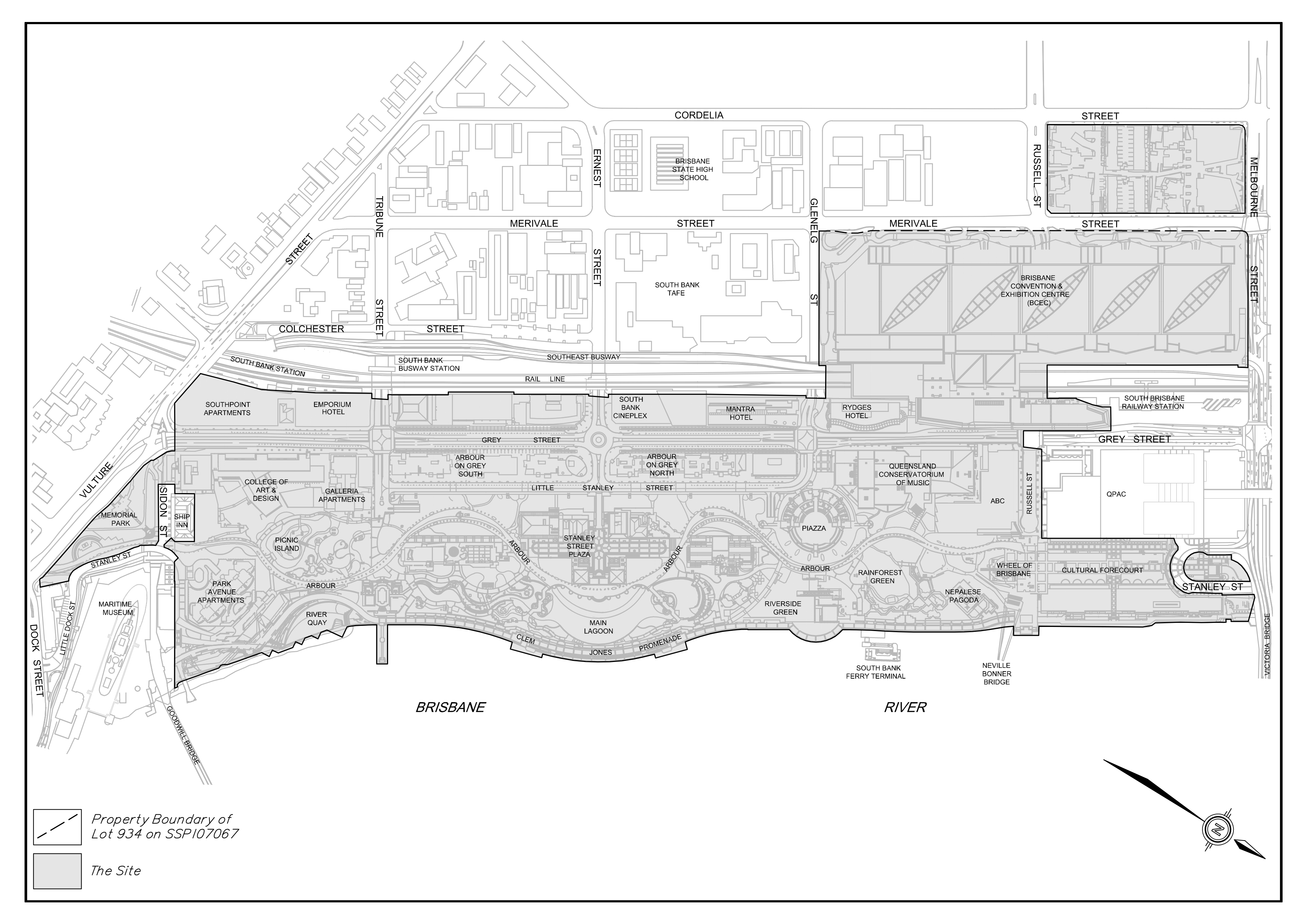
For section 3 of the Act, definition site, the parts of the corporation area shown as the site in schedule 1 are declared to be the site.
4Control of traffic by particular persons
(1)An authorised person, police officer, security officer or appropriately qualified contractor of the corporation may control traffic on the site and, for that purpose, may give a direction to a person on the site.(2)A person given a direction under subsection (1) must comply with the direction unless the person has a reasonable excuse.Maximum penalty—6 penalty units.
(3)In this section—contractor, of the corporation, means a person, other than an authorised person, police officer or security officer, who is engaged to provide traffic control services for the corporation under a contract between the person and the corporation.
5Controlling driving, parking or standing of vehicles
(1)The corporation may, by way of a sign displayed at a place on the site, control the driving, parking or standing of vehicles at the place, including, for example, by indicating—(a)a maximum speed limit for the place; or(b)a pedestrian crossing at the place; or(c)any of the following for a vehicle or type of vehicle—(i)that the vehicle, or type of vehicle, may or may not be driven, parked or stood at the place;(ii)when the vehicle, or type of vehicle, may or may not be driven, parked or stood at the place;(iii)a purpose for which the vehicle, or type of vehicle, may or may not be driven, parked or stood at the place.(2)A person at the place must comply with the sign unless the person has a reasonable excuse.Maximum penalty—10 penalty units.
(3)In this section—sign includes an official traffic sign.
6Notices about contravention of sign
(1)This section applies if a sign mentioned in section 5, other than an official traffic sign, does not state all of the following information—(a)that a contravention of the sign is an offence against this by-law;(b)the maximum penalty for the offence.(2)The corporation must display a notice stating the information—(a)at or near each vehicular entrance to the place on the site to which the sign relates; and(b)in any other place the corporation considers appropriate.(3)A notice displayed under subsection (2)—(a)may contain any other information the corporation considers appropriate; and(b)must be easily visible to passers-by.
7Controlling entry to places and activities etc.
(1)For the purposes of the Act, the corporation may, by way of a sign displayed at a place on the site—(a)indicate the entitlement of a person to enter the place; ora sign indicating that an unauthorised person must not enter the place(b)control the activities, conduct or behaviour of a person at the place.(2)A person at the place must comply with the sign unless the person has a reasonable excuse.Maximum penalty—4 penalty units.
In this part—vehicle includes anything attached to, or contained in, the vehicle.
9Removal and holding of illegally parked vehicles
(1)This section applies if an authorised person, police officer or security officer—(a)believes on reasonable grounds that—(i)a vehicle has been parked in contravention of section 4(2) or 5(2); and(ii)it is necessary to remove the vehicle, having regard to the safety or convenience of traffic at the site; and(b)either—(i)can not immediately locate the driver of the vehicle; or(ii)believes on reasonable grounds that the driver of the vehicle is not willing or able to remove the vehicle immediately.(2)The authorised person, police officer or security officer may—(a)seize, remove and hold the vehicle; or(b)cause the vehicle to be seized, removed and held.(3)The vehicle must be held at a safe place.(4)As soon as practicable and no later than 14 days after the vehicle is seized, the corporation must give a written notice to the owner of the vehicle.(5)However, if within 14 days after the vehicle is seized the corporation can not identify or locate the owner, the corporation must give the notice to the owner by publishing the notice—(a)in a newspaper circulating generally in the State; and(b)on the corporation’s website.(6)The notice must state—(a)where the vehicle is being held; and(b)how the owner may recover the vehicle.(7)The owner must pay to the corporation the reasonable cost of seizing, removing, holding and returning the vehicle.
10Sale of unrecovered vehicles
(1)This section applies if the owner of a vehicle does not recover the vehicle within 2 months after being given a notice in relation to the vehicle under section 9(4) or (5).(2)The corporation may sell the vehicle by public auction after publishing a notice of the auction—(a)in a newspaper circulating generally in the State; and(b)on the corporation’s website.(3)The notice must—(a)identify the vehicle; and(b)state that the vehicle is to be sold by auction; and(c)state how the owner may recover the vehicle before the auction; and(d)state the time and place of the auction.(4)The proceeds of sale must be applied in the following order—(a)in payment of the reasonable expenses of the sale;(b)in payment of the reasonable cost of seizing, removing and holding the vehicle;(c)in payment of any balance as provided under subsection (6) or (7).(5)The corporation must retain the balance of the proceeds for 1 year after the sale.(6)If the owner, within 1 year after the sale, asks the corporation to pay the balance of the proceeds to the owner, the corporation must pay to the owner—(a)the balance of the proceeds; and(b)interest on the balance of the proceeds, at the rate of 5% a year, for the period—(i)starting on the day of the sale; and(ii)ending on the day the owner is paid the balance of the proceeds.(7)If the owner does not, within 1 year after the sale, ask the corporation to pay the balance of the proceeds to the owner, the corporation must pay the balance of the proceeds, and any interest earned on the balance, into the consolidated fund.
A person must not enter or exit from the site, other than at a place provided by the corporation for that purpose, unless the person has a reasonable excuse.Maximum penalty—4 penalty units.
(1)The corporation may temporarily close the site if the corporation considers the closure is necessary or convenient, having regard to any of the following—(a)the safety of persons, or the protection of property, on the site;(b)an activity to be conducted on the site;(c)another matter the corporation considers relevant.(2)The closure may, but need not, be for a particular period every day.(3)While the site is closed, the corporation must display a sign at each entry to the site stating the site is closed.
(1)A person must not enter the site while the site is closed under section 12 unless the entry is—(a)allowed under subsection (3)(a); or(b)otherwise authorised by law.Maximum penalty—4 penalty units.
(2)The corporation may, having regard to the reason the site is closed, tell authorised persons and security officers the following—(a)the persons who may enter the site while it is closed (the permitted persons);(b)the conditions, if any, on which the permitted persons may enter.(3)An authorised person or security officer must, while on duty at an entry to the site while it is closed—(a)allow permitted persons to enter the site and inform them of the conditions; and(b)refuse entry to the site to anyone not otherwise authorised by law to enter the site.
14Corporation may authorise appropriately qualified employees of employing office
(1)The corporation may, by instrument in writing signed by the corporation manager, authorise a person to exercise a power of an authorised person under this by-law if—(a)the person is an employee of the employing office who is performing work for the corporation under a work performance arrangement; and(b)the corporation is satisfied the employee is appropriately qualified to exercise the power.(2)The corporation may withdraw an authorisation given to a person under subsection (1) at any time by signed notice given to the person.
15Conditions and limit on powers
(1)The powers of an authorised person are subject to any conditions stated in—(a)the authorised person’s instrument of authorisation; or(b)a notice signed by the corporation manager and given to the authorised person by the corporation.(2)The instrument of authorisation or signed notice may limit the authorised person’s powers.(3)An authorised person’s authorisation ends if—(a)the term of the authorisation stated in a condition of the authorisation ends; or(b)the authorisation otherwise ends under a condition of the authorisation; or(c)the authorisation is withdrawn under section 14(2); or(d)the authorised person stops being an employee of the employing office who is performing work for the corporation under a work performance arrangement.(4)Subsection (3) does not limit the ways an authorised person’s authorisation ends.
(1)The corporation must issue an identity card to each authorised person.(2)The identity card must—(a)contain a recent photo of the authorised person; and(b)contain a copy of the authorised person’s signature; and(c)identify the person as an authorised person under this by-law; and(d)state an expiry date for the card.(3)This section does not prevent the issue of a single identity card to a person for this by-law and other purposes.
17Production or display of identity card
(1)In exercising a power under this by-law in relation to another person in the other person’s presence, an authorised person must—(a)produce the authorised person’s identity card for the other person’s inspection before exercising the power; or(b)have the identity card displayed so it is clearly visible to the other person when exercising the power.(2)However, if it is not practicable to comply with subsection (1), the authorised person must produce the identity card for the other person’s inspection at the first reasonable opportunity.
If the authorisation of a person as an authorised person ends, the person must return the person’s identity card to the corporation within 21 days after the authorisation ends unless the person has a reasonable excuse.Maximum penalty—10 penalty units.
The South Bank Corporation By-law 2014, SL No. 176 is repealed.
In this part—former, in relation to a provision, means the provision of the repealed by-law as in force from time to time before the commencement.new, in relation to a provision, means the provision of this by-law as in force from the commencement.repealed by-law means the repealed South Bank Corporation By-law 2014.
21Vehicle seized before commencement
(1)This section applies if—(a)before the commencement, a vehicle was seized, removed and held under former section 8; and(b)immediately before the commencement, the vehicle—(i)had not been recovered by its owner; and(ii)had not been sold by public auction under former section 9.(2)From the commencement—(a)new part 4 applies in relation to the vehicle as if it had been seized, removed and held under new section 9; and(b)a notice given to the owner by the corporation under former section 8 before the commencement is taken to have been given to the owner under—(i)for a notice given under former section 8(4)—new section 9(4); or(ii)for a notice given under former section 8(5)—new section 9(5); and(c)a notice of auction given to the owner by the corporation under former section 9 before the commencement is taken to have been given under new section 10.(3)However—(a)new section 9(5)(b) does not apply in relation to a notice mentioned in subsection (2)(b)(ii); and(b)new section 10(2)(b) does not apply in relation to a notice mentioned in subsection (2)(c).
22Authorisation of person under former s 13
(1)This section applies to a person who, immediately before the commencement, was authorised under former section 13 to exercise a power of an authorised person under the repealed by-law.(2)From the commencement, the person is taken to be authorised under new section 14(1) to exercise the equivalent power of an authorised person under this by-law.(3)For subsection (2), the authorisation under new section 14(1) is subject to the conditions, and continues for the remainder of the term, of the authorisation mentioned in subsection (1).
23References to repealed by-law
(1)This section applies in relation to each of the following—(a)a site notice under former section 5 or 7 that was in effect immediately before the commencement;(b)a notice under former section 6 that was in effect immediately before the commencement;(c)an identity card issued to a person under former section 15, if the authorisation was in effect immediately before the commencement;(d)any other instrument.(2)In the site notice, notice, identity card or instrument—(a)a reference to the repealed by-law may, if the context permits, be taken to be a reference to this by-law; and(b)a reference to a provision of the repealed by-law may, if the context permits, be taken to be a reference to the equivalent new provision.(3)In this section—equivalent new provision, for a provision of the repealed by-law, means the provision of this by-law that deals with the same subject matter as the provision of the repealed by-law.
authorised person, in relation to a power under this by-law, means a person who is authorised to exercise the power under section 14(1).
display, in relation to a sign, means erect, mark, place or otherwise display the sign.
official traffic sign see the Transport Operations (Road Use Management) Act 1995, schedule 4.
owner, of a vehicle, includes the person in whose name the vehicle is registered under—
(a)the Transport Operations (Road Use Management) Act 1995; or
(b)a law of another State that provides for the same matter as the Act mentioned in paragraph (a).
sign includes a moveable sign and a sign marked on a road, footpath, building or other place.
site means the parts of the corporation area declared to be the site under section 3.
See also schedule 1.
traffic includes vehicular and pedestrian traffic.
vehicle, for part 4, see section 8.